A birthday on the globe
5 April on the globe: what happened in the world on this day, and who was born
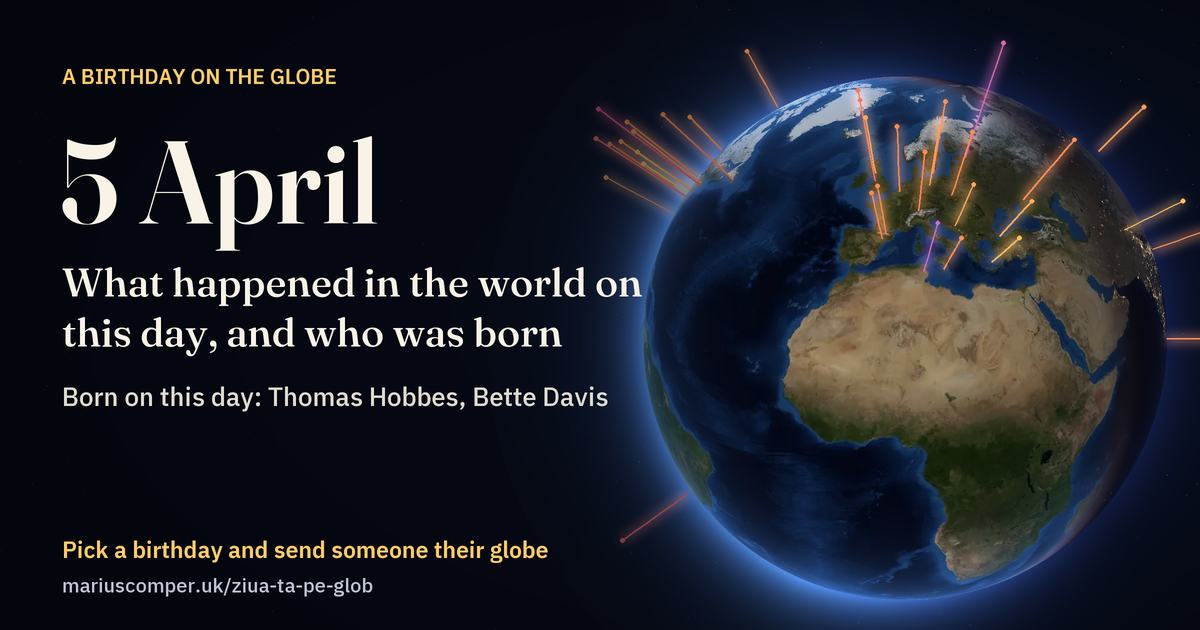
For 5 April, the English Wikipedia lists 59 events and 557 births. 34 of the events stand at their places as rays of light; six more are dashed circles, where the sentence links only to a country or a sea. The taller the ray, the longer ago it happened. The people born that day come further down, as blue points.
A birthday, yours or someone else’s:
Turn it into a greetingScroll: the globe turns to each place
The day you were born, on the globe.
Three things from your day
Scroll: your day first, then 5 April through the years
The Earth on 5 April
The picture on the globe was assembled by NASA from satellite photographs taken in April 2004: the snow, the ice and the green are those of the month.
On 5 April the Sun passes straight overhead at noon along the parallel of 6.2° north. In London, the day lasts about 13 hours 15 minutes.
Beyond 84° north the Sun no longer sets; beyond 84° south it no longer rises.
The line between day and night is tilted on the globe exactly as on this day of the year. On the dark side you can see the lights of towns.
Britain & Ireland · Birkenhead Park
1847
Birkenhead Park, generally acknowledged as the world's first publicly funded civic park, opened in Birkenhead, England.
On the map: Birkenhead Park.
Asia · Tiananmen Square
1976
In China, the April Fifth Movement leads to the Tiananmen Incident.
On the map: Tiananmen Square.
Also on the day’s list of Wikipedia in Spanish and Chinese.
North America · Plymouth, Massachusetts
1621
The Mayflower sets sail from Plymouth, Massachusetts on a return trip to England.
On the map: Plymouth, Massachusetts.
Also on the day’s list of Wikipedia in Spanish.
North America · Santa Monica Civic Auditorium
1965
My Fair Lady wins Best Picture at the 37th Academy Awards.
On the map: Santa Monica Civic Auditorium.
5 April
What the other Wikipedias remember#
For these years the English list has nothing on this day. The events below come from the same day’s lists on Wikipedia in Chinese and were translated for this page.
From Wikipedia in Chinese · Easter Island
1722
The fleet of Jacob Roggeveen, an explorer of the Dutch West India Company, discovers Easter Island in the South Pacific.
On the map: Easter Island.
Translated from the list on Wikipedia in Chinese.
5 April
Born on 5 April#
The English Wikipedia lists 557 births for this day. The blue points are the birthplaces of 60 of these people: those written about in the most Wikipedia editions, where Wikidata gives a place of birth.
Born on 5 April
1588
Thomas Hobbes, English philosopher (died 1679)
Place of birth: Westport.
Born on 5 April
1908
Bette Davis, American actress (died 1989)
Place of birth: Lowell.
Born on 5 April
1916
Gregory Peck, American actor, political activist, and producer (died 2003)
Place of birth: San Diego.
Born on 5 April
1900
Spencer Tracy, American actor (died 1967)
Place of birth: Milwaukee.
Born in Britain and Ireland
1837
Algernon Charles Swinburne, English poet, playwright, novelist, and critic (died 1909)
Place of birth: London.
Born in Britain and Ireland
1982
Hayley Atwell, English-American actress
Place of birth: London.
Born in Britain and Ireland
1989
Lily James, English actress
Place of birth: Esher.
5 April
Number one in the charts that week
At the cinema
An animal recorded that day
The record can be seen in GBIF, which brings together wildlife records from around the world.
All your birthdays
The weather that day
Data: Met Office Hadley Centre (HadCET); NOAA (GHCN-Daily, Mauna Loa).
Above the Earth
Sources: Jonathan McDowell, GCAT (launches); GFZ Potsdam (Kp index). Days are counted in Universal Time.
Football that day
International matches played that day:
Source: the “International football results” dataset kept by Mart Jürisoo (CC0).
Also that day
The earthquake’s page at the USGS
Source: the USGS catalogue. The day is counted in Universal Time (UTC).
In those days
Make a link for someone
Type the name, pick the day and the year of birth. The link opens straight on their day, with their name in the greeting.
The link carries the name, date and place typed here; anyone who gets it can see them.
Put another birthday beside it
Your mother’s, your child’s, a friend’s: the two days appear side by side.
Below: 5 April through the years.
The whole globe of the day
Drag the globe to turn it. Touch a ray or a point to read what happened there.
Everything Wikipedia lists for 5 April
The list is the English Wikipedia’s, in its own wording, as it stood in October 2026. 19 events have no place on the map: the sentence links to no place with coordinates, only to places too wide to mark, or to several countries.
- 823
Lothair I is crowned King of Italy by Pope Paschal I.
no place on the mapWikipedia: Lothair I - 919
The second Fatimid invasion of Egypt begins, when the Fatimid heir-apparent, al-Qa'im bi-Amr Allah, sets out from Raqqada at the head of his army.
Africa · RaqqadaWikipedia: Fatimid invasion of Egypt - 1242
During the Battle on the Ice of Lake Peipus, Russian forces, led by Alexander Nevsky, rebuff an invasion attempt by the Teutonic Knights.
Europe · Battle on the IceWikipedia: Battle on the Ice - 1536
Charles V makes a Royal Entry into Rome, demolishing a swath of the city to re-enact a Roman triumph.
no place on the mapWikipedia: Charles V, Holy Roman Emperor - 1566
Two hundred Dutch noblemen, led by Hendrick van Brederode, force themselves into the presence of Margaret of Parma and present the Petition of Compromise, denouncing the Spanish Inquisition in the Seventeen Provinces.
Europe · Seventeen ProvincesWikipedia: Habsburg Netherlands - 1614
In Virginia, Native American Pocahontas marries English colonist John Rolfe.
North America · VirginiaWikipedia: Native Americans in the United States - 1614
The second English Parliament of king James I, the so-called Addled Parliament, opens.
no place on the mapWikipedia: James VI and I - 1621
The Mayflower sets sail from Plymouth, Massachusetts on a return trip to England.
North America · Plymouth, MassachusettsWikipedia: Mayflower - 1710
The Statute of Anne, the first legislation in Great Britain providing for copyright regulated by the government and courts, received royal assent and entered into force five days later.
no place on the mapWikipedia: Statute of Anne - 1792
United States President George Washington exercises his authority to veto a bill, the first time this power is used in the United States.
no place on the mapWikipedia: George Washington - 1795
Peace of Basel between France and Prussia is made.
no place on the mapWikipedia: Peace of Basel - 1818
In the Battle of Maipú, Chile's independence movement, led by Bernardo O'Higgins and José de San Martín, win a decisive victory over Spain, leaving 2,000 Spaniards and 1,000 Chilean patriots dead.
Latin America · Battle of MaipúWikipedia: Battle of Maipú - 1847
Birkenhead Park, generally acknowledged as the world's first publicly funded civic park, opened in Birkenhead, England.
Britain & Ireland · Birkenhead ParkWikipedia: Birkenhead Park - 1862
American Civil War: The Battle of Yorktown begins.
North America · Siege of YorktownWikipedia: American Civil War - 1879
Bolivia declares war on Chile, and Chile declares war on Peru, starting the War of the Pacific.
no place on the mapWikipedia: War of the Pacific - 1902
A stand box collapses at Ibrox Park (now Ibrox Stadium) in Glasgow, Scotland, which led to the deaths of 25 and injuries to more than 500 supporters during an international association football match between Scotland and England.
Britain & Ireland · 1902 Ibrox disasterWikipedia: 1902 Ibrox disaster - 1910
The Transandine Railway connecting Chile and Argentina is inaugurated.
no place on the mapWikipedia: Transandine Railway - 1922
The American Birth Control League, forerunner of Planned Parenthood, is incorporated.
no place on the mapWikipedia: American Birth Control League - 1932
Dominion of Newfoundland: Ten thousand rioters seize the Colonial Building leading to the end of self-government.
North America · Colonial BuildingWikipedia: 1932 Colonial Building riot - 1933
Andorran Revolution: The Young Andorrans occupy the Casa de la Vall and force the government to hold democratic elections with universal male suffrage.
Europe · Casa de la VallWikipedia: 1933 Andorran parliamentary election - 1933
Nazi sympathisers attempted to kidnap two German-Jewish filmmakers in Liechtenstein.
Europe · Rotter kidnappingWikipedia: Rotter kidnapping - 1933
U.S. President Franklin D. Roosevelt signs two executive orders: 6101 to establish the Civilian Conservation Corps, and 6102 "forbidding the Hoarding of Gold Coin, Gold Bullion, and Gold Certificates" by U.S. citizens.
no place on the mapWikipedia: Franklin D. Roosevelt - 1936
Tupelo–Gainesville tornado outbreak: An F5 tornado kills 233 in Tupelo, Mississippi.
North America · Tupelo, MississippiWikipedia: 1936 Tupelo–Gainesville tornado outbreak - 1938
Spanish Civil War: Two days after the Nationalist army occupied the Catalan city of Lleida, dictator Francisco Franco decrees the abolition of the Generalitat (the autonomous government of Catalonia), the self-government granted by the Republic, and the official status of the Catalan language.
Europe · LleidaWikipedia: Spanish Civil War - 1942
World War II: Adolf Hitler issues Fuhrer Directive No. 41 summarizing Case Blue, including the German Sixth Army's planned assault on Stalingrad.
Europe · Case BlueWikipedia: Case Blue - 1942
World War II: The Imperial Japanese Navy launches a carrier-based air attack on Colombo, Ceylon during the Indian Ocean raid. Port and civilian facilities are damaged and the Royal Navy cruisers HMS Cornwall and HMS Dorsetshire are sunk southwest of the island.
Asia · Air raid on CeylonWikipedia: Air raid on Ceylon - 1943
World War II: United States Army Air Forces bomber aircraft accidentally cause more than 900 civilian deaths, including 209 children, and 1,300 wounded among the civilian population of the Belgian town of Mortsel. Their target was the Erla factory 1 kilometre (0.62 mi) from the residential area hit.
Europe · MortselWikipedia: United States Army Air Forces - 1944
Siegfried Lederer, a Czech Jew, escaped from Auschwitz with the aid of an SS officer who opposed the Holocaust.
Europe · Theresienstadt family campWikipedia: Siegfried Lederer's escape from Auschwitz - 1945
Cold War: Yugoslav leader Josip Broz Tito signs an agreement with the Soviet Union to allow "temporary entry of Soviet troops into Yugoslav territory".
no place on the mapWikipedia: Cold War - 1946
A Fleet Air Arm Vickers Wellington crashes into a residential area in Rabat, Malta during a training exercise, killing all four crew members and 16 civilians on the ground.
Europe · 1946 Rabat Vickers Wellington crashWikipedia: 1946 Rabat Vickers Wellington crash - 1946
Soviet troops end their year-long occupation of the Danish island of Bornholm.
Europe · BornholmWikipedia: Soviet Union - 1949
A fire in a hospital in Effingham, Illinois, kills 77 people and leads to nationwide fire code improvements in the United States.
North America · 1949 St. Anthony's Hospital fireWikipedia: 1949 St. Anthony's Hospital fire - 1951
Cold War: Ethel and Julius Rosenberg are sentenced to death for spying for the Soviet Union.
Asia · Soviet UnionWikipedia: Julius and Ethel Rosenberg - 1955
Aware that he was slowing down both physically and mentally in his old age, Winston Churchill retired as prime minister of the United Kingdom.
no place on the mapWikipedia: Winston Churchill - 1956
Cuban Revolution: Fidel Castro declares himself at war with Cuban President Fulgencio Batista.
no place on the mapWikipedia: Cuban Revolution - 1958
Ripple Rock, an underwater threat to navigation in the Seymour Narrows in Canada, is destroyed in one of the largest non-nuclear controlled explosions of the time.
North America · Ripple RockWikipedia: Ripple Rock - 1965
My Fair Lady wins Best Picture at the 37th Academy Awards.
North America · Santa Monica Civic AuditoriumWikipedia: 37th Academy Awards - 1966
During the Buddhist Uprising, South Vietnamese Prime Minister Nguyễn Cao Kỳ personally attempts to lead the capture of the restive city of Đà Nẵng before backing down.
Asia · Da NangWikipedia: Buddhist Uprising - 1971
In Sri Lanka, Janatha Vimukthi Peramuna launches a revolt against the United Front government of Sirimavo Bandaranaike.
Asia · Sri LankaWikipedia: 1971 JVP insurrection - 1974
Carrie, the first novel by American author Stephen King, is published for the first time with a print run of 30,000 copies.
no place on the mapWikipedia: Carrie - 1976
In China, the April Fifth Movement leads to the Tiananmen Incident.
Asia · Tiananmen SquareWikipedia: 1976 Tiananmen incident - 1977
The US Supreme Court rules that congressional legislation that diminished the size of the Sioux people's reservation thereby destroyed the tribe's jurisdictional authority over the area in Rosebud Sioux Tribe v. Kneip.
North America · Supreme Court of the United StatesWikipedia: Supreme Court of the United States - 1979
Faculty members, clerical workers, and librarians at Boston University went on strike.
North America · Boston UniversityWikipedia: 1979 Boston University strike - 1983
The People's Armed Police is officially founded.
no place on the mapWikipedia: People's Armed Police - 1986
The Libyan secret service bombed a discotheque in West Berlin, resulting in three deaths and 229 others injured.
Europe · West Berlin discotheque bombingWikipedia: West Berlin discotheque bombing - 1991
An ASA EMB 120 crashes in Brunswick, Georgia, killing all 23 aboard, including Sen. John Tower and astronaut Sonny Carter.
North America · Atlantic Southeast Airlines Flight 2311Wikipedia: Atlantic Southeast Airlines Flight 2311 - 1991
The Space Shuttle Atlantis launches on STS-37 to deploy the Compton Gamma Ray Observatory.
no place on the mapWikipedia: Space Shuttle Atlantis - 1992
Alberto Fujimori, president of Peru, dissolves the Peruvian congress by military force.
no place on the mapWikipedia: 1992 Peruvian self-coup - 1992
Peace protesters Suada Dilberovic and Olga Sučić are killed on the Vrbanja Bridge in Sarajevo, becoming the first casualties of the Bosnian War.
Europe · SarajevoWikipedia: Suada and Olga bridge - 1998
In Japan, the Akashi Kaikyō Bridge opens to traffic, becoming the longest bridge span in the world.
Asia · JapanWikipedia: Akashi Kaikyo Bridge - 1999
Two Libyans suspected of bringing down Pan Am Flight 103 in 1988 are handed over for eventual trial in the Netherlands.
Britain & Ireland · Pan Am Flight 103Wikipedia: Pan Am Flight 103 - 2000
Fan violence broke out before a UEFA Cup semifinal in Istanbul, Turkey, resulting in two Leeds United supporters being stabbed to death and Galatasaray supporters being banned from attending the second leg in England.
Asia · IstanbulWikipedia: 2000 UEFA Cup semi-final violence - 2002
In the first reported data breach, 250,000 social security numbers collected by the State of California were stolen from a data center.
North America · CaliforniaWikipedia: Data breach - 2007
The cruise ship MS Sea Diamond strikes a volcanic reef near Nea Kameni and sinks the next day. Two passengers were never recovered and are presumed dead.
Europe · Nea KameniWikipedia: Cruise ship - 2009
North Korea launches its controversial Kwangmyŏngsŏng-2 satellite. The satellite passed over mainland Japan, which prompted an immediate reaction from the United Nations Security Council, as well as participating states of six-party talks.
no place on the mapWikipedia: North Korea - 2010
Space Shuttle Discovery is launched on STS-131 to resupply the International Space Station.
no place on the mapWikipedia: Space Shuttle Discovery - 2010
Twenty-nine coal miners are killed in an explosion at the Upper Big Branch Mine in West Virginia.
North America · Upper Big Branch Mine disasterWikipedia: Upper Big Branch Mine disaster - 2010
Up to 50 people are killed and another 100 injured in two militant suicide bombings and attacks in Khyber Pakhtunkhwa province of Pakistan: the first on an Awami National Party rally in Timergara; the second on the U.S. Consulate in Peshawar.
Asia · PeshawarWikipedia: 2010 North-West Frontier Province attacks - 2018
Agents with the U.S. Immigration and Customs Enforcement raid a slaughterhouse in Tennessee, detaining nearly 100 undocumented Hispanic workers in one of the largest workplace raids in the history of the United States.
North America · 2018 Southeastern Provisions raidWikipedia: United States Immigration and Customs Enforcement
What the other Wikipedias remember
For these years the English list has nothing on this day. The events below come from the same day’s lists on Wikipedia in Chinese and were translated for this page.
- 1722
The fleet of Jacob Roggeveen, an explorer of the Dutch West India Company, discovers Easter Island in the South Pacific.
Who was born on 5 April
In order of how many Wikipedia editions have an article about each. The first 60 of 557 are shown.
- 1588
Thomas Hobbes, English philosopher (died 1679)
WestportWikipedia: Thomas Hobbes - 1908
Bette Davis, American actress (died 1989)
LowellWikipedia: Bette Davis - 1916
Gregory Peck, American actor, political activist, and producer (died 2003)
San DiegoWikipedia: Gregory Peck - 1568
Pope Urban VIII (died 1644)
FlorenceWikipedia: Pope Urban VIII - 1947
Gloria Macapagal Arroyo, Filipino academic and politician, 14th President of the Philippines
- 1900
Spencer Tracy, American actor (died 1967)
MilwaukeeWikipedia: Spencer Tracy - 1937
Colin Powell, American general and politician, 65th United States Secretary of State (died 2021)
New York CityWikipedia: Colin Powell - 1950
Agnetha Fältskog, Swedish singer-songwriter and producer
JönköpingWikipedia: Agnetha Fältskog - 1827
Joseph Lister, English surgeon and academic (died 1912)
Upton House, NewhamWikipedia: Joseph Lister - 1908
Herbert von Karajan, Austrian conductor and manager (died 1989)
SalzburgWikipedia: Herbert von Karajan - 1934
Roman Herzog, German lawyer and politician, 7th President of Germany (died 2017)
LandshutWikipedia: Roman Herzog - 1955
Akira Toriyama, Japanese illustrator (died 2024)
- 1929
Ivar Giaever, Norwegian-American physicist and academic, Nobel Prize laureate (died 2025)
BergenWikipedia: Ivar Giaever - 1973
Pharrell Williams, American singer, songwriter and rapper
Virginia BeachWikipedia: Pharrell Williams - 1856
Booker T. Washington, African-American educator, essayist and historian (died 1915)
Hale's FordWikipedia: Booker T. Washington - 1837
Algernon Charles Swinburne, English poet, playwright, novelist, and critic (died 1909)
- 1732
Jean-Honoré Fragonard, French painter and etcher (died 1806)
- 1923
Nguyễn Văn Thiệu, Vietnamese general and politician, 5th President of South Vietnam (died 2001)
Phan Rang – Tháp ChàmWikipedia: Nguyễn Văn Thiệu - 1982
Hayley Atwell, English-American actress
LondonWikipedia: Hayley Atwell - 1989
Lily James, English actress
- 1969
Ravindra Prabhat, Indian writer and journalist
SitamarhiWikipedia: Ravindra Prabhat - 1804
Matthias Jakob Schleiden, German botanist (died 1881)
- 1984
Kisho Yano, Japanese footballer
HamamatsuWikipedia: Kisho Yano - 1991
Yassine Bounou, Moroccan footballer
MontrealWikipedia: Yassine Bounou - 1979
Mitsuo Ogasawara, Japanese footballer
MoriokaWikipedia: Mitsuo Ogasawara - 1901
Melvyn Douglas, American actor (died 1981)
- 1883
Walter Huston, Canadian-American actor and singer (died 1950)
TorontoWikipedia: Walter Huston - 1949
Judith Resnik, American engineer and astronaut (died 1986)
- 1926
Roger Corman, American actor, director, producer, and screenwriter (died 2024)
DetroitWikipedia: Roger Corman - 1982
Thomas Hitzlsperger, German footballer
- 1976
Simone Inzaghi, Italian footballer
PiacenzaWikipedia: Simone Inzaghi - 1942
Peter Greenaway, Welsh director and screenwriter
NewportWikipedia: Peter Greenaway - 1958
Ryoichi Kawakatsu, Japanese footballer
- 1976
Fernando Morientes, Spanish footballer and coach
CillerosWikipedia: Fernando Morientes - 1954
Yoshiichi Watanabe, Japanese footballer
- 1955
Takayoshi Yamano, Japanese footballer
Osaka PrefectureWikipedia: Takayoshi Yamano - 1991
Nathaniel Clyne, English footballer
StockwellWikipedia: Nathaniel Clyne - 1832
Jules Ferry, French lawyer and politician, 44th Prime Minister of France (died 1893)
Saint-Dié-des-VosgesWikipedia: Jules Ferry - 1933
Frank Gorshin, American actor (died 2005)
PittsburghWikipedia: Frank Gorshin - 1979
Vlada Avramov, Serbian footballer
Novi SadWikipedia: Vlada Avramov - 1980
Joris Mathijsen, Dutch footballer
- 1995
Sei Muroya, Japanese footballer
Osaka PrefectureWikipedia: Sei Muroya - 1857
Alexander of Battenberg (died 1893)
- 1917
Robert Bloch, American author (died 1994)
ChicagoWikipedia: Robert Bloch - 1958
Daniel Schneidermann, French journalist
- 1962
Kirsan Ilyumzhinov, Russian businessman and politician, 1st President of Kalmykia
- 1984
Aram Mp3, Armenian singer and comedian
YerevanWikipedia: Aram Mp3 - 1992
Shintaro Kurumaya, Japanese footballer
KumamotoWikipedia: Shintaro Kurumaya - 1863
Princess Victoria of Hesse and by Rhine (died 1950)
Windsor CastleWikipedia: Princess Victoria of Hesse and by Rhine - 1929
Hugo Claus, Belgian author, poet, and painter (died 2008)
BrugesWikipedia: Hugo Claus - 1987
Fyodor Kudryashov, Russian footballer
MamakanWikipedia: Fyodor Kudryashov - 1784
Louis Spohr, German violinist, composer, and conductor (died 1859)
BrunswickWikipedia: Louis Spohr - 1920
Arthur Hailey, English-Canadian soldier and author (died 2004)
- 1929
Nigel Hawthorne, English actor and producer (died 2001)
CoventryWikipedia: Nigel Hawthorne - 1942
Pascal Couchepin, Swiss politician
MartignyWikipedia: Pascal Couchepin - 1810
Sir Henry Rawlinson, British East India Company army officer and politician (died 1895)
ChadlingtonWikipedia: Sir Henry Rawlinson, 1st Baronet - 1943
Jean-Louis Tauran, French cardinal (died 2018)
BordeauxWikipedia: Jean-Louis Tauran - 1979
Timo Hildebrand, German footballer
- 1914
Felice Borel, Italian footballer (died 1993)
- 1922
Tom Finney, English footballer (died 2014)
PrestonWikipedia: Tom Finney
What is celebrated on 5 April
- Christian feast day: Agape, Chionia, and Irene
- Christian feast day: Albert of Montecorvino
- Christian feast day: Catherine of Palma
- Christian feast day: Derfel Gadarn
- Christian feast day: Æthelburh of Kent
- Christian feast day: Gerald of Sauve-Majeure
- Christian feast day: Juliana of Liège
- Christian feast day: Maria Crescentia Höss
- Christian feast day: Blessed Mariano de la Mata
- Christian feast day: Pandita Mary Ramabai (Episcopal Church (USA))
- Christian feast day: Ruadhán of Lorrha
- Christian feast day: Vincent Ferrer
- Christian feast day: April 5 (Eastern Orthodox liturgics)
- Cold Food Festival, held on April 4 if it is a leap year (China); and its related observances:
A greeting link for someone
Type a name and, if you like, the year of birth. The link opens with a greeting, and beside each event it says how old the person turned that day, or how many years before their birth it happened.
The name and the year go only into the link you send.
All 366 days
How the globe is made
Where the events come from
Each edition of this page uses the day’s list from Wikipedia in its own language: Romanian, English, Spanish, Chinese. The lists are written by volunteers and differ from one edition to the next; the text of each event is Wikipedia’s, with a link to the article. A row that appears twice in a list is shown once. The lists have not been checked event by event: they are Wikipedia’s, mistakes included.
For events before 1582, and for countries that moved to the Gregorian calendar later (Britain in 1752, Russia in 1918), the same day may be counted Old Style in one list and New Style in another.
The chapter “What the other Wikipedias remember” adds up to five events a day from the lists of the other three editions, only for years in which the English list has nothing on that day. They were translated for this page, passed the same filters as the tour, and are not counted among the events of the English list.
How an event gets onto the map
The place comes from Wikidata. If the sentence links to the article about the event itself (a battle, an opening, an earthquake), dated to the same year, the ray stands on its coordinates or on those of its location. Otherwise it stands on the first place the sentence links to: a town, a building, a mountain, an island. This second step can be wrong: sometimes the sentence only mentions the place. That is why the page says, under each event, which place the ray stands on.
When the sentence links to a single state or province, or to a single sea, lake or desert larger than 5,000 km², the globe shows a dashed circle, not a ray. The circle has the area Wikidata gives, with its radius kept between 1.2° and 16°, or a radius of 4.5° when Wikidata gives no area; it says only that the sentence links to that place. Organisations, ships, spacecraft, museum objects, rivers, mountain ranges, languages and continents are never used as places. When a sentence names several states and no exact place, the event stays in the list only.
What the height means
The height of a ray shows how many years have passed, on a logarithmic scale: 10 years, 100 years and 1,000 years are equal steps apart; anything older than about 2,600 years has the tallest ray. The colour runs from pale yellow for recent years to violet for antiquity.
Where the tour stops
In each region the tour stops at up to three events (five in Britain and Ireland), chosen mainly by three things: whether Wikipedia’s editors put the event in the “On this day” box of their main page (the English, Spanish and Chinese editions), how many Wikipedia editions have an article about it, and how many of the four lists include it. Events whose sentence or article is about a war, an attack, a crime or a disaster are left out of the tour; they stay in the whole list, in Wikipedia’s wording. The filter is a list of words and a list of Wikidata types, so it can miss some.
The tour of births names the people with articles in the most editions and leaves aside those whom the list or Wikidata describes as rulers, politicians, commanders, leaders of movements or criminals; they stay in the list.
The Earth and the Sun
The daytime images are NASA’s Blue Marble Next Generation mosaics, one for each month of 2004; the night side is Black Marble 2016. The tilt of the line between day and night is computed for the day; the hour is chosen so that the place being read is in daylight. The latitude where the Sun stands overhead is the average of the four years of the leap cycle; in a given year it can differ by up to 0.4°.
The day you were born
The number ones come from the weekly lists on Wikipedia: Billboard for the United States (from 1940; the Hot 100 from August 1958), the UK Singles Chart (from November 1952), Los 40 Principales for Spain (from July 1966) and, for Romania, the Romanian Top 100 and Airplay 100 (2001–2021, with missing weeks). The page shows the chart of the week in which the day of birth falls, with its date; Billboard and the UK chart are dated at the end of their week. For Romania before 2001 and for China these sources have no weekly chart.
The films are those that reached cinemas in the United States up to ten days before or three days after that day (some of them in a few cinemas at first), from the English Wikipedia’s yearly lists (from 1968), in order of how many editions have an article about them. The events “in those days” are the ones on the neighbouring days’ lists that carry the year of birth, passed through the same filter as the tour.
The day of birth, year included
The Moon, the star sign and the constellation are worked out by the page itself, for noon Universal Time on the day. The lit part of the Moon is rounded and can differ by a few per cent from that at the hour of birth. The sign follows the usual zodiac of twelve equal parts starting at the March equinox; the constellation is the one the Sun actually stood in front of, by the borders set by the International Astronomical Union, and within a day of a border the page does not name it. When the Sun changes sign while it is that day anywhere on Earth, the page gives the moment of crossing, rounded to ten minutes and accurate to within about a quarter of an hour, and the clock time in a few cities, with the time zone and summer time of that year.
The year in the Chinese calendar is the one your device’s own calendar gives for the date, checked against the Hong Kong Observatory’s tables. “All your birthdays” uses the same sources as the rest of the chapter for the same day in every year since the birth: the temperature, well-known launches that took place on that very day, matches of the teams the edition follows, snow deeper than 10 cm and strong geomagnetic storms. The three things at the top and the four on the picture are chosen in a fixed order (the song, the animal, a full Moon, a well-known launch before an ordinary earthquake); on the picture you can change them.
When the link carries a year of birth, the page adds a few things about that exact day. The weather is the Met Office’s Central England temperature record and the readings from New York’s Central Park; the “usual high” is the average of the daily highs of 1961–1990 for that date, with two days either side. The carbon dioxide figure is the monthly mean at the Mauna Loa observatory, where measurements begin in March 1958.
The earthquake is the one with the largest magnitude in the USGS catalogue for that day, counted in Universal Time. Before the 1960s the catalogue has gaps even above magnitude 5.5, so in the older years many days have no earthquake. The page gives only the magnitude and the place: the country the epicentre falls in or, when the epicentre is at sea within 300 km of a coast, the nearest country; farther out, only the ocean.
The launches are those that reached orbit or left for the Moon and the planets, from Jonathan McDowell’s GCAT catalogue. If nothing left that day, the page shows the nearest launch within three days before or after, and says how many days away it was. The geomagnetic storm appears only when the Kp index reached at least 5 in one of the day’s eight three-hour intervals.
The animal comes from GBIF: an observation made by a person (the animal seen or heard, or its tracks), dated to that exact day, with coordinates and a CC0 or CC BY licence. Only a few hundred well-known species are searched (mammals, birds, turtles, butterflies); of those noted that day, mammals and species with articles in many Wikipedia editions come first; birds noted almost every day, and species used recently, wait their turn. Observations dated 1 January are left out, because records without a day are often filed there. An observation shows that the animal was recorded there, not how many animals there were.
The matches are those between national teams. Only matches of England, Scotland, Wales, Northern Ireland, the Republic of Ireland, the United States, Canada and Australia are shown, along with those at the big final tournaments. The picture to send is drawn in the page from the day’s globe and the facts above, and stays on your device until you send it.
Sources
- Events, births and holidays: the day’s page on Wikipedia, text under CC BY-SA 4.0.
- Coordinates, places of birth and the number of editions: Wikidata (CC0).
- The Earth by day: NASA Blue Marble Next Generation. The Earth by night: NASA Black Marble 2016.
- Borders and regions: Natural Earth.
- World population and births per year: UN World Population Prospects 2024.
- Charts and films: Wikipedia’s lists for Billboard, the UK Singles Chart, Los 40 Principales, Romanian Top 100, Airplay 100 and American films by year (CC BY-SA 4.0).
- Weather: Met Office Hadley Centre, HadCET (Open Government Licence) and NOAA GHCN-Daily, New York Central Park. Carbon dioxide: NOAA Global Monitoring Laboratory, Mauna Loa.
- Earthquakes: the USGS catalogue. Launches: Jonathan McDowell, GCAT (CC BY). Kp index: GFZ Potsdam (CC BY 4.0). Matches: International football results, Mart Jürisoo (CC0).
- Animal observations: GBIF, with a link to each record; species names come from Wikidata.