A birthday on the globe
25 November on the globe: what happened in the world on this day, and who was born
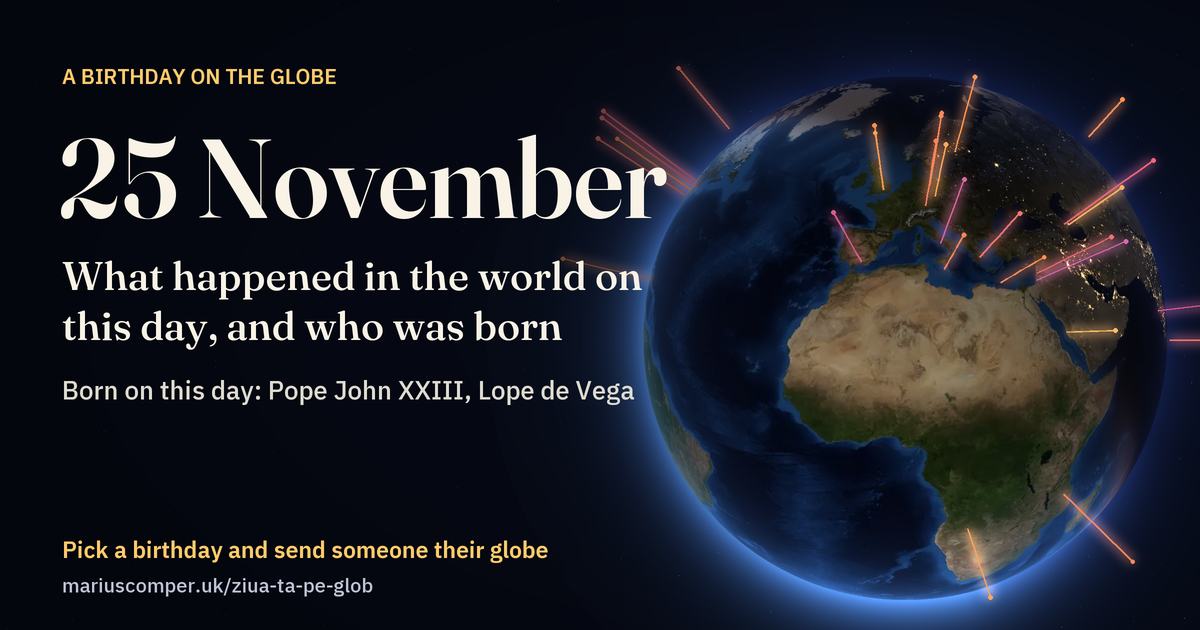
For 25 November, the English Wikipedia lists 68 events and 202 births. 28 of the events stand at their places as rays of light; 10 more are dashed circles, where the sentence links only to a country or a sea. The taller the ray, the longer ago it happened. The people born that day come further down, as blue points.
A birthday, yours or someone else’s:
Turn it into a greetingScroll: the globe turns to each place
The day you were born, on the globe.
Three things from your day
Scroll: your day first, then 25 November through the years
The Earth on 25 November
The picture on the globe was assembled by NASA from satellite photographs taken in November 2004: the snow, the ice and the green are those of the month.
On 25 November the Sun passes straight overhead at noon along the parallel of 20.7° south. In London, the day lasts about 8 hours 25 minutes.
Beyond 69° south the Sun no longer sets; beyond 69° north it no longer rises.
The line between day and night is tilted on the globe exactly as on this day of the year. On the dark side you can see the lights of towns.
Europe · Nafplio
1826
The Greek frigate Hellas arrives in Nafplion to become the first flagship of the Hellenic Navy.
On the map: Nafplio.
Europe · Munich
1901
Gustav Mahler's Symphony No. 4 premiered in Munich.
On the map: Munich.
Also on the day’s list of Wikipedia in Chinese.
Europe · Prussian Academy of Sciences
1915
Albert Einstein presents the field equations of general relativity to the Prussian Academy of Sciences.
On the map: Prussian Academy of Sciences.
Also on the day’s list of Wikipedia in Spanish and Chinese.
25 November
What the other Wikipedias remember#
For these years the English list has nothing on this day. The events below come from the same day’s lists on Wikipedia in Spanish and Chinese and were translated for this page.
From Wikipedia in Spanish · Túxpam de Rodríguez Cano
1956
In Mexico, Fidel Castro, his brother Raúl, Che Guevara and 79 other expeditionaries set sail from the port of Tuxpan on the yacht Granma to begin the Cuban Revolution.
On the map: Túxpam de Rodríguez Cano.
Translated from the list on Wikipedia in Spanish.
From Wikipedia in Chinese · Beijing
1998
Beijing officially announces its bid to host the 2008 Olympic Games.
On the map: Beijing.
Translated from the list on Wikipedia in Chinese.
25 November
Born on 25 November#
The English Wikipedia lists 202 births for this day. The blue points are the birthplaces of 60 of these people: those written about in the most Wikipedia editions, where Wikidata gives a place of birth.
Born on 25 November
1881
Pope John XXIII (died 1963)
Place of birth: Sotto il Monte Giovanni XXIII.
Born on 25 November
1562
Lope de Vega, Spanish playwright and poet (died 1635)
Place of birth: Madrid.
Born on 25 November
1844
Karl Benz, German engineer and businessman, founded Mercedes-Benz (died 1929)
Place of birth: Mühlburg.
Born on 25 November
1971
Christina Applegate, American actress
Place of birth: Hollywood.
Born in Britain and Ireland
1988
Jay Spearing, English footballer
Place of birth: Wallasey.
25 November
Number one in the charts that week
At the cinema
An animal recorded that day
The record can be seen in GBIF, which brings together wildlife records from around the world.
All your birthdays
The weather that day
Data: Met Office Hadley Centre (HadCET); NOAA (GHCN-Daily, Mauna Loa).
Above the Earth
Sources: Jonathan McDowell, GCAT (launches); GFZ Potsdam (Kp index). Days are counted in Universal Time.
Football that day
International matches played that day:
Source: the “International football results” dataset kept by Mart Jürisoo (CC0).
Also that day
The earthquake’s page at the USGS
Source: the USGS catalogue. The day is counted in Universal Time (UTC).
In those days
Make a link for someone
Type the name, pick the day and the year of birth. The link opens straight on their day, with their name in the greeting.
The link carries the name, date and place typed here; anyone who gets it can see them.
Put another birthday beside it
Your mother’s, your child’s, a friend’s: the two days appear side by side.
Below: 25 November through the years.
The whole globe of the day
Drag the globe to turn it. Touch a ray or a point to read what happened there.
Everything Wikipedia lists for 25 November
The list is the English Wikipedia’s, in its own wording, as it stood in October 2026. 30 events have no place on the map: the sentence links to no place with coordinates, only to places too wide to mark, or to several countries.
- 571 BC
Servius Tullius, king of Rome, celebrates the first of his three triumphs for his victory over the Etruscans.
Europe · Ancient RomeWikipedia: Servius Tullius - 1034
Máel Coluim mac Cináeda, King of Scots, dies. His grandson, Donnchad, son of Bethóc and Crínán of Dunkeld, inherits the throne.
no place on the mapWikipedia: Malcolm II of Scotland - 1120
The White Ship sinks in the English Channel, drowning William Adelin, son and heir of Henry I of England.
no place on the mapWikipedia: White Ship disaster - 1177
Baldwin IV of Jerusalem and Raynald of Châtillon defeat Saladin at the Battle of Montgisard.
Asia · Battle of MontgisardWikipedia: Battle of Montgisard - 1343
A tsunami, caused by an earthquake in the Tyrrhenian Sea, devastates Naples and the Maritime Republic of Amalfi, among other places.
Europe · 1343 Naples tsunamiWikipedia: 1343 Naples tsunami - 1400
King Minkhaung I becomes king of Ava.
Asia · Kingdom of AvaWikipedia: Minkhaung I - 1487
Elizabeth of York is crowned Queen Consort of England.
no place on the mapWikipedia: Elizabeth of York - 1491
The siege of Granada, the last Moorish stronghold in Spain, ends with the Treaty of Granada.
Europe · Treaty of GranadaWikipedia: Treaty of Granada - 1510
Portuguese conquest of Goa: Portuguese naval forces under the command of Afonso de Albuquerque, and local mercenaries working for privateer Timoji, seize Goa from the Bijapur Sultanate, resulting in 451 years of Portuguese colonial rule.
Asia · Old GoaWikipedia: Portuguese conquest of Goa - 1596
The Cudgel War begins in Finland (at the time part of Sweden), when peasants rebel against the imposition of taxes by the nobility.
no place on the mapWikipedia: Cudgel War - 1667
A deadly earthquake rocks Shemakha in the Caucasus, killing 80,000 people.
Asia · 1667 Shamakhi earthquakeWikipedia: 1667 Shamakhi earthquake - 1678
Trunajaya rebellion: After a long and logistically challenging march, the allied Mataram and Dutch troops successfully assault the rebel stronghold of Kediri.
Asia · Mataram SultanateWikipedia: Trunajaya rebellion - 1755
King Ferdinand VI of Spain grants royal protection to the Beaterio de la Compañia de Jesus, now known as the Congregation of the Religious of the Virgin Mary.
no place on the mapWikipedia: Ferdinand VI - 1758
French and Indian War: British forces capture Fort Duquesne from French control. Later, Fort Pitt will be built nearby and grow into modern Pittsburgh.
North America · Fort DuquesneWikipedia: French and Indian War - 1759
An earthquake hits the Mediterranean destroying Beirut and Damascus and killing 30,000–40,000.
Asia · 1759 Near East earthquakesWikipedia: 1759 Near East earthquakes - 1783
American Revolutionary War: The last British troops leave New York City, three months after the signing of the Treaty of Paris.
North America · New York CityWikipedia: Evacuation Day - 1795
Partitions of Poland: Stanisław August Poniatowski, the last king of independent Poland, is forced to abdicate and is exiled to Russia.
no place on the mapWikipedia: Partitions of Poland - 1826
The Greek frigate Hellas arrives in Nafplion to become the first flagship of the Hellenic Navy.
Europe · NafplioWikipedia: Greek frigate Hellas - 1833
A massive undersea earthquake, estimated magnitude between 8.7 and 9.2, rocks Sumatra, producing a massive tsunami all along the Indonesian coast.
Asia · 1833 Sumatra earthquakeWikipedia: 1833 Sumatra earthquake - 1839
A cyclone slams into south-eastern India. An estimated 300,000 deaths resulted from the disaster.
no place on the mapWikipedia: 1839 Coringa cyclone - 1863
American Civil War: Battle of Missionary Ridge: Union forces led by General Ulysses S. Grant break the Siege of Chattanooga by routing Confederate troops under General Braxton Bragg at Missionary Ridge in Tennessee.
North America · Battle of Missionary RidgeWikipedia: American Civil War - 1864
American Civil War: A group of Confederate operatives calling themselves the Confederate Army of Manhattan starts fires in more than 20 locations in an unsuccessful attempt to burn down New York City.
no place on the mapWikipedia: Confederate Army of Manhattan - 1874
The United States Greenback Party is established as a political party consisting primarily of farmers affected by the Panic of 1873.
no place on the mapWikipedia: Panic of 1873 - 1876
American Indian Wars: In retaliation for the American defeat at the Battle of the Little Bighorn, United States Army troops sack the sleeping village of Cheyenne Chief Dull Knife at the headwaters of the Powder River.
North America · Battle of the Little BighornWikipedia: Battle of the Little Bighorn - 1885
Banff National Park, the oldest national park in Canada, was established as the Banff Hot Springs Reserve.
North America · Banff National ParkWikipedia: Banff National Park - 1901
Gustav Mahler's Symphony No. 4 premiered in Munich.
Europe · MunichWikipedia: Gustav Mahler - 1905
Prince Carl of Denmark arrives in Norway to become King Haakon VII of Norway.
no place on the mapWikipedia: Haakon VII - 1908
A fire breaks out on SS Sardinia as it leaves Malta's Grand Harbour, resulting in the ship's grounding and the deaths of at least 118 people.
Europe · Grand HarbourWikipedia: SS Sardinia - 1912
Românul de la Pind, the longest-running newspaper by and about Aromanians prior to World War II, ceases its publications.
no place on the mapWikipedia: World War II - 1915
Albert Einstein presents the field equations of general relativity to the Prussian Academy of Sciences.
Europe · Prussian Academy of SciencesWikipedia: Albert Einstein - 1917
World War I: German forces defeat Portuguese army of about 1,200 at Negomano on the border of modern-day Mozambique and Tanzania.
Africa · Battle of NgomanoWikipedia: World War I - 1918
Vojvodina, formerly Austro-Hungarian crown land, proclaims its secession from Austria-Hungary to join the Kingdom of Serbia.
no place on the mapWikipedia: Vojvodina - 1926
The deadliest November tornado outbreak in U.S. history kills 76 people and injures more than 400.
no place on the mapWikipedia: List of North American tornadoes and tornado outbreaks - 1931
Wilhelm Schäfer leaves the Nazi Party and hands over the Boxheim Documents to the Frankfurt police.
no place on the mapWikipedia: Nazi Party - 1936
In Berlin, Germany and Japan sign the Anti-Comintern Pact, agreeing to consult on measures "to safeguard their common interests" in the case of an unprovoked attack by the Soviet Union against either nation.
Europe · BerlinWikipedia: Anti-Comintern Pact - 1940
The de Havilland Mosquito, one of the most successful military aircraft in the Second World War, made its first flight.
no place on the mapWikipedia: De Havilland Mosquito - 1941
World War II: HMS Barham is sunk by a German torpedo.
Africa · HMS BarhamWikipedia: World War II - 1943
World War II: Statehood of Bosnia and Herzegovina is re-established at the State Anti-fascist Council for the National Liberation of Bosnia and Herzegovina.
Europe · Bosnia and HerzegovinaWikipedia: Bosnia and Herzegovina - 1947
New Zealand ratifies the Statute of Westminster and thus becomes independent of legislative control by the United Kingdom.
no place on the mapWikipedia: Statute of Westminster 1931 - 1947
Red Scare: The "Hollywood Ten" are blacklisted by Hollywood movie studios.
no place on the mapWikipedia: Cinema of the United States - 1950
The Great Appalachian Storm of 1950 impacts 22 American states, killing 353 people, injuring over 160, and causing US$66.7 million in damages (1950 dollars).
no place on the mapWikipedia: Great Appalachian Storm of 1950 - 1951
The left-wing Japanese novelist Wataru Kaji disappeared, leading to a government inquiry in which CIA involvement was investigated; Kaji stated he was kidnapped and held against his will by intelligence officers, which the United States denied.
no place on the mapWikipedia: Wataru Kaji - 1952
Agatha Christie's murder-mystery play The Mousetrap opens at the Ambassadors Theatre in London's West End after a premiere in Nottingham, UK. It will become the longest continuously running play in history.
Britain & Ireland · Ambassadors TheatreWikipedia: Agatha Christie - 1952
Korean War: After 42 days of fighting, the Battle of Triangle Hill ends in a Chinese victory. American and South Korean units abandon their attempt to capture the "Iron Triangle".
Asia · Battle of Triangle HillWikipedia: Korean War - 1958
French Sudan gains autonomy as a self-governing member of the French Community.
Africa · French SudanWikipedia: French Sudan - 1960
The Mirabal sisters of the Dominican Republic are assassinated.
Latin America · Mirabal sistersWikipedia: Mirabal sisters - 1963
State funeral of John F. Kennedy; after lying in state at the United States Capitol, a Requiem Mass takes place at Cathedral of St. Matthew the Apostle and the President is buried at Arlington National Cemetery.
North America · United States CapitolWikipedia: State funeral of John F. Kennedy - 1968
The Old Student House in Helsinki, Finland is occupied by a large group of University of Helsinki students.
Europe · Old Student House, HelsinkiWikipedia: Old Student House, Helsinki - 1970
In Japan, author Yukio Mishima and one compatriot commit ritualistic seppuku after an unsuccessful coup attempt.
no place on the mapWikipedia: Yukio Mishima - 1973
Georgios Papadopoulos, head of the military Regime of the Colonels in Greece, is ousted in a hardliners' coup led by Brigadier General Dimitrios Ioannidis.
no place on the mapWikipedia: Greek junta - 1975
Coup of 25 November 1975, a failed military coup d'état by Portuguese far-left activists seeking to hijack the Portuguese transition to democracy to establish a communist regime.
no place on the mapWikipedia: Coup of 25 November 1975 - 1975
Suriname gains independence from the Netherlands.
Latin America · SurinameWikipedia: Suriname - 1975
Upon Suriname's independence from the Netherlands, Johan Ferrier became its first president.
no place on the mapWikipedia: Johan Ferrier - 1977
Former Senator Benigno Aquino Jr., is found guilty by the Philippine Military Commission No. 2 and is sentenced to death by firing squad. He is later assassinated in 1983.
no place on the mapWikipedia: Ninoy Aquino - 1980
Sangoulé Lamizana, president of Upper Volta, is ousted from power in a coup d'état led by Colonel Saye Zerbo.
no place on the mapWikipedia: 1980 Upper Voltan coup d'état - 1981
A group of Conservative members of Parliament wrote a letter outlining their opposition to the economic policy of Margaret Thatcher, leading to speculation over a split from the party.
no place on the mapWikipedia: Gang of 25 - 1981
Pope John Paul II appoints Joseph Cardinal Ratzinger (the future Pope Benedict XVI) Prefect of the Congregation for the Doctrine of the Faith.
no place on the mapWikipedia: Pope John Paul II - 1984
Thirty-six top musicians gather in a Notting Hill studio and record Band Aid's "Do They Know It's Christmas?" in order to raise money for famine relief in Ethiopia.
Britain & Ireland · Notting HillWikipedia: Notting Hill - 1985
A Soviet Air Force Antonov An-12 is shot down near Menongue in Angola's Cuando Cubango Province, killing 21.
Africa · 1985 Aeroflot Antonov An-12 shootdownWikipedia: 1985 Aeroflot Antonov An-12 shootdown - 1986
Iran–Contra affair: U.S. Attorney General Edwin Meese announces that profits from covert weapons sales to Iran were illegally diverted to the anti-communist Contra rebels in Nicaragua.
no place on the mapWikipedia: Iran–Contra affair - 1986
The King Fahd Causeway is officially opened in the Persian Gulf.
Asia · Persian GulfWikipedia: King Fahd Causeway - 1987
Typhoon Nina pummels the Philippines with category 5 winds of 265 km/h (165 mph) and a surge that destroys entire villages. At least 1,036 deaths are attributed to the storm.
Asia · PhilippinesWikipedia: Typhoon Nina - 1992
The Federal Assembly of Czechoslovakia votes to split the country into the Czech Republic and Slovakia, with effect from January 1, 1993.
Europe · Federal AssemblyWikipedia: Federal Assembly - 1999
A five-year-old Cuban boy, Elián González, is rescued by fishermen while floating in an inner tube off the Florida coast.
no place on the mapWikipedia: Elián González - 2000
The 2000 Baku earthquake, with a Richter magnitude of 7.0 kills 26 people dead in Baku, Azerbaijan, being the strongest earthquake in the region in 158 years.
Asia · 2000 Baku earthquakeWikipedia: 2000 Baku earthquake - 2008
Cyclone Nisha strikes northern Sri Lanka, killing 15 people and displacing 90,000 others while dealing the region the highest rainfall in nine decades.
Asia · Sri LankaWikipedia: Cyclone Nisha - 2009
Jeddah floods: Freak rains swamp the city of Jeddah, Saudi Arabia, during an ongoing Hajj pilgrimage. Three thousand cars are swept away and 122 people perish in the torrents, with 350 others missing.
Asia · 2009 Jeddah floodsWikipedia: 2009 Jeddah floods - 2013
English-Irish boy band One Direction released their third studio album Midnight Memories which debuted at number one on the Billboard 200 and became the best-selling album of 2013.
no place on the mapWikipedia: One Direction
What the other Wikipedias remember
For these years the English list has nothing on this day. The events below come from the same day’s lists on Wikipedia in Spanish and Chinese and were translated for this page.
- 1956
In Mexico, Fidel Castro, his brother Raúl, Che Guevara and 79 other expeditionaries set sail from the port of Tuxpan on the yacht Granma to begin the Cuban Revolution.
Latin America · Túxpam de Rodríguez CanoTranslated from the list on Wikipedia in SpanishWikipedia: Revolución cubana - 1998
Beijing officially announces its bid to host the 2008 Olympic Games.
Who was born on 25 November
In order of how many Wikipedia editions have an article about each. The first 60 of 202 are shown.
- 1881
Pope John XXIII (died 1963)
Sotto il Monte Giovanni XXIIIWikipedia: Pope John XXIII - 1562
Lope de Vega, Spanish playwright and poet (died 1635)
MadridWikipedia: Lope de Vega - 1915
Augusto Pinochet, Chilean general and politician, 30th President of Chile (died 2006)
ValparaísoWikipedia: Augusto Pinochet - 1835
Andrew Carnegie, Scottish-American businessman and philanthropist (died 1919)
DunfermlineWikipedia: Andrew Carnegie - 1844
Karl Benz, German engineer and businessman, founded Mercedes-Benz (died 1929)
MühlburgWikipedia: Carl Benz - 1981
Xabi Alonso, Spanish footballer
TolosaWikipedia: Xabi Alonso - 1971
Christina Applegate, American actress
HollywoodWikipedia: Christina Applegate - 2002
Pedri, Spanish footballer
TeguesteWikipedia: Pedri - 1895
Anastas Mikoyan, Soviet politician, Chairman of the Presidium of the Supreme Soviet of the Soviet Union (died 1978)
SanahinWikipedia: Anastas Mikoyan - 1923
Mauno Koivisto, Finnish banker and politician, 9th President of Finland (died 2017)
- 1887
Nikolai Vavilov, Russian botanist and geneticist (died 1943)
- 1845
José Maria de Eça de Queirós, Portuguese-French journalist and author (died 1900)
Póvoa de VarzimWikipedia: Eça de Queiroz - 1895
Ludvík Svoboda, Czech general and politician, 8th President of Czechoslovakia (died 1979)
HroznatínWikipedia: Ludvík Svoboda - 1900
Rudolf Höss, German SS officer, commandant of Auschwitz, convicted war criminal (died 1947)
Baden-BadenWikipedia: Rudolf Höss - 1986
Katie Cassidy, American actress
Los AngelesWikipedia: Katie Cassidy - 1814
Julius Robert von Mayer, German physician and physicist (died 1878)
HeilbronnWikipedia: Julius von Mayer - 1984
Gaspard Ulliel, French actor (died 2022)
Neuilly-sur-SeineWikipedia: Gaspard Ulliel - 1609
Henrietta Maria of France, Queen Consort of England, Scotland and Ireland (died 1669)
- 1638
Catherine of Braganza, Queen Consort of England, Scotland and Ireland (died 1705)
Ducal Palace of Vila ViçosaWikipedia: Catherine of Braganza - 1926
Poul Anderson, American author (died 2001)
BristolWikipedia: Poul Anderson - 1870
Maurice Denis, French painter of Les Nabis movement (died 1943)
GranvilleWikipedia: Maurice Denis - 1914
Joe DiMaggio, American baseball player and coach (died 1999)
MartinezWikipedia: Joe DiMaggio - 1454
Catherine Cornaro, Queen of Cyprus (died 1510)
- 1951
Arturo Pérez-Reverte, Spanish author and journalist
CartagenaWikipedia: Arturo Pérez-Reverte - 1979
Joel Kinnaman, Swedish actor
StockholmWikipedia: Joel Kinnaman - 1960
John F. Kennedy Jr., American lawyer, journalist, and publisher (died 1999)
Washington, D.C.Wikipedia: John F. Kennedy Jr. - 1944
Ben Stein, American actor, television personality, game show host, lawyer, and author
Washington, D.C.Wikipedia: Ben Stein - 1988
Nodar Kumaritashvili, Georgian luger (died 2010)
- 1940
Percy Sledge, American singer (died 2015)
LeightonWikipedia: Percy Sledge - 1920
Ricardo Montalbán, Mexican-American actor, singer, and director (died 2009)
TorreónWikipedia: Ricardo Montalbán - 1951
Johnny Rep, Dutch footballer and manager
ZaandamWikipedia: Johnny Rep - 1980
Aaron Mokoena, South African footballer
JohannesburgWikipedia: Aaron Mokoena - 1889
Reşat Nuri Güntekin, Turkish author and playwright (died 1956)
IstanbulWikipedia: Reşat Nuri Güntekin - 1952
Gabriele Oriali, Italian footballer and manager
- 1960
Amy Grant, American singer-songwriter
AugustaWikipedia: Amy Grant - 1876
Princess Victoria Melita of Saxe-Coburg and Gotha (died 1936)
San Anton PalaceWikipedia: Princess Victoria Melita of Saxe-Coburg and Gotha - 1966
Billy Burke, American actor
BellinghamWikipedia: Billy Burke - 1895
Wilhelm Kempff, German pianist and composer (died 1991)
JüterbogWikipedia: Wilhelm Kempff - 1787
Franz Xaver Gruber, Austrian organist and composer (died 1863)
UnterweitzbergWikipedia: Franz Xaver Gruber - 1924
Paul Desmond, American saxophonist and composer (died 1977)
San FranciscoWikipedia: Paul Desmond - 1926
Jeffrey Hunter, American actor and producer (died 1969)
New OrleansWikipedia: Jeffrey Hunter - 1964
Mark Lanegan, American singer-songwriter (died 2022)
EllensburgWikipedia: Mark Lanegan - 1968
Jill Hennessy, Canadian actress and singer
EdmontonWikipedia: Jill Hennessy - 1988
Jay Spearing, English footballer
WallaseyWikipedia: Jay Spearing - 1868
Ernest Louis, Grand Duke of Hesse (died 1937)
- 1962
Hironobu Sakaguchi, Japanese videogame designer
- 1917
Alparslan Türkeş, Cypriot-Turkish colonel and politician, Deputy Prime Minister of Turkey (died 1997)
NicosiaWikipedia: Alparslan Türkeş - 1947
John Larroquette, American actor
New OrleansWikipedia: John Larroquette - 1951
Charlaine Harris, American author and poet
- 1841
Ernst Schröder, German mathematician and academic (died 1902)
MannheimWikipedia: Ernst Schröder - 1959
Charles Kennedy, Scottish journalist and politician (died 2015)
InvernessWikipedia: Charles Kennedy - 1977
Guillermo Cañas, Argentinian tennis player
TapialesWikipedia: Guillermo Cañas - 1978
Ringo Sheena, Japanese singer-songwriter and producer
FukuokaWikipedia: Ringo Sheena - 1941
Riaz Ahmed Gohar Shahi, Pakistani spiritual leader and author
Rawalpindi DistrictWikipedia: Riaz Ahmed Gohar Shahi - 1967
Anthony Nesty, Surinamese swimmer
Port of SpainWikipedia: Anthony Nesty - 1577
Piet Pieterszoon Hein, Dutch admiral (died 1629)
DelfshavenWikipedia: Piet Pieterszoon Hein - 1963
Kevin Chamberlin, American actor and director
BaltimoreWikipedia: Kevin Chamberlin - 1896
Virgil Thomson, American composer and critic (died 1989)
Kansas CityWikipedia: Virgil Thomson - 1846
Carrie Nation, American activist (died 1911)
Garrard CountyWikipedia: Carrie Nation - 1933
Kathryn Crosby, American actress and singer (died 2024)
HoustonWikipedia: Kathryn Crosby
What is celebrated on 25 November
- Christian feast day: Catherine of Alexandria and its related observances
- Christian feast day: Elizabeth of Reute
- Christian feast day: Isaac Watts (Lutheran Church and Church of England)
- Christian feast day: James Otis Sargent Huntington (Episcopal Church)
- Christian feast day: November 25 (Eastern Orthodox liturgics)
- International Day for the Elimination of Violence against Women
- Roses Revolution Day, against obstetric violence
A greeting link for someone
Type a name and, if you like, the year of birth. The link opens with a greeting, and beside each event it says how old the person turned that day, or how many years before their birth it happened.
The name and the year go only into the link you send.
All 366 days
How the globe is made
Where the events come from
Each edition of this page uses the day’s list from Wikipedia in its own language: Romanian, English, Spanish, Chinese. The lists are written by volunteers and differ from one edition to the next; the text of each event is Wikipedia’s, with a link to the article. A row that appears twice in a list is shown once. The lists have not been checked event by event: they are Wikipedia’s, mistakes included.
For events before 1582, and for countries that moved to the Gregorian calendar later (Britain in 1752, Russia in 1918), the same day may be counted Old Style in one list and New Style in another.
The chapter “What the other Wikipedias remember” adds up to five events a day from the lists of the other three editions, only for years in which the English list has nothing on that day. They were translated for this page, passed the same filters as the tour, and are not counted among the events of the English list.
How an event gets onto the map
The place comes from Wikidata. If the sentence links to the article about the event itself (a battle, an opening, an earthquake), dated to the same year, the ray stands on its coordinates or on those of its location. Otherwise it stands on the first place the sentence links to: a town, a building, a mountain, an island. This second step can be wrong: sometimes the sentence only mentions the place. That is why the page says, under each event, which place the ray stands on.
When the sentence links to a single state or province, or to a single sea, lake or desert larger than 5,000 km², the globe shows a dashed circle, not a ray. The circle has the area Wikidata gives, with its radius kept between 1.2° and 16°, or a radius of 4.5° when Wikidata gives no area; it says only that the sentence links to that place. Organisations, ships, spacecraft, museum objects, rivers, mountain ranges, languages and continents are never used as places. When a sentence names several states and no exact place, the event stays in the list only.
What the height means
The height of a ray shows how many years have passed, on a logarithmic scale: 10 years, 100 years and 1,000 years are equal steps apart; anything older than about 2,600 years has the tallest ray. The colour runs from pale yellow for recent years to violet for antiquity.
Where the tour stops
In each region the tour stops at up to three events (five in Britain and Ireland), chosen mainly by three things: whether Wikipedia’s editors put the event in the “On this day” box of their main page (the English, Spanish and Chinese editions), how many Wikipedia editions have an article about it, and how many of the four lists include it. Events whose sentence or article is about a war, an attack, a crime or a disaster are left out of the tour; they stay in the whole list, in Wikipedia’s wording. The filter is a list of words and a list of Wikidata types, so it can miss some.
The tour of births names the people with articles in the most editions and leaves aside those whom the list or Wikidata describes as rulers, politicians, commanders, leaders of movements or criminals; they stay in the list.
The Earth and the Sun
The daytime images are NASA’s Blue Marble Next Generation mosaics, one for each month of 2004; the night side is Black Marble 2016. The tilt of the line between day and night is computed for the day; the hour is chosen so that the place being read is in daylight. The latitude where the Sun stands overhead is the average of the four years of the leap cycle; in a given year it can differ by up to 0.4°.
The day you were born
The number ones come from the weekly lists on Wikipedia: Billboard for the United States (from 1940; the Hot 100 from August 1958), the UK Singles Chart (from November 1952), Los 40 Principales for Spain (from July 1966) and, for Romania, the Romanian Top 100 and Airplay 100 (2001–2021, with missing weeks). The page shows the chart of the week in which the day of birth falls, with its date; Billboard and the UK chart are dated at the end of their week. For Romania before 2001 and for China these sources have no weekly chart.
The films are those that reached cinemas in the United States up to ten days before or three days after that day (some of them in a few cinemas at first), from the English Wikipedia’s yearly lists (from 1968), in order of how many editions have an article about them. The events “in those days” are the ones on the neighbouring days’ lists that carry the year of birth, passed through the same filter as the tour.
The day of birth, year included
The Moon, the star sign and the constellation are worked out by the page itself, for noon Universal Time on the day. The lit part of the Moon is rounded and can differ by a few per cent from that at the hour of birth. The sign follows the usual zodiac of twelve equal parts starting at the March equinox; the constellation is the one the Sun actually stood in front of, by the borders set by the International Astronomical Union, and within a day of a border the page does not name it. When the Sun changes sign while it is that day anywhere on Earth, the page gives the moment of crossing, rounded to ten minutes and accurate to within about a quarter of an hour, and the clock time in a few cities, with the time zone and summer time of that year.
The year in the Chinese calendar is the one your device’s own calendar gives for the date, checked against the Hong Kong Observatory’s tables. “All your birthdays” uses the same sources as the rest of the chapter for the same day in every year since the birth: the temperature, well-known launches that took place on that very day, matches of the teams the edition follows, snow deeper than 10 cm and strong geomagnetic storms. The three things at the top and the four on the picture are chosen in a fixed order (the song, the animal, a full Moon, a well-known launch before an ordinary earthquake); on the picture you can change them.
When the link carries a year of birth, the page adds a few things about that exact day. The weather is the Met Office’s Central England temperature record and the readings from New York’s Central Park; the “usual high” is the average of the daily highs of 1961–1990 for that date, with two days either side. The carbon dioxide figure is the monthly mean at the Mauna Loa observatory, where measurements begin in March 1958.
The earthquake is the one with the largest magnitude in the USGS catalogue for that day, counted in Universal Time. Before the 1960s the catalogue has gaps even above magnitude 5.5, so in the older years many days have no earthquake. The page gives only the magnitude and the place: the country the epicentre falls in or, when the epicentre is at sea within 300 km of a coast, the nearest country; farther out, only the ocean.
The launches are those that reached orbit or left for the Moon and the planets, from Jonathan McDowell’s GCAT catalogue. If nothing left that day, the page shows the nearest launch within three days before or after, and says how many days away it was. The geomagnetic storm appears only when the Kp index reached at least 5 in one of the day’s eight three-hour intervals.
The animal comes from GBIF: an observation made by a person (the animal seen or heard, or its tracks), dated to that exact day, with coordinates and a CC0 or CC BY licence. Only a few hundred well-known species are searched (mammals, birds, turtles, butterflies); of those noted that day, mammals and species with articles in many Wikipedia editions come first; birds noted almost every day, and species used recently, wait their turn. Observations dated 1 January are left out, because records without a day are often filed there. An observation shows that the animal was recorded there, not how many animals there were.
The matches are those between national teams. Only matches of England, Scotland, Wales, Northern Ireland, the Republic of Ireland, the United States, Canada and Australia are shown, along with those at the big final tournaments. The picture to send is drawn in the page from the day’s globe and the facts above, and stays on your device until you send it.
Sources
- Events, births and holidays: the day’s page on Wikipedia, text under CC BY-SA 4.0.
- Coordinates, places of birth and the number of editions: Wikidata (CC0).
- The Earth by day: NASA Blue Marble Next Generation. The Earth by night: NASA Black Marble 2016.
- Borders and regions: Natural Earth.
- World population and births per year: UN World Population Prospects 2024.
- Charts and films: Wikipedia’s lists for Billboard, the UK Singles Chart, Los 40 Principales, Romanian Top 100, Airplay 100 and American films by year (CC BY-SA 4.0).
- Weather: Met Office Hadley Centre, HadCET (Open Government Licence) and NOAA GHCN-Daily, New York Central Park. Carbon dioxide: NOAA Global Monitoring Laboratory, Mauna Loa.
- Earthquakes: the USGS catalogue. Launches: Jonathan McDowell, GCAT (CC BY). Kp index: GFZ Potsdam (CC BY 4.0). Matches: International football results, Mart Jürisoo (CC0).
- Animal observations: GBIF, with a link to each record; species names come from Wikidata.