A birthday on the globe
6 June on the globe: what happened in the world on this day, and who was born
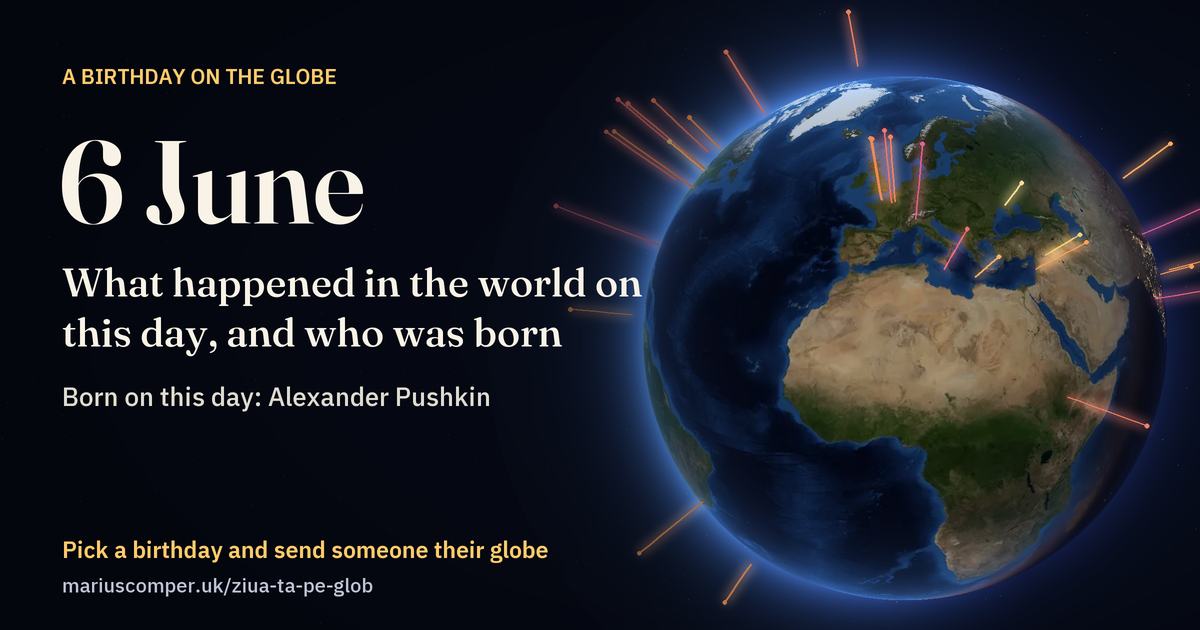
For 6 June, the English Wikipedia lists 43 events and 120 births. 30 of the events stand at their places as rays of light; three more are dashed circles, where the sentence links only to a country or a sea. The taller the ray, the longer ago it happened. The people born that day come further down, as blue points.
A birthday, yours or someone else’s:
Turn it into a greetingScroll: the globe turns to each place
The day you were born, on the globe.
Three things from your day
Scroll: your day first, then 6 June through the years
The Earth on 6 June
The picture on the globe was assembled by NASA from satellite photographs taken in June 2004: the snow, the ice and the green are those of the month.
On 6 June the Sun passes straight overhead at noon along the parallel of 22.7° north. In London, the day lasts about 16 hours 30 minutes.
Beyond 67° north the Sun no longer sets; beyond 67° south it no longer rises.
The line between day and night is tilted on the globe exactly as on this day of the year. On the dark side you can see the lights of towns.
Asia · Raigad Fort
1674
Shivaji is crowned as the first Chhatrapati of the Maratha Empire at Raigad Fort.
On the map: Raigad Fort.
North America · Chicago "L"
1892
The Chicago "L" elevated rail system begins operation.
On the map: Chicago "L".
Also on the day’s list of Wikipedia in Spanish.
North America · Camden, New Jersey
1933
The first drive-in theater opens in Camden, New Jersey.
On the map: Camden, New Jersey.
6 June
What the other Wikipedias remember#
For these years the English list has nothing on this day. The events below come from the same day’s lists on Wikipedia in Chinese and Spanish and were translated for this page.
From Wikipedia in Chinese · University of Oxford
1683
The Ashmolean Museum of the University of Oxford in Britain officially opens, and is recognised as the first university museum in the English-speaking world.
On the map: University of Oxford.
Translated from the list on Wikipedia in Chinese.
From Wikipedia in Spanish · French Open
2004
At the Roland Garros tournament, the Argentine tennis player Gastón Gaudio is crowned champion, beating his compatriot Guillermo Coria. He is the first Argentine to win the title in 27 years.
On the map: French Open.
Translated from the list on Wikipedia in Spanish.
The article on Wikipedia in Spanish: Torneo de Roland Garros
6 June
Born on 6 June#
The English Wikipedia lists 120 births for this day. The blue points are the birthplaces of 60 of these people: those written about in the most Wikipedia editions, where Wikidata gives a place of birth.
Born on 6 June
1799
Alexander Pushkin, Russian author and poet (died 1837)
Place of birth: Moscow.
Born on 6 June
1599
Diego Velázquez (date of baptism), Spanish painter and educator (died 1660)
Place of birth: Seville.
Born on 6 June
1875
Thomas Mann, German author and critic, Nobel Prize laureate (died 1955)
Place of birth: Lübeck.
Born on 6 June
1606
Pierre Corneille, French playwright and producer (died 1684)
Place of birth: Rouen.
Born on 6 June
1850
Karl Ferdinand Braun, German-American physicist and academic, Nobel Prize laureate in 1909 for physics (died 1918)
Place of birth: Fulda.
Born in Britain and Ireland
1868
Robert Falcon Scott, English sailor and explorer (died 1912)
Place of birth: Plymouth.
Born in Britain and Ireland
1963
Jason Isaacs, English actor
Place of birth: Liverpool.
Born in Britain and Ireland
1985
Drew McIntyre, Scottish professional wrestler
Place of birth: Ayr.
6 June
Number one in the charts that week
At the cinema
An animal recorded that day
The record can be seen in GBIF, which brings together wildlife records from around the world.
All your birthdays
The weather that day
Data: Met Office Hadley Centre (HadCET); NOAA (GHCN-Daily, Mauna Loa).
Above the Earth
Sources: Jonathan McDowell, GCAT (launches); GFZ Potsdam (Kp index). Days are counted in Universal Time.
Football that day
International matches played that day:
Source: the “International football results” dataset kept by Mart Jürisoo (CC0).
Also that day
The earthquake’s page at the USGS
Source: the USGS catalogue. The day is counted in Universal Time (UTC).
In those days
Make a link for someone
Type the name, pick the day and the year of birth. The link opens straight on their day, with their name in the greeting.
The link carries the name, date and place typed here; anyone who gets it can see them.
Put another birthday beside it
Your mother’s, your child’s, a friend’s: the two days appear side by side.
Below: 6 June through the years.
The whole globe of the day
Drag the globe to turn it. Touch a ray or a point to read what happened there.
Everything Wikipedia lists for 6 June
The list is the English Wikipedia’s, in its own wording, as it stood in October 2026. 10 events have no place on the map: the sentence links to no place with coordinates, only to places too wide to mark, or to several countries.
- 913
Constantine VII, the eight-year-old illegitimate son of Leo VI the Wise, becomes nominal ruler of the Byzantine Empire under the regency of a seven-man council headed by Patriarch Nicholas Mystikos, appointed by Constantine's uncle Alexander on his deathbed.
Asia · Byzantine EmpireWikipedia: Constantine VII - 1505
The M8.2–8.8 Lo Mustang earthquake affects Tibet and Nepal, causing severe damage in Kathmandu and parts of the Indo-Gangetic plain.
Asia · 1505 Lo Mustang earthquakeWikipedia: 1505 Lo Mustang earthquake - 1513
War of the League of Cambrai: In the Battle of Novara, Swiss troops defeat the French under Louis II de la Trémoille, forcing them to abandon Milan; Duke Massimiliano Sforza is restored.
Europe · Battle of NovaraWikipedia: Battle of Novara - 1523
Swedish regent Gustav Vasa is elected King of Sweden and, marking a symbolic end to the Kalmar Union, 6 June is designated the country's national day.
Europe · Kalmar UnionWikipedia: Gustav Vasa - 1654
Swedish Queen Christina abdicates her throne in favour of her cousin Charles Gustav and converts to Catholicism.
no place on the mapWikipedia: Christina, Queen of Sweden - 1674
Shivaji is crowned as the first Chhatrapati of the Maratha Empire at Raigad Fort.
Asia · Raigad FortWikipedia: Shivaji - 1749
A plot by Muslim slaves in Malta to assassinate Manuel Pinto da Fonseca of the Knights Hospitaller was uncovered.
Europe · 1749 Muslim slave revolt plot in MaltaWikipedia: 1749 Muslim slave revolt plot in Malta - 1762
Seven Years' War: British forces begin the Siege of Havana and temporarily capture the city.
Latin America · Siege of HavanaWikipedia: Seven Years' War - 1813
War of 1812: In the Battle of Stoney Creek, considered a critical turning point in the war, a British force of 700 under John Vincent defeats an American force twice its size under William Winder and John Chandler.
North America · Battle of Stoney CreekWikipedia: Battle of Stoney Creek - 1822
Alexis St Martin is accidentally shot in the stomach, leading to William Beaumont's studies on digestion.
no place on the mapWikipedia: Alexis St. Martin - 1832
The June Rebellion in Paris is put down by the National Guard.
Europe · ParisWikipedia: June Rebellion - 1844
The Young Men's Christian Association (YMCA) is founded in London.
no place on the mapWikipedia: YMCA - 1859
Queensland is established as a separate colony from New South Wales. The date is still celebrated as Queensland Day.
no place on the mapWikipedia: Queensland - 1862
American Civil War: The First Battle of Memphis, a naval engagement fought on the Mississippi River, results in the capture of Memphis, Tennessee by Union forces from the Confederates.
North America · First Battle of MemphisWikipedia: American Civil War - 1882
The Shewan forces of Menelik II of Ethiopia defeat the Gojjame army in the Battle of Embabo. The Shewans capture Negus Tekle Haymanot of Gojjam, and their victory leads to a Shewan hegemony over the territories south of the Abay River.
Africa · Battle of EmbaboWikipedia: Battle of Embabo - 1889
The Great Seattle Fire destroys all of downtown Seattle.
North America · Great Seattle FireWikipedia: Great Seattle Fire - 1892
The Chicago "L" elevated rail system begins operation.
North America · Chicago "L"Wikipedia: Chicago "L" - 1894
Governor Davis H. Waite orders the Colorado state militia to protect and support the miners engaged in the Cripple Creek miners' strike.
North America · 1894 Cripple Creek miners' strikeWikipedia: 1894 Cripple Creek miners' strike - 1912
The eruption of Novarupta in Alaska begins. It is the largest volcanic eruption of the 20th century.
North America · NovaruptaWikipedia: Novarupta - 1918
World War I: U.S. Marine Corps suffers its worst single day's casualties during the Battle of Belleau Wood while attempting to recapture the wood at Château-Thierry (the losses are exceeded at the Battle of Tarawa in November 1943).
Europe · Battle of Belleau WoodWikipedia: World War I - 1925
The original Chrysler Corporation is founded by Walter Chrysler from the remains of the Maxwell Motor Company.
no place on the mapWikipedia: Chrysler - 1933
The first drive-in theater opens in Camden, New Jersey.
North America · Camden, New JerseyWikipedia: Drive-in theater - 1934
New Deal: U.S. President Franklin D. Roosevelt signs the Securities Exchange Act of 1934 into law, establishing the U.S. Securities and Exchange Commission.
no place on the mapWikipedia: New Deal - 1942
World War II: The United States Navy's victory over the Imperial Japanese Navy at the Battle of Midway is a major turning point in the Pacific Theater. All four Japanese fleet carriers taking part—Akagi, Kaga, Sōryū and Hiryū—are sunk, as is the heavy cruiser Mikuma. The American carrier Yorktown and the destroyer Hammann are also sunk.
Oceans · Battle of MidwayWikipedia: World War II - 1944
World War II: Capture of the Caen canal and Orne river bridges by British paratroopers, also known as Operation Coup de Main (incorrectly referred to as Operation Deadstick.)
Europe · Capture of the Caen Canal and Orne River bridgesWikipedia: Capture of the Caen Canal and Orne River bridges - 1944
World War II: Commencement of Operation Overlord: The Allied invasion of Normandy begins with the execution of Operation Neptune—commonly referred to as D-Day—the largest seaborne invasion in history. Nearly 160,000 Allied troops cross the English Channel with about 5,000 landing and assault craft, 289 escort vessels, and 277 minesweepers participating. By the end of the day, the Allies have landed on five invasion beaches and are pushing inland.
Europe · Operation OverlordWikipedia: Operation Overlord - 1966
March Against Fear: African-American civil rights activist James Meredith is wounded in an ambush by white sniper James Aubrey Norvell. Meredith and Norvell are photographed by Jack R. Thornell, whose photo will receive the 1967 Pulitzer Prize in Photography, the last one to be awarded in the category.
no place on the mapWikipedia: 1967 Pulitzer Prize - 1971
Hughes Airwest Flight 706 collides with a McDonnell Douglas F-4 Phantom II of the United States Marine Corps over the San Gabriel Mountains, killing 50.
North America · Hughes Airwest Flight 706Wikipedia: Hughes Airwest Flight 706 - 1971
Soyuz 11 is launched. The mission ends in disaster when all three cosmonauts, Georgy Dobrovolsky, Vladislav Volkov, and Viktor Patsayev are suffocated by uncontrolled decompression of the capsule during re-entry on 29 June.
no place on the mapWikipedia: Soyuz 11 - 1971
Vietnam War: Australian forces attacked a heavily fortified North Vietnamese base camp at the Battle of Long Khánh.
Asia · Battle of Long KhánhWikipedia: Vietnam War - 1975
British referendum results in continued membership of the European Economic Community, with 67% of votes in favour.
Europe · European UnionWikipedia: Referendum - 1976
Chief Minister of Sabah Faud Stephens, Peter Joinud Mojuntin, and several other politicians are killed in a plane crash near Kota Kinabalu International Airport in Malaysia.
Asia · 1976 Sabah Air GAF Nomad crashWikipedia: 1976 Sabah Air GAF Nomad crash - 1982
1982 Lebanon War: The war begins as forces under Israeli Defense Minister Ariel Sharon invade southern Lebanon during Operation Peace for the Galilee, eventually reaching as far north as the capital Beirut.
Asia · BeirutWikipedia: 1982 Lebanon War - 1982
Falklands War: The Royal Navy destroyer HMS Cardiff engaged and destroyed a British Army helicopter in a friendly-fire incident.
Latin America · Falklands WarWikipedia: Falklands War - 1985
The grave of "Wolfgang Gerhard" is opened in Embu, Brazil; the exhumed remains are later proven to be those of Josef Mengele, Auschwitz's "Angel of Death"; Mengele is thought to have drowned while swimming in February 1979.
Latin America · Embu das ArtesWikipedia: Embu das Artes - 1992
Copa Airlines Flight 201 breaks apart in mid-air and crashes into the Darién Gap in Panama, killing all 47 aboard.
Latin America · Copa Airlines Flight 201Wikipedia: Copa Airlines Flight 201 - 1993
Punsalmaagiin Ochirbat wins the first presidential election in Mongolia.
no place on the mapWikipedia: 1993 Mongolian presidential election - 1994
China Northwest Airlines Flight 2303 crashes near Xi'an Xianyang International Airport, killing all 160 people on board.
Asia · China Northwest Airlines Flight 2303Wikipedia: China Northwest Airlines Flight 2303 - 2002
Eastern Mediterranean event. A near-Earth asteroid estimated at ten meters in diameter explodes over the Mediterranean Sea between Greece and Libya. The explosion is estimated to have a force of 26 kilotons, slightly more powerful than the Nagasaki atomic bomb.
Africa · 2002 Eastern Mediterranean eventWikipedia: 2002 Eastern Mediterranean event - 2017
Syrian civil war: The Battle of Raqqa begins with an offensive by the Syrian Democratic Forces (SDF) to capture the city from the Islamic State of Iraq and the Levant (ISIL).
Asia · Battle of RaqqaWikipedia: Battle of Raqqa - 2021
A man rammed a pickup truck into Muslim Pakistani Canadian pedestrians in Ontario, Canada, killing four members of the same family.
North America · 2021 London, Ontario truck attackWikipedia: 2021 London, Ontario truck attack - 2023
Russo-Ukrainian war: The Kakhovka Dam is destroyed.
Europe · Destruction of the Kakhovka DamWikipedia: Russo-Ukrainian war - 2024
The launch of SpaceX Starship integrated flight test 4 (IFT-4)
no place on the mapWikipedia: Starship flight test 4
What the other Wikipedias remember
For these years the English list has nothing on this day. The events below come from the same day’s lists on Wikipedia in Chinese and Spanish and were translated for this page.
- 1683
The Ashmolean Museum of the University of Oxford in Britain officially opens, and is recognised as the first university museum in the English-speaking world.
Britain & Ireland · University of OxfordTranslated from the list on Wikipedia in ChineseWikipedia: 牛津大学 - 2004
At the Roland Garros tournament, the Argentine tennis player Gastón Gaudio is crowned champion, beating his compatriot Guillermo Coria. He is the first Argentine to win the title in 27 years.
Europe · French OpenTranslated from the list on Wikipedia in SpanishWikipedia: Torneo de Roland Garros
Who was born on 6 June
In order of how many Wikipedia editions have an article about each. The first 60 of 120 are shown.
- 1799
Alexander Pushkin, Russian author and poet (died 1837)
- 1599
Diego Velázquez (date of baptism), Spanish painter and educator (died 1660)
SevilleWikipedia: Diego Velázquez - 1875
Thomas Mann, German author and critic, Nobel Prize laureate (died 1955)
LübeckWikipedia: Thomas Mann - 1901
Sukarno, Indonesian engineer and politician, 1st President of Indonesia (died 1970)
SurabayaWikipedia: Sukarno - 1606
Pierre Corneille, French playwright and producer (died 1684)
- 1850
Karl Ferdinand Braun, German-American physicist and academic, Nobel Prize laureate in 1909 for physics (died 1918)
- 1934
Albert II, King of the Belgians from 9 August 1993 to 21 July 2013 (abdicated)
- 1868
Robert Falcon Scott, English sailor and explorer (died 1912)
PlymouthWikipedia: Robert Falcon Scott - 1956
Björn Borg, Swedish tennis player; winner of eleven Grand Slam singles titles including five consecutive Wimbledons
StockholmWikipedia: Björn Borg - 1903
Aram Khachaturian, Armenian composer and conductor (died 1978)
- 1909
Isaiah Berlin, Latvian-English historian and philosopher (died 1997)
- 1933
Heinrich Rohrer, Swiss physicist and academic, Nobel Prize laureate (died 2013)
- 1943
Richard Smalley, American chemist and academic, Nobel Prize laureate in 1996 for chemistry (died 2005)
- 1967
Paul Giamatti, American actor and producer
New HavenWikipedia: Paul Giamatti - 1980
Pete Hegseth, American author, political commentator and 29th United States Secretary of Defense
MinneapolisWikipedia: Pete Hegseth - 1714
Joseph I of Portugal, King of Portugal from 31 July 1750 until his death (died 1777)
- 1436
Regiomontanus (Johannes Müller von Königsberg), German mathematician, astronomer, and bishop (died 1476)
Königsberg in BayernWikipedia: Regiomontanus - 1963
Jason Isaacs, English actor
LiverpoolWikipedia: Jason Isaacs - 1960
Steve Vai, American musician
Carle PlaceWikipedia: Steve Vai - 1841
Eliza Orzeszkowa, Polish author and publisher (died 1910)
MiĺkaŭščynaWikipedia: Eliza Orzeszkowa - 1985
Sebastian Larsson, Swedish footballer
EskilstunaWikipedia: Sebastian Larsson - 1896
Italo Balbo, Italian air marshal and fascist politician who played a key role in developing Mussolini's air force (died 1940)
QuartesanaWikipedia: Italo Balbo - 1932
David Scott, American colonel, engineer, and astronaut who was the commander of Apollo 15
San AntonioWikipedia: David Scott - 1983
Michael Krohn-Dehli, Danish footballer
CopenhagenWikipedia: Michael Krohn-Dehli - 1918
Edwin G. Krebs, American biochemist and academic, Nobel Prize laureate (died 2009)
LansingWikipedia: Edwin G. Krebs - 1944
Phillip Allen Sharp, American molecular biologist; 1993 Nobel Prize laureate (Physiology or Medicine)
FalmouthWikipedia: Phillip Allen Sharp - 1947
Robert Englund, American actor; best known for Nightmare on Elm Street
GlendaleWikipedia: Robert Englund - 1857
Aleksandr Lyapunov, Russian mathematician and physicist (died 1918)
YaroslavlWikipedia: Aleksandr Lyapunov - 1962
Hirokazu Kore-eda, Japanese director
- 1929
Sunil Dutt, Indian actor, director, producer, and politician (died 2005)
JhelumWikipedia: Sunil Dutt - 1916
Hamani Diori, Nigerien academic and politician, 1st President of Niger (died 1989)
SoudouréWikipedia: Hamani Diori - 1995
Julian Green, American soccer player
- 1946
Tony Levin, American bass player and songwriter
- 1952
Harvey Fierstein, American actor and playwright; winner of four Tony Awards
BrooklynWikipedia: Harvey Fierstein - 1979
Roberto De Zerbi, Italian football manager
BresciaWikipedia: Roberto De Zerbi - 1994
Yvon Mvogo, Swiss footballer
YaoundéWikipedia: Yvon Mvogo - 1919
Peter Carington, 6th Baron Carrington, English army officer and politician, 6th Secretary General of NATO (died 2018)
- 1955
Sandra Bernhard, American stand-up comic and actress
- 1985
Drew McIntyre, Scottish professional wrestler
- 1898
Ninette de Valois, English ballerina, choreographer, and director (died 2001)
BlessingtonWikipedia: Ninette de Valois - 1944
Tommie Smith, American sprinter and football player; winner of 1968 Olympic 200m gold medal in a world record time
ClarksvilleWikipedia: Tommie Smith - 1955
Sam Simon, American director, producer and screenwriter; co-developer of The Simpsons (died 2015)
Los AngelesWikipedia: Sam Simon - 1985
Becky Sauerbrunn, American footballer; twice a winner of the FIFA Women's World Cup, also an Olympic gold medallist
St. LouisWikipedia: Becky Sauerbrunn - 1519
Andrea Cesalpino, Italian philosopher, physician, and botanist (died 1603)
- 1917
Kirk Kerkorian, American businessman, founded the Tracinda Corporation (died 2015)
- 1955
Lee Smolin, American theoretical physicist
New York CityWikipedia: Lee Smolin - 2001
Rayan Aït-Nouri, French-Algerian footballer
MontreuilWikipedia: Rayan Aït-Nouri - 1966
Tony Yeboah, Ghanaian footballer
KumasiWikipedia: Tony Yeboah - 1896
Henry Allingham, English World War I soldier and supercentenarian (died 2009)
- 1923
V. C. Andrews, American author, illustrator, and painter (died 1986)
PortsmouthWikipedia: V. C. Andrews - 1974
Sonya Walger, British-American actress
HampsteadWikipedia: Sonya Walger - 1755
Nathan Hale, American soldier (died 1776)
CoventryWikipedia: Nathan Hale - 1756
John Trumbull, American soldier and painter (died 1843)
LebanonWikipedia: John Trumbull - 1939
Louis Andriessen, Dutch pianist and composer (died 2021)
UtrechtWikipedia: Louis Andriessen - 1954
Władysław Żmuda, Polish footballer and manager; 91 caps for Poland and voted Best Young Player at the 1974 FIFA World Cup
- 1947
David Blunkett, British Labour politician; Home Secretary 2001–2004
SheffieldWikipedia: David Blunkett - 1990
Pape Souaré, Senegalese footballer
PikineWikipedia: Pape Souaré - 1898
Jacobus Johannes Fouché, South African politician, 2nd State President of South Africa (died 1980)
WepenerWikipedia: Jim Fouché - 1935
Grant Green, American jazz guitarist and composer (died 1979)
St. LouisWikipedia: Grant Green - 1906
Max August Zorn, German mathematician and academic who is noted for Zorn's lemma (died 1993)
KrefeldWikipedia: Max August Zorn
What is celebrated on 6 June
- Christian feast day: Bessarion of Egypt
- Christian feast day: Claudius of Besançon
- Christian feast day: Iarlaithe mac Loga
- Christian feast day: Ini Kopuria (Anglican Church of Melanesia, Church of England, Episcopal Church)
- Christian feast day: Blessed Innocent Guz
- Christian feast day: Marcellin Champagnat
- Christian feast day: Blessed Maria Laura Mainetti
- Christian feast day: Norbert
- Christian feast day: June 6 (Eastern Orthodox liturgics)
- D-Day Invasion Anniversary
- Engineer's Day in Taiwan
- Korean Children's Union Foundation Day in North Korea
- Memorial Day in South Korea
- National Day of Sweden, marking the end of the Kalmar Union and the coronation of King Gustav Vasa
A greeting link for someone
Type a name and, if you like, the year of birth. The link opens with a greeting, and beside each event it says how old the person turned that day, or how many years before their birth it happened.
The name and the year go only into the link you send.
All 366 days
How the globe is made
Where the events come from
Each edition of this page uses the day’s list from Wikipedia in its own language: Romanian, English, Spanish, Chinese. The lists are written by volunteers and differ from one edition to the next; the text of each event is Wikipedia’s, with a link to the article. A row that appears twice in a list is shown once. The lists have not been checked event by event: they are Wikipedia’s, mistakes included.
For events before 1582, and for countries that moved to the Gregorian calendar later (Britain in 1752, Russia in 1918), the same day may be counted Old Style in one list and New Style in another.
The chapter “What the other Wikipedias remember” adds up to five events a day from the lists of the other three editions, only for years in which the English list has nothing on that day. They were translated for this page, passed the same filters as the tour, and are not counted among the events of the English list.
How an event gets onto the map
The place comes from Wikidata. If the sentence links to the article about the event itself (a battle, an opening, an earthquake), dated to the same year, the ray stands on its coordinates or on those of its location. Otherwise it stands on the first place the sentence links to: a town, a building, a mountain, an island. This second step can be wrong: sometimes the sentence only mentions the place. That is why the page says, under each event, which place the ray stands on.
When the sentence links to a single state or province, or to a single sea, lake or desert larger than 5,000 km², the globe shows a dashed circle, not a ray. The circle has the area Wikidata gives, with its radius kept between 1.2° and 16°, or a radius of 4.5° when Wikidata gives no area; it says only that the sentence links to that place. Organisations, ships, spacecraft, museum objects, rivers, mountain ranges, languages and continents are never used as places. When a sentence names several states and no exact place, the event stays in the list only.
What the height means
The height of a ray shows how many years have passed, on a logarithmic scale: 10 years, 100 years and 1,000 years are equal steps apart; anything older than about 2,600 years has the tallest ray. The colour runs from pale yellow for recent years to violet for antiquity.
Where the tour stops
In each region the tour stops at up to three events (five in Britain and Ireland), chosen mainly by three things: whether Wikipedia’s editors put the event in the “On this day” box of their main page (the English, Spanish and Chinese editions), how many Wikipedia editions have an article about it, and how many of the four lists include it. Events whose sentence or article is about a war, an attack, a crime or a disaster are left out of the tour; they stay in the whole list, in Wikipedia’s wording. The filter is a list of words and a list of Wikidata types, so it can miss some.
The tour of births names the people with articles in the most editions and leaves aside those whom the list or Wikidata describes as rulers, politicians, commanders, leaders of movements or criminals; they stay in the list.
The Earth and the Sun
The daytime images are NASA’s Blue Marble Next Generation mosaics, one for each month of 2004; the night side is Black Marble 2016. The tilt of the line between day and night is computed for the day; the hour is chosen so that the place being read is in daylight. The latitude where the Sun stands overhead is the average of the four years of the leap cycle; in a given year it can differ by up to 0.4°.
The day you were born
The number ones come from the weekly lists on Wikipedia: Billboard for the United States (from 1940; the Hot 100 from August 1958), the UK Singles Chart (from November 1952), Los 40 Principales for Spain (from July 1966) and, for Romania, the Romanian Top 100 and Airplay 100 (2001–2021, with missing weeks). The page shows the chart of the week in which the day of birth falls, with its date; Billboard and the UK chart are dated at the end of their week. For Romania before 2001 and for China these sources have no weekly chart.
The films are those that reached cinemas in the United States up to ten days before or three days after that day (some of them in a few cinemas at first), from the English Wikipedia’s yearly lists (from 1968), in order of how many editions have an article about them. The events “in those days” are the ones on the neighbouring days’ lists that carry the year of birth, passed through the same filter as the tour.
The day of birth, year included
The Moon, the star sign and the constellation are worked out by the page itself, for noon Universal Time on the day. The lit part of the Moon is rounded and can differ by a few per cent from that at the hour of birth. The sign follows the usual zodiac of twelve equal parts starting at the March equinox; the constellation is the one the Sun actually stood in front of, by the borders set by the International Astronomical Union, and within a day of a border the page does not name it. When the Sun changes sign while it is that day anywhere on Earth, the page gives the moment of crossing, rounded to ten minutes and accurate to within about a quarter of an hour, and the clock time in a few cities, with the time zone and summer time of that year.
The year in the Chinese calendar is the one your device’s own calendar gives for the date, checked against the Hong Kong Observatory’s tables. “All your birthdays” uses the same sources as the rest of the chapter for the same day in every year since the birth: the temperature, well-known launches that took place on that very day, matches of the teams the edition follows, snow deeper than 10 cm and strong geomagnetic storms. The three things at the top and the four on the picture are chosen in a fixed order (the song, the animal, a full Moon, a well-known launch before an ordinary earthquake); on the picture you can change them.
When the link carries a year of birth, the page adds a few things about that exact day. The weather is the Met Office’s Central England temperature record and the readings from New York’s Central Park; the “usual high” is the average of the daily highs of 1961–1990 for that date, with two days either side. The carbon dioxide figure is the monthly mean at the Mauna Loa observatory, where measurements begin in March 1958.
The earthquake is the one with the largest magnitude in the USGS catalogue for that day, counted in Universal Time. Before the 1960s the catalogue has gaps even above magnitude 5.5, so in the older years many days have no earthquake. The page gives only the magnitude and the place: the country the epicentre falls in or, when the epicentre is at sea within 300 km of a coast, the nearest country; farther out, only the ocean.
The launches are those that reached orbit or left for the Moon and the planets, from Jonathan McDowell’s GCAT catalogue. If nothing left that day, the page shows the nearest launch within three days before or after, and says how many days away it was. The geomagnetic storm appears only when the Kp index reached at least 5 in one of the day’s eight three-hour intervals.
The animal comes from GBIF: an observation made by a person (the animal seen or heard, or its tracks), dated to that exact day, with coordinates and a CC0 or CC BY licence. Only a few hundred well-known species are searched (mammals, birds, turtles, butterflies); of those noted that day, mammals and species with articles in many Wikipedia editions come first; birds noted almost every day, and species used recently, wait their turn. Observations dated 1 January are left out, because records without a day are often filed there. An observation shows that the animal was recorded there, not how many animals there were.
The matches are those between national teams. Only matches of England, Scotland, Wales, Northern Ireland, the Republic of Ireland, the United States, Canada and Australia are shown, along with those at the big final tournaments. The picture to send is drawn in the page from the day’s globe and the facts above, and stays on your device until you send it.
Sources
- Events, births and holidays: the day’s page on Wikipedia, text under CC BY-SA 4.0.
- Coordinates, places of birth and the number of editions: Wikidata (CC0).
- The Earth by day: NASA Blue Marble Next Generation. The Earth by night: NASA Black Marble 2016.
- Borders and regions: Natural Earth.
- World population and births per year: UN World Population Prospects 2024.
- Charts and films: Wikipedia’s lists for Billboard, the UK Singles Chart, Los 40 Principales, Romanian Top 100, Airplay 100 and American films by year (CC BY-SA 4.0).
- Weather: Met Office Hadley Centre, HadCET (Open Government Licence) and NOAA GHCN-Daily, New York Central Park. Carbon dioxide: NOAA Global Monitoring Laboratory, Mauna Loa.
- Earthquakes: the USGS catalogue. Launches: Jonathan McDowell, GCAT (CC BY). Kp index: GFZ Potsdam (CC BY 4.0). Matches: International football results, Mart Jürisoo (CC0).
- Animal observations: GBIF, with a link to each record; species names come from Wikidata.