A birthday on the globe
2 May on the globe: what happened in the world on this day, and who was born
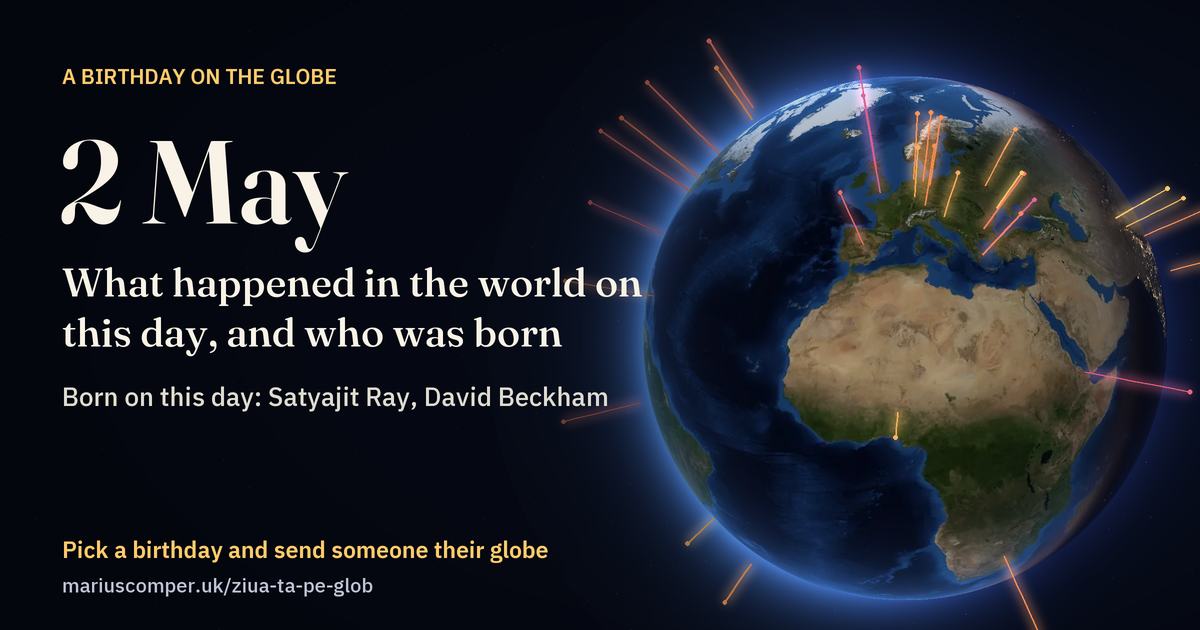
For 2 May, the English Wikipedia lists 53 events and 180 births. 31 of the events stand at their places as rays of light; two more are dashed circles, where the sentence links only to a country or a sea. The taller the ray, the longer ago it happened. The people born that day come further down, as blue points.
A birthday, yours or someone else’s:
Turn it into a greetingScroll: the globe turns to each place
The day you were born, on the globe.
Three things from your day
Scroll: your day first, then 2 May through the years
The Earth on 2 May
The picture on the globe was assembled by NASA from satellite photographs taken in May 2004: the snow, the ice and the green are those of the month.
On 2 May the Sun passes straight overhead at noon along the parallel of 15.5° north. In London, the day lasts about 14 hours 55 minutes.
Beyond 75° north the Sun no longer sets; beyond 75° south it no longer rises.
The line between day and night is tilted on the globe exactly as on this day of the year. On the dark side you can see the lights of towns.
Britain & Ireland · Portsmouth
1194
King Richard I of England gives Portsmouth its first royal charter.
On the map: Portsmouth.
Britain & Ireland · Lochleven Castle
1568
Mary, Queen of Scots, escapes from Lochleven Castle.
On the map: Lochleven Castle.
Europe · Athens
1906
Closing ceremony of the Intercalated Games in Athens, Greece.
On the map: Athens.
Europe · Cuxhaven
1963
Berthold Seliger launches a rocket with three stages and a maximum flight altitude of more than 100 kilometres (62 mi) near Cuxhaven. It is the only sounding rocket developed in Germany.
On the map: Cuxhaven.
Wikipedia: Seliger Forschungs- und Entwicklungsgesellschaft mbH
Africa · Beilul
1625
Afonso Mendes, appointed by Pope Gregory XV as Latin Patriarch of Ethiopia, arrives at Beilul from Goa.
On the map: Beilul.
Also on the day’s list of Wikipedia in Chinese.
Africa · Johannesburg
1952
A De Havilland Comet makes the first jetliner flight with fare-paying passengers, from London to Johannesburg.
On the map: Johannesburg.
Also on the day’s list of Wikipedia in Chinese.
Asia · Shishapangma
1964
First ascent of Shishapangma, the fourteenth highest mountain in the world and the lowest of the Eight-thousanders.
On the map: Shishapangma.
Also on the day’s list of Wikipedia in Romanian.
Latin America · Chaitén
2008
Chaitén Volcano begins erupting in Chile, forcing the evacuation of more than 4,500 people.
On the map: Chaitén.
Also on the day’s list of Wikipedia in Spanish.
North America · Indianapolis
1920
The first game of the Negro National League baseball is played in Indianapolis.
On the map: Indianapolis.
2 May
What the other Wikipedias remember#
For these years the English list has nothing on this day. The events below come from the same day’s lists on Wikipedia in Romanian and Spanish and were translated for this page.
From Wikipedia in Romanian · Paris
1635
In Paris, the Jardin Royal des plantes médicinales, the royal garden of medicinal plants, opens. The garden was planted under the instructions of the physicians of King Louis XIII, Jean Hérouard and Guy de La Brosse. Five years later, it was made available to the public.
On the map: Paris.
Translated from the list on Wikipedia in Romanian.
From Wikipedia in Spanish · Bilbao
1874
In Bilbao (Spain), the Carlist siege is lifted.
On the map: Bilbao.
Translated from the list on Wikipedia in Spanish.
2 May
Born on 2 May#
The English Wikipedia lists 180 births for this day. The blue points are the birthplaces of 60 of these people: those written about in the most Wikipedia editions, where Wikidata gives a place of birth.
Born on 2 May
1921
Satyajit Ray, Indian director, producer, and screenwriter (died 1992)
Place of birth: Kolkata.
Born on 2 May
1772
Novalis, German author and poet (died 1801)
Place of birth: Wiederstedt.
Born on 2 May
1972
Dwayne Johnson, American actor and wrestler
Place of birth: Hayward.
Born on 2 May
1860
Theodor Herzl, Austro-Hungarian Zionist philosopher, journalist and author (died 1904)
Place of birth: Pest.
Born in Britain and Ireland
1859
Jerome K. Jerome, English author and playwright (died 1927)
Place of birth: Walsall.
Born in Britain and Ireland
1985
Lily Allen, English singer-songwriter and actress
Place of birth: Hammersmith.
Born in Britain and Ireland
1946
David Suchet, English actor
Place of birth: Paddington.
2 May
Number one in the charts that week
At the cinema
An animal recorded that day
The record can be seen in GBIF, which brings together wildlife records from around the world.
All your birthdays
The weather that day
Data: Met Office Hadley Centre (HadCET); NOAA (GHCN-Daily, Mauna Loa).
Above the Earth
Sources: Jonathan McDowell, GCAT (launches); GFZ Potsdam (Kp index). Days are counted in Universal Time.
Football that day
International matches played that day:
Source: the “International football results” dataset kept by Mart Jürisoo (CC0).
Also that day
The earthquake’s page at the USGS
Source: the USGS catalogue. The day is counted in Universal Time (UTC).
In those days
Make a link for someone
Type the name, pick the day and the year of birth. The link opens straight on their day, with their name in the greeting.
The link carries the name, date and place typed here; anyone who gets it can see them.
Put another birthday beside it
Your mother’s, your child’s, a friend’s: the two days appear side by side.
Below: 2 May through the years.
The whole globe of the day
Drag the globe to turn it. Touch a ray or a point to read what happened there.
Everything Wikipedia lists for 2 May
The list is the English Wikipedia’s, in its own wording, as it stood in October 2026. 20 events have no place on the map: the sentence links to no place with coordinates, only to places too wide to mark, or to several countries.
- 1194
King Richard I of England gives Portsmouth its first royal charter.
Britain & Ireland · PortsmouthWikipedia: Richard I of England - 1230
William de Braose is hanged by Prince Llywelyn the Great.
no place on the mapWikipedia: William de Braose - 1250
Mamluks under Baybars murder the Ayyubid sultan Turanshah for fear of losing their privileges.
no place on the mapWikipedia: Mamluk - 1388
The surrender of the Acropolis of Athens to Nerio Acciaioli ends the Catalan presence in the Duchy of Athens.
Europe · Acropolis of AthensWikipedia: Catalan Company - 1536
Anne Boleyn, Queen of England, is arrested and imprisoned on charges of adultery, incest, treason and witchcraft.
no place on the mapWikipedia: Anne Boleyn - 1559
John Knox returns from exile to Scotland to become the leader of the nascent Scottish Reformation.
no place on the mapWikipedia: Scottish Reformation - 1568
Mary, Queen of Scots, escapes from Lochleven Castle.
Britain & Ireland · Lochleven CastleWikipedia: Mary, Queen of Scots - 1611
The King James Version of the Bible is published for the first time in London, England, by printer Robert Barker.
no place on the mapWikipedia: King James Version - 1625
Afonso Mendes, appointed by Pope Gregory XV as Latin Patriarch of Ethiopia, arrives at Beilul from Goa.
Africa · BeilulWikipedia: Afonso Mendes - 1670
King Charles II of England grants a permanent charter to the Hudson's Bay Company to open up the fur trade in North America.
no place on the mapWikipedia: Charles II of England - 1808
Outbreak of the Peninsular War: The people of Madrid rise up in rebellion against French occupation. Francisco de Goya later memorializes this event in his painting The Second of May 1808.
Europe · Dos de Mayo UprisingWikipedia: Dos de Mayo Uprising - 1812
The Siege of Cuautla during the Mexican War of Independence ends with both sides claiming victory.
Latin America · Siege of CuautlaWikipedia: Siege of Cuautla - 1829
After anchoring nearby, Captain Charles Fremantle of HMS Challenger declares the Swan River Colony in Australia.
no place on the mapWikipedia: Charles Fremantle - 1863
American Civil War: Stonewall Jackson is wounded by friendly fire while returning to camp after reconnoitering during the Battle of Chancellorsville. He succumbs to pneumonia eight days later.
North America · Battle of ChancellorsvilleWikipedia: American Civil War - 1866
Peruvian defenders fight off the Spanish fleet at the Battle of Callao.
Latin America · Battle of CallaoWikipedia: Battle of Callao - 1867
Albert Günther publishes the first study to recognise that the New Zealand tuatara is not a lizard.
no place on the mapWikipedia: Albert Günther - 1876
The April Uprising breaks out in Ottoman Bulgaria.
Europe · April Uprising of 1876Wikipedia: April Uprising of 1876 - 1878
A dust explosion at the world's largest flour mill in Minneapolis resulted in 18 deaths.
North America · Great Mill DisasterWikipedia: Great Mill Disaster - 1885
Cree and Assiniboine warriors win the Battle of Cut Knife, their largest victory over Canadian forces during the North-West Rebellion.
North America · Battle of Cut KnifeWikipedia: Battle of Cut Knife - 1889
Menelik II, Emperor of Ethiopia, signs the Treaty of Wuchale, giving Italy control over Eritrea.
no place on the mapWikipedia: Treaty of Wuchale - 1906
Closing ceremony of the Intercalated Games in Athens, Greece.
Europe · AthensWikipedia: 1906 Intercalated Games - 1920
The first game of the Negro National League baseball is played in Indianapolis.
North America · IndianapolisWikipedia: Negro National League - 1933
Germany's independent labor unions are replaced by the German Labour Front.
no place on the mapWikipedia: German Labour Front - 1941
World War II: Following the coup d'état against Iraq Crown Prince 'Abd al-Ilah earlier that year, the United Kingdom launches the Anglo-Iraqi War to restore him to power.
no place on the mapWikipedia: 1941 Iraqi coup d'état - 1945
World War II: A death march from Dachau to the Austrian border is halted by the segregated, all-Nisei 522nd Field Artillery Battalion of the U.S. Army in southern Bavaria, saving several hundred prisoners.
Europe · Dachau concentration campWikipedia: Death marches during the Holocaust - 1945
World War II: The Soviet Union announces the fall of Berlin.
Europe · Battle of BerlinWikipedia: Battle of Berlin - 1945
World War II: The US 82nd Airborne Division liberates Wöbbelin concentration camp finding 1,000 dead prisoners, most of whom starved to death.
Europe · Wöbbelin concentration campWikipedia: Wöbbelin concentration camp - 1945
World War II: The surrender of Caserta comes into effect, by which German troops in Italy cease fighting.
no place on the mapWikipedia: Surrender at Caserta - 1952
A De Havilland Comet makes the first jetliner flight with fare-paying passengers, from London to Johannesburg.
Africa · JohannesburgWikipedia: De Havilland Comet - 1963
Berthold Seliger launches a rocket with three stages and a maximum flight altitude of more than 100 kilometres (62 mi) near Cuxhaven. It is the only sounding rocket developed in Germany.
Europe · CuxhavenWikipedia: Seliger Forschungs- und Entwicklungsgesellschaft mbH - 1964
First ascent of Shishapangma, the fourteenth highest mountain in the world and the lowest of the Eight-thousanders.
Asia · ShishapangmaWikipedia: First ascent - 1964
Vietnam War: An explosion sinks the American aircraft carrier USNS Card while it is docked at Saigon. Two Viet Cong combat swimmers had placed explosives on the ship's hull. She is raised and returned to service less than seven months later.
Asia · Attack on USNS CardWikipedia: Vietnam War - 1969
The British ocean liner Queen Elizabeth 2 departs on her maiden voyage to New York City.
no place on the mapWikipedia: Queen Elizabeth 2 - 1970
ALM Flight 980 ditches in the Caribbean Sea near Saint Croix, killing 23.
Latin America · ALM Flight 980Wikipedia: ALM Flight 980 - 1972
In the early morning hours a fire breaks out at the Sunshine Mine located between Kellogg and Wallace, Idaho, killing 91 workers.
North America · Sunshine MineWikipedia: Sunshine Mine - 1982
Falklands War: The British nuclear submarine HMS Conqueror sinks the Argentine cruiser ARA General Belgrano.
Latin America · Falklands WarWikipedia: Falklands War - 1986
Chernobyl disaster: The City of Chernobyl is evacuated six days after the disaster.
Europe · Chernobyl disasterWikipedia: Chernobyl disaster - 1986
Henri Toivonen was killed in an accident while leading the Tour de Corse rally, resulting in FISA banning the popular Group B rally cars for the following season.
no place on the mapWikipedia: Tour de Corse - 1989
Cold War: Hungary begins dismantling its border fence with Austria, which allows a number of East Germans to defect.
Europe · East GermanyWikipedia: Removal of Hungary's border fence with Austria - 1995
During the Croatian War of Independence, the Army of the Republic of Serb Krajina fires cluster bombs at Zagreb, killing seven and wounding over 175 civilians.
Europe · ZagrebWikipedia: Croatian War of Independence - 1998
The European Central Bank is founded in Brussels in order to define and execute the European Union's monetary policy.
Europe · European Central BankWikipedia: European Central Bank - 1999
Panamanian general election: Mireya Moscoso becomes the first woman to be elected President of Panama.
no place on the mapWikipedia: 1999 Panamanian general election - 2000
President Bill Clinton announces that accurate GPS access would no longer be restricted to the United States military.
no place on the mapWikipedia: Bill Clinton - 2003
Cyclone Manou formed in the Indian Ocean; over the next two weeks it struck Madagascar and left more than 100,000 people homeless.
no place on the mapWikipedia: Cyclone Manou - 2004
The Yelwa massacre concludes. It began on 4 February 2004 when armed Muslims killed 78 Christians at Yelwa, Nigeria. In response, about 630 Muslims were killed by Christians on May 2.
Africa · YelwaWikipedia: Yelwa massacre - 2008
Chaitén Volcano begins erupting in Chile, forcing the evacuation of more than 4,500 people.
Latin America · ChaiténWikipedia: Chaitén - 2008
Cyclone Nargis makes landfall in Burma killing over 138,000 people and leaving millions of people homeless.
Asia · MyanmarWikipedia: Cyclone Nargis - 2011
An E. coli outbreak strikes Europe, mostly in Germany, leaving more than 30 people dead and many others are taken ill.
no place on the mapWikipedia: 2011 Germany E. coli O104:H4 outbreak - 2011
Osama bin Laden, the mastermind behind the September 11 attacks and the FBI's most wanted fugitive, is killed by the United States Navy SEALs in Abbottabad, Pakistan.
Asia · Killing of Osama bin LadenWikipedia: September 11 attacks - 2011
The Conservative Party of Canada won enough seats in the federal election to establish their first majority government.
no place on the mapWikipedia: 2011 Canadian federal election - 2012
A pastel version of The Scream, by Norwegian painter Edvard Munch, sells for $120 million in a New York City auction, setting a new world record for a work of art at auction.
no place on the mapWikipedia: The Scream - 2014
Russo-Ukrainian War: Forty-eight people were killed during a confrontation between pro-Russian protesters and pro-Ukrainian unity protesters in the southern Ukrainian port city of Odesa.
Europe · OdesaWikipedia: Russo-Ukrainian war - 2014
Two mudslides in Badakhshan, Afghanistan, leave up to 2,500 people missing.
Asia · 2014 Badakhshan mudslidesWikipedia: 2014 Badakhshan mudslides
What the other Wikipedias remember
For these years the English list has nothing on this day. The events below come from the same day’s lists on Wikipedia in Romanian and Spanish and were translated for this page.
- 1635
In Paris, the Jardin Royal des plantes médicinales, the royal garden of medicinal plants, opens. The garden was planted under the instructions of the physicians of King Louis XIII, Jean Hérouard and Guy de La Brosse. Five years later, it was made available to the public.
- 1874
In Bilbao (Spain), the Carlist siege is lifted.
Who was born on 2 May
In order of how many Wikipedia editions have an article about each. The first 60 of 180 are shown.
- 1729
Catherine the Great of Russia (died 1796)
SzczecinWikipedia: Catherine the Great - 1921
Satyajit Ray, Indian director, producer, and screenwriter (died 1992)
KolkataWikipedia: Satyajit Ray - 1975
David Beckham, English footballer, coach, and model
- 1772
Novalis, German author and poet (died 1801)
WiederstedtWikipedia: Novalis - 1972
Dwayne Johnson, American actor and wrestler
HaywardWikipedia: Dwayne Johnson - 1860
Theodor Herzl, Austro-Hungarian Zionist philosopher, journalist and author (died 1904)
- 1859
Jerome K. Jerome, English author and playwright (died 1927)
WalsallWikipedia: Jerome K. Jerome - 1985
Lily Allen, English singer-songwriter and actress
HammersmithWikipedia: Lily Allen - 2015
Princess Charlotte of Wales, British royal, and third in line to the British throne
St Mary's HospitalWikipedia: Princess Charlotte of Wales - 1892
Manfred von Richthofen, German captain and pilot (died 1918)
- 1942
Jacques Rogge, Belgian businessman (died 2021)
- 1955
Donatella Versace, Italian fashion designer
Reggio CalabriaWikipedia: Donatella Versace - 1601
Athanasius Kircher, German priest and scholar (died 1680)
- 1660
Alessandro Scarlatti, Italian composer (died 1725)
- 1360
Yongle Emperor of China (died 1424)
NanjingWikipedia: Yongle Emperor - 1946
David Suchet, English actor
PaddingtonWikipedia: David Suchet - 1903
Benjamin Spock, American pediatrician, activist, and author (died 1998)
New HavenWikipedia: Benjamin Spock - 1886
Gottfried Benn, German author and poet (died 1956)
PutlitzWikipedia: Gottfried Benn - 1929
Édouard Balladur, Turkish-French economist and politician, 162nd Prime Minister of France (died 2026)
- 1952
Christine Baranski, American actress and singer
- 1983
Tina Maze, Slovenian skier
Slovenj GradecWikipedia: Tina Maze - 1935
Luis Suárez Miramontes, Spanish footballer and manager (died 2023)
A CoruñaWikipedia: Luis Suárez - 1935
Faisal II of Iraq, the last King of Iraq (died 1958)
BaghdadWikipedia: Faisal II - 1996
Julian Brandt, German footballer
BremenWikipedia: Julian Brandt - 1953
Valery Gergiev, Russian conductor and director
- 1981
Tiago Mendes, Portuguese footballer
Viana do CasteloWikipedia: Tiago Mendes - 1929
Jigme Dorji Wangchuck, Druk Gyalpo of Bhutan (died 1972)
- 1936
Engelbert Humperdinck, English singer and pianist
- 1737
William Petty, 2nd Earl of Shelburne, Irish-English politician, Prime Minister of Great Britain (died 1805)
- 1885
Hedda Hopper, American actress and gossip columnist (died 1966)
HollidaysburgWikipedia: Hedda Hopper - 1980
Tim Borowski, German footballer
NeubrandenburgWikipedia: Tim Borowski - 1983
Alessandro Diamanti, Italian footballer
- 1990
Paul George, American basketball player
PalmdaleWikipedia: Paul George - 1879
James F. Byrnes, American stenographer and politician, 49th United States Secretary of State (died 1972)
CharlestonWikipedia: James F. Byrnes - 1983
Maynor Figueroa, Honduran footballer
JutiapaWikipedia: Maynor Figueroa - 1872
Ichiyō Higuchi, Japanese writer (died 1896)
- 1946
Lesley Gore, American singer-songwriter (died 2015)
BrooklynWikipedia: Lesley Gore - 1987
Saara Aalto, Finnish singer and actress
OulunsaloWikipedia: Saara Aalto - 1802
Heinrich Gustav Magnus, German chemist and physicist (died 1870)
- 1923
Patrick Hillery, Irish physician and politician, 6th President of Ireland (died 2008)
Milltown MalbayWikipedia: Patrick Hillery - 1980
Ellie Kemper, American actress, comedian and writer
Kansas CityWikipedia: Ellie Kemper - 1936
Norma Aleandro, Argentinian actress, director, and screenwriter
Buenos AiresWikipedia: Norma Aleandro - 1960
Stephen Daldry, English director and producer
- 1978
Kumail Nanjiani, Pakistani-American actor, stand-up comedian, and screenwriter
KarachiWikipedia: Kumail Nanjiani - 1402
Eleanor of Aragon, Queen of Portugal (died 1445)
Medina del CampoWikipedia: Eleanor of Aragon, Queen of Portugal - 1551
William Camden, English historian and topographer (died 1623)
- 1579
Tokugawa Hidetada, Japanese shōgun (died 1632)
HamamatsuWikipedia: Tokugawa Hidetada - 1929
Link Wray, American singer-songwriter and guitarist (died 2005)
- 1806
Catherine Labouré, French nun and saint (died 1876)
Fain-lès-MoutiersWikipedia: Catherine Labouré - 1990
Kay Panabaker, American actress
OrangeWikipedia: Kay Panabaker - 1894
Norma Talmadge, American actress of the silent era (died 1957)
Jersey CityWikipedia: Norma Talmadge - 1958
David O'Leary, English-Irish footballer and manager
London Borough of HackneyWikipedia: David O'Leary - 1962
Jimmy White, English snooker player
TootingWikipedia: Jimmy White - 1973
Florian Henckel von Donnersmarck, German director and screenwriter
- 1924
Theodore Bikel, Austrian-American singer-songwriter, guitarist, and actor (died 2015)
- 1938
Moshoeshoe II of Lesotho (died 1996)
- 1889
Ki Hajar Dewantara, Indonesian philosopher, academic, and politician (died 1959)
YogyakartaWikipedia: Ki Hajar Dewantara - 1954
Elliot Goldenthal, American composer and conductor
BrooklynWikipedia: Elliot Goldenthal - 1992
Sunmi, South Korean singer
IksanWikipedia: Sunmi - 1947
James Dyson, English businessman, founded the Dyson Company
CromerWikipedia: James Dyson
What is celebrated on 2 May
- Christian feast day: Ahudemmeh (Syriac Orthodox Church).
- Christian feast day: Athanasius of Alexandria (Western Christianity)
- Christian feast day: Bolesław Strzelecki (Catholic Church)
- Christian feast day: Boris I of Bulgaria (Bulgarian Orthodox Church)
- Christian feast day: Germanus of Normandy
- Christian feast day: Joseph Luu Van Nguyen (Catholic Church)
- Christian feast day: Wiborada (Catholic Church)
- Christian feast day: William Tirry (Catholic Church)
- Christian feast day: May 2 (Eastern Orthodox liturgics)
- The last day of the Festival of Ridván (Baháʼí Faith) (this date is non-Gregorian and may change according to the March equinox, see List of observances set by the Baháʼí calendar)
- Anniversary of the Dos de Mayo Uprising (Community of Madrid, Spain)
- Birth Anniversary of Third Druk Gyalpo (Bhutan)
- Flag Day (Poland)
- Indonesia National Education Day
A greeting link for someone
Type a name and, if you like, the year of birth. The link opens with a greeting, and beside each event it says how old the person turned that day, or how many years before their birth it happened.
The name and the year go only into the link you send.
All 366 days
How the globe is made
Where the events come from
Each edition of this page uses the day’s list from Wikipedia in its own language: Romanian, English, Spanish, Chinese. The lists are written by volunteers and differ from one edition to the next; the text of each event is Wikipedia’s, with a link to the article. A row that appears twice in a list is shown once. The lists have not been checked event by event: they are Wikipedia’s, mistakes included.
For events before 1582, and for countries that moved to the Gregorian calendar later (Britain in 1752, Russia in 1918), the same day may be counted Old Style in one list and New Style in another.
The chapter “What the other Wikipedias remember” adds up to five events a day from the lists of the other three editions, only for years in which the English list has nothing on that day. They were translated for this page, passed the same filters as the tour, and are not counted among the events of the English list.
How an event gets onto the map
The place comes from Wikidata. If the sentence links to the article about the event itself (a battle, an opening, an earthquake), dated to the same year, the ray stands on its coordinates or on those of its location. Otherwise it stands on the first place the sentence links to: a town, a building, a mountain, an island. This second step can be wrong: sometimes the sentence only mentions the place. That is why the page says, under each event, which place the ray stands on.
When the sentence links to a single state or province, or to a single sea, lake or desert larger than 5,000 km², the globe shows a dashed circle, not a ray. The circle has the area Wikidata gives, with its radius kept between 1.2° and 16°, or a radius of 4.5° when Wikidata gives no area; it says only that the sentence links to that place. Organisations, ships, spacecraft, museum objects, rivers, mountain ranges, languages and continents are never used as places. When a sentence names several states and no exact place, the event stays in the list only.
What the height means
The height of a ray shows how many years have passed, on a logarithmic scale: 10 years, 100 years and 1,000 years are equal steps apart; anything older than about 2,600 years has the tallest ray. The colour runs from pale yellow for recent years to violet for antiquity.
Where the tour stops
In each region the tour stops at up to three events (five in Britain and Ireland), chosen mainly by three things: whether Wikipedia’s editors put the event in the “On this day” box of their main page (the English, Spanish and Chinese editions), how many Wikipedia editions have an article about it, and how many of the four lists include it. Events whose sentence or article is about a war, an attack, a crime or a disaster are left out of the tour; they stay in the whole list, in Wikipedia’s wording. The filter is a list of words and a list of Wikidata types, so it can miss some.
The tour of births names the people with articles in the most editions and leaves aside those whom the list or Wikidata describes as rulers, politicians, commanders, leaders of movements or criminals; they stay in the list.
The Earth and the Sun
The daytime images are NASA’s Blue Marble Next Generation mosaics, one for each month of 2004; the night side is Black Marble 2016. The tilt of the line between day and night is computed for the day; the hour is chosen so that the place being read is in daylight. The latitude where the Sun stands overhead is the average of the four years of the leap cycle; in a given year it can differ by up to 0.4°.
The day you were born
The number ones come from the weekly lists on Wikipedia: Billboard for the United States (from 1940; the Hot 100 from August 1958), the UK Singles Chart (from November 1952), Los 40 Principales for Spain (from July 1966) and, for Romania, the Romanian Top 100 and Airplay 100 (2001–2021, with missing weeks). The page shows the chart of the week in which the day of birth falls, with its date; Billboard and the UK chart are dated at the end of their week. For Romania before 2001 and for China these sources have no weekly chart.
The films are those that reached cinemas in the United States up to ten days before or three days after that day (some of them in a few cinemas at first), from the English Wikipedia’s yearly lists (from 1968), in order of how many editions have an article about them. The events “in those days” are the ones on the neighbouring days’ lists that carry the year of birth, passed through the same filter as the tour.
The day of birth, year included
The Moon, the star sign and the constellation are worked out by the page itself, for noon Universal Time on the day. The lit part of the Moon is rounded and can differ by a few per cent from that at the hour of birth. The sign follows the usual zodiac of twelve equal parts starting at the March equinox; the constellation is the one the Sun actually stood in front of, by the borders set by the International Astronomical Union, and within a day of a border the page does not name it. When the Sun changes sign while it is that day anywhere on Earth, the page gives the moment of crossing, rounded to ten minutes and accurate to within about a quarter of an hour, and the clock time in a few cities, with the time zone and summer time of that year.
The year in the Chinese calendar is the one your device’s own calendar gives for the date, checked against the Hong Kong Observatory’s tables. “All your birthdays” uses the same sources as the rest of the chapter for the same day in every year since the birth: the temperature, well-known launches that took place on that very day, matches of the teams the edition follows, snow deeper than 10 cm and strong geomagnetic storms. The three things at the top and the four on the picture are chosen in a fixed order (the song, the animal, a full Moon, a well-known launch before an ordinary earthquake); on the picture you can change them.
When the link carries a year of birth, the page adds a few things about that exact day. The weather is the Met Office’s Central England temperature record and the readings from New York’s Central Park; the “usual high” is the average of the daily highs of 1961–1990 for that date, with two days either side. The carbon dioxide figure is the monthly mean at the Mauna Loa observatory, where measurements begin in March 1958.
The earthquake is the one with the largest magnitude in the USGS catalogue for that day, counted in Universal Time. Before the 1960s the catalogue has gaps even above magnitude 5.5, so in the older years many days have no earthquake. The page gives only the magnitude and the place: the country the epicentre falls in or, when the epicentre is at sea within 300 km of a coast, the nearest country; farther out, only the ocean.
The launches are those that reached orbit or left for the Moon and the planets, from Jonathan McDowell’s GCAT catalogue. If nothing left that day, the page shows the nearest launch within three days before or after, and says how many days away it was. The geomagnetic storm appears only when the Kp index reached at least 5 in one of the day’s eight three-hour intervals.
The animal comes from GBIF: an observation made by a person (the animal seen or heard, or its tracks), dated to that exact day, with coordinates and a CC0 or CC BY licence. Only a few hundred well-known species are searched (mammals, birds, turtles, butterflies); of those noted that day, mammals and species with articles in many Wikipedia editions come first; birds noted almost every day, and species used recently, wait their turn. Observations dated 1 January are left out, because records without a day are often filed there. An observation shows that the animal was recorded there, not how many animals there were.
The matches are those between national teams. Only matches of England, Scotland, Wales, Northern Ireland, the Republic of Ireland, the United States, Canada and Australia are shown, along with those at the big final tournaments. The picture to send is drawn in the page from the day’s globe and the facts above, and stays on your device until you send it.
Sources
- Events, births and holidays: the day’s page on Wikipedia, text under CC BY-SA 4.0.
- Coordinates, places of birth and the number of editions: Wikidata (CC0).
- The Earth by day: NASA Blue Marble Next Generation. The Earth by night: NASA Black Marble 2016.
- Borders and regions: Natural Earth.
- World population and births per year: UN World Population Prospects 2024.
- Charts and films: Wikipedia’s lists for Billboard, the UK Singles Chart, Los 40 Principales, Romanian Top 100, Airplay 100 and American films by year (CC BY-SA 4.0).
- Weather: Met Office Hadley Centre, HadCET (Open Government Licence) and NOAA GHCN-Daily, New York Central Park. Carbon dioxide: NOAA Global Monitoring Laboratory, Mauna Loa.
- Earthquakes: the USGS catalogue. Launches: Jonathan McDowell, GCAT (CC BY). Kp index: GFZ Potsdam (CC BY 4.0). Matches: International football results, Mart Jürisoo (CC0).
- Animal observations: GBIF, with a link to each record; species names come from Wikidata.