A birthday on the globe
16 April on the globe: what happened in the world on this day, and who was born
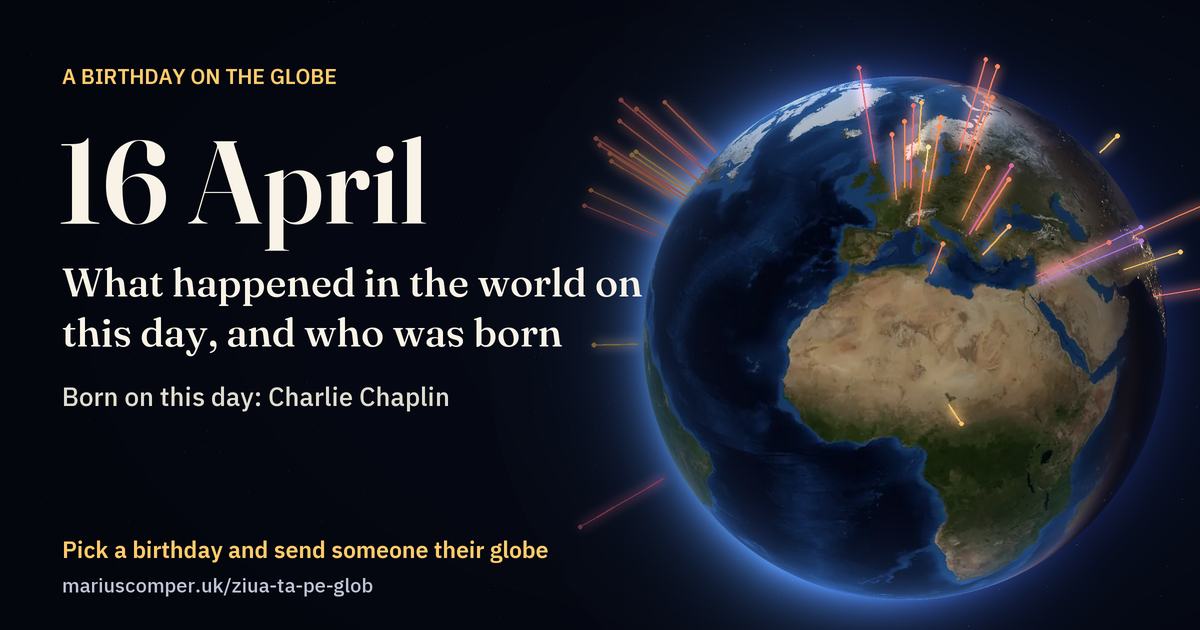
For 16 April, the English Wikipedia lists 57 events and 199 births. 39 of the events stand at their places as rays of light; three more are dashed circles, where the sentence links only to a country or a sea. The taller the ray, the longer ago it happened. The people born that day come further down, as blue points.
A birthday, yours or someone else’s:
Turn it into a greetingScroll: the globe turns to each place
The day you were born, on the globe.
Three things from your day
Scroll: your day first, then 16 April through the years
The Earth on 16 April
The picture on the globe was assembled by NASA from satellite photographs taken in April 2004: the snow, the ice and the green are those of the month.
On 16 April the Sun passes straight overhead at noon along the parallel of 10.3° north. In London, the day lasts about 13 hours 55 minutes.
Beyond 80° north the Sun no longer sets; beyond 80° south it no longer rises.
The line between day and night is tilted on the globe exactly as on this day of the year. On the dark side you can see the lights of towns.
Europe · University of Münster
1780
Franz Friedrich Wilhelm von Fürstenberg founds the University of Münster.
On the map: University of Münster.
Also on the day’s list of Wikipedia in Spanish.
Europe · Treaty of Rapallo
1922
The Treaty of Rapallo, pursuant to which Germany and the Soviet Union re-establish diplomatic relations, is signed.
On the map: the coordinates Wikidata gives for the article “Treaty of Rapallo”.
Also on the day’s list of Wikipedia in Spanish and Chinese.
Europe · Athens
2003
The Treaty of Accession is signed in Athens admitting ten new member states to the European Union.
On the map: Athens.
Also on the day’s list of Wikipedia in Chinese.
Asia · Bori Bunder
1853
The Great Indian Peninsula Railway opens the first passenger rail in India, from Bori Bunder to Thane.
On the map: Bori Bunder.
Latin America · Salta
1582
Spanish conquistador Hernando de Lerma founds the settlement of Salta, Argentina.
On the map: Salta.
Also on the day’s list of Wikipedia in Spanish.
North America · Lake Champlain
1818
The United States Senate ratifies the Rush–Bagot Treaty, limiting naval armaments on the Great Lakes and Lake Champlain.
On the map: Lake Champlain.
North America · Matthews Arena
1910
The oldest indoor ice hockey arena used for the sport in the 21st century, Boston Arena, opens for the first time.
On the map: Matthews Arena.
Also on the day’s list of Wikipedia in Spanish.
North America · Cape Canaveral, Florida
1972
Apollo program: The launch of Apollo 16 from Cape Canaveral, Florida.
On the map: Cape Canaveral, Florida.
Also on the day’s list of Wikipedia in Spanish.
16 April
Born on 16 April#
The English Wikipedia lists 199 births for this day. The blue points are the birthplaces of 60 of these people: those written about in the most Wikipedia editions, where Wikidata gives a place of birth.
Born on 16 April
1889
Charlie Chaplin, English actor, director, producer, screenwriter, and composer (died 1977)
Place of birth: Walworth.
Born on 16 April
1927
Pope Benedict XVI (died 2022)
Place of birth: Birth house of Benedict XVI.
Born on 16 April
1844
Anatole France, French journalist, novelist, and poet, Nobel Prize laureate (died 1924)
Place of birth: Paris.
Born on 16 April
1971
Selena, American singer-songwriter, actress, and fashion designer (died 1995)
Place of birth: Lake Jackson.
Born on 16 April
1921
Peter Ustinov, English actor, director, producer, and screenwriter (died 2004)
Place of birth: London Borough of Camden.
Born in Britain and Ireland
1922
Kingsley Amis, English novelist, poet, and critic (died 1995)
Place of birth: Clapham Common.
Born in Britain and Ireland
1871
John Millington Synge, Irish author, poet, and playwright (died 1909)
Place of birth: Rathfarnham.
Born in Britain and Ireland
1984
Claire Foy, English actress
Place of birth: Stockport.
16 April
Number one in the charts that week
At the cinema
An animal recorded that day
The record can be seen in GBIF, which brings together wildlife records from around the world.
All your birthdays
The weather that day
Data: Met Office Hadley Centre (HadCET); NOAA (GHCN-Daily, Mauna Loa).
Above the Earth
Sources: Jonathan McDowell, GCAT (launches); GFZ Potsdam (Kp index). Days are counted in Universal Time.
Football that day
International matches played that day:
Source: the “International football results” dataset kept by Mart Jürisoo (CC0).
Also that day
The earthquake’s page at the USGS
Source: the USGS catalogue. The day is counted in Universal Time (UTC).
In those days
Make a link for someone
Type the name, pick the day and the year of birth. The link opens straight on their day, with their name in the greeting.
The link carries the name, date and place typed here; anyone who gets it can see them.
Put another birthday beside it
Your mother’s, your child’s, a friend’s: the two days appear side by side.
Below: 16 April through the years.
The whole globe of the day
Drag the globe to turn it. Touch a ray or a point to read what happened there.
Everything Wikipedia lists for 16 April
The list is the English Wikipedia’s, in its own wording, as it stood in October 2026. 15 events have no place on the map: the sentence links to no place with coordinates, only to places too wide to mark, or to several countries.
- 1457 BC
Battle of Megiddo: The first battle to have been recorded in what is accepted as relatively reliable detail.
Asia · Battle of MegiddoWikipedia: Battle of Megiddo - 69
Defeated by Vitellius' troops at Bedriacum, Roman emperor Otho commits suicide.
no place on the mapWikipedia: Vitellius - 73
Masada, a Jewish fortress, falls to the Romans after several months of siege, ending the First Jewish–Roman War.
Asia · MasadaWikipedia: First Jewish–Roman War - 556
Pope Pelagius I is consecrated following Imperial approval by Emperor Justinian I.
no place on the mapWikipedia: Byzantine Papacy - 682
Pope Leo II is elected head of the Catholic Church, although he will not be consecrated until 17 August.
no place on the mapWikipedia: Pope Leo II - 1346
Stefan Dušan, "the Mighty", is crowned Emperor of the Serbs at Skopje, his empire occupying much of the Balkans.
Europe · SkopjeWikipedia: Stefan Dušan - 1520
The Revolt of the Comuneros begins in Spain against the rule of Charles V.
Europe · Crown of CastileWikipedia: Revolt of the Comuneros - 1582
Spanish conquistador Hernando de Lerma founds the settlement of Salta, Argentina.
Latin America · SaltaWikipedia: Conquistador - 1746
The Battle of Culloden is fought between the French-supported Jacobites and the British Hanoverian forces commanded by William Augustus, Duke of Cumberland, in Scotland.
Britain & Ireland · Battle of CullodenWikipedia: Battle of Culloden - 1780
Franz Friedrich Wilhelm von Fürstenberg founds the University of Münster.
Europe · University of MünsterWikipedia: University of Münster - 1797
The Spithead mutiny begins, immobilising the Channel fleet.
no place on the mapWikipedia: Spithead and Nore mutinies - 1799
French Revolutionary Wars: The Battle of Mount Tabor: Napoleon drives Ottoman Turks across the River Jordan near Acre.
Asia · Battle of Mount TaborWikipedia: Battle of Mount Tabor - 1818
The United States Senate ratifies the Rush–Bagot Treaty, limiting naval armaments on the Great Lakes and Lake Champlain.
North America · Lake ChamplainWikipedia: Rush–Bagot Treaty - 1838
The French Army captures Veracruz in the Pastry War.
Latin America · Battle of VeracruzWikipedia: Battle of Veracruz - 1847
Shooting of a Māori by an English sailor results in the opening of the Wanganui Campaign of the New Zealand Wars.
no place on the mapWikipedia: Whanganui campaign - 1853
The Great Indian Peninsula Railway opens the first passenger rail in India, from Bori Bunder to Thane.
Asia · Bori BunderWikipedia: Great Indian Peninsula Railway - 1858
The Wernerian Natural History Society, a former Scottish learned society, is dissolved.
no place on the mapWikipedia: Wernerian Natural History Society - 1862
American Civil War: Battle at Lee's Mills in Virginia.
North America · Siege of YorktownWikipedia: American Civil War - 1862
American Civil War: The District of Columbia Compensated Emancipation Act, a bill ending slavery in the District of Columbia, becomes law.
no place on the mapWikipedia: District of Columbia Compensated Emancipation Act - 1863
American Civil War: During the Vicksburg Campaign, gunboats commanded by acting Rear Admiral David Dixon Porter run downriver past Confederate artillery batteries at Vicksburg.
North America · Vicksburg campaignWikipedia: Vicksburg campaign - 1878
The Senate of the Grand Duchy of Finland issues a declaration establishing a city of Kotka on the southern part islands from the old Kymi parish.
Europe · KotkaWikipedia: Senate of Finland - 1881
In Dodge City, Kansas, Bat Masterson fights his last gun battle.
North America · Dodge City, KansasWikipedia: Dodge City, Kansas - 1908
Natural Bridges National Monument is established in Utah.
North America · Natural Bridges National MonumentWikipedia: Natural Bridges National Monument - 1910
The oldest indoor ice hockey arena used for the sport in the 21st century, Boston Arena, opens for the first time.
North America · Matthews ArenaWikipedia: Ice hockey - 1912
Harriet Quimby becomes the first woman to fly an airplane across the English Channel.
no place on the mapWikipedia: Harriet Quimby - 1917
Russian Revolution: Vladimir Lenin returns to Petrograd, Russia, from exile in Switzerland.
Europe · Saint PetersburgWikipedia: Russian Revolution - 1917
World War I: Several French army corps began a massive assault against the German-occupied Chemin des Dames ridge, south of Laon, France.
Europe · Second Battle of the AisneWikipedia: World War I - 1919
Mohandas Gandhi organizes a day of "prayer and fasting" in response to the killing of Indian protesters in the Jallianwala Bagh massacre by the British colonial troops three days earlier.
Asia · Jallianwala Bagh massacreWikipedia: Jallianwala Bagh massacre - 1919
Polish–Lithuanian War: The Polish Army launches the Vilna offensive to capture Vilnius in modern Lithuania.
Europe · VilniusWikipedia: Polish–Lithuanian War - 1922
The Treaty of Rapallo, pursuant to which Germany and the Soviet Union re-establish diplomatic relations, is signed.
Europe · Treaty of RapalloWikipedia: Treaty of Rapallo - 1925
During the Communist St Nedelya Church assault in Sofia, Bulgaria, 150 are killed and 500 are wounded.
Europe · St. Nedelya Church bombingWikipedia: St. Nedelya Church bombing - 1941
World War II: The Italian-German Tarigo convoy is attacked and destroyed by British ships.
Africa · Battle of the Tarigo ConvoyWikipedia: Battle of the Tarigo Convoy - 1941
World War II: The Nazi-affiliated Ustaše is put in charge of the Independent State of Croatia by the Axis powers after Operation 25 is effected.
no place on the mapWikipedia: Invasion of Yugoslavia - 1943
Albert Hofmann accidentally discovers the hallucinogenic effects of the research drug LSD. He intentionally takes the drug three days later on April 19.
no place on the mapWikipedia: Albert Hofmann - 1944
World War II: Allied forces start bombing Belgrade, killing about 1,100 people. This bombing fell on the Orthodox Christian Easter.
Europe · Allied bombing of Yugoslavia in World War IIWikipedia: Allied bombing of Yugoslavia in World War II - 1945
Second World War: British and Canadian forces concluded the Liberation of Arnhem in the Netherlands from German occupation.
Europe · Liberation of ArnhemWikipedia: World War II - 1945
World War II: More than 7,000 die when the German transport ship Goya is sunk by a Soviet submarine.
no place on the mapWikipedia: MV Goya - 1945
World War II: The Red Army begins the final assault on German forces around Berlin, with nearly one million troops fighting in the Battle of the Seelow Heights.
Europe · Battle of BerlinWikipedia: Battle of Berlin - 1945
World War II: The United States Army liberates Nazi Sonderlager (high security) prisoner-of-war camp Oflag IV-C (better known as Colditz).
Europe · Oflag IV-CWikipedia: Oflag IV-C - 1947
An explosion on board a freighter in port causes Texas City in the state of Texas, United States, to catch fire, killing almost 600 people.
North America · Texas City disasterWikipedia: Texas City disaster - 1947
Bernard Baruch first applies the term "Cold War" to describe the relationship between the United States and the Soviet Union.
Asia · Soviet UnionWikipedia: Cold War - 1948
The Organization of European Economic Co-operation is formed.
no place on the mapWikipedia: OECD - 1961
In a nationally broadcast speech, Cuban leader Fidel Castro declares that he is a Marxist–Leninist and that Cuba is going to adopt Communism.
no place on the mapWikipedia: Fidel Castro - 1963
U.S. civil rights campaigner Dr. Martin Luther King Jr. writes his open letter from Birmingham Jail, sometimes known as "The Negro Is Your Brother", while incarcerated in Birmingham, Alabama, for protesting against segregation.
North America · Birmingham, AlabamaWikipedia: Martin Luther King Jr. - 1972
Apollo program: The launch of Apollo 16 from Cape Canaveral, Florida.
North America · Cape Canaveral, FloridaWikipedia: Apollo program - 2001
India and Bangladesh begin a five-day border conflict, but are unable to resolve the disputes about their border.
Asia · BangladeshWikipedia: 2001 Bangladesh–India border skirmishes - 2003
The Treaty of Accession is signed in Athens admitting ten new member states to the European Union.
Europe · AthensWikipedia: Treaty of Accession 2003 - 2007
Virginia Tech shooting: Seung-Hui Cho murders 32 people and injures 17 before committing suicide.
North America · Virginia Tech shootingWikipedia: Virginia Tech shooting - 2008
The U.S. Supreme Court rules in the Baze v. Rees decision that execution by lethal injection does not violate the Eighth Amendment ban against cruel and unusual punishment.
North America · Supreme Court of the United StatesWikipedia: Supreme Court of the United States - 2012
The Pulitzer Prize winners are announced. It was the first time since 1977 that no book won the Fiction Prize.
no place on the mapWikipedia: 2012 Pulitzer Prize - 2012
The trial for Anders Behring Breivik, the perpetrator of the 2011 Norway attacks, begins in Oslo, Norway.
Europe · 2011 Norway attacksWikipedia: 2011 Norway attacks - 2013
A 7.8-magnitude earthquake strikes Sistan and Balochistan province, Iran, killing at least 35 people and injuring 117 others.
Asia · 2013 Saravan earthquakeWikipedia: 2013 Saravan earthquake - 2013
The 2013 Baga massacre is started when Boko Haram militants engage government soldiers in Baga.
Africa · 2013 Baga massacreWikipedia: 2013 Baga massacre - 2014
The South Korean ferry MV Sewol capsizes and sinks near Jindo Island, killing 304 passengers and crew and leading to widespread criticism of the South Korean government, media, and shipping authorities.
Asia · Sinking of MV SewolWikipedia: Sinking of MV Sewol - 2016
Ecuador's worst earthquake in nearly 40 years kills 676 and injures more than 230,000.
Latin America · 2016 Ecuador earthquakeWikipedia: 2016 Ecuador earthquake - 2018
The New York Times and The New Yorker win the Pulitzer Prize for Public Service for breaking news of the Harvey Weinstein sexual abuse scandal.
no place on the mapWikipedia: The New York Times - 2024
The historic Børsen in Copenhagen, Denmark, is severely damaged by a fire.
Europe · BørsenWikipedia: Børsen
Who was born on 16 April
In order of how many Wikipedia editions have an article about each. The first 60 of 199 are shown.
- 1889
Charlie Chaplin, English actor, director, producer, screenwriter, and composer (died 1977)
WalworthWikipedia: Charlie Chaplin - 1927
Pope Benedict XVI (died 2022)
Birth house of Benedict XVIWikipedia: Pope Benedict XVI - 1844
Anatole France, French journalist, novelist, and poet, Nobel Prize laureate (died 1924)
- 1971
Selena, American singer-songwriter, actress, and fashion designer (died 1995)
Lake JacksonWikipedia: Selena - 1940
Queen Margrethe II of Denmark
AmalienborgWikipedia: Margrethe II - 1921
Peter Ustinov, English actor, director, producer, and screenwriter (died 2004)
London Borough of CamdenWikipedia: Peter Ustinov - 1973
Akon, Senegalese-American singer, rapper and songwriter
St. LouisWikipedia: Akon - 1947
Kareem Abdul-Jabbar, American basketball player and coach
New York CityWikipedia: Kareem Abdul-Jabbar - 1955
Henri, Grand Duke of Luxembourg
Betzdorf CastleWikipedia: Henri, Grand Duke of Luxembourg - 1755
Louise Élisabeth Vigée Le Brun, French painter (died 1842)
- 1965
Martin Lawrence, German-American actor, director, producer, and screenwriter
FrankfurtWikipedia: Martin Lawrence - 1986
Shinji Okazaki, Japanese footballer
TakarazukaWikipedia: Shinji Okazaki - 1886
Ernst Thälmann, German politician (died 1944)
HamburgWikipedia: Ernst Thälmann - 1977
Freddie Ljungberg, Swedish footballer
VittsjöWikipedia: Freddie Ljungberg - 1996
Anya Taylor-Joy, Argentine-British actress
- 1728
Joseph Black, French-Scottish physician and chemist (died 1799)
BordeauxWikipedia: Joseph Black - 1960
Rafael Benítez, Spanish footballer and manager
- 2002
Sadie Sink, American actress
BrenhamWikipedia: Sadie Sink - 1922
Kingsley Amis, English novelist, poet, and critic (died 1995)
Clapham CommonWikipedia: Kingsley Amis - 1924
Henry Mancini, American composer and conductor (died 1994)
ClevelandWikipedia: Henry Mancini - 1871
John Millington Synge, Irish author, poet, and playwright (died 1909)
RathfarnhamWikipedia: John Millington Synge - 1960
Pierre Littbarski, German footballer and manager
West BerlinWikipedia: Pierre Littbarski - 1984
Claire Foy, English actress
StockportWikipedia: Claire Foy - 1987
Aaron Lennon, English international footballer
- 1954
Ellen Barkin, American actress
The BronxWikipedia: Ellen Barkin - 1939
Dusty Springfield, English singer and record producer (died 1999)
- 1786
John Franklin, English admiral and politician, fourth Lieutenant Governor of Van Diemen's Land (died 1847)
SpilsbyWikipedia: John Franklin - 1972
Conchita Martínez, Spanish-American tennis player
- 1982
Gina Carano, American mixed martial artist and actress
DallasWikipedia: Gina Carano - 1985
Taye Taiwo, Nigerian footballer
- 1660
Hans Sloane, Irish-English physician and academic (died 1753)
KillyleaghWikipedia: Hans Sloane - 1947
Gerry Rafferty, Scottish singer-songwriter (died 2011)
PaisleyWikipedia: Gerry Rafferty - 1495
Petrus Apianus, German mathematician and astronomer (died 1557)
LeisnigWikipedia: Petrus Apianus - 1821
Ford Madox Brown, French-English soldier and painter (died 1893)
- 1823
Gotthold Eisenstein, German mathematician and academic (died 1852)
- 1985
Luol Deng, Sudanese-English basketball player
- 1971
Natasha Zvereva, Belarusian tennis player
- 1646
Jules Hardouin-Mansart, French architect (probable; (died 1708)
- 1922
Leo Tindemans, Belgian politician, 43rd Prime Minister of Belgium (died 2014)
ZwijndrechtWikipedia: Leo Tindemans - 1956
David M. Brown, American captain, pilot, and astronaut (died 2003)
Arlington CountyWikipedia: David M. Brown - 1965
Jon Cryer, American actor, director, producer, and screenwriter
New York CityWikipedia: Jon Cryer - 1918
Spike Milligan, Indian-Irish actor, comedian, and writer (died 2002)
AhilyanagarWikipedia: Spike Milligan - 1942
Sir Frank Williams, English businessman, founded the Williams F1 Racing Team (died 2021)
South ShieldsWikipedia: Frank Williams - 1979
Christijan Albers, Dutch racing driver
EindhovenWikipedia: Christijan Albers - 1982
Boris Diaw, French basketball player
Cormeilles-en-ParisisWikipedia: Boris Diaw - 1935
Bobby Vinton, American singer
CanonsburgWikipedia: Bobby Vinton - 1993
Chance the Rapper, American rapper
ChicagoWikipedia: Chance the Rapper - 1839
Antonio Starabba, Marchese di Rudinì, Italian politician, 12th Prime Minister of Italy (died 1908)
- 1935
Sarah Kirsch, German poet and author (died 2013)
LimlingerodeWikipedia: Sarah Kirsch - 1985
Nate Diaz, American mixed martial artist
StocktonWikipedia: Nate Diaz - 1996
Taylor Townsend, American tennis player
ChicagoWikipedia: Taylor Townsend - 1952
Michel Blanc, French actor and director (died 2024)
CourbevoieWikipedia: Michel Blanc - 1927
Edie Adams, American actress and singer (died 2008)
KingstonWikipedia: Edie Adams - 1919
Merce Cunningham, American dancer and choreographer (died 2009)
CentraliaWikipedia: Merce Cunningham - 1950
David Graf, American actor (died 2001)
ZanesvilleWikipedia: David Graf - 1976
Lukas Haas, American actor and musician
West HollywoodWikipedia: Lukas Haas - 1986
Epke Zonderland, Dutch gymnast
- 1911
Guy Burgess, English-Russian spy (died 1963)
DevonportWikipedia: Guy Burgess - 1935
Dominique Venner, French journalist and historian (died 2013)
7th arrondissement of ParisWikipedia: Dominique Venner - 1488
Jungjong of Joseon (died 1544)
ChangdeokgungWikipedia: Jungjong of Joseon
What is celebrated on 16 April
- Christian feast day: Benedict Joseph Labre
- Christian feast day: Bernadette Soubirous
- Christian feast day: Drogo
- Christian feast day: Engratia
- Christian feast day: Fructuosus of Braga
- Christian feast day: Isabella Gilmore (Church of England)
- Christian feast day: Martyrs of Zaragoza
- Christian feast day: Molly Brant (Konwatsijayenni) (Anglican Church of Canada, Episcopal Church)
- Christian feast day: Turibius of Astorga
- Christian feast day: April 16 (Eastern Orthodox liturgics)
- Birthday of José de Diego (Puerto Rico, United States)
- Birthday of Queen Margrethe II (Denmark)
- Flag Day (Jordan)
- Emancipation Day (Washington, D.C., United States)
A greeting link for someone
Type a name and, if you like, the year of birth. The link opens with a greeting, and beside each event it says how old the person turned that day, or how many years before their birth it happened.
The name and the year go only into the link you send.
All 366 days
How the globe is made
Where the events come from
Each edition of this page uses the day’s list from Wikipedia in its own language: Romanian, English, Spanish, Chinese. The lists are written by volunteers and differ from one edition to the next; the text of each event is Wikipedia’s, with a link to the article. A row that appears twice in a list is shown once. The lists have not been checked event by event: they are Wikipedia’s, mistakes included.
For events before 1582, and for countries that moved to the Gregorian calendar later (Britain in 1752, Russia in 1918), the same day may be counted Old Style in one list and New Style in another.
The chapter “What the other Wikipedias remember” adds up to five events a day from the lists of the other three editions, only for years in which the English list has nothing on that day. They were translated for this page, passed the same filters as the tour, and are not counted among the events of the English list.
How an event gets onto the map
The place comes from Wikidata. If the sentence links to the article about the event itself (a battle, an opening, an earthquake), dated to the same year, the ray stands on its coordinates or on those of its location. Otherwise it stands on the first place the sentence links to: a town, a building, a mountain, an island. This second step can be wrong: sometimes the sentence only mentions the place. That is why the page says, under each event, which place the ray stands on.
When the sentence links to a single state or province, or to a single sea, lake or desert larger than 5,000 km², the globe shows a dashed circle, not a ray. The circle has the area Wikidata gives, with its radius kept between 1.2° and 16°, or a radius of 4.5° when Wikidata gives no area; it says only that the sentence links to that place. Organisations, ships, spacecraft, museum objects, rivers, mountain ranges, languages and continents are never used as places. When a sentence names several states and no exact place, the event stays in the list only.
What the height means
The height of a ray shows how many years have passed, on a logarithmic scale: 10 years, 100 years and 1,000 years are equal steps apart; anything older than about 2,600 years has the tallest ray. The colour runs from pale yellow for recent years to violet for antiquity.
Where the tour stops
In each region the tour stops at up to three events (five in Britain and Ireland), chosen mainly by three things: whether Wikipedia’s editors put the event in the “On this day” box of their main page (the English, Spanish and Chinese editions), how many Wikipedia editions have an article about it, and how many of the four lists include it. Events whose sentence or article is about a war, an attack, a crime or a disaster are left out of the tour; they stay in the whole list, in Wikipedia’s wording. The filter is a list of words and a list of Wikidata types, so it can miss some.
The tour of births names the people with articles in the most editions and leaves aside those whom the list or Wikidata describes as rulers, politicians, commanders, leaders of movements or criminals; they stay in the list.
The Earth and the Sun
The daytime images are NASA’s Blue Marble Next Generation mosaics, one for each month of 2004; the night side is Black Marble 2016. The tilt of the line between day and night is computed for the day; the hour is chosen so that the place being read is in daylight. The latitude where the Sun stands overhead is the average of the four years of the leap cycle; in a given year it can differ by up to 0.4°.
The day you were born
The number ones come from the weekly lists on Wikipedia: Billboard for the United States (from 1940; the Hot 100 from August 1958), the UK Singles Chart (from November 1952), Los 40 Principales for Spain (from July 1966) and, for Romania, the Romanian Top 100 and Airplay 100 (2001–2021, with missing weeks). The page shows the chart of the week in which the day of birth falls, with its date; Billboard and the UK chart are dated at the end of their week. For Romania before 2001 and for China these sources have no weekly chart.
The films are those that reached cinemas in the United States up to ten days before or three days after that day (some of them in a few cinemas at first), from the English Wikipedia’s yearly lists (from 1968), in order of how many editions have an article about them. The events “in those days” are the ones on the neighbouring days’ lists that carry the year of birth, passed through the same filter as the tour.
The day of birth, year included
The Moon, the star sign and the constellation are worked out by the page itself, for noon Universal Time on the day. The lit part of the Moon is rounded and can differ by a few per cent from that at the hour of birth. The sign follows the usual zodiac of twelve equal parts starting at the March equinox; the constellation is the one the Sun actually stood in front of, by the borders set by the International Astronomical Union, and within a day of a border the page does not name it. When the Sun changes sign while it is that day anywhere on Earth, the page gives the moment of crossing, rounded to ten minutes and accurate to within about a quarter of an hour, and the clock time in a few cities, with the time zone and summer time of that year.
The year in the Chinese calendar is the one your device’s own calendar gives for the date, checked against the Hong Kong Observatory’s tables. “All your birthdays” uses the same sources as the rest of the chapter for the same day in every year since the birth: the temperature, well-known launches that took place on that very day, matches of the teams the edition follows, snow deeper than 10 cm and strong geomagnetic storms. The three things at the top and the four on the picture are chosen in a fixed order (the song, the animal, a full Moon, a well-known launch before an ordinary earthquake); on the picture you can change them.
When the link carries a year of birth, the page adds a few things about that exact day. The weather is the Met Office’s Central England temperature record and the readings from New York’s Central Park; the “usual high” is the average of the daily highs of 1961–1990 for that date, with two days either side. The carbon dioxide figure is the monthly mean at the Mauna Loa observatory, where measurements begin in March 1958.
The earthquake is the one with the largest magnitude in the USGS catalogue for that day, counted in Universal Time. Before the 1960s the catalogue has gaps even above magnitude 5.5, so in the older years many days have no earthquake. The page gives only the magnitude and the place: the country the epicentre falls in or, when the epicentre is at sea within 300 km of a coast, the nearest country; farther out, only the ocean.
The launches are those that reached orbit or left for the Moon and the planets, from Jonathan McDowell’s GCAT catalogue. If nothing left that day, the page shows the nearest launch within three days before or after, and says how many days away it was. The geomagnetic storm appears only when the Kp index reached at least 5 in one of the day’s eight three-hour intervals.
The animal comes from GBIF: an observation made by a person (the animal seen or heard, or its tracks), dated to that exact day, with coordinates and a CC0 or CC BY licence. Only a few hundred well-known species are searched (mammals, birds, turtles, butterflies); of those noted that day, mammals and species with articles in many Wikipedia editions come first; birds noted almost every day, and species used recently, wait their turn. Observations dated 1 January are left out, because records without a day are often filed there. An observation shows that the animal was recorded there, not how many animals there were.
The matches are those between national teams. Only matches of England, Scotland, Wales, Northern Ireland, the Republic of Ireland, the United States, Canada and Australia are shown, along with those at the big final tournaments. The picture to send is drawn in the page from the day’s globe and the facts above, and stays on your device until you send it.
Sources
- Events, births and holidays: the day’s page on Wikipedia, text under CC BY-SA 4.0.
- Coordinates, places of birth and the number of editions: Wikidata (CC0).
- The Earth by day: NASA Blue Marble Next Generation. The Earth by night: NASA Black Marble 2016.
- Borders and regions: Natural Earth.
- World population and births per year: UN World Population Prospects 2024.
- Charts and films: Wikipedia’s lists for Billboard, the UK Singles Chart, Los 40 Principales, Romanian Top 100, Airplay 100 and American films by year (CC BY-SA 4.0).
- Weather: Met Office Hadley Centre, HadCET (Open Government Licence) and NOAA GHCN-Daily, New York Central Park. Carbon dioxide: NOAA Global Monitoring Laboratory, Mauna Loa.
- Earthquakes: the USGS catalogue. Launches: Jonathan McDowell, GCAT (CC BY). Kp index: GFZ Potsdam (CC BY 4.0). Matches: International football results, Mart Jürisoo (CC0).
- Animal observations: GBIF, with a link to each record; species names come from Wikidata.