A birthday on the globe
26 June on the globe: what happened in the world on this day, and who was born
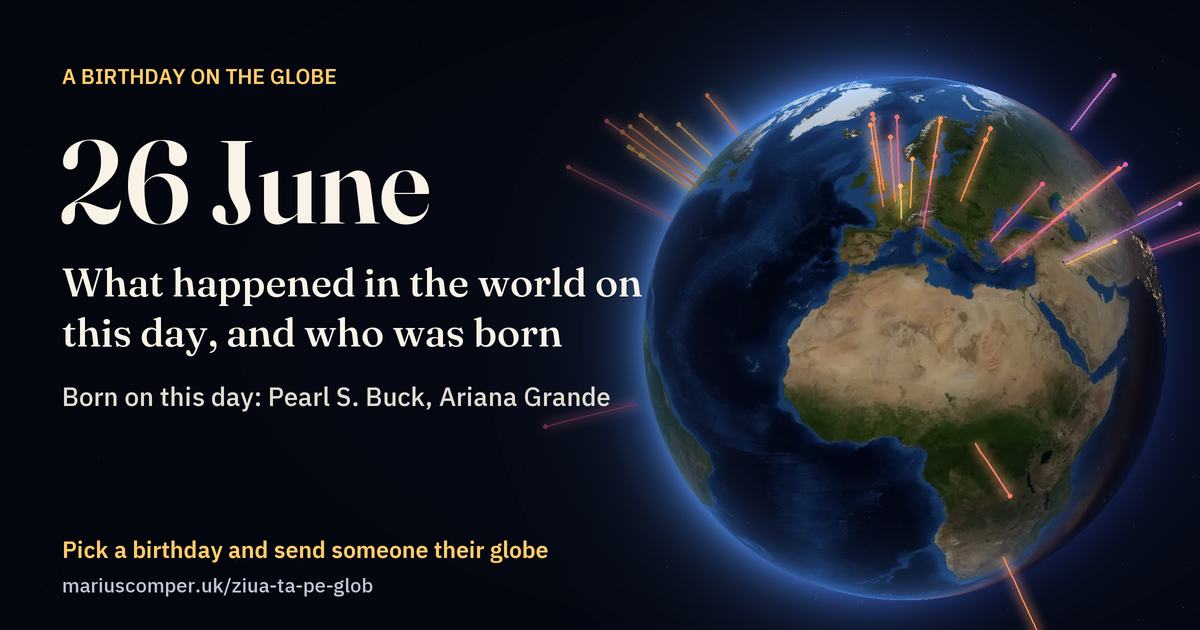
For 26 June, the English Wikipedia lists 74 events and 216 births. 38 of the events stand at their places as rays of light; eight more are dashed circles, where the sentence links only to a country or a sea. The taller the ray, the longer ago it happened. The people born that day come further down, as blue points.
A birthday, yours or someone else’s:
Turn it into a greetingScroll: the globe turns to each place
The day you were born, on the globe.
Three things from your day
Scroll: your day first, then 26 June through the years
The Earth on 26 June
The picture on the globe was assembled by NASA from satellite photographs taken in June 2004: the snow, the ice and the green are those of the month.
On 26 June the Sun passes straight overhead at noon along the parallel of 23.4° north. In London, the day lasts about 16 hours 35 minutes.
Beyond 67° north the Sun no longer sets; beyond 67° south it no longer rises.
The line between day and night is tilted on the globe exactly as on this day of the year. On the dark side you can see the lights of towns.
Britain & Ireland · Hyde Park, London
1857
The first investiture of the Victoria Cross takes place in Hyde Park, London.
On the map: Hyde Park, London.
Also on the day’s list of Wikipedia in Spanish.
Britain & Ireland · Science Museum, London
1909
The Science Museum in London comes into existence as an independent entity.
On the map: Science Museum, London.
Also on the day’s list of Wikipedia in Spanish.
Europe · 1906 French Grand Prix
1906
The first Grand Prix motor race is held at Le Mans.
On the map: the coordinates Wikidata gives for the article “1906 French Grand Prix”.
Also on the day’s list of Wikipedia in Spanish and Romanian.
Africa · Bangui
1889
Bangui is founded by Albert Dolisie and Alfred Uzac in what was then the upper reaches of the French Congo.
On the map: Bangui.
Also on the day’s list of Wikipedia in Spanish and Chinese.
Africa · Congress of the People
1955
The South African Congress Alliance adopts the Freedom Charter at the Congress of the People in Kliptown.
On the map: the coordinates Wikidata gives for the article “Congress of the People”.
Also on the day’s list of Wikipedia in Spanish.
Asia · Hong Kong Island
1843
Treaty of Nanking comes into effect; Hong Kong Island is ceded to the British "in perpetuity".
On the map: Hong Kong Island.
Also on the day’s list of Wikipedia in Spanish.
North America · Charter of the United Nations
1945
The United Nations Charter is signed by 50 Allied nations in San Francisco, California.
On the map: the coordinates Wikidata gives for the article “Charter of the United Nations”.
Also on the day’s list of Wikipedia in Spanish, Romanian and Chinese.
North America · Supreme Court of the United States
2003
The U.S. Supreme Court rules in Lawrence v. Texas that sex-based sodomy laws are unconstitutional.
On the map: Supreme Court of the United States.
North America · Supreme Court of the United States
2013
The U.S. Supreme Court rules, 5–4, that Section 3 of the Defense of Marriage Act is unconstitutional and in violation of the Fifth Amendment to the United States Constitution.
On the map: Supreme Court of the United States.
Also on the day’s list of Wikipedia in Spanish.
26 June
What the other Wikipedias remember#
For these years the English list has nothing on this day. The events below come from the same day’s lists on Wikipedia in Chinese and were translated for this page.
From Wikipedia in Chinese · Toronto
1976
The CN Tower in Toronto, Canada, opens to the public for the first time; it is then the tallest free-standing structure in the world.
On the map: Toronto.
Translated from the list on Wikipedia in Chinese.
26 June
Born on 26 June#
The English Wikipedia lists 216 births for this day. The blue points are the birthplaces of 60 of these people: those written about in the most Wikipedia editions, where Wikidata gives a place of birth.
Born on 26 June
1892
Pearl S. Buck, American novelist, essayist, short story writer, Nobel Prize laureate (died 1973)
Place of birth: Hillsboro.
Born on 26 June
1993
Ariana Grande, American singer-songwriter, dancer, and actress
Place of birth: Boca Raton.
Born on 26 June
1730
Charles Messier, French astronomer and academic (died 1817)
Place of birth: Badonviller.
Born on 26 June
1937
Robert Coleman Richardson, American physicist and academic, Nobel Prize laureate (died 2013)
Place of birth: Washington, D.C..
Born in Britain and Ireland
1913
Maurice Wilkes, English computer scientist and physicist (died 2010)
Place of birth: Dudley.
Born in Britain and Ireland
1969
Colin Greenwood, English bass player and songwriter
Place of birth: Oxford.
Born in Britain and Ireland
1931
Colin Wilson, English philosopher and author (died 2013)
Place of birth: Leicester.
26 June
Number one in the charts that week
At the cinema
An animal recorded that day
The record can be seen in GBIF, which brings together wildlife records from around the world.
All your birthdays
The weather that day
Data: Met Office Hadley Centre (HadCET); NOAA (GHCN-Daily, Mauna Loa).
Above the Earth
Sources: Jonathan McDowell, GCAT (launches); GFZ Potsdam (Kp index). Days are counted in Universal Time.
Football that day
International matches played that day:
Source: the “International football results” dataset kept by Mart Jürisoo (CC0).
Also that day
The earthquake’s page at the USGS
Source: the USGS catalogue. The day is counted in Universal Time (UTC).
In those days
Make a link for someone
Type the name, pick the day and the year of birth. The link opens straight on their day, with their name in the greeting.
The link carries the name, date and place typed here; anyone who gets it can see them.
Put another birthday beside it
Your mother’s, your child’s, a friend’s: the two days appear side by side.
Below: 26 June through the years.
The whole globe of the day
Drag the globe to turn it. Touch a ray or a point to read what happened there.
Everything Wikipedia lists for 26 June
The list is the English Wikipedia’s, in its own wording, as it stood in October 2026. 28 events have no place on the map: the sentence links to no place with coordinates, only to places too wide to mark, or to several countries.
- 4
Augustus adopts Tiberius.
no place on the mapWikipedia: Augustus - 221
Roman emperor Elagabalus adopts his cousin Alexander Severus as his heir and grants him the title of Caesar.
no place on the mapWikipedia: Roman emperor - 363
Roman emperor Julian is fatally wounded by Sassanid troops in a skirmish close to Samarra while retreating from his failed siege of Ctesiphon.
Asia · SamarraWikipedia: Battle of Samarra - 684
Pope Benedict II is consecrated as pope following imperial approval from the Byzantine Emperor. He is the last pope to require the confirmation of the emperor; the next popes require only that of the more closely situated exarch of Ravenna.
no place on the mapWikipedia: Pope Benedict II - 699
En no Ozuno, a Japanese mystic and apothecary who will later be regarded as the founder of the folk religion Shugendō, is banished to Izu Ōshima.
Asia · Izu ŌshimaWikipedia: En no Gyōja - 1243
Election of Pope Innocent IV following the death of Pope Celestine IV in 1241.
no place on the mapWikipedia: 1243 papal election - 1243
Mongols under Baiju Noyan defeat the Seljuk Turks under Kaykhusraw II at the Battle of Köse Dağ. The Sultanate of Rum subsequently becomes a vassal to the Mongol Empire.
Asia · Battle of Köse DağWikipedia: Battle of Köse Dağ - 1295
Przemysł II crowned king of Poland, following Ducal period. The white eagle is added to the Polish coat of arms.
no place on the mapWikipedia: Przemysł II - 1407
Ulrich von Jungingen becomes Grand Master of the Teutonic Knights.
no place on the mapWikipedia: Ulrich von Jungingen - 1409
Western Schism: The Roman Catholic Church is led into a double schism as Petros Philargos is crowned Pope Alexander V after the Council of Pisa, joining Pope Gregory XII in Rome and Pope Benedict XIII in Avignon.
Europe · PisaWikipedia: Council of Pisa - 1460
War of the Roses: Richard Neville, 16th Earl of Warwick, and Edward, Earl of March, land in England with a rebel army and march on London.
no place on the mapWikipedia: Wars of the Roses - 1483
Richard III becomes King of England.
no place on the mapWikipedia: Richard III of England - 1522
Ottomans begin the second Siege of Rhodes.
Europe · Siege of RhodesWikipedia: Siege of Rhodes - 1539
Afghan Sur forces under Sher Shah Suri defeat a Mughal army under Humayun in the battle of Chausa.
Asia · ChausaWikipedia: Battle of Chausa - 1541
Francisco Pizarro is assassinated in Lima by the son of his former companion and later antagonist, Diego de Almagro the younger. Almagro is later caught and executed.
Latin America · LimaWikipedia: Francisco Pizarro - 1579
Livonian campaign of Stephen Báthory begins.
no place on the mapWikipedia: Livonian campaign of Stephen Báthory - 1656
A joined Hospitaller-Venetian fleet defeats a numerically superior Ottoman fleet in the battle of the Dardanelles.
Asia · Battle of the DardanellesWikipedia: Battle of the Dardanelles - 1718
Alexei Petrovich, Tsarevich of Russia, Peter the Great's son, mysteriously dies after being sentenced to death by his father for plotting against him.
no place on the mapWikipedia: Alexei Petrovich, Tsarevich of Russia - 1723
After a siege and bombardment by cannon, Baku surrenders to the Russians.
no place on the mapWikipedia: Russo-Persian War - 1740
A combined force of Spanish, free blacks and allied Indians defeat a British garrison at the Siege of Fort Mose near St. Augustine during the War of Jenkins' Ear.
North America · Battle of Bloody MoseWikipedia: Battle of Bloody Mose - 1794
French Revolutionary Wars: Battle of Fleurus marks the first successful military use of aircraft and turns the tide of the War of the First Coalition.
Europe · Battle of FleurusWikipedia: Battle of Fleurus - 1830
William IV becomes king of Britain and Hanover following the death without surviving legitimate issue of his older brother George IV.
no place on the mapWikipedia: William IV - 1843
Treaty of Nanking comes into effect; Hong Kong Island is ceded to the British "in perpetuity".
Asia · Hong Kong IslandWikipedia: Treaty of Nanking - 1844
Julia Gardiner married U.S. President John Tyler at the Church of the Ascension in New York, becoming the first lady.
North America · Church of the Ascension, EpiscopalWikipedia: Julia Gardiner Tyler - 1848
End of the June Days Uprising in Paris, France.
no place on the mapWikipedia: June Days uprising - 1857
The first investiture of the Victoria Cross takes place in Hyde Park, London.
Britain & Ireland · Hyde Park, LondonWikipedia: Victoria Cross - 1886
Henri Moissan isolates elemental fluorine for the first time.
no place on the mapWikipedia: Henri Moissan - 1889
Bangui is founded by Albert Dolisie and Alfred Uzac in what was then the upper reaches of the French Congo.
Africa · BanguiWikipedia: Bangui - 1906
The first Grand Prix motor race is held at Le Mans.
Europe · 1906 French Grand PrixWikipedia: 1906 French Grand Prix - 1907
Organized by Vladimir Lenin and Joseph Stalin, among others, Bolshevik revolutionaries robbed a bank stagecoach in Tiflis, present-day Georgia.
Asia · 1907 Tiflis bank robberyWikipedia: 1907 Tiflis bank robbery - 1909
The Science Museum in London comes into existence as an independent entity.
Britain & Ireland · Science Museum, LondonWikipedia: Science Museum, London - 1917
World War I: The American Expeditionary Forces begin to arrive in France. They will first enter combat in the Battle of Hamel on July 4.
no place on the mapWikipedia: World War I - 1918
World War I: Allied forces under John J. Pershing and James Harbord defeat Imperial German forces under Wilhelm, German Crown Prince in the Battle of Belleau Wood.
Europe · Battle of Belleau WoodWikipedia: Battle of Belleau Wood - 1924
The American occupation of the Dominican Republic ends after eight years.
Latin America · Dominican RepublicWikipedia: Military Government of Santo Domingo - 1934
United States President Franklin D. Roosevelt signs the Federal Credit Union Act, which establishes credit unions.
no place on the mapWikipedia: Franklin D. Roosevelt - 1936
Initial flight of the Focke-Wulf Fw 61, the first practical helicopter.
no place on the mapWikipedia: Focke-Wulf Fw 61 - 1940
World War II: Under the Molotov–Ribbentrop Pact, the Soviet Union presents an ultimatum to Romania requiring it to cede Bessarabia and the northern part of Bukovina.
no place on the mapWikipedia: Molotov–Ribbentrop Pact - 1941
World War II: Soviet planes bomb Kassa, Hungary (now Košice, Slovakia), giving Hungary the impetus to declare war the next day.
Europe · Bombing of KassaWikipedia: Bombing of Kassa - 1942
The first flight of the Grumman F6F Hellcat.
no place on the mapWikipedia: Grumman F6F Hellcat - 1944
World War II: San Marino, a neutral state, is mistakenly bombed by the RAF based on faulty information, leading to 35 civilian deaths.
Europe · San MarinoWikipedia: San Marino - 1944
World War II: The Battle of Osuchy in Osuchy, Poland, one of the largest battles between Nazi Germany and Polish resistance forces, ends with the defeat of the latter.
Europe · Battle of OsuchyWikipedia: Battle of Osuchy - 1945
The United Nations Charter is signed by 50 Allied nations in San Francisco, California.
North America · Charter of the United NationsWikipedia: Charter of the United Nations - 1948
Cold War: The first supply flights are made in response to the Berlin Blockade.
Europe · Berlin BlockadeWikipedia: Berlin Blockade - 1948
William Shockley files the original patent for the grown-junction transistor, the first bipolar junction transistor.
no place on the mapWikipedia: William Shockley - 1950
A Douglas DC-4 Skymaster aircraft crashed after departing from Perth, becoming the worst peacetime aviation accident in Australia's history.
Oceania · 1950 Australian National Airways Douglas DC-4 crashWikipedia: 1950 Australian National Airways Douglas DC-4 crash - 1952
The Pan-Malayan Labour Party is founded in Malaya, as a union of statewide labour parties.
Asia · Federation of MalayaWikipedia: Labour Party of Malaya - 1953
Lavrentiy Beria, head of MVD, is arrested by Nikita Khrushchev and other members of the Politburo.
no place on the mapWikipedia: Lavrentiy Beria - 1955
The South African Congress Alliance adopts the Freedom Charter at the Congress of the People in Kliptown.
Africa · Congress of the PeopleWikipedia: Congress of the People - 1959
Swedish boxer Ingemar Johansson becomes world champion of heavyweight boxing, by defeating American Floyd Patterson on technical knockout after two minutes and three seconds in the third round at Yankee Stadium.
North America · Yankee StadiumWikipedia: Floyd Patterson vs. Ingemar Johansson - 1960
Madagascar gains its independence from France.
Africa · MadagascarWikipedia: Madagascar - 1960
The former British Protectorate of British Somaliland gains its independence as Somaliland.
Africa · British SomalilandWikipedia: British Somaliland - 1963
Cold War: U.S. President John F. Kennedy gives his "Ich bin ein Berliner" speech, underlining the support of the United States for democratic West Germany shortly after Soviet-supported East Germany erected the Berlin Wall.
Europe · Ich bin ein BerlinerWikipedia: Ich bin ein Berliner - 1967
Karol Wojtyła (later John Paul II) is made a cardinal by Pope Paul VI.
no place on the mapWikipedia: Pope John Paul II - 1974
The Universal Product Code is scanned for the first time to sell a package of Wrigley's chewing gum at the Marsh Supermarket in Troy, Ohio.
North America · Troy, OhioWikipedia: Universal Product Code - 1975
Two FBI agents and a member of the American Indian Movement are killed in a shootout on the Pine Ridge Indian Reservation in South Dakota; Leonard Peltier is later convicted of the murders in a controversial trial.
no place on the mapWikipedia: Federal Bureau of Investigation - 1978
Air Canada Flight 189, flying to Toronto, overruns the runway and crashes into the Etobicoke Creek ravine. Two of the 107 passengers on board perish.
North America · Air Canada Flight 189Wikipedia: Air Canada Flight 189 - 1981
Dan-Air Flight 240, flying to East Midlands Airport, crashes in Nailstone, Leicestershire. All three crew members perish.
Britain & Ireland · Dan-Air Flight 240Wikipedia: Dan-Air Flight 240 - 1988
The first crash of an Airbus A320 occurs when Air France Flight 296Q crashes at Mulhouse–Habsheim Airfield in Habsheim, France, during an air show, killing three of the 136 people on board.
Europe · Air France Flight 296QWikipedia: Air France Flight 296Q - 1991
Yugoslav Wars: The Yugoslav People's Army begins the Ten-Day War in Slovenia.
Europe · SloveniaWikipedia: Yugoslav Wars - 1995
Hamad bin Khalifa Al Thani deposes his father Khalifa bin Hamad Al Thani, the Emir of Qatar, in a bloodless coup d'état.
Asia · QatarWikipedia: 1995 Qatari coup d'état - 1997
J. K. Rowling publishes the first of her Harry Potter novel series, Harry Potter and the Philosopher's Stone, in the United Kingdom.
no place on the mapWikipedia: J. K. Rowling - 1997
The U.S. Supreme Court rules that the Communications Decency Act violates the First Amendment to the United States Constitution.
North America · Supreme Court of the United StatesWikipedia: Supreme Court of the United States - 2000
The Human Genome Project announces the completion of a "rough draft" sequence.
no place on the mapWikipedia: Human Genome Project - 2003
The U.S. Supreme Court rules in Lawrence v. Texas that sex-based sodomy laws are unconstitutional.
North America · Supreme Court of the United StatesWikipedia: Supreme Court of the United States - 2006
Mari Alkatiri, the first Prime Minister of East Timor, resigns after weeks of political unrest.
no place on the mapWikipedia: Mari Alkatiri - 2007
Pope Benedict XVI reinstates the traditional laws of papal election in which a successful candidate must receive two-thirds of the votes.
no place on the mapWikipedia: Pope Benedict XVI - 2008
A suicide bomber dressed as an Iraqi policeman detonates an explosive vest, killing 25 people.
Asia · Al-KarmahWikipedia: 2008 Karmah bombing - 2010
A G20 summit, the largest and most expensive security operation in Canadian history, began in downtown Toronto.
North America · TorontoWikipedia: 2010 G20 Toronto summit - 2012
The Waldo Canyon fire descends into the Mountain Shadows neighborhood in Colorado Springs, United States, burning 347 homes in a matter of hours and killing two people.
North America · Waldo Canyon FireWikipedia: Waldo Canyon Fire - 2013
Riots in China's Xinjiang region kill at least 36 people and injure 21 others.
Asia · XinjiangWikipedia: June 2013 Shanshan riots - 2013
The U.S. Supreme Court rules, 5–4, that Section 3 of the Defense of Marriage Act is unconstitutional and in violation of the Fifth Amendment to the United States Constitution.
North America · Supreme Court of the United StatesWikipedia: Supreme Court of the United States - 2015
Five different terrorist attacks in France, Tunisia, Somalia, Kuwait, and Syria occur on what was dubbed Bloody Friday by international media. Upwards of 750 people are either killed or injured in these uncoordinated attacks.
Europe · Saint Quentin-FallavierWikipedia: 26 June 2015 Islamist attacks - 2015
The U.S. Supreme Court rules, 5–4, that same-sex couples have a constitutional right to marriage under the 14th Amendment to the United States Constitution.
North America · Supreme Court of the United StatesWikipedia: Supreme Court of the United States - 2024
Julian Assange, founder of WikiLeaks, returns to Australia after pleading guilty to one charge of espionage in a Saipan court and subsequently being released by the United States Department of Justice.
no place on the mapWikipedia: Julian Assange
What the other Wikipedias remember
For these years the English list has nothing on this day. The events below come from the same day’s lists on Wikipedia in Chinese and were translated for this page.
- 1976
The CN Tower in Toronto, Canada, opens to the public for the first time; it is then the tallest free-standing structure in the world.
Who was born on 26 June
In order of how many Wikipedia editions have an article about each. The first 60 of 216 are shown.
- 1892
Pearl S. Buck, American novelist, essayist, short story writer, Nobel Prize laureate (died 1973)
HillsboroWikipedia: Pearl S. Buck - 1993
Ariana Grande, American singer-songwriter, dancer, and actress
Boca RatonWikipedia: Ariana Grande - 1908
Salvador Allende, Chilean physician and politician, 29th President of Chile (died 1973)
SantiagoWikipedia: Salvador Allende - 1968
Paolo Maldini, Italian footballer
- 1730
Charles Messier, French astronomer and academic (died 1817)
BadonvillerWikipedia: Charles Messier - 1963
Mikhail Khodorkovsky, Russian-Swiss businessman and philanthropist
- 1937
Robert Coleman Richardson, American physicist and academic, Nobel Prize laureate (died 2013)
Washington, D.C.Wikipedia: Robert Coleman Richardson - 1933
Claudio Abbado, Italian conductor (died 2014)
- 1987
Samir Nasri, French footballer
MarseilleWikipedia: Samir Nasri - 1944
Gennady Zyuganov, Russian politician
MymrinoWikipedia: Gennady Zyuganov - 1968
Guðni Th. Jóhannesson, Icelandic lecturer and politician, 6th President of Iceland
ReykjavíkWikipedia: Guðni Th. Jóhannesson - 1970
Paul Thomas Anderson, American director, producer, and screenwriter
Studio CityWikipedia: Paul Thomas Anderson - 1904
Peter Lorre, Slovak-American actor and singer (died 1964)
RužomberokWikipedia: Peter Lorre - 1984
Indila, French singer
ParisWikipedia: Indila - 1984
Aubrey Plaza, American actress
WilmingtonWikipedia: Aubrey Plaza - 1899
Grand Duchess Maria Nikolaevna of Russia (died 1918)
- 1992
Jennette McCurdy, American actress and singer-songwriter
Los AngelesWikipedia: Jennette McCurdy - 1913
Aimé Césaire, French poet, author, and politician (died 2008)
Basse-PointeWikipedia: Aimé Césaire - 1922
Eleanor Parker, American actress (died 2013)
CedarvilleWikipedia: Eleanor Parker - 1942
Gilberto Gil, Brazilian singer-songwriter, guitarist, and politician, Brazilian Minister of Culture
SalvadorWikipedia: Gilberto Gil - 1970
Sean Hayes, American actor
Evergreen ParkWikipedia: Sean Hayes - 1970
Chris O'Donnell, American actor
WinnetkaWikipedia: Chris O'Donnell - 1997
Jacob Elordi, Australian actor
NudgeeWikipedia: Jacob Elordi - 1821
Bartolomé Mitre, Argentinian soldier, journalist, and politician, 6th President of Argentina (died 1906)
ArgentinaWikipedia: Bartolomé Mitre - 1956
Catherine Samba-Panza, interim president of the Central African Republic
N'DjamenaWikipedia: Catherine Samba-Panza - 1726
Victor Amadeus III, King of Sardinia (died 1796)
- 1911
Babe Didrikson Zaharias, American golfer and basketball player (died 1956)
Port ArthurWikipedia: Babe Didrikson Zaharias - 1980
Jason Schwartzman, American actor and drummer
Los AngelesWikipedia: Jason Schwartzman - 1992
Joel Campbell, Costa Rican footballer
San JoséWikipedia: Joel Campbell - 1913
Maurice Wilkes, English computer scientist and physicist (died 2010)
- 1983
Felipe Melo, Brazilian footballer
Volta RedondaWikipedia: Felipe Melo - 1866
George Herbert, 5th Earl of Carnarvon, English archaeologist and banker, backer in the discovery of Tutankhamun's tomb (died 1923)
Highclere CastleWikipedia: George Herbert, 5th Earl of Carnarvon - 1956
Chris Isaak, American singer-songwriter, guitarist, and actor
StocktonWikipedia: Chris Isaak - 1869
Martin Andersen Nexø, Danish journalist and author (died 1954)
CopenhagenWikipedia: Martin Andersen Nexø - 1966
Dany Boon, French actor, director, and screenwriter
ArmentièresWikipedia: Dany Boon - 1979
Ryan Tedder, American singer-songwriter, pianist, and producer
- 1992
Rudy Gobert, French basketball player
Saint-QuentinWikipedia: Rudy Gobert - 1898
Willy Messerschmitt, German engineer and businessman (died 1978)
FrankfurtWikipedia: Willy Messerschmitt - 1925
Pavel Belyayev, Soviet soldier, pilot and cosmonaut (died 1970)
ChelishchevoWikipedia: Pavel Belyayev - 2005
Princess Alexia of the Netherlands
Bronovo HospitalWikipedia: Princess Alexia of the Netherlands - 1854
Robert Laird Borden, Canadian lawyer and politician, 8th Prime Minister of Canada (died 1937)
Grand-PréWikipedia: Robert Borden - 1961
Greg LeMond, American cyclist
LakewoodWikipedia: Greg LeMond - 1970
Nick Offerman, American actor
JolietWikipedia: Nick Offerman - 1984
Deron Williams, American basketball player
ParkersburgWikipedia: Deron Williams - 1964
Tommi Mäkinen, Finnish racing driver
Jyväskylän maalaiskuntaWikipedia: Tommi Mäkinen - 1969
Colin Greenwood, English bass player and songwriter
- 1681
Hedvig Sophia of Sweden (died 1708)
Stockholm CityWikipedia: Hedvig Sophia of Sweden - 1916
Virginia Satir, American psychotherapist and author (died 1988)
NeillsvilleWikipedia: Virginia Satir - 1865
Bernard Berenson, Lithuanian-American historian and author (died 1959)
VilniusWikipedia: Bernard Berenson - 1921
Violette Szabo, French-British secret agent (died 1945)
Levallois-PerretWikipedia: Violette Szabo - 1954
Luis Arconada, Spanish footballer
San SebastiánWikipedia: Luis Arconada - 1914
Princess Sophie of Greece and Denmark, European royalty (died 2001)
- 1974
Derek Jeter, American baseball player
PequannockWikipedia: Derek Jeter - 1981
Paolo Cannavaro, Italian footballer
- 1467
Ferdinand II of Naples (died 1496)
- 1931
Colin Wilson, English philosopher and author (died 2013)
LeicesterWikipedia: Colin Wilson - 1694
Georg Brandt, Swedish chemist and mineralogist (died 1768)
SkinnskattebergWikipedia: Georg Brandt - 1817
Branwell Brontë, English painter and poet (died 1848)
YorkshireWikipedia: Branwell Brontë - 1909
Wolfgang Reitherman, German-American animator, director, and producer (died 1985)
- 1929
Milton Glaser, American illustrator and graphic designer (died 2020)
The BronxWikipedia: Milton Glaser
What is celebrated on 26 June
- Day of the Armed Forces of Azerbaijan
- Christian feast day: Anthelm of Belley
- Christian feast day: David the Dendrite
- Christian feast day: Blessed Giacinto Longhin
- Christian feast day: Hermogius
- Christian feast day: Isabel Florence Hapgood (Episcopal Church)
- Christian feast day: Jeremiah (Lutheran)
- Christian feast day: John and Paul
- Christian feast day: José María Robles Hurtado (one of Saints of the Cristero War)
- Christian feast day: Josemaría Escrivá
- Christian feast day: Mar Abhai (Syriac Orthodox Church)
- Christian feast day: Pelagius of Córdoba
- Christian feast day: Blessed Therese-Madeleine Fantou
- Christian feast day: Vigilius of Trent
A greeting link for someone
Type a name and, if you like, the year of birth. The link opens with a greeting, and beside each event it says how old the person turned that day, or how many years before their birth it happened.
The name and the year go only into the link you send.
All 366 days
How the globe is made
Where the events come from
Each edition of this page uses the day’s list from Wikipedia in its own language: Romanian, English, Spanish, Chinese. The lists are written by volunteers and differ from one edition to the next; the text of each event is Wikipedia’s, with a link to the article. A row that appears twice in a list is shown once. The lists have not been checked event by event: they are Wikipedia’s, mistakes included.
For events before 1582, and for countries that moved to the Gregorian calendar later (Britain in 1752, Russia in 1918), the same day may be counted Old Style in one list and New Style in another.
The chapter “What the other Wikipedias remember” adds up to five events a day from the lists of the other three editions, only for years in which the English list has nothing on that day. They were translated for this page, passed the same filters as the tour, and are not counted among the events of the English list.
How an event gets onto the map
The place comes from Wikidata. If the sentence links to the article about the event itself (a battle, an opening, an earthquake), dated to the same year, the ray stands on its coordinates or on those of its location. Otherwise it stands on the first place the sentence links to: a town, a building, a mountain, an island. This second step can be wrong: sometimes the sentence only mentions the place. That is why the page says, under each event, which place the ray stands on.
When the sentence links to a single state or province, or to a single sea, lake or desert larger than 5,000 km², the globe shows a dashed circle, not a ray. The circle has the area Wikidata gives, with its radius kept between 1.2° and 16°, or a radius of 4.5° when Wikidata gives no area; it says only that the sentence links to that place. Organisations, ships, spacecraft, museum objects, rivers, mountain ranges, languages and continents are never used as places. When a sentence names several states and no exact place, the event stays in the list only.
What the height means
The height of a ray shows how many years have passed, on a logarithmic scale: 10 years, 100 years and 1,000 years are equal steps apart; anything older than about 2,600 years has the tallest ray. The colour runs from pale yellow for recent years to violet for antiquity.
Where the tour stops
In each region the tour stops at up to three events (five in Britain and Ireland), chosen mainly by three things: whether Wikipedia’s editors put the event in the “On this day” box of their main page (the English, Spanish and Chinese editions), how many Wikipedia editions have an article about it, and how many of the four lists include it. Events whose sentence or article is about a war, an attack, a crime or a disaster are left out of the tour; they stay in the whole list, in Wikipedia’s wording. The filter is a list of words and a list of Wikidata types, so it can miss some.
The tour of births names the people with articles in the most editions and leaves aside those whom the list or Wikidata describes as rulers, politicians, commanders, leaders of movements or criminals; they stay in the list.
The Earth and the Sun
The daytime images are NASA’s Blue Marble Next Generation mosaics, one for each month of 2004; the night side is Black Marble 2016. The tilt of the line between day and night is computed for the day; the hour is chosen so that the place being read is in daylight. The latitude where the Sun stands overhead is the average of the four years of the leap cycle; in a given year it can differ by up to 0.4°.
The day you were born
The number ones come from the weekly lists on Wikipedia: Billboard for the United States (from 1940; the Hot 100 from August 1958), the UK Singles Chart (from November 1952), Los 40 Principales for Spain (from July 1966) and, for Romania, the Romanian Top 100 and Airplay 100 (2001–2021, with missing weeks). The page shows the chart of the week in which the day of birth falls, with its date; Billboard and the UK chart are dated at the end of their week. For Romania before 2001 and for China these sources have no weekly chart.
The films are those that reached cinemas in the United States up to ten days before or three days after that day (some of them in a few cinemas at first), from the English Wikipedia’s yearly lists (from 1968), in order of how many editions have an article about them. The events “in those days” are the ones on the neighbouring days’ lists that carry the year of birth, passed through the same filter as the tour.
The day of birth, year included
The Moon, the star sign and the constellation are worked out by the page itself, for noon Universal Time on the day. The lit part of the Moon is rounded and can differ by a few per cent from that at the hour of birth. The sign follows the usual zodiac of twelve equal parts starting at the March equinox; the constellation is the one the Sun actually stood in front of, by the borders set by the International Astronomical Union, and within a day of a border the page does not name it. When the Sun changes sign while it is that day anywhere on Earth, the page gives the moment of crossing, rounded to ten minutes and accurate to within about a quarter of an hour, and the clock time in a few cities, with the time zone and summer time of that year.
The year in the Chinese calendar is the one your device’s own calendar gives for the date, checked against the Hong Kong Observatory’s tables. “All your birthdays” uses the same sources as the rest of the chapter for the same day in every year since the birth: the temperature, well-known launches that took place on that very day, matches of the teams the edition follows, snow deeper than 10 cm and strong geomagnetic storms. The three things at the top and the four on the picture are chosen in a fixed order (the song, the animal, a full Moon, a well-known launch before an ordinary earthquake); on the picture you can change them.
When the link carries a year of birth, the page adds a few things about that exact day. The weather is the Met Office’s Central England temperature record and the readings from New York’s Central Park; the “usual high” is the average of the daily highs of 1961–1990 for that date, with two days either side. The carbon dioxide figure is the monthly mean at the Mauna Loa observatory, where measurements begin in March 1958.
The earthquake is the one with the largest magnitude in the USGS catalogue for that day, counted in Universal Time. Before the 1960s the catalogue has gaps even above magnitude 5.5, so in the older years many days have no earthquake. The page gives only the magnitude and the place: the country the epicentre falls in or, when the epicentre is at sea within 300 km of a coast, the nearest country; farther out, only the ocean.
The launches are those that reached orbit or left for the Moon and the planets, from Jonathan McDowell’s GCAT catalogue. If nothing left that day, the page shows the nearest launch within three days before or after, and says how many days away it was. The geomagnetic storm appears only when the Kp index reached at least 5 in one of the day’s eight three-hour intervals.
The animal comes from GBIF: an observation made by a person (the animal seen or heard, or its tracks), dated to that exact day, with coordinates and a CC0 or CC BY licence. Only a few hundred well-known species are searched (mammals, birds, turtles, butterflies); of those noted that day, mammals and species with articles in many Wikipedia editions come first; birds noted almost every day, and species used recently, wait their turn. Observations dated 1 January are left out, because records without a day are often filed there. An observation shows that the animal was recorded there, not how many animals there were.
The matches are those between national teams. Only matches of England, Scotland, Wales, Northern Ireland, the Republic of Ireland, the United States, Canada and Australia are shown, along with those at the big final tournaments. The picture to send is drawn in the page from the day’s globe and the facts above, and stays on your device until you send it.
Sources
- Events, births and holidays: the day’s page on Wikipedia, text under CC BY-SA 4.0.
- Coordinates, places of birth and the number of editions: Wikidata (CC0).
- The Earth by day: NASA Blue Marble Next Generation. The Earth by night: NASA Black Marble 2016.
- Borders and regions: Natural Earth.
- World population and births per year: UN World Population Prospects 2024.
- Charts and films: Wikipedia’s lists for Billboard, the UK Singles Chart, Los 40 Principales, Romanian Top 100, Airplay 100 and American films by year (CC BY-SA 4.0).
- Weather: Met Office Hadley Centre, HadCET (Open Government Licence) and NOAA GHCN-Daily, New York Central Park. Carbon dioxide: NOAA Global Monitoring Laboratory, Mauna Loa.
- Earthquakes: the USGS catalogue. Launches: Jonathan McDowell, GCAT (CC BY). Kp index: GFZ Potsdam (CC BY 4.0). Matches: International football results, Mart Jürisoo (CC0).
- Animal observations: GBIF, with a link to each record; species names come from Wikidata.