A birthday on the globe
23 September on the globe: what happened in the world on this day, and who was born
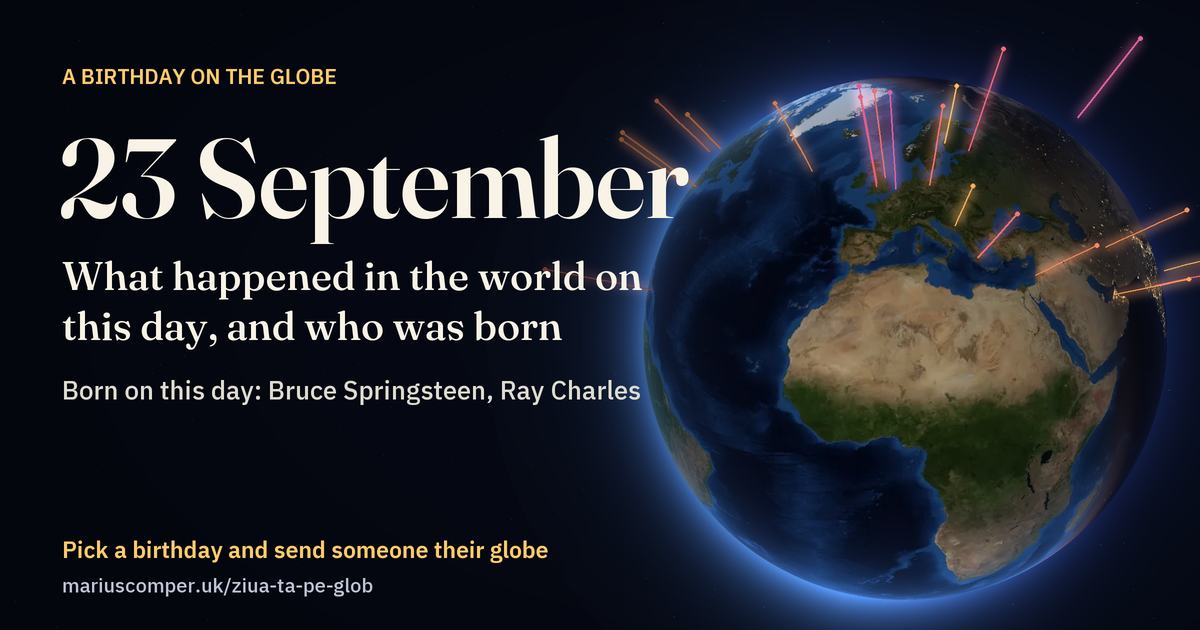
For 23 September, the English Wikipedia lists 50 events and 244 births. 22 of the events stand at their places as rays of light; 10 more are dashed circles, where the sentence links only to a country or a sea. The taller the ray, the longer ago it happened. The people born that day come further down, as blue points.
A birthday, yours or someone else’s:
Turn it into a greetingScroll: the globe turns to each place
The day you were born, on the globe.
Three things from your day
Scroll: your day first, then 23 September through the years
The Earth on 23 September
The picture on the globe was assembled by NASA from satellite photographs taken in September 2004: the snow, the ice and the green are those of the month.
On 23 September the Sun passes straight overhead at noon along the parallel of 0.1° south. In London, the day lasts about 12 hours 10 minutes.
The line between day and night is tilted on the globe exactly as on this day of the year. On the dark side you can see the lights of towns.
Europe · Saint Petersburg
1723
The treaty of Saint Petersburg is signed, in which Imperial Russia gains Derbent, Baku, and the coastal areas in between as well as the provinces of Gilan, Mazandaran, and Astrabad from Safavid Persia while the Shah receives Russian soldiers for domestic peacekeeping.
On the map: Saint Petersburg.
Also on the day’s list of Wikipedia in Spanish.
Europe · Berlin Observatory
1846
Astronomers Urbain Le Verrier, John Couch Adams and Johann Gottfried Galle collaborate on the discovery of Neptune.
On the map: Berlin Observatory.
North America · Checkers speech
1952
After being accused of financial improprieties, Senator Richard Nixon delivers his "Checkers speech" nationwide on television and radio, defending his actions and successfully salvaging his nomination as the Republican candidate for Vice President.
On the map: Checkers speech.
23 September
What the other Wikipedias remember#
For these years the English list has nothing on this day. The events below come from the same day’s lists on Wikipedia in Chinese and Spanish and were translated for this page.
From Wikipedia in Chinese · Kyoto
1889
Fusajiro Yamauchi founds the Nintendo company in Kyoto, initially mainly making handmade hanafuda cards.
On the map: Kyoto.
Translated from the list on Wikipedia in Chinese.
From Wikipedia in Spanish · Barcelona
1982
In Barcelona (Spain), the Mini Estadi, stadium of Fútbol Club Barcelona "B" and owned by Fútbol Club Barcelona, opens.
On the map: Barcelona.
Translated from the list on Wikipedia in Spanish.
From Wikipedia in Chinese · United States Congress
1986
The US Congress passes a bill designating the rose as the national flower of the United States.
On the map: United States Congress.
Translated from the list on Wikipedia in Chinese.
From Wikipedia in Spanish · Sydney
1993
In Monaco, the International Olympic Committee chooses Sydney as host of the 2000 Olympic Games.
On the map: Sydney.
Translated from the list on Wikipedia in Spanish.
The article on Wikipedia in Spanish: Juegos Olímpicos de Sídney 2000
23 September
Born on 23 September#
The English Wikipedia lists 244 births for this day. The blue points are the birthplaces of 60 of these people: those written about in the most Wikipedia editions, where Wikidata gives a place of birth.
Born on 23 September
1949
Bruce Springsteen, American singer-songwriter and guitarist
Place of birth: Long Branch.
Born on 23 September
1930
Ray Charles, American singer-songwriter, pianist, and actor (died 2004)
Place of birth: Albany.
Born on 23 September
1901
Jaroslav Seifert, Czech poet and journalist, Nobel Prize laureate (died 1986)
Place of birth: Žižkov.
Born on 23 September
1943
Julio Iglesias, Spanish singer-songwriter
Place of birth: Madrid.
Born on 23 September
1926
John William Coltrane, American jazz saxophonist and composer (died 1967)
Place of birth: Hamlet.
Born in Britain and Ireland
1869
Mary Mallon, American cook and typhoid carrier (died 1938)
Place of birth: Cookstown.
Born in Britain and Ireland
1756
John Loudon McAdam, Scottish engineer (died 1836)
Place of birth: Ayr.
23 September
Number one in the charts that week
At the cinema
An animal recorded that day
The record can be seen in GBIF, which brings together wildlife records from around the world.
All your birthdays
The weather that day
Data: Met Office Hadley Centre (HadCET); NOAA (GHCN-Daily, Mauna Loa).
Above the Earth
Sources: Jonathan McDowell, GCAT (launches); GFZ Potsdam (Kp index). Days are counted in Universal Time.
Football that day
International matches played that day:
Source: the “International football results” dataset kept by Mart Jürisoo (CC0).
Also that day
The earthquake’s page at the USGS
Source: the USGS catalogue. The day is counted in Universal Time (UTC).
In those days
Make a link for someone
Type the name, pick the day and the year of birth. The link opens straight on their day, with their name in the greeting.
The link carries the name, date and place typed here; anyone who gets it can see them.
Put another birthday beside it
Your mother’s, your child’s, a friend’s: the two days appear side by side.
Below: 23 September through the years.
The whole globe of the day
Drag the globe to turn it. Touch a ray or a point to read what happened there.
Everything Wikipedia lists for 23 September
The list is the English Wikipedia’s, in its own wording, as it stood in October 2026. 18 events have no place on the map: the sentence links to no place with coordinates, only to places too wide to mark, or to several countries.
- 38
Drusilla, Caligula's sister who died in June, with whom the emperor is said to have an incestuous relationship, is deified.
no place on the mapWikipedia: Julia Drusilla - 1122
Pope Callixtus II and Holy Roman Emperor Henry V agree to the Concordat of Worms to put an end to the Investiture Controversy.
no place on the mapWikipedia: Concordat of Worms - 1338
The Battle of Arnemuiden, in which a French force defeats the English, is the first naval battle of the Hundred Years' War and the first European naval battle in which gunpowder artillery is used.
Europe · Battle of ArnemuidenWikipedia: Battle of Arnemuiden - 1409
The Battle of Kherlen is the second significant victory over Ming dynasty China by the Mongols since 1368.
Asia · Kherlen RiverWikipedia: Battle of Kherlen - 1459
The Battle of Blore Heath, the first major battle of the English Wars of the Roses, is won by the Yorkists.
Britain & Ireland · Battle of Blore HeathWikipedia: Battle of Blore Heath - 1561
King Philip II of Spain issues cedula, ordering a halt to colonizing efforts in Florida.
no place on the mapWikipedia: Philip II of Spain - 1642
First English Civil War: The Battle of Powick Bridge, the first engagement between the primary field armies of the Royalists and the Parliamentarians, ends in a Royalist victory.
Britain & Ireland · Battle of Powick BridgeWikipedia: Battle of Powick Bridge - 1723
The treaty of Saint Petersburg is signed, in which Imperial Russia gains Derbent, Baku, and the coastal areas in between as well as the provinces of Gilan, Mazandaran, and Astrabad from Safavid Persia while the Shah receives Russian soldiers for domestic peacekeeping.
Europe · Saint PetersburgWikipedia: Treaty of Saint Petersburg - 1779
American Revolutionary War: John Paul Jones, naval commander of the United States, on board the USS Bonhomme Richard, wins the Battle of Flamborough Head.
Britain & Ireland · Battle of Flamborough HeadWikipedia: Battle of Flamborough Head - 1780
American Revolutionary War: British officer John André was captured by Patriot forces, thereby revealing a plot by Continental Army general Benedict Arnold to hand over West Point, New York.
no place on the mapWikipedia: American Revolutionary War - 1803
Second Anglo-Maratha War: The Battle of Assaye is fought between the British East India Company and the Maratha Empire in India.
Asia · Battle of AssayeWikipedia: Battle of Assaye - 1821
Tripolitsa, Greece, is captured by Greek rebels during the Greek War of Independence.
Europe · Siege of TripolitsaWikipedia: Siege of Tripolitsa - 1846
Astronomers Urbain Le Verrier, John Couch Adams and Johann Gottfried Galle collaborate on the discovery of Neptune.
Europe · Berlin ObservatoryWikipedia: Discovery of Neptune - 1868
The Grito de Lares occurs in Puerto Rico against Spanish rule.
Latin America · Grito de LaresWikipedia: Grito de Lares - 1879
The Macedo-Romanian Cultural Society is founded.
no place on the mapWikipedia: Macedo-Romanian Cultural Society - 1884
On the night of 23–24 September, the steamship Arctique runs aground near Cape Virgenes leading to the discovery of nearby placer gold, beginning the Tierra del Fuego gold rush.
no place on the mapWikipedia: Tierra del Fuego Gold Rush - 1885
Ethiopian forces under Ras Alula defeat Mahdist Sudanese forces in the battle of Kufit.
Africa · Ethiopian EmpireWikipedia: Battle of Kufit - 1899
Philippine-American War: the American Asiatic Squadron destroys a Filipino battery at the Battle of Olongapo.
no place on the mapWikipedia: Battle of Olongapo - 1905
Norway and Sweden sign the Karlstad Treaty, peacefully dissolving the Union between the two countries.
no place on the mapWikipedia: Dissolution of the union between Norway and Sweden - 1913
The United Mine Workers of America launch a strike which eventually escalated into the Colorado Coalfield War.
North America · Colorado Coalfield WarWikipedia: Colorado Coalfield War - 1918
World War I: British forces capture Haifa, Acre, and Es Salt from the Ottoman Empire.
Asia · Battle of HaifaWikipedia: World War I - 1920
The Louisiana hurricane dissipates over Kansas after forcing around 4,500 people to evacuate and causing $1.45 million in damages.
North America · KansasWikipedia: 1920 Louisiana hurricane - 1932
Saudi National Day: Crown Prince (later king) Faisal of Saudi Arabia, on behalf of Ibn Saud, proclaims the unification of the Kingdom of Saudi Arabia, the current iteration of the Third Saudi State.
Asia · Saudi ArabiaWikipedia: Saudi National Day - 1942
World War II: The Matanikau action on Guadalcanal begins: U.S. Marines attack Japanese units along the Matanikau River.
Oceania · Actions along the MatanikauWikipedia: World War II - 1947
A magnitude 6.9 earthquake strikes South Khorasan in Iran, killing over 500 people.
Asia · 1947 Dustabad earthquakeWikipedia: 1947 Dustabad earthquake - 1950
Korean War: The Battle of Hill 282 is the first US friendly-fire incident on British military personnel since World War II.
no place on the mapWikipedia: Battle of Hill 282 - 1951
George VI, king of the United Kingdom, has his left lung removed in an operation after a malignant tumour was found.
no place on the mapWikipedia: George VI - 1952
After being accused of financial improprieties, Senator Richard Nixon delivers his "Checkers speech" nationwide on television and radio, defending his actions and successfully salvaging his nomination as the Republican candidate for Vice President.
North America · Checkers speechWikipedia: Checkers speech - 1955
An all-white jury in Mississippi finds Roy Bryant and J. W. Milam not guilty in the torture-murder of 14-year-old African American boy Emmett Till.
North America · MississippiWikipedia: Mississippi - 1956
A tropical storm originating in the eastern Pacific Ocean passes into the Gulf of Mexico and is upgraded and named Hurricane Flossy just hours before striking the Gulf Coast and causing 15 deaths and an estimated US$24.8 million in damages.
no place on the mapWikipedia: Tropical cyclone - 1957
Little Rock schools integration crisis: President Dwight D. Eisenhower sends the 101st Airborne Division to Little Rock, Arkansas, and federalizes the Arkansas National Guard, ordering both to support the integration of Little Rock Central High School.
North America · Little Rock NineWikipedia: 101st Airborne Division - 1961
U.S. President John F. Kennedy nominates African American civil rights lawyer Thurgood Marshall to the Court of Appeals for the Second Circuit, although pro-segregation Southern senators manage to delay his confirmation until September 11, 1962.
North America · United States Court of Appeals for the Second CircuitWikipedia: John F. Kennedy - 1962
Flying Tiger Line Flight 923, a Lockheed L-1049H Super Constellation registered as N6923C, ditches into the Atlantic Ocean killing 28 out the 76 occupants onboard. The remaining 48 were rescued six hours later.
Oceans · Flying Tiger Line Flight 923Wikipedia: Flying Tiger Line Flight 923 - 1964
Typhoon Wilda, one of the strongest typhoons to ever strike Japan, makes landfall, causing at least 30 fatalities and sinking at least 64 ships.
Asia · JapanWikipedia: Typhoon Wilda - 1967
Seven people die, 46 people are injured, and more than 150 boats capsize when a squall hits Lake Michigan during Michigan's first coho salmon sport fishing season.
North America · MichiganWikipedia: 1967 coho salmon fishing disaster - 1973
Argentine general election: Juan Perón returns to power in Argentina.
no place on the mapWikipedia: September 1973 Argentine presidential election - 1983
Gulf Air Flight 771 is destroyed by a bomb, killing all 112 people on board.
Asia · Gulf Air Flight 771Wikipedia: Gulf Air Flight 771 - 1997
Irish rock band U2 performed in Sarajevo, the first major artist to hold a concert in the city since the end of the Bosnian War.
Europe · SarajevoWikipedia: U2 concert in Sarajevo - 1999
Qantas Flight 1 overruns a runway in Bangkok during a storm, causing minor injuries to some passengers.
Asia · Qantas Flight 1Wikipedia: Qantas Flight 1 - 2002
The first version of the web browser Firefox was released by the Mozilla Organization.
no place on the mapWikipedia: Firefox - 2004
Over 3,000 people die in Haiti after Hurricane Jeanne produces massive flooding and mudslides.
Latin America · HaitiWikipedia: Hurricane Jeanne - 2008
Matti Saari kills ten people at a school in Finland before committing suicide.
Europe · Kauhajoki school shootingWikipedia: Kauhajoki school shooting - 2010
Teresa Lewis becomes the first woman to be executed by the U.S. state of Virginia since 1912, and the first woman in the state to be executed by lethal injection.
North America · VirginiaWikipedia: Teresa Lewis - 2013
Twenty-five people are killed after Typhoon Usagi passes Hong Kong and China.
no place on the mapWikipedia: Typhoon Usagi - 2016
Following a number of high-profile sexual assaults, major reforms were enacted to strengthen laws related to rape in Germany.
no place on the mapWikipedia: Rape in Germany - 2019
The British travel company Thomas Cook Group ceased operations with immediate effect, leaving around 600,000 tourists stranded around the world.
no place on the mapWikipedia: Thomas Cook Group - 2019
Twenty people die on the first of two days of rioting in Papua and West Papua over an alleged racist incident.
no place on the mapWikipedia: 2019 Papua protests - 2020
A grand jury in Kentucky declines to indict three police officers for the shooting death of Breonna Taylor in a drug raid gone wrong, leading to nationwide protests in the U.S.
North America · KentuckyWikipedia: Grand jury - 2022
Voting begins in the five-day sham annexation referendums in Russian-occupied Ukraine, leading to Russian annexation of Donetsk, Kherson, Luhansk and Zaporizhzhia oblasts.
Europe · Luhansk People's RepublicWikipedia: 2022 annexation referendums in Russian-occupied Ukraine - 2024
Israel launches airstrikes against Hezbollah targets in Lebanon, killing more than 490 people.
no place on the mapWikipedia: September 2024 Israeli attacks against Lebanon
What the other Wikipedias remember
For these years the English list has nothing on this day. The events below come from the same day’s lists on Wikipedia in Chinese and Spanish and were translated for this page.
- 1889
Fusajiro Yamauchi founds the Nintendo company in Kyoto, initially mainly making handmade hanafuda cards.
- 1982
In Barcelona (Spain), the Mini Estadi, stadium of Fútbol Club Barcelona "B" and owned by Fútbol Club Barcelona, opens.
- 1986
The US Congress passes a bill designating the rose as the national flower of the United States.
North America · United States CongressTranslated from the list on Wikipedia in ChineseWikipedia: 美国国会 - 1993
In Monaco, the International Olympic Committee chooses Sydney as host of the 2000 Olympic Games.
Oceania · SydneyTranslated from the list on Wikipedia in SpanishWikipedia: Juegos Olímpicos de Sídney 2000
Who was born on 23 September
In order of how many Wikipedia editions have an article about each. The first 60 of 244 are shown.
- 63 BC
Augustus, Roman emperor (died 14 AD)
- 1215
Kublai Khan, Mongolian emperor (died 1294)
Mongol EmpireWikipedia: Kublai Khan - 1949
Bruce Springsteen, American singer-songwriter and guitarist
Long BranchWikipedia: Bruce Springsteen - 1930
Ray Charles, American singer-songwriter, pianist, and actor (died 2004)
AlbanyWikipedia: Ray Charles - 1901
Jaroslav Seifert, Czech poet and journalist, Nobel Prize laureate (died 1986)
- 1916
Aldo Moro, Italian academic and politician, 39th Prime Minister of Italy (died 1978)
MaglieWikipedia: Aldo Moro - 1943
Julio Iglesias, Spanish singer-songwriter
- 1940
Michel Temer, Brazilian lawyer and politician, 25th Vice President of Brazil
- 1926
John William Coltrane, American jazz saxophonist and composer (died 1967)
HamletWikipedia: John Coltrane - 1956
Paolo Rossi, Italian footballer (died 2020)
- 1920
Mickey Rooney, American actor, singer, director, and producer (died 2014)
BrooklynWikipedia: Mickey Rooney - 1938
Romy Schneider, German-French actress (died 1982)
- 1890
Friedrich Paulus, German field marshal (died 1957)
GuxhagenWikipedia: Friedrich Paulus - 1713
Ferdinand VI of Spain (died 1759)
MadridWikipedia: Ferdinand VI - 1915
Clifford Shull, American physicist and academic, Nobel Prize laureate (died 2001)
PittsburghWikipedia: Clifford Shull - 1988
Juan Martín del Potro, Argentinian tennis player
- 1819
Hippolyte Fizeau, French physicist and academic (died 1896)
- 1959
Jason Alexander, American actor, singer, and voice artist
- 1838
Victoria Woodhull, American journalist and activist (died 1927)
- 1889
Walter Lippmann, American journalist and publisher, co-founded The New Republic (died 1974)
New York CityWikipedia: Walter Lippmann - 1978
Anthony Mackie, American actor
New OrleansWikipedia: Anthony Mackie - 1880
John Boyd Orr, 1st Baron Boyd-Orr, Scottish biologist, physician, and politician, Nobel Prize laureate (died 1971)
KilmaursWikipedia: John Boyd Orr - 1917
Asima Chatterjee, Indian chemist (died 2006)
KolkataWikipedia: Asima Chatterjee - 1861
Robert Bosch, German engineer and businessman, founded Robert Bosch GmbH (died 1942)
AlbeckWikipedia: Robert Bosch - 1865
Suzanne Valadon, French model and painter (died 1938)
Bessines-sur-GartempeWikipedia: Suzanne Valadon - 1771
Emperor Kōkaku of Japan (died 1840)
- 1791
Johann Franz Encke, German astronomer and academic (died 1865)
- 1979
Fábio Simplício, Brazilian footballer
São PauloWikipedia: Fábio Simplício - 1869
Mary Mallon, American cook and typhoid carrier (died 1938)
CookstownWikipedia: Mary Mallon - 1982
Shyla Stylez, Canadian pornographic actress (died 2017)
ArmstrongWikipedia: Shyla Stylez - 1865
Emma Orczy, Hungarian-English author and playwright (died 1947)
TarnaörsWikipedia: Baroness Orczy - 1970
Ani DiFranco, American singer-songwriter and guitarist
BuffaloWikipedia: Ani DiFranco - 1974
Matt Hardy, American wrestler
CameronWikipedia: Matt Hardy - 1863
Alexandre Yersin, Swiss-French physician and bacteriologist (died 1943)
AubonneWikipedia: Alexandre Yersin - 1897
Paul Delvaux, Belgian painter (died 1994)
- 1961
William C. McCool, American commander, pilot, and astronaut (died 2003)
San DiegoWikipedia: William C. McCool - 1934
Per Olov Enquist, Swedish journalist, author, and playwright (died 2020)
HjoggböleWikipedia: Per Olov Enquist - 1740
Empress Go-Sakuramachi of Japan (died 1813)
- 1897
Walter Pidgeon, Canadian-American actor and singer (died 1984)
Saint JohnWikipedia: Walter Pidgeon - 1936
Valentín Paniagua, Peruvian lawyer and politician, 91st President of Peru (died 2006)
- 1945
Igor Ivanov, Russian politician and diplomat, Russian Minister of Foreign Affairs
MoscowWikipedia: Igor Ivanov - 1965
Mark Woodforde, Australian tennis player and sportscaster
AdelaideWikipedia: Mark Woodforde - 1791
Theodor Körner, German soldier and author (died 1813)
DresdenWikipedia: Theodor Körner - 1158
Geoffrey II, Duke of Brittany (died 1186)
- 1907
Anne Desclos, French journalist and author (died 1998)
RochefortWikipedia: Anne Desclos - 1954
Cherie Blair, English lawyer and academic
- 1981
Robert Doornbos, Dutch racing driver
RotterdamWikipedia: Robert Doornbos - 1991
Melanie Oudin, American tennis player
MariettaWikipedia: Melanie Oudin - 1756
John Loudon McAdam, Scottish engineer (died 1836)
- 1899
Louise Nevelson, American sculptor (died 1988)
PereiaslavWikipedia: Louise Nevelson - 1957
Rosalind Chao, American actress
AnaheimWikipedia: Rosalind Chao - 1947
Mary Kay Place, American actress
- 1959
Elizabeth Peña, American actress (died 2014)
ElizabethWikipedia: Elizabeth Peña - 1961
Chi McBride, American actor
ChicagoWikipedia: Chi McBride - 1963
Alex Proyas, Egyptian-Australian director, producer, and screenwriter
AlexandriaWikipedia: Alex Proyas - 1984
Anneliese van der Pol, Dutch-American entertainer
AmsterdamWikipedia: Anneliese van der Pol - 1935
Prem Chopra, Indian actor
LahoreWikipedia: Prem Chopra - 1945
Paul Petersen, American actor, singer, author, and activist
GlendaleWikipedia: Paul Petersen - 1971
Sean Spicer, American political aide, 30th White House Press Secretary
ManhassetWikipedia: Sean Spicer - 1989
Brandon Jennings, American basketball player
ComptonWikipedia: Brandon Jennings
What is celebrated on 23 September
- Christian feast day: Adomnán
- Christian feast day: Blessed Bernardyna Maria Jabłońska
- Christian feast day: Cissa of Crowland (or of Northumbria)
- Christian feast day: Blessed Elena Duglioli
- Christian feast day: Elisabeth and Zechariah
- Christian feast day: Blessed Émilie Gamelin
- Christian feast day: Blessed Francisco de Paula Victor
- Christian feast day: Padre Pio
- Christian feast day: Pope Linus
- Christian feast day: Sossius
- Christian feast day: Thecla (Roman Catholic Church)
- Christian feast day: September 23 (Eastern Orthodox liturgics)
- Grito de Lares (Puerto Rico)
- Haifa Day (Israel)
A greeting link for someone
Type a name and, if you like, the year of birth. The link opens with a greeting, and beside each event it says how old the person turned that day, or how many years before their birth it happened.
The name and the year go only into the link you send.
All 366 days
How the globe is made
Where the events come from
Each edition of this page uses the day’s list from Wikipedia in its own language: Romanian, English, Spanish, Chinese. The lists are written by volunteers and differ from one edition to the next; the text of each event is Wikipedia’s, with a link to the article. A row that appears twice in a list is shown once. The lists have not been checked event by event: they are Wikipedia’s, mistakes included.
For events before 1582, and for countries that moved to the Gregorian calendar later (Britain in 1752, Russia in 1918), the same day may be counted Old Style in one list and New Style in another.
The chapter “What the other Wikipedias remember” adds up to five events a day from the lists of the other three editions, only for years in which the English list has nothing on that day. They were translated for this page, passed the same filters as the tour, and are not counted among the events of the English list.
How an event gets onto the map
The place comes from Wikidata. If the sentence links to the article about the event itself (a battle, an opening, an earthquake), dated to the same year, the ray stands on its coordinates or on those of its location. Otherwise it stands on the first place the sentence links to: a town, a building, a mountain, an island. This second step can be wrong: sometimes the sentence only mentions the place. That is why the page says, under each event, which place the ray stands on.
When the sentence links to a single state or province, or to a single sea, lake or desert larger than 5,000 km², the globe shows a dashed circle, not a ray. The circle has the area Wikidata gives, with its radius kept between 1.2° and 16°, or a radius of 4.5° when Wikidata gives no area; it says only that the sentence links to that place. Organisations, ships, spacecraft, museum objects, rivers, mountain ranges, languages and continents are never used as places. When a sentence names several states and no exact place, the event stays in the list only.
What the height means
The height of a ray shows how many years have passed, on a logarithmic scale: 10 years, 100 years and 1,000 years are equal steps apart; anything older than about 2,600 years has the tallest ray. The colour runs from pale yellow for recent years to violet for antiquity.
Where the tour stops
In each region the tour stops at up to three events (five in Britain and Ireland), chosen mainly by three things: whether Wikipedia’s editors put the event in the “On this day” box of their main page (the English, Spanish and Chinese editions), how many Wikipedia editions have an article about it, and how many of the four lists include it. Events whose sentence or article is about a war, an attack, a crime or a disaster are left out of the tour; they stay in the whole list, in Wikipedia’s wording. The filter is a list of words and a list of Wikidata types, so it can miss some.
The tour of births names the people with articles in the most editions and leaves aside those whom the list or Wikidata describes as rulers, politicians, commanders, leaders of movements or criminals; they stay in the list.
The Earth and the Sun
The daytime images are NASA’s Blue Marble Next Generation mosaics, one for each month of 2004; the night side is Black Marble 2016. The tilt of the line between day and night is computed for the day; the hour is chosen so that the place being read is in daylight. The latitude where the Sun stands overhead is the average of the four years of the leap cycle; in a given year it can differ by up to 0.4°.
The day you were born
The number ones come from the weekly lists on Wikipedia: Billboard for the United States (from 1940; the Hot 100 from August 1958), the UK Singles Chart (from November 1952), Los 40 Principales for Spain (from July 1966) and, for Romania, the Romanian Top 100 and Airplay 100 (2001–2021, with missing weeks). The page shows the chart of the week in which the day of birth falls, with its date; Billboard and the UK chart are dated at the end of their week. For Romania before 2001 and for China these sources have no weekly chart.
The films are those that reached cinemas in the United States up to ten days before or three days after that day (some of them in a few cinemas at first), from the English Wikipedia’s yearly lists (from 1968), in order of how many editions have an article about them. The events “in those days” are the ones on the neighbouring days’ lists that carry the year of birth, passed through the same filter as the tour.
The day of birth, year included
The Moon, the star sign and the constellation are worked out by the page itself, for noon Universal Time on the day. The lit part of the Moon is rounded and can differ by a few per cent from that at the hour of birth. The sign follows the usual zodiac of twelve equal parts starting at the March equinox; the constellation is the one the Sun actually stood in front of, by the borders set by the International Astronomical Union, and within a day of a border the page does not name it. When the Sun changes sign while it is that day anywhere on Earth, the page gives the moment of crossing, rounded to ten minutes and accurate to within about a quarter of an hour, and the clock time in a few cities, with the time zone and summer time of that year.
The year in the Chinese calendar is the one your device’s own calendar gives for the date, checked against the Hong Kong Observatory’s tables. “All your birthdays” uses the same sources as the rest of the chapter for the same day in every year since the birth: the temperature, well-known launches that took place on that very day, matches of the teams the edition follows, snow deeper than 10 cm and strong geomagnetic storms. The three things at the top and the four on the picture are chosen in a fixed order (the song, the animal, a full Moon, a well-known launch before an ordinary earthquake); on the picture you can change them.
When the link carries a year of birth, the page adds a few things about that exact day. The weather is the Met Office’s Central England temperature record and the readings from New York’s Central Park; the “usual high” is the average of the daily highs of 1961–1990 for that date, with two days either side. The carbon dioxide figure is the monthly mean at the Mauna Loa observatory, where measurements begin in March 1958.
The earthquake is the one with the largest magnitude in the USGS catalogue for that day, counted in Universal Time. Before the 1960s the catalogue has gaps even above magnitude 5.5, so in the older years many days have no earthquake. The page gives only the magnitude and the place: the country the epicentre falls in or, when the epicentre is at sea within 300 km of a coast, the nearest country; farther out, only the ocean.
The launches are those that reached orbit or left for the Moon and the planets, from Jonathan McDowell’s GCAT catalogue. If nothing left that day, the page shows the nearest launch within three days before or after, and says how many days away it was. The geomagnetic storm appears only when the Kp index reached at least 5 in one of the day’s eight three-hour intervals.
The animal comes from GBIF: an observation made by a person (the animal seen or heard, or its tracks), dated to that exact day, with coordinates and a CC0 or CC BY licence. Only a few hundred well-known species are searched (mammals, birds, turtles, butterflies); of those noted that day, mammals and species with articles in many Wikipedia editions come first; birds noted almost every day, and species used recently, wait their turn. Observations dated 1 January are left out, because records without a day are often filed there. An observation shows that the animal was recorded there, not how many animals there were.
The matches are those between national teams. Only matches of England, Scotland, Wales, Northern Ireland, the Republic of Ireland, the United States, Canada and Australia are shown, along with those at the big final tournaments. The picture to send is drawn in the page from the day’s globe and the facts above, and stays on your device until you send it.
Sources
- Events, births and holidays: the day’s page on Wikipedia, text under CC BY-SA 4.0.
- Coordinates, places of birth and the number of editions: Wikidata (CC0).
- The Earth by day: NASA Blue Marble Next Generation. The Earth by night: NASA Black Marble 2016.
- Borders and regions: Natural Earth.
- World population and births per year: UN World Population Prospects 2024.
- Charts and films: Wikipedia’s lists for Billboard, the UK Singles Chart, Los 40 Principales, Romanian Top 100, Airplay 100 and American films by year (CC BY-SA 4.0).
- Weather: Met Office Hadley Centre, HadCET (Open Government Licence) and NOAA GHCN-Daily, New York Central Park. Carbon dioxide: NOAA Global Monitoring Laboratory, Mauna Loa.
- Earthquakes: the USGS catalogue. Launches: Jonathan McDowell, GCAT (CC BY). Kp index: GFZ Potsdam (CC BY 4.0). Matches: International football results, Mart Jürisoo (CC0).
- Animal observations: GBIF, with a link to each record; species names come from Wikidata.