A birthday on the globe
18 October on the globe: what happened in the world on this day, and who was born
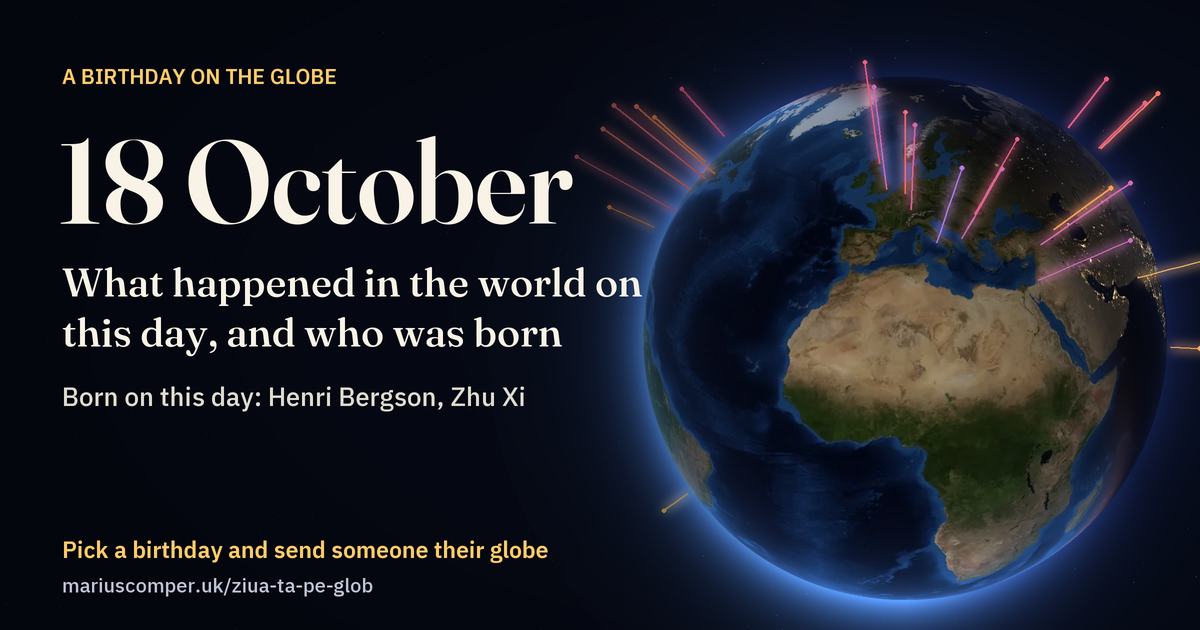
For 18 October, the English Wikipedia lists 56 events and 255 births. 23 of the events stand at their places as rays of light; nine more are dashed circles, where the sentence links only to a country or a sea. The taller the ray, the longer ago it happened. The people born that day come further down, as blue points.
A birthday, yours or someone else’s:
Turn it into a greetingScroll: the globe turns to each place
The day you were born, on the globe.
Three things from your day
Scroll: your day first, then 18 October through the years
The Earth on 18 October
The picture on the globe was assembled by NASA from satellite photographs taken in October 2004: the snow, the ice and the green are those of the month.
On 18 October the Sun passes straight overhead at noon along the parallel of 9.6° south. In London, the day lasts about 10 hours 35 minutes.
Beyond 80° south the Sun no longer sets; beyond 80° north it no longer rises.
The line between day and night is tilted on the globe exactly as on this day of the year. On the dark side you can see the lights of towns.
Asia · Mor Bar Sauma Monastery
1166
Michael the Syrian, one of the most important Syriac historians, is consecrated as Syriac Orthodox Patriarch at the Mor Bar Sauma Monastery.
On the map: Mor Bar Sauma Monastery.
Asia · Henrik Igityan National Centre for Aesthetics
1978
Based on the world's first children's art museum, the Henrik Igityan National Centre for Aesthetics opened in Yerevan.
On the map: Henrik Igityan National Centre for Aesthetics.
Latin America · Mexico City
1968
At the Summer Olympics in Mexico City, American athlete Bob Beamon achieved a distance of 8.90 m (29.2 ft) in the long jump event, setting a world record that stood for 23 years.
On the map: Mexico City.
Also on the day’s list of Wikipedia in Spanish, Romanian and Chinese.
North America · Morro Bay, California
1587
Filipino sailors disembarked from the Manila galleon Nuestra Señora de Buena Esperanza in what is now Morro Bay, California, the first documented instance of Asians in the Americas.
On the map: Morro Bay, California.
North America · Alaska Purchase
1867
United States takes possession of Alaska after purchasing it from Russia for $7.2 million. Celebrated annually in the state as Alaska Day.
On the map: the coordinates Wikidata gives for the article “Alaska Purchase”.
Also on the day’s list of Wikipedia in Chinese.
18 October
What the other Wikipedias remember#
For these years the English list has nothing on this day. The events below come from the same day’s lists on Wikipedia in Chinese and were translated for this page.
From Wikipedia in Chinese · Heidelberg University
1386
Heidelberg University is founded, promoted by Rupert I, Elector of the Electorate of the Palatinate, becoming the third university established within the Holy Roman Empire after the universities of Prague and Vienna.
On the map: Heidelberg University.
Translated from the list on Wikipedia in Chinese.
18 October
Born on 18 October#
The English Wikipedia lists 255 births for this day. The blue points are the birthplaces of 60 of these people: those written about in the most Wikipedia editions, where Wikidata gives a place of birth.
Born on 18 October
1859
Henri Bergson, French philosopher and theologian, Nobel Prize laureate (died 1941)
Place of birth: Paris.
Born on 18 October
1130
Zhu Xi, Chinese philosopher (died 1200)
Place of birth: Youxi County.
Born on 18 October
1926
Chuck Berry, American singer-songwriter and guitarist (died 2017)
Place of birth: St. Louis.
Born on 18 October
1956
Martina Navratilova, Czech-American tennis player and coach
Place of birth: Prague.
Born on 18 October
1960
Jean-Claude Van Damme, Belgian martial artist, actor, and producer, and screenwriter
Place of birth: Berchem-Sainte-Agathe.
Born in Britain and Ireland
1984
Milo Yiannopoulos, British journalist and public speaker
Place of birth: Kent.
Born in Britain and Ireland
1992
Barry Keoghan, Irish actor
Place of birth: Summerhill.
Born in Britain and Ireland
1785
Thomas Love Peacock, English author and poet (died 1866)
Place of birth: Weymouth.
18 October
Number one in the charts that week
At the cinema
An animal recorded that day
The record can be seen in GBIF, which brings together wildlife records from around the world.
All your birthdays
The weather that day
Data: Met Office Hadley Centre (HadCET); NOAA (GHCN-Daily, Mauna Loa).
Above the Earth
Sources: Jonathan McDowell, GCAT (launches); GFZ Potsdam (Kp index). Days are counted in Universal Time.
Football that day
International matches played that day:
Source: the “International football results” dataset kept by Mart Jürisoo (CC0).
Also that day
The earthquake’s page at the USGS
Source: the USGS catalogue. The day is counted in Universal Time (UTC).
In those days
Make a link for someone
Type the name, pick the day and the year of birth. The link opens straight on their day, with their name in the greeting.
The link carries the name, date and place typed here; anyone who gets it can see them.
Put another birthday beside it
Your mother’s, your child’s, a friend’s: the two days appear side by side.
Below: 18 October through the years.
The whole globe of the day
Drag the globe to turn it. Touch a ray or a point to read what happened there.
Everything Wikipedia lists for 18 October
The list is the English Wikipedia’s, in its own wording, as it stood in October 2026. 24 events have no place on the map: the sentence links to no place with coordinates, only to places too wide to mark, or to several countries.
- 33
Heartbroken by the deaths of her sons Nero and Drusus, and banished to the island of Pandateria by Tiberius, Agrippina the Elder dies of self-inflicted starvation.
Europe · VentoteneWikipedia: Nero Julius Caesar - 320
Pappus of Alexandria, Greek philosopher, observes an eclipse of the Sun and writes a commentary on The Great Astronomer (Almagest).
no place on the mapWikipedia: Pappus of Alexandria - 614
King Chlothar II promulgates the Edict of Paris (Edictum Chlotacharii), a sort of Frankish Magna Carta that defends the rights of the Frankish nobles while it excludes Jews from all civil employment in the Frankish Kingdom.
Europe · FranciaWikipedia: Chlothar II - 629
Dagobert I is crowned King of the Franks.
no place on the mapWikipedia: Dagobert I - 1009
The Church of the Holy Sepulchre, a Christian church in Jerusalem, is completely destroyed by the Fatimid caliph Al-Hakim bi-Amr Allah, who hacks the Church's foundations down to bedrock.
Asia · Church of the Holy SepulchreWikipedia: Church of the Holy Sepulchre - 1016
The Danes defeat the English in the Battle of Assandun.
Britain & Ireland · Battle of AssandunWikipedia: Battle of Assandun - 1081
The Normans defeat the Byzantine Empire in the Battle of Dyrrhachium.
Europe · Battle of DyrrhachiumWikipedia: Battle of Dyrrhachium - 1166
Michael the Syrian, one of the most important Syriac historians, is consecrated as Syriac Orthodox Patriarch at the Mor Bar Sauma Monastery.
Asia · Mor Bar Sauma MonasteryWikipedia: Michael the Syrian - 1281
Pope Martin IV excommunicates King Peter III of Aragon for usurping the crown of Sicily (a sentence renewed on 7 May and 18 November 1282).
no place on the mapWikipedia: Pope Martin IV - 1356
Basel earthquake, the most significant historic seismological event north of the Alps, destroys the town of Basel, Switzerland.
Europe · 1356 Basel earthquakeWikipedia: 1356 Basel earthquake - 1540
Spanish conquistador Hernando de Soto's forces destroy the fortified town of Mabila in present-day Alabama, killing Tuskaloosa.
North America · AlabamaWikipedia: Mabila - 1561
In Japan the fourth Battle of Kawanakajima is fought between the forces of Uesugi Kenshin and Takeda Shingen, resulting in a draw.
Asia · Battles of KawanakajimaWikipedia: Japan - 1565
Ships belonging to the Matsura clan of Japan fail to capture the Portuguese trading carrack in the Battle of Fukuda Bay, the first recorded naval battle between Japan and the West.
Asia · Battle of Fukuda BayWikipedia: Battle of Fukuda Bay - 1587
Filipino sailors disembarked from the Manila galleon Nuestra Señora de Buena Esperanza in what is now Morro Bay, California, the first documented instance of Asians in the Americas.
North America · Morro Bay, CaliforniaWikipedia: Filipinos - 1597
King Philip II of Spain sends his third and final armada against England, but it ends in failure due to storms. The remaining ships are captured or sunk by the English.
no place on the mapWikipedia: Third Spanish Armada - 1599
Michael the Brave, Prince of Wallachia, defeats the Army of Andrew Báthory in the Battle of Șelimbăr, leading to the first recorded unification of the Romanian people.
Europe · Battle of ȘelimbărWikipedia: Battle of Șelimbăr - 1630
Frendraught Castle in Scotland, the home of James Crichton of Frendraught, burns down.
Britain & Ireland · Frendraught CastleWikipedia: Frendraught Castle - 1648
Boston shoemakers form the first American labor organization.
no place on the mapWikipedia: Trade union - 1748
Signing of the Treaty of Aix-la-Chapelle ends the War of the Austrian Succession.
Europe · Treaty of Aix-la-ChapelleWikipedia: Treaty of Aix-la-Chapelle - 1775
African-American poet Phillis Wheatley is freed from slavery.
no place on the mapWikipedia: African Americans - 1775
American Revolutionary War: The Burning of Falmouth (now Portland, Maine).
North America · Burning of FalmouthWikipedia: Burning of Falmouth - 1779
American Revolutionary War: The Franco-American Siege of Savannah is lifted.
North America · Siege of SavannahWikipedia: Siege of Savannah - 1851
Herman Melville's Moby-Dick is first published as The Whale by Richard Bentley of London.
no place on the mapWikipedia: Herman Melville - 1860
The Second Opium War finally ends at the Convention of Peking with the ratification of the Treaty of Tientsin, an unequal treaty.
Asia · BeijingWikipedia: Second Opium War - 1867
United States takes possession of Alaska after purchasing it from Russia for $7.2 million. Celebrated annually in the state as Alaska Day.
North America · Alaska PurchaseWikipedia: Alaska Purchase - 1873
Renton defeated Kilmarnock 2–0 in the opening match of the inaugural Scottish Cup.
no place on the mapWikipedia: Renton F.C. - 1887
Johannes Brahms conducts the premiere of his Double Concerto, composed for violinist Joseph Joachim and cellist Robert Hausmann.
no place on the mapWikipedia: Johannes Brahms - 1898
The United States takes possession of Puerto Rico from Spain.
Latin America · Puerto RicoWikipedia: Puerto Rico - 1900
Count Bernhard von Bülow becomes chancellor of Germany.
no place on the mapWikipedia: Bernhard von Bülow - 1906
The Robert Burns Memorial Statue, the first public statue erected in New Brunswick, was dedicated in Fredericton.
North America · Robert Burns Memorial StatueWikipedia: Robert Burns Memorial Statue - 1912
First Balkan War: King Peter I of Serbia issues a declaration "To the Serbian People", as his country joins the war.
no place on the mapWikipedia: First Balkan War - 1914
The Schoenstatt Apostolic Movement is founded in Germany.
no place on the mapWikipedia: Schoenstatt Apostolic Movement - 1921
The Crimean Autonomous Soviet Socialist Republic is formed as part of the Russian Soviet Federative Socialist Republic.
no place on the mapWikipedia: Crimea in the Soviet Union - 1922
The British Broadcasting Company (later Corporation) is founded by a consortium, to establish a nationwide network of radio transmitters to provide a national broadcasting service.
no place on the mapWikipedia: British Broadcasting Company - 1929
The Judicial Committee of the Privy Council overrules the Supreme Court of Canada in Edwards v. Canada when it declares that women are considered "Persons" under Canadian law.
no place on the mapWikipedia: Judicial Committee of the Privy Council - 1943
Pere Areny, convicted of the murder of his brother, became the last person to be executed by Andorra.
Europe · AndorraWikipedia: Pere Areny - 1944
World War II: Soviet Union begins the liberation of Czechoslovakia from Nazi Germany.
no place on the mapWikipedia: World War II - 1944
World War II: The state funeral of Field Marshal Erwin Rommel takes place in Ulm, Germany.
no place on the mapWikipedia: Erwin Rommel - 1945
A group of the Venezuelan Armed Forces, led by Mario Vargas, Marcos Pérez Jiménez and Carlos Delgado Chalbaud, stages a coup d'état against president Isaías Medina Angarita, who is overthrown by the end of the day.
Latin America · VenezuelaWikipedia: 1945 Venezuelan coup d'état - 1945
Argentine military officer and politician Juan Perón marries actress Eva Duarte.
Latin America · ArgentinaWikipedia: Argentina - 1945
The USSR's nuclear program receives plans for the United States plutonium bomb from Klaus Fuchs at the Los Alamos National Laboratory.
North America · Los Alamos National LaboratoryWikipedia: Soviet Union - 1954
Texas Instruments announces the Regency TR-1, the first mass-produced transistor radio.
no place on the mapWikipedia: Regency TR-1 - 1963
Félicette, a black and white female Parisian stray cat, becomes the first cat launched into space.
no place on the mapWikipedia: Félicette - 1967
The Soviet probe Venera 4 reaches Venus and becomes the first spacecraft to measure the atmosphere of another planet.
Asia · Soviet UnionWikipedia: Soviet Union - 1968
At the Summer Olympics in Mexico City, American athlete Bob Beamon achieved a distance of 8.90 m (29.2 ft) in the long jump event, setting a world record that stood for 23 years.
Latin America · Mexico CityWikipedia: 1968 Summer Olympics - 1977
German Autumn: A set of events revolving around the kidnapping of Hanns Martin Schleyer and the hijacking of a Lufthansa flight by the Red Army Faction (RAF) comes to an end when Schleyer is murdered and various RAF members allegedly commit suicide.
Europe · West GermanyWikipedia: German Autumn - 1978
Based on the world's first children's art museum, the Henrik Igityan National Centre for Aesthetics opened in Yerevan.
Asia · Henrik Igityan National Centre for AestheticsWikipedia: Henrik Igityan National Centre for Aesthetics - 1979
The Federal Communications Commission (FCC) begins allowing people to have home satellite earth stations without a federal government license.
no place on the mapWikipedia: Federal Communications Commission - 1989
The Space Shuttle Atlantis launches on STS-34 to deploy the Jupiter-bound Galileo space probe.
no place on the mapWikipedia: Space Shuttle Atlantis - 1991
The Supreme Council of Azerbaijan adopts a declaration of independence from the Soviet Union.
no place on the mapWikipedia: Azerbaijan - 1992
Merpati Nustantara Airlines Flight 5601 crashes into Mount Papandayan near the town of Garut in West Java, Indonesia, killing 31.
Asia · Mount PapandayanWikipedia: Merpati Nusantara Airlines Flight 5601 - 1993
Nihilism, the first professional runway show from the British designer Alexander McQueen, was staged in London.
no place on the mapWikipedia: Nihilism - 2003
Bolivian gas conflict: Bolivian President Gonzalo Sánchez de Lozada is forced to resign and leave Bolivia.
Latin America · BoliviaWikipedia: Bolivian gas war - 2007
Karachi bombing: A suicide attack on a motorcade carrying former Pakistani Prime Minister Benazir Bhutto kills 139 and wounds 450 more. Bhutto herself is uninjured.
Asia · 2007 Karsaz bombingWikipedia: 2007 Karsaz bombing - 2019
NASA Astronauts Jessica Meir and Christina Koch take part in the first all-female spacewalk when they venture out of the International Space Station to replace a power controller.
no place on the mapWikipedia: NASA Astronaut Corps - 2019
Riots in Chile's capital Santiago escalate into open battles, with attacks reported at nearly all of the city's 164 Metro stations. President Sebastián Piñera later announces a 15-day state of emergency in the capital.
Latin America · Santiago MetroWikipedia: Social Outburst
What the other Wikipedias remember
For these years the English list has nothing on this day. The events below come from the same day’s lists on Wikipedia in Chinese and were translated for this page.
- 1386
Heidelberg University is founded, promoted by Rupert I, Elector of the Electorate of the Palatinate, becoming the third university established within the Holy Roman Empire after the universities of Prague and Vienna.
Who was born on 18 October
In order of how many Wikipedia editions have an article about each. The first 60 of 255 are shown.
- 1859
Henri Bergson, French philosopher and theologian, Nobel Prize laureate (died 1941)
- 1130
Zhu Xi, Chinese philosopher (died 1200)
Youxi CountyWikipedia: Zhu Xi - 1926
Chuck Berry, American singer-songwriter and guitarist (died 2017)
St. LouisWikipedia: Chuck Berry - 1956
Martina Navratilova, Czech-American tennis player and coach
- 1960
Jean-Claude Van Damme, Belgian martial artist, actor, and producer, and screenwriter
Berchem-Sainte-AgatheWikipedia: Jean-Claude Van Damme - 1987
Zac Efron, American actor and singer
San Luis ObispoWikipedia: Zac Efron - 1405
Pope Pius II (died 1464)
PienzaWikipedia: Pope Pius II - 1919
Pierre Trudeau, Canadian lawyer, academic, and politician, 15th Prime Minister of Canada (died 2000)
MontrealWikipedia: Pierre Trudeau - 1991
Zohran Mamdani, American politician, mayor of New York City
Nsambya HospitalWikipedia: Zohran Mamdani - 1777
Heinrich von Kleist, German author and poet (died 1811)
Frankfurt (Oder)Wikipedia: Heinrich von Kleist - 1945
Huell Howser, American television host and actor (died 2013)
GallatinWikipedia: Huell Howser - 1831
Frederick III, German Emperor (died 1888)
New PalaceWikipedia: Frederick III, German Emperor - 1939
Lee Harvey Oswald, American assassin of John F. Kennedy (died 1963)
New OrleansWikipedia: Lee Harvey Oswald - 1984
Freida Pinto, Indian actress and model
MumbaiWikipedia: Freida Pinto - 1663
Prince Eugene of Savoy (died 1736)
- 1926
Klaus Kinski, German-American actor, director, and screenwriter (died 1991)
- 1984
Lindsey Vonn, American skier
Saint PaulWikipedia: Lindsey Vonn - 1905
Félix Houphouët-Boigny, Ivorian union leader and politician, 1st President of Côte d'Ivoire (died 1993)
- 1927
George C. Scott, American actor and director (died 1999)
- 1920
Melina Mercouri, Greek actress, singer, and politician, 9th Greek Minister of Culture (died 1994)
KolonakiWikipedia: Melina Mercouri - 1929
Violeta Chamorro, Nicaraguan publisher and politician, President of Nicaragua (died 2025)
- 1741
Pierre Choderlos de Laclos, French general and author (died 1803)
- 1804
Mongkut, Thai king (died 1868)
Thonburi ProvinceWikipedia: Mongkut - 1959
Mauricio Funes, Salvadoran politician, former president of El Salvador (died 2025)
San SalvadorWikipedia: Mauricio Funes - 1979
Ne-Yo, American singer, songwriter, record producer, dancer, and actor
CamdenWikipedia: Ne-Yo - 1925
Ramiz Alia, Albanian politician, 1st President of Albania (died 2011)
ShkodërWikipedia: Ramiz Alia - 1965
Zakir Naik, Indian Islamic preacher; founder and president of the Islamic Research Foundation (IRF)
MumbaiWikipedia: Zakir Naik - 1946
Howard Shore, Canadian composer, conductor, and producer
TorontoWikipedia: Howard Shore - 1983
Dante, Brazilian footballer
SalvadorWikipedia: Dante - 1873
Ivanoe Bonomi, Italian lawyer and politician, 25th Prime Minister of Italy (died 1951)
MantuaWikipedia: Ivanoe Bonomi - 1932
Vytautas Landsbergis, Lithuanian musicologist and politician
- 1961
Wynton Marsalis, American trumpet player, composer, and educator
New OrleansWikipedia: Wynton Marsalis - 1984
Milo Yiannopoulos, British journalist and public speaker
- 1990
Brittney Griner, American basketball player
HoustonWikipedia: Brittney Griner - 1523
Anna Jagiellon, daughter of Sigismund I of Poland (died 1596)
- 1918
Konstantinos Mitsotakis, Greek lawyer and politician, 178th Prime Minister of Greece (died 2017)
- 1935
Peter Boyle, American actor (died 2006)
NorristownWikipedia: Peter Boyle - 1991
Tyler Posey, American actor and musician
Santa MonicaWikipedia: Tyler Posey - 1880
Ze'ev Jabotinsky, Ukrainian-Russian general, journalist, and theorist (died 1940)
- 1706
Baldassare Galuppi, Italian harpsichord player and composer (died 1785)
- 1992
Barry Keoghan, Irish actor
SummerhillWikipedia: Barry Keoghan - 1898
Lotte Lenya, Austrian singer and actress (died 1981)
ViennaWikipedia: Lotte Lenya - 1870
D. T. Suzuki, Japanese author and scholar (died 1966)
HondamachiWikipedia: D. T. Suzuki - 1902
Miriam Hopkins, American actress (died 1972)
SavannahWikipedia: Miriam Hopkins - 1909
Norberto Bobbio, Italian philosopher and theorist (died 2004)
- 1968
Michael Stich, German tennis player and sportscaster
PinnebergWikipedia: Michael Stich - 1634
Luca Giordano, Italian painter and illustrator (died 1705)
NaplesWikipedia: Luca Giordano - 1902
Pascual Jordan, German physicist and theorist (died 1980)
HanoverWikipedia: Pascual Jordan - 1977
Ryan Nelsen, New Zealand-American soccer player and coach
ChristchurchWikipedia: Ryan Nelsen - 1994
Pascal Wehrlein, German-Mauritian race car driver
SigmaringenWikipedia: Pascal Wehrlein - 1127
Emperor Go-Shirakawa of Japan (died 1192)
- 1984
Esperanza Spalding, American singer-songwriter and bassist
PortlandWikipedia: Esperanza Spalding - 1822
Midhat Pasha, Ottoman civil servant and politician, 238th Grand Vizier of the Ottoman Empire (died 1883)
IstanbulWikipedia: Midhat Pasha - 1882
Lucien Petit-Breton, French cyclist (died 1917)
- 1973
James Foley, American photographer and journalist (died 2014)
RochesterWikipedia: James Foley - 1984
Robert Harting, German discus thrower
CottbusWikipedia: Robert Harting - 1947
Joe Morton, American actor
The BronxWikipedia: Joe Morton - 1785
Thomas Love Peacock, English author and poet (died 1866)
WeymouthWikipedia: Thomas Love Peacock - 1952
Chuck Lorre, American director, producer, and screenwriter
BethpageWikipedia: Chuck Lorre - 1547
Justus Lipsius, Belgian philologist and scholar (died 1606)
OverijseWikipedia: Justus Lipsius
What is celebrated on 18 October
- Alaska Day (Alaska, United States)
- Christian feast day: Asclepiades of Antioch
- Christian feast day: Isaac Jogues
- Christian feast day: Luke the Evangelist
- Christian feast day: Peter of Alcantara, can also be celebrated on October 19.
- Christian feast day: October 18 (Eastern Orthodox liturgics)
- Day of Restoration of Independence (Azerbaijan), celebrates the independence of Azerbaijan from the Soviet Union in 1991.
- Necktie Day (Croatia)
- Persons Day (Canada)
- World Menopause Day
A greeting link for someone
Type a name and, if you like, the year of birth. The link opens with a greeting, and beside each event it says how old the person turned that day, or how many years before their birth it happened.
The name and the year go only into the link you send.
All 366 days
How the globe is made
Where the events come from
Each edition of this page uses the day’s list from Wikipedia in its own language: Romanian, English, Spanish, Chinese. The lists are written by volunteers and differ from one edition to the next; the text of each event is Wikipedia’s, with a link to the article. A row that appears twice in a list is shown once. The lists have not been checked event by event: they are Wikipedia’s, mistakes included.
For events before 1582, and for countries that moved to the Gregorian calendar later (Britain in 1752, Russia in 1918), the same day may be counted Old Style in one list and New Style in another.
The chapter “What the other Wikipedias remember” adds up to five events a day from the lists of the other three editions, only for years in which the English list has nothing on that day. They were translated for this page, passed the same filters as the tour, and are not counted among the events of the English list.
How an event gets onto the map
The place comes from Wikidata. If the sentence links to the article about the event itself (a battle, an opening, an earthquake), dated to the same year, the ray stands on its coordinates or on those of its location. Otherwise it stands on the first place the sentence links to: a town, a building, a mountain, an island. This second step can be wrong: sometimes the sentence only mentions the place. That is why the page says, under each event, which place the ray stands on.
When the sentence links to a single state or province, or to a single sea, lake or desert larger than 5,000 km², the globe shows a dashed circle, not a ray. The circle has the area Wikidata gives, with its radius kept between 1.2° and 16°, or a radius of 4.5° when Wikidata gives no area; it says only that the sentence links to that place. Organisations, ships, spacecraft, museum objects, rivers, mountain ranges, languages and continents are never used as places. When a sentence names several states and no exact place, the event stays in the list only.
What the height means
The height of a ray shows how many years have passed, on a logarithmic scale: 10 years, 100 years and 1,000 years are equal steps apart; anything older than about 2,600 years has the tallest ray. The colour runs from pale yellow for recent years to violet for antiquity.
Where the tour stops
In each region the tour stops at up to three events (five in Britain and Ireland), chosen mainly by three things: whether Wikipedia’s editors put the event in the “On this day” box of their main page (the English, Spanish and Chinese editions), how many Wikipedia editions have an article about it, and how many of the four lists include it. Events whose sentence or article is about a war, an attack, a crime or a disaster are left out of the tour; they stay in the whole list, in Wikipedia’s wording. The filter is a list of words and a list of Wikidata types, so it can miss some.
The tour of births names the people with articles in the most editions and leaves aside those whom the list or Wikidata describes as rulers, politicians, commanders, leaders of movements or criminals; they stay in the list.
The Earth and the Sun
The daytime images are NASA’s Blue Marble Next Generation mosaics, one for each month of 2004; the night side is Black Marble 2016. The tilt of the line between day and night is computed for the day; the hour is chosen so that the place being read is in daylight. The latitude where the Sun stands overhead is the average of the four years of the leap cycle; in a given year it can differ by up to 0.4°.
The day you were born
The number ones come from the weekly lists on Wikipedia: Billboard for the United States (from 1940; the Hot 100 from August 1958), the UK Singles Chart (from November 1952), Los 40 Principales for Spain (from July 1966) and, for Romania, the Romanian Top 100 and Airplay 100 (2001–2021, with missing weeks). The page shows the chart of the week in which the day of birth falls, with its date; Billboard and the UK chart are dated at the end of their week. For Romania before 2001 and for China these sources have no weekly chart.
The films are those that reached cinemas in the United States up to ten days before or three days after that day (some of them in a few cinemas at first), from the English Wikipedia’s yearly lists (from 1968), in order of how many editions have an article about them. The events “in those days” are the ones on the neighbouring days’ lists that carry the year of birth, passed through the same filter as the tour.
The day of birth, year included
The Moon, the star sign and the constellation are worked out by the page itself, for noon Universal Time on the day. The lit part of the Moon is rounded and can differ by a few per cent from that at the hour of birth. The sign follows the usual zodiac of twelve equal parts starting at the March equinox; the constellation is the one the Sun actually stood in front of, by the borders set by the International Astronomical Union, and within a day of a border the page does not name it. When the Sun changes sign while it is that day anywhere on Earth, the page gives the moment of crossing, rounded to ten minutes and accurate to within about a quarter of an hour, and the clock time in a few cities, with the time zone and summer time of that year.
The year in the Chinese calendar is the one your device’s own calendar gives for the date, checked against the Hong Kong Observatory’s tables. “All your birthdays” uses the same sources as the rest of the chapter for the same day in every year since the birth: the temperature, well-known launches that took place on that very day, matches of the teams the edition follows, snow deeper than 10 cm and strong geomagnetic storms. The three things at the top and the four on the picture are chosen in a fixed order (the song, the animal, a full Moon, a well-known launch before an ordinary earthquake); on the picture you can change them.
When the link carries a year of birth, the page adds a few things about that exact day. The weather is the Met Office’s Central England temperature record and the readings from New York’s Central Park; the “usual high” is the average of the daily highs of 1961–1990 for that date, with two days either side. The carbon dioxide figure is the monthly mean at the Mauna Loa observatory, where measurements begin in March 1958.
The earthquake is the one with the largest magnitude in the USGS catalogue for that day, counted in Universal Time. Before the 1960s the catalogue has gaps even above magnitude 5.5, so in the older years many days have no earthquake. The page gives only the magnitude and the place: the country the epicentre falls in or, when the epicentre is at sea within 300 km of a coast, the nearest country; farther out, only the ocean.
The launches are those that reached orbit or left for the Moon and the planets, from Jonathan McDowell’s GCAT catalogue. If nothing left that day, the page shows the nearest launch within three days before or after, and says how many days away it was. The geomagnetic storm appears only when the Kp index reached at least 5 in one of the day’s eight three-hour intervals.
The animal comes from GBIF: an observation made by a person (the animal seen or heard, or its tracks), dated to that exact day, with coordinates and a CC0 or CC BY licence. Only a few hundred well-known species are searched (mammals, birds, turtles, butterflies); of those noted that day, mammals and species with articles in many Wikipedia editions come first; birds noted almost every day, and species used recently, wait their turn. Observations dated 1 January are left out, because records without a day are often filed there. An observation shows that the animal was recorded there, not how many animals there were.
The matches are those between national teams. Only matches of England, Scotland, Wales, Northern Ireland, the Republic of Ireland, the United States, Canada and Australia are shown, along with those at the big final tournaments. The picture to send is drawn in the page from the day’s globe and the facts above, and stays on your device until you send it.
Sources
- Events, births and holidays: the day’s page on Wikipedia, text under CC BY-SA 4.0.
- Coordinates, places of birth and the number of editions: Wikidata (CC0).
- The Earth by day: NASA Blue Marble Next Generation. The Earth by night: NASA Black Marble 2016.
- Borders and regions: Natural Earth.
- World population and births per year: UN World Population Prospects 2024.
- Charts and films: Wikipedia’s lists for Billboard, the UK Singles Chart, Los 40 Principales, Romanian Top 100, Airplay 100 and American films by year (CC BY-SA 4.0).
- Weather: Met Office Hadley Centre, HadCET (Open Government Licence) and NOAA GHCN-Daily, New York Central Park. Carbon dioxide: NOAA Global Monitoring Laboratory, Mauna Loa.
- Earthquakes: the USGS catalogue. Launches: Jonathan McDowell, GCAT (CC BY). Kp index: GFZ Potsdam (CC BY 4.0). Matches: International football results, Mart Jürisoo (CC0).
- Animal observations: GBIF, with a link to each record; species names come from Wikidata.