A birthday on the globe
24 January on the globe: what happened in the world on this day, and who was born
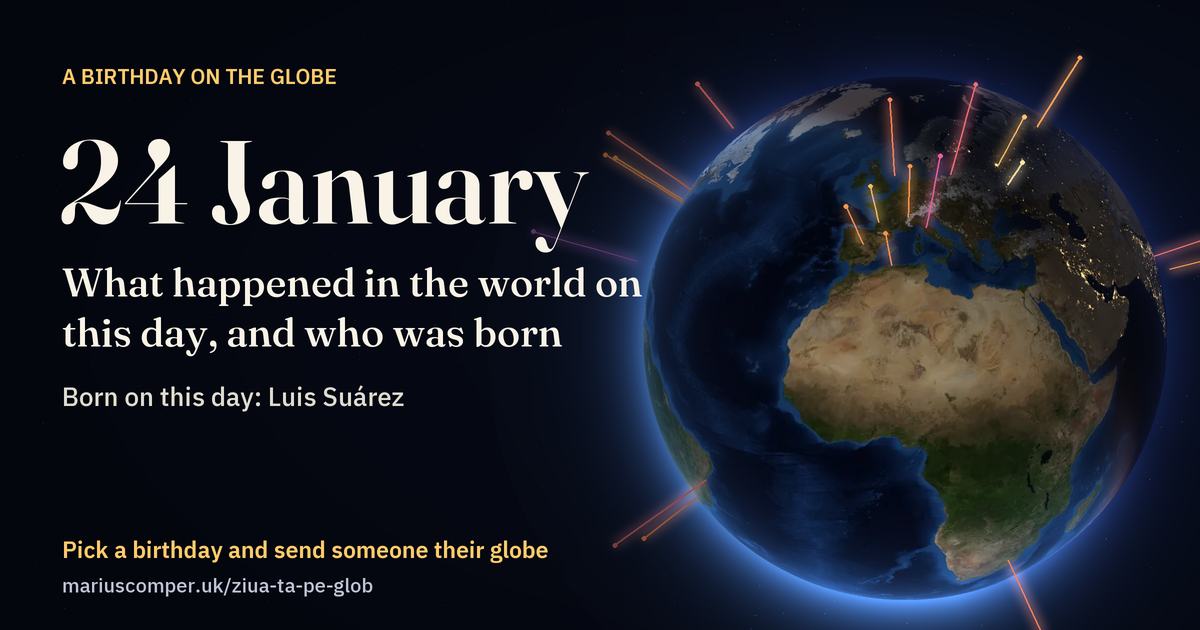
For 24 January, the English Wikipedia lists 44 events and 205 births. 21 of the events stand at their places as rays of light; two more are dashed circles, where the sentence links only to a country or a sea. The taller the ray, the longer ago it happened. The people born that day come further down, as blue points.
A birthday, yours or someone else’s:
Turn it into a greetingScroll: the globe turns to each place
The day you were born, on the globe.
Three things from your day
Scroll: your day first, then 24 January through the years
The Earth on 24 January
The picture on the globe was assembled by NASA from satellite photographs taken in January 2004: the snow, the ice and the green are those of the month.
On 24 January the Sun passes straight overhead at noon along the parallel of 19.3° south. In London, the day lasts about 8 hours 45 minutes.
Beyond 71° south the Sun no longer sets; beyond 71° north it no longer rises.
The line between day and night is tilted on the globe exactly as on this day of the year. On the dark side you can see the lights of towns.
Europe · Council of Florence
1438
The Council of Basel suspends Pope Eugene IV.
On the map: Council of Florence.
Also on the day’s list of Wikipedia in Spanish.
Asia · University of Calcutta
1857
The University of Calcutta is formally founded as the first fully fledged university in South Asia.
On the map: University of Calcutta.
Also on the day’s list of Wikipedia in Spanish.
Latin America · Quiriguá
771
Kʼakʼ Tiliw Chan Yopaat dedicated a 65-ton stele, the largest stone known to be quarried by the Maya civilization, at his city of Quiriguá.
On the map: Quiriguá.
Also on the day’s list of Wikipedia in Chinese.
North America · California gold rush
1848
California Gold Rush: James W. Marshall finds gold at Sutter's Mill near Sacramento.
On the map: California gold rush.
Also on the day’s list of Wikipedia in Spanish, Romanian and Chinese.
North America · Supreme Court of the United States
1916
In Brushaber v. Union Pacific Railroad Co., the Supreme Court of the United States declares the federal income tax constitutional.
On the map: Supreme Court of the United States.
Also on the day’s list of Wikipedia in Spanish.
24 January
What the other Wikipedias remember#
For these years the English list has nothing on this day. The events below come from the same day’s lists on Wikipedia in Spanish and Chinese and were translated for this page.
From Wikipedia in Spanish · Tuamotus
1521
In the Tuamotu archipelago, Ferdinand Magellan discovers the island of San Pablo.
On the map: Tuamotus.
Translated from the list on Wikipedia in Spanish.
From Wikipedia in Chinese · Saint Petersburg
1924
After the death of Vladimir Lenin, the Soviet government renames Petrograd, built by Peter the Great, as "Leningrad".
On the map: Saint Petersburg.
Translated from the list on Wikipedia in Chinese.
From Wikipedia in Spanish · New York City
1983
The American tennis player John McEnroe beats the Czech Ivan Lendl and is proclaimed champion of the Masters tournament held in New York.
On the map: New York City.
Translated from the list on Wikipedia in Spanish.
24 January
Born on 24 January#
The English Wikipedia lists 205 births for this day. The blue points are the birthplaces of 60 of these people: those written about in the most Wikipedia editions, where Wikidata gives a place of birth.
Born on 24 January
1732
Pierre Beaumarchais, French playwright and financier (died 1799)
Place of birth: rue Saint-Denis.
Born on 24 January
1776
E. T. A. Hoffmann, German jurist, author, and composer (died 1822)
Place of birth: Königsberg.
Born on 24 January
1862
Edith Wharton, American novelist and short story writer (died 1937)
Place of birth: New York City.
Born on 24 January
1917
Ernest Borgnine, American actor (died 2012)
Place of birth: Hamden.
Born in Britain and Ireland
1928
Desmond Morris, English zoologist, ethologist, and painter (died 2026)
Place of birth: Purton.
Born in Britain and Ireland
1986
Mischa Barton, English-American actress
Place of birth: Hammersmith.
Born in Britain and Ireland
1670
William Congreve, English playwright and poet (died 1729)
Place of birth: Leeds.
24 January
Number one in the charts that week
At the cinema
An animal recorded that day
The record can be seen in GBIF, which brings together wildlife records from around the world.
All your birthdays
The weather that day
Data: Met Office Hadley Centre (HadCET); NOAA (GHCN-Daily, Mauna Loa).
Above the Earth
Sources: Jonathan McDowell, GCAT (launches); GFZ Potsdam (Kp index). Days are counted in Universal Time.
Football that day
International matches played that day:
Source: the “International football results” dataset kept by Mart Jürisoo (CC0).
Also that day
The earthquake’s page at the USGS
Source: the USGS catalogue. The day is counted in Universal Time (UTC).
In those days
Make a link for someone
Type the name, pick the day and the year of birth. The link opens straight on their day, with their name in the greeting.
The link carries the name, date and place typed here; anyone who gets it can see them.
Put another birthday beside it
Your mother’s, your child’s, a friend’s: the two days appear side by side.
Below: 24 January through the years.
The whole globe of the day
Drag the globe to turn it. Touch a ray or a point to read what happened there.
Everything Wikipedia lists for 24 January
The list is the English Wikipedia’s, in its own wording, as it stood in October 2026. 21 events have no place on the map: the sentence links to no place with coordinates, only to places too wide to mark, or to several countries.
- 41
Claudius is proclaimed Roman emperor by the Praetorian Guard after they assassinate the previous emperor, his nephew Caligula.
no place on the mapWikipedia: Claudius - 771
Kʼakʼ Tiliw Chan Yopaat dedicated a 65-ton stele, the largest stone known to be quarried by the Maya civilization, at his city of Quiriguá.
Latin America · QuiriguáWikipedia: Kʼakʼ Tiliw Chan Yopaat - 914
Start of the First Fatimid invasion of Egypt.
no place on the mapWikipedia: Fatimid invasion of Egypt - 1438
The Council of Basel suspends Pope Eugene IV.
Europe · Council of FlorenceWikipedia: Council of Florence - 1458
Matthias Corvinus is elected King of Hungary.
no place on the mapWikipedia: Matthias Corvinus - 1536
King Henry VIII of England suffers an accident while jousting, leading to a brain injury that historians say may have influenced his later erratic behaviour and possible impotence.
no place on the mapWikipedia: Henry VIII - 1651
Arauco War: Spanish and Mapuche authorities meet in the Parliament of Boroa renewing the fragile peace established at the parliaments of Quillín in 1641 and 1647.
no place on the mapWikipedia: Arauco War - 1679
King Charles II of England dissolves the Cavalier Parliament.
no place on the mapWikipedia: Charles II of England - 1742
Charles VII Albert becomes Holy Roman Emperor.
no place on the mapWikipedia: Charles VII, Holy Roman Emperor - 1758
During the Seven Years' War the leading burghers of Königsberg submit to Elizabeth of Russia, thus forming Russian Prussia (until 1763).
Europe · KönigsbergWikipedia: Seven Years' War - 1817
Crossing of the Andes: Many soldiers of Juan Gregorio de las Heras are captured during the action of Picheuta.
no place on the mapWikipedia: Crossing of the Andes - 1835
Slaves in Salvador da Bahia, Brazil, stage a revolt, which is instrumental in ending slavery there 50 years later.
Latin America · SalvadorWikipedia: Malê revolt - 1848
California Gold Rush: James W. Marshall finds gold at Sutter's Mill near Sacramento.
North America · California gold rushWikipedia: California gold rush - 1857
The University of Calcutta is formally founded as the first fully fledged university in South Asia.
Asia · University of CalcuttaWikipedia: University of Calcutta - 1859
The United Principalities of Moldavia and Wallachia (later named Romania) is formed as a personal union under the rule of Domnitor Alexandru Ioan Cuza.
no place on the mapWikipedia: United Principalities of Moldavia and Wallachia - 1900
Second Boer War: Boers stop a British attempt to break the Siege of Ladysmith in the Battle of Spion Kop.
Africa · Siege of LadysmithWikipedia: Second Boer War - 1908
The first Boy Scout troop is organized in England by Robert Baden-Powell.
no place on the mapWikipedia: Scouting - 1913
Greek military aviators Michael Moutoussis and Aristeidis Moraitinis performed the first naval air mission in history, with a Farman MF.7 hydroplane.
no place on the mapWikipedia: Michael Moutoussis - 1915
World War I: British Grand Fleet battle cruisers under Vice-Admiral Sir David Beatty engage Rear-Admiral Franz von Hipper's battle cruisers in the Battle of Dogger Bank.
Oceans · Battle of Dogger BankWikipedia: World War I - 1916
In Brushaber v. Union Pacific Railroad Co., the Supreme Court of the United States declares the federal income tax constitutional.
North America · Supreme Court of the United StatesWikipedia: Supreme Court of the United States - 1918
The Gregorian calendar is introduced in Russia by decree of the Council of People's Commissars effective February 14 (New Style).
no place on the mapWikipedia: Gregorian calendar - 1933
The 20th Amendment to the United States Constitution is ratified, changing the beginning and end of terms for all elected federal offices.
no place on the mapWikipedia: Twentieth Amendment to the United States Constitution - 1935
Gottfried Krueger Brewing Company starts selling the first canned beer.
no place on the mapWikipedia: Gottfried Krueger Brewing Company - 1939
The deadliest earthquake in Chilean history strikes Chillán, killing approximately 28,000 people.
Latin America · 1939 Chillán earthquakeWikipedia: 1939 Chillán earthquake - 1942
World War II: The Allies bombard Bangkok, leading Thailand, then under Japanese control, to declare war against the United States and United Kingdom.
no place on the mapWikipedia: Bombing of Bangkok in World War II - 1943
World War II: Franklin D. Roosevelt and Winston Churchill conclude a conference in Casablanca.
no place on the mapWikipedia: Casablanca Conference - 1946
The United Nations General Assembly passes its first resolution to establish the United Nations Atomic Energy Commission.
no place on the mapWikipedia: United Nations General Assembly - 1960
Algerian War: Some units of European volunteers in Algiers stage an insurrection known as the "barricades week", during which they seize government buildings and clash with local police.
Africa · AlgiersWikipedia: Algerian War - 1961
Goldsboro B-52 crash: A bomber carrying two H-bombs breaks up in mid-air over North Carolina. The uranium core of one weapon remains lost.
North America · 1961 Goldsboro B-52 crashWikipedia: 1961 Goldsboro B-52 crash - 1966
Air India Flight 101 crashes into Mont Blanc.
Europe · Air India Flight 101Wikipedia: Air India Flight 101 - 1968
Vietnam War: The 1st Australian Task Force launches Operation Coburg against the North Vietnamese Army and Viet Cong during wider fighting around Long Bình and Biên Hòa.
Asia · Operation CoburgWikipedia: Vietnam War - 1972
Japanese Sgt. Shoichi Yokoi is found hiding in a Guam jungle, where he had been since the end of World War II.
Oceania · GuamWikipedia: Shoichi Yokoi - 1977
The Atocha massacre occurs in Madrid during the Spanish transition to democracy.
Europe · 1977 Atocha massacreWikipedia: 1977 Atocha massacre - 1978
Soviet satellite Kosmos 954, with a nuclear reactor on board, burns up in Earth's atmosphere, scattering radioactive debris over Canada's Northwest Territories. Only 1% is recovered.
no place on the mapWikipedia: Soviet Union - 1986
The Voyager 2 space probe makes its closest approach to Uranus.
no place on the mapWikipedia: Voyager 2 - 1987
About 20,000 protestors march in a civil rights demonstration in Forsyth County, Georgia, United States.
North America · 1987 Forsyth County protestsWikipedia: 1987 Forsyth County protests - 1988
An Aeroflot Yakovlev Yak-40 crashes at Nizhnevartovsk Airport, killing 27 people.
Asia · Nizhnevartovsk AirportWikipedia: Aeroflot - 1990
Japan launches Hiten, the country's first lunar probe, the first robotic lunar probe since the Soviet Union's Luna 24 in 1976, and the first lunar probe launched by a country other than Soviet Union or the United States.
Asia · Soviet UnionWikipedia: Hiten - 2003
The United States Department of Homeland Security officially begins operation.
no place on the mapWikipedia: United States Department of Homeland Security - 2009
Cyclone Klaus makes landfall near Bordeaux, France, causing 26 deaths as well as extensive disruptions to public transport and power supplies.
Europe · BordeauxWikipedia: Cyclone Klaus - 2011
At least 35 are killed and 180 injured in a bombing at Moscow's Domodedovo Airport.
Europe · Domodedovo International Airport bombingWikipedia: Domodedovo International Airport bombing - 2018
Former doctor Larry Nassar is sentenced up to 175 years in prison after being found guilty of using his position to sexually abuse female gymnasts.
no place on the mapWikipedia: Larry Nassar - 2024
An Ilyushin Il-76 crashes in Russia's Korochansky District, killing all 74 people on board.
Europe · 2024 Korochansky Ilyushin Il-76 crashWikipedia: 2024 Korochansky Ilyushin Il-76 crash - 2026
At least 70 people are killed and 10 others missing after major landslides in West Java, Indonesia.
Asia · 2026 West Bandung landslideWikipedia: 2026 West Bandung landslide
What the other Wikipedias remember
For these years the English list has nothing on this day. The events below come from the same day’s lists on Wikipedia in Spanish and Chinese and were translated for this page.
- 1521
In the Tuamotu archipelago, Ferdinand Magellan discovers the island of San Pablo.
- 1924
After the death of Vladimir Lenin, the Soviet government renames Petrograd, built by Peter the Great, as "Leningrad".
- 1983
The American tennis player John McEnroe beats the Czech Ivan Lendl and is proclaimed champion of the Masters tournament held in New York.
Who was born on 24 January
In order of how many Wikipedia editions have an article about each. The first 60 of 205 are shown.
- 1712
Frederick the Great, Prussian king (died 1786)
- 1987
Luis Suárez, Uruguayan footballer
- 76
Hadrian, Roman emperor (died 138)
ItalicaWikipedia: Hadrian - 1953
Moon Jae-in, South Korean politician, 19th President of South Korea
- 1940
Joachim Gauck, German pastor and politician, 11th President of Germany
RostockWikipedia: Joachim Gauck - 1732
Pierre Beaumarchais, French playwright and financier (died 1799)
rue Saint-DenisWikipedia: Pierre-Augustin de Beaumarchais - 1776
E. T. A. Hoffmann, German jurist, author, and composer (died 1822)
KönigsbergWikipedia: E. T. A. Hoffmann - 1862
Edith Wharton, American novelist and short story writer (died 1937)
New York CityWikipedia: Edith Wharton - 1917
Ernest Borgnine, American actor (died 2012)
- 1947
Michio Kaku, American physicist and academic
San JoseWikipedia: Michio Kaku - 1941
Dan Shechtman, Israeli chemist and academic, Nobel Prize laureate
Tel AvivWikipedia: Dan Shechtman - 1943
Sharon Tate, American model and actress (died 1969)
DallasWikipedia: Sharon Tate - 1961
Nastassja Kinski, German-American actress and producer
West BerlinWikipedia: Nastassja Kinski - 1679
Christian Wolff, German philosopher and academic (died 1754)
WrocławWikipedia: Christian Wolff - 1746
Gustav III of Sweden (died 1792)
The Royal Court ParishWikipedia: Gustav III - 1941
Neil Diamond, American singer-songwriter and guitarist
BrooklynWikipedia: Neil Diamond - 1949
John Belushi, American actor and screenwriter (died 1982)
Humboldt ParkWikipedia: John Belushi - 1950
Daniel Auteuil, French actor, director, and screenwriter
AlgiersWikipedia: Daniel Auteuil - 1891
Walter Model, German field marshal (died 1945)
GenthinWikipedia: Walter Model - 1848
Vasily Surikov, Russian painter (died 1916)
KrasnoyarskWikipedia: Vasily Surikov - 1961
Guido Buchwald, German footballer and manager
West BerlinWikipedia: Guido Buchwald - 1888
Vicki Baum, Austrian author and screenwriter (died 1960)
ViennaWikipedia: Vicki Baum - 1928
Desmond Morris, English zoologist, ethologist, and painter (died 2026)
- 1970
Matthew Lillard, American actor
LansingWikipedia: Matthew Lillard - 1986
Mischa Barton, English-American actress
HammersmithWikipedia: Mischa Barton - 1670
William Congreve, English playwright and poet (died 1729)
- 1967
Phil LaMarr, American actor and comedian
Los AngelesWikipedia: Phil LaMarr - 1916
Rafael Caldera, Venezuelan lawyer and politician, 65th President of Venezuela (died 2009)
San FelipeWikipedia: Rafael Caldera - 1989
Ki Sung-yueng, South Korean footballer
GwangjuWikipedia: Ki Sung-yueng - 1705
Farinelli, Italian castrato singer (died 1782)
AndriaWikipedia: Farinelli - 1978
Kristen Schaal, American actress, voice artist, comedian and writer
LongmontWikipedia: Kristen Schaal - 1979
Tatyana Ali, American actress and singer
North BellmoreWikipedia: Tatyana Ali - 1664
John Vanbrugh, English architect and dramatist (died 1726)
City of LondonWikipedia: John Vanbrugh - 1749
Charles James Fox, English businessman and politician, Secretary of State for Foreign and Commonwealth Affairs (died 1806)
WestminsterWikipedia: Charles James Fox - 1928
Michel Serrault, French actor (died 2007)
- 1907
Maurice Couve de Murville, French soldier and politician, Prime Minister of France (died 1999)
- 1925
Maria Tallchief, American ballerina and actress (died 2013)
FairfaxWikipedia: Maria Tallchief - 1981
Carrie Coon, American actress
Copley TownshipWikipedia: Carrie Coon - 1886
Henry King, American actor, director, producer, and screenwriter (died 1982)
ChristiansburgWikipedia: Henry King - 1931
Lars Hörmander, Swedish mathematician and academic (died 2012)
MjällbyWikipedia: Lars Hörmander - 1959
Michel Preud'homme, Belgian footballer and manager
- 1974
Ed Helms, American actor, producer, and screenwriter
AtlantaWikipedia: Ed Helms - 1444
Galeazzo Maria Sforza, Duke of Milan (died 1476)
- 1989
Gong Lijiao, Chinese shot putter
Luquan DistrictWikipedia: Gong Lijiao - 1947
Giorgio Chinaglia, Italian footballer (died 2012)
CarraraWikipedia: Giorgio Chinaglia - 1972
Beth Hart, American singer-songwriter and musician
Los AngelesWikipedia: Beth Hart - 1977
Michelle Hunziker, Swiss-Dutch actress, model and singer
SorengoWikipedia: Michelle Hunziker - 1983
Shaun Maloney, Scottish footballer
- 1888
Ernst Heinkel, German engineer and businessman, founded the Heinkel Aircraft Manufacturing Company (died 1958)
Grunbach stationWikipedia: Ernst Heinkel - 1968
Mary Lou Retton, American gymnast
FairmontWikipedia: Mary Lou Retton - 1983
Scott Speed, American race car driver
MantecaWikipedia: Scott Speed - 1547
Joanna of Austria, Grand Duchess of Tuscany, Austrian Archduchess (died 1578)
- 1864
Marguerite Durand, French actress, journalist, and activist (died 1936)
8th arrondissement of ParisWikipedia: Marguerite Durand - 1955
Alan Sokal, American physicist and author
- 1926
Georges Lautner, French director and screenwriter (died 2013)
- 1967
Michael Kiske, German singer
HamburgWikipedia: Michael Kiske - 1684
Charles Alexander, Duke of Württemberg, German noble (died 1737)
- 1953
Yuri Bashmet, Russian violinist, viola player, and conductor
Rostov-on-DonWikipedia: Yuri Bashmet - 1966
Karin Viard, French actress
- 1915
Robert Motherwell, American painter and academic (died 1991)
AberdeenWikipedia: Robert Motherwell
What is celebrated on 24 January
- Christian feast day: Babylas of Antioch
- Christian feast day: Exuperantius of Cingoli
- Christian feast day: Felician of Foligno
- Christian feast day: Francis de Sales
- Christian feast day: Blessed Marie Poussepin
- Christian feast day: Pratulin Martyrs (Greek Catholic Church)
- Christian feast day: January 24 (Eastern Orthodox liturgics)
- Day of the Unification of the Romanian Principalities (Romania)
- Feast of Our Lady of Peace (Roman Catholic Church), and its related observances: Feria de Alasitas (La Paz)
- Uttar Pradesh Day (Uttar Pradesh, India)
- National Girl Child Day (India)
A greeting link for someone
Type a name and, if you like, the year of birth. The link opens with a greeting, and beside each event it says how old the person turned that day, or how many years before their birth it happened.
The name and the year go only into the link you send.
All 366 days
How the globe is made
Where the events come from
Each edition of this page uses the day’s list from Wikipedia in its own language: Romanian, English, Spanish, Chinese. The lists are written by volunteers and differ from one edition to the next; the text of each event is Wikipedia’s, with a link to the article. A row that appears twice in a list is shown once. The lists have not been checked event by event: they are Wikipedia’s, mistakes included.
For events before 1582, and for countries that moved to the Gregorian calendar later (Britain in 1752, Russia in 1918), the same day may be counted Old Style in one list and New Style in another.
The chapter “What the other Wikipedias remember” adds up to five events a day from the lists of the other three editions, only for years in which the English list has nothing on that day. They were translated for this page, passed the same filters as the tour, and are not counted among the events of the English list.
How an event gets onto the map
The place comes from Wikidata. If the sentence links to the article about the event itself (a battle, an opening, an earthquake), dated to the same year, the ray stands on its coordinates or on those of its location. Otherwise it stands on the first place the sentence links to: a town, a building, a mountain, an island. This second step can be wrong: sometimes the sentence only mentions the place. That is why the page says, under each event, which place the ray stands on.
When the sentence links to a single state or province, or to a single sea, lake or desert larger than 5,000 km², the globe shows a dashed circle, not a ray. The circle has the area Wikidata gives, with its radius kept between 1.2° and 16°, or a radius of 4.5° when Wikidata gives no area; it says only that the sentence links to that place. Organisations, ships, spacecraft, museum objects, rivers, mountain ranges, languages and continents are never used as places. When a sentence names several states and no exact place, the event stays in the list only.
What the height means
The height of a ray shows how many years have passed, on a logarithmic scale: 10 years, 100 years and 1,000 years are equal steps apart; anything older than about 2,600 years has the tallest ray. The colour runs from pale yellow for recent years to violet for antiquity.
Where the tour stops
In each region the tour stops at up to three events (five in Britain and Ireland), chosen mainly by three things: whether Wikipedia’s editors put the event in the “On this day” box of their main page (the English, Spanish and Chinese editions), how many Wikipedia editions have an article about it, and how many of the four lists include it. Events whose sentence or article is about a war, an attack, a crime or a disaster are left out of the tour; they stay in the whole list, in Wikipedia’s wording. The filter is a list of words and a list of Wikidata types, so it can miss some.
The tour of births names the people with articles in the most editions and leaves aside those whom the list or Wikidata describes as rulers, politicians, commanders, leaders of movements or criminals; they stay in the list.
The Earth and the Sun
The daytime images are NASA’s Blue Marble Next Generation mosaics, one for each month of 2004; the night side is Black Marble 2016. The tilt of the line between day and night is computed for the day; the hour is chosen so that the place being read is in daylight. The latitude where the Sun stands overhead is the average of the four years of the leap cycle; in a given year it can differ by up to 0.4°.
The day you were born
The number ones come from the weekly lists on Wikipedia: Billboard for the United States (from 1940; the Hot 100 from August 1958), the UK Singles Chart (from November 1952), Los 40 Principales for Spain (from July 1966) and, for Romania, the Romanian Top 100 and Airplay 100 (2001–2021, with missing weeks). The page shows the chart of the week in which the day of birth falls, with its date; Billboard and the UK chart are dated at the end of their week. For Romania before 2001 and for China these sources have no weekly chart.
The films are those that reached cinemas in the United States up to ten days before or three days after that day (some of them in a few cinemas at first), from the English Wikipedia’s yearly lists (from 1968), in order of how many editions have an article about them. The events “in those days” are the ones on the neighbouring days’ lists that carry the year of birth, passed through the same filter as the tour.
The day of birth, year included
The Moon, the star sign and the constellation are worked out by the page itself, for noon Universal Time on the day. The lit part of the Moon is rounded and can differ by a few per cent from that at the hour of birth. The sign follows the usual zodiac of twelve equal parts starting at the March equinox; the constellation is the one the Sun actually stood in front of, by the borders set by the International Astronomical Union, and within a day of a border the page does not name it. When the Sun changes sign while it is that day anywhere on Earth, the page gives the moment of crossing, rounded to ten minutes and accurate to within about a quarter of an hour, and the clock time in a few cities, with the time zone and summer time of that year.
The year in the Chinese calendar is the one your device’s own calendar gives for the date, checked against the Hong Kong Observatory’s tables. “All your birthdays” uses the same sources as the rest of the chapter for the same day in every year since the birth: the temperature, well-known launches that took place on that very day, matches of the teams the edition follows, snow deeper than 10 cm and strong geomagnetic storms. The three things at the top and the four on the picture are chosen in a fixed order (the song, the animal, a full Moon, a well-known launch before an ordinary earthquake); on the picture you can change them.
When the link carries a year of birth, the page adds a few things about that exact day. The weather is the Met Office’s Central England temperature record and the readings from New York’s Central Park; the “usual high” is the average of the daily highs of 1961–1990 for that date, with two days either side. The carbon dioxide figure is the monthly mean at the Mauna Loa observatory, where measurements begin in March 1958.
The earthquake is the one with the largest magnitude in the USGS catalogue for that day, counted in Universal Time. Before the 1960s the catalogue has gaps even above magnitude 5.5, so in the older years many days have no earthquake. The page gives only the magnitude and the place: the country the epicentre falls in or, when the epicentre is at sea within 300 km of a coast, the nearest country; farther out, only the ocean.
The launches are those that reached orbit or left for the Moon and the planets, from Jonathan McDowell’s GCAT catalogue. If nothing left that day, the page shows the nearest launch within three days before or after, and says how many days away it was. The geomagnetic storm appears only when the Kp index reached at least 5 in one of the day’s eight three-hour intervals.
The animal comes from GBIF: an observation made by a person (the animal seen or heard, or its tracks), dated to that exact day, with coordinates and a CC0 or CC BY licence. Only a few hundred well-known species are searched (mammals, birds, turtles, butterflies); of those noted that day, mammals and species with articles in many Wikipedia editions come first; birds noted almost every day, and species used recently, wait their turn. Observations dated 1 January are left out, because records without a day are often filed there. An observation shows that the animal was recorded there, not how many animals there were.
The matches are those between national teams. Only matches of England, Scotland, Wales, Northern Ireland, the Republic of Ireland, the United States, Canada and Australia are shown, along with those at the big final tournaments. The picture to send is drawn in the page from the day’s globe and the facts above, and stays on your device until you send it.
Sources
- Events, births and holidays: the day’s page on Wikipedia, text under CC BY-SA 4.0.
- Coordinates, places of birth and the number of editions: Wikidata (CC0).
- The Earth by day: NASA Blue Marble Next Generation. The Earth by night: NASA Black Marble 2016.
- Borders and regions: Natural Earth.
- World population and births per year: UN World Population Prospects 2024.
- Charts and films: Wikipedia’s lists for Billboard, the UK Singles Chart, Los 40 Principales, Romanian Top 100, Airplay 100 and American films by year (CC BY-SA 4.0).
- Weather: Met Office Hadley Centre, HadCET (Open Government Licence) and NOAA GHCN-Daily, New York Central Park. Carbon dioxide: NOAA Global Monitoring Laboratory, Mauna Loa.
- Earthquakes: the USGS catalogue. Launches: Jonathan McDowell, GCAT (CC BY). Kp index: GFZ Potsdam (CC BY 4.0). Matches: International football results, Mart Jürisoo (CC0).
- Animal observations: GBIF, with a link to each record; species names come from Wikidata.