A birthday on the globe
4 October on the globe: what happened in the world on this day, and who was born
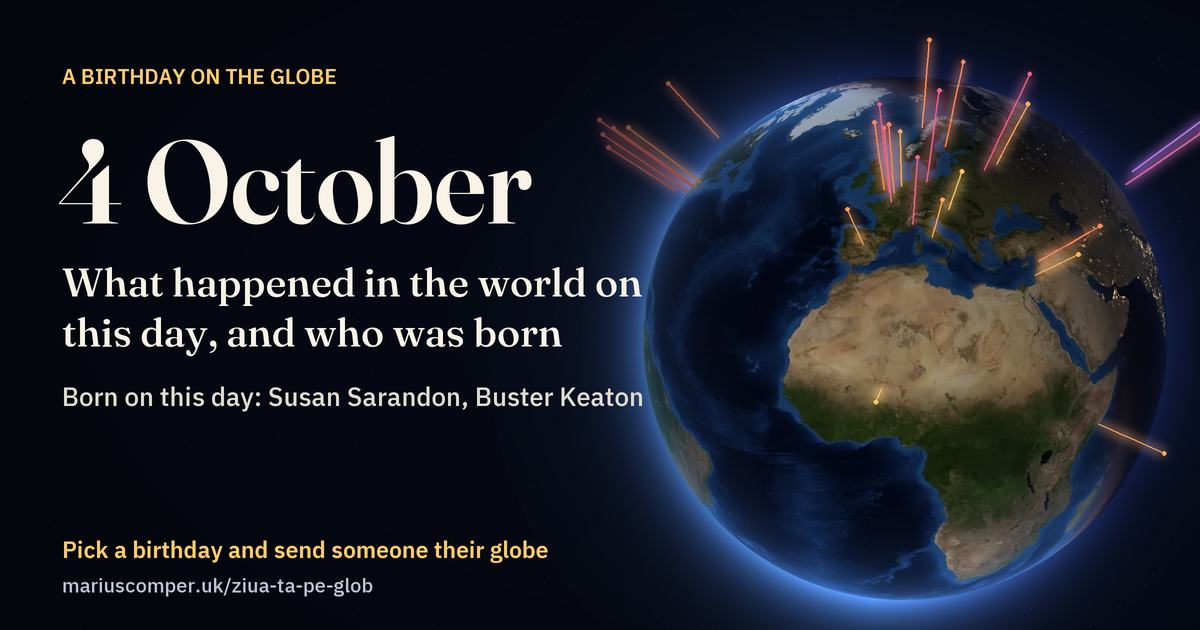
For 4 October, the English Wikipedia lists 52 events and 237 births. 26 of the events stand at their places as rays of light; two more are dashed circles, where the sentence links only to a country or a sea. The taller the ray, the longer ago it happened. The people born that day come further down, as blue points.
A birthday, yours or someone else’s:
Turn it into a greetingScroll: the globe turns to each place
The day you were born, on the globe.
Three things from your day
Scroll: your day first, then 4 October through the years
The Earth on 4 October
The picture on the globe was assembled by NASA from satellite photographs taken in October 2004: the snow, the ice and the green are those of the month.
On 4 October the Sun passes straight overhead at noon along the parallel of 4.3° south. In London, the day lasts about 11 hours 25 minutes.
Beyond 86° south the Sun no longer sets; beyond 86° north it no longer rises.
The line between day and night is tilted on the globe exactly as on this day of the year. On the dark side you can see the lights of towns.
Europe · Madrid
1991
The Protocol on Environmental Protection to the Antarctic Treaty is opened for signature.
On the map: Madrid.
Wikipedia: Protocol on Environmental Protection to the Antarctic Treaty
North America · Texas A&M University
1876
The Agricultural and Mechanical College of Texas (now known as Texas A&M) opens as the first public college in Texas.
On the map: Texas A&M University.
Also on the day’s list of Wikipedia in Chinese.
North America · Mount Rushmore
1927
Gutzon Borglum begins sculpting Mount Rushmore.
On the map: Mount Rushmore.
Also on the day’s list of Wikipedia in Chinese.
4 October
What the other Wikipedias remember#
For these years the English list has nothing on this day. The events below come from the same day’s lists on Wikipedia in Romanian and were translated for this page.
From Wikipedia in Romanian · Frankfurt
1745
Francis I, Holy Roman Emperor, husband of Maria Theresa, is crowned at Frankfurt am Main.
On the map: Frankfurt.
Translated from the list on Wikipedia in Romanian.
The article on Wikipedia in Romanian: Maria Terezia a Austriei
4 October
Born on 4 October#
The English Wikipedia lists 237 births for this day. The blue points are the birthplaces of 60 of these people: those written about in the most Wikipedia editions, where Wikidata gives a place of birth.
Born on 4 October
1946
Susan Sarandon, American actress and activist
Place of birth: Jackson Heights.
Born on 4 October
1895
Buster Keaton, American film actor, director, and producer (died 1966)
Place of birth: Piqua.
Born on 4 October
1923
Charlton Heston, American actor, director and gun rights activist (died 2008)
Place of birth: Evanston.
Born on 4 October
1916
Vitaly Ginzburg, Russian physicist and academic, Nobel Prize laureate (died 2009)
Place of birth: Moscow.
Born on 4 October
1956
Christoph Waltz, Austrian-German actor
Place of birth: Vienna.
Born in Britain and Ireland
1979
Caitríona Balfe, Irish actress
Place of birth: Dublin.
Born in Britain and Ireland
1937
Jackie Collins, English-American author and actress (died 2015)
Place of birth: Hampstead.
Born in Britain and Ireland
1996
Ella Balinska, English actress
Place of birth: London.
4 October
Number one in the charts that week
At the cinema
An animal recorded that day
The record can be seen in GBIF, which brings together wildlife records from around the world.
All your birthdays
The weather that day
Data: Met Office Hadley Centre (HadCET); NOAA (GHCN-Daily, Mauna Loa).
Above the Earth
Sources: Jonathan McDowell, GCAT (launches); GFZ Potsdam (Kp index). Days are counted in Universal Time.
Football that day
International matches played that day:
Source: the “International football results” dataset kept by Mart Jürisoo (CC0).
Also that day
The earthquake’s page at the USGS
Source: the USGS catalogue. The day is counted in Universal Time (UTC).
In those days
Make a link for someone
Type the name, pick the day and the year of birth. The link opens straight on their day, with their name in the greeting.
The link carries the name, date and place typed here; anyone who gets it can see them.
Put another birthday beside it
Your mother’s, your child’s, a friend’s: the two days appear side by side.
Below: 4 October through the years.
The whole globe of the day
Drag the globe to turn it. Touch a ray or a point to read what happened there.
Everything Wikipedia lists for 4 October
The list is the English Wikipedia’s, in its own wording, as it stood in October 2026. 24 events have no place on the map: the sentence links to no place with coordinates, only to places too wide to mark, or to several countries.
- 23
Rebels sack the Chinese capital Chang'an during a peasant rebellion.
Asia · Chang'anWikipedia: Chang'an - 1209
Otto IV is crowned Emperor of the Holy Roman Empire by Pope Innocent III.
Europe · Holy Roman EmpireWikipedia: Otto IV, Holy Roman Emperor - 1302
The Byzantine–Venetian War comes to an end.
no place on the mapWikipedia: Byzantine–Venetian War - 1363
Battle of Lake Poyang: In one of the largest naval battles in history, Zhu Yuanzhang's rebels defeat rival Chen Youliang.
Asia · Battle of Lake PoyangWikipedia: Battle of Lake Poyang - 1448
Skanderbeg and Gjergj Arianiti signed a peace treaty to end the Albanian–Venetian War.
no place on the mapWikipedia: Albanian–Venetian War - 1511
Formation of the Holy League of Aragon, the Papal States and Venice against France.
no place on the mapWikipedia: War of the League of Cambrai - 1535
The Coverdale Bible is printed, with translations into English by William Tyndale and Myles Coverdale.
no place on the mapWikipedia: Coverdale Bible - 1582
The Gregorian Calendar is introduced by Pope Gregory XIII.
no place on the mapWikipedia: Gregorian calendar - 1602
Eighty Years' War and the Anglo-Spanish War: A fleet of Spanish galleys are defeated by English and Dutch galleons in the English Channel.
Britain & Ireland · Battle of the Narrow SeasWikipedia: Eighty Years' War - 1633
Smolensk War: Forces from the Polish–Lithuanian Commonwealth broke the Russian siege of Smolensk.
Europe · Siege of SmolenskWikipedia: Smolensk War - 1636
Thirty Years' War: The Swedish Army defeats the armies of Saxony and the Holy Roman Empire at the Battle of Wittstock.
Europe · Battle of WittstockWikipedia: Battle of Wittstock - 1693
Nine Years' War: Piedmontese troops are defeated by the French.
Europe · Battle of MarsagliaWikipedia: Nine Years' War - 1777
American Revolutionary War: Troops under George Washington are repelled by British troops under William Howe.
North America · Battle of GermantownWikipedia: Battle of Germantown - 1795
Napoleon first rises to prominence by suppressing counter-revolutionary rioters threatening the National Convention.
Europe · 13 VendémiaireWikipedia: 13 Vendémiaire - 1824
Mexico adopts a new constitution and becomes a federal republic.
no place on the mapWikipedia: 1824 Constitution of Mexico - 1830
The Belgian Revolution takes legal form when the provisional government secedes from the Netherlands.
no place on the mapWikipedia: Belgian Revolution - 1853
The Crimean War begins when the Ottoman Empire declares war on the Russian Empire.
no place on the mapWikipedia: Crimean War - 1862
American Civil War: The two-day Second Battle of Corinth ends in a Union victory, with General William Rosecrans protecting the critical rail junction of Corinth, Mississippi from Confederate forces under General Earl Van Dorn.
North America · Second Battle of CorinthWikipedia: American Civil War - 1876
The Agricultural and Mechanical College of Texas (now known as Texas A&M) opens as the first public college in Texas.
North America · Texas A&M UniversityWikipedia: Texas A&M University - 1883
First meeting of the Boys' Brigade in Glasgow, Scotland.
no place on the mapWikipedia: Boys' Brigade - 1895
Horace Rawlins wins the first U.S. Open Men's Golf Championship.
no place on the mapWikipedia: Horace Rawlins - 1917
World War I: The Battle of Broodseinde is fought between the British and German armies in Flanders.
Europe · Battle of BroodseindeWikipedia: World War I - 1918
First World War: The Japanese merhant ship Hirano Maru was sunk by a German submarine in the Celtic Sea with the loss of 291 lives.
no place on the mapWikipedia: World War I - 1918
World War I: An explosion kills more than 100 people and destroys a Shell Loading Plant in New Jersey.
North America · T. A. Gillespie Company Shell Loading Plant explosionWikipedia: T. A. Gillespie Company Shell Loading Plant explosion - 1920
The Mannerheim League for Child Welfare, a Finnish non-governmental organization, is founded on the initiative of Sophie Mannerheim.
no place on the mapWikipedia: Mannerheim League for Child Welfare - 1925
Great Syrian Revolt: Rebels led by Fawzi al-Qawuqji capture Hama from the French Mandate of Syria.
Asia · 1925 Hama uprisingWikipedia: 1925 Hama uprising - 1925
S2, a Finnish Sokol class torpedo boat, sinks during a fierce storm near the coast of Pori in the Gulf of Bothnia, taking with it the whole crew of 53.
Europe · PoriWikipedia: Finnish torpedo boat S2 - 1927
Gutzon Borglum begins sculpting Mount Rushmore.
North America · Mount RushmoreWikipedia: Gutzon Borglum - 1936
The Metropolitan Police and various anti-fascist organizations violently clash in the Battle of Cable Street.
Britain & Ireland · Battle of Cable StreetWikipedia: Battle of Cable Street - 1941
Norman Rockwell's Willie Gillis character debuts on the cover of The Saturday Evening Post.
no place on the mapWikipedia: Willie Gillis - 1943
World War II: Allied forces executed Operation Leader, an air raid against German shipping near Bodø, Norway.
Europe · Operation LeaderWikipedia: World War II - 1957
Sputnik 1 becomes the first artificial satellite to orbit the Earth.
no place on the mapWikipedia: Sputnik 1 - 1958
The current constitution of France is adopted.
no place on the mapWikipedia: Constitution of France - 1960
Eastern Airlines flight 375 crashes on takeoff from Boston's Logan International Airport, killing 62 people of the 72 aboard.
North America · Eastern Air Lines Flight 375Wikipedia: Eastern Air Lines Flight 375 - 1963
Hurricane Flora kills 6,000 in Cuba and Haiti.
no place on the mapWikipedia: Hurricane Flora - 1965
Pope Paul VI begins the first papal visit to the Americas.
no place on the mapWikipedia: Pope Paul VI - 1966
Basutoland becomes independent from the United Kingdom and is renamed Lesotho.
Africa · BasutolandWikipedia: Basutoland - 1967
Omar Ali Saifuddien III of Brunei abdicates in favour of his son.
no place on the mapWikipedia: Omar Ali Saifuddien III - 1983
Richard Noble sets a new land speed record of 633.468 miles per hour (1,019.468 km/h) at the Black Rock Desert in Nevada.
no place on the mapWikipedia: Richard Noble - 1985
The Free Software Foundation is founded.
no place on the mapWikipedia: Free Software Foundation - 1991
The Protocol on Environmental Protection to the Antarctic Treaty is opened for signature.
- 1992
El Al Flight 1862 crashes into two apartment buildings in Amsterdam, killing 43 including 39 on the ground.
Europe · El Al Flight 1862Wikipedia: El Al Flight 1862 - 1992
The Rome General Peace Accords end a 16-year civil war in Mozambique.
Europe · Rome General Peace AccordsWikipedia: Rome General Peace Accords - 1993
Battle of Mogadishu occurs killing 18 U.S. Special Forces, two UN Peacekeepers and at least 600 Somalian militia men and civilians.
Africa · Battle of MogadishuWikipedia: Battle of Mogadishu - 1993
Tanks bombard the Russian parliament, while demonstrators against President Yeltsin rally outside.
Europe · MoscowWikipedia: 1993 Russian constitutional crisis - 1997
The second largest cash robbery in U.S. history occurs in North Carolina.
no place on the mapWikipedia: October 1997 Loomis Fargo robbery - 2001
Siberia Airlines Flight 1812 crashes after being struck by an errant Ukrainian missile. Seventy-eight people are killed.
no place on the mapWikipedia: Siberia Airlines Flight 1812 - 2003
The Maxim restaurant suicide bombing in Israel kills twenty-one Israelis, both Jews and Arabs.
Asia · Maxim restaurant suicide bombingWikipedia: Maxim restaurant suicide bombing - 2004
SpaceShipOne wins the Ansari X Prize for private spaceflight.
no place on the mapWikipedia: SpaceShipOne - 2006
WikiLeaks is launched.
no place on the mapWikipedia: WikiLeaks - 2010
The Ajka plant accident in Hungary releases a million cubic metres of liquid alumina sludge, killing nine, injuring 122, and severely contaminating two major rivers.
Europe · Ajka alumina plant accidentWikipedia: Ajka alumina plant accident - 2017
Joint Nigerien-American Special Forces are ambushed by Islamic State militants outside the village of Tongo Tongo.
Africa · Tongo Tongo ambushWikipedia: Tongo Tongo ambush
What the other Wikipedias remember
For these years the English list has nothing on this day. The events below come from the same day’s lists on Wikipedia in Romanian and were translated for this page.
- 1745
Francis I, Holy Roman Emperor, husband of Maria Theresa, is crowned at Frankfurt am Main.
Europe · FrankfurtTranslated from the list on Wikipedia in RomanianWikipedia: Maria Terezia a Austriei
Who was born on 4 October
In order of how many Wikipedia editions have an article about each. The first 60 of 237 are shown.
- 1822
Rutherford B. Hayes, American general, lawyer, and politician, 19th President of the United States (died 1893)
DelawareWikipedia: Rutherford B. Hayes - 1946
Susan Sarandon, American actress and activist
Jackson HeightsWikipedia: Susan Sarandon - 1895
Buster Keaton, American film actor, director, and producer (died 1966)
- 1923
Charlton Heston, American actor, director and gun rights activist (died 2008)
EvanstonWikipedia: Charlton Heston - 1916
Vitaly Ginzburg, Russian physicist and academic, Nobel Prize laureate (died 2009)
- 1956
Christoph Waltz, Austrian-German actor
- 1989
Dakota Johnson, American actress
- 1941
Anne Rice, American author (died 2021)
New OrleansWikipedia: Anne Rice - 1942
Jóhanna Sigurðardóttir, Icelandic politician, 24th Prime Minister of Iceland
ReykjavíkWikipedia: Jóhanna Sigurðardóttir - 1814
Jean-François Millet, French painter and educator (died 1875)
Gréville-HagueWikipedia: Jean-François Millet - 1976
Alicia Silverstone, American actress, producer, and author
San FranciscoWikipedia: Alicia Silverstone - 1289
Louis X of France (died 1316)
- 1918
Kenichi Fukui, Japanese chemist and academic, Nobel Prize laureate (died 1998)
- 1787
François Guizot, French historian and politician, 22nd Prime Minister of France (died 1874)
- 1892
Engelbert Dollfuss, Austrian soldier and politician, 14th Federal Chancellor of Austria (died 1934)
- 1550
Charles IX of Sweden (died 1611)
Tre Kronor CastleWikipedia: Charles IX of Sweden - 1928
Alvin Toffler, German-American journalist and author (died 2016)
New York CityWikipedia: Alvin Toffler - 1980
Tomáš Rosický, Czech footballer
PragueWikipedia: Tomáš Rosický - 1903
Ernst Kaltenbrunner, Austrian-German lawyer and general, convicted Nuremberg war criminal (died 1946)
- 1542
Robert Bellarmine, Italian cardinal and saint (died 1621)
MontepulcianoWikipedia: Robert Bellarmine - 1938
Kurt Wüthrich, Swiss chemist and biophysicist, Nobel Prize laureate
AarbergWikipedia: Kurt Wüthrich - 1967
Liev Schreiber, American actor and director
San FranciscoWikipedia: Liev Schreiber - 1895
Richard Sorge, German journalist and spy (died 1944)
Sabunchu raionWikipedia: Richard Sorge - 1982
Ilhan Omar, American politician
MogadishuWikipedia: Ilhan Omar - 1988
Derrick Rose, American basketball player
ChicagoWikipedia: Derrick Rose - 1626
Richard Cromwell, English academic and politician, Lord Protector of Great Britain (died 1712)
HuntingdonWikipedia: Richard Cromwell - 1881
Walther von Brauchitsch, German field marshal (died 1948)
- 1955
Jorge Valdano, Argentinian footballer, coach, and manager
Las ParejasWikipedia: Jorge Valdano - 1931
Richard Rorty, American philosopher and author (died 2007)
New York CityWikipedia: Richard Rorty - 1976
Mauro Camoranesi, Argentinian-Italian footballer and manager
- 1917
Violeta Parra, Chilean singer-songwriter and guitarist (died 1967)
San CarlosWikipedia: Violeta Parra - 1988
Melissa Benoist, American actress and singer
HoustonWikipedia: Melissa Benoist - 1903
John Vincent Atanasoff, American physicist and academic, invented the Atanasoff–Berry computer (died 1995)
- 1379
Henry III of Castile (died 1406)
- 1720
Giovanni Battista Piranesi, Italian sculptor and illustrator (died 1778)
- 1984
Lena Katina, Russian singer-songwriter
MoscowWikipedia: Lena Katina - 1841
Prudente de Morais, Brazilian lawyer and politician, 3rd President of Brazil (died 1912)
- 1515
Lucas Cranach the Younger, German painter (died 1586)
Lutherstadt WittenbergWikipedia: Lucas Cranach the Younger - 1946
Chuck Hagel, American sergeant and politician, 24th United States Secretary of Defense
North PlatteWikipedia: Chuck Hagel - 1948
Linda McMahon, American businesswoman and politician
New BernWikipedia: Linda McMahon - 1979
Caitríona Balfe, Irish actress
- 1979
Rachael Leigh Cook, American actress
MinneapolisWikipedia: Rachael Leigh Cook - 1937
Jackie Collins, English-American author and actress (died 2015)
HampsteadWikipedia: Jackie Collins - 1949
Armand Assante, American actor and producer
New York CityWikipedia: Armand Assante - 1841
Maria Sophie of Bavaria (died 1925)
PossenhofenWikipedia: Maria Sophie of Bavaria - 1961
Kazuki Takahashi, Japanese author and illustrator, created Yu-Gi-Oh! (died 2022)
- 1975
Cristiano Lucarelli, Italian footballer and manager
- 1983
Vicky Krieps, Luxembourgish actress
LuxembourgWikipedia: Vicky Krieps - 1836
Juliette Adam, French author (died 1936)
VerberieWikipedia: Juliette Adam - 1947
Ann Widdecombe, English politician, Shadow Secretary of State for Health (died 2026)
- 1996
Ella Balinska, English actress
LondonWikipedia: Ella Balinska - 1585
Anna of Tyrol, Holy Roman Empress (died 1618)
InnsbruckWikipedia: Anna of Tyrol - 1868
Marcelo Torcuato de Alvear, Argentinian lawyer and politician, 20th President of Argentina (died 1942)
Buenos AiresWikipedia: Marcelo Torcuato de Alvear - 1995
Mikolas Josef, Czech singer and songwriter
PragueWikipedia: Mikolas Josef - 1570
Péter Pázmány, Hungarian cardinal and philosopher (died 1637)
OradeaWikipedia: Péter Pázmány - 1633
Bernardino Ramazzini, Italian physician (died 1714)
- 1861
Frederic Remington, American painter, sculptor, and illustrator (died 1909)
- 1941
Robert Wilson, American director and playwright (died 2025)
- 1957
Bill Fagerbakke, American actor
FontanaWikipedia: Bill Fagerbakke - 1976
Ueli Steck, Swiss mountaineer and rock climber (died 2017)
Langnau im EmmentalWikipedia: Ueli Steck
What is celebrated on 4 October
- Christian feast day: Amun
- Christian feast day: Aurea of Paris
- Christian feast day: Francis of Assisi Conclusion of Creationtide
- Christian feast day: Blessed Francis Xavier Seelos
- Christian feast day: Petronius of Bologna
- Christian feast day: October 4 (Eastern Orthodox liturgics)
- Feast of St Francis of Assisi patron saints of Italy.
- Cinnamon Roll Day (Sweden and Finland)
- Day of Peace and Reconciliation (Mozambique)
- Independence Day, celebrates the independence of Lesotho from the United Kingdom in 1966.
- The beginning of World Space Week (International)
- World Animal Day
A greeting link for someone
Type a name and, if you like, the year of birth. The link opens with a greeting, and beside each event it says how old the person turned that day, or how many years before their birth it happened.
The name and the year go only into the link you send.
All 366 days
How the globe is made
Where the events come from
Each edition of this page uses the day’s list from Wikipedia in its own language: Romanian, English, Spanish, Chinese. The lists are written by volunteers and differ from one edition to the next; the text of each event is Wikipedia’s, with a link to the article. A row that appears twice in a list is shown once. The lists have not been checked event by event: they are Wikipedia’s, mistakes included.
For events before 1582, and for countries that moved to the Gregorian calendar later (Britain in 1752, Russia in 1918), the same day may be counted Old Style in one list and New Style in another.
The chapter “What the other Wikipedias remember” adds up to five events a day from the lists of the other three editions, only for years in which the English list has nothing on that day. They were translated for this page, passed the same filters as the tour, and are not counted among the events of the English list.
How an event gets onto the map
The place comes from Wikidata. If the sentence links to the article about the event itself (a battle, an opening, an earthquake), dated to the same year, the ray stands on its coordinates or on those of its location. Otherwise it stands on the first place the sentence links to: a town, a building, a mountain, an island. This second step can be wrong: sometimes the sentence only mentions the place. That is why the page says, under each event, which place the ray stands on.
When the sentence links to a single state or province, or to a single sea, lake or desert larger than 5,000 km², the globe shows a dashed circle, not a ray. The circle has the area Wikidata gives, with its radius kept between 1.2° and 16°, or a radius of 4.5° when Wikidata gives no area; it says only that the sentence links to that place. Organisations, ships, spacecraft, museum objects, rivers, mountain ranges, languages and continents are never used as places. When a sentence names several states and no exact place, the event stays in the list only.
What the height means
The height of a ray shows how many years have passed, on a logarithmic scale: 10 years, 100 years and 1,000 years are equal steps apart; anything older than about 2,600 years has the tallest ray. The colour runs from pale yellow for recent years to violet for antiquity.
Where the tour stops
In each region the tour stops at up to three events (five in Britain and Ireland), chosen mainly by three things: whether Wikipedia’s editors put the event in the “On this day” box of their main page (the English, Spanish and Chinese editions), how many Wikipedia editions have an article about it, and how many of the four lists include it. Events whose sentence or article is about a war, an attack, a crime or a disaster are left out of the tour; they stay in the whole list, in Wikipedia’s wording. The filter is a list of words and a list of Wikidata types, so it can miss some.
The tour of births names the people with articles in the most editions and leaves aside those whom the list or Wikidata describes as rulers, politicians, commanders, leaders of movements or criminals; they stay in the list.
The Earth and the Sun
The daytime images are NASA’s Blue Marble Next Generation mosaics, one for each month of 2004; the night side is Black Marble 2016. The tilt of the line between day and night is computed for the day; the hour is chosen so that the place being read is in daylight. The latitude where the Sun stands overhead is the average of the four years of the leap cycle; in a given year it can differ by up to 0.4°.
The day you were born
The number ones come from the weekly lists on Wikipedia: Billboard for the United States (from 1940; the Hot 100 from August 1958), the UK Singles Chart (from November 1952), Los 40 Principales for Spain (from July 1966) and, for Romania, the Romanian Top 100 and Airplay 100 (2001–2021, with missing weeks). The page shows the chart of the week in which the day of birth falls, with its date; Billboard and the UK chart are dated at the end of their week. For Romania before 2001 and for China these sources have no weekly chart.
The films are those that reached cinemas in the United States up to ten days before or three days after that day (some of them in a few cinemas at first), from the English Wikipedia’s yearly lists (from 1968), in order of how many editions have an article about them. The events “in those days” are the ones on the neighbouring days’ lists that carry the year of birth, passed through the same filter as the tour.
The day of birth, year included
The Moon, the star sign and the constellation are worked out by the page itself, for noon Universal Time on the day. The lit part of the Moon is rounded and can differ by a few per cent from that at the hour of birth. The sign follows the usual zodiac of twelve equal parts starting at the March equinox; the constellation is the one the Sun actually stood in front of, by the borders set by the International Astronomical Union, and within a day of a border the page does not name it. When the Sun changes sign while it is that day anywhere on Earth, the page gives the moment of crossing, rounded to ten minutes and accurate to within about a quarter of an hour, and the clock time in a few cities, with the time zone and summer time of that year.
The year in the Chinese calendar is the one your device’s own calendar gives for the date, checked against the Hong Kong Observatory’s tables. “All your birthdays” uses the same sources as the rest of the chapter for the same day in every year since the birth: the temperature, well-known launches that took place on that very day, matches of the teams the edition follows, snow deeper than 10 cm and strong geomagnetic storms. The three things at the top and the four on the picture are chosen in a fixed order (the song, the animal, a full Moon, a well-known launch before an ordinary earthquake); on the picture you can change them.
When the link carries a year of birth, the page adds a few things about that exact day. The weather is the Met Office’s Central England temperature record and the readings from New York’s Central Park; the “usual high” is the average of the daily highs of 1961–1990 for that date, with two days either side. The carbon dioxide figure is the monthly mean at the Mauna Loa observatory, where measurements begin in March 1958.
The earthquake is the one with the largest magnitude in the USGS catalogue for that day, counted in Universal Time. Before the 1960s the catalogue has gaps even above magnitude 5.5, so in the older years many days have no earthquake. The page gives only the magnitude and the place: the country the epicentre falls in or, when the epicentre is at sea within 300 km of a coast, the nearest country; farther out, only the ocean.
The launches are those that reached orbit or left for the Moon and the planets, from Jonathan McDowell’s GCAT catalogue. If nothing left that day, the page shows the nearest launch within three days before or after, and says how many days away it was. The geomagnetic storm appears only when the Kp index reached at least 5 in one of the day’s eight three-hour intervals.
The animal comes from GBIF: an observation made by a person (the animal seen or heard, or its tracks), dated to that exact day, with coordinates and a CC0 or CC BY licence. Only a few hundred well-known species are searched (mammals, birds, turtles, butterflies); of those noted that day, mammals and species with articles in many Wikipedia editions come first; birds noted almost every day, and species used recently, wait their turn. Observations dated 1 January are left out, because records without a day are often filed there. An observation shows that the animal was recorded there, not how many animals there were.
The matches are those between national teams. Only matches of England, Scotland, Wales, Northern Ireland, the Republic of Ireland, the United States, Canada and Australia are shown, along with those at the big final tournaments. The picture to send is drawn in the page from the day’s globe and the facts above, and stays on your device until you send it.
Sources
- Events, births and holidays: the day’s page on Wikipedia, text under CC BY-SA 4.0.
- Coordinates, places of birth and the number of editions: Wikidata (CC0).
- The Earth by day: NASA Blue Marble Next Generation. The Earth by night: NASA Black Marble 2016.
- Borders and regions: Natural Earth.
- World population and births per year: UN World Population Prospects 2024.
- Charts and films: Wikipedia’s lists for Billboard, the UK Singles Chart, Los 40 Principales, Romanian Top 100, Airplay 100 and American films by year (CC BY-SA 4.0).
- Weather: Met Office Hadley Centre, HadCET (Open Government Licence) and NOAA GHCN-Daily, New York Central Park. Carbon dioxide: NOAA Global Monitoring Laboratory, Mauna Loa.
- Earthquakes: the USGS catalogue. Launches: Jonathan McDowell, GCAT (CC BY). Kp index: GFZ Potsdam (CC BY 4.0). Matches: International football results, Mart Jürisoo (CC0).
- Animal observations: GBIF, with a link to each record; species names come from Wikidata.