A birthday on the globe
28 April on the globe: what happened in the world on this day, and who was born
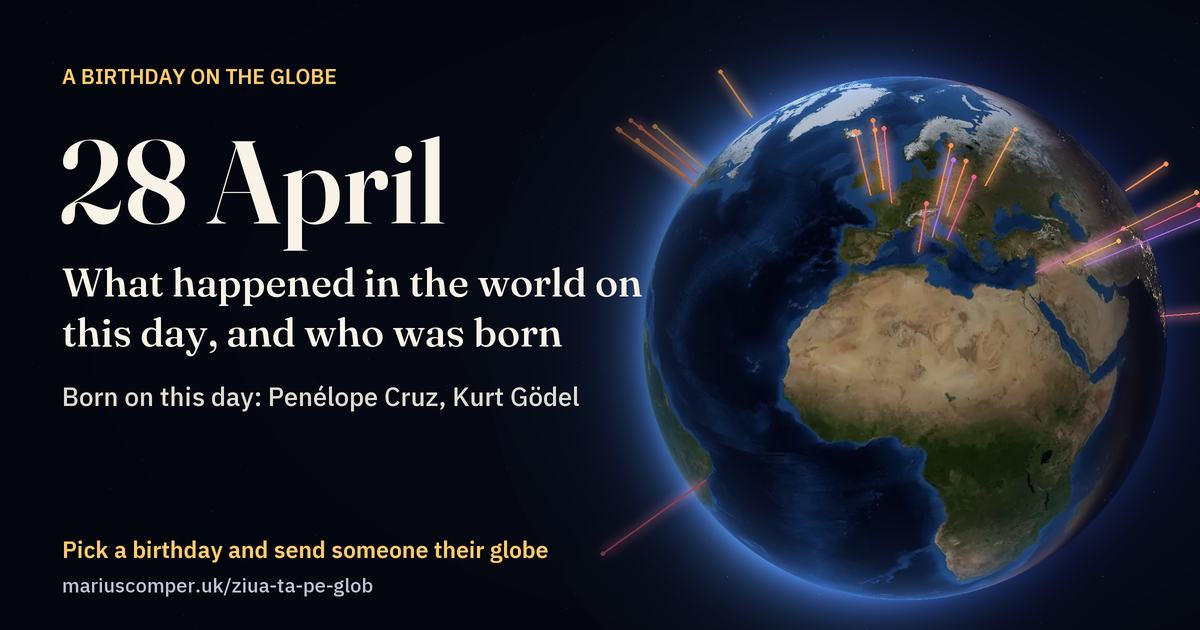
For 28 April, the English Wikipedia lists 56 events and 189 births. 28 of the events stand at their places as rays of light; seven more are dashed circles, where the sentence links only to a country or a sea. The taller the ray, the longer ago it happened. The people born that day come further down, as blue points.
A birthday, yours or someone else’s:
Turn it into a greetingScroll: the globe turns to each place
The day you were born, on the globe.
Three things from your day
Scroll: your day first, then 28 April through the years
The Earth on 28 April
The picture on the globe was assembled by NASA from satellite photographs taken in April 2004: the snow, the ice and the green are those of the month.
On 28 April the Sun passes straight overhead at noon along the parallel of 14.3° north. In London, the day lasts about 14 hours 40 minutes.
Beyond 76° north the Sun no longer sets; beyond 76° south it no longer rises.
The line between day and night is tilted on the globe exactly as on this day of the year. On the dark side you can see the lights of towns.
Britain & Ireland · Wembley Stadium
1923
Wembley Stadium is opened, named initially as the Empire Stadium.
On the map: Wembley Stadium.
Britain & Ireland · Abbey Road Studios
1973
The Dark Side of the Moon by Pink Floyd, recorded in Abbey Road Studios goes to number one on the US Billboard chart, beginning a record-breaking 741-week chart run.
On the map: Abbey Road Studios.
Europe · Rome
357
Emperor Constantius II enters Rome for the first time to celebrate his victory over Magnus Magnentius.
On the map: Rome.
Europe · Paris
1796
The Armistice of Cherasco is signed by Napoleon Bonaparte and Vittorio Amedeo III, King of Sardinia, expanding French territory along the Mediterranean coast.
On the map: Paris.
Asia · University of Santo Tomas
1611
Establishment of the Pontifical and Royal University of Santo Tomas, the Catholic University of the Philippines and the largest Catholic university in the world.
On the map: University of Santo Tomas.
Also on the day’s list of Wikipedia in Spanish and Chinese.
North America · Rockefeller Foundation
1937
South African medical researcher Max Theiler develops the yellow fever vaccine at the Rockefeller Foundation in New York City.
On the map: Rockefeller Foundation.
North America · New York City Center
1948
Igor Stravinsky conducts the premiere of his American ballet, Orpheus at the New York City Center.
On the map: New York City Center.
North America · Trump International Hotel and Tower
2008
The 1,388-foot-tall (423.2 m) Trump International Hotel and Tower in Chicago, with the world's highest residence above ground level at the time, held its grand opening.
On the map: Trump International Hotel and Tower.
28 April
Born on 28 April#
The English Wikipedia lists 189 births for this day. The blue points are the birthplaces of 60 of these people: those written about in the most Wikipedia editions, where Wikidata gives a place of birth.
Born on 28 April
1974
Penélope Cruz, Spanish actress and producer
Place of birth: Alcobendas.
Born on 28 April
1906
Kurt Gödel, Czech-American mathematician, philosopher, and academic (died 1978)
Place of birth: Brno.
Born on 28 April
1981
Jessica Alba, American model and actress
Place of birth: Pomona.
Born on 28 April
1926
Harper Lee, American novelist (died 2016)
Place of birth: Monroeville.
Born on 28 April
1948
Terry Pratchett, English journalist, author, and screenwriter (died 2015)
Place of birth: Beaconsfield.
Born in Britain and Ireland
1854
Hertha Marks Ayrton, Polish-British engineer, mathematician, and physicist. (died 1923)
Place of birth: Portsea Island.
Born in Britain and Ireland
1960
Ian Rankin, Scottish author
Place of birth: Cardenden.
Born in Britain and Ireland
1968
Howard Donald, English singer-songwriter and producer
Place of birth: Droylsden.
28 April
Number one in the charts that week
At the cinema
An animal recorded that day
The record can be seen in GBIF, which brings together wildlife records from around the world.
All your birthdays
The weather that day
Data: Met Office Hadley Centre (HadCET); NOAA (GHCN-Daily, Mauna Loa).
Above the Earth
Sources: Jonathan McDowell, GCAT (launches); GFZ Potsdam (Kp index). Days are counted in Universal Time.
Football that day
International matches played that day:
Source: the “International football results” dataset kept by Mart Jürisoo (CC0).
Also that day
The earthquake’s page at the USGS
Source: the USGS catalogue. The day is counted in Universal Time (UTC).
In those days
Make a link for someone
Type the name, pick the day and the year of birth. The link opens straight on their day, with their name in the greeting.
The link carries the name, date and place typed here; anyone who gets it can see them.
Put another birthday beside it
Your mother’s, your child’s, a friend’s: the two days appear side by side.
Below: 28 April through the years.
The whole globe of the day
Drag the globe to turn it. Touch a ray or a point to read what happened there.
Everything Wikipedia lists for 28 April
The list is the English Wikipedia’s, in its own wording, as it stood in October 2026. 21 events have no place on the map: the sentence links to no place with coordinates, only to places too wide to mark, or to several countries.
- 224
The Battle of Hormozdgan is fought. Ardashir I defeats and kills Artabanus V, effectively ending the Parthian Empire.
Asia · Battle of HormozdganWikipedia: Battle of Hormozdgan - 357
Emperor Constantius II enters Rome for the first time to celebrate his victory over Magnus Magnentius.
Europe · RomeWikipedia: Constantius II - 1192
Assassination of Conrad of Montferrat (Conrad I), King of Jerusalem, in Tyre, two days after his title to the throne is confirmed by election. The killing is carried out by Hashshashin.
Asia · Tyre, LebanonWikipedia: Order of Assassins - 1253
Nichiren, a Japanese Buddhist monk, propounds Namu Myōhō Renge Kyō for the first time and declares it to be the essence of Buddhism, in effect founding Nichiren Buddhism.
no place on the mapWikipedia: Nichiren - 1294
Temür, grandson of Kublai, is elected Khagan of the Mongols with the reigning title Oljeitu.
no place on the mapWikipedia: Temür Khan - 1503
The Battle of Cerignola is fought. It is noted as one of the first European battles in history won by small arms fire using gunpowder.
Europe · Battle of CerignolaWikipedia: Battle of Cerignola - 1611
Establishment of the Pontifical and Royal University of Santo Tomas, the Catholic University of the Philippines and the largest Catholic university in the world.
Asia · University of Santo TomasWikipedia: University of Santo Tomas - 1625
A combined Spanish and Portuguese fleet of 52 ships commences the recapture of Bahia from the Dutch during the Dutch–Portuguese War.
Latin America · Recapture of BahiaWikipedia: Recapture of Bahia - 1738
Pope Clement XII issues the first papal condemnation of Freemasonry and formally prohibits Catholics from becoming Freemasons.
no place on the mapWikipedia: Pope Clement XII - 1758
The Marathas defeat the Afghans in the Battle of Attock and capture the city.
no place on the mapWikipedia: Maratha Empire - 1783
Second Anglo-Mysore War: British troops surrendered the fortress of Bednore in southwestern India to French and Mysorean forces; many of the prisoners were later murdered.
Asia · Siege of BednoreWikipedia: Second Anglo-Mysore War - 1788
Maryland becomes the seventh state to ratify the United States Constitution.
North America · MarylandWikipedia: Maryland - 1789
The Mutiny on the Bounty occurs, with the ship's captain, Lieutenant William Bligh and 18 sailors, set adrift, and the rebel crew setting sail for Tahiti. Eventually the majority of rebels sail for Pitcairn Island.
Oceans · Mutiny on the BountyWikipedia: Mutiny on the Bounty - 1792
France invades the Austrian Netherlands (present day Belgium and Luxembourg), beginning the French Revolutionary Wars.
no place on the mapWikipedia: French Revolutionary Wars - 1794
Sardinians, headed by Giovanni Maria Angioy, start a revolution against the Savoy domination, expelling Viceroy Balbiano and his officials from Cagliari, the capital and largest city of the island.
Europe · CagliariWikipedia: Sardinians - 1796
The Armistice of Cherasco is signed by Napoleon Bonaparte and Vittorio Amedeo III, King of Sardinia, expanding French territory along the Mediterranean coast.
Europe · ParisWikipedia: Treaty of Paris - 1858
The Bawani Imli massacre, where 52 Indian freedom fighters are hanged to death on a tamarind tree by British colonial forces.
no place on the mapWikipedia: Bawani Imli massacre - 1859
The sailing clipper ship Pomona is wrecked on the coast of Ireland with the loss of 424 of the 448 passengers and crew aboard.
no place on the mapWikipedia: Pomona - 1869
Chinese and Irish laborers for the Central Pacific Railroad working on the first transcontinental railroad lay ten miles of track in one day, a feat which has never been matched.
no place on the mapWikipedia: Central Pacific Railroad - 1881
Billy the Kid escapes from the Lincoln County jail in Mesilla, New Mexico.
North America · Mesilla, New MexicoWikipedia: Billy the Kid - 1887
A week after being arrested by the Prussian Secret Police, French police inspector Guillaume Schnaebelé is released on order of Wilhelm I, German Emperor, defusing a possible war.
no place on the mapWikipedia: Prussian Secret Police - 1910
Frenchman Louis Paulhan wins the 1910 London to Manchester air race, the first long-distance aeroplane race in the United Kingdom.
no place on the mapWikipedia: 1910 London to Manchester air race - 1920
The Azerbaijan Soviet Socialist Republic is founded.
Asia · Azerbaijan Soviet Socialist RepublicWikipedia: Azerbaijan Soviet Socialist Republic - 1923
Wembley Stadium is opened, named initially as the Empire Stadium.
Britain & Ireland · Wembley StadiumWikipedia: Wembley Stadium - 1930
The Independence Producers host the first night game in the history of Organized Baseball in Independence, Kansas.
North America · Independence, KansasWikipedia: Independence Producers - 1937
South African medical researcher Max Theiler develops the yellow fever vaccine at the Rockefeller Foundation in New York City.
North America · Rockefeller FoundationWikipedia: South Africa - 1941
The Ustaše massacre nearly 200 Serbs in the village of Gudovac, the first massacre of their genocidal campaign against Serbs of the Independent State of Croatia.
Europe · Gudovac massacreWikipedia: Gudovac massacre - 1944
World War II: Nine German E-boats attack US and UK units during Exercise Tiger, the rehearsal for the Normandy landings, killing 946.
Britain & Ireland · Exercise TigerWikipedia: Exercise Tiger - 1945
Benito Mussolini and his mistress Clara Petacci are shot dead by Walter Audisio, a member of the Italian resistance movement.
no place on the mapWikipedia: Benito Mussolini - 1945
The Holocaust: Nazi Germany carries out its final use of gas chambers to execute 33 Upper Austrian socialist and communist leaders in Mauthausen concentration camp.
Europe · Mauthausen concentration campWikipedia: The Holocaust - 1947
Thor Heyerdahl and five crew mates set out from Peru on the Kon-Tiki to demonstrate that Peruvian natives could have settled Polynesia.
Latin America · PeruWikipedia: Thor Heyerdahl - 1948
Igor Stravinsky conducts the premiere of his American ballet, Orpheus at the New York City Center.
North America · New York City CenterWikipedia: Igor Stravinsky - 1949
The Hukbalahap are accused of assassinating former First Lady of the Philippines Aurora Quezon, while she is en route to dedicate a hospital in memory of her late husband; her daughter and ten others are also killed.
no place on the mapWikipedia: Hukbalahap - 1952
Dwight D. Eisenhower resigns as Supreme Allied Commander of NATO in order to campaign in the 1952 United States presidential election.
no place on the mapWikipedia: 1952 United States presidential election - 1952
The Sino-Japanese Peace Treaty (Treaty of Taipei) is signed in Taipei, Taiwan between Japan and the Republic of China to officially end the Second Sino-Japanese War.
Asia · Taipei Guest HouseWikipedia: Treaty of Taipei - 1952
The Treaty of San Francisco comes into effect, restoring Japanese sovereignty and ending its state of war with most of the Allies of World War II.
no place on the mapWikipedia: Treaty of San Francisco - 1960
The Sibley Commission issued their final report, urging the government of the U.S. state of Georgia to abandon its strategy of massive resistance and legalize some instances of school integration.
North America · GeorgiaWikipedia: Sibley Commission - 1965
United States occupation of the Dominican Republic: American troops land in the Dominican Republic to "forestall establishment of a Communist dictatorship" and to evacuate US Army troops.
Latin America · Dominican RepublicWikipedia: Dominican Civil War - 1967
Vietnam War: Boxer Muhammad Ali refuses his induction into the United States Army and is subsequently stripped of his championship and license.
no place on the mapWikipedia: Vietnam War - 1969
Charles de Gaulle resigns as President of France.
no place on the mapWikipedia: Charles de Gaulle - 1970
Vietnam War: US President Richard Nixon formally authorizes American combat troops to take part in the Cambodian campaign.
no place on the mapWikipedia: Vietnam War - 1972
Scottish trade unionist Jimmy Reid condemned the capitalist "rat race" in his inaugural address as Rector of the University of Glasgow.
no place on the mapWikipedia: Jimmy Reid - 1973
The Dark Side of the Moon by Pink Floyd, recorded in Abbey Road Studios goes to number one on the US Billboard chart, beginning a record-breaking 741-week chart run.
Britain & Ireland · Abbey Road StudiosWikipedia: Abbey Road Studios - 1975
General Cao Văn Viên, chief of the South Vietnamese military, departs for the US as the North Vietnamese Army closes in on victory.
Asia · South VietnamWikipedia: 1975 spring offensive - 1977
The Red Army Faction trial ends, with Andreas Baader, Gudrun Ensslin and Jan-Carl Raspe found guilty of four counts of murder and more than 30 counts of attempted murder.
no place on the mapWikipedia: Red Army Faction - 1978
The President of Afghanistan, Mohammad Daoud Khan, is overthrown and assassinated in a coup led by pro-communist rebels.
Asia · Saur RevolutionWikipedia: Saur Revolution - 1983
The West German news magazine Stern begins publishing excerpts from the purported diaries of Adolf Hitler, later revealed to be forgeries.
no place on the mapWikipedia: Stern - 1986
High levels of radiation resulting from the Chernobyl disaster are detected at Forsmark Nuclear Power Plant in Sweden, leading Soviet authorities to publicly announce the accident.
Europe · Chernobyl disasterWikipedia: Chernobyl disaster - 1988
Near Maui, Hawaii, flight attendant Clarabelle "C.B." Lansing is blown out of Aloha Airlines Flight 243, a Boeing 737, and falls to her death when part of the plane's fuselage rips open in mid-flight.
North America · Aloha Airlines Flight 243Wikipedia: Aloha Airlines Flight 243 - 1991
Space Shuttle Discovery launches on STS-39, the first unclassified shuttle mission for the United States Department of Defense.
no place on the mapWikipedia: Space Shuttle Discovery - 1994
Former Central Intelligence Agency counterintelligence officer and analyst Aldrich Ames pleads guilty to giving US secrets to the Soviet Union and later Russia.
Asia · Soviet UnionWikipedia: Central Intelligence Agency - 1996
Port Arthur massacre, Tasmania: A gunman, Martin Bryant, opens fire at the Broad Arrow Cafe in Port Arthur, Tasmania, killing 35 people and wounding 23 others.
Oceania · Port Arthur massacreWikipedia: Port Arthur massacre - 1996
Whitewater controversy: President Bill Clinton gives a 41⁄2 hour videotaped testimony for the defense.
North America · Whitewater controversyWikipedia: Whitewater controversy - 1999
A 14-year-old former student in Taber, Alberta, opened fire at his high school, killing one student and wounding another in Canada's first fatal school shooting in more than two decades.
North America · 1999 W. R. Myers High School shootingWikipedia: 1999 W. R. Myers High School shooting - 2004
CBS News releases evidence of the Abu Ghraib torture and prisoner abuse. The photographs show rape and abuse from the American troops over Iraqi detainees.
Asia · Abu Ghraib torture and prisoner abuseWikipedia: Abu Ghraib torture and prisoner abuse - 2008
The 1,388-foot-tall (423.2 m) Trump International Hotel and Tower in Chicago, with the world's highest residence above ground level at the time, held its grand opening.
North America · Trump International Hotel and TowerWikipedia: Trump International Hotel and Tower
Who was born on 28 April
In order of how many Wikipedia editions have an article about each. The first 60 of 189 are shown.
- 1937
Saddam Hussein, Iraqi general and politician, 5th President of Iraq (died 2006)
- 1758
James Monroe, American soldier, lawyer, and politician, 5th President of the United States (died 1831)
Monroe HallWikipedia: James Monroe - 1974
Penélope Cruz, Spanish actress and producer
AlcobendasWikipedia: Penélope Cruz - 1906
Kurt Gödel, Czech-American mathematician, philosopher, and academic (died 1978)
- 1981
Jessica Alba, American model and actress
PomonaWikipedia: Jessica Alba - 1926
Harper Lee, American novelist (died 2016)
MonroevilleWikipedia: Harper Lee - 1948
Terry Pratchett, English journalist, author, and screenwriter (died 2015)
BeaconsfieldWikipedia: Terry Pratchett - 1889
António de Oliveira Salazar, Portuguese economist and politician, 100th Prime Minister of Portugal (died 1970)
Freguesia de VimieiroWikipedia: António de Oliveira Salazar - 32
Otho, Roman emperor (died 69 AD)
FerentiumWikipedia: Otho - 1896
Tristan Tzara, Romanian-French poet and critic (died 1963)
- 1908
Oskar Schindler, Czech-German businessman (died 1974)
SvitavyWikipedia: Oskar Schindler - 1442
Edward IV, king of England (died 1483)
RouenWikipedia: Edward IV - 1924
Kenneth Kaunda, Zambian educator and politician, first president of Zambia (died 2021)
ChinsaliWikipedia: Kenneth Kaunda - 1874
Karl Kraus, Austrian journalist and author (died 1936)
- 1950
Jay Leno, American comedian, talk show host, and producer
New RochelleWikipedia: Jay Leno - 1988
Juan Mata, Spanish footballer
Villafranca Montes de OcaWikipedia: Juan Mata - 1941
Karl Barry Sharpless, American chemist and academic, Nobel Prize laureate
PhiladelphiaWikipedia: Karl Barry Sharpless - 1970
Diego Simeone, Argentinian footballer and manager
Buenos AiresWikipedia: Diego Simeone - 1900
Jan Oort, Dutch astronomer and academic (died 1992)
FranekerWikipedia: Jan Oort - 1878
Lionel Barrymore, American actor and director (died 1954)
PhiladelphiaWikipedia: Lionel Barrymore - 1838
Tobias Asser, Dutch lawyer and scholar, Nobel Prize laureate (died 1913)
AmsterdamWikipedia: Tobias Asser - 1941
Ann-Margret, Swedish-American actress, singer, and dancer
StockholmWikipedia: Ann-Margret - 1545
Yi Sun-sin, Korean commander (died 1598)
HanseongbuWikipedia: Yi Sun-sin - 1995
Melanie Martinez, American singer
AstoriaWikipedia: Melanie Martinez - 1936
Tariq Aziz, Iraqi journalist and politician, Iraqi Minister of Foreign Affairs (died 2015)
Tel KeppeWikipedia: Tariq Aziz - 1953
Roberto Bolaño, Chilean novelist, short-story writer, poet, and essayist (died 2003)
SantiagoWikipedia: Roberto Bolaño - 1916
Ferruccio Lamborghini, Italian businessman, created Lamborghini (died 1993)
- 1930
James Baker, American lawyer and politician, 61st United States Secretary of State
HoustonWikipedia: James Baker - 1928
Yves Klein, French painter (died 1962)
- 1928
Eugene Merle Shoemaker, American geologist and astronomer (died 1997)
Los AngelesWikipedia: Eugene Merle Shoemaker - 1952
Mary McDonnell, American actress
Wilkes-BarreWikipedia: Mary McDonnell - 1676
Frederick I, prince consort and king of Sweden (died 1751)
- 1980
Bradley Wiggins, English cyclist
- 1987
Samantha Ruth Prabhu, Indian actress and model
- 1854
Hertha Marks Ayrton, Polish-British engineer, mathematician, and physicist. (died 1923)
Portsea IslandWikipedia: Hertha Ayrton - 1900
Heinrich Müller, German SS officer, Gestapo chief, and key individual in the Holocaust (died 1945)
- 1960
Walter Zenga, Italian footballer and manager
- 1987
Zoran Tošić, Serbian footballer
ZrenjaninWikipedia: Zoran Tošić - 1960
Ian Rankin, Scottish author
CardendenWikipedia: Ian Rankin - 1960
Elena Kagan, American lawyer and jurist, Associate Justice of the Supreme Court of the United States
New York CityWikipedia: Elena Kagan - 1973
Jorge Garcia, American actor and producer
- 1949
Bruno Kirby, American actor and director (died 2006)
New York CityWikipedia: Bruno Kirby - 1984
Dmitri Torbinski, Russian footballer
NorilskWikipedia: Dmitri Torbinski - 1402
Nezahualcoyotl, Acolhuan philosopher, warrior, poet and ruler (died 1472)
Texcoco de MoraWikipedia: Nezahualcoyotl - 1930
Carolyn Jones, American actress (died 1983)
AmarilloWikipedia: Carolyn Jones - 1971
Bridget Moynahan, American actress
BinghamtonWikipedia: Bridget Moynahan - 1897
Ye Jianying, Chinese general and politician, Head of State of the People's Republic of China (died 1986)
Jiaying ZhouWikipedia: Ye Jianying - 1953
Kim Gordon, American singer-songwriter, guitarist, and producer
RochesterWikipedia: Kim Gordon - 1949
Paul Guilfoyle, American actor
- 1921
Simin Daneshvar, Iranian author and academic (died 2012)
- 1982
Chris Kaman, American basketball player
Grand RapidsWikipedia: Chris Kaman - 1986
Jenna Ushkowitz, Korean-American actress, singer, and dancer
- 1989
Emil Salomonsson, Swedish footballer
ÖrkelljungaWikipedia: Emil Salomonsson - 1955
Saeb Erekat, Chief Palestinian negotiator (died 2020)
Abu DisWikipedia: Saeb Erekat - 1908
Ethel Catherwood, American-Canadian high jumper and javelin thrower (died 1987)
- 1988
Jonathan Biabiany, French footballer
- 1968
Howard Donald, English singer-songwriter and producer
DroylsdenWikipedia: Howard Donald - 1912
Kaneto Shindō, Japanese director, producer, and screenwriter (died 2012)
HiroshimaWikipedia: Kaneto Shindo - 1938
Madge Sinclair, Jamaican-American actress (died 1995)
KingstonWikipedia: Madge Sinclair - 1974
Margo Dydek, Polish basketball player and coach (died 2011)
WarsawWikipedia: Margo Dydek
What is celebrated on 28 April
- Christian feast day: Aphrodisius and companions
- Christian feast day: Gianna Beretta Molla
- Christian feast day: Kirill of Turov (Orthodox, added to Roman Martyrology in 1969)
- Christian feast day: Louis de Montfort
- Christian feast day: Blessed Marie Louise Trichet
- Christian feast day: Pamphilus of Sulmona
- Christian feast day: Peter Chanel
- Christian feast day: Vitalis and Valeria of Milan
- Christian feast day: April 28 (Eastern Orthodox liturgics)
- Mujahideen Victory Day (Afghanistan)
- National Heroes Day (Barbados)
- Restoration of Sovereignty Day (Japan)
- Sardinia Day (Sardinia)
- Workers' Memorial Day and World Day for Safety and Health at Work (international) National Day of Mourning (Canada)
A greeting link for someone
Type a name and, if you like, the year of birth. The link opens with a greeting, and beside each event it says how old the person turned that day, or how many years before their birth it happened.
The name and the year go only into the link you send.
All 366 days
How the globe is made
Where the events come from
Each edition of this page uses the day’s list from Wikipedia in its own language: Romanian, English, Spanish, Chinese. The lists are written by volunteers and differ from one edition to the next; the text of each event is Wikipedia’s, with a link to the article. A row that appears twice in a list is shown once. The lists have not been checked event by event: they are Wikipedia’s, mistakes included.
For events before 1582, and for countries that moved to the Gregorian calendar later (Britain in 1752, Russia in 1918), the same day may be counted Old Style in one list and New Style in another.
The chapter “What the other Wikipedias remember” adds up to five events a day from the lists of the other three editions, only for years in which the English list has nothing on that day. They were translated for this page, passed the same filters as the tour, and are not counted among the events of the English list.
How an event gets onto the map
The place comes from Wikidata. If the sentence links to the article about the event itself (a battle, an opening, an earthquake), dated to the same year, the ray stands on its coordinates or on those of its location. Otherwise it stands on the first place the sentence links to: a town, a building, a mountain, an island. This second step can be wrong: sometimes the sentence only mentions the place. That is why the page says, under each event, which place the ray stands on.
When the sentence links to a single state or province, or to a single sea, lake or desert larger than 5,000 km², the globe shows a dashed circle, not a ray. The circle has the area Wikidata gives, with its radius kept between 1.2° and 16°, or a radius of 4.5° when Wikidata gives no area; it says only that the sentence links to that place. Organisations, ships, spacecraft, museum objects, rivers, mountain ranges, languages and continents are never used as places. When a sentence names several states and no exact place, the event stays in the list only.
What the height means
The height of a ray shows how many years have passed, on a logarithmic scale: 10 years, 100 years and 1,000 years are equal steps apart; anything older than about 2,600 years has the tallest ray. The colour runs from pale yellow for recent years to violet for antiquity.
Where the tour stops
In each region the tour stops at up to three events (five in Britain and Ireland), chosen mainly by three things: whether Wikipedia’s editors put the event in the “On this day” box of their main page (the English, Spanish and Chinese editions), how many Wikipedia editions have an article about it, and how many of the four lists include it. Events whose sentence or article is about a war, an attack, a crime or a disaster are left out of the tour; they stay in the whole list, in Wikipedia’s wording. The filter is a list of words and a list of Wikidata types, so it can miss some.
The tour of births names the people with articles in the most editions and leaves aside those whom the list or Wikidata describes as rulers, politicians, commanders, leaders of movements or criminals; they stay in the list.
The Earth and the Sun
The daytime images are NASA’s Blue Marble Next Generation mosaics, one for each month of 2004; the night side is Black Marble 2016. The tilt of the line between day and night is computed for the day; the hour is chosen so that the place being read is in daylight. The latitude where the Sun stands overhead is the average of the four years of the leap cycle; in a given year it can differ by up to 0.4°.
The day you were born
The number ones come from the weekly lists on Wikipedia: Billboard for the United States (from 1940; the Hot 100 from August 1958), the UK Singles Chart (from November 1952), Los 40 Principales for Spain (from July 1966) and, for Romania, the Romanian Top 100 and Airplay 100 (2001–2021, with missing weeks). The page shows the chart of the week in which the day of birth falls, with its date; Billboard and the UK chart are dated at the end of their week. For Romania before 2001 and for China these sources have no weekly chart.
The films are those that reached cinemas in the United States up to ten days before or three days after that day (some of them in a few cinemas at first), from the English Wikipedia’s yearly lists (from 1968), in order of how many editions have an article about them. The events “in those days” are the ones on the neighbouring days’ lists that carry the year of birth, passed through the same filter as the tour.
The day of birth, year included
The Moon, the star sign and the constellation are worked out by the page itself, for noon Universal Time on the day. The lit part of the Moon is rounded and can differ by a few per cent from that at the hour of birth. The sign follows the usual zodiac of twelve equal parts starting at the March equinox; the constellation is the one the Sun actually stood in front of, by the borders set by the International Astronomical Union, and within a day of a border the page does not name it. When the Sun changes sign while it is that day anywhere on Earth, the page gives the moment of crossing, rounded to ten minutes and accurate to within about a quarter of an hour, and the clock time in a few cities, with the time zone and summer time of that year.
The year in the Chinese calendar is the one your device’s own calendar gives for the date, checked against the Hong Kong Observatory’s tables. “All your birthdays” uses the same sources as the rest of the chapter for the same day in every year since the birth: the temperature, well-known launches that took place on that very day, matches of the teams the edition follows, snow deeper than 10 cm and strong geomagnetic storms. The three things at the top and the four on the picture are chosen in a fixed order (the song, the animal, a full Moon, a well-known launch before an ordinary earthquake); on the picture you can change them.
When the link carries a year of birth, the page adds a few things about that exact day. The weather is the Met Office’s Central England temperature record and the readings from New York’s Central Park; the “usual high” is the average of the daily highs of 1961–1990 for that date, with two days either side. The carbon dioxide figure is the monthly mean at the Mauna Loa observatory, where measurements begin in March 1958.
The earthquake is the one with the largest magnitude in the USGS catalogue for that day, counted in Universal Time. Before the 1960s the catalogue has gaps even above magnitude 5.5, so in the older years many days have no earthquake. The page gives only the magnitude and the place: the country the epicentre falls in or, when the epicentre is at sea within 300 km of a coast, the nearest country; farther out, only the ocean.
The launches are those that reached orbit or left for the Moon and the planets, from Jonathan McDowell’s GCAT catalogue. If nothing left that day, the page shows the nearest launch within three days before or after, and says how many days away it was. The geomagnetic storm appears only when the Kp index reached at least 5 in one of the day’s eight three-hour intervals.
The animal comes from GBIF: an observation made by a person (the animal seen or heard, or its tracks), dated to that exact day, with coordinates and a CC0 or CC BY licence. Only a few hundred well-known species are searched (mammals, birds, turtles, butterflies); of those noted that day, mammals and species with articles in many Wikipedia editions come first; birds noted almost every day, and species used recently, wait their turn. Observations dated 1 January are left out, because records without a day are often filed there. An observation shows that the animal was recorded there, not how many animals there were.
The matches are those between national teams. Only matches of England, Scotland, Wales, Northern Ireland, the Republic of Ireland, the United States, Canada and Australia are shown, along with those at the big final tournaments. The picture to send is drawn in the page from the day’s globe and the facts above, and stays on your device until you send it.
Sources
- Events, births and holidays: the day’s page on Wikipedia, text under CC BY-SA 4.0.
- Coordinates, places of birth and the number of editions: Wikidata (CC0).
- The Earth by day: NASA Blue Marble Next Generation. The Earth by night: NASA Black Marble 2016.
- Borders and regions: Natural Earth.
- World population and births per year: UN World Population Prospects 2024.
- Charts and films: Wikipedia’s lists for Billboard, the UK Singles Chart, Los 40 Principales, Romanian Top 100, Airplay 100 and American films by year (CC BY-SA 4.0).
- Weather: Met Office Hadley Centre, HadCET (Open Government Licence) and NOAA GHCN-Daily, New York Central Park. Carbon dioxide: NOAA Global Monitoring Laboratory, Mauna Loa.
- Earthquakes: the USGS catalogue. Launches: Jonathan McDowell, GCAT (CC BY). Kp index: GFZ Potsdam (CC BY 4.0). Matches: International football results, Mart Jürisoo (CC0).
- Animal observations: GBIF, with a link to each record; species names come from Wikidata.