A birthday on the globe
17 August on the globe: what happened in the world on this day, and who was born
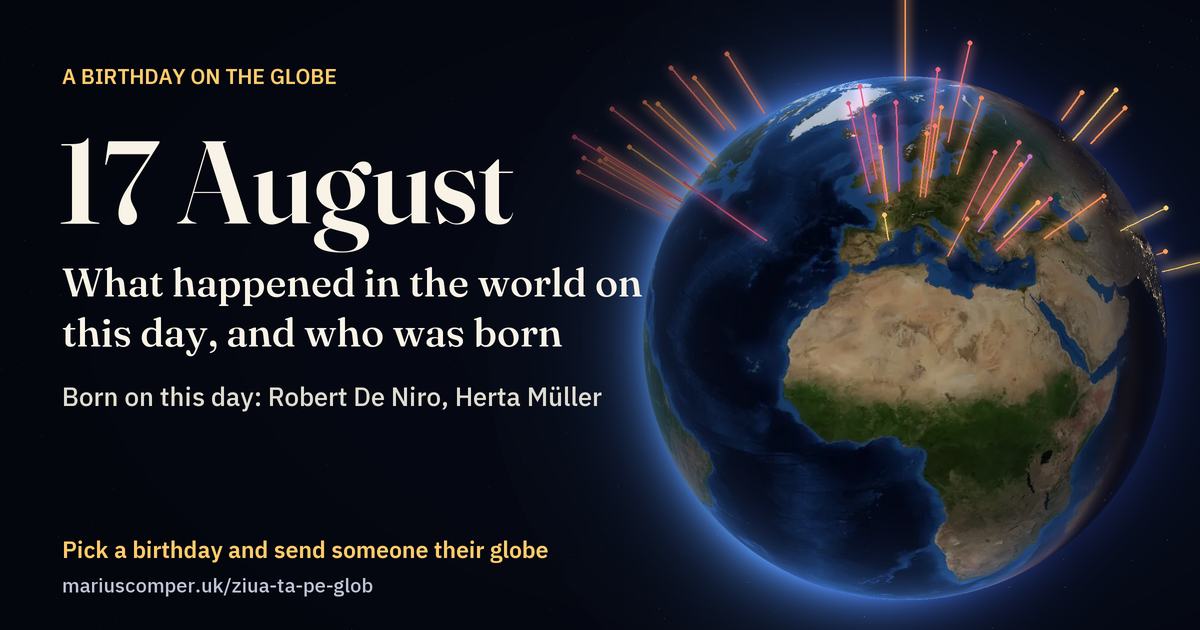
For 17 August, the English Wikipedia lists 74 events and 222 births. 43 of the events stand at their places as rays of light; nine more are dashed circles, where the sentence links only to a country or a sea. The taller the ray, the longer ago it happened. The people born that day come further down, as blue points.
A birthday, yours or someone else’s:
Turn it into a greetingScroll: the globe turns to each place
The day you were born, on the globe.
Three things from your day
Scroll: your day first, then 17 August through the years
The Earth on 17 August
The picture on the globe was assembled by NASA from satellite photographs taken in August 2004: the snow, the ice and the green are those of the month.
On 17 August the Sun passes straight overhead at noon along the parallel of 13.4° north. In London, the day lasts about 14 hours 30 minutes.
Beyond 77° north the Sun no longer sets; beyond 77° south it no longer rises.
The line between day and night is tilted on the globe exactly as on this day of the year. On the dark side you can see the lights of towns.
Europe · Azores
1597
Islands Voyage: Robert Devereux, 2nd Earl of Essex, and Sir Walter Raleigh set sail on an expedition to the Azores.
On the map: Azores.
Europe · Făgăraș
1723
Ioan Giurgiu Patachi becomes Bishop of Făgăraș and is festively installed in his position at the St. Nicolas Cathedral in Făgăraș, after being formally confirmed earlier by Pope Clement XI.
On the map: Făgăraș.
Europe · Bayreuth Festspielhaus
1876
Richard Wagner's Götterdämmerung, the last opera in his Ring cycle, premieres at the Bayreuth Festspielhaus.
On the map: Bayreuth Festspielhaus.
North America · Roanoke Island
1585
A first group of colonists sent by Sir Walter Raleigh under the charge of Ralph Lane lands in the New World to create Roanoke Colony on Roanoke Island, off the coast of present-day North Carolina.
On the map: Roanoke Island.
North America · Albany, New York
1807
Robert Fulton's North River Steamboat leaves New York City for Albany, New York, on the Hudson River, inaugurating the first commercial steamboat service in the world.
On the map: Albany, New York.
North America · Pike Place Market
1907
Pike Place Market, one of the oldest continuously operated public farmers' markets in the U.S. and a popular tourist attraction, opens in Seattle, Washington.
On the map: Pike Place Market.
Also on the day’s list of Wikipedia in Chinese.
Oceans · North Pole
1977
The Soviet icebreaker Arktika becomes the first surface ship to reach the North Pole.
On the map: North Pole.
Also on the day’s list of Wikipedia in Romanian.
17 August
Born on 17 August#
The English Wikipedia lists 222 births for this day. The blue points are the birthplaces of 60 of these people: those written about in the most Wikipedia editions, where Wikidata gives a place of birth.
Born on 17 August
1943
Robert De Niro, American actor, entrepreneur, director, and producer
Place of birth: New York City.
Born on 17 August
1953
Herta Müller, Romanian-German poet and author, Nobel Prize laureate
Place of birth: Nițchidorf.
Born on 17 August
1893
Mae West, American stage and film actress (died 1980)
Place of birth: Brooklyn.
Born on 17 August
1932
V. S. Naipaul, Trinidadian-English novelist and essayist, Nobel Prize laureate (died 2018)
Place of birth: Chaguanas.
Born on 17 August
1977
Thierry Henry, French footballer
Place of birth: Les Ulis.
Born in Britain and Ireland
1920
Maureen O'Hara, Irish-American actress and singer (died 2015)
Place of birth: Ranelagh.
Born in Britain and Ireland
1930
Ted Hughes, English poet and playwright (died 1998)
Place of birth: Mytholmroyd.
Born in Britain and Ireland
1982
Phil Jagielka, English footballer
Place of birth: Sale.
17 August
Number one in the charts that week
At the cinema
An animal recorded that day
The record can be seen in GBIF, which brings together wildlife records from around the world.
All your birthdays
The weather that day
Data: Met Office Hadley Centre (HadCET); NOAA (GHCN-Daily, Mauna Loa).
Above the Earth
Sources: Jonathan McDowell, GCAT (launches); GFZ Potsdam (Kp index). Days are counted in Universal Time.
Football that day
International matches played that day:
Source: the “International football results” dataset kept by Mart Jürisoo (CC0).
Also that day
The earthquake’s page at the USGS
Source: the USGS catalogue. The day is counted in Universal Time (UTC).
In those days
Make a link for someone
Type the name, pick the day and the year of birth. The link opens straight on their day, with their name in the greeting.
The link carries the name, date and place typed here; anyone who gets it can see them.
Put another birthday beside it
Your mother’s, your child’s, a friend’s: the two days appear side by side.
Below: 17 August through the years.
The whole globe of the day
Drag the globe to turn it. Touch a ray or a point to read what happened there.
Everything Wikipedia lists for 17 August
The list is the English Wikipedia’s, in its own wording, as it stood in October 2026. 22 events have no place on the map: the sentence links to no place with coordinates, only to places too wide to mark, or to several countries.
- 986
Byzantine–Bulgarian wars: Battle of the Gates of Trajan: The Bulgarians under the Comitopuli Samuel and Aron defeat the Byzantine forces at the Gate of Trajan, with Byzantine Emperor Basil II barely escaping.
Europe · Battle of the Gates of TrajanWikipedia: Battle of the Gates of Trajan - 1186
Georgenberg Pact: Ottokar IV, Duke of Styria and Leopold V, Duke of Austria sign a heritage agreement in which Ottokar gives his duchy to Leopold and to his son Frederick under the stipulation that Austria and Styria would henceforth remain undivided.
no place on the mapWikipedia: Georgenberg Pact - 1386
Karl Topia, the ruler of Princedom of Albania, forges an alliance with the Republic of Venice, committing to participate in all wars of the Republic and receiving coastal protection against the Ottomans in return.
no place on the mapWikipedia: Karl Thopia - 1424
Hundred Years' War: Battle of Verneuil: An English force under John, Duke of Bedford defeats a larger French army under Jean II, Duke of Alençon, John Stewart, and Earl Archibald of Douglas.
Europe · Battle of VerneuilWikipedia: Battle of Verneuil - 1488
Konrad Bitz, the Bishop of Turku, marks the date of his preface to Missale Aboense, the oldest known book of Finland.
Europe · FinlandWikipedia: List of bishops of Turku - 1498
Cesare Borgia, son of Pope Alexander VI, becomes the first person in history to resign the cardinalate; later that same day, King Louis XII of France names him Duke of Valentinois.
no place on the mapWikipedia: Cesare Borgia - 1549
Battle of Sampford Courtenay: The Prayer Book Rebellion is quashed in England.
Britain & Ireland · Battle of Sampford CourtenayWikipedia: Prayer Book Rebellion - 1560
The Catholic Church is overthrown and Protestantism is established as the national religion in Scotland.
Britain & Ireland · Kingdom of ScotlandWikipedia: Catholic Church - 1585
A first group of colonists sent by Sir Walter Raleigh under the charge of Ralph Lane lands in the New World to create Roanoke Colony on Roanoke Island, off the coast of present-day North Carolina.
North America · Roanoke IslandWikipedia: Walter Raleigh - 1585
Eighty Years' War: Siege of Antwerp: Antwerp is captured by Spanish forces under Alexander Farnese, Duke of Parma, who orders Protestants to leave the city and as a result over half of the 100,000 inhabitants flee to the northern provinces.
Europe · Fall of AntwerpWikipedia: Eighty Years' War - 1597
Islands Voyage: Robert Devereux, 2nd Earl of Essex, and Sir Walter Raleigh set sail on an expedition to the Azores.
Europe · AzoresWikipedia: Islands Voyage - 1648
The Parliamentarians defeat a English Royalist and Scottish army in the battle of Preston.
Britain & Ireland · Battle of PrestonWikipedia: Battle of Preston - 1668
The magnitude 8.0 North Anatolia earthquake causes 8,000 deaths in northern Anatolia, Ottoman Empire.
Asia · 1668 North Anatolia earthquakeWikipedia: 1668 North Anatolia earthquake - 1676
Scanian War: Swedish forces defeated Danish troops at the Battle of Halmstad.
Europe · Battle of HalmstadWikipedia: Scanian War - 1717
Austro-Turkish War of 1716–18: The month-long Siege of Belgrade ends with Prince Eugene of Savoy's Austrian troops capturing the city from the Ottoman Empire.
Europe · Siege of BelgradeWikipedia: Austro-Turkish War - 1723
Ioan Giurgiu Patachi becomes Bishop of Făgăraș and is festively installed in his position at the St. Nicolas Cathedral in Făgăraș, after being formally confirmed earlier by Pope Clement XI.
Europe · FăgărașWikipedia: Ioan Giurgiu Patachi - 1740
Pope Benedict XIV, previously known as Prospero Lambertini, succeeds Clement XII as the 247th Pope.
no place on the mapWikipedia: Pope Benedict XIV - 1784
Classical composer Luigi Boccherini receives a pay rise of 12,000 reals from his employer, the Infante Luis, Count of Chinchón.
no place on the mapWikipedia: Luigi Boccherini - 1798
The Vietnamese Catholics report a Marian apparition in Quảng Trị, an event which is called Our Lady of La Vang.
no place on the mapWikipedia: Vietnam - 1807
Robert Fulton's North River Steamboat leaves New York City for Albany, New York, on the Hudson River, inaugurating the first commercial steamboat service in the world.
North America · Albany, New YorkWikipedia: Robert Fulton - 1808
The Finnish War: The Battle of Alavus is fought.
Europe · Battle of AlavusWikipedia: Battle of Alavus - 1827
Dutch King William I and Pope Leo XII sign concord.
no place on the mapWikipedia: William I of the Netherlands - 1836
British parliament accepts registration of births, marriages and deaths.
no place on the mapWikipedia: Parliament of the United Kingdom - 1862
American Civil War: Major General J. E. B. Stuart is assigned command of all the cavalry of the Confederate Army of Northern Virginia.
no place on the mapWikipedia: American Civil War - 1862
American Indian Wars: The Dakota War of 1862 begins in Minnesota as Dakota warriors attack white settlements along the Minnesota River.
North America · Dakota TerritoryWikipedia: Dakota War of 1862 - 1863
American Civil War: In Charleston, South Carolina, Union batteries and ships bombard Confederate-held Fort Sumter.
North America · Charleston, South CarolinaWikipedia: Charleston, South Carolina - 1864
American Civil War: Battle of Gainesville: Confederate forces defeat Union troops near Gainesville, Florida.
North America · Battle of GainesvilleWikipedia: Battle of Gainesville - 1866
The Grand Duchy of Baden announces its withdrawal from the German Confederation and signs a treaty of peace and alliance with Prussia.
no place on the mapWikipedia: Grand Duchy of Baden - 1876
Richard Wagner's Götterdämmerung, the last opera in his Ring cycle, premieres at the Bayreuth Festspielhaus.
Europe · Bayreuth FestspielhausWikipedia: Bayreuth Festspielhaus - 1883
The first public performance of the Dominican Republic's national anthem, Himno Nacional.
Latin America · Dominican RepublicWikipedia: Dominican Republic - 1896
Bridget Driscoll becomes the first recorded case of a pedestrian killed in a collision with a motor car in the United Kingdom.
no place on the mapWikipedia: Death of Bridget Driscoll - 1907
Pike Place Market, one of the oldest continuously operated public farmers' markets in the U.S. and a popular tourist attraction, opens in Seattle, Washington.
North America · Pike Place MarketWikipedia: Pike Place Market - 1914
World War I: Battle of Stallupönen: The German army of General Hermann von François defeats the Russian force commanded by Paul von Rennenkampf near modern-day Nesterov, Russia.
Europe · Battle of StallupönenWikipedia: World War I - 1915
A Category 4 hurricane hits Galveston, Texas with winds at 135 miles per hour (217 km/h).
North America · Galveston, TexasWikipedia: 1915 Galveston hurricane - 1915
Jewish American Leo Frank is lynched in Marietta, Georgia, USA after his death sentence is commuted by Governor John M. Slaton.
North America · Marietta, GeorgiaWikipedia: Leo Frank - 1916
World War I: Romania signs a secret treaty with the Entente Powers. According to the treaty, Romania agreed to join the war on the Allied side.
Europe · Treaty of BucharestWikipedia: Treaty of Bucharest - 1918
Bolshevik revolutionary leader Moisei Uritsky is assassinated.
no place on the mapWikipedia: Bolsheviks - 1942
World War II: U.S. Marines raid the Japanese-held Pacific island of Makin.
Oceans · Raid on Makin IslandWikipedia: Raid on Makin Island - 1943
World War II: First Québec Conference of Winston Churchill, Franklin D. Roosevelt, and William Lyon Mackenzie King begins.
North America · Quebec CityWikipedia: First Quebec Conference - 1943
World War II: The Royal Air Force begins Operation Hydra, the first air raid of the Operation Crossbow strategic bombing campaign against Germany's V-weapon program.
Europe · Operation HydraWikipedia: Operation Hydra - 1943
World War II: The U.S. Eighth Air Force suffers the loss of 60 bombers on the Schweinfurt–Regensburg mission.
Europe · SchweinfurtWikipedia: Schweinfurt–Regensburg mission - 1943
World War II: The U.S. Seventh Army under General George S. Patton arrives in Messina, Italy, followed several hours later by the British 8th Army under Field Marshal Bernard Montgomery, thus completing the Allied conquest of Sicily.
Europe · MessinaWikipedia: Allied invasion of Sicily - 1945
Evacuation of Manchukuo: At Talitzou by the Sino-Korean border, Puyi, then the Kangde Emperor of Manchukuo, formally renounces the imperial throne, dissolves the state, and cedes its territory to the Republic of China.
Asia · ManchukuoWikipedia: Evacuation of Manchukuo - 1945
Sukarno and Mohammad Hatta proclaim the independence of Indonesia, igniting the Indonesian National Revolution against the Dutch Empire.
Asia · IndonesiaWikipedia: Proclamation of Indonesian Independence - 1945
The novella Animal Farm by George Orwell is first published.
no place on the mapWikipedia: Animal Farm - 1947
The Radcliffe Line, the border between the Dominions of India and Pakistan, is revealed.
no place on the mapWikipedia: Radcliffe Line - 1949
Matsukawa derailment: Unknown saboteurs cause a passenger train to derail and overturn in Fukushima Prefecture, Japan, killing three crew members and igniting a political firestorm between the Japanese Communist Party and the government of Occupied Japan that will eventually lead to the Japanese Red Purge.
Asia · Matsukawa derailmentWikipedia: Matsukawa derailment - 1949
The 6.7 Ms Karlıova earthquake shakes eastern Turkey with a maximum Mercalli intensity of X (Extreme), leaving 320–450 dead.
Asia · 1949 Karlıova earthquakeWikipedia: 1949 Karlıova earthquake - 1950
Korean War: Forty-two American prisoners of war are massacred by the Korean People's Army on a hill above Waegwan, South Korea.
Asia · Hill 303 massacreWikipedia: Hill 303 massacre - 1953
First meeting of Narcotics Anonymous takes place, in Southern California.
no place on the mapWikipedia: Narcotics Anonymous - 1955
Hurricane Diane makes landfall near Wilmington, North Carolina; it went on to cause major floods and kill more than 184 people.
North America · Wilmington, North CarolinaWikipedia: Hurricane Diane - 1958
Pioneer 0, America's first attempt at lunar orbit, is launched using the first Thor-Able rocket and fails. Notable as one of the first attempted launches beyond Earth orbit by any country.
no place on the mapWikipedia: Pioneer 0 - 1959
American musician Miles Davis released Kind of Blue, which became one of the best-selling and most critically acclaimed jazz recordings of all time.
no place on the mapWikipedia: Miles Davis - 1959
Quake Lake is formed by the magnitude 7.2 1959 Hebgen Lake earthquake near Hebgen Lake in Montana.
North America · 1959 Hebgen Lake earthquakeWikipedia: 1959 Hebgen Lake earthquake - 1960
Aeroflot Flight 036 crashes in Soviet Ukraine, killing 34.
Europe · Ukrainian Soviet Socialist RepublicWikipedia: Aeroflot Flight 036 - 1962
Peter Fechter is shot and bleeds to death while trying to cross the new Berlin Wall.
no place on the mapWikipedia: Killing of Peter Fechter - 1969
Category 5 Hurricane Camille hits the U.S. Gulf Coast, killing 256 and causing $1.42 billion in damage.
no place on the mapWikipedia: Hurricane Camille - 1970
Soviet Union Venera program: Venera 7 launched. It will become the first spacecraft to successfully transmit data from the surface of another planet (Venus).
no place on the mapWikipedia: Venera program - 1976
A magnitude 7.9 earthquake hits off the coast of Mindanao, Philippines, triggering a destructive tsunami, killing between 5,000 and 8,000 people and leaving more than 90,000 homeless.
Asia · 1976 Moro Gulf earthquakeWikipedia: 1976 Moro Gulf earthquake - 1977
The Soviet icebreaker Arktika becomes the first surface ship to reach the North Pole.
Oceans · North PoleWikipedia: Arktika - 1978
Double Eagle II becomes first balloon to cross the Atlantic Ocean when it lands in Miserey, France near Paris, 137 hours after leaving Presque Isle, Maine.
Europe · MisereyWikipedia: Double Eagle II - 1985
The 1985–86 Hormel strike begins in Austin, Minnesota.
North America · Austin, MinnesotaWikipedia: 1985–1986 Hormel strike - 1988
President of Pakistan Muhammad Zia-ul-Haq and U.S. Ambassador Arnold Raphel are killed in a plane crash.
no place on the mapWikipedia: 1988 Pakistan Air Force C-130B crash - 1991
Strathfield massacre: In Sydney, New South Wales, Australia, taxi driver Wade Frankum shoots and kills seven people and injures six others before turning the gun on himself.
Oceania · Strathfield massacreWikipedia: Strathfield massacre - 1998
Lewinsky scandal: US President Bill Clinton admits in taped testimony that he had an "improper physical relationship" with White House intern Monica Lewinsky; later that same day he admits before the nation that he "misled people" about the relationship.
North America · Clinton–Lewinsky scandalWikipedia: Clinton–Lewinsky scandal - 1999
The 7.6 Mw İzmit earthquake shakes northwestern Turkey with a maximum Mercalli intensity of IX (Violent), leaving 17,118–17,127 dead and 43,953–50,000 injured.
Asia · 1999 İzmit earthquakeWikipedia: 1999 İzmit earthquake - 2004
The National Assembly of Serbia unanimously adopts new state symbols for Serbia: Bože pravde becomes the new anthem and the coat of arms is adopted for the whole country.
Europe · SerbiaWikipedia: National Assembly - 2005
Over 500 bombs are set off by terrorists at 300 locations in 63 out of the 64 districts of Bangladesh.
Asia · BangladeshWikipedia: 2005 Bangladesh bombings - 2005
The first forced evacuation of settlers, as part of Israeli disengagement from Gaza, starts.
Asia · Gaza StripWikipedia: Israeli disengagement from the Gaza Strip - 2008
American swimmer Michael Phelps becomes the first person to win eight gold medals at one Olympic Games.
no place on the mapWikipedia: Michael Phelps - 2009
An accident at the Sayano-Shushenskaya Dam in Khakassia, Russia, kills 75 and shuts down the hydroelectric power station, leading to widespread power failure in the local area.
Asia · Sayano-Shushenskaya power station accidentWikipedia: Sayano-Shushenskaya power station accident - 2015
A bomb explodes near the Erawan Shrine in Bangkok, Thailand, killing at least 19 people and injuring 123 others.
Asia · 2015 Bangkok bombingWikipedia: 2015 Bangkok bombing - 2017
Barcelona attacks: A van is driven into pedestrians in La Rambla, killing 14 and injuring at least 100.
Europe · 2017 Barcelona attacksWikipedia: 2017 Barcelona attacks - 2019
A bomb explodes at a wedding in Kabul killing 63 people and leaving 182 injured.
Asia · 17 August 2019 Kabul bombingWikipedia: 17 August 2019 Kabul bombing
Who was born on 17 August
In order of how many Wikipedia editions have an article about each. The first 60 of 222 are shown.
- 1943
Robert De Niro, American actor, entrepreneur, director, and producer
New York CityWikipedia: Robert De Niro - 1953
Herta Müller, Romanian-German poet and author, Nobel Prize laureate
NițchidorfWikipedia: Herta Müller - 1893
Mae West, American stage and film actress (died 1980)
BrooklynWikipedia: Mae West - 1932
V. S. Naipaul, Trinidadian-English novelist and essayist, Nobel Prize laureate (died 2018)
ChaguanasWikipedia: V. S. Naipaul - 1977
Thierry Henry, French footballer
Les UlisWikipedia: Thierry Henry - 1926
Jiang Zemin, Chinese engineer and politician, former General Secretary of the Chinese Communist Party (paramount leader) and President of China (died 2022)
YangzhouWikipedia: Jiang Zemin - 1960
Sean Penn, American actor, director, and political activist
Santa MonicaWikipedia: Sean Penn - 1629
John III Sobieski, Polish–Lithuanian king (died 1696)
- 1911
Mikhail Botvinnik, Russian chess player and engineer (died 1995)
- 1944
Larry Ellison, American businessman, co-founded the Oracle Corporation
The BronxWikipedia: Larry Ellison - 1887
Charles I of Austria (died 1922)
Persenbeug CastleWikipedia: Charles I of Austria - 1887
Marcus Garvey, Jamaican journalist and activist, founded Black Star Line (died 1940)
Saint Ann's BayWikipedia: Marcus Garvey - 1952
Nelson Piquet, Brazilian race car driver and businessman
Rio de JaneiroWikipedia: Nelson Piquet - 1920
Maureen O'Hara, Irish-American actress and singer (died 2015)
RanelaghWikipedia: Maureen O'Hara - 1977
William Gallas, French footballer
Asnières-sur-SeineWikipedia: William Gallas - 1977
Tarja Turunen, Finnish singer-songwriter and producer
- 1930
Ted Hughes, English poet and playwright (died 1998)
MytholmroydWikipedia: Ted Hughes - 1936
Margaret Heafield Hamilton, American computer scientist, systems engineer, and business owner
- 1991
Austin Butler, American actor
AnaheimWikipedia: Austin Butler - 1982
Phil Jagielka, English footballer
- 1786
Davy Crockett, American soldier and politician (died 1836)
LimestoneWikipedia: Davy Crockett - 1993
Ederson Moraes, Brazilian footballer
- 1970
Jim Courier, American tennis player and sportscaster
SanfordWikipedia: Jim Courier - 1968
Helen McCrory, English actress (died 2021)
LondonWikipedia: Helen McCrory - 1980
Daniel Güiza, Spanish footballer
Jerez de la FronteraWikipedia: Dani Güiza - 2003
Rayan Cherki, French footballer
3rd arrondissement of LyonWikipedia: Rayan Cherki - 1959
Jonathan Franzen, American novelist and essayist
Western SpringsWikipedia: Jonathan Franzen - 1801
Fredrika Bremer, Swedish writer and feminist (died 1865)
PiikkiöWikipedia: Fredrika Bremer - 1952
Guillermo Vilas, Argentinian tennis player
Mar del PlataWikipedia: Guillermo Vilas - 1958
Belinda Carlisle, American singer-songwriter
HollywoodWikipedia: Belinda Carlisle - 2000
Lil Pump, American rapper and songwriter
MiamiWikipedia: Lil Pump - 1993
Sarah Sjöström, Swedish swimmer
Salem MunicipalityWikipedia: Sarah Sjöström - 1994
Taissa Farmiga, American actress
Whitehouse StationWikipedia: Taissa Farmiga - 1786
Princess Victoria of Saxe-Coburg-Saalfeld (died 1861)
- 1929
Francis Gary Powers, American captain and pilot (died 1977)
- 1753
Josef Dobrovský, Bohemian philologist and historian (died 1828)
BalassagyarmatWikipedia: Josef Dobrovský - 1896
Leslie Groves, American general and engineer, head of the Manhattan Project (died 1970)
AlbanyWikipedia: Leslie Groves - 1988
Jihadi John, Kuwaiti-British member of ISIS (died 2015)
Al JahraWikipedia: Jihadi John - 1994
Phoebe Bridgers, American singer/songwriter
PasadenaWikipedia: Phoebe Bridgers - 1969
Donnie Wahlberg, American singer-songwriter, actor and producer
- 1959
David Koresh, American cult leader (died 1993)
HoustonWikipedia: David Koresh - 1988
Brady Corbet, American actor and director
ScottsdaleWikipedia: Brady Corbet - 1954
Andrés Pastrana Arango, Colombian lawyer and politician, 38th President of Colombia
- 1985
Yū Aoi, Japanese actress and model
KasugaWikipedia: Yū Aoi - 1578
Francesco Albani, Italian painter (died 1660)
BolognaWikipedia: Francesco Albani - 1980
Jan Kromkamp, Dutch footballer
MakkingaWikipedia: Jan Kromkamp - 1686
Nicola Porpora, Italian composer and educator (died 1768)
- 1982
Mark Salling, American actor and musician (died 2018)
DallasWikipedia: Mark Salling - 1768
Louis Desaix, French general (died 1800)
Ayat-sur-SiouleWikipedia: Louis Desaix - 1890
Harry Hopkins, American politician and diplomat, 8th United States Secretary of Commerce (died 1946)
Sioux CityWikipedia: Harry Hopkins - 1913
Mark Felt, American lawyer and agent, 2nd Deputy Director of the Federal Bureau of Investigation (died 2008)
Twin FallsWikipedia: Mark Felt - 1954
Eric Johnson, American singer-songwriter, guitarist, and producer
AustinWikipedia: Eric Johnson - 1473
Richard of Shrewsbury, Duke of York (died 1483)
- 1603
Lennart Torstensson, Swedish Field Marshal, Privy Councillour and Governor-General (died 1651)
ForstenaWikipedia: Lennart Torstensson - 1947
Mohamed Abdelaziz, Sahrawi politician, President of the Sahrawi Arab Democratic Republic (died 2016)
- 1949
Julian Fellowes, English actor, director, screenwriter, and politician
- 1986
Rudy Gay, American basketball player
BaltimoreWikipedia: Rudy Gay - 2003
The Kid Laroi, Australian rapper and songwriter
WaterlooWikipedia: The Kid Laroi - 1932
Jean-Jacques Sempé, French cartoonist (died 2022)
BordeauxWikipedia: Jean-Jacques Sempé - 1957
Robin Cousins, British competitive figure skater
BristolWikipedia: Robin Cousins
What is celebrated on 17 August
- Christian feast day: Saint Beatrice of Silva
- Christian feast day: Saint Clare of Montefalco
- Christian feast day: Elias of Enna
- Christian feast day: Saint Hyacinth of Poland
- Christian feast day: Jacobo Kyushei Tomonaga
- Christian feast day: Saint Jeanne Delanoue
- Christian feast day: Saint Mammes of Caesarea
- Christian feast day: Samuel Johnson, Timothy Cutler, and Thomas Bradbury Chandler (Episcopal Church)
- Christian feast day: August 17 (Eastern Orthodox liturgics)
- Engineer's Day (Colombia)
- Independence Day, celebrates the independence proclamation of Indonesia from Japan in 1945.
A greeting link for someone
Type a name and, if you like, the year of birth. The link opens with a greeting, and beside each event it says how old the person turned that day, or how many years before their birth it happened.
The name and the year go only into the link you send.
All 366 days
How the globe is made
Where the events come from
Each edition of this page uses the day’s list from Wikipedia in its own language: Romanian, English, Spanish, Chinese. The lists are written by volunteers and differ from one edition to the next; the text of each event is Wikipedia’s, with a link to the article. A row that appears twice in a list is shown once. The lists have not been checked event by event: they are Wikipedia’s, mistakes included.
For events before 1582, and for countries that moved to the Gregorian calendar later (Britain in 1752, Russia in 1918), the same day may be counted Old Style in one list and New Style in another.
The chapter “What the other Wikipedias remember” adds up to five events a day from the lists of the other three editions, only for years in which the English list has nothing on that day. They were translated for this page, passed the same filters as the tour, and are not counted among the events of the English list.
How an event gets onto the map
The place comes from Wikidata. If the sentence links to the article about the event itself (a battle, an opening, an earthquake), dated to the same year, the ray stands on its coordinates or on those of its location. Otherwise it stands on the first place the sentence links to: a town, a building, a mountain, an island. This second step can be wrong: sometimes the sentence only mentions the place. That is why the page says, under each event, which place the ray stands on.
When the sentence links to a single state or province, or to a single sea, lake or desert larger than 5,000 km², the globe shows a dashed circle, not a ray. The circle has the area Wikidata gives, with its radius kept between 1.2° and 16°, or a radius of 4.5° when Wikidata gives no area; it says only that the sentence links to that place. Organisations, ships, spacecraft, museum objects, rivers, mountain ranges, languages and continents are never used as places. When a sentence names several states and no exact place, the event stays in the list only.
What the height means
The height of a ray shows how many years have passed, on a logarithmic scale: 10 years, 100 years and 1,000 years are equal steps apart; anything older than about 2,600 years has the tallest ray. The colour runs from pale yellow for recent years to violet for antiquity.
Where the tour stops
In each region the tour stops at up to three events (five in Britain and Ireland), chosen mainly by three things: whether Wikipedia’s editors put the event in the “On this day” box of their main page (the English, Spanish and Chinese editions), how many Wikipedia editions have an article about it, and how many of the four lists include it. Events whose sentence or article is about a war, an attack, a crime or a disaster are left out of the tour; they stay in the whole list, in Wikipedia’s wording. The filter is a list of words and a list of Wikidata types, so it can miss some.
The tour of births names the people with articles in the most editions and leaves aside those whom the list or Wikidata describes as rulers, politicians, commanders, leaders of movements or criminals; they stay in the list.
The Earth and the Sun
The daytime images are NASA’s Blue Marble Next Generation mosaics, one for each month of 2004; the night side is Black Marble 2016. The tilt of the line between day and night is computed for the day; the hour is chosen so that the place being read is in daylight. The latitude where the Sun stands overhead is the average of the four years of the leap cycle; in a given year it can differ by up to 0.4°.
The day you were born
The number ones come from the weekly lists on Wikipedia: Billboard for the United States (from 1940; the Hot 100 from August 1958), the UK Singles Chart (from November 1952), Los 40 Principales for Spain (from July 1966) and, for Romania, the Romanian Top 100 and Airplay 100 (2001–2021, with missing weeks). The page shows the chart of the week in which the day of birth falls, with its date; Billboard and the UK chart are dated at the end of their week. For Romania before 2001 and for China these sources have no weekly chart.
The films are those that reached cinemas in the United States up to ten days before or three days after that day (some of them in a few cinemas at first), from the English Wikipedia’s yearly lists (from 1968), in order of how many editions have an article about them. The events “in those days” are the ones on the neighbouring days’ lists that carry the year of birth, passed through the same filter as the tour.
The day of birth, year included
The Moon, the star sign and the constellation are worked out by the page itself, for noon Universal Time on the day. The lit part of the Moon is rounded and can differ by a few per cent from that at the hour of birth. The sign follows the usual zodiac of twelve equal parts starting at the March equinox; the constellation is the one the Sun actually stood in front of, by the borders set by the International Astronomical Union, and within a day of a border the page does not name it. When the Sun changes sign while it is that day anywhere on Earth, the page gives the moment of crossing, rounded to ten minutes and accurate to within about a quarter of an hour, and the clock time in a few cities, with the time zone and summer time of that year.
The year in the Chinese calendar is the one your device’s own calendar gives for the date, checked against the Hong Kong Observatory’s tables. “All your birthdays” uses the same sources as the rest of the chapter for the same day in every year since the birth: the temperature, well-known launches that took place on that very day, matches of the teams the edition follows, snow deeper than 10 cm and strong geomagnetic storms. The three things at the top and the four on the picture are chosen in a fixed order (the song, the animal, a full Moon, a well-known launch before an ordinary earthquake); on the picture you can change them.
When the link carries a year of birth, the page adds a few things about that exact day. The weather is the Met Office’s Central England temperature record and the readings from New York’s Central Park; the “usual high” is the average of the daily highs of 1961–1990 for that date, with two days either side. The carbon dioxide figure is the monthly mean at the Mauna Loa observatory, where measurements begin in March 1958.
The earthquake is the one with the largest magnitude in the USGS catalogue for that day, counted in Universal Time. Before the 1960s the catalogue has gaps even above magnitude 5.5, so in the older years many days have no earthquake. The page gives only the magnitude and the place: the country the epicentre falls in or, when the epicentre is at sea within 300 km of a coast, the nearest country; farther out, only the ocean.
The launches are those that reached orbit or left for the Moon and the planets, from Jonathan McDowell’s GCAT catalogue. If nothing left that day, the page shows the nearest launch within three days before or after, and says how many days away it was. The geomagnetic storm appears only when the Kp index reached at least 5 in one of the day’s eight three-hour intervals.
The animal comes from GBIF: an observation made by a person (the animal seen or heard, or its tracks), dated to that exact day, with coordinates and a CC0 or CC BY licence. Only a few hundred well-known species are searched (mammals, birds, turtles, butterflies); of those noted that day, mammals and species with articles in many Wikipedia editions come first; birds noted almost every day, and species used recently, wait their turn. Observations dated 1 January are left out, because records without a day are often filed there. An observation shows that the animal was recorded there, not how many animals there were.
The matches are those between national teams. Only matches of England, Scotland, Wales, Northern Ireland, the Republic of Ireland, the United States, Canada and Australia are shown, along with those at the big final tournaments. The picture to send is drawn in the page from the day’s globe and the facts above, and stays on your device until you send it.
Sources
- Events, births and holidays: the day’s page on Wikipedia, text under CC BY-SA 4.0.
- Coordinates, places of birth and the number of editions: Wikidata (CC0).
- The Earth by day: NASA Blue Marble Next Generation. The Earth by night: NASA Black Marble 2016.
- Borders and regions: Natural Earth.
- World population and births per year: UN World Population Prospects 2024.
- Charts and films: Wikipedia’s lists for Billboard, the UK Singles Chart, Los 40 Principales, Romanian Top 100, Airplay 100 and American films by year (CC BY-SA 4.0).
- Weather: Met Office Hadley Centre, HadCET (Open Government Licence) and NOAA GHCN-Daily, New York Central Park. Carbon dioxide: NOAA Global Monitoring Laboratory, Mauna Loa.
- Earthquakes: the USGS catalogue. Launches: Jonathan McDowell, GCAT (CC BY). Kp index: GFZ Potsdam (CC BY 4.0). Matches: International football results, Mart Jürisoo (CC0).
- Animal observations: GBIF, with a link to each record; species names come from Wikidata.