A birthday on the globe
16 March on the globe: what happened in the world on this day, and who was born
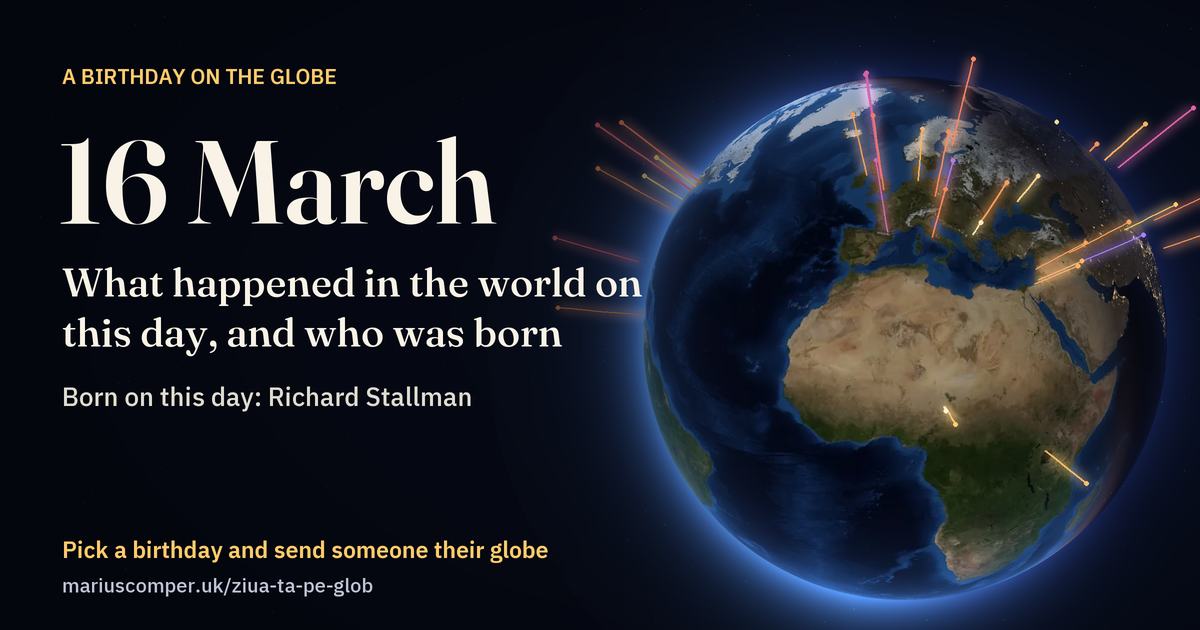
For 16 March, the English Wikipedia lists 61 events and 351 births. 37 of the events stand at their places as rays of light; three more are dashed circles, where the sentence links only to a country or a sea. The taller the ray, the longer ago it happened. The people born that day come further down, as blue points.
A birthday, yours or someone else’s:
Turn it into a greetingScroll: the globe turns to each place
The day you were born, on the globe.
Three things from your day
Scroll: your day first, then 16 March through the years
The Earth on 16 March
The picture on the globe was assembled by NASA from satellite photographs taken in March 2004: the snow, the ice and the green are those of the month.
On 16 March the Sun passes straight overhead at noon along the parallel of 1.5° south. In London, the day lasts about 11 hours 55 minutes.
The line between day and night is tilted on the globe exactly as on this day of the year. On the dark side you can see the lights of towns.
Britain & Ireland · The Oval
1872
The Wanderers F.C. win the first FA Cup, the oldest football competition in the world, beating Royal Engineers A.F.C. 1–0 at The Oval in Kennington, London.
On the map: The Oval.
Europe · Prague Castle
1939
From Prague Castle, Hitler proclaims Bohemia and Moravia a German protectorate.
On the map: Prague Castle.
Also on the day’s list of Wikipedia in Romanian.
Europe · St. Michael's Church, Hamburg
2002
Sofia Gubaidulina's Johannes-Ostern is premiered, together with her earlier Johannes-Passion, at Hamburg's Michaeliskirche, performed by soloists, choir and orchestra from the Mariinsky Theatre combined with NDR choir and orchestra, conducted by Valery Gergiev.
On the map: St. Michael's Church, Hamburg.
Asia · Jericho
2005
Israel officially hands over Jericho to Palestinian control.
On the map: Jericho.
Also on the day’s list of Wikipedia in Spanish and Romanian.
Oceania · Melbourne
1898
In Melbourne, the representatives of five colonies adopt a constitution, which would become the basis of the Commonwealth of Australia.[page needed]
On the map: Melbourne.
North America · Auburn, Massachusetts
1926
History of rocketry: Robert Goddard launches the first liquid-fueled rocket, at Auburn, Massachusetts.
On the map: Auburn, Massachusetts.
16 March
What the other Wikipedias remember#
For these years the English list has nothing on this day. The events below come from the same day’s lists on Wikipedia in Spanish and were translated for this page.
From Wikipedia in Spanish · Teatro La Fenice
1833
At the Teatro La Fenice (in Venice), the opera Beatrice di Tenda, by Vincenzo Bellini, premieres.
On the map: Teatro La Fenice.
Translated from the list on Wikipedia in Spanish.
16 March
Born on 16 March#
The English Wikipedia lists 351 births for this day. The blue points are the birthplaces of 60 of these people: those written about in the most Wikipedia editions, where Wikidata gives a place of birth.
Born on 16 March
1953
Richard Stallman, American computer scientist and programmer
Place of birth: Manhattan.
Born on 16 March
1839
Sully Prudhomme, French poet and critic, Nobel Prize laureate (died 1907)
Place of birth: 10ᵗʰ arrondissement of Paris.
Born on 16 March
1789
Georg Ohm, German physicist and mathematician (died 1854)
Place of birth: Erlangen.
Born on 16 March
1926
Jerry Lewis, American actor and comedian (died 2017)
Place of birth: Newark.
Born on 16 March
1941
Bernardo Bertolucci, Italian director and screenwriter (died 2018)
Place of birth: Parma.
Born in Britain and Ireland
1989
Theo Walcott, English footballer
Place of birth: Stanmore.
Born in Britain and Ireland
1997
Dominic Calvert-Lewin, English footballer
Place of birth: Sheffield.
Born in Britain and Ireland
1799
Anna Atkins, English botanist and photographer (died 1871)
Place of birth: Tonbridge.
16 March
Number one in the charts that week
At the cinema
An animal recorded that day
The record can be seen in GBIF, which brings together wildlife records from around the world.
All your birthdays
The weather that day
Data: Met Office Hadley Centre (HadCET); NOAA (GHCN-Daily, Mauna Loa).
Above the Earth
Sources: Jonathan McDowell, GCAT (launches); GFZ Potsdam (Kp index). Days are counted in Universal Time.
Football that day
International matches played that day:
Source: the “International football results” dataset kept by Mart Jürisoo (CC0).
Also that day
The earthquake’s page at the USGS
Source: the USGS catalogue. The day is counted in Universal Time (UTC).
In those days
Make a link for someone
Type the name, pick the day and the year of birth. The link opens straight on their day, with their name in the greeting.
The link carries the name, date and place typed here; anyone who gets it can see them.
Put another birthday beside it
Your mother’s, your child’s, a friend’s: the two days appear side by side.
Below: 16 March through the years.
The whole globe of the day
Drag the globe to turn it. Touch a ray or a point to read what happened there.
Everything Wikipedia lists for 16 March
The list is the English Wikipedia’s, in its own wording, as it stood in October 2026. 21 events have no place on the map: the sentence links to no place with coordinates, only to places too wide to mark, or to several countries.
- 597 BC
The first siege of Jerusalem by the Neo-Babylonian Empire ends with the city surrendering to king Nebuchadnezzar II.
Asia · Siege of JerusalemWikipedia: Siege of Jerusalem - 445
Western Roman Emperor Valentinian III is assassinated while practising on the Campus Martius on behalf of Petronius Maximus.
Europe · Campus MartiusWikipedia: Roman emperor - 934
Five Dynasties and Ten Kingdoms period: Chinese general Meng Zhixiang proclaimed himself emperor and established Later Shu as a new state independent of Later Tang.
no place on the mapWikipedia: Five Dynasties and Ten Kingdoms period - 1190
Massacre of Jews at Clifford's Tower, York.
Britain & Ireland · York CastleWikipedia: York Castle - 1244
Over 200 Cathars who refuse to recant are burnt to death after the Fall of Montségur.
Europe · Siege of MontségurWikipedia: Siege of Montségur - 1322
Despenser War: A royalist army defeated troops loyal to Thomas, 2nd Earl of Lancaster, in the Battle of Boroughbridge, which allowed King Edward II of England to hold on to power for another five years.
Britain & Ireland · Battle of BoroughbridgeWikipedia: Battle of Boroughbridge - 1355
Amidst the Red Turban Rebellions, Han Lin'er, a claimed descendant of Emperor Huizong of Song, is proclaimed emperor of the restored Song dynasty in Bozhou.
Asia · BozhouWikipedia: Red Turban Rebellions - 1621
Samoset, an Abenaki, visits the settlers of Plymouth Colony and greets them, "Welcome, Englishmen! My name is Samoset."
no place on the mapWikipedia: Samoset - 1660
The Long Parliament of England is dissolved so as to prepare for the new Convention Parliament.
no place on the mapWikipedia: Convention Parliament - 1689
The Royal Welch Fusiliers, one of the oldest line-infantry regiments of the British Army, was founded.
no place on the mapWikipedia: Royal Welch Fusiliers - 1696
The Dutch bombard Givet during the Nine Years' War.
no place on the mapWikipedia: Nine Years' War - 1782
American Revolutionary War: Spain captured the island of Roatán from England off the coast of what is now Honduras.
Latin America · Battle of RoatánWikipedia: Battle of Roatán - 1792
King Gustav III of Sweden is shot; he dies on March 29.
no place on the mapWikipedia: Gustav III - 1802
The Army Corps of Engineers is established to found and operate the United States Military Academy at West Point.
North America · United States Army Corps of EngineersWikipedia: United States Military Academy - 1815
Prince Willem proclaims himself King of the United Kingdom of the Netherlands, the first constitutional monarch in the Netherlands.
no place on the mapWikipedia: William I of the Netherlands - 1819
The Bank for Savings in the City of New-York, the first savings bank in New York City, was incorporated.
no place on the mapWikipedia: Bank for Savings in the City of New-York - 1872
The Wanderers F.C. win the first FA Cup, the oldest football competition in the world, beating Royal Engineers A.F.C. 1–0 at The Oval in Kennington, London.
Britain & Ireland · The OvalWikipedia: The Oval - 1898
In Melbourne, the representatives of five colonies adopt a constitution, which would become the basis of the Commonwealth of Australia.[page needed]
Oceania · MelbourneWikipedia: Constitution of Australia - 1916
The 7th and 10th US cavalry regiments under John J. Pershing cross the US–Mexico border to join the hunt for Pancho Villa.
no place on the mapWikipedia: John J. Pershing - 1918
Finnish Civil War: Battle of Länkipohja is infamous for its bloody aftermath as the Whites execute 70–100 capitulated Reds.
Europe · Battle of LänkipohjaWikipedia: Battle of Länkipohja - 1924
In accordance with the Treaty of Rome, Fiume becomes annexed as part of Italy.
Europe · RomeWikipedia: Treaty of Rome - 1925
An earthquake (measuring around 7.0 magnitude) occurs in Dali, China, killing an estimated 5,000 people.
Asia · 1925 Dali earthquakeWikipedia: 1925 Dali earthquake - 1926
History of rocketry: Robert Goddard launches the first liquid-fueled rocket, at Auburn, Massachusetts.
North America · Auburn, MassachusettsWikipedia: Rocket - 1935
Adolf Hitler orders Germany to rearm itself in violation of the Treaty of Versailles. Conscription is reintroduced to form the Wehrmacht.
no place on the mapWikipedia: Treaty of Versailles - 1936
Warmer-than-normal temperatures rapidly melt snow and ice on the upper Allegheny and Monongahela rivers, leading to a major flood in Pittsburgh.
no place on the mapWikipedia: Pittsburgh flood of 1936 - 1939
From Prague Castle, Hitler proclaims Bohemia and Moravia a German protectorate.
Europe · Prague CastleWikipedia: Prague Castle - 1941
Operation Appearance takes place to re-establish British Somaliland.
Africa · British SomalilandWikipedia: Operation Appearance - 1945
World War II: Ninety percent of Würzburg, Germany is destroyed in only 20 minutes by British bombers, resulting in at least 4,000 deaths.
no place on the mapWikipedia: Bombing of Würzburg in World War II - 1945
World War II: The Battle of Iwo Jima ends, but small pockets of Japanese resistance persist.
Oceans · Battle of Iwo JimaWikipedia: World War II - 1960
African American civil rights activists in Savannah, Georgia, conducted a sit-in, commencing the Savannah Protest Movement.
North America · Savannah, GeorgiaWikipedia: African Americans - 1962
Flying Tiger Line Flight 739 disappears in the western Pacific Ocean with all 107 aboard missing and presumed dead.
Oceans · Flying Tiger Line Flight 739Wikipedia: Flying Tiger Line Flight 739 - 1966
Launch of Gemini 8 with astronauts Neil Armstrong and David Scott. It would perform the first docking of two spacecraft in orbit.
no place on the mapWikipedia: Gemini 8 - 1968
Vietnam War: My Lai massacre occurs; between 347 and 500 Vietnamese villagers are killed by American troops.
Asia · My Lai massacreWikipedia: Vietnam War - 1969
A Viasa McDonnell Douglas DC-9 crashes in Maracaibo, Venezuela, killing 155.
Latin America · Viasa Flight 742Wikipedia: Viasa Flight 742 - 1977
Assassination of Kamal Jumblatt, the main leader of the anti-government forces in the Lebanese Civil War.
no place on the mapWikipedia: Lebanese Civil War - 1978
A Balkan Bulgarian Airlines Tupolev Tu-134 crashes near Gabare, Bulgaria, killing 73.
Europe · Balkan Bulgarian Airlines Flight 107Wikipedia: Balkan Bulgarian Airlines Flight 107 - 1978
Former Italian Prime Minister Aldo Moro is kidnapped; he is later murdered by his captors.
no place on the mapWikipedia: Aldo Moro - 1978
Supertanker Amoco Cadiz splits in two after running aground on the Portsall Rocks, three miles off the coast of Brittany, resulting in the largest oil spill in history at that time.
Europe · BrittanyWikipedia: Amoco Cadiz - 1979
Sino-Vietnamese War: The People's Liberation Army crosses the border back into China, ending the war.
no place on the mapWikipedia: Sino-Vietnamese War - 1984
William Buckley, the CIA station chief in Lebanon, is kidnapped by Hezbollah; he later dies in captivity.
no place on the mapWikipedia: William Francis Buckley - 1985
Associated Press newsman Terry Anderson is taken hostage in Beirut; he is not released until December 1991.
Asia · BeirutWikipedia: Associated Press - 1988
Halabja chemical attack: The Kurdish town of Halabja in Iraq is attacked with a mix of poison gas and nerve agents on the orders of Saddam Hussein, killing 5,000 people and injuring about 10,000 people.
Asia · Halabja massacreWikipedia: Halabja massacre - 1988
Iran–Contra affair: Lieutenant Colonel Oliver North and Vice Admiral John Poindexter are indicted on charges of conspiracy to defraud the United States.
no place on the mapWikipedia: Iran–Contra affair - 1988
The Troubles: Ulster loyalist militant Michael Stone attacks a Provisional IRA funeral in Belfast with pistols and grenades. Three persons, one of them a member of PIRA, are killed, and more than 60 others are wounded.
Britain & Ireland · Milltown Cemetery attackWikipedia: The Troubles - 1995
Mississippi formally ratifies the Thirteenth Amendment to the United States Constitution, becoming the last state to approve the abolition of slavery. The Thirteenth Amendment was officially ratified in 1865.
North America · MississippiWikipedia: Mississippi - 2001
A series of bomb blasts in the city of Shijiazhuang, China kill 108 people and injure 38 others, the biggest mass murder in China in decades.
Asia · ShijiazhuangWikipedia: 2001 Shijiazhuang bombings - 2002
Sofia Gubaidulina's Johannes-Ostern is premiered, together with her earlier Johannes-Passion, at Hamburg's Michaeliskirche, performed by soloists, choir and orchestra from the Mariinsky Theatre combined with NDR choir and orchestra, conducted by Valery Gergiev.
Europe · St. Michael's Church, HamburgWikipedia: St. Michael's Church, Hamburg - 2003
American activist Rachel Corrie is killed in Rafah by being run over by an Israel Defense Forces bulldozer while trying to obstruct the demolition of a home.
Asia · RafahWikipedia: Rachel Corrie - 2005
Israel officially hands over Jericho to Palestinian control.
Asia · JerichoWikipedia: Israel - 2010
The Kasubi Tombs, Uganda's only cultural World Heritage Site, are destroyed in a fire.
Africa · Kasubi TombsWikipedia: Kasubi Tombs - 2012
Indian cricketer Sachin Tendulkar becomes the first batter in history to score 100 centuries in international cricket.
no place on the mapWikipedia: Sachin Tendulkar - 2014
Crimea votes in a controversial referendum to secede from Ukraine to join Russia.
no place on the mapWikipedia: 2014 Crimean status referendum - 2015
Natalia Kills and Willy Moon were fired as judges on the second series of The X Factor New Zealand, following public backlash over comments they made to a contestant during the first live show.
no place on the mapWikipedia: Teddy Sinclair - 2016
A bomb detonates in a bus carrying government employees in Peshawar, Pakistan, killing 15 and injuring at least 30.
Asia · PeshawarWikipedia: 2016 Peshawar bus bombing - 2016
Two suicide bombers detonate their explosives at a mosque during morning prayer on the outskirts of Maiduguri, Nigeria, killing 24 and injuring 18.
Africa · MaiduguriWikipedia: March 2016 Maiduguri bombings - 2020
The Dow Jones Industrial Average falls by 2,997.10, the single largest point drop in history and the second-largest percentage drop ever at 12.93%, an even greater crash than Black Monday (1929). This follows the U.S. Federal Reserve announcing that it will cut its target interest rate to 0–0.25%.
North America · Wall Street crash of 1929Wikipedia: 2020 stock market crash - 2021
Atlanta spa shootings: Eight people are killed and one is injured in a trio of shootings at spas in and near Atlanta, Georgia, U.S. A suspect is arrested the same day.
North America · 2021 Atlanta spa shootingsWikipedia: 2021 Atlanta spa shootings - 2022
A 7.4-magnitude earthquake occurs off the coast of Fukushima, Japan, killing 4 people and injuring 225.
Asia · 2022 Fukushima earthquakeWikipedia: 2022 Fukushima earthquake - 2022
Mariupol theatre airstrike during the siege of Mariupol.
Europe · Mariupol theatre airstrikeWikipedia: Mariupol theatre airstrike - 2025
A fire breaks out in a nightclub in Kočani, North Macedonia, killing at least 59 people and injuring 155 others.
Europe · Kočani nightclub fireWikipedia: Kočani nightclub fire - 2026
A series of Boko Haram bombings leave 26 dead and 146 injured in Maiduguri, Nigeria.
Africa · Boko HaramWikipedia: 2026 Maiduguri bombings
What the other Wikipedias remember
For these years the English list has nothing on this day. The events below come from the same day’s lists on Wikipedia in Spanish and were translated for this page.
- 1833
At the Teatro La Fenice (in Venice), the opera Beatrice di Tenda, by Vincenzo Bellini, premieres.
Who was born on 16 March
In order of how many Wikipedia editions have an article about each. The first 60 of 351 are shown.
- 1751
James Madison, American academic and politician, 4th President of the United States (died 1836)
Port ConwayWikipedia: James Madison - 1953
Richard Stallman, American computer scientist and programmer
ManhattanWikipedia: Richard Stallman - 1839
Sully Prudhomme, French poet and critic, Nobel Prize laureate (died 1907)
10ᵗʰ arrondissement of ParisWikipedia: Sully Prudhomme - 1959
Jens Stoltenberg, Norwegian economist and politician, 27th Prime Minister of Norway, 13th Secretary General of NATO
- 1789
Georg Ohm, German physicist and mathematician (died 1854)
ErlangenWikipedia: Georg Ohm - 1965
Mark Carney, Canadian economist and politician, Prime Minister of Canada
Fort SmithWikipedia: Mark Carney - 1926
Jerry Lewis, American actor and comedian (died 2017)
NewarkWikipedia: Jerry Lewis - 1941
Bernardo Bertolucci, Italian director and screenwriter (died 2018)
- 1911
Josef Mengele, German physician, SS captain and mass-murderer (died 1979)
GünzburgWikipedia: Josef Mengele - 1986
Alexandra Daddario, American actress
New York CityWikipedia: Alexandra Daddario - 1953
Isabelle Huppert, French actress
16th arrondissement of ParisWikipedia: Isabelle Huppert - 1750
Caroline Herschel, German-English astronomer (died 1848)
HanoverWikipedia: Caroline Herschel - 1918
Frederick Reines, American physicist and academic, Nobel Prize laureate (died 1998)
PatersonWikipedia: Frederick Reines - 1989
Theo Walcott, English footballer
StanmoreWikipedia: Theo Walcott - 1892
César Vallejo, Peruvian poet (died 1938)
Santiago de ChucoWikipedia: César Vallejo - 1927
Vladimir Komarov, Russian pilot, engineer, and cosmonaut (died 1967)
- 1912
Pat Nixon, American teacher, First Lady of the United States (died 1993)
- 1859
Alexander Stepanovich Popov, Russian physicist and inventor (died 1906)
KrasnoturyinskWikipedia: Aleksandr Popov - 1774
Matthew Flinders, English navigator and cartographer (died 1814)
DoningtonWikipedia: Matthew Flinders - 1944
Andrew S. Tanenbaum, American computer scientist and academic
New York CityWikipedia: Andrew S. Tanenbaum - 1822
Rosa Bonheur, French painter and sculptor (died 1899)
BordeauxWikipedia: Rosa Bonheur - 1916
Mercedes McCambridge, American actress (died 2004)
- 1967
Lauren Graham, American actress and producer
HonoluluWikipedia: Lauren Graham - 1920
Traudl Junge, German secretary (died 2002)
MunichWikipedia: Traudl Junge - 1989
Blake Griffin, American basketball player
Oklahoma CityWikipedia: Blake Griffin - 1997
Dominic Calvert-Lewin, English footballer
SheffieldWikipedia: Dominic Calvert-Lewin - 1976
Zhu Chen, Qatari chess Grandmaster
WenzhouWikipedia: Zhu Chen - 1799
Anna Atkins, English botanist and photographer (died 1871)
TonbridgeWikipedia: Anna Atkins - 1800
Emperor Ninkō of Japan (died 1846)
- 1851
Martinus Beijerinck, Dutch microbiologist and botanist (died 1931)
AmsterdamWikipedia: Martinus Beijerinck - 1916
Tsutomu Yamaguchi, Japanese engineer and businessman (died 2010)
NagasakiWikipedia: Tsutomu Yamaguchi - 1956
Eveline Widmer-Schlumpf, Swiss lawyer and politician
- 1964
Gore Verbinski, American director, producer, and screenwriter
Oak RidgeWikipedia: Gore Verbinski - 1975
Sienna Guillory, English model and actress
KetteringWikipedia: Sienna Guillory - 1991
Admir Mehmedi, Swiss footballer
GostivarWikipedia: Admir Mehmedi - 1938
Carlos Bilardo, Argentinian footballer and manager
La Paternal, Buenos AiresWikipedia: Carlos Bilardo - 1687
Sophia Dorothea of Hanover, queen consort of Frederick William I (died 1757)
- 1949
Victor Garber, Canadian actor and singer
LondonWikipedia: Victor Garber - 1971
Alan Tudyk, American actor
El PasoWikipedia: Alan Tudyk - 1399
The Xuande Emperor, ruler of Ming China (died 1435)
BeijingWikipedia: Xuande Emperor - 1771
Antoine-Jean Gros, French painter (died 1835)
- 1996
Ivan Toney, English footballer
NorthamptonWikipedia: Ivan Toney - 1856
Napoléon, Prince Imperial of France (died 1879)
- 1878
Clemens August Graf von Galen, German cardinal (died 1946)
- 1906
Francisco Ayala, Spanish sociologist, author, and translator (died 2009)
GranadaWikipedia: Francisco Ayala - 1910
Aladár Gerevich, Hungarian fencer (died 1991)
JászberényWikipedia: Aladár Gerevich - 1915
Kunihiko Kodaira, Japanese mathematician (died 1997)
- 1932
Walter Cunningham, American astronaut (died 2023)
CrestonWikipedia: Walter Cunningham - 1959
Flavor Flav, American rapper and actor
RooseveltWikipedia: Flavor Flav - 1994
Joel Embiid, Cameroonian basketball player
YaoundéWikipedia: Joel Embiid - 1846
Gösta Mittag-Leffler, Swedish mathematician and academic (died 1927)
StockholmWikipedia: Gösta Mittag-Leffler - 1935
Teresa Berganza, Spanish soprano and actress (died 2022)
- 1963
Jerome Flynn, English actor and singer
BromleyWikipedia: Jerome Flynn - 1997
Florian Neuhaus, German footballer
Landsberg am LechWikipedia: Florian Neuhaus - 1927
Daniel Patrick Moynihan, American sociologist and politician, 12th United States Ambassador to the United Nations (died 2003)
- 1988
Jhené Aiko, American singer-songwriter and rapper
Los AngelesWikipedia: Jhené Aiko - 1908
Robert Rossen, American director, producer, and screenwriter (died 1966)
New York CityWikipedia: Robert Rossen - 1928
Christa Ludwig, German opera singer (died 2021)
- 1936
Raymond Vahan Damadian, Armenian-American inventor, invented the MRI (died 2022)
New York CityWikipedia: Raymond Damadian - 1937
Amos Tversky, Israeli-American psychologist and academic (died 1996)
What is celebrated on 16 March
- Christian feast day: Eusebia of Hamage
- Christian feast day: Finian Lobhar (Finian the Leper)
- Christian feast day: Heribert of Cologne
- Christian feast day: Hilarius of Aquileia
- Christian feast day: Jean de Brébeuf
- Christian feast day: Blessed John Amias and Robert Dalby
- Christian feast day: Julian of Antioch
- Christian feast day: March 16 (Eastern Orthodox liturgics)
- Day of the Book Smugglers (Lithuania)
- Remembrance day of the Latvian legionnaires (Latvia)
- Saint Urho's Day (Finnish Americans and Finnish Canadians)
A greeting link for someone
Type a name and, if you like, the year of birth. The link opens with a greeting, and beside each event it says how old the person turned that day, or how many years before their birth it happened.
The name and the year go only into the link you send.
All 366 days
How the globe is made
Where the events come from
Each edition of this page uses the day’s list from Wikipedia in its own language: Romanian, English, Spanish, Chinese. The lists are written by volunteers and differ from one edition to the next; the text of each event is Wikipedia’s, with a link to the article. A row that appears twice in a list is shown once. The lists have not been checked event by event: they are Wikipedia’s, mistakes included.
For events before 1582, and for countries that moved to the Gregorian calendar later (Britain in 1752, Russia in 1918), the same day may be counted Old Style in one list and New Style in another.
The chapter “What the other Wikipedias remember” adds up to five events a day from the lists of the other three editions, only for years in which the English list has nothing on that day. They were translated for this page, passed the same filters as the tour, and are not counted among the events of the English list.
How an event gets onto the map
The place comes from Wikidata. If the sentence links to the article about the event itself (a battle, an opening, an earthquake), dated to the same year, the ray stands on its coordinates or on those of its location. Otherwise it stands on the first place the sentence links to: a town, a building, a mountain, an island. This second step can be wrong: sometimes the sentence only mentions the place. That is why the page says, under each event, which place the ray stands on.
When the sentence links to a single state or province, or to a single sea, lake or desert larger than 5,000 km², the globe shows a dashed circle, not a ray. The circle has the area Wikidata gives, with its radius kept between 1.2° and 16°, or a radius of 4.5° when Wikidata gives no area; it says only that the sentence links to that place. Organisations, ships, spacecraft, museum objects, rivers, mountain ranges, languages and continents are never used as places. When a sentence names several states and no exact place, the event stays in the list only.
What the height means
The height of a ray shows how many years have passed, on a logarithmic scale: 10 years, 100 years and 1,000 years are equal steps apart; anything older than about 2,600 years has the tallest ray. The colour runs from pale yellow for recent years to violet for antiquity.
Where the tour stops
In each region the tour stops at up to three events (five in Britain and Ireland), chosen mainly by three things: whether Wikipedia’s editors put the event in the “On this day” box of their main page (the English, Spanish and Chinese editions), how many Wikipedia editions have an article about it, and how many of the four lists include it. Events whose sentence or article is about a war, an attack, a crime or a disaster are left out of the tour; they stay in the whole list, in Wikipedia’s wording. The filter is a list of words and a list of Wikidata types, so it can miss some.
The tour of births names the people with articles in the most editions and leaves aside those whom the list or Wikidata describes as rulers, politicians, commanders, leaders of movements or criminals; they stay in the list.
The Earth and the Sun
The daytime images are NASA’s Blue Marble Next Generation mosaics, one for each month of 2004; the night side is Black Marble 2016. The tilt of the line between day and night is computed for the day; the hour is chosen so that the place being read is in daylight. The latitude where the Sun stands overhead is the average of the four years of the leap cycle; in a given year it can differ by up to 0.4°.
The day you were born
The number ones come from the weekly lists on Wikipedia: Billboard for the United States (from 1940; the Hot 100 from August 1958), the UK Singles Chart (from November 1952), Los 40 Principales for Spain (from July 1966) and, for Romania, the Romanian Top 100 and Airplay 100 (2001–2021, with missing weeks). The page shows the chart of the week in which the day of birth falls, with its date; Billboard and the UK chart are dated at the end of their week. For Romania before 2001 and for China these sources have no weekly chart.
The films are those that reached cinemas in the United States up to ten days before or three days after that day (some of them in a few cinemas at first), from the English Wikipedia’s yearly lists (from 1968), in order of how many editions have an article about them. The events “in those days” are the ones on the neighbouring days’ lists that carry the year of birth, passed through the same filter as the tour.
The day of birth, year included
The Moon, the star sign and the constellation are worked out by the page itself, for noon Universal Time on the day. The lit part of the Moon is rounded and can differ by a few per cent from that at the hour of birth. The sign follows the usual zodiac of twelve equal parts starting at the March equinox; the constellation is the one the Sun actually stood in front of, by the borders set by the International Astronomical Union, and within a day of a border the page does not name it. When the Sun changes sign while it is that day anywhere on Earth, the page gives the moment of crossing, rounded to ten minutes and accurate to within about a quarter of an hour, and the clock time in a few cities, with the time zone and summer time of that year.
The year in the Chinese calendar is the one your device’s own calendar gives for the date, checked against the Hong Kong Observatory’s tables. “All your birthdays” uses the same sources as the rest of the chapter for the same day in every year since the birth: the temperature, well-known launches that took place on that very day, matches of the teams the edition follows, snow deeper than 10 cm and strong geomagnetic storms. The three things at the top and the four on the picture are chosen in a fixed order (the song, the animal, a full Moon, a well-known launch before an ordinary earthquake); on the picture you can change them.
When the link carries a year of birth, the page adds a few things about that exact day. The weather is the Met Office’s Central England temperature record and the readings from New York’s Central Park; the “usual high” is the average of the daily highs of 1961–1990 for that date, with two days either side. The carbon dioxide figure is the monthly mean at the Mauna Loa observatory, where measurements begin in March 1958.
The earthquake is the one with the largest magnitude in the USGS catalogue for that day, counted in Universal Time. Before the 1960s the catalogue has gaps even above magnitude 5.5, so in the older years many days have no earthquake. The page gives only the magnitude and the place: the country the epicentre falls in or, when the epicentre is at sea within 300 km of a coast, the nearest country; farther out, only the ocean.
The launches are those that reached orbit or left for the Moon and the planets, from Jonathan McDowell’s GCAT catalogue. If nothing left that day, the page shows the nearest launch within three days before or after, and says how many days away it was. The geomagnetic storm appears only when the Kp index reached at least 5 in one of the day’s eight three-hour intervals.
The animal comes from GBIF: an observation made by a person (the animal seen or heard, or its tracks), dated to that exact day, with coordinates and a CC0 or CC BY licence. Only a few hundred well-known species are searched (mammals, birds, turtles, butterflies); of those noted that day, mammals and species with articles in many Wikipedia editions come first; birds noted almost every day, and species used recently, wait their turn. Observations dated 1 January are left out, because records without a day are often filed there. An observation shows that the animal was recorded there, not how many animals there were.
The matches are those between national teams. Only matches of England, Scotland, Wales, Northern Ireland, the Republic of Ireland, the United States, Canada and Australia are shown, along with those at the big final tournaments. The picture to send is drawn in the page from the day’s globe and the facts above, and stays on your device until you send it.
Sources
- Events, births and holidays: the day’s page on Wikipedia, text under CC BY-SA 4.0.
- Coordinates, places of birth and the number of editions: Wikidata (CC0).
- The Earth by day: NASA Blue Marble Next Generation. The Earth by night: NASA Black Marble 2016.
- Borders and regions: Natural Earth.
- World population and births per year: UN World Population Prospects 2024.
- Charts and films: Wikipedia’s lists for Billboard, the UK Singles Chart, Los 40 Principales, Romanian Top 100, Airplay 100 and American films by year (CC BY-SA 4.0).
- Weather: Met Office Hadley Centre, HadCET (Open Government Licence) and NOAA GHCN-Daily, New York Central Park. Carbon dioxide: NOAA Global Monitoring Laboratory, Mauna Loa.
- Earthquakes: the USGS catalogue. Launches: Jonathan McDowell, GCAT (CC BY). Kp index: GFZ Potsdam (CC BY 4.0). Matches: International football results, Mart Jürisoo (CC0).
- Animal observations: GBIF, with a link to each record; species names come from Wikidata.