A birthday on the globe
17 June on the globe: what happened in the world on this day, and who was born
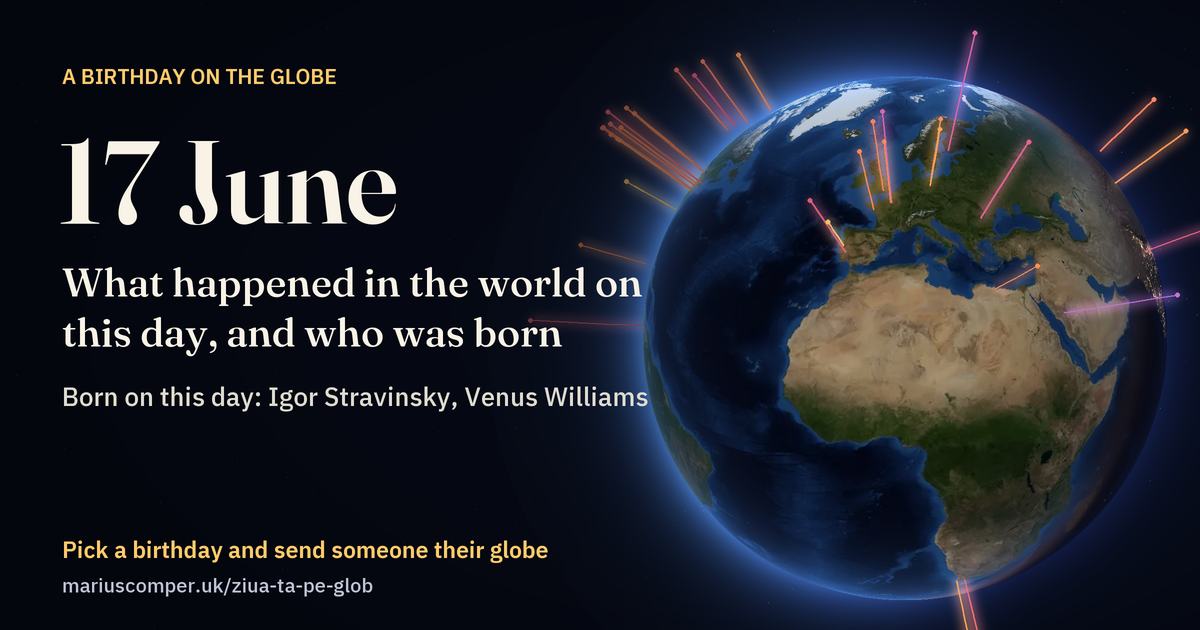
For 17 June, the English Wikipedia lists 64 events and 238 births. 38 of the events stand at their places as rays of light; six more are dashed circles, where the sentence links only to a country or a sea. The taller the ray, the longer ago it happened. The people born that day come further down, as blue points.
A birthday, yours or someone else’s:
Turn it into a greetingScroll: the globe turns to each place
The day you were born, on the globe.
Three things from your day
Scroll: your day first, then 17 June through the years
The Earth on 17 June
The picture on the globe was assembled by NASA from satellite photographs taken in June 2004: the snow, the ice and the green are those of the month.
On 17 June the Sun passes straight overhead at noon along the parallel of 23.4° north. In London, the day lasts about 16 hours 40 minutes.
Beyond 67° north the Sun no longer sets; beyond 67° south it no longer rises.
The line between day and night is tilted on the globe exactly as on this day of the year. On the dark side you can see the lights of towns.
Europe · Turku Cathedral
1300
Turku Cathedral is consecrated by Bishop Magnus I in the city of Turku (Swedish: Åbo).
On the map: Turku Cathedral.
Asia · Lop Nur
1967
Nuclear weapons testing: China announces a successful test of its first thermonuclear weapon.
On the map: Lop Nur.
Oceania · Tahiti
1767
Samuel Wallis, a British sea captain, sights Tahiti and is considered the first European to reach the island.
On the map: Tahiti.
17 June
Latin America and the Caribbean#
Two events from the day’s list are placed here, between 1773 and 1952.
Latin America · Cúcuta
1773
Cúcuta, Colombia, is founded by Juana Rangel de Cuéllar.
On the map: Cúcuta.
Also on the day’s list of Wikipedia in Spanish.
Latin America · Decree 900
1952
Guatemala passes Decree 900, ordering the redistribution of uncultivated land.
On the map: Decree 900.
North America · New Albion
1579
Sir Francis Drake claims a land he calls Nova Albion (modern California) for England.
On the map: New Albion.
Also on the day’s list of Wikipedia in Spanish.
North America · Statue of Liberty
1885
The Statue of Liberty arrives in New York Harbor.
On the map: Statue of Liberty.
Also on the day’s list of Wikipedia in Spanish and Chinese.
North America · Supreme Court of the United States
1963
The United States Supreme Court rules 8–1 in Abington School District v. Schempp against requiring the reciting of Bible verses and the Lord's Prayer in public schools.
On the map: Supreme Court of the United States.
17 June
Born on 17 June#
The English Wikipedia lists 238 births for this day. The blue points are the birthplaces of 60 of these people: those written about in the most Wikipedia editions, where Wikidata gives a place of birth.
Born on 17 June
1882
Igor Stravinsky, Russian pianist, composer, and conductor (died 1971)
Place of birth: Lomonosov.
Born on 17 June
1980
Venus Williams, American tennis player
Place of birth: Lynwood.
Born on 17 June
1898
M. C. Escher, Dutch illustrator (died 1972)
Place of birth: Leeuwarden.
Born on 17 June
1818
Charles Gounod, French composer and academic (died 1893)
Place of birth: Paris.
Born on 17 June
1990
Jordan Henderson, English footballer
Place of birth: Sunderland.
Born in Britain and Ireland
1832
William Crookes, English chemist and physicist (died 1919)
Place of birth: London.
Born in Britain and Ireland
1936
Ken Loach, English director, producer, and screenwriter
Place of birth: Nuneaton.
Born in Britain and Ireland
1976
Scott Adkins, English actor and martial artist
Place of birth: Sutton Coldfield.
17 June
Number one in the charts that week
At the cinema
An animal recorded that day
The record can be seen in GBIF, which brings together wildlife records from around the world.
All your birthdays
The weather that day
Data: Met Office Hadley Centre (HadCET); NOAA (GHCN-Daily, Mauna Loa).
Above the Earth
Sources: Jonathan McDowell, GCAT (launches); GFZ Potsdam (Kp index). Days are counted in Universal Time.
Football that day
International matches played that day:
Source: the “International football results” dataset kept by Mart Jürisoo (CC0).
Also that day
The earthquake’s page at the USGS
Source: the USGS catalogue. The day is counted in Universal Time (UTC).
In those days
Make a link for someone
Type the name, pick the day and the year of birth. The link opens straight on their day, with their name in the greeting.
The link carries the name, date and place typed here; anyone who gets it can see them.
Put another birthday beside it
Your mother’s, your child’s, a friend’s: the two days appear side by side.
Below: 17 June through the years.
The whole globe of the day
Drag the globe to turn it. Touch a ray or a point to read what happened there.
Everything Wikipedia lists for 17 June
The list is the English Wikipedia’s, in its own wording, as it stood in October 2026. 20 events have no place on the map: the sentence links to no place with coordinates, only to places too wide to mark, or to several countries.
- 653
Pope Martin I is arrested and taken to Constantinople, due to his opposition to monothelitism.
no place on the mapWikipedia: Pope Martin I - 656
After a prolonged siege by rebels who demand his abdication, caliph Uthman is assassinated as the rebels enter his palace.
Asia · Assassination of UthmanWikipedia: Assassination of Uthman - 1128
Former Empress Matilda, daughter and designated heiress of king Henry I of England, marries Geoffrey Plantagenet, Count of Anjou.
no place on the mapWikipedia: Empress Matilda - 1242
Following the Disputation of Paris, twenty-four carriage loads of Jewish religious manuscripts are burnt in Paris.
Europe · ParisWikipedia: Disputation of Paris - 1300
Turku Cathedral is consecrated by Bishop Magnus I in the city of Turku (Swedish: Åbo).
Europe · Turku CathedralWikipedia: Turku Cathedral - 1397
The Kalmar Union is formed under the rule of Margaret I of Denmark.
Europe · Kalmar UnionWikipedia: Kalmar Union - 1462
Vlad the Impaler attempts to assassinate Mehmed II (The Night Attack at Târgovişte), forcing him to retreat from Wallachia.
Europe · TârgovișteWikipedia: Night attack at Târgoviște - 1497
Battle of Deptford Bridge: Forces under King Henry VII defeat troops led by Michael An Gof.
no place on the mapWikipedia: Cornish rebellion of 1497 - 1579
Sir Francis Drake claims a land he calls Nova Albion (modern California) for England.
North America · New AlbionWikipedia: Francis Drake - 1596
The Dutch explorer Willem Barentsz discovers the Arctic archipelago of Spitsbergen.
Europe · SvalbardWikipedia: Willem Barentsz - 1631
Mumtaz Mahal dies during childbirth. Her husband, Mughal emperor Shah Jahan I, will spend the next 17 years building her mausoleum, the Taj Mahal.
Asia · Taj MahalWikipedia: Mumtaz Mahal - 1665
Battle of Montes Claros: Portugal definitively secures independence from Spain in the last battle of the Portuguese Restoration War.
Europe · Battle of Montes ClarosWikipedia: Battle of Montes Claros - 1673
French explorers Jacques Marquette and Louis Jolliet reach the Mississippi River and become the first Europeans to make a detailed account of its course.
no place on the mapWikipedia: French people - 1767
Samuel Wallis, a British sea captain, sights Tahiti and is considered the first European to reach the island.
Oceania · TahitiWikipedia: Samuel Wallis - 1773
Cúcuta, Colombia, is founded by Juana Rangel de Cuéllar.
Latin America · CúcutaWikipedia: Cúcuta - 1775
American Revolutionary War: Colonists inflict heavy casualties on British forces while losing the Battle of Bunker Hill.
North America · Battle of Bunker HillWikipedia: Battle of Bunker Hill - 1789
In France, the Third Estate declares itself the National Assembly.
Europe · FranceWikipedia: France - 1794
Foundation of Anglo-Corsican Kingdom.
Europe · Anglo-Corsican KingdomWikipedia: Anglo-Corsican Kingdom - 1795
French Revolutionary Wars: Off the coast of Brittany, a Royal Navy squadron commanded by William Cornwallis fended off a numerically superior French Navy fleet.
Europe · BrittanyWikipedia: French Revolutionary Wars - 1795
The burghers of Swellendam expel the Dutch East India Company magistrate and declare a republic.
Africa · SwellendamWikipedia: Swellendam - 1831
The steam locomotive Best Friend of Charleston causes the first boiler explosion caused by a steam locomotive.
no place on the mapWikipedia: Best Friend of Charleston - 1839
In the Kingdom of Hawaii, Kamehameha III issues the edict of toleration which gives Roman Catholics the freedom to worship in the Hawaiian Islands. The Hawaii Catholic Church and the Cathedral of Our Lady of Peace are established as a result.
North America · Cathedral Basilica of Our Lady of PeaceWikipedia: Hawaiian Kingdom - 1843
The Wairau Affray, the first serious clash of arms between Māori and British settlers in the New Zealand Wars, takes place.
Oceania · Wairau AffrayWikipedia: Wairau Affray - 1861
American Civil War: Battle of Vienna, Virginia.
North America · Battle of Vienna, VirginiaWikipedia: American Civil War - 1863
American Civil War: Battle of Aldie in the Gettysburg campaign.
North America · Battle of AldieWikipedia: Battle of Aldie - 1876
American Indian Wars: Battle of the Rosebud: One thousand five hundred Sioux and Cheyenne led by Crazy Horse beat back General George Crook's forces at Rosebud Creek in Montana Territory.
North America · Battle of the RosebudWikipedia: Battle of the Rosebud - 1877
American Indian Wars: Battle of White Bird Canyon: The Nez Perce defeat the U.S. Cavalry at White Bird Canyon in the Idaho Territory.
North America · Battle of White Bird CanyonWikipedia: Battle of White Bird Canyon - 1885
The Statue of Liberty arrives in New York Harbor.
North America · Statue of LibertyWikipedia: Statue of Liberty - 1898
The United States Navy Hospital Corps is established.
no place on the mapWikipedia: Hospital corpsman - 1900
Boxer Rebellion: Western Allied and Japanese forces capture the Taku Forts in Tianjin, China.
Asia · Taku FortsWikipedia: Boxer Rebellion - 1901
The College Board introduces its first standardized test, the forerunner to the SAT.
no place on the mapWikipedia: College Board - 1910
Aurel Vlaicu pilots an A. Vlaicu nr. 1 on its first flight.
no place on the mapWikipedia: Aurel Vlaicu - 1913
In Detroit, autoworkers for car manufacturer Studebaker went on strike in the American auto industry's first major strike action.
North America · DetroitWikipedia: 1913 Studebaker strike - 1919
Hundreds of Canadian soldiers rioted in Epsom, England, leading to the death of a British police officer.
Britain & Ireland · Epsom riotWikipedia: Epsom riot - 1922
Portuguese naval aviators Gago Coutinho and Sacadura Cabral complete the first aerial crossing of the South Atlantic.
no place on the mapWikipedia: First aerial crossing of the South Atlantic - 1929
The town of Murchison, New Zealand is rocked by a 7.8 magnitude earthquake killing 17. At the time it was New Zealand's worst natural disaster.
Oceania · 1929 Murchison earthquakeWikipedia: 1929 Murchison earthquake - 1930
U.S. president Herbert Hoover signs the Smoot–Hawley Tariff Act into law.
no place on the mapWikipedia: Herbert Hoover - 1932
Bonus Army: Around a thousand World War I veterans amass at the United States Capitol as the U.S. Senate considers a bill that would give them certain benefits.
North America · Bonus ArmyWikipedia: Bonus Army - 1933
Union Station massacre: In Kansas City, Missouri, four FBI agents and captured fugitive Frank Nash are gunned down by gangsters attempting to free Nash.
North America · Kansas City massacreWikipedia: Kansas City massacre - 1939
Last public guillotining in France: Eugen Weidmann, a convicted murderer, is executed in Versailles outside the Saint-Pierre prison.
Europe · Versailles, YvelinesWikipedia: Eugen Weidmann - 1940
The three Baltic states of Estonia, Latvia and Lithuania fall under the occupation of the Soviet Union.
no place on the mapWikipedia: Baltic states - 1940
World War II: RMS Lancastria is attacked and sunk by the Luftwaffe near Saint-Nazaire, France. At least 3,000 are killed in Britain's worst maritime disaster.
Europe · Saint-NazaireWikipedia: World War II - 1940
World War II: The British Army's 11th Hussars assault and take Fort Capuzzo in Libya from Italian forces.
Africa · Fort CapuzzoWikipedia: Fort Capuzzo - 1944
Iceland declares independence from Denmark and becomes a republic.
Europe · IcelandWikipedia: Iceland - 1948
United Air Lines Flight 624, a Douglas DC-6, crashes near Mount Carmel, Pennsylvania, killing all 43 people on board.
North America · United Air Lines Flight 624Wikipedia: United Air Lines Flight 624 - 1952
Guatemala passes Decree 900, ordering the redistribution of uncultivated land.
Latin America · Decree 900Wikipedia: Decree 900 - 1953
Cold War: East Germany Workers Uprising: In East Germany, the Soviet Union orders a division of troops into East Berlin to quell a rebellion.
Europe · East BerlinWikipedia: Cold War - 1958
The Ironworkers Memorial Second Narrows Crossing, in the process of being built to connect Vancouver and North Vancouver (Canada), collapses into the Burrard Inlet killing 18 ironworkers and injuring others.
North America · North VancouverWikipedia: Ironworkers Memorial Second Narrows Crossing - 1960
The Nez Perce tribe is awarded $4 million for 7 million acres (28,000 km2) of land undervalued at four cents/acre in the 1863 treaty.
no place on the mapWikipedia: Nez Perce - 1963
A day after South Vietnamese president Ngo Dinh Diem announced the Joint Communiqué to end the Buddhist crisis, a riot involving around 2,000 people breaks out. One person is killed.
no place on the mapWikipedia: Buddhist crisis - 1963
The United States Supreme Court rules 8–1 in Abington School District v. Schempp against requiring the reciting of Bible verses and the Lord's Prayer in public schools.
North America · Supreme Court of the United StatesWikipedia: Abington School District v. Schempp - 1967
Nuclear weapons testing: China announces a successful test of its first thermonuclear weapon.
Asia · Lop NurWikipedia: Project 639 - 1971
U.S. president Richard Nixon in a televised press conference calls drug abuse "America's public enemy number one", starting the war on drugs.
no place on the mapWikipedia: War on drugs - 1972
Watergate scandal: Five White House operatives are arrested for burgling the offices of the Democratic National Committee during an attempt by members of the administration of President Richard M. Nixon to illegally wiretap the political opposition as part of a broader campaign to subvert the democratic process.
North America · White HouseWikipedia: White House - 1985
Space Shuttle program: STS-51-G mission: Space Shuttle Discovery launches carrying Sultan bin Salman bin Abdulaziz Al Saud, the first Arab and first Muslim in space, as a payload specialist.
no place on the mapWikipedia: Space Shuttle program - 1987
With the death of the last individual of the species, the dusky seaside sparrow becomes extinct.
no place on the mapWikipedia: Dusky seaside sparrow - 1989
Interflug Flight 102 crashes during a rejected takeoff from Berlin Schönefeld Airport, killing 21 people.
Europe · Interflug Flight 102Wikipedia: Interflug Flight 102 - 1991
Apartheid: The South African Parliament repeals the Population Registration Act which required racial classification of all South Africans at birth.
Africa · Parliament of South AfricaWikipedia: Apartheid - 1992
A "joint understanding" agreement on arms reduction is signed by U.S. president George Bush and Russian president Boris Yeltsin (this would be later codified in START II).
no place on the mapWikipedia: START II - 1994
Following a televised low-speed highway chase, O. J. Simpson is arrested for the murders of his ex-wife, Nicole Brown Simpson, and her friend Ronald Goldman.
no place on the mapWikipedia: O. J. Simpson - 2009
Following a petition, the liberal progressive Czech Pirate Party was officially registered as a political party.
no place on the mapWikipedia: Czech Pirate Party - 2015
Nine people are killed in a mass shooting at Emanuel African Methodist Episcopal Church in Charleston, South Carolina.
North America · Charleston church shootingWikipedia: Charleston church shooting - 2017
A series of wildfires in central Portugal kill at least 64 people and injure 204 others.
Europe · June 2017 Portugal wildfiresWikipedia: June 2017 Portugal wildfires - 2021
Juneteenth National Independence Day is signed into law by President Joe Biden, to become the first federal holiday established since Martin Luther King Jr. Day in 1983.
no place on the mapWikipedia: Juneteenth
Who was born on 17 June
In order of how many Wikipedia editions have an article about each. The first 60 of 238 are shown.
- 1882
Igor Stravinsky, Russian pianist, composer, and conductor (died 1971)
LomonosovWikipedia: Igor Stravinsky - 1980
Venus Williams, American tennis player
LynwoodWikipedia: Venus Williams - 1239
Edward I, English king (died 1307)
Palace of WestminsterWikipedia: Edward I - 1898
M. C. Escher, Dutch illustrator (died 1972)
LeeuwardenWikipedia: M. C. Escher - 1942
Mohamed ElBaradei, Egyptian politician, Vice President of Egypt, Nobel Prize laureate
- 1682
Charles XII, Swedish king (died 1718)
The Royal Court ParishWikipedia: Charles XII of Sweden - 1818
Charles Gounod, French composer and academic (died 1893)
- 1900
Martin Bormann, German politician (died 1945)
HalberstadtWikipedia: Martin Bormann - 1990
Jordan Henderson, English footballer
SunderlandWikipedia: Jordan Henderson - 1929
Tigran Petrosian, Armenian chess player (died 1984)
TbilisiWikipedia: Tigran Petrosian - 1987
Kendrick Lamar, American rapper
ComptonWikipedia: Kendrick Lamar - 1888
Heinz Guderian, German general (died 1954)
ChełmnoWikipedia: Heinz Guderian - 1960
Thomas Haden Church, American actor
WoodlandWikipedia: Thomas Haden Church - 1945
Eddy Merckx, Belgian cyclist and sportscaster
Meensel-KiezegemWikipedia: Eddy Merckx - 1832
William Crookes, English chemist and physicist (died 1919)
- 1920
François Jacob, French biologist and geneticist, Nobel Prize laureate (died 2013)
- 1940
George Akerlof, American economist and academic, Nobel Prize laureate
New HavenWikipedia: George Akerlof - 1943
Newt Gingrich, American historian and politician, 58th Speaker of the United States House of Representatives
HarrisburgWikipedia: Newt Gingrich - 1936
Ken Loach, English director, producer, and screenwriter
NuneatonWikipedia: Ken Loach - 1999
Elena Rybakina, Russian-born Kazakhstani tennis player
- 1963
Greg Kinnear, American actor, television presenter, and producer
LogansportWikipedia: Greg Kinnear - 1995
Clément Lenglet, French footballer
BeauvaisWikipedia: Clément Lenglet - 1800
William Parsons, 3rd Earl of Rosse, English-Irish astronomer and politician (died 1867)
- 1945
Ken Livingstone, English politician, 1st Mayor of London
LambethWikipedia: Ken Livingstone - 1973
Leander Paes, Indian tennis player
KolkataWikipedia: Leander Paes - 1976
Scott Adkins, English actor and martial artist
Sutton ColdfieldWikipedia: Scott Adkins - 1982
Alex Rodrigo Dias da Costa, Brazilian footballer
NiteróiWikipedia: Alex - 1971
Paulina Rubio, Mexican pop singer
Mexico CityWikipedia: Paulina Rubio - 1982
Jodie Whittaker, English actress
SkelmanthorpeWikipedia: Jodie Whittaker - 1880
Carl Van Vechten, American author and photographer (died 1964)
Cedar RapidsWikipedia: Carl Van Vechten - 1808
Henrik Wergeland, Norwegian poet, playwright, and linguist (died 1845)
Kristiansand MunicipalityWikipedia: Henrik Wergeland - 1920
Setsuko Hara, Japanese actress (died 2015)
YokohamaWikipedia: Setsuko Hara - 1985
Marcos Baghdatis, Cypriot tennis player
LimassolWikipedia: Marcos Baghdatis - 1943
Barry Manilow, American singer-songwriter and producer
BrooklynWikipedia: Barry Manilow - 1958
Jello Biafra, American singer-songwriter and producer
BoulderWikipedia: Jello Biafra - 1988
Stephanie Rice, Australian swimmer
BrisbaneWikipedia: Stephanie Rice - 1928
Juan María Bordaberry, President of Uruguay (died 2011)
MontevideoWikipedia: Juan María Bordaberry - 1975
Juan Carlos Valerón, Spanish footballer
ArguineguínWikipedia: Juan Carlos Valerón - 1818
Sophie of Württemberg, queen of the Netherlands (died 1877)
StuttgartWikipedia: Sophie of Württemberg - 1943
Chantal Mouffe, Belgian theorist and author
- 1691
Giovanni Paolo Panini, Italian painter and architect (died 1765)
PiacenzaWikipedia: Giovanni Paolo Panini - 1904
Ralph Bellamy, American actor (died 1991)
ChicagoWikipedia: Ralph Bellamy - 1810
Ferdinand Freiligrath, German poet and translator (died 1876)
- 1603
Joseph of Cupertino, Italian mystic and saint (died 1663)
CopertinoWikipedia: Joseph of Cupertino - 1604
John Maurice, Dutch nobleman (died 1679)
- 1937
Ted Nelson, American sociologist and philosopher
ChicagoWikipedia: Ted Nelson - 1997
KJ Apa, New Zealand actor
AucklandWikipedia: KJ Apa - 1970
Will Forte, American actor, comedian, and screenwriter
Alameda CountyWikipedia: Will Forte - 1982
Arthur Darvill, English actor
BirminghamWikipedia: Arthur Darvill - 1811
Jón Sigurðsson, Icelandic scholar and politician (died 1879)
HrafnseyriWikipedia: Jón Sigurðsson - 1914
John Hersey, American journalist and author (died 1993)
TianjinWikipedia: John Hersey - 1966
Jason Patric, American actor
QueensWikipedia: Jason Patric - 1833
Manuel González Flores, Mexican general and president (died 1893)
Heroica MatamorosWikipedia: Manuel González Flores - 1983
Lee Ryan, English singer/actor
ChathamWikipedia: Lee Ryan - 1925
Alexander Shulgin, American pharmacologist and chemist (died 2014)
BerkeleyWikipedia: Alexander Shulgin - 1937
Clodovil Hernandes, Brazilian fashion designer, television presenter and politician (died 2009)
ElisiárioWikipedia: Clodovil Hernandes - 1571
Thomas Mun, English writer on economics (died 1641)
LondonWikipedia: Thomas Mun - 1960
Adrián Campos, Spanish race car driver (died 2021)
AlziraWikipedia: Adrián Campos - 1964
Michael Gross, German swimmer
FrankfurtWikipedia: Michael Gross - 1969
Paul Tergat, Kenyan runner
Baringo CountyWikipedia: Paul Tergat
What is celebrated on 17 June
- Christian feast day: Albert Chmielowski
- Christian feast day: Botolph (England and Scandinavia)
- Christian feast day: Gondulphus of Berry
- Christian feast day: Hervé
- Christian feast day: Hypatius of Bithynia (Eastern Orthodox and Byzantine Catholic Churches)
- Christian feast day: Rainerius
- Christian feast day: Samuel and Henrietta Barnett (Church of England)
- Christian feast day: Theresa of Portugal
- Christian feast day: June 17 (Eastern Orthodox liturgics)
- Father's Day (El Salvador, Guatemala)
- Icelandic National Day, celebrates the independence of Iceland from Kingdom of Denmark in 1944.
- National Day of Remembrance for the Victims of Forest Fires (Portugal)
- Occupation of the Latvian Republic Day (Latvia)
- World Day to Combat Desertification and Drought (international)
A greeting link for someone
Type a name and, if you like, the year of birth. The link opens with a greeting, and beside each event it says how old the person turned that day, or how many years before their birth it happened.
The name and the year go only into the link you send.
All 366 days
How the globe is made
Where the events come from
Each edition of this page uses the day’s list from Wikipedia in its own language: Romanian, English, Spanish, Chinese. The lists are written by volunteers and differ from one edition to the next; the text of each event is Wikipedia’s, with a link to the article. A row that appears twice in a list is shown once. The lists have not been checked event by event: they are Wikipedia’s, mistakes included.
For events before 1582, and for countries that moved to the Gregorian calendar later (Britain in 1752, Russia in 1918), the same day may be counted Old Style in one list and New Style in another.
The chapter “What the other Wikipedias remember” adds up to five events a day from the lists of the other three editions, only for years in which the English list has nothing on that day. They were translated for this page, passed the same filters as the tour, and are not counted among the events of the English list.
How an event gets onto the map
The place comes from Wikidata. If the sentence links to the article about the event itself (a battle, an opening, an earthquake), dated to the same year, the ray stands on its coordinates or on those of its location. Otherwise it stands on the first place the sentence links to: a town, a building, a mountain, an island. This second step can be wrong: sometimes the sentence only mentions the place. That is why the page says, under each event, which place the ray stands on.
When the sentence links to a single state or province, or to a single sea, lake or desert larger than 5,000 km², the globe shows a dashed circle, not a ray. The circle has the area Wikidata gives, with its radius kept between 1.2° and 16°, or a radius of 4.5° when Wikidata gives no area; it says only that the sentence links to that place. Organisations, ships, spacecraft, museum objects, rivers, mountain ranges, languages and continents are never used as places. When a sentence names several states and no exact place, the event stays in the list only.
What the height means
The height of a ray shows how many years have passed, on a logarithmic scale: 10 years, 100 years and 1,000 years are equal steps apart; anything older than about 2,600 years has the tallest ray. The colour runs from pale yellow for recent years to violet for antiquity.
Where the tour stops
In each region the tour stops at up to three events (five in Britain and Ireland), chosen mainly by three things: whether Wikipedia’s editors put the event in the “On this day” box of their main page (the English, Spanish and Chinese editions), how many Wikipedia editions have an article about it, and how many of the four lists include it. Events whose sentence or article is about a war, an attack, a crime or a disaster are left out of the tour; they stay in the whole list, in Wikipedia’s wording. The filter is a list of words and a list of Wikidata types, so it can miss some.
The tour of births names the people with articles in the most editions and leaves aside those whom the list or Wikidata describes as rulers, politicians, commanders, leaders of movements or criminals; they stay in the list.
The Earth and the Sun
The daytime images are NASA’s Blue Marble Next Generation mosaics, one for each month of 2004; the night side is Black Marble 2016. The tilt of the line between day and night is computed for the day; the hour is chosen so that the place being read is in daylight. The latitude where the Sun stands overhead is the average of the four years of the leap cycle; in a given year it can differ by up to 0.4°.
The day you were born
The number ones come from the weekly lists on Wikipedia: Billboard for the United States (from 1940; the Hot 100 from August 1958), the UK Singles Chart (from November 1952), Los 40 Principales for Spain (from July 1966) and, for Romania, the Romanian Top 100 and Airplay 100 (2001–2021, with missing weeks). The page shows the chart of the week in which the day of birth falls, with its date; Billboard and the UK chart are dated at the end of their week. For Romania before 2001 and for China these sources have no weekly chart.
The films are those that reached cinemas in the United States up to ten days before or three days after that day (some of them in a few cinemas at first), from the English Wikipedia’s yearly lists (from 1968), in order of how many editions have an article about them. The events “in those days” are the ones on the neighbouring days’ lists that carry the year of birth, passed through the same filter as the tour.
The day of birth, year included
The Moon, the star sign and the constellation are worked out by the page itself, for noon Universal Time on the day. The lit part of the Moon is rounded and can differ by a few per cent from that at the hour of birth. The sign follows the usual zodiac of twelve equal parts starting at the March equinox; the constellation is the one the Sun actually stood in front of, by the borders set by the International Astronomical Union, and within a day of a border the page does not name it. When the Sun changes sign while it is that day anywhere on Earth, the page gives the moment of crossing, rounded to ten minutes and accurate to within about a quarter of an hour, and the clock time in a few cities, with the time zone and summer time of that year.
The year in the Chinese calendar is the one your device’s own calendar gives for the date, checked against the Hong Kong Observatory’s tables. “All your birthdays” uses the same sources as the rest of the chapter for the same day in every year since the birth: the temperature, well-known launches that took place on that very day, matches of the teams the edition follows, snow deeper than 10 cm and strong geomagnetic storms. The three things at the top and the four on the picture are chosen in a fixed order (the song, the animal, a full Moon, a well-known launch before an ordinary earthquake); on the picture you can change them.
When the link carries a year of birth, the page adds a few things about that exact day. The weather is the Met Office’s Central England temperature record and the readings from New York’s Central Park; the “usual high” is the average of the daily highs of 1961–1990 for that date, with two days either side. The carbon dioxide figure is the monthly mean at the Mauna Loa observatory, where measurements begin in March 1958.
The earthquake is the one with the largest magnitude in the USGS catalogue for that day, counted in Universal Time. Before the 1960s the catalogue has gaps even above magnitude 5.5, so in the older years many days have no earthquake. The page gives only the magnitude and the place: the country the epicentre falls in or, when the epicentre is at sea within 300 km of a coast, the nearest country; farther out, only the ocean.
The launches are those that reached orbit or left for the Moon and the planets, from Jonathan McDowell’s GCAT catalogue. If nothing left that day, the page shows the nearest launch within three days before or after, and says how many days away it was. The geomagnetic storm appears only when the Kp index reached at least 5 in one of the day’s eight three-hour intervals.
The animal comes from GBIF: an observation made by a person (the animal seen or heard, or its tracks), dated to that exact day, with coordinates and a CC0 or CC BY licence. Only a few hundred well-known species are searched (mammals, birds, turtles, butterflies); of those noted that day, mammals and species with articles in many Wikipedia editions come first; birds noted almost every day, and species used recently, wait their turn. Observations dated 1 January are left out, because records without a day are often filed there. An observation shows that the animal was recorded there, not how many animals there were.
The matches are those between national teams. Only matches of England, Scotland, Wales, Northern Ireland, the Republic of Ireland, the United States, Canada and Australia are shown, along with those at the big final tournaments. The picture to send is drawn in the page from the day’s globe and the facts above, and stays on your device until you send it.
Sources
- Events, births and holidays: the day’s page on Wikipedia, text under CC BY-SA 4.0.
- Coordinates, places of birth and the number of editions: Wikidata (CC0).
- The Earth by day: NASA Blue Marble Next Generation. The Earth by night: NASA Black Marble 2016.
- Borders and regions: Natural Earth.
- World population and births per year: UN World Population Prospects 2024.
- Charts and films: Wikipedia’s lists for Billboard, the UK Singles Chart, Los 40 Principales, Romanian Top 100, Airplay 100 and American films by year (CC BY-SA 4.0).
- Weather: Met Office Hadley Centre, HadCET (Open Government Licence) and NOAA GHCN-Daily, New York Central Park. Carbon dioxide: NOAA Global Monitoring Laboratory, Mauna Loa.
- Earthquakes: the USGS catalogue. Launches: Jonathan McDowell, GCAT (CC BY). Kp index: GFZ Potsdam (CC BY 4.0). Matches: International football results, Mart Jürisoo (CC0).
- Animal observations: GBIF, with a link to each record; species names come from Wikidata.