A birthday on the globe
29 December on the globe: what happened in the world on this day, and who was born
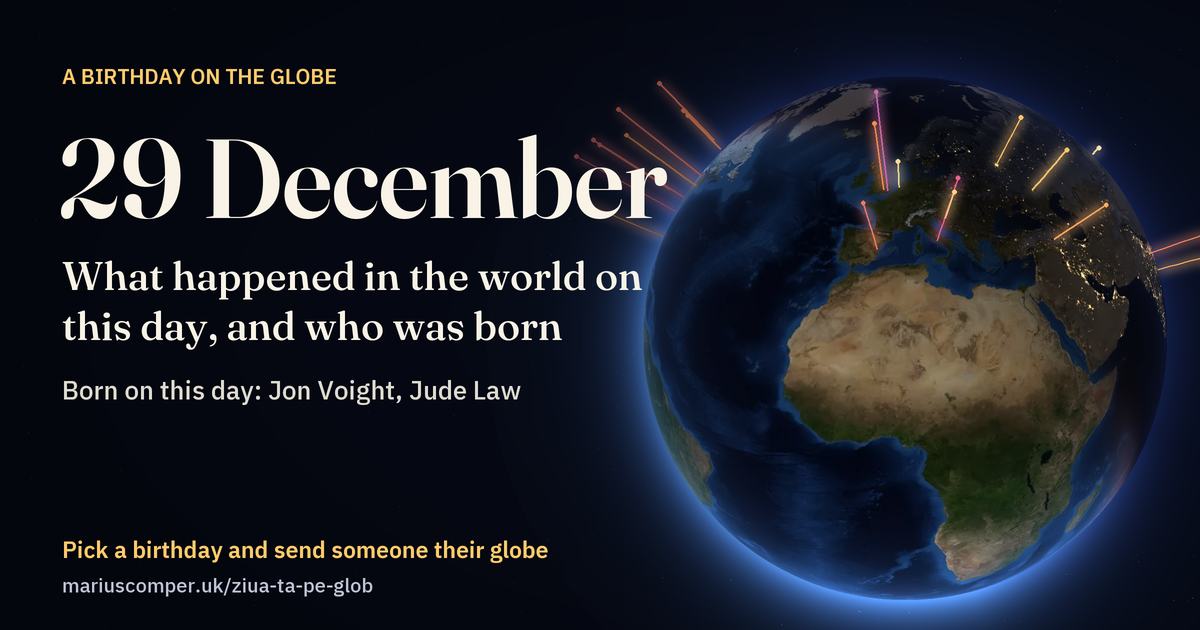
For 29 December, the English Wikipedia lists 37 events and 289 births. 21 of the events stand at their places as rays of light; two more are dashed circles, where the sentence links only to a country or a sea. The taller the ray, the longer ago it happened. The people born that day come further down, as blue points.
A birthday, yours or someone else’s:
Turn it into a greetingScroll: the globe turns to each place
The day you were born, on the globe.
Three things from your day
Scroll: your day first, then 29 December through the years
The Earth on 29 December
The picture on the globe was assembled by NASA from satellite photographs taken in December 2004: the snow, the ice and the green are those of the month.
On 29 December the Sun passes straight overhead at noon along the parallel of 23.2° south. In London, the day lasts about 7 hours 50 minutes.
Beyond 67° south the Sun no longer sets; beyond 67° north it no longer rises.
The line between day and night is tilted on the globe exactly as on this day of the year. On the dark side you can see the lights of towns.
Asia · Prayagraj
1930
Sir Muhammad Iqbal's presidential address in Allahabad introduces the two-nation theory and outlines a vision for the creation of Pakistan.
On the map: Prayagraj.
North America · New Echota
1835
The Treaty of New Echota is signed, ceding all the lands of the Cherokee east of the Mississippi River to the United States.
On the map: New Echota.
North America · Hollywood, Los Angeles
1913
Cecil B. DeMille starts filming Hollywood's first feature film, The Squaw Man.
On the map: Hollywood, Los Angeles.
North America · California Institute of Technology
1959
American physicist Richard Feynman gave a speech entitled "There's Plenty of Room at the Bottom" at Caltech, anticipating the field of nanotechnology.
On the map: California Institute of Technology.
Also on the day’s list of Wikipedia in Chinese.
29 December
What the other Wikipedias remember#
For these years the English list has nothing on this day. The events below come from the same day’s lists on Wikipedia in Spanish and Chinese and were translated for this page.
From Wikipedia in Spanish · Biblioteca Nacional de España
1711
In Madrid (Spain), King Philip V founds the National Library of Spain.
On the map: Biblioteca Nacional de España.
Translated from the list on Wikipedia in Spanish.
From Wikipedia in Spanish · Madrid
1858
In Madrid (Spain), the Compañía de los Ferrocarriles del Norte de España is constituted for the construction of the Madrid-Irún line.
On the map: Madrid.
Translated from the list on Wikipedia in Spanish.
From Wikipedia in Chinese · Hong Kong
1993
The consecration ceremony is held for the Tian Tan Buddha at Po Lin Monastery on Lantau Island, Hong Kong, then the largest outdoor bronze Buddha statue in the world.
On the map: Hong Kong.
Translated from the list on Wikipedia in Chinese.
29 December
Born on 29 December#
The English Wikipedia lists 289 births for this day. The blue points are the birthplaces of 60 of these people: those written about in the most Wikipedia editions, where Wikidata gives a place of birth.
Born on 29 December
1938
Jon Voight, American actor and producer
Place of birth: Yonkers.
Born on 29 December
1910
Ronald Coase, English-American economist, author, and academic, Nobel Prize laureate (died 2013)
Place of birth: Willesden.
Born on 29 December
1936
Mary Tyler Moore, American actress and producer (died 2017)
Place of birth: Brooklyn.
Born on 29 December
1876
Pablo Casals, Catalan cellist and conductor (died 1973)
Place of birth: El Vendrell.
Born in Britain and Ireland
1946
Marianne Faithfull, English singer-songwriter and actress (died 2025)
Place of birth: Hampstead.
Born in Britain and Ireland
1978
Kieron Dyer, English footballer and coach
Place of birth: Ipswich.
Born in Britain and Ireland
1947
Cozy Powell, English drummer, songwriter, and producer (died 1998)
Place of birth: Cirencester.
29 December
Number one in the charts that week
At the cinema
An animal recorded that day
The record can be seen in GBIF, which brings together wildlife records from around the world.
All your birthdays
The weather that day
Data: Met Office Hadley Centre (HadCET); NOAA (GHCN-Daily, Mauna Loa).
Above the Earth
Sources: Jonathan McDowell, GCAT (launches); GFZ Potsdam (Kp index). Days are counted in Universal Time.
Football that day
International matches played that day:
Source: the “International football results” dataset kept by Mart Jürisoo (CC0).
Also that day
The earthquake’s page at the USGS
Source: the USGS catalogue. The day is counted in Universal Time (UTC).
In those days
Make a link for someone
Type the name, pick the day and the year of birth. The link opens straight on their day, with their name in the greeting.
The link carries the name, date and place typed here; anyone who gets it can see them.
Put another birthday beside it
Your mother’s, your child’s, a friend’s: the two days appear side by side.
Below: 29 December through the years.
The whole globe of the day
Drag the globe to turn it. Touch a ray or a point to read what happened there.
Everything Wikipedia lists for 29 December
The list is the English Wikipedia’s, in its own wording, as it stood in October 2026. 14 events have no place on the map: the sentence links to no place with coordinates, only to places too wide to mark, or to several countries.
- 1170
Thomas Becket, Archbishop of Canterbury, is assassinated inside Canterbury Cathedral by followers of King Henry II; he subsequently becomes a saint and martyr in the Anglican Communion and the Catholic Church.
Britain & Ireland · Canterbury CathedralWikipedia: Thomas Becket - 1503
The Battle of Garigliano was fought between a Spanish army under Gonzalo Fernández de Córdoba and a French army commanded by Ludovico II, Marquess of Saluzzo.
Europe · Battle of GariglianoWikipedia: Battle of Garigliano - 1607
According to John Smith, Pocahontas, daughter of Powhatan leader Wahunsenacawh, successfully pleads for his life after tribal leaders attempt to execute him.
no place on the mapWikipedia: John Smith - 1778
American Revolutionary War: British forces under the command of Lieutenant Colonel Archibald Campbell defeat American forces under Major General Robert Howe and capture the port city of Savannah, Georgia.
North America · Capture of SavannahWikipedia: Capture of Savannah - 1812
USS Constitution, under the command of Captain William Bainbridge, captures HMS Java off the coast of Brazil after a three-hour battle.
no place on the mapWikipedia: USS Constitution - 1835
The Treaty of New Echota is signed, ceding all the lands of the Cherokee east of the Mississippi River to the United States.
North America · New EchotaWikipedia: Treaty of New Echota - 1845
The United States annexes the Republic of Texas and admits it as the 28th state.
no place on the mapWikipedia: Texas annexation - 1860
The launch of HMS Warrior, with her combination of screw propeller, iron hull and iron armour, renders all previous warships obsolete.
no place on the mapWikipedia: HMS Warrior - 1862
American Civil War: The Battle of Chickasaw Bayou ends in a Union defeat as forces under General William T. Sherman are repulsed with heavy losses by Confederate troops under General John C. Pemberton.
North America · Battle of Chickasaw BayouWikipedia: American Civil War - 1874
The military coup of Gen. Martinez Campos in Sagunto ends the failed First Spanish Republic and the monarchy is restored as Prince Alfonso is proclaimed King of Spain.
Europe · SaguntoWikipedia: Arsenio Martínez Campos - 1876
The Ashtabula River railroad disaster occurs, leaving 64 injured and 92 dead at Ashtabula, Ohio.
North America · Ashtabula, OhioWikipedia: Ashtabula River railroad disaster - 1890
Wounded Knee Massacre: On Pine Ridge Indian Reservation, 300 Lakota are killed by the United States 7th Cavalry Regiment.
North America · Wounded Knee MassacreWikipedia: Wounded Knee Massacre - 1911
Mongolia gains independence from the Qing dynasty, enthroning 8th Jebtsundamba Khutughtu as Khagan of Mongolia.
no place on the mapWikipedia: Mongolia - 1913
Cecil B. DeMille starts filming Hollywood's first feature film, The Squaw Man.
North America · Hollywood, Los AngelesWikipedia: Cecil B. DeMille - 1915
First World War: The French parliament passed a law granting the land occupied by British war graves as "the free gift of the French people".
no place on the mapWikipedia: World War I - 1928
The Northern Expedition, a military campaign by the National Revolutionary Army of the Kuomintang, ended with the complete control of the Republic of China.
no place on the mapWikipedia: Northern Expedition - 1930
Sir Muhammad Iqbal's presidential address in Allahabad introduces the two-nation theory and outlines a vision for the creation of Pakistan.
Asia · PrayagrajWikipedia: Muhammad Iqbal - 1934
Japan renounces the Washington Naval Treaty of 1922 and the London Naval Treaty of 1930.
no place on the mapWikipedia: Washington Naval Treaty - 1937
The Irish Free State is replaced by a new state called Ireland with the adoption of a new constitution.
no place on the mapWikipedia: Irish Free State - 1940
World War II: in the Second Great Fire of London, the Luftwaffe fire-bombs London, England, killing almost 200 civilians.
Britain & Ireland · Second Great Fire of LondonWikipedia: World War II - 1959
American physicist Richard Feynman gave a speech entitled "There's Plenty of Room at the Bottom" at Caltech, anticipating the field of nanotechnology.
North America · California Institute of TechnologyWikipedia: Richard Feynman - 1972
Eastern Air Lines Flight 401 (a Lockheed L-1011 TriStar) crashes in the Florida Everglades on approach to Miami International Airport, Florida, killing 101 of the 176 people on board.
North America · Eastern Air Lines Flight 401Wikipedia: Eastern Air Lines Flight 401 - 1975
A bomb explodes at LaGuardia Airport in New York City, killing 11 people and injuring more than 75.
North America · 1975 LaGuardia Airport bombingWikipedia: 1975 LaGuardia Airport bombing - 1989
Czech writer, philosopher and dissident Václav Havel is elected the first post-communist President of Czechoslovakia.
Europe · CzechoslovakiaWikipedia: Václav Havel - 1989
The Nikkei 225 for the Tokyo Stock Exchange hits its all-time intra-day high of 38,957.44 and closing high at 38,915.87, serving as the apex of the Japanese asset price bubble.
no place on the mapWikipedia: Nikkei 225 - 1992
Fernando Collor de Mello, president of Brazil, tries to resign amidst corruption charges, but is then impeached.
no place on the mapWikipedia: Fernando Collor de Mello - 1994
Turkish Airlines Flight 278 (a Boeing 737-400) crashes on approach to Van Ferit Melen Airport in Van, Turkey, killing 57 of the 76 people on board.
Asia · Turkish Airlines Flight 278Wikipedia: Turkish Airlines Flight 278 - 1996
Guatemala and leaders of Guatemalan National Revolutionary Unity sign a peace accord ending a 36-year civil war.
Latin America · GuatemalaWikipedia: Guatemalan Civil War - 1998
Leaders of the Khmer Rouge apologize for the Cambodian genocide that claimed over one million lives.
Asia · Cambodian genocideWikipedia: Cambodian genocide - 2003
The last known speaker of Akkala Sami dies, rendering the language extinct.
no place on the mapWikipedia: Akkala Sámi - 2006
The UK settles its Anglo-American loan, post-WWII loan debt.
no place on the mapWikipedia: Anglo-American loan - 2012
A Tupolev Tu-204 airliner crashes in a ditch between the airport fence and the M3 highway after overshooting a runway at Vnukovo International Airport in Moscow, Russia, killing five people and leaving three others critically injured.
Europe · Red Wings Airlines Flight 9268Wikipedia: Red Wings Airlines Flight 9268 - 2013
A suicide bomb attack at the Volgograd-1 railway station in the southern Russian city of Volgograd kills at least 18 people and wounds 40 others.
Europe · December 2013 Volgograd bombingsWikipedia: December 2013 Volgograd bombings - 2013
Seven-time Formula One champion Michael Schumacher suffers a massive head injury while skiing in the French Alps.
no place on the mapWikipedia: Formula One - 2020
A magnitude 6.4 earthquake hits near the town of Petrinja in Sisak-Moslavina County, Croatia, killing seven people.
Europe · 2020 Petrinja earthquakeWikipedia: 2020 Petrinja earthquake - 2023
South Africa files a genocide case against Israel at the International Court of Justice over Israeli conducts in the Gaza Strip.
Europe · International Court of JusticeWikipedia: Israel - 2024
Jeju Air Flight 2216 crashes into a wall in Muan, South Korea, killing 179 of the 181 occupants. It is the worst aircraft accident on South Korean soil in history.
Asia · Jeju Air Flight 2216Wikipedia: Jeju Air Flight 2216
What the other Wikipedias remember
For these years the English list has nothing on this day. The events below come from the same day’s lists on Wikipedia in Spanish and Chinese and were translated for this page.
- 1711
In Madrid (Spain), King Philip V founds the National Library of Spain.
Europe · Biblioteca Nacional de EspañaTranslated from the list on Wikipedia in SpanishWikipedia: Felipe V de España - 1858
In Madrid (Spain), the Compañía de los Ferrocarriles del Norte de España is constituted for the construction of the Madrid-Irún line.
- 1993
The consecration ceremony is held for the Tian Tan Buddha at Po Lin Monastery on Lantau Island, Hong Kong, then the largest outdoor bronze Buddha statue in the world.
Who was born on 29 December
In order of how many Wikipedia editions have an article about each. The first 60 of 289 are shown.
- 1808
Andrew Johnson, American general and politician, 17th President of the United States (died 1875)
RaleighWikipedia: Andrew Johnson - 1938
Jon Voight, American actor and producer
YonkersWikipedia: Jon Voight - 1809
William Ewart Gladstone, English lawyer and politician, Prime Minister of the United Kingdom (died 1898)
LiverpoolWikipedia: William Ewart Gladstone - 1962
Carles Puigdemont, Catalan politician and journalist, former president
- 1972
Jude Law, English actor
LewishamWikipedia: Jude Law - 1709
Elizabeth Petrovna, Russian empress (died 1762)
KolomenskoyeWikipedia: Elizabeth of Russia - 1721
Madame de Pompadour, mistress of King Louis XV (died 1764)
- 1963
Ulf Kristersson, Swedish politician, Leader of the Swedish Moderate Party and 35th Prime Minister of Sweden
Lund Cathedral parishWikipedia: Ulf Kristersson - 1953
Thomas Bach, German fencer, lawyer and sports administrator; 9th President of the International Olympic Committee
WürzburgWikipedia: Thomas Bach - 1910
Ronald Coase, English-American economist, author, and academic, Nobel Prize laureate (died 2013)
WillesdenWikipedia: Ronald Coase - 1936
Mary Tyler Moore, American actress and producer (died 2017)
BrooklynWikipedia: Mary Tyler Moore - 1876
Pablo Casals, Catalan cellist and conductor (died 1973)
El VendrellWikipedia: Pablo Casals - 1998
Victor Osimhen, Nigerian footballer
- 1843
Elisabeth of Wied (died 1916)
NeuwiedWikipedia: Elisabeth of Wied - 1896
David Alfaro Siqueiros, Mexican painter (died 1974)
Chihuahua CityWikipedia: David Alfaro Siqueiros - 1996
Dylan Minnette, American actor, musician and singer
EvansvilleWikipedia: Dylan Minnette - 1800
Charles Goodyear, American chemist and engineer (died 1860)
New HavenWikipedia: Charles Goodyear - 1945
Birendra of Nepal, King of Nepal from 1972 to 2001 (died 2001)
KathmanduWikipedia: Birendra of Nepal - 1989
Kei Nishikori, Japanese tennis player
MatsueWikipedia: Kei Nishikori - 1859
Venustiano Carranza, Mexican soldier and politician, 37th President of Mexico (died 1920)
Cuatro Ciénegas de CarranzaWikipedia: Venustiano Carranza - 1946
Marianne Faithfull, English singer-songwriter and actress (died 2025)
HampsteadWikipedia: Marianne Faithfull - 1947
Ted Danson, American actor and producer
San DiegoWikipedia: Ted Danson - 1959
Patricia Clarkson, American actress
New OrleansWikipedia: Patricia Clarkson - 1962
Wynton Rufer, New Zealand footballer
WellingtonWikipedia: Wynton Rufer - 1885
Roman von Ungern-Sternberg, Austrian-Russian general (died 1921)
- 1979
Diego Luna, Mexican actor, director and producer
Mexico CityWikipedia: Diego Luna - 1942
Rajesh Khanna, Indian actor (died 2012)
AmritsarWikipedia: Rajesh Khanna - 1915
Jo Van Fleet, American actress (died 1996)
OaklandWikipedia: Jo Van Fleet - 1974
Twinkle Khanna, Indian actress and writer
- 1982
Alison Brie, American actress
HollywoodWikipedia: Alison Brie - 1995
Ross Lynch, American singer and actor
LittletonWikipedia: Ross Lynch - 1921
Dobrica Ćosić, Serbian politician, 1st President of the Federal Republic of Yugoslavia (died 2014)
Velika DrenovaWikipedia: Dobrica Ćosić - 1996
Sana Minatozaki, Japanese singer
OsakaWikipedia: Sana - 1911
Klaus Fuchs, German physicist and spy (died 1988)
Rüsselsheim am MainWikipedia: Klaus Fuchs - 1999
Francisco Trincão, Portuguese footballer
Viana do CasteloWikipedia: Francisco Trincão - 1788
Christian Jürgensen Thomsen, Danish antiquarian (died 1865)
CopenhagenWikipedia: Christian Jürgensen Thomsen - 1977
Katherine Moennig, American actress
PhiladelphiaWikipedia: Katherine Moennig - 2000
Orkun Kökçü, Dutch-Turkish footballer
HaarlemWikipedia: Orkun Kökçü - 1969
Jennifer Ehle, American actress
Winston-SalemWikipedia: Jennifer Ehle - 1976
Danny McBride, American actor, producer and screenwriter
StatesboroWikipedia: Danny McBride - 1978
Kieron Dyer, English footballer and coach
IpswichWikipedia: Kieron Dyer - 1809
Albert Pike, American author, poet, orator, editor, lawyer, jurist, and general (died 1891)
- 1950
Jon Polito, American actor (died 2016)
PhiladelphiaWikipedia: Jon Polito - 1981
Shizuka Arakawa, Japanese figure skater and sportscaster
ShinagawaWikipedia: Shizuka Arakawa - 1992
Mislav Oršić, Croatian footballer
ZagrebWikipedia: Mislav Oršić - 1947
Cozy Powell, English drummer, songwriter, and producer (died 1998)
CirencesterWikipedia: Cozy Powell - 1970
Enrico Chiesa, Italian footballer and manager
- 1816
Carl Ludwig, German physician and physiologist (died 1895)
WitzenhausenWikipedia: Carl Ludwig - 1923
Cheikh Anta Diop, Senegalese historian, anthropologist, and physicist (died 1986)
ThieytouWikipedia: Cheikh Anta Diop - 1942
Óscar Rodríguez Maradiaga, Honduran cardinal
TegucigalpaWikipedia: Óscar Rodríguez Maradiaga - 1978
Angelo Taylor, American hurdler and sprinter
AlbanyWikipedia: Angelo Taylor - 1988
Christen Press, American footballer
Los AngelesWikipedia: Christen Press - 1988
Ágnes Szávay, Hungarian tennis player
KiskunhalasWikipedia: Ágnes Szávay - 1994
Princess Kako of Akishino, Japanese princess
- 1903
Candido Portinari, Brazilian painter (died 1962)
BrodowskiWikipedia: Candido Portinari - 1920
Viveca Lindfors, Swedish-American actress, singer and poet (died 1995)
UppsalaWikipedia: Viveca Lindfors - 1965
Dexter Holland, American musician, singer, songwriter, and biologist
Garden GroveWikipedia: Dexter Holland - 1966
Christian Kracht, Swiss author
- 1991
Steven Caulker, English footballer
FelthamWikipedia: Steven Caulker - 1937
Barbara Steele, English actress
BirkenheadWikipedia: Barbara Steele
What is celebrated on 29 December
- Christian feast day: Ebrulf
- Christian feast day: Thomas Becket
- Christian feast day: Trophimus of Arles
- Christian feast day: December 29 (Eastern Orthodox liturgics)
- Constitution Day (Ireland)
- Independence Day (Mongolia)
- The fifth day of Christmas (Western Christianity)
- The fourth day of Kwanzaa (United States)
A greeting link for someone
Type a name and, if you like, the year of birth. The link opens with a greeting, and beside each event it says how old the person turned that day, or how many years before their birth it happened.
The name and the year go only into the link you send.
All 366 days
How the globe is made
Where the events come from
Each edition of this page uses the day’s list from Wikipedia in its own language: Romanian, English, Spanish, Chinese. The lists are written by volunteers and differ from one edition to the next; the text of each event is Wikipedia’s, with a link to the article. A row that appears twice in a list is shown once. The lists have not been checked event by event: they are Wikipedia’s, mistakes included.
For events before 1582, and for countries that moved to the Gregorian calendar later (Britain in 1752, Russia in 1918), the same day may be counted Old Style in one list and New Style in another.
The chapter “What the other Wikipedias remember” adds up to five events a day from the lists of the other three editions, only for years in which the English list has nothing on that day. They were translated for this page, passed the same filters as the tour, and are not counted among the events of the English list.
How an event gets onto the map
The place comes from Wikidata. If the sentence links to the article about the event itself (a battle, an opening, an earthquake), dated to the same year, the ray stands on its coordinates or on those of its location. Otherwise it stands on the first place the sentence links to: a town, a building, a mountain, an island. This second step can be wrong: sometimes the sentence only mentions the place. That is why the page says, under each event, which place the ray stands on.
When the sentence links to a single state or province, or to a single sea, lake or desert larger than 5,000 km², the globe shows a dashed circle, not a ray. The circle has the area Wikidata gives, with its radius kept between 1.2° and 16°, or a radius of 4.5° when Wikidata gives no area; it says only that the sentence links to that place. Organisations, ships, spacecraft, museum objects, rivers, mountain ranges, languages and continents are never used as places. When a sentence names several states and no exact place, the event stays in the list only.
What the height means
The height of a ray shows how many years have passed, on a logarithmic scale: 10 years, 100 years and 1,000 years are equal steps apart; anything older than about 2,600 years has the tallest ray. The colour runs from pale yellow for recent years to violet for antiquity.
Where the tour stops
In each region the tour stops at up to three events (five in Britain and Ireland), chosen mainly by three things: whether Wikipedia’s editors put the event in the “On this day” box of their main page (the English, Spanish and Chinese editions), how many Wikipedia editions have an article about it, and how many of the four lists include it. Events whose sentence or article is about a war, an attack, a crime or a disaster are left out of the tour; they stay in the whole list, in Wikipedia’s wording. The filter is a list of words and a list of Wikidata types, so it can miss some.
The tour of births names the people with articles in the most editions and leaves aside those whom the list or Wikidata describes as rulers, politicians, commanders, leaders of movements or criminals; they stay in the list.
The Earth and the Sun
The daytime images are NASA’s Blue Marble Next Generation mosaics, one for each month of 2004; the night side is Black Marble 2016. The tilt of the line between day and night is computed for the day; the hour is chosen so that the place being read is in daylight. The latitude where the Sun stands overhead is the average of the four years of the leap cycle; in a given year it can differ by up to 0.4°.
The day you were born
The number ones come from the weekly lists on Wikipedia: Billboard for the United States (from 1940; the Hot 100 from August 1958), the UK Singles Chart (from November 1952), Los 40 Principales for Spain (from July 1966) and, for Romania, the Romanian Top 100 and Airplay 100 (2001–2021, with missing weeks). The page shows the chart of the week in which the day of birth falls, with its date; Billboard and the UK chart are dated at the end of their week. For Romania before 2001 and for China these sources have no weekly chart.
The films are those that reached cinemas in the United States up to ten days before or three days after that day (some of them in a few cinemas at first), from the English Wikipedia’s yearly lists (from 1968), in order of how many editions have an article about them. The events “in those days” are the ones on the neighbouring days’ lists that carry the year of birth, passed through the same filter as the tour.
The day of birth, year included
The Moon, the star sign and the constellation are worked out by the page itself, for noon Universal Time on the day. The lit part of the Moon is rounded and can differ by a few per cent from that at the hour of birth. The sign follows the usual zodiac of twelve equal parts starting at the March equinox; the constellation is the one the Sun actually stood in front of, by the borders set by the International Astronomical Union, and within a day of a border the page does not name it. When the Sun changes sign while it is that day anywhere on Earth, the page gives the moment of crossing, rounded to ten minutes and accurate to within about a quarter of an hour, and the clock time in a few cities, with the time zone and summer time of that year.
The year in the Chinese calendar is the one your device’s own calendar gives for the date, checked against the Hong Kong Observatory’s tables. “All your birthdays” uses the same sources as the rest of the chapter for the same day in every year since the birth: the temperature, well-known launches that took place on that very day, matches of the teams the edition follows, snow deeper than 10 cm and strong geomagnetic storms. The three things at the top and the four on the picture are chosen in a fixed order (the song, the animal, a full Moon, a well-known launch before an ordinary earthquake); on the picture you can change them.
When the link carries a year of birth, the page adds a few things about that exact day. The weather is the Met Office’s Central England temperature record and the readings from New York’s Central Park; the “usual high” is the average of the daily highs of 1961–1990 for that date, with two days either side. The carbon dioxide figure is the monthly mean at the Mauna Loa observatory, where measurements begin in March 1958.
The earthquake is the one with the largest magnitude in the USGS catalogue for that day, counted in Universal Time. Before the 1960s the catalogue has gaps even above magnitude 5.5, so in the older years many days have no earthquake. The page gives only the magnitude and the place: the country the epicentre falls in or, when the epicentre is at sea within 300 km of a coast, the nearest country; farther out, only the ocean.
The launches are those that reached orbit or left for the Moon and the planets, from Jonathan McDowell’s GCAT catalogue. If nothing left that day, the page shows the nearest launch within three days before or after, and says how many days away it was. The geomagnetic storm appears only when the Kp index reached at least 5 in one of the day’s eight three-hour intervals.
The animal comes from GBIF: an observation made by a person (the animal seen or heard, or its tracks), dated to that exact day, with coordinates and a CC0 or CC BY licence. Only a few hundred well-known species are searched (mammals, birds, turtles, butterflies); of those noted that day, mammals and species with articles in many Wikipedia editions come first; birds noted almost every day, and species used recently, wait their turn. Observations dated 1 January are left out, because records without a day are often filed there. An observation shows that the animal was recorded there, not how many animals there were.
The matches are those between national teams. Only matches of England, Scotland, Wales, Northern Ireland, the Republic of Ireland, the United States, Canada and Australia are shown, along with those at the big final tournaments. The picture to send is drawn in the page from the day’s globe and the facts above, and stays on your device until you send it.
Sources
- Events, births and holidays: the day’s page on Wikipedia, text under CC BY-SA 4.0.
- Coordinates, places of birth and the number of editions: Wikidata (CC0).
- The Earth by day: NASA Blue Marble Next Generation. The Earth by night: NASA Black Marble 2016.
- Borders and regions: Natural Earth.
- World population and births per year: UN World Population Prospects 2024.
- Charts and films: Wikipedia’s lists for Billboard, the UK Singles Chart, Los 40 Principales, Romanian Top 100, Airplay 100 and American films by year (CC BY-SA 4.0).
- Weather: Met Office Hadley Centre, HadCET (Open Government Licence) and NOAA GHCN-Daily, New York Central Park. Carbon dioxide: NOAA Global Monitoring Laboratory, Mauna Loa.
- Earthquakes: the USGS catalogue. Launches: Jonathan McDowell, GCAT (CC BY). Kp index: GFZ Potsdam (CC BY 4.0). Matches: International football results, Mart Jürisoo (CC0).
- Animal observations: GBIF, with a link to each record; species names come from Wikidata.