A birthday on the globe
25 January on the globe: what happened in the world on this day, and who was born
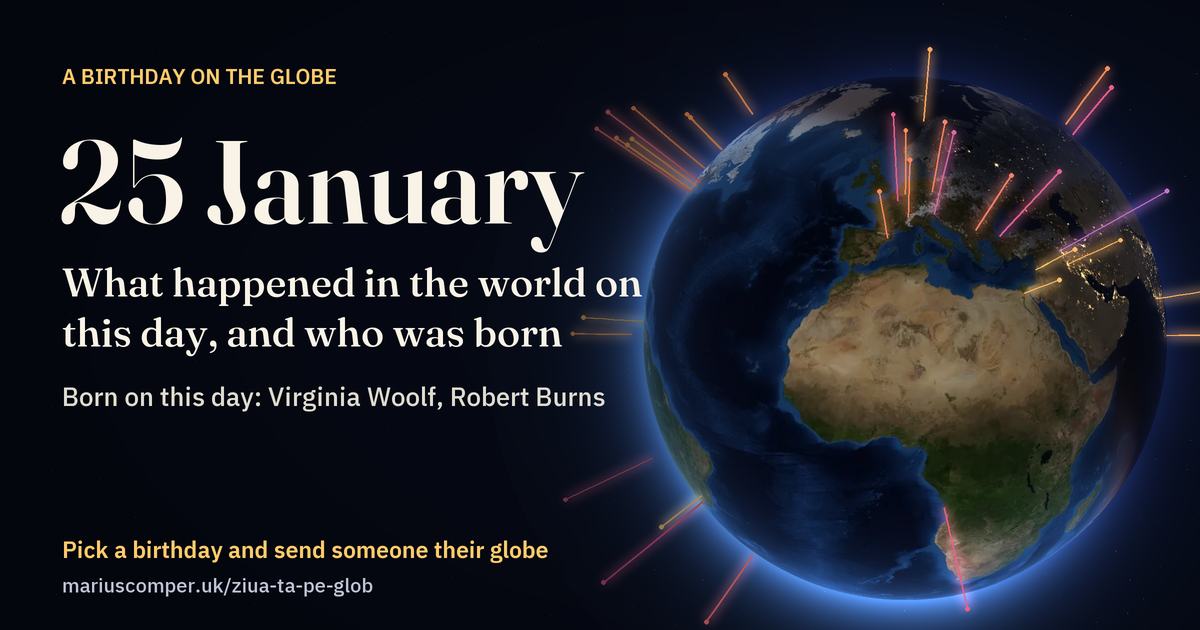
For 25 January, the English Wikipedia lists 72 events and 185 births. 34 of the events stand at their places as rays of light; eight more are dashed circles, where the sentence links only to a country or a sea. The taller the ray, the longer ago it happened. The people born that day come further down, as blue points.
A birthday, yours or someone else’s:
Turn it into a greetingScroll: the globe turns to each place
The day you were born, on the globe.
Three things from your day
Scroll: your day first, then 25 January through the years
The Earth on 25 January
The picture on the globe was assembled by NASA from satellite photographs taken in January 2004: the snow, the ice and the green are those of the month.
On 25 January the Sun passes straight overhead at noon along the parallel of 19.1° south. In London, the day lasts about 8 hours 45 minutes.
Beyond 71° south the Sun no longer sets; beyond 71° north it no longer rises.
The line between day and night is tilted on the globe exactly as on this day of the year. On the dark side you can see the lights of towns.
Europe · Reims Cathedral
1515
Coronation of Francis I of France takes place at Reims Cathedral, where the new monarch is anointed with the oil of Clovis and girt with the sword of Charlemagne.
On the map: Reims Cathedral.
Also on the day’s list of Wikipedia in Romanian and Chinese.
Europe · 1924 Winter Olympics
1924
The 1924 Winter Olympics opens in Chamonix, in the French Alps, inaugurating the Winter Olympic Games.
On the map: the coordinates Wikidata gives for the article “1924 Winter Olympics”.
Also on the day’s list of Wikipedia in Spanish, Romanian and Chinese.
Europe · Catalunya Central
1932
Alt Llobregat insurrection suppressed in Central Catalonia, Spain.
On the map: Catalunya Central.
Africa · Luanda
1575
Luanda, the capital of Angola, is founded by the Portuguese navigator Paulo Dias de Novais.
On the map: Luanda.
Latin America · São Paulo
1554
São Paulo, Brazil, is founded by Jesuit priests.
On the map: São Paulo.
Also on the day’s list of Wikipedia in Spanish and Chinese.
Latin America · Port Egmont
1765
Port Egmont, the first British colony in the Falkland Islands, was founded.
On the map: Port Egmont.
North America · University of Virginia
1819
University of Virginia chartered by Commonwealth of Virginia, with Thomas Jefferson one of its founders.
On the map: University of Virginia.
North America · Chicago
1937
The Guiding Light debuts on NBC radio from Chicago. In 1952 it moves to CBS television, where it remains until September 18, 2009.
On the map: Chicago.
North America · Hollywood Athletic Club
1949
The first Emmy Awards are presented in the United States; the venue is the Hollywood Athletic Club.
On the map: Hollywood Athletic Club.
25 January
What the other Wikipedias remember#
For these years the English list has nothing on this day. The events below come from the same day’s lists on Wikipedia in Chinese and Romanian and were translated for this page.
From Wikipedia in Chinese · David
1504
Michelangelo completes the carving of the statue of David.
On the map: David.
Translated from the list on Wikipedia in Chinese.
From Wikipedia in Romanian · Moscow
1755
At the suggestion of Mikhail Vasilyevich Lomonosov, by a decree of Empress Elizabeth I, the first university in Russia is founded in Moscow: the M. V. Lomonosov Moscow State University.
On the map: Moscow.
Translated from the list on Wikipedia in Romanian.
The article on Wikipedia in Romanian: Universitatea de Stat din Moscova
25 January
Born on 25 January#
The English Wikipedia lists 185 births for this day. The blue points are the birthplaces of 60 of these people: those written about in the most Wikipedia editions, where Wikidata gives a place of birth.
Born on 25 January
1882
Virginia Woolf, English novelist, essayist, short story writer, and critic (died 1941)
Place of birth: London.
Born on 25 January
1759
Robert Burns, Scottish poet and songwriter (died 1796)
Place of birth: Alloway.
Born on 25 January
1938
Vladimir Vysotsky, Russian singer-songwriter, actor, and poet (died 1980)
Place of birth: Moscow.
Born on 25 January
1627
Robert Boyle, Anglo-Irish chemist and physicist (died 1691)
Place of birth: Lismore Castle.
Born on 25 January
1874
W. Somerset Maugham, British playwright, novelist, and short story writer (died 1965)
Place of birth: 8th arrondissement of Paris.
Born in Britain and Ireland
1949
Paul Nurse, English geneticist and biologist, Nobel Prize laureate
Place of birth: Norwich.
25 January
Number one in the charts that week
At the cinema
An animal recorded that day
The record can be seen in GBIF, which brings together wildlife records from around the world.
All your birthdays
The weather that day
Data: Met Office Hadley Centre (HadCET); NOAA (GHCN-Daily, Mauna Loa).
Above the Earth
Sources: Jonathan McDowell, GCAT (launches); GFZ Potsdam (Kp index). Days are counted in Universal Time.
Football that day
International matches played that day:
Source: the “International football results” dataset kept by Mart Jürisoo (CC0).
Also that day
The earthquake’s page at the USGS
Source: the USGS catalogue. The day is counted in Universal Time (UTC).
In those days
Make a link for someone
Type the name, pick the day and the year of birth. The link opens straight on their day, with their name in the greeting.
The link carries the name, date and place typed here; anyone who gets it can see them.
Put another birthday beside it
Your mother’s, your child’s, a friend’s: the two days appear side by side.
Below: 25 January through the years.
The whole globe of the day
Drag the globe to turn it. Touch a ray or a point to read what happened there.
Everything Wikipedia lists for 25 January
The list is the English Wikipedia’s, in its own wording, as it stood in October 2026. 30 events have no place on the map: the sentence links to no place with coordinates, only to places too wide to mark, or to several countries.
- 41
After a night of negotiation, Claudius is accepted as Roman emperor by the Senate.
no place on the mapWikipedia: Claudius - 750
In the Battle of the Zab, the Abbasid rebels defeat the Umayyad Caliphate, leading to the overthrow of the dynasty.
Asia · Battle of the ZabWikipedia: Battle of the Zab - 1327
Fourteen-year-old Edward III ascends the throne of England after his father the king is forced to abdicate by Queen Isabella and her lover, Roger Mortimer.
no place on the mapWikipedia: Edward III - 1348
A strong earthquake strikes the South Alpine region of Friuli in modern Italy, causing considerable damage to buildings as far away as Rome.
Europe · 1348 Eastern Alps earthquakeWikipedia: 1348 Eastern Alps earthquake - 1479
The Treaty of Constantinople ends the 16-year-long First Ottoman–Venetian War.
Asia · ConstantinopleWikipedia: Treaty of Constantinople - 1494
Alfonso II becomes King of Naples.
Europe · Kingdom of NaplesWikipedia: Alfonso II of Naples - 1515
Coronation of Francis I of France takes place at Reims Cathedral, where the new monarch is anointed with the oil of Clovis and girt with the sword of Charlemagne.
Europe · Reims CathedralWikipedia: Coronation of the French monarch - 1533
Henry VIII of England secretly marries his second wife Anne Boleyn.
no place on the mapWikipedia: Henry VIII - 1554
São Paulo, Brazil, is founded by Jesuit priests.
Latin America · São PauloWikipedia: São Paulo - 1573
Battle of Mikatagahara: In Japan, Takeda Shingen defeats Tokugawa Ieyasu.
Asia · Battle of MikatagaharaWikipedia: Battle of Mikatagahara - 1575
Luanda, the capital of Angola, is founded by the Portuguese navigator Paulo Dias de Novais.
Africa · LuandaWikipedia: Luanda - 1585
Walter Raleigh is knighted, shortly after renaming a North American region as "Virginia", in honour of Elizabeth I, Queen of England, sometimes referred to as the "Virgin Queen".
no place on the mapWikipedia: Walter Raleigh - 1650
As part of the purges following the Great Potosí Mint Fraud of 1649 Francisco Gómez de la Rocha, a rich former corregidor of Potosí, is executed.
Latin America · PotosíWikipedia: Great Potosí Mint Fraud of 1649 - 1704
The Apalachee massacre: A combined British and Muscogee force from the Province of Carolina destroys the main fortified mission of Ayubale, breaking Spain's hold on Spanish Florida.
North America · Province of CarolinaWikipedia: Apalachee massacre - 1725
Privateer Amaro Pargo was declared a hidalgo, a member of the Spanish nobility.
no place on the mapWikipedia: Amaro Pargo - 1765
Port Egmont, the first British colony in the Falkland Islands, was founded.
Latin America · Port EgmontWikipedia: Port Egmont - 1787
Shays' Rebellion: The rebellion's largest confrontation, outside the Springfield Armory, results in the killing of four rebels and the wounding of twenty.
North America · Springfield ArmoryWikipedia: Shays's Rebellion - 1791
The British Parliament passes the Constitutional Act of 1791 and splits the old Province of Quebec into Upper Canada and Lower Canada.
no place on the mapWikipedia: Parliament of Great Britain - 1792
The London Corresponding Society is founded.
no place on the mapWikipedia: London Corresponding Society - 1819
University of Virginia chartered by Commonwealth of Virginia, with Thomas Jefferson one of its founders.
North America · University of VirginiaWikipedia: University of Virginia - 1858
The Wedding March by Felix Mendelssohn is played at the marriage of Queen Victoria's daughter, Victoria, and Friedrich of Prussia, and becomes a popular wedding processional.
no place on the mapWikipedia: Wedding March - 1879
The Bulgarian National Bank is founded.
Europe · Bulgarian National BankWikipedia: Bulgarian National Bank - 1881
Thomas Edison and Alexander Graham Bell form the Oriental Telephone Company.
no place on the mapWikipedia: Thomas Edison - 1890
Nellie Bly completes her round-the-world journey in 72 days.
no place on the mapWikipedia: Nellie Bly - 1909
Richard Strauss's opera Elektra receives its debut performance at the Dresden State Opera.
Europe · SemperoperWikipedia: Semperoper - 1915
Alexander Graham Bell inaugurates U.S. transcontinental telephone service, speaking from New York to Thomas Watson in San Francisco.
no place on the mapWikipedia: Alexander Graham Bell - 1917
Sinking of the SS Laurentic after hitting two German mines off the coast of northwest Ireland.
no place on the mapWikipedia: SS Laurentic - 1918
The Finnish Defence Forces (The White Guards) are established as the official army of independent Finland, and Baron C. G. E. Mannerheim is appointed its Commander-in-Chief.
Europe · FinlandWikipedia: Finnish Defence Forces - 1918
The Ukrainian People's Republic declares independence from Soviet Russia.
no place on the mapWikipedia: Ukrainian People's Republic - 1924
The 1924 Winter Olympics opens in Chamonix, in the French Alps, inaugurating the Winter Olympic Games.
Europe · 1924 Winter OlympicsWikipedia: 1924 Winter Olympics - 1932
Alt Llobregat insurrection suppressed in Central Catalonia, Spain.
Europe · Catalunya CentralWikipedia: Alt Llobregat insurrection - 1932
Second Sino-Japanese War: The Chinese National Revolutionary Army begins the defense of Harbin.
Asia · HarbinWikipedia: Defense of Harbin - 1937
The Guiding Light debuts on NBC radio from Chicago. In 1952 it moves to CBS television, where it remains until September 18, 2009.
North America · ChicagoWikipedia: Guiding Light - 1941
Pope Pius XII elevates the Apostolic Vicariate of the Hawaiian Islands to the dignity of a diocese. It becomes the Roman Catholic Diocese of Honolulu.
North America · Diocese of HonoluluWikipedia: Pope Pius XII - 1942
World War II: Thailand declares war on the United States and United Kingdom.
no place on the mapWikipedia: World War II - 1944
Representatives of the Chetnik movement began a four-day congress to organise political opposition to the Allied support of the communist-led Yugoslav Partisans in Yugoslavia.
Europe · YugoslaviaWikipedia: Chetniks - 1945
World War II: The Battle of the Bulge ends.
Europe · Battle of the BulgeWikipedia: Battle of the Bulge - 1946
The United Mine Workers rejoins the American Federation of Labor.
no place on the mapWikipedia: United Mine Workers of America - 1946
United Nations Security Council Resolution 1 relating to Military Staff Committee is adopted.
no place on the mapWikipedia: United Nations Security Council Resolution 1 - 1947
Thomas Goldsmith Jr. files a patent for a "Cathode Ray Tube Amusement Device", the first ever electronic game.
no place on the mapWikipedia: Thomas T. Goldsmith Jr. - 1949
The first Emmy Awards are presented in the United States; the venue is the Hollywood Athletic Club.
North America · Hollywood Athletic ClubWikipedia: Emmy Awards - 1960
The National Association of Broadcasters in the United States reacts to the "payola" scandal by threatening fines for any disc jockeys who accept money for playing particular records.
North America · National Association of BroadcastersWikipedia: National Association of Broadcasters - 1961
In Washington, D.C., US President John F. Kennedy delivers the first live presidential television news conference.
no place on the mapWikipedia: John F. Kennedy - 1961
Walt Disney Productions released the animated feature One Hundred and One Dalmatians, based on Dodie Smith's 1956 children's novel The Hundred and One Dalmatians.
no place on the mapWikipedia: Walt Disney Pictures - 1964
Blue Ribbon Sports, which would later become Nike, is founded by University of Oregon track and field athletes.
North America · University of OregonWikipedia: Nike, Inc. - 1967
South Vietnamese junta leader and Prime Minister Nguyen Cao Ky fires rival, Deputy Prime Minister and Defence Minister Nguyen Huu Co, while the latter is overseas on a diplomatic visit.
Asia · South VietnamWikipedia: South Vietnam - 1969
Brazilian Army captain Carlos Lamarca deserts in order to fight against the military dictatorship, taking with him ten machine guns and 63 rifles.
no place on the mapWikipedia: Brazilian Army - 1971
Charles Manson and four "Family" members (three of them female) are found guilty of the 1969 Tate–LaBianca murders.
North America · Tate–LaBianca murdersWikipedia: Tate–LaBianca murders - 1971
Idi Amin leads a coup deposing Milton Obote and becomes Uganda's president.
Africa · UgandaWikipedia: 1971 Ugandan coup d'état - 1979
Pope John Paul II starts his first official papal visits outside Italy to The Bahamas, Dominican Republic, and Mexico.
no place on the mapWikipedia: Pope John Paul II - 1980
Mother Teresa is honored with India's highest civilian award, the Bharat Ratna.
no place on the mapWikipedia: Mother Teresa - 1986
The National Resistance Movement topples the government of Tito Okello in Uganda.
Africa · UgandaWikipedia: National Resistance Movement - 1990
Avianca Flight 052 crashes in Cove Neck, New York, killing 73.
North America · Avianca Flight 052Wikipedia: Avianca Flight 052 - 1993
Five people are shot outside the CIA Headquarters in Langley, Virginia. Two are killed and three wounded.
North America · 1993 CIA headquarters shootingWikipedia: 1993 CIA headquarters shooting - 1994
The spacecraft Clementine by BMDO and NASA is launched.
no place on the mapWikipedia: Clementine - 1995
The Norwegian rocket incident: Russia almost launches a nuclear attack after it mistakes Black Brant XII, a Norwegian research rocket, for a US Trident missile.
Europe · Norwegian rocket incidentWikipedia: Norwegian rocket incident - 1996
Billy Bailey becomes the last person to be hanged in the United States.
no place on the mapWikipedia: Billy Bailey - 1998
A suicide attack by the Liberation Tigers of Tamil Eelam on Sri Lanka's Temple of the Tooth kills eight and injures 25 others.
Asia · Temple of the ToothWikipedia: Liberation Tigers of Tamil Eelam - 1998
During a historic visit to Cuba, Pope John Paul II demands political reforms and the release of political prisoners while condemning US attempts to isolate the country.
no place on the mapWikipedia: Pope John Paul II - 1999
A 6.0 magnitude earthquake hits western Colombia killing at least 1,000.
Latin America · 1999 Colombia earthquakeWikipedia: 1999 Colombia earthquake - 2003
Invasion of Iraq: A group of people leave London, England, for Baghdad, Iraq, to serve as human shields, intending to prevent the U.S.-led coalition troops from bombing certain locations.
Asia · BaghdadWikipedia: 2003 invasion of Iraq - 2004
Mars Exploration Rover Opportunity landed on Mars and rolled into Eagle crater, a small crater on the Meridiani Planum.
no place on the mapWikipedia: Mars Exploration Rover - 2005
A stampede at the Mandhradevi temple in Maharashtra, India kills at least 258.
Asia · Mandher Devi temple stampedeWikipedia: Mandher Devi temple stampede - 2006
Mexican professional wrestler Juana Barraza is arrested in connection with the serial killing of at least ten elderly women.
no place on the mapWikipedia: Lucha libre - 2006
Three independent observing campaigns announced the discovery of OGLE-2005-BLG-390Lb, a super-Earth 21,500 ± 3,300 light-years away from Earth near the center of the Milky Way.
no place on the mapWikipedia: OGLE-2005-BLG-390Lb - 2010
Avatar, a science-fiction film directed by James Cameron, became the highest-grossing film of all time.
no place on the mapWikipedia: Avatar - 2010
Ethiopian Airlines Flight 409 crashes into the Mediterranean Sea off the coast of Na'ameh, Lebanon, killing 90.
Asia · Ethiopian Airlines Flight 409Wikipedia: Ethiopian Airlines Flight 409 - 2011
The first wave of the Egyptian revolution begins throughout the country, marked by street demonstrations, rallies, acts of civil disobedience, riots, labour strikes, and violent clashes.
Africa · 2011 Egyptian revolutionWikipedia: 2011 Egyptian revolution - 2013
At least 50 people are killed and 120 people are injured in a prison riot in Barquisimeto, Venezuela.
Latin America · 2013 Uribana prison riotWikipedia: 2013 Uribana prison riot - 2015
A clash in Mamasapano, Maguindanao in the Philippines kills 44 members of Special Action Force (SAF), at least 18 from the Moro Islamic Liberation Front and five from the Bangsamoro Islamic Freedom Fighters.
Asia · Mamasapano clashWikipedia: Mamasapano clash - 2018
An Ariane 5 rocket is launched carrying SES-14, Al Yah 3, and NASA's Global-scale Observations of the Limb and Disk, but the satellites end up in the wrong orbit.
no place on the mapWikipedia: Ariane flight VA241 - 2019
A mining company's dam collapses in Brumadinho, Brazil, a south-eastern city, killing 270 people.
Latin America · Brumadinho dam disasterWikipedia: Brumadinho dam disaster
What the other Wikipedias remember
For these years the English list has nothing on this day. The events below come from the same day’s lists on Wikipedia in Chinese and Romanian and were translated for this page.
- 1504
Michelangelo completes the carving of the statue of David.
- 1755
At the suggestion of Mikhail Vasilyevich Lomonosov, by a decree of Empress Elizabeth I, the first university in Russia is founded in Moscow: the M. V. Lomonosov Moscow State University.
Europe · MoscowTranslated from the list on Wikipedia in RomanianWikipedia: Universitatea de Stat din Moscova
Who was born on 25 January
In order of how many Wikipedia editions have an article about each. The first 60 of 185 are shown.
- 1978
Volodymyr Zelenskyy, Ukrainian actor, comedian, and politician, 6th President of Ukraine
Kryvyi RihWikipedia: Volodymyr Zelenskyy - 1882
Virginia Woolf, English novelist, essayist, short story writer, and critic (died 1941)
- 1759
Robert Burns, Scottish poet and songwriter (died 1796)
AllowayWikipedia: Robert Burns - 1938
Vladimir Vysotsky, Russian singer-songwriter, actor, and poet (died 1980)
- 1627
Robert Boyle, Anglo-Irish chemist and physicist (died 1691)
Lismore CastleWikipedia: Robert Boyle - 1874
W. Somerset Maugham, British playwright, novelist, and short story writer (died 1965)
8th arrondissement of ParisWikipedia: W. Somerset Maugham - 1933
Corazon Aquino, Filipino politician, 11th President of the Philippines (died 2009)
PaniquiWikipedia: Corazon Aquino - 1736
Joseph-Louis Lagrange, Italian-French mathematician and astronomer (died 1813)
- 1928
Eduard Shevardnadze, Georgian general and politician, 2nd President of Georgia (died 2014)
- 1981
Alicia Keys, American singer-songwriter, pianist, and actress
Hell's KitchenWikipedia: Alicia Keys - 1980
Xavi, Spanish footballer
TerrassaWikipedia: Xavi - 1942
Eusébio, Mozambican-Portuguese footballer (died 2014)
MaputoWikipedia: Eusébio - 1917
Ilya Prigogine, Russian-Belgian chemist and physicist, Nobel Prize laureate (died 2003)
- 1984
Robinho, Brazilian footballer
São VicenteWikipedia: Robinho - 1938
Etta James, American singer (died 2012)
Los AngelesWikipedia: Etta James - 1927
Antônio Carlos Jobim, Brazilian singer-songwriter and pianist (died 1994)
Rio de JaneiroWikipedia: Antônio Carlos Jobim - 1477
Anne of Brittany (probable; died 1514)
Château des ducs de BretagneWikipedia: Anne of Brittany - 1860
Charles Curtis, American lawyer and politician, 31st Vice President of the United States (died 1936)
- 1899
Paul-Henri Spaak, Belgian lawyer and politician, 46th Prime Minister of Belgium (died 1972)
- 1978
Charlene, Princess of Monaco
- 1949
Paul Nurse, English geneticist and biologist, Nobel Prize laureate
NorwichWikipedia: Paul Nurse - 1923
Arvid Carlsson, Swedish pharmacologist and physician, Nobel Prize laureate (died 2018)
UppsalaWikipedia: Arvid Carlsson - 750
Leo IV the Khazar, Byzantine emperor (died 780)
ConstantinopleWikipedia: Leo IV the Khazar - 1987
Maria Kirilenko, Russian tennis player
- 1981
Toše Proeski, Macedonian singer (died 2007)
PrilepWikipedia: Toše Proeski - 1886
Wilhelm Furtwängler, German conductor and composer (died 1954)
SchönebergWikipedia: Wilhelm Furtwängler - 1996
Adama Traoré, Spanish footballer
L'Hospitalet de LlobregatWikipedia: Adama Traoré - 1913
Witold Lutosławski, Polish composer and conductor (died 1994)
- 1985
Tina Karol, Ukrainian singer and Eurovision Song Contest 2006 contestant
OrotukanWikipedia: Tina Karol - 1900
Theodosius Dobzhansky, Russian-American geneticist and pioneer of evolutionary biology (died 1975)
- 1984
Stefan Kießling, German footballer
LichtenfelsWikipedia: Stefan Kießling - 1947
Tostão, Brazilian footballer, journalist, and physician
Belo HorizonteWikipedia: Tostão - 1991
Ariana DeBose, American actress, singer, and dancer
WilmingtonWikipedia: Ariana DeBose - 1743
Friedrich Heinrich Jacobi, German philosopher and author (died 1819)
DüsseldorfWikipedia: Friedrich Heinrich Jacobi - 1917
Jânio Quadros, Brazilian lawyer and politician, 22nd President of Brazil (died 1992)
Campo GrandeWikipedia: Jânio Quadros - 1943
Tobe Hooper, American director, producer, and screenwriter (died 2017)
AustinWikipedia: Tobe Hooper - 1967
David Ginola, French footballer
GassinWikipedia: David Ginola - 1935
António Ramalho Eanes, Portuguese general and politician, 16th President of Portugal
- 1937
Ange-Félix Patassé, Central African engineer and politician, 5th President of the Central African Republic (died 2011)
- 1971
Luca Badoer, Italian racing driver
MontebellunaWikipedia: Luca Badoer - 1739
Charles François Dumouriez, French general and politician, French Minister of Defence (died 1823)
- 1954
Ricardo Bochini, Argentinian footballer and manager
- 1975
Mia Kirshner, Canadian actress
TorontoWikipedia: Mia Kirshner - 1978
Denis Menchov, Russian cyclist
- 1991
Ahmed Hegazi, Egyptian footballer
IsmailiaWikipedia: Ahmed Hegazi - 1931
Dean Jones, American actor and singer (died 2015)
DecaturWikipedia: Dean Jones - 1971
Ana Ortiz, American actress
ManhattanWikipedia: Ana Ortiz - 1938
Leiji Matsumoto, Japanese author, illustrator, and animator (died 2023)
Kyoto PrefectureWikipedia: Leiji Matsumoto - 1947
Ángel Nieto, Spanish motorcycle racer (died 2017)
ZamoraWikipedia: Ángel Nieto - 1985
Michael Trevino, American actor
MontebelloWikipedia: Michael Trevino - 1894
Aino Aalto, Finnish architect and designer (died 1949)
HelsinkiWikipedia: Aino Aalto - 1929
Benny Golson, American saxophonist and composer (died 2024)
PhiladelphiaWikipedia: Benny Golson - 1963
Fernando Haddad, Brazilian academic and politician, 61st Mayor of São Paulo
São PauloWikipedia: Fernando Haddad - 1957
Jenifer Lewis, American actress and singer
KinlochWikipedia: Jenifer Lewis - 1980
Michelle McCool, American wrestler
PalatkaWikipedia: Michelle McCool - 1988
Tatiana Golovin, French tennis player
- 1615
Govert Flinck, Dutch painter (died 1660)
- 1823
José María Iglesias, Mexican politician and interim President (died 1891)
Mexico CityWikipedia: José María Iglesias - 1878
Ernst Alexanderson, Swedish-American engineer (died 1975)
Uppsala Cathedral AssemblyWikipedia: Ernst Alexanderson - 1979
Christine Lakin, American actress and director
What is celebrated on 25 January
- Betico Day (Aruba)
- Burns Night (Scotland)
- Christian feast day: Dydd Santes Dwynwen (Wales)
- Christian feast day: Feast of the Conversion of Saint Paul (Catholic, Eastern Orthodox, Oriental Orthodox, Anglican and Lutheran churches, which concludes the Week of Prayer for Christian Unity)
- Christian feast day: Gregory the Theologian (Eastern (Byzantine) Catholic Church)
- Christian feast day: The last day of the Week of Prayer for Christian Unity (Christian ecumenism)
- Christian feast day: January 25 (Eastern Orthodox liturgics)
- National Nutrition Day (Indonesia)
- National Police Day (Egypt)
- National Voters' Day (India)
- Revolution Day 2011 (Egypt)
- Tatiana Day or Russian Students Day (Russia, Eastern Orthodox)
A greeting link for someone
Type a name and, if you like, the year of birth. The link opens with a greeting, and beside each event it says how old the person turned that day, or how many years before their birth it happened.
The name and the year go only into the link you send.
All 366 days
How the globe is made
Where the events come from
Each edition of this page uses the day’s list from Wikipedia in its own language: Romanian, English, Spanish, Chinese. The lists are written by volunteers and differ from one edition to the next; the text of each event is Wikipedia’s, with a link to the article. A row that appears twice in a list is shown once. The lists have not been checked event by event: they are Wikipedia’s, mistakes included.
For events before 1582, and for countries that moved to the Gregorian calendar later (Britain in 1752, Russia in 1918), the same day may be counted Old Style in one list and New Style in another.
The chapter “What the other Wikipedias remember” adds up to five events a day from the lists of the other three editions, only for years in which the English list has nothing on that day. They were translated for this page, passed the same filters as the tour, and are not counted among the events of the English list.
How an event gets onto the map
The place comes from Wikidata. If the sentence links to the article about the event itself (a battle, an opening, an earthquake), dated to the same year, the ray stands on its coordinates or on those of its location. Otherwise it stands on the first place the sentence links to: a town, a building, a mountain, an island. This second step can be wrong: sometimes the sentence only mentions the place. That is why the page says, under each event, which place the ray stands on.
When the sentence links to a single state or province, or to a single sea, lake or desert larger than 5,000 km², the globe shows a dashed circle, not a ray. The circle has the area Wikidata gives, with its radius kept between 1.2° and 16°, or a radius of 4.5° when Wikidata gives no area; it says only that the sentence links to that place. Organisations, ships, spacecraft, museum objects, rivers, mountain ranges, languages and continents are never used as places. When a sentence names several states and no exact place, the event stays in the list only.
What the height means
The height of a ray shows how many years have passed, on a logarithmic scale: 10 years, 100 years and 1,000 years are equal steps apart; anything older than about 2,600 years has the tallest ray. The colour runs from pale yellow for recent years to violet for antiquity.
Where the tour stops
In each region the tour stops at up to three events (five in Britain and Ireland), chosen mainly by three things: whether Wikipedia’s editors put the event in the “On this day” box of their main page (the English, Spanish and Chinese editions), how many Wikipedia editions have an article about it, and how many of the four lists include it. Events whose sentence or article is about a war, an attack, a crime or a disaster are left out of the tour; they stay in the whole list, in Wikipedia’s wording. The filter is a list of words and a list of Wikidata types, so it can miss some.
The tour of births names the people with articles in the most editions and leaves aside those whom the list or Wikidata describes as rulers, politicians, commanders, leaders of movements or criminals; they stay in the list.
The Earth and the Sun
The daytime images are NASA’s Blue Marble Next Generation mosaics, one for each month of 2004; the night side is Black Marble 2016. The tilt of the line between day and night is computed for the day; the hour is chosen so that the place being read is in daylight. The latitude where the Sun stands overhead is the average of the four years of the leap cycle; in a given year it can differ by up to 0.4°.
The day you were born
The number ones come from the weekly lists on Wikipedia: Billboard for the United States (from 1940; the Hot 100 from August 1958), the UK Singles Chart (from November 1952), Los 40 Principales for Spain (from July 1966) and, for Romania, the Romanian Top 100 and Airplay 100 (2001–2021, with missing weeks). The page shows the chart of the week in which the day of birth falls, with its date; Billboard and the UK chart are dated at the end of their week. For Romania before 2001 and for China these sources have no weekly chart.
The films are those that reached cinemas in the United States up to ten days before or three days after that day (some of them in a few cinemas at first), from the English Wikipedia’s yearly lists (from 1968), in order of how many editions have an article about them. The events “in those days” are the ones on the neighbouring days’ lists that carry the year of birth, passed through the same filter as the tour.
The day of birth, year included
The Moon, the star sign and the constellation are worked out by the page itself, for noon Universal Time on the day. The lit part of the Moon is rounded and can differ by a few per cent from that at the hour of birth. The sign follows the usual zodiac of twelve equal parts starting at the March equinox; the constellation is the one the Sun actually stood in front of, by the borders set by the International Astronomical Union, and within a day of a border the page does not name it. When the Sun changes sign while it is that day anywhere on Earth, the page gives the moment of crossing, rounded to ten minutes and accurate to within about a quarter of an hour, and the clock time in a few cities, with the time zone and summer time of that year.
The year in the Chinese calendar is the one your device’s own calendar gives for the date, checked against the Hong Kong Observatory’s tables. “All your birthdays” uses the same sources as the rest of the chapter for the same day in every year since the birth: the temperature, well-known launches that took place on that very day, matches of the teams the edition follows, snow deeper than 10 cm and strong geomagnetic storms. The three things at the top and the four on the picture are chosen in a fixed order (the song, the animal, a full Moon, a well-known launch before an ordinary earthquake); on the picture you can change them.
When the link carries a year of birth, the page adds a few things about that exact day. The weather is the Met Office’s Central England temperature record and the readings from New York’s Central Park; the “usual high” is the average of the daily highs of 1961–1990 for that date, with two days either side. The carbon dioxide figure is the monthly mean at the Mauna Loa observatory, where measurements begin in March 1958.
The earthquake is the one with the largest magnitude in the USGS catalogue for that day, counted in Universal Time. Before the 1960s the catalogue has gaps even above magnitude 5.5, so in the older years many days have no earthquake. The page gives only the magnitude and the place: the country the epicentre falls in or, when the epicentre is at sea within 300 km of a coast, the nearest country; farther out, only the ocean.
The launches are those that reached orbit or left for the Moon and the planets, from Jonathan McDowell’s GCAT catalogue. If nothing left that day, the page shows the nearest launch within three days before or after, and says how many days away it was. The geomagnetic storm appears only when the Kp index reached at least 5 in one of the day’s eight three-hour intervals.
The animal comes from GBIF: an observation made by a person (the animal seen or heard, or its tracks), dated to that exact day, with coordinates and a CC0 or CC BY licence. Only a few hundred well-known species are searched (mammals, birds, turtles, butterflies); of those noted that day, mammals and species with articles in many Wikipedia editions come first; birds noted almost every day, and species used recently, wait their turn. Observations dated 1 January are left out, because records without a day are often filed there. An observation shows that the animal was recorded there, not how many animals there were.
The matches are those between national teams. Only matches of England, Scotland, Wales, Northern Ireland, the Republic of Ireland, the United States, Canada and Australia are shown, along with those at the big final tournaments. The picture to send is drawn in the page from the day’s globe and the facts above, and stays on your device until you send it.
Sources
- Events, births and holidays: the day’s page on Wikipedia, text under CC BY-SA 4.0.
- Coordinates, places of birth and the number of editions: Wikidata (CC0).
- The Earth by day: NASA Blue Marble Next Generation. The Earth by night: NASA Black Marble 2016.
- Borders and regions: Natural Earth.
- World population and births per year: UN World Population Prospects 2024.
- Charts and films: Wikipedia’s lists for Billboard, the UK Singles Chart, Los 40 Principales, Romanian Top 100, Airplay 100 and American films by year (CC BY-SA 4.0).
- Weather: Met Office Hadley Centre, HadCET (Open Government Licence) and NOAA GHCN-Daily, New York Central Park. Carbon dioxide: NOAA Global Monitoring Laboratory, Mauna Loa.
- Earthquakes: the USGS catalogue. Launches: Jonathan McDowell, GCAT (CC BY). Kp index: GFZ Potsdam (CC BY 4.0). Matches: International football results, Mart Jürisoo (CC0).
- Animal observations: GBIF, with a link to each record; species names come from Wikidata.