A birthday on the globe
30 September on the globe: what happened in the world on this day, and who was born
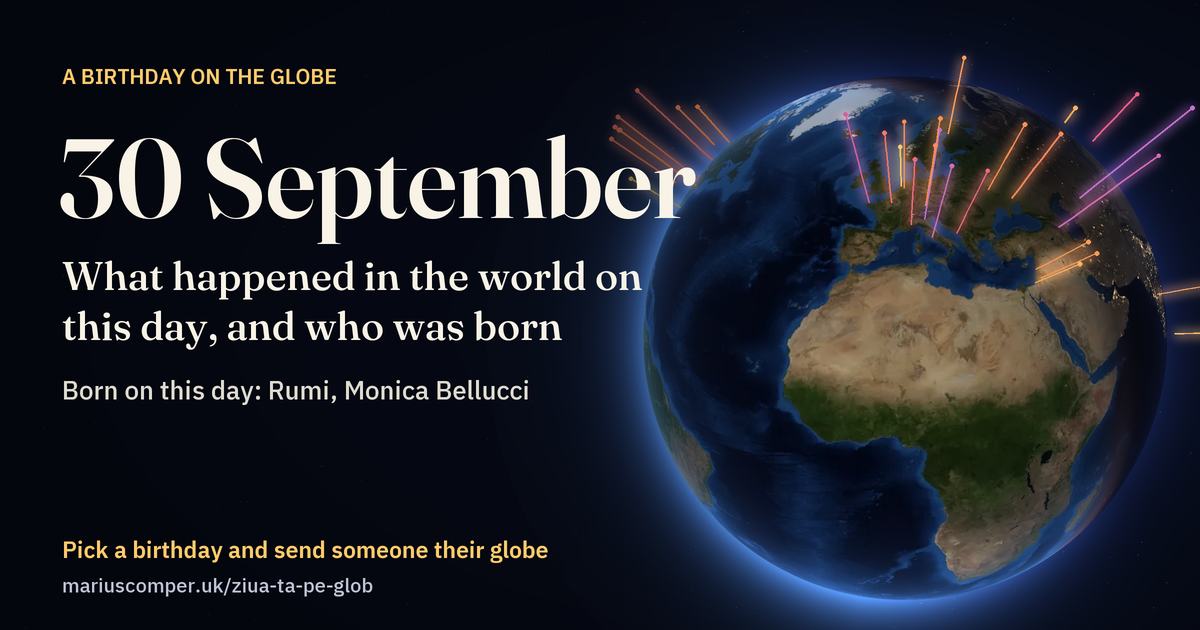
For 30 September, the English Wikipedia lists 59 events and 224 births. 31 of the events stand at their places as rays of light; two more are dashed circles, where the sentence links only to a country or a sea. The taller the ray, the longer ago it happened. The people born that day come further down, as blue points.
A birthday, yours or someone else’s:
Turn it into a greetingScroll: the globe turns to each place
The day you were born, on the globe.
Three things from your day
Scroll: your day first, then 30 September through the years
The Earth on 30 September
The picture on the globe was assembled by NASA from satellite photographs taken in September 2004: the snow, the ice and the green are those of the month.
On 30 September the Sun passes straight overhead at noon along the parallel of 2.8° south. In London, the day lasts about 11 hours 45 minutes.
Beyond 87° south the Sun no longer sets; beyond 87° north it no longer rises.
The line between day and night is tilted on the globe exactly as on this day of the year. On the dark side you can see the lights of towns.
Europe · Herceg Novi
1687
The Venetians under Girolamo Corner take the city of Herceg Novi from the Ottoman Empire.
On the map: Herceg Novi.
Europe · Paris
1863
Georges Bizet's opera Les pêcheurs de perles, premieres in Paris.
On the map: Paris.
Also on the day’s list of Wikipedia in Romanian.
Europe · Van Gogh Museum
2016
Two paintings with a combined value of $100 million are recovered after having been stolen from the Van Gogh Museum in 2002.
On the map: Van Gogh Museum.
North America · Vulcan Street Plant
1882
Thomas Edison's first commercial hydroelectric power plant, the Vulcan Street Plant, begins operation.
On the map: Vulcan Street Plant.
North America · Times Square Theater
1920
Times Square Theater opened on Broadway with a production of The Mirage, a play written by its owner, Edgar Selwyn.
On the map: Times Square Theater.
North America · Yankee Stadium
1947
The 1947 World Series begins. It is the first to be televised, to include an African-American player, to exceed $2 million in receipts, to see a pinch-hit home run, and to have six umpires on the field.
On the map: Yankee Stadium.
30 September
What the other Wikipedias remember#
For these years the English list has nothing on this day. The events below come from the same day’s lists on Wikipedia in Chinese and were translated for this page.
From Wikipedia in Chinese · unification of Germany
1862
The Prussian prime minister Otto von Bismarck delivers his "blood and iron" speech, declaring that German unification cannot be achieved through speeches and votes but must be accomplished through "blood and iron".
On the map: unification of Germany.
Translated from the list on Wikipedia in Chinese.
From Wikipedia in Chinese · Shek Kip Mei Station
1979
The Modified Initial System, linking Shek Kip Mei station to Kwun Tong station, officially opens, becoming the first operating line of the Hong Kong MTR system.
On the map: Shek Kip Mei Station.
Translated from the list on Wikipedia in Chinese.
30 September
Born on 30 September#
The English Wikipedia lists 224 births for this day. The blue points are the birthplaces of 60 of these people: those written about in the most Wikipedia editions, where Wikidata gives a place of birth.
Born on 30 September
1207
Rumi, Persian mystic and poet (died 1273)
Place of birth: Vakhsh.
Born on 30 September
1964
Monica Bellucci, Italian actress and fashion model
Place of birth: Città di Castello.
Born on 30 September
1928
Elie Wiesel, Romanian-American author, academic, and activist, Nobel Prize laureate (died 2016)
Place of birth: Sighetu Marmației.
Born on 30 September
1997
Max Verstappen, Dutch race car driver
Place of birth: Hasselt.
Born on 30 September
1924
Truman Capote, American novelist, playwright, and screenwriter (died 1984)
Place of birth: New Orleans.
Born in Britain and Ireland
1921
Deborah Kerr, Scottish-English actress (died 2007)
Place of birth: Hillhead.
Born in Britain and Ireland
1905
Nevill Francis Mott, English physicist and academic, Nobel Prize laureate (died 1996)
Place of birth: Leeds.
Born in Britain and Ireland
1981
Cecelia Ahern, Irish author
Place of birth: Dublin.
30 September
Number one in the charts that week
At the cinema
An animal recorded that day
The record can be seen in GBIF, which brings together wildlife records from around the world.
All your birthdays
The weather that day
Data: Met Office Hadley Centre (HadCET); NOAA (GHCN-Daily, Mauna Loa).
Above the Earth
Sources: Jonathan McDowell, GCAT (launches); GFZ Potsdam (Kp index). Days are counted in Universal Time.
Football that day
International matches played that day:
Source: the “International football results” dataset kept by Mart Jürisoo (CC0).
Also that day
The earthquake’s page at the USGS
Source: the USGS catalogue. The day is counted in Universal Time (UTC).
In those days
Make a link for someone
Type the name, pick the day and the year of birth. The link opens straight on their day, with their name in the greeting.
The link carries the name, date and place typed here; anyone who gets it can see them.
Put another birthday beside it
Your mother’s, your child’s, a friend’s: the two days appear side by side.
Below: 30 September through the years.
The whole globe of the day
Drag the globe to turn it. Touch a ray or a point to read what happened there.
Everything Wikipedia lists for 30 September
The list is the English Wikipedia’s, in its own wording, as it stood in October 2026. 26 events have no place on the map: the sentence links to no place with coordinates, only to places too wide to mark, or to several countries.
- 489
The Ostrogoths under Theoderic the Great defeat the forces of Odoacer for the second time.
Europe · VeronaWikipedia: Battle of Verona - 737
The Türgesh drive back an Umayyad invasion of Khuttal, follow them south of the Oxus, and capture their baggage train.
Asia · Amu DaryaWikipedia: Battle of the Baggage - 1061
Election of Pope Alexander II following the death of Pope Nicholas II two months prior.
Europe · 1061 papal electionWikipedia: 1061 papal election - 1139
A magnitude 7.7 earthquake strikes the Caucasus mountains in the Seljuk Empire, causing mass destruction and killing up to 300,000 people.
Asia · 1139 Ganja earthquakeWikipedia: 1139 Ganja earthquake - 1342
Battle of Morlaix is fought in the Hundred Years' War.
Europe · Battle of MorlaixWikipedia: Battle of Morlaix - 1399
Henry IV is proclaimed king of England.
no place on the mapWikipedia: Henry IV of England - 1520
Suleiman the Magnificent becomes sultan of the Ottoman Empire.
no place on the mapWikipedia: Suleiman the Magnificent - 1541
Spanish conquistador Hernando de Soto and his forces enter Tula territory in present-day western Arkansas, encountering fierce resistance.
no place on the mapWikipedia: Hernando de Soto - 1551
A coup by the military establishment of Japan's Ōuchi clan forces their lord to commit suicide, and their city is burned.
Asia · Tainei-ji incidentWikipedia: Tainei-ji incident - 1687
The Venetians under Girolamo Corner take the city of Herceg Novi from the Ottoman Empire.
Europe · Herceg NoviWikipedia: Girolamo Corner - 1736
The Lebanese Council of 1736 begins, a major turning point in the reform of the Maronite Church. In the following three days, the assembled Maronite and Latin clergy presided by Yusuf ibn Siman as-Simani discuss various reforms and elaborate rules and canons.
no place on the mapWikipedia: Lebanese Council of 1736 - 1744
War of the Austrian Succession: France and Spain defeat Sardinia at the Battle of Madonna dell'Olmo, but soon have to withdraw from Sardinia.
Europe · CuneoWikipedia: Battle of Madonna dell'Olmo - 1791
France's National Constituent Assembly is dissolved, to be replaced the next day by the National Legislative Assembly.
no place on the mapWikipedia: National Constituent Assembly - 1791
The first performance of Mozart's opera The Magic Flute takes place two months before his death.
no place on the mapWikipedia: The Magic Flute - 1863
Georges Bizet's opera Les pêcheurs de perles, premieres in Paris.
Europe · ParisWikipedia: Georges Bizet - 1882
Thomas Edison's first commercial hydroelectric power plant, the Vulcan Street Plant, begins operation.
North America · Vulcan Street PlantWikipedia: Thomas Edison - 1888
Jack the Ripper kills his third and fourth victims, Elizabeth Stride and Catherine Eddowes.
no place on the mapWikipedia: Jack the Ripper - 1895
Friedrich Nietzsche finished writing The Antichrist, with the 7 propositions Law Against Christianity, marked by him as a Day of Salvation, Day and Year 1 of a new calendar.
no place on the mapWikipedia: Friedrich Nietzsche - 1906
The Royal Galician Academy, the Galician language's biggest linguistic authority, is established in La Coruña, Spain.
no place on the mapWikipedia: Royal Galician Academy - 1907
The McKinley National Memorial, the final resting place of assassinated U.S. President William McKinley and his family, is dedicated in Canton, Ohio.
North America · McKinley National MemorialWikipedia: McKinley National Memorial - 1909
The Cunard Line's RMS Mauretania makes a record-breaking westbound crossing of the Atlantic, that will not be bettered for 20 years.
no place on the mapWikipedia: RMS Mauretania - 1915
World War I: Radoje Ljutovac becomes the first soldier in history to shoot down an enemy aircraft with ground-to-air fire.
no place on the mapWikipedia: World War I - 1918
Ukrainian War of Independence: Insurgent forces led by Nestor Makhno defeats the Central Powers at the battle of Dibrivka.
Europe · Battle of DibrivkaWikipedia: Central Powers - 1919
The Elaine massacre in Arkansas commences.
North America · Elaine massacreWikipedia: Elaine massacre - 1920
Times Square Theater opened on Broadway with a production of The Mirage, a play written by its owner, Edgar Selwyn.
North America · Times Square TheaterWikipedia: Times Square Theater - 1935
The Hoover Dam, astride the border between the U.S. states of Arizona and Nevada, is dedicated.
North America · Hoover DamWikipedia: Hoover Dam - 1936
American journalists Herbert R. Ekins, reporter for the New York World-Telegram, Dorothy Kilgallen of the New York Journal and Leo Kieran of The New York Times start the race to travel around the world on commercial airline flights. The race takes 18 ½ days.
no place on the mapWikipedia: New York World-Telegram - 1938
Britain, France, Germany and Italy sign the Munich Agreement, whereby Germany annexes the Sudetenland region of Czechoslovakia.
Europe · Munich AgreementWikipedia: Munich Agreement - 1938
The League of Nations unanimously outlaws "intentional bombings of civilian populations".
no place on the mapWikipedia: League of Nations - 1939
NBC broadcasts the first televised American football game.
no place on the mapWikipedia: 1939 Waynesburg vs. Fordham football game - 1939
World War II: General Władysław Sikorski becomes prime minister of the Polish government-in-exile.
no place on the mapWikipedia: World War II - 1941
World War II: The Babi Yar massacre comes to an end.
Europe · Babi YarWikipedia: Babi Yar - 1943
The United States Merchant Marine Academy is dedicated by President Roosevelt.
North America · United States Merchant Marine AcademyWikipedia: United States Merchant Marine Academy - 1944
World War II: the Germans commence a counter offensive to retake the Nijmegen salient, this having been captured by the allies during Operation Market Garden.
Europe · Battle of the Nijmegen salientWikipedia: Operation Market Garden - 1945
The Bourne End rail crash, in Hertfordshire, England, kills 43.
no place on the mapWikipedia: Bourne End rail crash - 1947
Pakistan joins the United Nations.
Asia · PakistanWikipedia: Pakistan - 1947
The 1947 World Series begins. It is the first to be televised, to include an African-American player, to exceed $2 million in receipts, to see a pinch-hit home run, and to have six umpires on the field.
North America · Yankee StadiumWikipedia: 1947 World Series - 1949
The Berlin Airlift ends.
Europe · Berlin BlockadeWikipedia: Berlin Blockade - 1954
The U.S. Navy submarine USS Nautilus is commissioned as the world's first nuclear-powered vessel.
no place on the mapWikipedia: USS Nautilus - 1955
American film actor James Dean suffered fatal injuries in a head-on car accident near Cholame, California.
North America · Death of James DeanWikipedia: Death of James Dean - 1960
The Flintstones, the first prime-time animated sitcom, premieres on ABC television.
no place on the mapWikipedia: The Flintstones - 1966
Bechuanaland declares its independence, and becomes the Republic of Botswana.
Africa · BotswanaWikipedia: Botswana - 1968
The Boeing 747 is rolled out and shown to the public for the first time.
no place on the mapWikipedia: Boeing 747 - 1970
Jordan makes a deal with the PFLP for the release of the remaining hostages from the Dawson's Field hijackings.
Asia · Dawson's Field hijackingsWikipedia: Dawson's Field hijackings - 1975
Malév Flight 240 crashes into the Mediterranean Sea while on approach to Beirut International Airport in Beirut, Lebanon, killing 60.
Asia · Beirut–Rafic Hariri International AirportWikipedia: Malév Flight 240 - 1975
The Boeing AH-64 Apache, the primary attack helicopter for a number of countries, made its first flight.
no place on the mapWikipedia: Boeing AH-64 Apache - 1978
Finnair Flight 405 is hijacked by Aarno Lamminparras in Oulu, Finland.
Europe · OuluWikipedia: Finnair Flight 405 - 1980
Ethernet specifications are published by Xerox working with Intel and Digital Equipment Corporation.
no place on the mapWikipedia: Ethernet - 1982
Cheers, an American television sitcom, debuted with its pilot episode on NBC.
no place on the mapWikipedia: Cheers - 1993
The 6.2 Mw Latur earthquake shakes Maharashtra, India with a maximum Mercalli intensity of VIII (Severe) killing 9,748 and injuring 30,000.
Asia · 1993 Latur earthquakeWikipedia: 1993 Latur earthquake - 1994
Space Shuttle Endeavour is launched on STS-68.
no place on the mapWikipedia: Space Shuttle Endeavour - 1998
The Internet Corporation for Assigned Names and Numbers (ICANN), a nonprofit organization that manages the assignment of domain names and IP addresses in the Internet, was incorporated.
no place on the mapWikipedia: ICANN - 1999
The Tokaimura nuclear accident causes the deaths of two technicians in Japan's second-worst nuclear accident.
Asia · Tokaimura nuclear accidentsWikipedia: Tokaimura nuclear accidents - 2000
Israeli–Palestinian conflict: Twelve-year-old Muhammad al-Durrah is shot and killed on the second day of the Second Intifada.
Asia · Killing of Muhammad al-DurrahWikipedia: Killing of Muhammad al-Durrah - 2005
Controversial drawings of Muhammad are printed in a Danish newspaper.
no place on the mapWikipedia: Jyllands-Posten Muhammad cartoons controversy - 2009
The 7.6 Mw Sumatra earthquake leaves 1,115 people dead.
Asia · 2009 Sumatra earthquakesWikipedia: 2009 Sumatra earthquakes - 2016
Hurricane Matthew becomes a Category 5 hurricane, making it the strongest hurricane to form in the Caribbean Sea since 2007.
North America · Hurricane MatthewWikipedia: Hurricane Matthew - 2016
Two paintings with a combined value of $100 million are recovered after having been stolen from the Van Gogh Museum in 2002.
Europe · Van Gogh MuseumWikipedia: Van Gogh Museum - 2019
President Martín Vizcarra dissolved the Congress of Peru, resulting in a constitutional crisis.
no place on the mapWikipedia: 2019–2020 Peruvian constitutional crisis
What the other Wikipedias remember
For these years the English list has nothing on this day. The events below come from the same day’s lists on Wikipedia in Chinese and were translated for this page.
- 1862
The Prussian prime minister Otto von Bismarck delivers his "blood and iron" speech, declaring that German unification cannot be achieved through speeches and votes but must be accomplished through "blood and iron".
- 1979
The Modified Initial System, linking Shek Kip Mei station to Kwun Tong station, officially opens, becoming the first operating line of the Hong Kong MTR system.
Who was born on 30 September
In order of how many Wikipedia editions have an article about each. The first 60 of 224 are shown.
- 1207
Rumi, Persian mystic and poet (died 1273)
VakhshWikipedia: Rumi - 1964
Monica Bellucci, Italian actress and fashion model
Città di CastelloWikipedia: Monica Bellucci - 1928
Elie Wiesel, Romanian-American author, academic, and activist, Nobel Prize laureate (died 2016)
Sighetu MarmațieiWikipedia: Elie Wiesel - 1997
Max Verstappen, Dutch race car driver
HasseltWikipedia: Max Verstappen - 1924
Truman Capote, American novelist, playwright, and screenwriter (died 1984)
New OrleansWikipedia: Truman Capote - 1975
Marion Cotillard, French actress and singer
12th arrondissement of ParisWikipedia: Marion Cotillard - 1986
Olivier Giroud, French footballer
ChambéryWikipedia: Olivier Giroud - 1870
Jean Baptiste Perrin, French-American physicist and chemist, Nobel Prize laureate (died 1942)
- 1945
Ehud Olmert, Israeli lawyer and politician, 12th Prime Minister of Israel
Nahalat JabotinskyWikipedia: Ehud Olmert - 1980
Martina Hingis, Swiss tennis player
- 1227
Pope Nicholas IV (died 1292)
LiscianoWikipedia: Pope Nicholas IV - 1921
Deborah Kerr, Scottish-English actress (died 2007)
HillheadWikipedia: Deborah Kerr - 1905
Nevill Francis Mott, English physicist and academic, Nobel Prize laureate (died 1996)
- 1951
Barry Marshall, Australian physician and academic, Nobel Prize laureate
KalgoorlieWikipedia: Barry Marshall - 1939
Jean-Marie Lehn, French chemist and academic, Nobel Prize laureate
RosheimWikipedia: Jean-Marie Lehn - 1882
Hans Geiger, German physicist and academic (died 1945)
Neustadt an der WeinstraßeWikipedia: Hans Geiger - 1714
Étienne Bonnot de Condillac, French epistemologist and philosopher (died 1780)
- 1732
Jacques Necker, Swiss-French politician, Prime Minister of France (died 1804)
- 1934
Udo Jürgens, Austrian-Swiss singer-songwriter and pianist (died 2014)
Klagenfurt am WörtherseeWikipedia: Udo Jürgens - 1943
Johann Deisenhofer, German-American biochemist and biophysicist, Nobel Prize laureate
ZusamaltheimWikipedia: Johann Deisenhofer - 1992
Ezra Miller, American actor and singer
WyckoffWikipedia: Ezra Miller - 1895
Lewis Milestone, Moldovan-American director, producer, and screenwriter (died 1980)
ChișinăuWikipedia: Lewis Milestone - 1908
David Oistrakh, Ukrainian-Russian violinist and educator (died 1974)
- 1931
Angie Dickinson, American actress
- 1957
Fran Drescher, American actress, producer, and screenwriter
QueensWikipedia: Fran Drescher - 1982
Kieran Culkin, American actor
New York CityWikipedia: Kieran Culkin - 1984
T-Pain, American rapper, producer, and actor
TallahasseeWikipedia: T-Pain - 1950
Laura Esquivel, Mexican author and screenwriter
Mexico CityWikipedia: Laura Esquivel - 1985
Cristian Rodríguez, Uruguayan footballer
Juan LacazeWikipedia: Cristian Rodríguez - 2002
Maddie Ziegler, American dancer and actress
PittsburghWikipedia: Maddie Ziegler - 1765
José María Morelos, Mexican priest and general (died 1815)
- 1986
Cristián Zapata, Colombian footballer
PadillaWikipedia: Cristián Zapata - 1981
Cecelia Ahern, Irish author
DublinWikipedia: Cecelia Ahern - 1982
Lacey Chabert, American actress
PurvisWikipedia: Lacey Chabert - 1961
Eric Stoltz, American actor, director, and producer
WhittierWikipedia: Eric Stoltz - 1917
Buddy Rich, American drummer, bandleader, and actor (died 1987)
BrooklynWikipedia: Buddy Rich - 1937
Valentyn Sylvestrov, Ukrainian pianist and composer
- 1863
Reinhard Scheer, German admiral (died 1928)
ObernkirchenWikipedia: Reinhard Scheer - 1965
Omid Djalili, English comedian, actor, and producer
KensingtonWikipedia: Omid Djalili - 1970
Tony Hale, American actor and producer
West PointWikipedia: Tony Hale - 1971
Jenna Elfman, American actress and producer
Los AngelesWikipedia: Jenna Elfman - 1947
Marc Bolan, English singer-songwriter and guitarist (died 1977)
Stoke NewingtonWikipedia: Marc Bolan - 1905
Michael Powell, English director, producer, and screenwriter (died 1990)
- 1932
Shintaro Ishihara, Japanese author, playwright, and politician, Governor of Tokyo (died 2022)
Suma-kuWikipedia: Shintaro Ishihara - 1917
Yuri Lyubimov, Russian actor and director (died 2014)
YaroslavlWikipedia: Yuri Lyubimov - 1974
Daniel Wu, American–born Hong Kong actor, director, and producer
BerkeleyWikipedia: Daniel Wu - 1994
Aliya Mustafina, Russian gymnast
YegoryevskWikipedia: Aliya Mustafina - 1700
Stanisław Konarski, Polish monk, poet, and playwright (died 1773)
Żarczyce DużeWikipedia: Stanisław Konarski - 1987
Aida Garifullina, Russian operatic soprano
- 1933
Cissy Houston, American singer (died 2024)
NewarkWikipedia: Cissy Houston - 1972
Ari Behn, Danish-Norwegian author and playwright (died 2019)
AarhusWikipedia: Ari Behn - 1852
Charles Villiers Stanford, Irish composer, conductor, and educator (died 1924)
- 1944
Jimmy Johnstone, Scottish footballer (died 2006)
UddingstonWikipedia: Jimmy Johnstone - 1946
Jochen Mass, German race car driver (died 2025)
DorfenWikipedia: Jochen Mass - 1883
Bernhard Rust, German educator and politician (died 1945)
HanoverWikipedia: Bernhard Rust - 1935
Johnny Mathis, American singer and actor
San FranciscoWikipedia: Johnny Mathis - 1977
Roy Carroll, Northern Irish goalkeeper and manager
EnniskillenWikipedia: Roy Carroll - 1887
Lil Dagover, Indonesian-German actress (died 1980)
MadiunWikipedia: Lil Dagover - 1960
Blanche Lincoln, American politician
- 1979
Andy van der Meyde, Dutch footballer
What is celebrated on 30 September
- Agricultural Reform (Nationalization) Day (São Tomé and Príncipe)
- Birth of Morelos (Mexico)
- Boy's Day (Poland)
- Christian feast day: Blessed Federico Albert
- Christian feast day: Gregory the Illuminator
- Christian feast day: Honorius of Canterbury
- Christian feast day: Jerome
- Christian feast day: September 30 (Eastern Orthodox liturgics)
- Independence Day (Botswana) or Botswana Day, celebrates the independence of Botswana from United Kingdom in 1966.
- International Translation Day (International Federation of Translators)
- National Day for Truth and Reconciliation or Orange Shirt Day (Canada)
A greeting link for someone
Type a name and, if you like, the year of birth. The link opens with a greeting, and beside each event it says how old the person turned that day, or how many years before their birth it happened.
The name and the year go only into the link you send.
All 366 days
How the globe is made
Where the events come from
Each edition of this page uses the day’s list from Wikipedia in its own language: Romanian, English, Spanish, Chinese. The lists are written by volunteers and differ from one edition to the next; the text of each event is Wikipedia’s, with a link to the article. A row that appears twice in a list is shown once. The lists have not been checked event by event: they are Wikipedia’s, mistakes included.
For events before 1582, and for countries that moved to the Gregorian calendar later (Britain in 1752, Russia in 1918), the same day may be counted Old Style in one list and New Style in another.
The chapter “What the other Wikipedias remember” adds up to five events a day from the lists of the other three editions, only for years in which the English list has nothing on that day. They were translated for this page, passed the same filters as the tour, and are not counted among the events of the English list.
How an event gets onto the map
The place comes from Wikidata. If the sentence links to the article about the event itself (a battle, an opening, an earthquake), dated to the same year, the ray stands on its coordinates or on those of its location. Otherwise it stands on the first place the sentence links to: a town, a building, a mountain, an island. This second step can be wrong: sometimes the sentence only mentions the place. That is why the page says, under each event, which place the ray stands on.
When the sentence links to a single state or province, or to a single sea, lake or desert larger than 5,000 km², the globe shows a dashed circle, not a ray. The circle has the area Wikidata gives, with its radius kept between 1.2° and 16°, or a radius of 4.5° when Wikidata gives no area; it says only that the sentence links to that place. Organisations, ships, spacecraft, museum objects, rivers, mountain ranges, languages and continents are never used as places. When a sentence names several states and no exact place, the event stays in the list only.
What the height means
The height of a ray shows how many years have passed, on a logarithmic scale: 10 years, 100 years and 1,000 years are equal steps apart; anything older than about 2,600 years has the tallest ray. The colour runs from pale yellow for recent years to violet for antiquity.
Where the tour stops
In each region the tour stops at up to three events (five in Britain and Ireland), chosen mainly by three things: whether Wikipedia’s editors put the event in the “On this day” box of their main page (the English, Spanish and Chinese editions), how many Wikipedia editions have an article about it, and how many of the four lists include it. Events whose sentence or article is about a war, an attack, a crime or a disaster are left out of the tour; they stay in the whole list, in Wikipedia’s wording. The filter is a list of words and a list of Wikidata types, so it can miss some.
The tour of births names the people with articles in the most editions and leaves aside those whom the list or Wikidata describes as rulers, politicians, commanders, leaders of movements or criminals; they stay in the list.
The Earth and the Sun
The daytime images are NASA’s Blue Marble Next Generation mosaics, one for each month of 2004; the night side is Black Marble 2016. The tilt of the line between day and night is computed for the day; the hour is chosen so that the place being read is in daylight. The latitude where the Sun stands overhead is the average of the four years of the leap cycle; in a given year it can differ by up to 0.4°.
The day you were born
The number ones come from the weekly lists on Wikipedia: Billboard for the United States (from 1940; the Hot 100 from August 1958), the UK Singles Chart (from November 1952), Los 40 Principales for Spain (from July 1966) and, for Romania, the Romanian Top 100 and Airplay 100 (2001–2021, with missing weeks). The page shows the chart of the week in which the day of birth falls, with its date; Billboard and the UK chart are dated at the end of their week. For Romania before 2001 and for China these sources have no weekly chart.
The films are those that reached cinemas in the United States up to ten days before or three days after that day (some of them in a few cinemas at first), from the English Wikipedia’s yearly lists (from 1968), in order of how many editions have an article about them. The events “in those days” are the ones on the neighbouring days’ lists that carry the year of birth, passed through the same filter as the tour.
The day of birth, year included
The Moon, the star sign and the constellation are worked out by the page itself, for noon Universal Time on the day. The lit part of the Moon is rounded and can differ by a few per cent from that at the hour of birth. The sign follows the usual zodiac of twelve equal parts starting at the March equinox; the constellation is the one the Sun actually stood in front of, by the borders set by the International Astronomical Union, and within a day of a border the page does not name it. When the Sun changes sign while it is that day anywhere on Earth, the page gives the moment of crossing, rounded to ten minutes and accurate to within about a quarter of an hour, and the clock time in a few cities, with the time zone and summer time of that year.
The year in the Chinese calendar is the one your device’s own calendar gives for the date, checked against the Hong Kong Observatory’s tables. “All your birthdays” uses the same sources as the rest of the chapter for the same day in every year since the birth: the temperature, well-known launches that took place on that very day, matches of the teams the edition follows, snow deeper than 10 cm and strong geomagnetic storms. The three things at the top and the four on the picture are chosen in a fixed order (the song, the animal, a full Moon, a well-known launch before an ordinary earthquake); on the picture you can change them.
When the link carries a year of birth, the page adds a few things about that exact day. The weather is the Met Office’s Central England temperature record and the readings from New York’s Central Park; the “usual high” is the average of the daily highs of 1961–1990 for that date, with two days either side. The carbon dioxide figure is the monthly mean at the Mauna Loa observatory, where measurements begin in March 1958.
The earthquake is the one with the largest magnitude in the USGS catalogue for that day, counted in Universal Time. Before the 1960s the catalogue has gaps even above magnitude 5.5, so in the older years many days have no earthquake. The page gives only the magnitude and the place: the country the epicentre falls in or, when the epicentre is at sea within 300 km of a coast, the nearest country; farther out, only the ocean.
The launches are those that reached orbit or left for the Moon and the planets, from Jonathan McDowell’s GCAT catalogue. If nothing left that day, the page shows the nearest launch within three days before or after, and says how many days away it was. The geomagnetic storm appears only when the Kp index reached at least 5 in one of the day’s eight three-hour intervals.
The animal comes from GBIF: an observation made by a person (the animal seen or heard, or its tracks), dated to that exact day, with coordinates and a CC0 or CC BY licence. Only a few hundred well-known species are searched (mammals, birds, turtles, butterflies); of those noted that day, mammals and species with articles in many Wikipedia editions come first; birds noted almost every day, and species used recently, wait their turn. Observations dated 1 January are left out, because records without a day are often filed there. An observation shows that the animal was recorded there, not how many animals there were.
The matches are those between national teams. Only matches of England, Scotland, Wales, Northern Ireland, the Republic of Ireland, the United States, Canada and Australia are shown, along with those at the big final tournaments. The picture to send is drawn in the page from the day’s globe and the facts above, and stays on your device until you send it.
Sources
- Events, births and holidays: the day’s page on Wikipedia, text under CC BY-SA 4.0.
- Coordinates, places of birth and the number of editions: Wikidata (CC0).
- The Earth by day: NASA Blue Marble Next Generation. The Earth by night: NASA Black Marble 2016.
- Borders and regions: Natural Earth.
- World population and births per year: UN World Population Prospects 2024.
- Charts and films: Wikipedia’s lists for Billboard, the UK Singles Chart, Los 40 Principales, Romanian Top 100, Airplay 100 and American films by year (CC BY-SA 4.0).
- Weather: Met Office Hadley Centre, HadCET (Open Government Licence) and NOAA GHCN-Daily, New York Central Park. Carbon dioxide: NOAA Global Monitoring Laboratory, Mauna Loa.
- Earthquakes: the USGS catalogue. Launches: Jonathan McDowell, GCAT (CC BY). Kp index: GFZ Potsdam (CC BY 4.0). Matches: International football results, Mart Jürisoo (CC0).
- Animal observations: GBIF, with a link to each record; species names come from Wikidata.