A birthday on the globe
9 April on the globe: what happened in the world on this day, and who was born
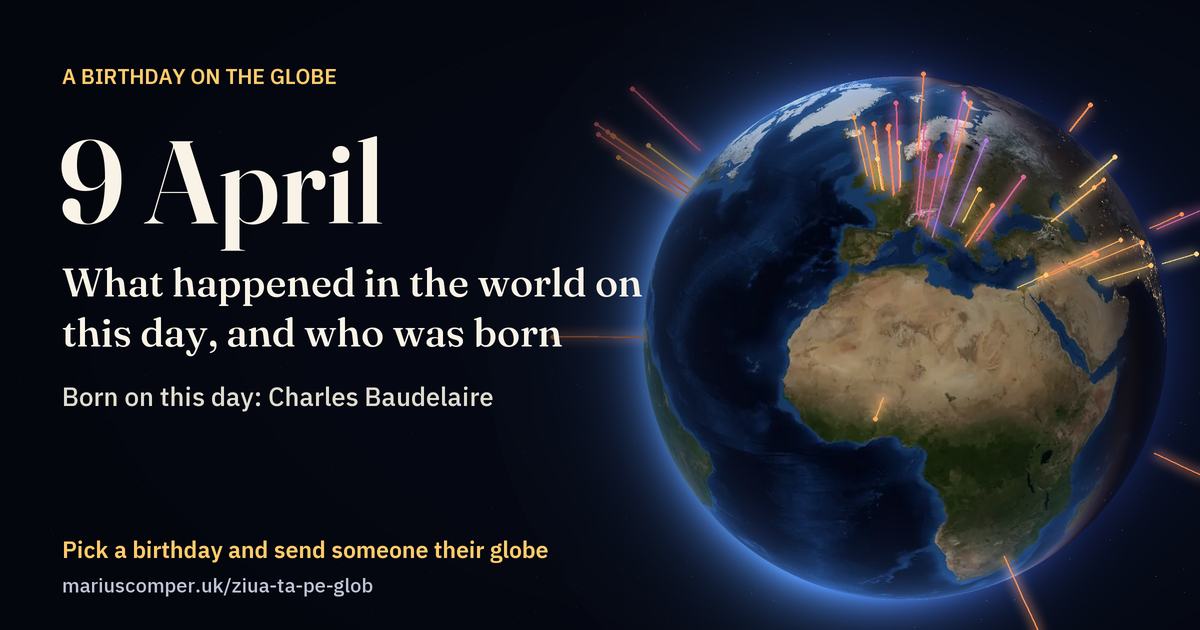
For 9 April, the English Wikipedia lists 66 events and 260 births. 45 of the events stand at their places as rays of light; three more are dashed circles, where the sentence links only to a country or a sea. The taller the ray, the longer ago it happened. The people born that day come further down, as blue points.
A birthday, yours or someone else’s:
Turn it into a greetingScroll: the globe turns to each place
The day you were born, on the globe.
Three things from your day
Scroll: your day first, then 9 April through the years
The Earth on 9 April
The picture on the globe was assembled by NASA from satellite photographs taken in April 2004: the snow, the ice and the green are those of the month.
On 9 April the Sun passes straight overhead at noon along the parallel of 7.7° north. In London, the day lasts about 13 hours 30 minutes.
Beyond 82° north the Sun no longer sets; beyond 82° south it no longer rises.
The line between day and night is tilted on the globe exactly as on this day of the year. On the dark side you can see the lights of towns.
Britain & Ireland · Croydon Airport
1937
The Kamikaze arrives at Croydon Airport in London. It is the first Japanese-built aircraft to fly to Europe.
On the map: Croydon Airport.
Britain & Ireland · Filton
1969
The first British-built Concorde 002 makes its maiden flight from Filton to RAF Fairford with Brian Trubshaw as the test pilot.
On the map: Filton.
Britain & Ireland · Wedding of Prince Charles and Camilla Parker Bowles
2005
Charles, Prince of Wales, married Camilla Parker Bowles in a civil ceremony at the Windsor Guildhall.
On the map: the coordinates Wikidata gives for the article “Wedding of Prince Charles and Camilla Parker Bowles”.
Wikipedia: Wedding of Prince Charles and Camilla Parker Bowles
Europe · Council of Florence
1438
The Council of Ferrara begins with its first session in presence of the Patriarch of Constantinople, representatives of the Patriarchal Sees of Antioch, Alexandria and Jerusalem and Pope Eugene IV presiding.
On the map: Council of Florence.
Europe · Lodi
1454
The Treaty of Lodi is signed, establishing a balance of power among northern Italian city-states for almost 50 years.
On the map: Lodi.
Also on the day’s list of Wikipedia in Spanish.
Europe · Corfu Channel incident
1947
United Nations Security Council Resolution 22 relating to Corfu Channel incident is adopted.
On the map: Corfu Channel incident.
Asia · Baikonur Cosmodrome
2020
Soyuz MS-16 is launched from the Baikonur Cosmodrome, carrying the Expedition 62/63 crew to the International Space Station.
On the map: Baikonur Cosmodrome.
North America · Louisiana
1682
Robert Cavelier de La Salle discovers the mouth of the Mississippi River, claims it for France and names it Louisiana.
On the map: Louisiana.
North America · United States Congress
1909
The U.S. Congress passes the Payne–Aldrich Tariff Act.
On the map: United States Congress.
North America · Lincoln Memorial
1939
African-American singer Marian Anderson gives a concert at the Lincoln Memorial after being denied the use of Constitution Hall by the Daughters of the American Revolution.
On the map: Lincoln Memorial.
Also on the day’s list of Wikipedia in Chinese.
9 April
What the other Wikipedias remember#
For these years the English list has nothing on this day. The events below come from the same day’s lists on Wikipedia in Chinese and were translated for this page.
From Wikipedia in Chinese · New York City
1931
The Empire State Building in New York is completed.
On the map: New York City.
Translated from the list on Wikipedia in Chinese.
9 April
Born on 9 April#
The English Wikipedia lists 260 births for this day. The blue points are the birthplaces of 60 of these people: those written about in the most Wikipedia editions, where Wikidata gives a place of birth.
Born on 9 April
1821
Charles Baudelaire, French poet and critic (died 1867)
Place of birth: former 11th arrondissement of Paris.
Born on 9 April
1933
Jean-Paul Belmondo, French actor and producer (died 2021)
Place of birth: Neuilly-sur-Seine.
Born on 9 April
1990
Kristen Stewart, American actress
Place of birth: Los Angeles.
Born on 9 April
1802
Elias Lönnrot, Finnish physician and philologist (died 1884)
Place of birth: Sammatti (Finland : Kunta).
Born on 9 April
1974
Jenna Jameson, American actress and pornographic performer
Place of birth: Las Vegas.
Born in Britain and Ireland
1830
Eadweard Muybridge, English photographer and cinematographer (died 1904)
Place of birth: Kingston upon Thames.
Born in Britain and Ireland
1806
Isambard Kingdom Brunel, English engineer, designed the Clifton Suspension Bridge (died 1859)
Place of birth: Portsmouth.
Born in Britain and Ireland
1975
Robbie Fowler, English footballer and manager
Place of birth: Toxteth.
9 April
Number one in the charts that week
At the cinema
An animal recorded that day
The record can be seen in GBIF, which brings together wildlife records from around the world.
All your birthdays
The weather that day
Data: Met Office Hadley Centre (HadCET); NOAA (GHCN-Daily, Mauna Loa).
Above the Earth
Sources: Jonathan McDowell, GCAT (launches); GFZ Potsdam (Kp index). Days are counted in Universal Time.
Football that day
International matches played that day:
Source: the “International football results” dataset kept by Mart Jürisoo (CC0).
Also that day
The earthquake’s page at the USGS
Source: the USGS catalogue. The day is counted in Universal Time (UTC).
In those days
Make a link for someone
Type the name, pick the day and the year of birth. The link opens straight on their day, with their name in the greeting.
The link carries the name, date and place typed here; anyone who gets it can see them.
Put another birthday beside it
Your mother’s, your child’s, a friend’s: the two days appear side by side.
Below: 9 April through the years.
The whole globe of the day
Drag the globe to turn it. Touch a ray or a point to read what happened there.
Everything Wikipedia lists for 9 April
The list is the English Wikipedia’s, in its own wording, as it stood in October 2026. 18 events have no place on the map: the sentence links to no place with coordinates, only to places too wide to mark, or to several countries.
- 193
The distinguished soldier Septimius Severus is proclaimed emperor by the army in Illyricum.
Europe · IllyricumWikipedia: Septimius Severus - 475
Byzantine Emperor Basiliscus issues a circular letter (Enkyklikon) to the bishops of his empire, supporting the Monophysite christological position.
no place on the mapWikipedia: List of Byzantine emperors - 537
Siege of Rome: The Byzantine general Belisarius receives his promised reinforcements, 1,600 cavalry, mostly of Hunnic or Slavic origin and expert bowmen. Despite shortages, he starts raids against the Gothic camps and Vitiges but is forced into a stalemate.
Europe · Siege of RomeWikipedia: Siege of Rome - 1241
Battle of Liegnitz: Mongol forces defeat the Polish and German armies.
Europe · Battle of LegnicaWikipedia: Battle of Legnica - 1288
Mongol invasions of Vietnam: Yuan forces are defeated by Trần forces in the Battle of Bach Dang in present-day northern Vietnam.
Asia · Battle of Bạch ĐằngWikipedia: Battle of Bạch Đằng - 1387
The Byzantine city of Thessalonike surrenders to the Ottomans, though rule reverts back to the Byzantines after the battle of Ankara.
Europe · ThessalonikiWikipedia: Battle of Ankara - 1388
Despite being outnumbered 16:1, forces of the Old Swiss Confederacy are victorious over the Archduchy of Austria in the Battle of Näfels.
Europe · Battle of NäfelsWikipedia: Battle of Näfels - 1438
The Council of Ferrara begins with its first session in presence of the Patriarch of Constantinople, representatives of the Patriarchal Sees of Antioch, Alexandria and Jerusalem and Pope Eugene IV presiding.
Europe · Council of FlorenceWikipedia: Council of Florence - 1454
The Treaty of Lodi is signed, establishing a balance of power among northern Italian city-states for almost 50 years.
Europe · LodiWikipedia: Treaty of Lodi - 1511
Resettled Shiite Muslims rise up in the Şahkulu rebellion under the leadership of Şahkulu against the Ottoman Empire.
Asia · Ottoman EmpireWikipedia: Şahkulu rebellion - 1609
Eighty Years' War: Spain and the Dutch Republic sign the Treaty of Antwerp to initiate twelve years of truce.
Europe · AntwerpWikipedia: Treaty of Antwerp - 1609
Philip III of Spain issues the decree of the "Expulsion of the Moriscos".
no place on the mapWikipedia: Philip III of Spain - 1682
Robert Cavelier de La Salle discovers the mouth of the Mississippi River, claims it for France and names it Louisiana.
North America · LouisianaWikipedia: René-Robert Cavelier, Sieur de La Salle - 1784
The Treaty of Paris, ratified by the United States Congress on January 14, 1784, is ratified by King George III of the Kingdom of Great Britain, ending the American Revolutionary War. Copies of the ratified documents are exchanged on May 12, 1784.
North America · United States CongressWikipedia: Treaty of Paris - 1860
On his phonautograph machine, Édouard-Léon Scott de Martinville makes the first known recording of an audible human voice.
no place on the mapWikipedia: Phonautograph - 1865
American Civil War: Robert E. Lee surrenders the Army of Northern Virginia (26,765 troops) to Ulysses S. Grant at Appomattox Court House, Virginia, effectively ending the war.
North America · Battle of Appomattox Court HouseWikipedia: American Civil War - 1909
The U.S. Congress passes the Payne–Aldrich Tariff Act.
North America · United States CongressWikipedia: United States Congress - 1917
World War I: The Battle of Arras: The battle begins with Canadian Corps executing a massive assault on Vimy Ridge.
Europe · Battle of ArrasWikipedia: World War I - 1918
World War I: The Battle of the Lys: The Portuguese Expeditionary Corps is crushed by the German forces during what is called the Spring Offensive on the Belgian region of Flanders.
Europe · Battle of the LysWikipedia: Battle of the Lys - 1937
The Kamikaze arrives at Croydon Airport in London. It is the first Japanese-built aircraft to fly to Europe.
Britain & Ireland · Croydon AirportWikipedia: Kamikaze - 1939
African-American singer Marian Anderson gives a concert at the Lincoln Memorial after being denied the use of Constitution Hall by the Daughters of the American Revolution.
North America · Lincoln MemorialWikipedia: Lincoln Memorial - 1940
Vidkun Quisling seizes power in Norway.
no place on the mapWikipedia: Vidkun Quisling - 1940
World War II: Operation Weserübung: Germany invades Denmark and Norway.
Europe · Operation WeserübungWikipedia: Operation Weserübung - 1942
World War II: An Indian Ocean raid by Japan's 1st Air Fleet sinks the British aircraft carrier HMS Hermes and the Australian destroyer HMAS Vampire.
Oceans · Indian Ocean raidWikipedia: Indian Ocean raid - 1942
World War II: The Battle of Bataan ends and the Bataan Death March begins.
Asia · Battle of BataanWikipedia: Bataan Death March - 1945
Dietrich Bonhoeffer, Lutheran pastor and anti-Nazi dissident, is executed by the Nazi regime.
no place on the mapWikipedia: Dietrich Bonhoeffer - 1945
The United States Atomic Energy Commission is formed.
no place on the mapWikipedia: United States Atomic Energy Commission - 1945
World War II: The Battle of Königsberg, in East Prussia, ends.
Europe · Battle of KönigsbergWikipedia: Battle of Königsberg - 1945
World War II: The German heavy cruiser Admiral Scheer is sunk by the Royal Air Force.
no place on the mapWikipedia: German cruiser Admiral Scheer - 1946
About 500 postal workers in Tel Aviv and Jaffa went on strike.
Asia · Tel AvivWikipedia: Jaffa - 1947
The Glazier–Higgins–Woodward tornadoes kill 181 and injure 970 in Texas, Oklahoma, and Kansas.
no place on the mapWikipedia: Tornado outbreak of April 9–11, 1947 - 1947
The Journey of Reconciliation, the first interracial Freedom Ride begins through the upper South in violation of Jim Crow laws. The riders wanted enforcement of the United States Supreme Court's 1946 Irene Morgan decision that banned racial segregation in interstate travel.
North America · Supreme Court of the United StatesWikipedia: Southern United States - 1947
United Nations Security Council Resolution 22 relating to Corfu Channel incident is adopted.
Europe · Corfu Channel incidentWikipedia: Corfu Channel incident - 1948
Fighters from the Irgun and Lehi Zionist terror groups attacked Deir Yassin near Jerusalem, killing over 100 Palestinians.
Asia · Deir Yassin massacreWikipedia: Deir Yassin massacre - 1948
Jorge Eliécer Gaitán's assassination provokes a violent riot in Bogotá (the Bogotazo), and a further ten years of violence in Colombia.
Latin America · BogotazoWikipedia: Bogotazo - 1952
Hugo Ballivián's government is overthrown by the Bolivian National Revolution, starting a period of agrarian reform, universal suffrage and the nationalization of tin mines
no place on the mapWikipedia: Hugo Ballivián - 1952
Japan Air Lines Flight 301 crashes into Mount Mihara, Izu Ōshima, Japan, killing 37.
Asia · Japan Air Lines Flight 301Wikipedia: Japan Air Lines Flight 301 - 1957
The Suez Canal in Egypt is cleared and opens to shipping following the Suez Crisis.
no place on the mapWikipedia: Suez Crisis - 1959
Project Mercury: NASA announces the selection of the United States' first seven astronauts, whom the news media quickly dub the "Mercury Seven".
no place on the mapWikipedia: Project Mercury - 1960
Dr. Hendrik Verwoerd, Prime Minister of South Africa and architect of apartheid, narrowly survives an assassination attempt by a white farmer, David Pratt in Johannesburg.
Africa · JohannesburgWikipedia: Hendrik Verwoerd - 1967
The first Boeing 737 (a 100 series) makes its maiden flight.
no place on the mapWikipedia: Boeing 737 - 1969
The first British-built Concorde 002 makes its maiden flight from Filton to RAF Fairford with Brian Trubshaw as the test pilot.
Britain & Ireland · FiltonWikipedia: Concorde - 1976
The first EMD F40PH, Amtrak's most widespread diesel locomotive for many years, entered into service.
no place on the mapWikipedia: EMD F40PH - 1980
The Iraqi regime of Saddam Hussein kills philosopher Muhammad Baqir al-Sadr and his sister Bint al-Huda after three days of torture.
Asia · IraqWikipedia: Iraq - 1981
The U.S. Navy nuclear submarine USS George Washington accidentally collides with the Nissho Maru, a Japanese cargo ship, sinking it and killing two Japanese sailors.
no place on the mapWikipedia: USS George Washington - 1989
Tbilisi massacre: An anti-Soviet peaceful demonstration and hunger strike in Tbilisi, demanding restoration of Georgian independence, is dispersed by the Soviet Army, resulting in 20 deaths and hundreds of injuries.
Asia · TbilisiWikipedia: Massacre of Tbilisi - 1990
An Embraer EMB 120 Brasilia collides in mid-air with a Cessna 172 over Gadsden, Alabama, killing both of the Cessna's occupants.
North America · Atlantic Southeast Airlines Flight 2254Wikipedia: Atlantic Southeast Airlines Flight 2254 - 1990
An IRA bombing in County Down, Northern Ireland, kills three members of the UDR.
Britain & Ireland · Downpatrick landmine attackWikipedia: Downpatrick landmine attack - 1990
The Sahtu Dene and Metis Comprehensive Land Claim Agreement is signed for 180,000 square kilometres (69,000 mi2) in the Mackenzie Valley of the western Arctic.
no place on the mapWikipedia: Sahtu Dene and Metis Comprehensive Land Claim Agreement - 1991
Georgia declares independence from the Soviet Union.
no place on the mapWikipedia: Georgia - 1992
A U.S. Federal Court finds former Panamanian dictator Manuel Noriega guilty of drug and racketeering charges. He is sentenced to 30 years in prison.
Latin America · PanamaWikipedia: Federal judiciary of the United States - 1993
Iranian filmmaker Morteza Avini was killed by a land mine in Fakkeh while producing a documentary.
Asia · Fakkeh, IranWikipedia: Morteza Avini - 1994
Space Shuttle program: Space Shuttle Endeavour is launched on STS-59.
no place on the mapWikipedia: Space Shuttle program - 1999
Ibrahim Baré Maïnassara, President of Niger, was shot dead by soldiers in Niamey.
Africa · NiameyWikipedia: Ibrahim Baré Maïnassara - 2003
Iraq War: Baghdad falls to American forces.
Asia · Battle of BaghdadWikipedia: Battle of Baghdad - 2005
Charles, Prince of Wales, married Camilla Parker Bowles in a civil ceremony at the Windsor Guildhall.
Britain & Ireland · Wedding of Prince Charles and Camilla Parker BowlesWikipedia: Wedding of Prince Charles and Camilla Parker Bowles - 2009
In Tbilisi, Georgia, up to 60,000 people protest against the government of Mikheil Saakashvili.
Asia · TbilisiWikipedia: 2009 Georgian demonstrations - 2011
Six people and the perpetrator are killed and 17 injured in a mass shooting at a shopping mall in Alphen aan den Rijn, Netherlands.
Europe · Alphen aan den Rijn shopping mall shootingWikipedia: Alphen aan den Rijn shopping mall shooting - 2013
A 6.1–magnitude earthquake strikes Iran killing 32 people and injuring over 850 people.
Asia · 2013 Bushehr earthquakeWikipedia: 2013 Bushehr earthquake - 2013
At least 13 people are killed and another three injured after a man goes on a spree shooting in the Serbian village of Velika Ivanča.
Europe · Velika Ivanča shootingWikipedia: Velika Ivanča shooting - 2014
A student stabs 20 people at Franklin Regional High School in Murrysville, Pennsylvania.
North America · 2014 Franklin Regional High School stabbingWikipedia: 2014 Franklin Regional High School stabbing - 2017
The Palm Sunday church bombings at Coptic churches in Tanta and Alexandria, Egypt, take place.
Africa · Palm Sunday church bombingsWikipedia: Palm Sunday church bombings - 2020
Soyuz MS-16 is launched from the Baikonur Cosmodrome, carrying the Expedition 62/63 crew to the International Space Station.
Asia · Baikonur CosmodromeWikipedia: Soyuz MS-16 - 2021
Burmese military and security forces commit the Bago massacre, during which at least 82 civilians are killed.
Asia · Bago massacreWikipedia: Bago massacre - 2021
Prince Philip, the consort of Queen Elizabeth II, died at Windsor Castle aged 99.
Britain & Ireland · Death and funeral of Prince Philip, Duke of EdinburghWikipedia: Death and funeral of Prince Philip, Duke of Edinburgh - 2021
Soyuz MS-18 is launched from the Baikonur Cosmodrome, carrying three members of the Expedition 64 crew to the International Space Station.
no place on the mapWikipedia: Soyuz MS-18
What the other Wikipedias remember
For these years the English list has nothing on this day. The events below come from the same day’s lists on Wikipedia in Chinese and were translated for this page.
- 1931
The Empire State Building in New York is completed.
Who was born on 9 April
In order of how many Wikipedia editions have an article about each. The first 60 of 260 are shown.
- 1821
Charles Baudelaire, French poet and critic (died 1867)
former 11th arrondissement of ParisWikipedia: Charles Baudelaire - 1933
Jean-Paul Belmondo, French actor and producer (died 2021)
Neuilly-sur-SeineWikipedia: Jean-Paul Belmondo - 1990
Kristen Stewart, American actress
Los AngelesWikipedia: Kristen Stewart - 1835
Leopold II of Belgium (died 1909)
BrusselsWikipedia: Leopold II of Belgium - 1926
Hugh Hefner, American publisher, founded Playboy Enterprises (died 2017)
ChicagoWikipedia: Hugh Hefner - 1802
Elias Lönnrot, Finnish physician and philologist (died 1884)
Sammatti (Finland : Kunta)Wikipedia: Elias Lönnrot - 1872
Léon Blum, French lawyer and politician, Prime Minister of France (died 1950)
rue Saint-DenisWikipedia: Léon Blum - 1974
Jenna Jameson, American actress and pornographic performer
Las VegasWikipedia: Jenna Jameson - 1938
Viktor Chernomyrdin, Russian businessman and politician, 30th Prime Minister of Russia (died 2010)
Chorny OtrogWikipedia: Viktor Chernomyrdin - 1865
Erich Ludendorff, German general and politician (died 1937)
KruszewniaWikipedia: Erich Ludendorff - 1967
Sam Harris, American author, philosopher, and neuroscientist
Los AngelesWikipedia: Sam Harris - 1998
Elle Fanning, American actress
ConyersWikipedia: Elle Fanning - 1954
Dennis Quaid, American actor
HoustonWikipedia: Dennis Quaid - 1971
Jacques Villeneuve, Canadian race car driver
Saint-Jean-sur-RichelieuWikipedia: Jacques Villeneuve - 1906
Victor Vasarely, Hungarian-French painter (died 1997)
HungaryWikipedia: Victor Vasarely - 1948
Jaya Bachchan, Indian actress and politician
JabalpurWikipedia: Jaya Bachchan - 1830
Eadweard Muybridge, English photographer and cinematographer (died 1904)
Kingston upon ThamesWikipedia: Eadweard Muybridge - 1986
Leighton Meester, American actress
Fort WorthWikipedia: Leighton Meester - 1806
Isambard Kingdom Brunel, English engineer, designed the Clifton Suspension Bridge (died 1859)
PortsmouthWikipedia: Isambard Kingdom Brunel - 1999
Lil Nas X, American rapper
AtlantaWikipedia: Lil Nas X - 1898
Paul Robeson, American singer, actor, and activist (died 1976)
PrincetonWikipedia: Paul Robeson - 1918
Jørn Utzon, Danish architect, designed the Sydney Opera House (died 2008)
CopenhagenWikipedia: Jørn Utzon - 1966
Cynthia Nixon, American actress
New York CityWikipedia: Cynthia Nixon - 1987
Jesse McCartney, American singer-songwriter and actor
New York CityWikipedia: Jesse McCartney - 1977
Gerard Way, American singer-songwriter and comic book writer
SummitWikipedia: Gerard Way - 1867
Chris Watson, Chilean-Australian journalist and politician, 3rd Prime Minister of Australia (died 1941)
ValparaísoWikipedia: Chris Watson - 1921
Yitzhak Navon, Israeli politician (died 2015)
JerusalemWikipedia: Yitzhak Navon - 1921
Mary Jackson, African-American mathematician and aerospace engineer (died 2005)
HamptonWikipedia: Mary Jackson - 1936
Valerie Solanas, American radical feminist author, attempted murderer (died 1988)
Ventnor CityWikipedia: Valerie Solanas - 1943
Leila Khaled, Palestinian activist
- 1996
Giovani Lo Celso, Argentine footballer
RosarioWikipedia: Giovani Lo Celso - 1975
Robbie Fowler, English footballer and manager
ToxtethWikipedia: Robbie Fowler - 1985
Antonio Nocerino, Italian footballer
- 1932
Carl Perkins, American singer-songwriter and guitarist (died 1998)
TiptonvilleWikipedia: Carl Perkins - 1933
Gian Maria Volonté, Italian actor (died 1994)
- 1963
Marc Jacobs, American-French fashion designer
New York CityWikipedia: Marc Jacobs - 1982
Jay Baruchel, Canadian actor
OttawaWikipedia: Jay Baruchel - 1649
James Scott, 1st Duke of Monmouth, English general and politician, Lord Lieutenant of Staffordshire (died 1685)
- 1928
Tom Lehrer, American singer-songwriter, pianist, and mathematician (died 2025)
New York CityWikipedia: Tom Lehrer - 1957
Seve Ballesteros, Spanish golfer and architect (died 2011)
PedreñaWikipedia: Seve Ballesteros - 1965
Paulina Porizkova, Czech-born Swedish-American model and actress
ProstějovWikipedia: Paulina Porizkova - 1865
Charles Proteus Steinmetz, Polish-American mathematician and engineer (died 1923)
- 1965
Mark Pellegrino, American actor
Los AngelesWikipedia: Mark Pellegrino - 1978
Jorge Andrade, Portuguese footballer
LisbonWikipedia: Jorge Andrade - 1598
Johann Crüger, Sorbian-German composer and theorist (died 1662)
- 1974
Alexander Pichushkin, Russian serial killer
MytishchiWikipedia: Alexander Pichushkin - 1285
Ayurbarwada Buyantu Khan, Emperor Renzong of Yuan (died 1320)
KarakorumWikipedia: Ayurbarwada Buyantu Khan - 1770
Thomas Johann Seebeck, German physicist and academic (died 1831)
- 1954
Iain Duncan Smith, British soldier and politician, Secretary of State for Work and Pensions
EdinburghWikipedia: Iain Duncan Smith - 1964
Doug Ducey, American politician and businessman, 23rd Governor of Arizona
ToledoWikipedia: Doug Ducey - 1895
Michel Simon, Swiss-French actor (died 1975)
GenevaWikipedia: Michel Simon - 1905
J. William Fulbright, American lawyer and politician (died 1995)
- 1928
Paul Arizin, American basketball player (died 2006)
PhiladelphiaWikipedia: Paul Arizin - 1984
Habiba Ghribi, Tunisian runner
KairouanWikipedia: Habiba Ghribi - 2000
Jackie Evancho, American singer
PittsburghWikipedia: Jackie Evancho - 1794
Theobald Boehm, German flute player and composer (died 1881)
- 1903
Ward Bond, American actor (died 1960)
BenkelmanWikipedia: Ward Bond - 1917
Johannes Bobrowski, German songwriter and poet (died 1965)
- 1919
J. Presper Eckert, American engineer, invented the ENIAC (died 1995)
PhiladelphiaWikipedia: J. Presper Eckert - 1981
Ireneusz Jeleń, Polish footballer
CieszynWikipedia: Ireneusz Jeleń
What is celebrated on 9 April
- Christian feast day: Acacius of Amida
- Christian feast day: Casilda of Toledo
- Christian feast day: Demetrius of Thessaloniki
- Christian feast day: Dietrich Bonhoeffer (Anglicanism, Lutheranism)
- Christian feast day: Gaucherius
- Christian feast day: Materiana
- Christian feast day: Blessed Thomas of Tolentino
- Christian feast day: Waltrude
- Christian feast day: April 9 (Eastern Orthodox liturgics)
- Baghdad Liberation Day (Iraqi Kurdistan)
- Constitution Day (Kosovo)
- Day of National Unity (Georgia)
- Day of Valor or Araw ng Kagitingan (Philippines)
- Feast of the Second Day of the Writing of the Book of the Law (Thelema)
A greeting link for someone
Type a name and, if you like, the year of birth. The link opens with a greeting, and beside each event it says how old the person turned that day, or how many years before their birth it happened.
The name and the year go only into the link you send.
All 366 days
How the globe is made
Where the events come from
Each edition of this page uses the day’s list from Wikipedia in its own language: Romanian, English, Spanish, Chinese. The lists are written by volunteers and differ from one edition to the next; the text of each event is Wikipedia’s, with a link to the article. A row that appears twice in a list is shown once. The lists have not been checked event by event: they are Wikipedia’s, mistakes included.
For events before 1582, and for countries that moved to the Gregorian calendar later (Britain in 1752, Russia in 1918), the same day may be counted Old Style in one list and New Style in another.
The chapter “What the other Wikipedias remember” adds up to five events a day from the lists of the other three editions, only for years in which the English list has nothing on that day. They were translated for this page, passed the same filters as the tour, and are not counted among the events of the English list.
How an event gets onto the map
The place comes from Wikidata. If the sentence links to the article about the event itself (a battle, an opening, an earthquake), dated to the same year, the ray stands on its coordinates or on those of its location. Otherwise it stands on the first place the sentence links to: a town, a building, a mountain, an island. This second step can be wrong: sometimes the sentence only mentions the place. That is why the page says, under each event, which place the ray stands on.
When the sentence links to a single state or province, or to a single sea, lake or desert larger than 5,000 km², the globe shows a dashed circle, not a ray. The circle has the area Wikidata gives, with its radius kept between 1.2° and 16°, or a radius of 4.5° when Wikidata gives no area; it says only that the sentence links to that place. Organisations, ships, spacecraft, museum objects, rivers, mountain ranges, languages and continents are never used as places. When a sentence names several states and no exact place, the event stays in the list only.
What the height means
The height of a ray shows how many years have passed, on a logarithmic scale: 10 years, 100 years and 1,000 years are equal steps apart; anything older than about 2,600 years has the tallest ray. The colour runs from pale yellow for recent years to violet for antiquity.
Where the tour stops
In each region the tour stops at up to three events (five in Britain and Ireland), chosen mainly by three things: whether Wikipedia’s editors put the event in the “On this day” box of their main page (the English, Spanish and Chinese editions), how many Wikipedia editions have an article about it, and how many of the four lists include it. Events whose sentence or article is about a war, an attack, a crime or a disaster are left out of the tour; they stay in the whole list, in Wikipedia’s wording. The filter is a list of words and a list of Wikidata types, so it can miss some.
The tour of births names the people with articles in the most editions and leaves aside those whom the list or Wikidata describes as rulers, politicians, commanders, leaders of movements or criminals; they stay in the list.
The Earth and the Sun
The daytime images are NASA’s Blue Marble Next Generation mosaics, one for each month of 2004; the night side is Black Marble 2016. The tilt of the line between day and night is computed for the day; the hour is chosen so that the place being read is in daylight. The latitude where the Sun stands overhead is the average of the four years of the leap cycle; in a given year it can differ by up to 0.4°.
The day you were born
The number ones come from the weekly lists on Wikipedia: Billboard for the United States (from 1940; the Hot 100 from August 1958), the UK Singles Chart (from November 1952), Los 40 Principales for Spain (from July 1966) and, for Romania, the Romanian Top 100 and Airplay 100 (2001–2021, with missing weeks). The page shows the chart of the week in which the day of birth falls, with its date; Billboard and the UK chart are dated at the end of their week. For Romania before 2001 and for China these sources have no weekly chart.
The films are those that reached cinemas in the United States up to ten days before or three days after that day (some of them in a few cinemas at first), from the English Wikipedia’s yearly lists (from 1968), in order of how many editions have an article about them. The events “in those days” are the ones on the neighbouring days’ lists that carry the year of birth, passed through the same filter as the tour.
The day of birth, year included
The Moon, the star sign and the constellation are worked out by the page itself, for noon Universal Time on the day. The lit part of the Moon is rounded and can differ by a few per cent from that at the hour of birth. The sign follows the usual zodiac of twelve equal parts starting at the March equinox; the constellation is the one the Sun actually stood in front of, by the borders set by the International Astronomical Union, and within a day of a border the page does not name it. When the Sun changes sign while it is that day anywhere on Earth, the page gives the moment of crossing, rounded to ten minutes and accurate to within about a quarter of an hour, and the clock time in a few cities, with the time zone and summer time of that year.
The year in the Chinese calendar is the one your device’s own calendar gives for the date, checked against the Hong Kong Observatory’s tables. “All your birthdays” uses the same sources as the rest of the chapter for the same day in every year since the birth: the temperature, well-known launches that took place on that very day, matches of the teams the edition follows, snow deeper than 10 cm and strong geomagnetic storms. The three things at the top and the four on the picture are chosen in a fixed order (the song, the animal, a full Moon, a well-known launch before an ordinary earthquake); on the picture you can change them.
When the link carries a year of birth, the page adds a few things about that exact day. The weather is the Met Office’s Central England temperature record and the readings from New York’s Central Park; the “usual high” is the average of the daily highs of 1961–1990 for that date, with two days either side. The carbon dioxide figure is the monthly mean at the Mauna Loa observatory, where measurements begin in March 1958.
The earthquake is the one with the largest magnitude in the USGS catalogue for that day, counted in Universal Time. Before the 1960s the catalogue has gaps even above magnitude 5.5, so in the older years many days have no earthquake. The page gives only the magnitude and the place: the country the epicentre falls in or, when the epicentre is at sea within 300 km of a coast, the nearest country; farther out, only the ocean.
The launches are those that reached orbit or left for the Moon and the planets, from Jonathan McDowell’s GCAT catalogue. If nothing left that day, the page shows the nearest launch within three days before or after, and says how many days away it was. The geomagnetic storm appears only when the Kp index reached at least 5 in one of the day’s eight three-hour intervals.
The animal comes from GBIF: an observation made by a person (the animal seen or heard, or its tracks), dated to that exact day, with coordinates and a CC0 or CC BY licence. Only a few hundred well-known species are searched (mammals, birds, turtles, butterflies); of those noted that day, mammals and species with articles in many Wikipedia editions come first; birds noted almost every day, and species used recently, wait their turn. Observations dated 1 January are left out, because records without a day are often filed there. An observation shows that the animal was recorded there, not how many animals there were.
The matches are those between national teams. Only matches of England, Scotland, Wales, Northern Ireland, the Republic of Ireland, the United States, Canada and Australia are shown, along with those at the big final tournaments. The picture to send is drawn in the page from the day’s globe and the facts above, and stays on your device until you send it.
Sources
- Events, births and holidays: the day’s page on Wikipedia, text under CC BY-SA 4.0.
- Coordinates, places of birth and the number of editions: Wikidata (CC0).
- The Earth by day: NASA Blue Marble Next Generation. The Earth by night: NASA Black Marble 2016.
- Borders and regions: Natural Earth.
- World population and births per year: UN World Population Prospects 2024.
- Charts and films: Wikipedia’s lists for Billboard, the UK Singles Chart, Los 40 Principales, Romanian Top 100, Airplay 100 and American films by year (CC BY-SA 4.0).
- Weather: Met Office Hadley Centre, HadCET (Open Government Licence) and NOAA GHCN-Daily, New York Central Park. Carbon dioxide: NOAA Global Monitoring Laboratory, Mauna Loa.
- Earthquakes: the USGS catalogue. Launches: Jonathan McDowell, GCAT (CC BY). Kp index: GFZ Potsdam (CC BY 4.0). Matches: International football results, Mart Jürisoo (CC0).
- Animal observations: GBIF, with a link to each record; species names come from Wikidata.