A birthday on the globe
19 March on the globe: what happened in the world on this day, and who was born
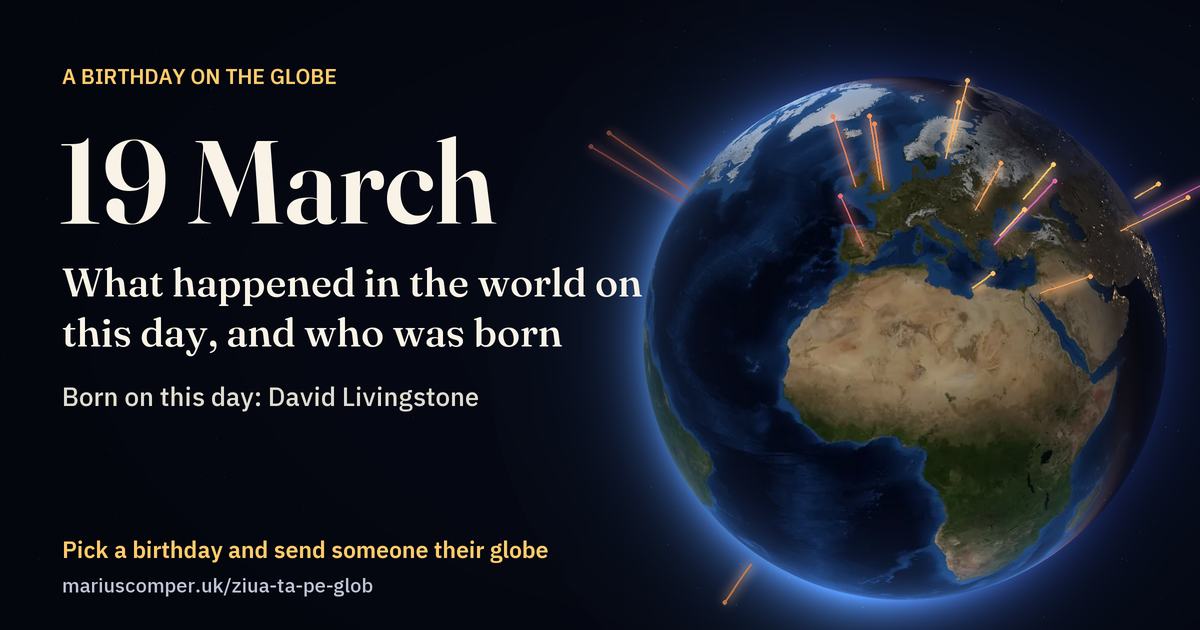
For 19 March, the English Wikipedia lists 50 events and 172 births. 18 of the events stand at their places as rays of light; seven more are dashed circles, where the sentence links only to a country or a sea. The taller the ray, the longer ago it happened. The people born that day come further down, as blue points.
A birthday, yours or someone else’s:
Turn it into a greetingScroll: the globe turns to each place
The day you were born, on the globe.
Three things from your day
Scroll: your day first, then 19 March through the years
The Earth on 19 March
The picture on the globe was assembled by NASA from satellite photographs taken in March 2004: the snow, the ice and the green are those of the month.
On 19 March the Sun passes straight overhead at noon along the parallel of 0.3° south. In London, the day lasts about 12 hours 5 minutes.
The line between day and night is tilted on the globe exactly as on this day of the year. On the dark side you can see the lights of towns.
Britain & Ireland · Adelphi Theatre
1944
The secular oratorio A Child of Our Time by Michael Tippett premiered at the Adelphi Theatre in London.
On the map: Adelphi Theatre.
Europe · Târgu Mureș
1990
The ethnic clashes of Târgu Mureș begin four days after the anniversary of the Revolutions of 1848 in the Austrian Empire.
On the map: Târgu Mureș.
Also on the day’s list of Wikipedia in Romanian.
North America · United States Congress
1918
The US Congress establishes time zones and approves daylight saving time.
On the map: United States Congress.
19 March
Born on 19 March#
The English Wikipedia lists 172 births for this day. The blue points are the birthplaces of 59 of these people: those written about in the most Wikipedia editions, where Wikidata gives a place of birth.
Born on 19 March
1813
David Livingstone, Scottish missionary and explorer (died 1873)
Place of birth: Blantyre.
Born on 19 March
1900
Frédéric Joliot-Curie, French physicist and academic, Nobel Prize laureate (died 1958)
Place of birth: 16th arrondissement of Paris.
Born on 19 March
1943
Mario J. Molina, Mexican chemist and academic, Nobel Prize laureate (died 2020)
Place of birth: Mexico City.
Born on 19 March
1976
Alessandro Nesta, Italian footballer and manager
Place of birth: Rome.
Born on 19 March
1534
José de Anchieta, Spanish missionary and saint (died 1597)
Place of birth: San Cristóbal de La Laguna.
Born in Britain and Ireland
1883
Norman Haworth, English chemist and academic, Nobel Prize laureate (died 1950)
Place of birth: Chorley.
Born in Britain and Ireland
1721
Tobias Smollett, Scottish-Italian poet and author (died 1771) (baptised on this day)
Place of birth: Dalquhurn House.
Born in Britain and Ireland
1981
Steve Cummings, English cyclist
Place of birth: Clatterbridge.
19 March
Number one in the charts that week
At the cinema
An animal recorded that day
The record can be seen in GBIF, which brings together wildlife records from around the world.
All your birthdays
The weather that day
Data: Met Office Hadley Centre (HadCET); NOAA (GHCN-Daily, Mauna Loa).
Above the Earth
Sources: Jonathan McDowell, GCAT (launches); GFZ Potsdam (Kp index). Days are counted in Universal Time.
Football that day
International matches played that day:
Source: the “International football results” dataset kept by Mart Jürisoo (CC0).
Also that day
The earthquake’s page at the USGS
Source: the USGS catalogue. The day is counted in Universal Time (UTC).
In those days
Make a link for someone
Type the name, pick the day and the year of birth. The link opens straight on their day, with their name in the greeting.
The link carries the name, date and place typed here; anyone who gets it can see them.
Put another birthday beside it
Your mother’s, your child’s, a friend’s: the two days appear side by side.
Below: 19 March through the years.
The whole globe of the day
Drag the globe to turn it. Touch a ray or a point to read what happened there.
Everything Wikipedia lists for 19 March
The list is the English Wikipedia’s, in its own wording, as it stood in October 2026. 25 events have no place on the map: the sentence links to no place with coordinates, only to places too wide to mark, or to several countries.
- 1205
Latin forces under Henry of Flanders defeat a Nicaean army under Constantine Laskaris in the Battle of Adramyttion.
Asia · Battle of AdramyttionWikipedia: Battle of Adramyttion - 1227
Election of Ugolino di Conti as Pope Gregory IX following the death of Pope Honorius III.
no place on the mapWikipedia: Pope Gregory IX - 1277
The Byzantine–Venetian treaty of 1277 is concluded, stipulating a two-year truce and renewing Venetian commercial privileges in the Byzantine Empire.
Asia · Byzantine EmpireWikipedia: Byzantine–Venetian treaty of 1277 - 1279
A Mongol victory at the Battle of Yamen ends the Song dynasty in China.
Asia · Battle of YamenWikipedia: Battle of Yamen - 1284
The Statute of Rhuddlan incorporates the Principality of Wales into England.
Britain & Ireland · Principality of WalesWikipedia: Statute of Rhuddlan - 1452
Frederick III of Habsburg is the last Holy Roman Emperor crowned by medieval tradition in Rome by Pope Nicholas V.
no place on the mapWikipedia: Frederick III, Holy Roman Emperor - 1563
The Edict of Amboise is signed, ending the first phase of the French Wars of Religion and granting certain freedoms to the Huguenots.
no place on the mapWikipedia: Edict of Amboise - 1649
The House of Commons of England passes an act abolishing the House of Lords, declaring it "useless and dangerous to the people of England".
no place on the mapWikipedia: House of Commons of England - 1687
Explorer Robert Cavelier de La Salle, searching for the mouth of the Mississippi River, is murdered by his own men.
no place on the mapWikipedia: René-Robert Cavelier, Sieur de La Salle - 1808
Charles IV, king of Spain, abdicates after riots and a popular revolt at the winter palace Aranjuez. His son, Ferdinand VII, takes the throne.
Europe · Tumult of AranjuezWikipedia: Tumult of Aranjuez - 1812
The Cortes of Cádiz promulgates the Spanish Constitution of 1812.
no place on the mapWikipedia: Cortes of Cádiz - 1824
American explorer Benjamin Morrell departs Antarctica after a voyage later plagued by claims of fraud.
Oceans · AntarcticaWikipedia: Benjamin Morrell - 1831
First documented bank heist in U.S. history, when burglars steal $245,000 (1831 values) from the City Bank (now Citibank) on Wall Street. Most of the money was recovered.
no place on the mapWikipedia: 1831 City Bank of New York theft - 1865
American Civil War: The Battle of Bentonville begins. By the end of the battle two days later, Confederate forces had retreated from Four Oaks, North Carolina.
North America · Battle of BentonvilleWikipedia: American Civil War - 1885
Louis Riel declares a provisional government in Saskatchewan, beginning the North-West Rebellion.
North America · SaskatchewanWikipedia: North-West Rebellion - 1911
Established by Clara Zetkin, Käte Duncker, and others, International Women's Day was first observed.
no place on the mapWikipedia: Clara Zetkin - 1918
The US Congress establishes time zones and approves daylight saving time.
North America · United States CongressWikipedia: United States Congress - 1920
The United States Senate rejects the Treaty of Versailles for the second time (the first time was on November 19, 1919).
no place on the mapWikipedia: Treaty of Versailles - 1921
Irish War of Independence: One of the biggest engagements of the war takes place at Crossbarry, County Cork. About 100 Irish Republican Army (IRA) volunteers escape an attempt by over 1,300 British forces to encircle them.
Britain & Ireland · CorkWikipedia: Crossbarry ambush - 1928
The highly influential American radio comedy show Amos 'n' Andy made its debut.
no place on the mapWikipedia: Radio comedy - 1932
The Sydney Harbour Bridge is opened.
no place on the mapWikipedia: Sydney Harbour Bridge - 1943
Frank Nitti, the Chicago Outfit Boss after Al Capone, commits suicide at the Chicago Central Railyard.
no place on the mapWikipedia: Frank Nitti - 1944
The secular oratorio A Child of Our Time by Michael Tippett premiered at the Adelphi Theatre in London.
Britain & Ireland · Adelphi TheatreWikipedia: Oratorio - 1944
World War II: The German army occupies Hungary.
Europe · HungaryWikipedia: German invasion of Hungary - 1945
World War II: Adolf Hitler issues his "Nero Decree" ordering all industries, military installations, shops, transportation facilities, and communications facilities in Germany to be destroyed.
Europe · Nazi GermanyWikipedia: Adolf Hitler - 1945
World War II: Off the coast of Japan, a dive bomber hits the aircraft carrier USS Franklin, killing 724 of her crew. Badly damaged, the ship is able to return to the US under her own power.
no place on the mapWikipedia: Dive bomber - 1946
French Guiana, Guadeloupe, Martinique, and Réunion become overseas départements of France.
no place on the mapWikipedia: French Guiana - 1958
The Monarch Underwear Company fire leaves 24 dead and 15 injured.
no place on the mapWikipedia: Monarch Underwear Company fire - 1962
Influential American musician Bob Dylan released his eponymous debut album, mainly comprising traditional folk, blues and gospel songs.
no place on the mapWikipedia: Bob Dylan - 1962
The Algerian War of Independence ends.
no place on the mapWikipedia: Algerian War - 1964
Over 500,000 Brazilians attend the March of the Family with God for Liberty, in protest against the government of João Goulart and against communism.
no place on the mapWikipedia: March of the Family with God for Liberty - 1965
The wreck of the SS Georgiana, valued at over $50,000,000 and said to have been the most powerful Confederate cruiser, is discovered by teenage diver and pioneer underwater archaeologist E. Lee Spence, exactly 102 years after its destruction.
no place on the mapWikipedia: SS Georgiana - 1969
The 385-metre-tall (1,263 ft) TV-mast at Emley Moor transmitting station, United Kingdom, collapses due to ice build-up.
Britain & Ireland · Emley Moor transmitting stationWikipedia: Emley Moor transmitting station - 1979
The United States House of Representatives begins broadcasting its day-to-day business via the cable television network C-SPAN.
no place on the mapWikipedia: United States House of Representatives - 1982
Falklands War: Argentinian forces land on South Georgia Island, precipitating war with the United Kingdom.
Latin America · Falklands WarWikipedia: Falklands War - 1987
American televangelist Jim Bakker resigned as the host of The PTL Club in the midst of a sex scandal.
no place on the mapWikipedia: Televangelism - 1989
The Egyptian flag is raised at Taba, marking the end of Israeli occupation since the Six Days War in 1967 and the Egypt–Israel peace treaty in 1979.
Africa · Taba, EgyptWikipedia: Egypt–Israel peace treaty - 1990
The ethnic clashes of Târgu Mureș begin four days after the anniversary of the Revolutions of 1848 in the Austrian Empire.
Europe · Târgu MureșWikipedia: Ethnic clashes of Târgu Mureș - 1998
An Ariana Afghan Airlines Boeing 727 crashes on approach to Kabul International Airport, killing all 45 on board.
Asia · 1998 Ariana Afghan Airlines Boeing 727 crashWikipedia: 1998 Ariana Afghan Airlines Boeing 727 crash - 2003
United States President George W. Bush addresses the nation, announcing the invasion of Iraq.
no place on the mapWikipedia: 2003 invasion of Iraq - 2004
Catalina affair: A Swedish DC-3 shot down by a Soviet MiG-15 in 1952 over the Baltic Sea is finally recovered after years of work.
Europe · Catalina affairWikipedia: Catalina affair - 2004
March 19 Shooting Incident: The Republic of China (Taiwan) president Chen Shui-bian is shot just before the country's presidential election on March 20.
Asia · March 19 shooting incidentWikipedia: March 19 shooting incident - 2004
The Konginkangas bus disaster kills 23 and injures 14 people in Äänekoski, Finland.
Europe · Konginkangas bus disasterWikipedia: Konginkangas bus disaster - 2008
GRB 080319B: A cosmic burst that is the farthest object visible to the naked eye is briefly observed.
no place on the mapWikipedia: GRB 080319B - 2011
Libyan Civil War: After the failure of Muammar Gaddafi's forces to take Benghazi, the French Air Force launches Opération Harmattan, beginning foreign military intervention in Libya.
Africa · Second Battle of BenghaziWikipedia: 2011 military intervention in Libya - 2013
A series of bombings and shootings kills at least 98 people and injures 240 others across Iraq.
Asia · IraqWikipedia: 19 March 2013 Iraq attacks - 2016
An explosion occurs in Taksim Square in Istanbul, Turkey, killing five people and injuring 36.
Asia · March 2016 Istanbul bombingWikipedia: March 2016 Istanbul bombing - 2016
Flydubai Flight 981 crashes while attempting to land at Rostov-on-Don international airport, killing all 62 on board.
Europe · Flydubai Flight 981Wikipedia: Flydubai Flight 981 - 2019
The first President of Kazakhstan, Nursultan Nazarbayev, resigns from office after nearly three decades, leaving Senate Chairman Kassym-Jomart Tokayev as the acting President and successor.
no place on the mapWikipedia: President of Kazakhstan - 2023
The Swiss Government brokers a deal for UBS to buy out rival Credit Suisse in an attempt to calm the 2023 banking crisis.
no place on the mapWikipedia: Acquisition of Credit Suisse by UBS
Who was born on 19 March
In order of how many Wikipedia editions have an article about each. The first 60 of 172 are shown.
- 1813
David Livingstone, Scottish missionary and explorer (died 1873)
BlantyreWikipedia: David Livingstone - 1906
Adolf Eichmann, German SS officer, one of the main organizers of the Holocaust (died 1962)
SolingenWikipedia: Adolf Eichmann - 1943
Mario Monti, Italian economist and politician, Prime Minister of Italy
VareseWikipedia: Mario Monti - 1905
Albert Speer, German architect and politician, convicted Nuremberg war criminal (died 1981)
MannheimWikipedia: Albert Speer - 1900
Frédéric Joliot-Curie, French physicist and academic, Nobel Prize laureate (died 1958)
16th arrondissement of ParisWikipedia: Frédéric Joliot-Curie - 1821
Richard Francis Burton, English soldier, geographer, and diplomat (died 1890)
- 1943
Mario J. Molina, Mexican chemist and academic, Nobel Prize laureate (died 2020)
Mexico CityWikipedia: Mario Molina - 1976
Alessandro Nesta, Italian footballer and manager
- 1534
José de Anchieta, Spanish missionary and saint (died 1597)
San Cristóbal de La LagunaWikipedia: Joseph of Anchieta - 1604
John IV of Portugal (died 1656)
Ducal Palace of Vila ViçosaWikipedia: John IV of Portugal - 1981
Kolo Touré, Ivorian footballer
BouakéWikipedia: Kolo Touré - 1993
Hakim Ziyech, Moroccan footballer
DrontenWikipedia: Hakim Ziyech - 1883
Norman Haworth, English chemist and academic, Nobel Prize laureate (died 1950)
ChorleyWikipedia: Norman Haworth - 1922
Hiroo Onoda, Japanese lieutenant (died 2014)
KainanWikipedia: Hiroo Onoda - 1956
Yegor Gaidar, Russian economist and politician, First Deputy Prime Minister of Russia (died 2009)
MoscowWikipedia: Yegor Gaidar - 1937
Egon Krenz, German politician, briefly leader of East Germany
KołobrzegWikipedia: Egon Krenz - 1995
Héctor Bellerín, Spanish footballer
BarcelonaWikipedia: Héctor Bellerín - 1928
Hans Küng, Swiss theologian and author (died 2021)
SurseeWikipedia: Hans Küng - 1206
Güyük Khan, Mongol ruler, 3rd Great Khan of the Mongol Empire (died 1248)
- 1860
William Jennings Bryan, American lawyer and politician, 41st United States Secretary of State (died 1925)
- 1888
Josef Albers, German-American painter and educator (died 1976)
BottropWikipedia: Josef Albers - 1721
Tobias Smollett, Scottish-Italian poet and author (died 1771) (baptised on this day)
Dalquhurn HouseWikipedia: Tobias Smollett - 1873
Max Reger, German pianist, composer, and conductor (died 1916)
BrandWikipedia: Max Reger - 1742
Túpac Amaru II, Peruvian rebel leader (died 1781)
- 1858
Kang Youwei, Chinese scholar and politician (died 1927)
Nanhai DistrictWikipedia: Kang Youwei - 1991
Aleksandr Kokorin, Russian footballer
ValuykiWikipedia: Aleksandr Kokorin - 1844
Minna Canth, Finnish journalist, playwright, and activist (died 1897)
TampereWikipedia: Minna Canth - 1848
Wyatt Earp, American police officer (died 1929)
MonmouthWikipedia: Wyatt Earp - 1891
Earl Warren, American lieutenant, jurist, and politician, 14th Chief Justice of the United States (died 1974)
Los AngelesWikipedia: Earl Warren - 1928
Patrick McGoohan, Irish-American actor, director, producer, and screenwriter (died 2009)
AstoriaWikipedia: Patrick McGoohan - 1979
Hedo Türkoğlu, Turkish basketball player
BayrampaşaWikipedia: Hedo Türkoğlu - 1849
Alfred von Tirpitz, German admiral and politician (died 1930)
Kostrzyn nad OdrąWikipedia: Alfred von Tirpitz - 1987
Miloš Teodosić, Serbian basketball player
ValjevoWikipedia: Miloš Teodosić - 1944
Sirhan Sirhan, Palestinian-Jordanian assassin of Robert F. Kennedy
JerusalemWikipedia: Sirhan Sirhan - 1979
Ivan Ljubičić, Croatian tennis player
Banja LukaWikipedia: Ivan Ljubičić - 1875
Zhang Zuolin, Chinese warlord (died 1928)
HaichengWikipedia: Zhang Zuolin - 1982
Brad Jones, Australian footballer
ArmadaleWikipedia: Brad Jones - 1601
Alonso Cano, Spanish painter, sculptor, and architect (died 1667)
GranadaWikipedia: Alonso Cano - 1987
AJ Lee, American wrestler and author
Union CityWikipedia: AJ Lee - 1542
Jan Zamoyski, Polish nobleman (died 1605)
SkokówkaWikipedia: Jan Zamoyski - 1931
Emma Andijewska, Ukrainian poet, writer and painter
DonetskWikipedia: Emma Andijewska - 1964
Yoko Kanno, Japanese pianist and composer
SendaiWikipedia: Yoko Kanno - 1976
Derek Chauvin, American criminal and former police officer
OakdaleWikipedia: Derek Chauvin - 1883
Joseph Stilwell, American general (died 1946)
PalatkaWikipedia: Joseph Stilwell - 1888
Léon Scieur, Belgian cyclist (died 1969)
FlorennesWikipedia: Léon Scieur - 1925
Brent Scowcroft, American general and diplomat, 9th United States National Security Advisor (died 2020)
- 1944
Said Musa, Belizean lawyer and politician, 5th Prime Minister of Belize
San IgnacioWikipedia: Said Musa - 1488
Johannes Magnus, Swedish archbishop and theologian (died 1544)
Linköping Cathedral CongregationWikipedia: Johannes Magnus - 1809
Fredrik Pacius, German composer and conductor (died 1891)
HamburgWikipedia: Fredrik Pacius - 1949
Blase J. Cupich, American theologian and cardinal
- 1998
Sakura Miyawaki, Japanese singer
KagoshimaWikipedia: Sakura Miyawaki - 1966
Olaf Marschall, German footballer and manager
- 1979
Christos Patsatzoglou, Greek footballer
- 1915
Patricia Morison, American actress and singer (died 2018)
New York CityWikipedia: Patricia Morison - 1981
Steve Cummings, English cyclist
ClatterbridgeWikipedia: Steve Cummings - 1661
Francesco Gasparini, Italian composer and educator (died 1727)
CamaioreWikipedia: Francesco Gasparini - 1684
Jean Astruc, French physician and scholar (died 1766)
- 1434
Ashikaga Yoshikatsu, Japanese shōgun (died 1443)
- 1739
Charles-François Lebrun, duc de Plaisance, French lawyer and politician (died 1824)
Saint-Sauveur-LendelinWikipedia: Charles-François Lebrun - 1916
Irving Wallace, American journalist, author, and screenwriter (died 1990)
ChicagoWikipedia: Irving Wallace
What is celebrated on 19 March
- Christian Observances: Alkmund of Derby
- Christian Observances: Blessed Andrea Gallerani
- Christian Observances: Blessed Marcel Callo
- Christian Observances: Blessed Sibyllina Biscossi
- Christian Observances: March 19 (Eastern Orthodox liturgics)
- Christian Observances: Earliest day on which Maundy Thursday can fall, while April 22 is the latest; celebrated on Thursday before Easter (Christianity)
- Minna Canth's Birthday and the Day of Equality (Finland)
- Kashubian Unity Day (Poland)
A greeting link for someone
Type a name and, if you like, the year of birth. The link opens with a greeting, and beside each event it says how old the person turned that day, or how many years before their birth it happened.
The name and the year go only into the link you send.
All 366 days
How the globe is made
Where the events come from
Each edition of this page uses the day’s list from Wikipedia in its own language: Romanian, English, Spanish, Chinese. The lists are written by volunteers and differ from one edition to the next; the text of each event is Wikipedia’s, with a link to the article. A row that appears twice in a list is shown once. The lists have not been checked event by event: they are Wikipedia’s, mistakes included.
For events before 1582, and for countries that moved to the Gregorian calendar later (Britain in 1752, Russia in 1918), the same day may be counted Old Style in one list and New Style in another.
The chapter “What the other Wikipedias remember” adds up to five events a day from the lists of the other three editions, only for years in which the English list has nothing on that day. They were translated for this page, passed the same filters as the tour, and are not counted among the events of the English list.
How an event gets onto the map
The place comes from Wikidata. If the sentence links to the article about the event itself (a battle, an opening, an earthquake), dated to the same year, the ray stands on its coordinates or on those of its location. Otherwise it stands on the first place the sentence links to: a town, a building, a mountain, an island. This second step can be wrong: sometimes the sentence only mentions the place. That is why the page says, under each event, which place the ray stands on.
When the sentence links to a single state or province, or to a single sea, lake or desert larger than 5,000 km², the globe shows a dashed circle, not a ray. The circle has the area Wikidata gives, with its radius kept between 1.2° and 16°, or a radius of 4.5° when Wikidata gives no area; it says only that the sentence links to that place. Organisations, ships, spacecraft, museum objects, rivers, mountain ranges, languages and continents are never used as places. When a sentence names several states and no exact place, the event stays in the list only.
What the height means
The height of a ray shows how many years have passed, on a logarithmic scale: 10 years, 100 years and 1,000 years are equal steps apart; anything older than about 2,600 years has the tallest ray. The colour runs from pale yellow for recent years to violet for antiquity.
Where the tour stops
In each region the tour stops at up to three events (five in Britain and Ireland), chosen mainly by three things: whether Wikipedia’s editors put the event in the “On this day” box of their main page (the English, Spanish and Chinese editions), how many Wikipedia editions have an article about it, and how many of the four lists include it. Events whose sentence or article is about a war, an attack, a crime or a disaster are left out of the tour; they stay in the whole list, in Wikipedia’s wording. The filter is a list of words and a list of Wikidata types, so it can miss some.
The tour of births names the people with articles in the most editions and leaves aside those whom the list or Wikidata describes as rulers, politicians, commanders, leaders of movements or criminals; they stay in the list.
The Earth and the Sun
The daytime images are NASA’s Blue Marble Next Generation mosaics, one for each month of 2004; the night side is Black Marble 2016. The tilt of the line between day and night is computed for the day; the hour is chosen so that the place being read is in daylight. The latitude where the Sun stands overhead is the average of the four years of the leap cycle; in a given year it can differ by up to 0.4°.
The day you were born
The number ones come from the weekly lists on Wikipedia: Billboard for the United States (from 1940; the Hot 100 from August 1958), the UK Singles Chart (from November 1952), Los 40 Principales for Spain (from July 1966) and, for Romania, the Romanian Top 100 and Airplay 100 (2001–2021, with missing weeks). The page shows the chart of the week in which the day of birth falls, with its date; Billboard and the UK chart are dated at the end of their week. For Romania before 2001 and for China these sources have no weekly chart.
The films are those that reached cinemas in the United States up to ten days before or three days after that day (some of them in a few cinemas at first), from the English Wikipedia’s yearly lists (from 1968), in order of how many editions have an article about them. The events “in those days” are the ones on the neighbouring days’ lists that carry the year of birth, passed through the same filter as the tour.
The day of birth, year included
The Moon, the star sign and the constellation are worked out by the page itself, for noon Universal Time on the day. The lit part of the Moon is rounded and can differ by a few per cent from that at the hour of birth. The sign follows the usual zodiac of twelve equal parts starting at the March equinox; the constellation is the one the Sun actually stood in front of, by the borders set by the International Astronomical Union, and within a day of a border the page does not name it. When the Sun changes sign while it is that day anywhere on Earth, the page gives the moment of crossing, rounded to ten minutes and accurate to within about a quarter of an hour, and the clock time in a few cities, with the time zone and summer time of that year.
The year in the Chinese calendar is the one your device’s own calendar gives for the date, checked against the Hong Kong Observatory’s tables. “All your birthdays” uses the same sources as the rest of the chapter for the same day in every year since the birth: the temperature, well-known launches that took place on that very day, matches of the teams the edition follows, snow deeper than 10 cm and strong geomagnetic storms. The three things at the top and the four on the picture are chosen in a fixed order (the song, the animal, a full Moon, a well-known launch before an ordinary earthquake); on the picture you can change them.
When the link carries a year of birth, the page adds a few things about that exact day. The weather is the Met Office’s Central England temperature record and the readings from New York’s Central Park; the “usual high” is the average of the daily highs of 1961–1990 for that date, with two days either side. The carbon dioxide figure is the monthly mean at the Mauna Loa observatory, where measurements begin in March 1958.
The earthquake is the one with the largest magnitude in the USGS catalogue for that day, counted in Universal Time. Before the 1960s the catalogue has gaps even above magnitude 5.5, so in the older years many days have no earthquake. The page gives only the magnitude and the place: the country the epicentre falls in or, when the epicentre is at sea within 300 km of a coast, the nearest country; farther out, only the ocean.
The launches are those that reached orbit or left for the Moon and the planets, from Jonathan McDowell’s GCAT catalogue. If nothing left that day, the page shows the nearest launch within three days before or after, and says how many days away it was. The geomagnetic storm appears only when the Kp index reached at least 5 in one of the day’s eight three-hour intervals.
The animal comes from GBIF: an observation made by a person (the animal seen or heard, or its tracks), dated to that exact day, with coordinates and a CC0 or CC BY licence. Only a few hundred well-known species are searched (mammals, birds, turtles, butterflies); of those noted that day, mammals and species with articles in many Wikipedia editions come first; birds noted almost every day, and species used recently, wait their turn. Observations dated 1 January are left out, because records without a day are often filed there. An observation shows that the animal was recorded there, not how many animals there were.
The matches are those between national teams. Only matches of England, Scotland, Wales, Northern Ireland, the Republic of Ireland, the United States, Canada and Australia are shown, along with those at the big final tournaments. The picture to send is drawn in the page from the day’s globe and the facts above, and stays on your device until you send it.
Sources
- Events, births and holidays: the day’s page on Wikipedia, text under CC BY-SA 4.0.
- Coordinates, places of birth and the number of editions: Wikidata (CC0).
- The Earth by day: NASA Blue Marble Next Generation. The Earth by night: NASA Black Marble 2016.
- Borders and regions: Natural Earth.
- World population and births per year: UN World Population Prospects 2024.
- Charts and films: Wikipedia’s lists for Billboard, the UK Singles Chart, Los 40 Principales, Romanian Top 100, Airplay 100 and American films by year (CC BY-SA 4.0).
- Weather: Met Office Hadley Centre, HadCET (Open Government Licence) and NOAA GHCN-Daily, New York Central Park. Carbon dioxide: NOAA Global Monitoring Laboratory, Mauna Loa.
- Earthquakes: the USGS catalogue. Launches: Jonathan McDowell, GCAT (CC BY). Kp index: GFZ Potsdam (CC BY 4.0). Matches: International football results, Mart Jürisoo (CC0).
- Animal observations: GBIF, with a link to each record; species names come from Wikidata.