A birthday on the globe
27 October on the globe: what happened in the world on this day, and who was born
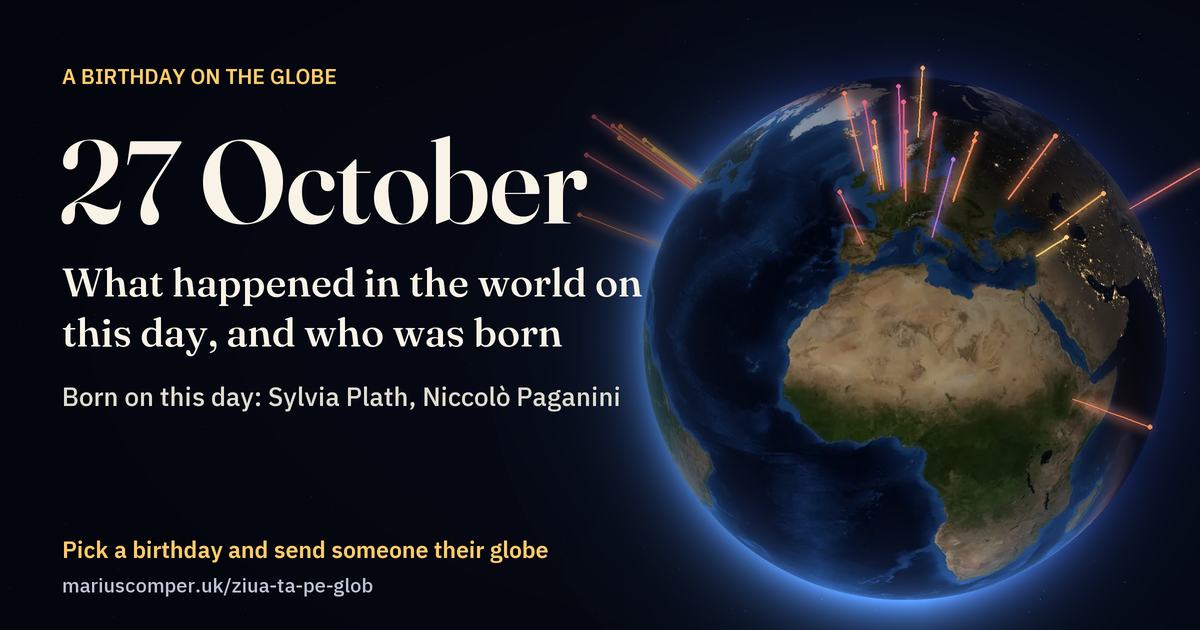
For 27 October, the English Wikipedia lists 56 events and 243 births. 27 of the events stand at their places as rays of light; five more are dashed circles, where the sentence links only to a country or a sea. The taller the ray, the longer ago it happened. The people born that day come further down, as blue points.
A birthday, yours or someone else’s:
Turn it into a greetingScroll: the globe turns to each place
The day you were born, on the globe.
Three things from your day
Scroll: your day first, then 27 October through the years
The Earth on 27 October
The picture on the globe was assembled by NASA from satellite photographs taken in October 2004: the snow, the ice and the green are those of the month.
On 27 October the Sun passes straight overhead at noon along the parallel of 12.8° south. In London, the day lasts about 10 hours.
Beyond 77° south the Sun no longer sets; beyond 77° north it no longer rises.
The line between day and night is tilted on the globe exactly as on this day of the year. On the dark side you can see the lights of towns.
Britain & Ireland · London
1930
Ratifications are exchanged in London for the first London Naval Treaty go into effect immediately, further limiting the expensive naval arms race among its five signatories.
On the map: London.
Also on the day’s list of Wikipedia in Chinese.
Europe · Amsterdam
1275
Traditional founding of the city of Amsterdam.
On the map: Amsterdam.
Also on the day’s list of Wikipedia in Spanish, Romanian and Chinese.
Europe · Madrid
1795
The United States and Spain sign the Treaty of Madrid, which establishes the boundaries between Spanish colonies and the U.S.
On the map: Madrid.
Europe · Zaporizhzhia
1919
The Fourth Regional Congress of Peasants, Workers and Insurgents is held by the Makhnovshchina at Oleksandrivsk.
On the map: Zaporizhzhia.
Wikipedia: Regional Congress of Peasants, Workers and Insurgents
North America · Philadelphia
1682
Philadelphia is founded in the Commonwealth of Pennsylvania.
On the map: Philadelphia.
Also on the day’s list of Wikipedia in Spanish and Chinese.
North America · New York City Subway
1904
The first underground segment of the New York City Subway opened, connecting New York City Hall with Harlem.
On the map: New York City Subway.
Also on the day’s list of Wikipedia in Spanish, Romanian and Chinese.
North America · Fenway Park
2004
The Boston Red Sox completed a sweep of the St. Louis Cardinals to win the 2004 World Series, breaking the so-called "Curse of the Bambino".
On the map: Fenway Park.
Also on the day’s list of Wikipedia in Chinese.
27 October
What the other Wikipedias remember#
For these years the English list has nothing on this day. The events below come from the same day’s lists on Wikipedia in Spanish and were translated for this page.
From Wikipedia in Spanish · Mexico City
1968
In the University City stadium in Mexico, the solemn closing ceremony of the XIX Olympic Games is held.
On the map: Mexico City.
Translated from the list on Wikipedia in Spanish.
The article on Wikipedia in Spanish: Juegos Olímpicos de México 1968
27 October
Born on 27 October#
The English Wikipedia lists 243 births for this day. The blue points are the birthplaces of 59 of these people: those written about in the most Wikipedia editions, where Wikidata gives a place of birth.
Born on 27 October
1932
Sylvia Plath, American poet, novelist, and short story writer (died 1963)
Place of birth: Jamaica Plain.
Born on 27 October
1782
Niccolò Paganini, Italian violinist and composer (died 1840)
Place of birth: Genoa.
Born on 27 October
1952
Roberto Benigni, Italian actor, director, and screenwriter
Place of birth: Castiglion Fiorentino.
Born on 27 October
1952
Francis Fukuyama, American political scientist, economist, and author
Place of birth: Hyde Park.
Born on 27 October
1939
John Cleese, English actor, comedian, screenwriter and producer
Place of birth: Weston-super-Mare.
Born in Britain and Ireland
1914
Dylan Thomas, Welsh poet and playwright (died 1953)
Place of birth: Swansea.
Born in Britain and Ireland
1984
Kelly Osbourne, English television personality
Place of birth: Westminster.
Born in Britain and Ireland
1957
Glenn Hoddle, English footballer and manager
Place of birth: Hayes.
27 October
Number one in the charts that week
At the cinema
An animal recorded that day
The record can be seen in GBIF, which brings together wildlife records from around the world.
All your birthdays
The weather that day
Data: Met Office Hadley Centre (HadCET); NOAA (GHCN-Daily, Mauna Loa).
Above the Earth
Sources: Jonathan McDowell, GCAT (launches); GFZ Potsdam (Kp index). Days are counted in Universal Time.
Football that day
International matches played that day:
Source: the “International football results” dataset kept by Mart Jürisoo (CC0).
Also that day
The earthquake’s page at the USGS
Source: the USGS catalogue. The day is counted in Universal Time (UTC).
In those days
Make a link for someone
Type the name, pick the day and the year of birth. The link opens straight on their day, with their name in the greeting.
The link carries the name, date and place typed here; anyone who gets it can see them.
Put another birthday beside it
Your mother’s, your child’s, a friend’s: the two days appear side by side.
Below: 27 October through the years.
The whole globe of the day
Drag the globe to turn it. Touch a ray or a point to read what happened there.
Everything Wikipedia lists for 27 October
The list is the English Wikipedia’s, in its own wording, as it stood in October 2026. 24 events have no place on the map: the sentence links to no place with coordinates, only to places too wide to mark, or to several countries.
- 312
Constantine the Great is said to have received his famous Vision of the Cross.
Europe · Battle of the Milvian BridgeWikipedia: Battle of the Milvian Bridge - 1275
Traditional founding of the city of Amsterdam.
Europe · AmsterdamWikipedia: Amsterdam - 1524
French troops lay siege to Pavia.
no place on the mapWikipedia: Italian campaign of 1524–1525 - 1553
Condemned as a heretic, Michael Servetus is burned at the stake just outside Geneva.
no place on the mapWikipedia: Michael Servetus - 1644
Second Battle of Newbury in the English Civil War.
Britain & Ireland · Second Battle of NewburyWikipedia: Second Battle of Newbury - 1674
The French garrison in Grave surrenders the town to a Dutch army after a difficult siege.
Europe · Grave, NetherlandsWikipedia: Siege of Grave - 1682
Philadelphia is founded in the Commonwealth of Pennsylvania.
North America · PhiladelphiaWikipedia: Philadelphia - 1726
J. S. Bach leads the first performance of Ich will den Kreuzstab gerne tragen, BWV 56, one of few works he called a cantata.
no place on the mapWikipedia: Johann Sebastian Bach - 1775
King George III expands on his Proclamation of Rebellion in the Thirteen Colonies in his speech from the throne at the opening of Parliament.
no place on the mapWikipedia: George III - 1795
The United States and Spain sign the Treaty of Madrid, which establishes the boundaries between Spanish colonies and the U.S.
Europe · MadridWikipedia: Pinckney's Treaty - 1806
The French Army under Napoleon enters Berlin following the Prussian defeat at the Battle of Jena–Auerstedt.
Europe · Battle of Jena–AuerstedtWikipedia: Battle of Jena–Auerstedt - 1810
United States annexes the former Spanish colony of West Florida.
North America · West FloridaWikipedia: West Florida - 1838
Missouri governor Lilburn Boggs issues the Extermination Order, which orders all Mormons to leave the state or be killed.
no place on the mapWikipedia: Lilburn Boggs - 1863
American Civil War: Union forces led by General William F. Smith defeat Confederate forces in the Battle of Brown's Ferry, opening up a supply line to the besieged city of Chattanooga, Tennessee.
Asia · Battle of Brown's FerryWikipedia: American Civil War - 1870
Franco-Prussian War: Marshal Bazaine surrenders to Prussian forces at the conclusion of the Siege of Metz along with 140,000 French soldiers.
Europe · Siege of MetzWikipedia: Siege of Metz - 1904
The first underground segment of the New York City Subway opened, connecting New York City Hall with Harlem.
North America · New York City SubwayWikipedia: New York City Hall - 1907
Fifteen people are killed in Hungary when gendarmes opened fire on a crowd gathered at a church consecration.
Europe · Černová massacreWikipedia: Černová massacre - 1913
A rail workers' strike in Chile escalates into a general strike, organized by the Regional Workers' Federation of Chile.
no place on the mapWikipedia: General strike - 1914
World War I: The new British battleship HMS Audacious is sunk by a minefield laid by the armed German merchant-cruiser Berlin.
Britain & Ireland · HMS AudaciousWikipedia: World War I - 1916
Negus Mikael, marching on the Ethiopian capital in support of his son Emperor Iyasu V, is defeated by Fitawrari Habte Giyorgis, securing the throne for Empress Zewditu I.
Africa · Addis AbabaWikipedia: Battle of Segale - 1919
The Fourth Regional Congress of Peasants, Workers and Insurgents is held by the Makhnovshchina at Oleksandrivsk.
Europe · ZaporizhzhiaWikipedia: Regional Congress of Peasants, Workers and Insurgents - 1922
A referendum in Rhodesia rejects the country's annexation to the South African Union.
Africa · Union of South AfricaWikipedia: 1922 Southern Rhodesian government referendum - 1924
The Uzbek SSR is founded in the Soviet Union.
no place on the mapWikipedia: Uzbek Soviet Socialist Republic - 1930
Ratifications are exchanged in London for the first London Naval Treaty go into effect immediately, further limiting the expensive naval arms race among its five signatories.
Britain & Ireland · LondonWikipedia: London Naval Treaty - 1936
Abdication Crisis: Mrs. Wallis Simpson obtains her divorce, which would eventually allow her to marry King Edward VIII of the United Kingdom, thus forcing his abdication from the throne.
no place on the mapWikipedia: Abdication of Edward VIII - 1942
The Empire of Japan achieved a pyrrhic victory against the United States at the Battle of the Santa Cruz Islands.
Oceans · Battle of the Santa Cruz IslandsWikipedia: Battle of the Santa Cruz Islands - 1944
World War II: German forces capture Banská Bystrica during Slovak National Uprising thus bringing it to an end.
Europe · Banská BystricaWikipedia: Slovak National Uprising - 1946
Inter-religious riots in which Hindu mobs targeted Muslim families began in the Indian state of Bihar, resulting in 2,000 to 30,000 deaths.
Asia · BiharWikipedia: 1946 Bihar riots - 1948
A deadly smog event begins in Donora, Pennsylvania, eventually killing 20 and sickening thousands.
North America · 1948 Donora smogWikipedia: 1948 Donora smog - 1954
Benjamin O. Davis, Jr. becomes the first African-American general in the United States Air Force.
no place on the mapWikipedia: Benjamin O. Davis Jr. - 1958
Iskander Mirza, the first President of Pakistan, is deposed by General Ayub Khan, who had been appointed the enforcer of martial law by Mirza 20 days earlier.
no place on the mapWikipedia: 1958 Pakistani military coup - 1961
NASA tests the first Saturn I rocket in Mission Saturn-Apollo 1.
no place on the mapWikipedia: Saturn I SA-1 - 1962
By refusing to agree to the firing of a nuclear torpedo at a US warship, Vasily Arkhipov averts nuclear war.
no place on the mapWikipedia: Vasily Arkhipov - 1962
Major Rudolf Anderson of the United States Air Force becomes the only direct human casualty of the Cuban Missile Crisis when his U-2 reconnaissance airplane is shot down over Cuba by a Soviet-supplied surface-to-air missile.
Latin America · Cuban Missile CrisisWikipedia: Cuban Missile Crisis - 1964
Ronald Reagan delivers a speech on behalf of the Republican candidate for president, Barry Goldwater. The speech launches his political career and comes to be known as "A Time for Choosing".
no place on the mapWikipedia: A Time for Choosing - 1967
American Catholic priest Philip Berrigan led a protest against the Vietnam War by pouring blood over Selective Service records in Baltimore, Maryland.
North America · BaltimoreWikipedia: Vietnam War - 1971
The Democratic Republic of the Congo is renamed Zaire.
no place on the mapWikipedia: First Congolese Republic - 1979
Saint Vincent and the Grenadines gains its independence from the United Kingdom.
Latin America · Saint Vincent and the GrenadinesWikipedia: Saint Vincent and the Grenadines - 1980
The Chun Doo-hwan government forcibly arrests and investigates monks and personnel of the Jogye Order.
Asia · South KoreaWikipedia: October 27th Buddhist Persecution - 1981
Cold War: The Soviet submarine S-363 runs aground on the east coast of Sweden.
no place on the mapWikipedia: Cold War - 1986
The British government suddenly deregulates financial markets, leading to a total restructuring of the way in which they operate in the country, in an event now referred to as the Big Bang.
no place on the mapWikipedia: Big Bang - 1988
Cold War: Ronald Reagan suspends construction of the new U.S. Embassy in Moscow due to Soviet listening devices in the building structure.
no place on the mapWikipedia: Embassy of the United States, Moscow - 1991
Turkmenistan achieves independence from the Soviet Union.
Asia · TurkmenistanWikipedia: Turkmenistan - 1992
United States Navy radioman Allen R. Schindler, Jr. is murdered by shipmate Terry M. Helvey for being gay, precipitating debate about gays in the military that results in the United States' "Don't ask, don't tell" military policy.
no place on the mapWikipedia: Murder of Allen R. Schindler Jr. - 1993
Widerøe Flight 744 crashes in Overhalla Municipality, Norway, killing six people.
Europe · Widerøe Flight 744Wikipedia: Widerøe Flight 744 - 1994
Gliese 229B is the first Substellar Mass Object to be unquestionably identified.
no place on the mapWikipedia: Gliese 229 - 1997
The 1997 Asian financial crisis causes a crash in the Dow Jones Industrial Average.
no place on the mapWikipedia: 1997 Asian financial crisis - 1999
Gunmen open fire in the Armenian Parliament, killing the Prime Minister and seven others.
Asia · Armenian parliament shootingWikipedia: Armenian parliament shooting - 2004
The Boston Red Sox completed a sweep of the St. Louis Cardinals to win the 2004 World Series, breaking the so-called "Curse of the Bambino".
North America · Fenway ParkWikipedia: 2004 World Series - 2011
Michael D. Higgins was elected President of Ireland with far more votes than any politician in the country's history.
no place on the mapWikipedia: 2011 Irish presidential election - 2014
Britain withdraws from Afghanistan at the end of Operation Herrick, after 12 years four months and seven days.
no place on the mapWikipedia: Operation Herrick - 2017
Catalonia declares independence from Spain.
no place on the mapWikipedia: Catalan declaration of independence - 2018
A gunman opens fire on a Pittsburgh synagogue killing eleven and injuring six, including four police officers.
North America · Pittsburgh synagogue shootingWikipedia: Pittsburgh synagogue shooting - 2018
Leicester City F.C. owner Vichai Srivaddhanaprabha dies in a helicopter crash along with four others after a Premier League match against West Ham United at the King Power Stadium in Leicester, England.
Britain & Ireland · 2018 Leicester helicopter crashWikipedia: 2018 Leicester helicopter crash - 2019
Islamic State of Iraq and the Levant founder and leader Abu Bakr al-Baghdadi kills himself and three children by detonating a suicide vest during the U.S. military Barisha raid in northwestern Syria.
Asia · Death of Abu Bakr al-BaghdadiWikipedia: Death of Abu Bakr al-Baghdadi - 2019
The Mocking of Christ by Cimabue sold at auction in France for €19.5 million, a record for a pre-1500 artwork.
no place on the mapWikipedia: The Mocking of Christ
What the other Wikipedias remember
For these years the English list has nothing on this day. The events below come from the same day’s lists on Wikipedia in Spanish and were translated for this page.
- 1968
In the University City stadium in Mexico, the solemn closing ceremony of the XIX Olympic Games is held.
Latin America · Mexico CityTranslated from the list on Wikipedia in SpanishWikipedia: Juegos Olímpicos de México 1968
Who was born on 27 October
In order of how many Wikipedia editions have an article about each. The first 60 of 243 are shown.
- 1858
Theodore Roosevelt, American colonel and politician, 26th President of the United States, Nobel Prize laureate (died 1919)
ManhattanWikipedia: Theodore Roosevelt - 1945
Luiz Inácio Lula da Silva, Brazilian union leader and politician, 35 and 39th President of Brazil
- 1932
Sylvia Plath, American poet, novelist, and short story writer (died 1963)
Jamaica PlainWikipedia: Sylvia Plath - 1782
Niccolò Paganini, Italian violinist and composer (died 1840)
- 1952
Roberto Benigni, Italian actor, director, and screenwriter
Castiglion FiorentinoWikipedia: Roberto Benigni - 1952
Francis Fukuyama, American political scientist, economist, and author
Hyde ParkWikipedia: Francis Fukuyama - 1939
John Cleese, English actor, comedian, screenwriter and producer
Weston-super-MareWikipedia: John Cleese - 1914
Dylan Thomas, Welsh poet and playwright (died 1953)
SwanseaWikipedia: Dylan Thomas - 1931
Nawal El Saadawi, Egyptian physician, psychiatrist, and author (died 2021)
Kafr TahlaWikipedia: Nawal El Saadawi - 1844
Klas Pontus Arnoldson, Swedish journalist and politician, Nobel Prize laureate (died 1916)
Domkyrkoförsamlingen in GöteborgWikipedia: Klas Pontus Arnoldson - 1920
K. R. Narayanan, Indian lawyer and politician, 10th President of India (died 2005)
UzhavoorWikipedia: K. R. Narayanan - 1992
Stephan El Shaarawy, Italian footballer
- 1918
Teresa Wright, American actress and singer (died 2005)
- 1923
Roy Lichtenstein, American painter and sculptor (died 1997)
ManhattanWikipedia: Roy Lichtenstein - 1978
Vanessa-Mae, Singaporean-English violinist and skier
SingaporeWikipedia: Vanessa-Mae - 1811
Isaac Singer, American actor and businessman, founded the Singer Corporation (died 1875)
PittstownWikipedia: Isaac Singer - 1894
Fritz Sauckel, German sailor and politician, convicted Nuremberg war criminal (died 1946)
HaßfurtWikipedia: Fritz Sauckel - 1963
Marla Maples, American model and actress
CohuttaWikipedia: Marla Maples - 1842
Giovanni Giolitti, Italian politician, 13th Prime Minister of Italy (died 1928)
MondovìWikipedia: Giovanni Giolitti - 1981
Volkan Demirel, Turkish footballer
IstanbulWikipedia: Volkan Demirel - 1946
Ivan Reitman, Slovak-Canadian actor, director, and producer (died 2022)
KomárnoWikipedia: Ivan Reitman - 1335
Taejo of Joseon (died 1408)
HamhungWikipedia: Taejo of Joseon - 1925
Warren Christopher, American soldier, lawyer, and politician, 63rd United States Secretary of State (died 2011)
ScrantonWikipedia: Warren Christopher - 1952
Atsuyoshi Furuta, Japanese footballer
HiroshimaWikipedia: Atsuyoshi Furuta - 1401
Catherine of Valois, Queen consort of England (died 1437)
Hôtel Saint-PolWikipedia: Catherine of Valois - 1917
Oliver Tambo, South African lawyer and politician (died 1993)
NkantoloWikipedia: Oliver Tambo - 1940
John Gotti, American mob boss (died 2002)
The BronxWikipedia: John Gotti - 1972
Maria Mutola, Mozambican runner and coach
MaputoWikipedia: Maria Mutola - 1971
Theodoros Zagorakis, Greek footballer and politician
- 1975
Aron Ralston, American mountaineer and engineer
MarionsWikipedia: Aron Ralston - 1984
Kelly Osbourne, English television personality
WestminsterWikipedia: Kelly Osbourne - 1922
Michel Galabru, French actor and playwright (died 2016)
- 1957
Glenn Hoddle, English footballer and manager
- 1980
Tanel Padar, Estonian singer-songwriter and guitarist
HaljalaWikipedia: Tanel Padar - 1858
Saitō Makoto, Japanese admiral and politician, 30th Prime Minister of Japan (died 1936)
MizusawaWikipedia: Saitō Makoto - 1945
Carrie Snodgress, American actress (died 2004)
Park RidgeWikipedia: Carrie Snodgress - 1953
Robert Picardo, American actor, director, and screenwriter
PhiladelphiaWikipedia: Robert Picardo - 1972
Elissa, Lebanese singer
Deir Al-AhmarWikipedia: Elissa - 1908
Lee Krasner, American painter (died 1984)
BrooklynWikipedia: Lee Krasner - 1922
Ruby Dee, American actress and poet (died 2014)
ClevelandWikipedia: Ruby Dee - 1932
Harry Gregg, Northern Irish footballer and manager (died 2020)
MagherafeltWikipedia: Harry Gregg - 1997
Lonzo Ball, American basketball player
AnaheimWikipedia: Lonzo Ball - 1958
Simon Le Bon, English singer-songwriter
BusheyWikipedia: Simon Le Bon - 1156
Raymond VI, Count of Toulouse (died 1222)
Saint-GillesWikipedia: Raymond VI of Toulouse - 1932
Jean-Pierre Cassel, French actor (died 2007)
13th arrondissement of ParisWikipedia: Jean-Pierre Cassel - 1951
K. K. Downing, English guitarist and songwriter
West BromwichWikipedia: K. K. Downing - 1970
Jonathan Stroud, English author
BedfordWikipedia: Jonathan Stroud - 1988
Brady Ellison, American archer
GlendaleWikipedia: Brady Ellison - 1973
Semmy Schilt, Dutch kick-boxer and mixed martial artist
RotterdamWikipedia: Semmy Schilt - 1760
August Neidhardt von Gneisenau, Prussian field marshal (died 1831)
Gneisenaustraße 2 SchildauWikipedia: August Neidhardt von Gneisenau - 1943
Carmen Argenziano, American actor and producer (died 2019)
- 1977
Kumar Sangakkara, Sri Lankan cricketer
- 1982
Patrick Fugit, American actor and producer
Salt Lake CityWikipedia: Patrick Fugit - 1987
Andrew Bynum, American basketball player
PlainsboroWikipedia: Andrew Bynum - 1950
Fran Lebowitz, American author
MorristownWikipedia: Fran Lebowitz - 1967
Scott Weiland, American singer-songwriter (died 2015)
San JoseWikipedia: Scott Weiland - 1980
Henriett Seth F., Hungarian autistic savant artist and author
- 1661
Fyodor Apraksin, Russian admiral (died 1728)
- 1942
Janusz Korwin-Mikke, Polish journalist and politician
- 1984
Yi Jianlian, Chinese basketball player
HeshanWikipedia: Yi Jianlian
What is celebrated on 27 October
- Christian feast day: Abbán
- Christian feast day: Abraham the Poor
- Christian feast day: Frumentius (Roman Catholic Church)
- Christian feast day: Gaudiosus of Naples
- Christian feast day: Kaleb of Axum
- Christian feast day: Namatius (Namace)
- Christian feast day: Oran of Iona
- Christian feast day: October 27 (Eastern Orthodox liturgics)
- Černová Tragedy Day (Slovakia)
- Flag Day (Greece)
- Independence Day (Saint Vincent and the Grenadines), celebrates the independence of Saint Vincent and the Grenadines from United Kingdom in 1979.
- International Religious Freedom Day (United States)
- National Black Cat Day (United Kingdom)
- Navy Day (United States) (unofficial, official date is October 13)
A greeting link for someone
Type a name and, if you like, the year of birth. The link opens with a greeting, and beside each event it says how old the person turned that day, or how many years before their birth it happened.
The name and the year go only into the link you send.
All 366 days
How the globe is made
Where the events come from
Each edition of this page uses the day’s list from Wikipedia in its own language: Romanian, English, Spanish, Chinese. The lists are written by volunteers and differ from one edition to the next; the text of each event is Wikipedia’s, with a link to the article. A row that appears twice in a list is shown once. The lists have not been checked event by event: they are Wikipedia’s, mistakes included.
For events before 1582, and for countries that moved to the Gregorian calendar later (Britain in 1752, Russia in 1918), the same day may be counted Old Style in one list and New Style in another.
The chapter “What the other Wikipedias remember” adds up to five events a day from the lists of the other three editions, only for years in which the English list has nothing on that day. They were translated for this page, passed the same filters as the tour, and are not counted among the events of the English list.
How an event gets onto the map
The place comes from Wikidata. If the sentence links to the article about the event itself (a battle, an opening, an earthquake), dated to the same year, the ray stands on its coordinates or on those of its location. Otherwise it stands on the first place the sentence links to: a town, a building, a mountain, an island. This second step can be wrong: sometimes the sentence only mentions the place. That is why the page says, under each event, which place the ray stands on.
When the sentence links to a single state or province, or to a single sea, lake or desert larger than 5,000 km², the globe shows a dashed circle, not a ray. The circle has the area Wikidata gives, with its radius kept between 1.2° and 16°, or a radius of 4.5° when Wikidata gives no area; it says only that the sentence links to that place. Organisations, ships, spacecraft, museum objects, rivers, mountain ranges, languages and continents are never used as places. When a sentence names several states and no exact place, the event stays in the list only.
What the height means
The height of a ray shows how many years have passed, on a logarithmic scale: 10 years, 100 years and 1,000 years are equal steps apart; anything older than about 2,600 years has the tallest ray. The colour runs from pale yellow for recent years to violet for antiquity.
Where the tour stops
In each region the tour stops at up to three events (five in Britain and Ireland), chosen mainly by three things: whether Wikipedia’s editors put the event in the “On this day” box of their main page (the English, Spanish and Chinese editions), how many Wikipedia editions have an article about it, and how many of the four lists include it. Events whose sentence or article is about a war, an attack, a crime or a disaster are left out of the tour; they stay in the whole list, in Wikipedia’s wording. The filter is a list of words and a list of Wikidata types, so it can miss some.
The tour of births names the people with articles in the most editions and leaves aside those whom the list or Wikidata describes as rulers, politicians, commanders, leaders of movements or criminals; they stay in the list.
The Earth and the Sun
The daytime images are NASA’s Blue Marble Next Generation mosaics, one for each month of 2004; the night side is Black Marble 2016. The tilt of the line between day and night is computed for the day; the hour is chosen so that the place being read is in daylight. The latitude where the Sun stands overhead is the average of the four years of the leap cycle; in a given year it can differ by up to 0.4°.
The day you were born
The number ones come from the weekly lists on Wikipedia: Billboard for the United States (from 1940; the Hot 100 from August 1958), the UK Singles Chart (from November 1952), Los 40 Principales for Spain (from July 1966) and, for Romania, the Romanian Top 100 and Airplay 100 (2001–2021, with missing weeks). The page shows the chart of the week in which the day of birth falls, with its date; Billboard and the UK chart are dated at the end of their week. For Romania before 2001 and for China these sources have no weekly chart.
The films are those that reached cinemas in the United States up to ten days before or three days after that day (some of them in a few cinemas at first), from the English Wikipedia’s yearly lists (from 1968), in order of how many editions have an article about them. The events “in those days” are the ones on the neighbouring days’ lists that carry the year of birth, passed through the same filter as the tour.
The day of birth, year included
The Moon, the star sign and the constellation are worked out by the page itself, for noon Universal Time on the day. The lit part of the Moon is rounded and can differ by a few per cent from that at the hour of birth. The sign follows the usual zodiac of twelve equal parts starting at the March equinox; the constellation is the one the Sun actually stood in front of, by the borders set by the International Astronomical Union, and within a day of a border the page does not name it. When the Sun changes sign while it is that day anywhere on Earth, the page gives the moment of crossing, rounded to ten minutes and accurate to within about a quarter of an hour, and the clock time in a few cities, with the time zone and summer time of that year.
The year in the Chinese calendar is the one your device’s own calendar gives for the date, checked against the Hong Kong Observatory’s tables. “All your birthdays” uses the same sources as the rest of the chapter for the same day in every year since the birth: the temperature, well-known launches that took place on that very day, matches of the teams the edition follows, snow deeper than 10 cm and strong geomagnetic storms. The three things at the top and the four on the picture are chosen in a fixed order (the song, the animal, a full Moon, a well-known launch before an ordinary earthquake); on the picture you can change them.
When the link carries a year of birth, the page adds a few things about that exact day. The weather is the Met Office’s Central England temperature record and the readings from New York’s Central Park; the “usual high” is the average of the daily highs of 1961–1990 for that date, with two days either side. The carbon dioxide figure is the monthly mean at the Mauna Loa observatory, where measurements begin in March 1958.
The earthquake is the one with the largest magnitude in the USGS catalogue for that day, counted in Universal Time. Before the 1960s the catalogue has gaps even above magnitude 5.5, so in the older years many days have no earthquake. The page gives only the magnitude and the place: the country the epicentre falls in or, when the epicentre is at sea within 300 km of a coast, the nearest country; farther out, only the ocean.
The launches are those that reached orbit or left for the Moon and the planets, from Jonathan McDowell’s GCAT catalogue. If nothing left that day, the page shows the nearest launch within three days before or after, and says how many days away it was. The geomagnetic storm appears only when the Kp index reached at least 5 in one of the day’s eight three-hour intervals.
The animal comes from GBIF: an observation made by a person (the animal seen or heard, or its tracks), dated to that exact day, with coordinates and a CC0 or CC BY licence. Only a few hundred well-known species are searched (mammals, birds, turtles, butterflies); of those noted that day, mammals and species with articles in many Wikipedia editions come first; birds noted almost every day, and species used recently, wait their turn. Observations dated 1 January are left out, because records without a day are often filed there. An observation shows that the animal was recorded there, not how many animals there were.
The matches are those between national teams. Only matches of England, Scotland, Wales, Northern Ireland, the Republic of Ireland, the United States, Canada and Australia are shown, along with those at the big final tournaments. The picture to send is drawn in the page from the day’s globe and the facts above, and stays on your device until you send it.
Sources
- Events, births and holidays: the day’s page on Wikipedia, text under CC BY-SA 4.0.
- Coordinates, places of birth and the number of editions: Wikidata (CC0).
- The Earth by day: NASA Blue Marble Next Generation. The Earth by night: NASA Black Marble 2016.
- Borders and regions: Natural Earth.
- World population and births per year: UN World Population Prospects 2024.
- Charts and films: Wikipedia’s lists for Billboard, the UK Singles Chart, Los 40 Principales, Romanian Top 100, Airplay 100 and American films by year (CC BY-SA 4.0).
- Weather: Met Office Hadley Centre, HadCET (Open Government Licence) and NOAA GHCN-Daily, New York Central Park. Carbon dioxide: NOAA Global Monitoring Laboratory, Mauna Loa.
- Earthquakes: the USGS catalogue. Launches: Jonathan McDowell, GCAT (CC BY). Kp index: GFZ Potsdam (CC BY 4.0). Matches: International football results, Mart Jürisoo (CC0).
- Animal observations: GBIF, with a link to each record; species names come from Wikidata.