A birthday on the globe
17 July on the globe: what happened in the world on this day, and who was born
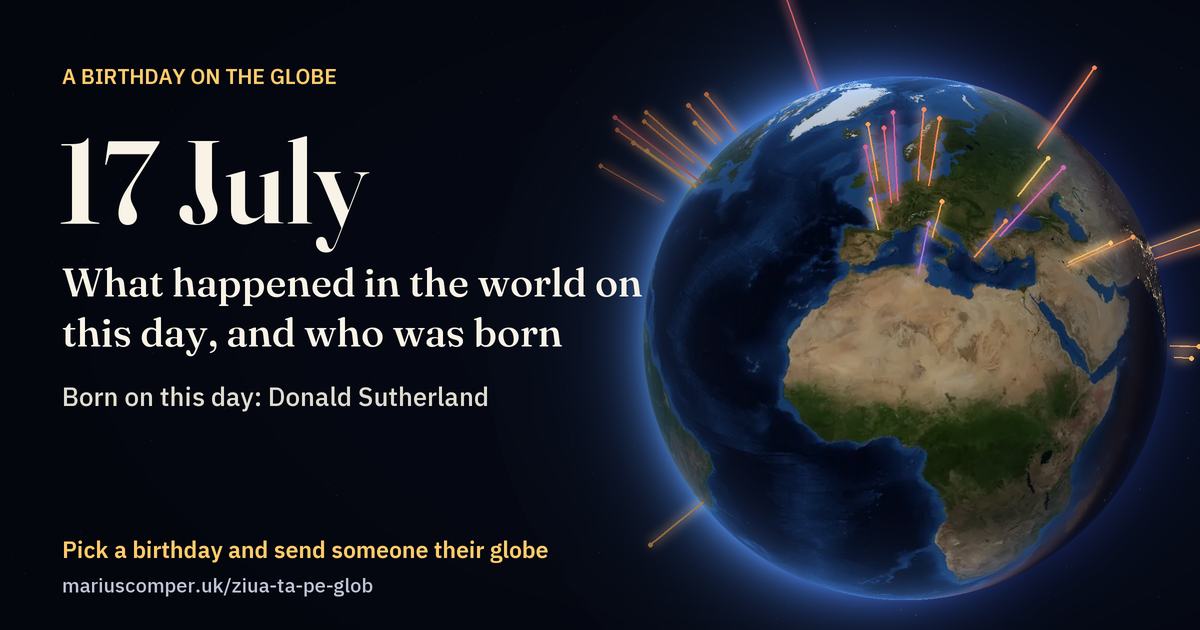
For 17 July, the English Wikipedia lists 51 events and 209 births. 32 of the events stand at their places as rays of light; four more are dashed circles, where the sentence links only to a country or a sea. The taller the ray, the longer ago it happened. The people born that day come further down, as blue points.
A birthday, yours or someone else’s:
Turn it into a greetingScroll: the globe turns to each place
The day you were born, on the globe.
Three things from your day
Scroll: your day first, then 17 July through the years
The Earth on 17 July
The picture on the globe was assembled by NASA from satellite photographs taken in July 2004: the snow, the ice and the green are those of the month.
On 17 July the Sun passes straight overhead at noon along the parallel of 21.2° north. In London, the day lasts about 16 hours 5 minutes.
Beyond 69° north the Sun no longer sets; beyond 69° south it no longer rises.
The line between day and night is tilted on the globe exactly as on this day of the year. On the dark side you can see the lights of towns.
Britain & Ireland · Manchester Metrolink
1992
The Manchester Metrolink, the first modern street-running light-rail system in the United Kingdom, was officially opened.
On the map: Manchester Metrolink.
Also on the day’s list of Wikipedia in Chinese.
Europe · Olympia, Greece
1948
In Olympia, Greece, the Summer Olympics torch relay, nicknamed the "relay of peace", began.
On the map: Olympia, Greece.
North America · Harvard School of Dental Medicine
1867
Harvard School of Dental Medicine is established in Boston, Massachusetts. It is the first dental school in the U.S. that is affiliated with a university.
On the map: Harvard School of Dental Medicine.
Also on the day’s list of Wikipedia in Chinese.
North America · Floyd Bennett Field
1938
Douglas Corrigan takes off from Brooklyn to fly the "wrong way" to Ireland and becomes known as "Wrong Way" Corrigan.
On the map: Floyd Bennett Field.
17 July
What the other Wikipedias remember#
For these years the English list has nothing on this day. The events below come from the same day’s lists on Wikipedia in Spanish and Romanian and were translated for this page.
From Wikipedia in Spanish · Anaheim
1955
In Anaheim (California), Disneyland opens.
On the map: Anaheim.
Translated from the list on Wikipedia in Spanish.
From Wikipedia in Spanish · Monumental Stadium, Buenos Aires
1993
At the Estadio Monumental de Núñez (Buenos Aires), the American band Guns N' Roses performs for the last time with the semi-classic line-up (made up of Duff McKagan, Slash, Axl Rose, Gilby Clarke and Matt Sorum), before 70,000 spectators.
On the map: Monumental Stadium, Buenos Aires.
Translated from the list on Wikipedia in Spanish.
From Wikipedia in Romanian · Brussels metropolitan area
1995
The first meeting in the "16+1" format of NATO takes place, with the participation of the Alliance's member states and Russia. The interim agreement on partnership and economic cooperation between the European Union and Russia is signed. (Brussels).
On the map: Brussels metropolitan area.
Translated from the list on Wikipedia in Romanian.
17 July
Born on 17 July#
The English Wikipedia lists 209 births for this day. The blue points are the birthplaces of 60 of these people: those written about in the most Wikipedia editions, where Wikidata gives a place of birth.
Born on 17 July
1935
Donald Sutherland, Canadian actor and producer (died 2024)
Place of birth: Saint John.
Born on 17 July
1888
Shmuel Yosef Agnon, Ukrainian-Israeli novelist, short story writer and poet, Nobel Prize laureate (died 1970)
Place of birth: Buchach.
Born on 17 July
1899
James Cagney, American actor and dancer (died 1986)
Place of birth: Manhattan.
Born on 17 July
1894
Georges Lemaître, Belgian priest, astronomer, and cosmologist (died 1966)
Born on 17 July
1917
Phyllis Diller, American actress, comedian, and voice artist (died 2012)
Place of birth: Lima.
Born in Britain and Ireland
1949
Geezer Butler, English bass player and songwriter
Place of birth: Birmingham.
Born in Britain and Ireland
1674
Isaac Watts, English hymnwriter and theologian (died 1748)
Place of birth: Southampton.
17 July
Number one in the charts that week
At the cinema
An animal recorded that day
The record can be seen in GBIF, which brings together wildlife records from around the world.
All your birthdays
The weather that day
Data: Met Office Hadley Centre (HadCET); NOAA (GHCN-Daily, Mauna Loa).
Above the Earth
Sources: Jonathan McDowell, GCAT (launches); GFZ Potsdam (Kp index). Days are counted in Universal Time.
Football that day
International matches played that day:
Source: the “International football results” dataset kept by Mart Jürisoo (CC0).
Also that day
The earthquake’s page at the USGS
Source: the USGS catalogue. The day is counted in Universal Time (UTC).
In those days
Make a link for someone
Type the name, pick the day and the year of birth. The link opens straight on their day, with their name in the greeting.
The link carries the name, date and place typed here; anyone who gets it can see them.
Put another birthday beside it
Your mother’s, your child’s, a friend’s: the two days appear side by side.
Below: 17 July through the years.
The whole globe of the day
Drag the globe to turn it. Touch a ray or a point to read what happened there.
Everything Wikipedia lists for 17 July
The list is the English Wikipedia’s, in its own wording, as it stood in October 2026. 15 events have no place on the map: the sentence links to no place with coordinates, only to places too wide to mark, or to several countries.
- 180
Twelve inhabitants of Scillium (near Kasserine, modern-day Tunisia) in North Africa are executed for being Christians. This is the earliest record of Christianity in that part of the world.
Africa · ScilliumWikipedia: Scillium - 561
Consecration of Pope John III following the death of Pope Pelagius I earlier that year.
no place on the mapWikipedia: Pope John III - 1048
Damasus II is elected pope, and dies 23 days later.
no place on the mapWikipedia: Pope Damasus II - 1048
Four year-old Henry IV is crowned as king of Germany in Aachen.
no place on the mapWikipedia: Henry IV, Holy Roman Emperor - 1203
The Fourth Crusade assaults Constantinople. The Byzantine emperor Alexios III Angelos flees from his capital into exile.
Asia · ConstantinopleWikipedia: Fourth Crusade - 1402
Zhu Di, better known by his era name as the Yongle Emperor, assumes the throne over the Ming dynasty of China.
Asia · Ming dynastyWikipedia: Regnal name - 1429
Hundred Years' War: Charles VII of France is crowned the King of France in the Reims Cathedral after a successful campaign by Joan of Arc.
Europe · Reims CathedralWikipedia: Hundred Years' War - 1453
Battle of Castillon: The last battle of the Hundred Years' War, the French under Jean Bureau defeat the English under the Earl of Shrewsbury, who is killed in the battle in Gascony.
Europe · Battle of CastillonWikipedia: Battle of Castillon - 1489
Sikandar Lodi succeeds Bahlul Khan Lodi as Sultan of Delhi.
no place on the mapWikipedia: Sikandar Khan Lodi - 1717
King George I of Great Britain sails down the River Thames with a barge of 50 musicians, where George Frideric Handel's Water Music is premiered.
no place on the mapWikipedia: George I of Great Britain - 1762
Former emperor Peter III of Russia is murdered.
no place on the mapWikipedia: Peter III of Russia - 1771
Bloody Falls massacre: Chipewyan chief Matonabbee, traveling as the guide to Samuel Hearne on his Arctic overland journey, massacres a group of unsuspecting Inuit.
North America · Bloody Falls massacreWikipedia: Bloody Falls massacre - 1791
Members of the French National Guard under the command of General Lafayette open fire on a crowd of radical Jacobins at the Champ de Mars, Paris, during the French Revolution, killing scores of people.
Europe · Champ de Mars massacreWikipedia: Champ de Mars massacre - 1794
The 16 Carmelite Martyrs of Compiègne are executed ten days prior to the end of the French Revolution's Reign of Terror.
no place on the mapWikipedia: Reign of Terror - 1821
The Kingdom of Spain cedes the territory of Florida to the United States.
Europe · SpainWikipedia: Spain - 1850
Vega becomes the first star (other than the Sun) to be photographed.
no place on the mapWikipedia: Vega - 1862
The garrotting and robbery of James Pilkington, a British member of Parliament, led to a moral panic in London.
no place on the mapWikipedia: London garrotting panics - 1863
The New Zealand Wars resumed as British forces led by General Duncan Cameron began the invasion of the Waikato.
no place on the mapWikipedia: Invasion of the Waikato - 1867
Harvard School of Dental Medicine is established in Boston, Massachusetts. It is the first dental school in the U.S. that is affiliated with a university.
North America · Harvard School of Dental MedicineWikipedia: Harvard School of Dental Medicine - 1899
NEC Corporation is organized as the first Japanese joint venture with foreign capital.
no place on the mapWikipedia: NEC - 1918
The RMS Carpathia is sunk off Ireland by the German SM U-55; five lives are lost.
no place on the mapWikipedia: RMS Carpathia - 1918
Tsar Nicholas II of Russia and his immediate family and retainers are executed by Bolshevik Chekists at the Ipatiev House in Yekaterinburg, Russia.
Asia · Ipatiev HouseWikipedia: Murder of the Romanov family - 1919
The form of government in the Republic of Finland is officially confirmed with the enactment of the Constitution of Finland. For this reason, July 17 is known as the Day of Democracy (Kansanvallan päivä) in Finland.
Europe · FinlandWikipedia: Finland - 1932
Altona Bloody Sunday: A riot between the Nazi Party paramilitary forces, the SS and SA, and the German Communist Party ensues.
Europe · Altona Bloody SundayWikipedia: Altona Bloody Sunday - 1936
Spanish Civil War: An Armed Forces rebellion against the recently elected leftist Popular Front government of Spain starts the civil war.
no place on the mapWikipedia: Spanish Civil War - 1938
Douglas Corrigan takes off from Brooklyn to fly the "wrong way" to Ireland and becomes known as "Wrong Way" Corrigan.
North America · Floyd Bennett FieldWikipedia: Douglas Corrigan - 1944
Port Chicago disaster: Near the San Francisco Bay, two ships laden with ammunition for the war explode in Port Chicago, California, killing 320.
North America · Port Chicago disasterWikipedia: Port Chicago disaster - 1945
World War II: The main three leaders of the Allied nations, Winston Churchill, Harry S. Truman and Joseph Stalin, hold the Potsdam Conference in the German city of Potsdam to decide the future of a defeated Germany.
Europe · Potsdam ConferenceWikipedia: World War II - 1948
In Olympia, Greece, the Summer Olympics torch relay, nicknamed the "relay of peace", began.
Europe · Olympia, GreeceWikipedia: 1948 Summer Olympics torch relay - 1953
The largest number of United States midshipman casualties in a single event results from an aircraft crash in Florida, killing 44.
North America · USMC R4Q NROTC crashWikipedia: USMC R4Q NROTC crash - 1954
First Indochina War: Viet Minh troops successfully ambush the armoured French column 'G.M. 42' in the Battle of Chu Dreh Pass in the Central Highlands. It is the last battle of the war.
Asia · Central HighlandsWikipedia: First Indochina War - 1962
Nuclear weapons testing: The "Small Boy" test shot Little Feller I becomes the last atmospheric test detonation at the Nevada National Security Site.
North America · Little FellerWikipedia: Little Feller - 1968
Abdul Rahman Arif is overthrown and the Ba'ath Party is installed as the governing power in Iraq with Ahmed Hassan al-Bakr as the new Iraqi President.
Asia · First Republic of IraqWikipedia: 17 July Revolution - 1973
King Mohammed Zahir Shah of Afghanistan, while having surgery in Italy, is deposed by his cousin Mohammed Daoud Khan.
Asia · AfghanistanWikipedia: Mohammad Zahir Shah - 1975
Apollo–Soyuz Test Project: An American Apollo and a Soviet Soyuz spacecraft dock with each other in orbit marking the first such link-up between spacecraft from the two nations.
no place on the mapWikipedia: Apollo–Soyuz - 1976
East Timor is annexed and becomes the 27th province of Indonesia.
no place on the mapWikipedia: Indonesian invasion of East Timor - 1976
The opening of the Summer Olympics in Montreal is marred by 25 African teams boycotting the games because of New Zealand's participation. Contrary to rulings by other international sports organizations, the IOC had declined to exclude New Zealand because of their participation in South African sporting events during apartheid.
North America · Olympic StadiumWikipedia: 1976 Summer Olympics - 1981
A structural failure leads to the collapse of a walkway at the Hyatt Regency in Kansas City, Missouri, killing 114 people and injuring more than 200.
North America · Hyatt Regency walkway collapseWikipedia: Hyatt Regency walkway collapse - 1992
The Manchester Metrolink, the first modern street-running light-rail system in the United Kingdom, was officially opened.
Britain & Ireland · Manchester MetrolinkWikipedia: Manchester Metrolink - 1994
Brazil win their fourth World Cup title, defeating Italy 3–2 on penalties.
North America · Rose BowlWikipedia: 1994 FIFA World Cup final - 1996
TWA Flight 800: Off the coast of Long Island, New York, a Paris-bound TWA Boeing 747 explodes, killing all 230 on board.
North America · TWA Flight 800Wikipedia: TWA Flight 800 - 1997
After takeoff from Husein Sastranegara International Airport, Sempati Air Flight 304 crashes into a residential neighborhood in Bandung, killing 28 people.
Asia · Husein Sastranegara AirportWikipedia: Sempati Air Flight 304 - 1998
A diplomatic conference adopts the Rome Statute of the International Criminal Court, establishing the permanent international court in The Hague, to prosecute individuals for genocide, crimes against humanity, war crimes, and the crime of aggression.
Europe · Rome StatuteWikipedia: Rome Statute - 1998
The 7.0 Mw Papua New Guinea earthquake triggers a tsunami that destroys ten villages in Papua New Guinea, killing up to 2,700 people, and leaving several thousand injured.
Oceania · 1998 Papua New Guinea earthquakeWikipedia: 1998 Papua New Guinea earthquake - 2000
During approach to Lok Nayak Jayaprakash Airport, Alliance Air Flight 7412 suddenly crashes into a residential neighborhood in Patna, India, killing 60 people.
Asia · Alliance Air Flight 7412Wikipedia: Alliance Air Flight 7412 - 2006
The 7.7 Mw Pangandaran tsunami earthquake severely affects the Indonesian island of Java, killing 668 people, and leaving more than 9,000 injured.
Oceans · 2006 Pangandaran earthquake and tsunamiWikipedia: 2006 Pangandaran earthquake and tsunami - 2007
TAM Airlines Flight 3054, an Airbus A320, crashes into a warehouse after landing too fast and missing the end of the São Paulo–Congonhas Airport runway, killing 199 people.
Latin America · TAM Airlines Flight 3054Wikipedia: TAM Airlines Flight 3054 - 2014
A French regional train on the Pau-Bayonne line crashes into a high-speed train near the town of Denguin, resulting in at least 25 injuries.
Europe · DenguinWikipedia: Denguin rail crash - 2014
Eric Garner is killed by police officer Daniel Pantaleo in New York City, after the latter put him in a prohibited chokehold while arresting him.
North America · Killing of Eric GarnerWikipedia: Killing of Eric Garner - 2014
Malaysia Airlines Flight 17, a Boeing 777, crashes near the border of Ukraine and Russia after being shot down. All 298 people on board are killed.
Europe · Malaysia Airlines Flight 17Wikipedia: Malaysia Airlines Flight 17 - 2015
At least 120 people are killed and 130 injured by a suicide bombing in Diyala Governorate, Iraq.
Asia · 2015 Khan Bani Saad bombingWikipedia: 2015 Khan Bani Saad bombing
What the other Wikipedias remember
For these years the English list has nothing on this day. The events below come from the same day’s lists on Wikipedia in Spanish and Romanian and were translated for this page.
- 1955
In Anaheim (California), Disneyland opens.
- 1993
At the Estadio Monumental de Núñez (Buenos Aires), the American band Guns N' Roses performs for the last time with the semi-classic line-up (made up of Duff McKagan, Slash, Axl Rose, Gilby Clarke and Matt Sorum), before 70,000 spectators.
Latin America · Monumental Stadium, Buenos AiresTranslated from the list on Wikipedia in SpanishWikipedia: Estadio Monumental - 1995
The first meeting in the "16+1" format of NATO takes place, with the participation of the Alliance's member states and Russia. The interim agreement on partnership and economic cooperation between the European Union and Russia is signed. (Brussels).
Who was born on 17 July
In order of how many Wikipedia editions have an article about each. The first 60 of 209 are shown.
- 1954
Angela Merkel, German chemist and politician, Chancellor of Germany from 2005 to 2021.
Elim hospitalWikipedia: Angela Merkel - 1935
Donald Sutherland, Canadian actor and producer (died 2024)
Saint JohnWikipedia: Donald Sutherland - 1888
Shmuel Yosef Agnon, Ukrainian-Israeli novelist, short story writer and poet, Nobel Prize laureate (died 1970)
- 1899
James Cagney, American actor and dancer (died 1986)
ManhattanWikipedia: James Cagney - 1947
Queen Camilla, Queen Consort of King Charles III of the United Kingdom
London Borough of LambethWikipedia: Queen Camilla - 1487
Ismail I of Iran (died 1524)
ArdabilWikipedia: Ismail I - 1894
Georges Lemaître, Belgian priest, astronomer, and cosmologist (died 1966)
- 1961
António Costa, Portuguese politician, 119th Prime Minister of Portugal
LisbonWikipedia: António Costa - 1917
Kenan Evren, Turkish general and politician, 7th President of Turkey (died 2015)
- 1963
Letsie III of Lesotho
MorijaWikipedia: Letsie III - 1920
Juan Antonio Samaranch, Spanish businessman, 7th President of the International Olympic Committee (died 2010)
BarcelonaWikipedia: Juan Antonio Samaranch - 1917
Phyllis Diller, American actress, comedian, and voice artist (died 2012)
- 1952
David Hasselhoff, American actor, singer, and producer
BaltimoreWikipedia: David Hasselhoff - 1744
Elbridge Gerry, American merchant and politician, 5th Vice President of the United States (died 1814)
MarbleheadWikipedia: Elbridge Gerry - 1831
Naser al-Din Shah of Qajar Iran (died 1896)
- 1698
Pierre Louis Maupertuis, French mathematician and philosopher (died 1759)
Saint-MaloWikipedia: Pierre Louis Maupertuis - 1958
Wong Kar-wai, Chinese director, producer, and screenwriter
ShanghaiWikipedia: Wong Kar-wai - 1714
Alexander Gottlieb Baumgarten, German philosopher and academic (died 1762)
- 1944
Carlos Alberto Torres, Brazilian footballer and manager (died 2016)
Rio de JaneiroWikipedia: Carlos Alberto Torres - 1975
Terence Tao, Australian-American mathematician
AdelaideWikipedia: Terence Tao - 1963
Matti Nykänen, Finnish ski jumper and singer (died 2019)
JyväskyläWikipedia: Matti Nykänen - 1971
Cory Doctorow, Canadian author and activist
TorontoWikipedia: Cory Doctorow - 1831
Xianfeng Emperor of China (died 1861)
Old Summer PalaceWikipedia: Xianfeng Emperor - 1763
John Jacob Astor, German-American businessman and philanthropist (died 1848)
WalldorfWikipedia: John Jacob Astor - 1972
Jaap Stam, Dutch footballer and manager
KampenWikipedia: Jaap Stam - 1976
Marcos Senna, Brazilian-Spanish footballer
São PauloWikipedia: Marcos Senna - 1949
Geezer Butler, English bass player and songwriter
BirminghamWikipedia: Geezer Butler - 1935
Diahann Carroll, American actress and singer (died 2019)
The BronxWikipedia: Diahann Carroll - 1889
Erle Stanley Gardner, American lawyer and author (died 1970)
- 1975
Darude, Finnish DJ and producer
- 1871
Lyonel Feininger, German-American painter and illustrator (died 1956)
New York CityWikipedia: Lyonel Feininger - 1797
Paul Delaroche, French painter and academic (died 1856)
- 1898
Berenice Abbott, American photographer (died 1991)
SpringfieldWikipedia: Berenice Abbott - 1969
Jason Clarke, Australian actor
WintonWikipedia: Jason Clarke - 1974
Claudio López, Argentine footballer
Río TerceroWikipedia: Claudio López - 1976
Anders Svensson, Swedish footballer and sportscaster
GothenburgWikipedia: Anders Svensson - 1932
Wojciech Kilar, Polish pianist and composer (died 2013)
- 1979
Mike Vogel, American actor
Abington TownshipWikipedia: Mike Vogel - 1932
Quino, Spanish-Argentinian cartoonist (died 2020)
FuengirolaWikipedia: Quino - 1945
Alexander, Crown Prince of Yugoslavia
- 1992
Billie Lourd, American actress
Los AngelesWikipedia: Billie Lourd - 1954
J. Michael Straczynski, American author, screenwriter, and producer
- 1975
Elena Anaya, Spanish actress
PalenciaWikipedia: Elena Anaya - 1978
Justine Triet, French film director and screenwriter
FécampWikipedia: Justine Triet - 1994
Kali Uchis, American singer-songwriter
AlexandriaWikipedia: Kali Uchis - 1960
Jan Wouters, Dutch footballer and manager
UtrechtWikipedia: Jan Wouters - 1964
Heather Langenkamp, American actress and producer
- 1956
Julie Bishop, Australian lawyer and politician, 38th Australian Minister for Foreign Affairs
LobethalWikipedia: Julie Bishop - 1960
Robin Shou, Hong Kong martial artist and actor
Hong KongWikipedia: Robin Shou - 1976
Dagmara Domińczyk, Polish-American actress
- 1674
Isaac Watts, English hymnwriter and theologian (died 1748)
SouthamptonWikipedia: Isaac Watts - 1920
Gordon Gould, American physicist and academic, invented the laser (died 2005)
ManhattanWikipedia: Gordon Gould - 1853
Alexius Meinong, Ukrainian-Austrian philosopher and academic (died 1920)
- 1954
Edward Natapei, Vanuatuan politician, 6th Prime Minister of Vanuatu (died 2015)
Futuna IslandWikipedia: Edward Natapei - 1976
Eric Winter, American actor
La MiradaWikipedia: Eric Winter - 1957
Wendy Freedman, Canadian-American cosmologist and astronomer
TorontoWikipedia: Wendy Freedman - 1976
Luke Bryan, American singer-songwriter and guitarist
LeesburgWikipedia: Luke Bryan - 1918
Carlos Manuel Arana Osorio, Guatemalan soldier and politician, President of Guatemala (died 2003)
- 1948
Ron Asheton, American guitarist and songwriter (died 2009)
Washington, D.C.Wikipedia: Ron Asheton - 1969
Jaan Kirsipuu, Estonian cyclist
What is celebrated on 17 July
- Christian feast day: Alexius of Rome (Western Church)
- Christian feast day: Andrew Zorard
- Christian feast day: Cynehelm
- Christian feast day: Cynllo
- Christian feast day: Inácio de Azevedo
- Christian feast day: Jadwiga of Poland
- Christian feast day: Magnus Felix Ennodius
- Christian feast day: Marcellina
- Christian feast day: Martyrs of Compiègne
- Christian feast day: Blessed Pavel Peter Gojdič (Greek Catholic Church)
- Christian feast day: Pope Leo IV
- Christian feast day: Romanov sainthood (Russian Orthodox Church)
- Christian feast day: Speratus and companions
- Christian feast day: William White (Episcopal Church)
A greeting link for someone
Type a name and, if you like, the year of birth. The link opens with a greeting, and beside each event it says how old the person turned that day, or how many years before their birth it happened.
The name and the year go only into the link you send.
All 366 days
How the globe is made
Where the events come from
Each edition of this page uses the day’s list from Wikipedia in its own language: Romanian, English, Spanish, Chinese. The lists are written by volunteers and differ from one edition to the next; the text of each event is Wikipedia’s, with a link to the article. A row that appears twice in a list is shown once. The lists have not been checked event by event: they are Wikipedia’s, mistakes included.
For events before 1582, and for countries that moved to the Gregorian calendar later (Britain in 1752, Russia in 1918), the same day may be counted Old Style in one list and New Style in another.
The chapter “What the other Wikipedias remember” adds up to five events a day from the lists of the other three editions, only for years in which the English list has nothing on that day. They were translated for this page, passed the same filters as the tour, and are not counted among the events of the English list.
How an event gets onto the map
The place comes from Wikidata. If the sentence links to the article about the event itself (a battle, an opening, an earthquake), dated to the same year, the ray stands on its coordinates or on those of its location. Otherwise it stands on the first place the sentence links to: a town, a building, a mountain, an island. This second step can be wrong: sometimes the sentence only mentions the place. That is why the page says, under each event, which place the ray stands on.
When the sentence links to a single state or province, or to a single sea, lake or desert larger than 5,000 km², the globe shows a dashed circle, not a ray. The circle has the area Wikidata gives, with its radius kept between 1.2° and 16°, or a radius of 4.5° when Wikidata gives no area; it says only that the sentence links to that place. Organisations, ships, spacecraft, museum objects, rivers, mountain ranges, languages and continents are never used as places. When a sentence names several states and no exact place, the event stays in the list only.
What the height means
The height of a ray shows how many years have passed, on a logarithmic scale: 10 years, 100 years and 1,000 years are equal steps apart; anything older than about 2,600 years has the tallest ray. The colour runs from pale yellow for recent years to violet for antiquity.
Where the tour stops
In each region the tour stops at up to three events (five in Britain and Ireland), chosen mainly by three things: whether Wikipedia’s editors put the event in the “On this day” box of their main page (the English, Spanish and Chinese editions), how many Wikipedia editions have an article about it, and how many of the four lists include it. Events whose sentence or article is about a war, an attack, a crime or a disaster are left out of the tour; they stay in the whole list, in Wikipedia’s wording. The filter is a list of words and a list of Wikidata types, so it can miss some.
The tour of births names the people with articles in the most editions and leaves aside those whom the list or Wikidata describes as rulers, politicians, commanders, leaders of movements or criminals; they stay in the list.
The Earth and the Sun
The daytime images are NASA’s Blue Marble Next Generation mosaics, one for each month of 2004; the night side is Black Marble 2016. The tilt of the line between day and night is computed for the day; the hour is chosen so that the place being read is in daylight. The latitude where the Sun stands overhead is the average of the four years of the leap cycle; in a given year it can differ by up to 0.4°.
The day you were born
The number ones come from the weekly lists on Wikipedia: Billboard for the United States (from 1940; the Hot 100 from August 1958), the UK Singles Chart (from November 1952), Los 40 Principales for Spain (from July 1966) and, for Romania, the Romanian Top 100 and Airplay 100 (2001–2021, with missing weeks). The page shows the chart of the week in which the day of birth falls, with its date; Billboard and the UK chart are dated at the end of their week. For Romania before 2001 and for China these sources have no weekly chart.
The films are those that reached cinemas in the United States up to ten days before or three days after that day (some of them in a few cinemas at first), from the English Wikipedia’s yearly lists (from 1968), in order of how many editions have an article about them. The events “in those days” are the ones on the neighbouring days’ lists that carry the year of birth, passed through the same filter as the tour.
The day of birth, year included
The Moon, the star sign and the constellation are worked out by the page itself, for noon Universal Time on the day. The lit part of the Moon is rounded and can differ by a few per cent from that at the hour of birth. The sign follows the usual zodiac of twelve equal parts starting at the March equinox; the constellation is the one the Sun actually stood in front of, by the borders set by the International Astronomical Union, and within a day of a border the page does not name it. When the Sun changes sign while it is that day anywhere on Earth, the page gives the moment of crossing, rounded to ten minutes and accurate to within about a quarter of an hour, and the clock time in a few cities, with the time zone and summer time of that year.
The year in the Chinese calendar is the one your device’s own calendar gives for the date, checked against the Hong Kong Observatory’s tables. “All your birthdays” uses the same sources as the rest of the chapter for the same day in every year since the birth: the temperature, well-known launches that took place on that very day, matches of the teams the edition follows, snow deeper than 10 cm and strong geomagnetic storms. The three things at the top and the four on the picture are chosen in a fixed order (the song, the animal, a full Moon, a well-known launch before an ordinary earthquake); on the picture you can change them.
When the link carries a year of birth, the page adds a few things about that exact day. The weather is the Met Office’s Central England temperature record and the readings from New York’s Central Park; the “usual high” is the average of the daily highs of 1961–1990 for that date, with two days either side. The carbon dioxide figure is the monthly mean at the Mauna Loa observatory, where measurements begin in March 1958.
The earthquake is the one with the largest magnitude in the USGS catalogue for that day, counted in Universal Time. Before the 1960s the catalogue has gaps even above magnitude 5.5, so in the older years many days have no earthquake. The page gives only the magnitude and the place: the country the epicentre falls in or, when the epicentre is at sea within 300 km of a coast, the nearest country; farther out, only the ocean.
The launches are those that reached orbit or left for the Moon and the planets, from Jonathan McDowell’s GCAT catalogue. If nothing left that day, the page shows the nearest launch within three days before or after, and says how many days away it was. The geomagnetic storm appears only when the Kp index reached at least 5 in one of the day’s eight three-hour intervals.
The animal comes from GBIF: an observation made by a person (the animal seen or heard, or its tracks), dated to that exact day, with coordinates and a CC0 or CC BY licence. Only a few hundred well-known species are searched (mammals, birds, turtles, butterflies); of those noted that day, mammals and species with articles in many Wikipedia editions come first; birds noted almost every day, and species used recently, wait their turn. Observations dated 1 January are left out, because records without a day are often filed there. An observation shows that the animal was recorded there, not how many animals there were.
The matches are those between national teams. Only matches of England, Scotland, Wales, Northern Ireland, the Republic of Ireland, the United States, Canada and Australia are shown, along with those at the big final tournaments. The picture to send is drawn in the page from the day’s globe and the facts above, and stays on your device until you send it.
Sources
- Events, births and holidays: the day’s page on Wikipedia, text under CC BY-SA 4.0.
- Coordinates, places of birth and the number of editions: Wikidata (CC0).
- The Earth by day: NASA Blue Marble Next Generation. The Earth by night: NASA Black Marble 2016.
- Borders and regions: Natural Earth.
- World population and births per year: UN World Population Prospects 2024.
- Charts and films: Wikipedia’s lists for Billboard, the UK Singles Chart, Los 40 Principales, Romanian Top 100, Airplay 100 and American films by year (CC BY-SA 4.0).
- Weather: Met Office Hadley Centre, HadCET (Open Government Licence) and NOAA GHCN-Daily, New York Central Park. Carbon dioxide: NOAA Global Monitoring Laboratory, Mauna Loa.
- Earthquakes: the USGS catalogue. Launches: Jonathan McDowell, GCAT (CC BY). Kp index: GFZ Potsdam (CC BY 4.0). Matches: International football results, Mart Jürisoo (CC0).
- Animal observations: GBIF, with a link to each record; species names come from Wikidata.