A birthday on the globe
3 March on the globe: what happened in the world on this day, and who was born
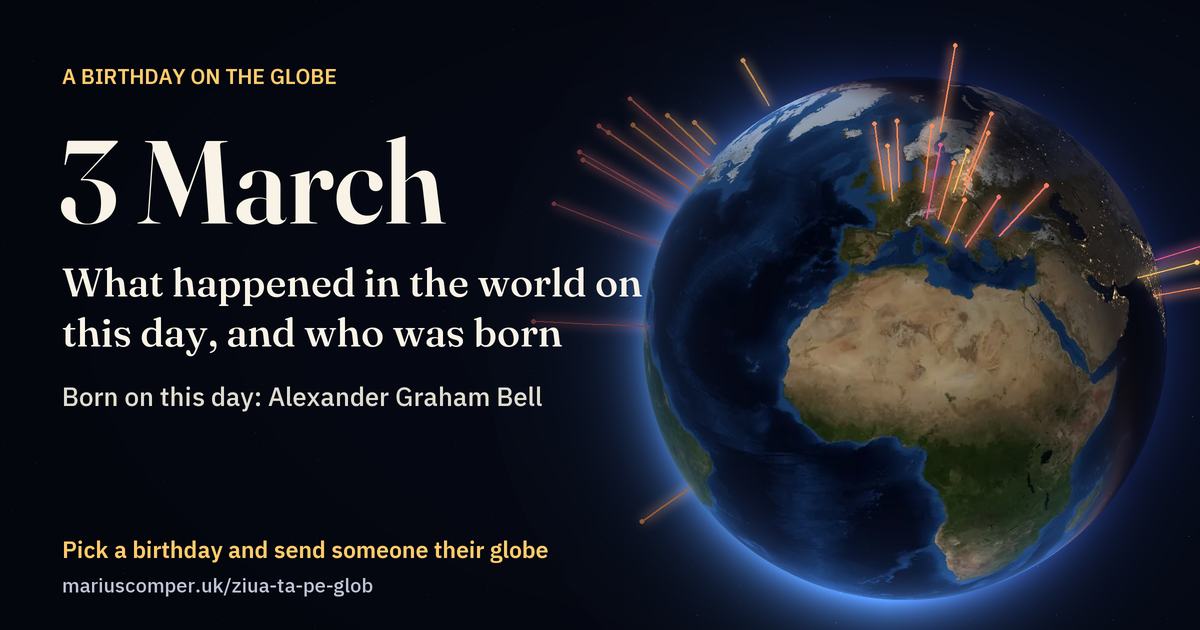
For 3 March, the English Wikipedia lists 53 events and 184 births. 30 of the events stand at their places as rays of light; nine more are dashed circles, where the sentence links only to a country or a sea. The taller the ray, the longer ago it happened. The people born that day come further down, as blue points.
A birthday, yours or someone else’s:
Turn it into a greetingScroll: the globe turns to each place
The day you were born, on the globe.
Three things from your day
Scroll: your day first, then 3 March through the years
The Earth on 3 March
The picture on the globe was assembled by NASA from satellite photographs taken in March 2004: the snow, the ice and the green are those of the month.
On 3 March the Sun passes straight overhead at noon along the parallel of 6.6° south. In London, the day lasts about 11 hours 5 minutes.
Beyond 83° south the Sun no longer sets; beyond 83° north it no longer rises.
The line between day and night is tilted on the globe exactly as on this day of the year. On the dark side you can see the lights of towns.
Europe · Teatro Olimpico
1585
The Olympic Theatre, designed by Andrea Palladio, is inaugurated in Vicenza.
On the map: Teatro Olimpico.
Also on the day’s list of Wikipedia in Spanish, Romanian and Chinese.
North America · First indoor ice hockey game
1875
The first indoor game of ice hockey was played at the Victoria Skating Rink in Montreal by James Creighton and students of McGill University.
On the map: the coordinates Wikidata gives for the article “First indoor ice hockey game”.
North America · Woman Suffrage Procession
1913
Thousands of women march in the Woman Suffrage Procession in Washington, D.C.
On the map: the coordinates Wikidata gives for the article “Woman Suffrage Procession”.
3 March
What the other Wikipedias remember#
For these years the English list has nothing on this day. The events below come from the same day’s lists on Wikipedia in Chinese and Spanish and were translated for this page.
From Wikipedia in Chinese · 1431 papal conclave
1431
After the death of Pope Martin V, the conclave elects Eugene IV as the new pope.
On the map: 1431 papal conclave.
Translated from the list on Wikipedia in Chinese.
From Wikipedia in Chinese · United States Congress
1931
The United States Congress formally adopts "The Star-Spangled Banner" as the national anthem of the United States, replacing "Hail, Columbia", which had often been used.
On the map: United States Congress.
Translated from the list on Wikipedia in Chinese.
From Wikipedia in Spanish · Bilbao
1964
In Bilbao (Spain), the Third Machine Tool Technical Fair is inaugurated.
On the map: Bilbao.
Translated from the list on Wikipedia in Spanish.
From Wikipedia in Spanish · Bilbao
1965
In Bilbao, the First Fair of the Electrical Industry and of Lifting and Transport Machinery is inaugurated.
On the map: Bilbao.
Translated from the list on Wikipedia in Spanish.
From Wikipedia in Chinese · San Francisco
2011
Apple announces the iPad 2 and iOS 4.3 at the Yerba Buena Center for the Arts in San Francisco.
On the map: San Francisco.
Translated from the list on Wikipedia in Chinese.
3 March
Born on 3 March#
The English Wikipedia lists 184 births for this day. The blue points are the birthplaces of 60 of these people: those written about in the most Wikipedia editions, where Wikidata gives a place of birth.
Born on 3 March
1847
Alexander Graham Bell, Scottish-American engineer and academic, invented the telephone (died 1922)
Place of birth: Edinburgh.
Born on 3 March
1845
Georg Cantor, Russian-German mathematician and philosopher (died 1918)
Place of birth: Saint Petersburg.
Born on 3 March
1982
Jessica Biel, American actress, singer, and producer
Place of birth: Ely.
Born on 3 March
1997
Camila Cabello, Cuban-American singer-songwriter and actress
Place of birth: Cojímar.
Born on 3 March
1987
Shraddha Kapoor, Indian actress, singer, and designer
Place of birth: Mumbai.
Born in Britain and Ireland
1756
William Godwin, English journalist and author (died 1836)
Place of birth: Wisbech.
Born in Britain and Ireland
1958
Miranda Richardson, English actress
Place of birth: Southport.
Born in Britain and Ireland
1977
Ronan Keating, Irish singer-songwriter and actor
Place of birth: Dublin.
3 March
Number one in the charts that week
At the cinema
An animal recorded that day
The record can be seen in GBIF, which brings together wildlife records from around the world.
All your birthdays
The weather that day
Data: Met Office Hadley Centre (HadCET); NOAA (GHCN-Daily, Mauna Loa).
Above the Earth
Sources: Jonathan McDowell, GCAT (launches); GFZ Potsdam (Kp index). Days are counted in Universal Time.
Football that day
International matches played that day:
Source: the “International football results” dataset kept by Mart Jürisoo (CC0).
Also that day
The earthquake’s page at the USGS
Source: the USGS catalogue. The day is counted in Universal Time (UTC).
In those days
Make a link for someone
Type the name, pick the day and the year of birth. The link opens straight on their day, with their name in the greeting.
The link carries the name, date and place typed here; anyone who gets it can see them.
Put another birthday beside it
Your mother’s, your child’s, a friend’s: the two days appear side by side.
Below: 3 March through the years.
The whole globe of the day
Drag the globe to turn it. Touch a ray or a point to read what happened there.
Everything Wikipedia lists for 3 March
The list is the English Wikipedia’s, in its own wording, as it stood in October 2026. 14 events have no place on the map: the sentence links to no place with coordinates, only to places too wide to mark, or to several countries.
- 473
Gundobad (nephew of Ricimer) nominates Glycerius as emperor of the Western Roman Empire.
Europe · Western Roman EmpireWikipedia: Gundobad - 724
Empress Genshō abdicates the throne in favor of her nephew Shōmu who becomes emperor of Japan.
Asia · JapanWikipedia: Empress Genshō - 880
Emperor Basil I ratifies the decrees of the Fourth Council of Constantinople, confirming the reinstatement of patriarch Photios I of Constantinople.
no place on the mapWikipedia: Fourth Council of Constantinople - 1284
The Statute of Rhuddlan was enacted, introducing English common law to the Principality of Wales.
Britain & Ireland · Principality of WalesWikipedia: Statute of Rhuddlan - 1575
Mughal Emperor Akbar defeats Sultan of Bengal Daud Khan Karrani's army at the Battle of Tukaroi.
Asia · Battle of TukaroiWikipedia: Battle of Tukaroi - 1585
The Olympic Theatre, designed by Andrea Palladio, is inaugurated in Vicenza.
Europe · Teatro OlimpicoWikipedia: Teatro Olimpico - 1776
American Revolutionary War: The first amphibious landing of the United States Marine Corps begins the Battle of Nassau.
Latin America · Raid of NassauWikipedia: American Revolutionary War - 1779
American Revolutionary War: The Continental Army is routed at the Battle of Brier Creek near Savannah, Georgia.
North America · Battle of Brier CreekWikipedia: Battle of Brier Creek - 1795
The Fédon Rebellion breaks out in Grenada, the rebels seizing Grenville and later Gouyave.
Latin America · Grenville, GrenadaWikipedia: Fédon's rebellion - 1799
The Russo-Ottoman siege of Corfu ends with the surrender of the French garrison.
Europe · Siege of CorfuWikipedia: Siege of Corfu - 1820
The U.S. Congress passed the Missouri Compromise, which balanced the admission of Missouri as a slave state with that of Maine as a free state.
North America · United States CongressWikipedia: Missouri Compromise - 1845
Florida is admitted as the 27th U.S. state.
North America · FloridaWikipedia: Florida - 1849
The Territory of Minnesota is created.
North America · Minnesota TerritoryWikipedia: Minnesota Territory - 1857
Second Opium War: France and the United Kingdom declare war on China.
no place on the mapWikipedia: Second Opium War - 1859
The two-day Great Slave Auction, one of the largest such auctions in United States history, concludes.
North America · Great Slave AuctionWikipedia: Great Slave Auction - 1861
Alexander II of Russia signs the Emancipation Manifesto, freeing serfs.
no place on the mapWikipedia: Emancipation reform of 1861 - 1873
Censorship in the United States: The U.S. Congress enacts the Comstock Law, making it illegal to send any "obscene literature and articles of immoral use" through the mail.
no place on the mapWikipedia: Comstock Act of 1873 - 1875
Bizet's Carmen premiered at the Opéra-Comique in Paris, with mezzo-soprano Célestine Galli-Marié in the title role.
no place on the mapWikipedia: Opéra-Comique - 1875
The first indoor game of ice hockey was played at the Victoria Skating Rink in Montreal by James Creighton and students of McGill University.
North America · First indoor ice hockey gameWikipedia: First indoor ice hockey game - 1878
The Russo-Turkish War ends with Bulgaria regaining its independence from the Ottoman Empire according to the Treaty of San Stefano.
Asia · YeşilköyWikipedia: Russo-Turkish War - 1891
Shoshone National Forest is established as the first national forest in the US and world.
North America · Shoshone National ForestWikipedia: Shoshone National Forest - 1913
Thousands of women march in the Woman Suffrage Procession in Washington, D.C.
North America · Woman Suffrage ProcessionWikipedia: Woman Suffrage Procession - 1918
Russia signs the Treaty of Brest-Litovsk, agreeing to withdraw from World War I, and conceding German control of the Baltic States, Belarus and Ukraine. It also conceded Turkish control of Ardahan, Kars and Batumi.
Europe · Treaty of Brest-LitovskWikipedia: Treaty of Brest-Litovsk - 1923
US magazine Time publishes its first issue.
no place on the mapWikipedia: Time - 1924
The Free State of Fiume is annexed by the Kingdom of Italy.
Europe · Free State of FiumeWikipedia: Free State of Fiume - 1924
The Ottoman Caliphate is abolished, when the Caliph Abdülmecid II of the Ottoman dynasty is deposed. The last remnant of the old monarchy gives way to the reformed Turkey of Kemal Atatürk.
Asia · TurkeyWikipedia: Ottoman Caliphate - 1933
The first Nazi concentration camp was opened in Nohra to reduce overcrowding in prisons from the arrest of German Communists.
Europe · Nohra concentration campWikipedia: Nohra concentration camp - 1938
Oil is discovered in Saudi Arabia.
Asia · Saudi ArabiaWikipedia: Petroleum - 1939
In Bombay, Mohandas Gandhi begins a hunger strike in protest at the autocratic rule in British India.
Asia · MumbaiWikipedia: Mumbai - 1940
Five people are killed in an arson attack on the offices of the communist newspaper Flamman in Luleå, Sweden.
Europe · LuleåWikipedia: Left Party - 1942
World War II: Ten Japanese warplanes raid Broome, Western Australia, killing more than 100 people.
Oceania · Attack on BroomeWikipedia: Attack on Broome - 1943
World War II: In London, 173 people are killed in a crush while trying to enter an air-raid shelter at Bethnal Green tube station.
Britain & Ireland · Bethnal Green tube stationWikipedia: Bethnal Green tube station - 1944
A freight train carrying stowaway passengers stalls in a tunnel shortly after departing from Balvano, Basilicata, Italy just after midnight, with 517 dying from carbon monoxide poisoning.
Europe · BalvanoWikipedia: Balvano train disaster - 1944
The Order of Nakhimov and Order of Ushakov are instituted in USSR as the highest naval awards.
Asia · Soviet UnionWikipedia: Order of Nakhimov - 1945
A Polish Home Army unit massacred at least 150 Ukrainian civilians in Pawłokoma, Poland.
Europe · Pawłokoma massacreWikipedia: Pawłokoma massacre - 1945
World War II: In poor visibility, the RAF mistakenly bombs the Bezuidenhout area of The Hague, Netherlands, killing 511 people.
Europe · Bombing of the BezuidenhoutWikipedia: Bombing of the Bezuidenhout - 1953
A De Havilland Comet (Canadian Pacific Air Lines) crashes in Karachi, Pakistan, killing 11 people.
Asia · KarachiWikipedia: De Havilland Comet - 1958
Nuri al-Said becomes Prime Minister of Iraq for the eighth time.
no place on the mapWikipedia: Nuri al-Said - 1969
Apollo program: NASA launches Apollo 9 to test the lunar module.
no place on the mapWikipedia: Apollo program - 1972
Mohawk Airlines Flight 405 crashes as a result of a control malfunction and insufficient training in emergency procedures.
North America · Mohawk Airlines Flight 405Wikipedia: Mohawk Airlines Flight 405 - 1972
The British rock band Jethro Tull released Thick as a Brick, a parody concept album allegedly adapted from an eight-year-old boy's epic poem.
no place on the mapWikipedia: Jethro Tull - 1974
Turkish Airlines Flight 981 crashes at Ermenonville near Paris, France killing all 346 aboard.
Europe · Turkish Airlines Flight 981Wikipedia: Turkish Airlines Flight 981 - 1980
The USS Nautilus is decommissioned and stricken from the Naval Vessel Register.
no place on the mapWikipedia: USS Nautilus - 1985
A magnitude 8.3 earthquake strikes the Valparaíso Region of Chile, killing 177 and leaving nearly a million people homeless.
Latin America · 1985 Algarrobo earthquakeWikipedia: 1985 Algarrobo earthquake - 1986
The American heavy metal band Metallica released their third studio album, Master of Puppets, considered one of the greatest in the genre's history.
no place on the mapWikipedia: Metallica - 1986
The Australia Act 1986 commences, causing Australia to become fully independent from the United Kingdom.
no place on the mapWikipedia: Australia Act 1986 - 1991
An amateur video captures the beating of Rodney King by Los Angeles police officers.
North America · Los Angeles Police DepartmentWikipedia: Amateur film - 1991
United Airlines Flight 585 crashes on its final approach to Colorado Springs killing everyone on board.
North America · United Airlines Flight 585Wikipedia: United Airlines Flight 585 - 2005
James Roszko murders four Royal Canadian Mounted Police constables during a drug bust at his property in Rochfort Bridge, Alberta, then commits suicide. This is the deadliest peace-time incident for the RCMP since 1885 and the North-West Rebellion.
North America · Mayerthorpe tragedyWikipedia: Mayerthorpe tragedy - 2005
Margaret Wilson is elected as Speaker of the New Zealand House of Representatives, beginning a period lasting until August 23, 2006, where all the highest political offices (including Elizabeth II as Head of State), were occupied by women, making New Zealand the first country for this to occur.
no place on the mapWikipedia: Margaret Wilson - 2005
Steve Fossett becomes the first person to fly an airplane non-stop around the world solo without refueling.
no place on the mapWikipedia: Steve Fossett - 2012
Two passenger trains collided near Szczekociny, Poland, resulting in 16 deaths and 58 injuries.
Europe · SzczekocinyWikipedia: Szczekociny rail crash - 2013
A bomb blast in Karachi, Pakistan, kills at least 48 people and injured 200 others in a predominantly Shia Muslim area.
Asia · KarachiWikipedia: March 2013 Karachi bombing
What the other Wikipedias remember
For these years the English list has nothing on this day. The events below come from the same day’s lists on Wikipedia in Chinese and Spanish and were translated for this page.
- 1431
After the death of Pope Martin V, the conclave elects Eugene IV as the new pope.
Europe · 1431 papal conclaveTranslated from the list on Wikipedia in ChineseWikipedia: 1431年教宗选举秘密会议 - 1931
The United States Congress formally adopts "The Star-Spangled Banner" as the national anthem of the United States, replacing "Hail, Columbia", which had often been used.
North America · United States CongressTranslated from the list on Wikipedia in ChineseWikipedia: 美国国会 - 1964
In Bilbao (Spain), the Third Machine Tool Technical Fair is inaugurated.
- 1965
In Bilbao, the First Fair of the Electrical Industry and of Lifting and Transport Machinery is inaugurated.
- 2011
Apple announces the iPad 2 and iOS 4.3 at the Yerba Buena Center for the Arts in San Francisco.
Who was born on 3 March
In order of how many Wikipedia editions have an article about each. The first 60 of 184 are shown.
- 1847
Alexander Graham Bell, Scottish-American engineer and academic, invented the telephone (died 1922)
EdinburghWikipedia: Alexander Graham Bell - 1845
Georg Cantor, Russian-German mathematician and philosopher (died 1918)
Saint PetersburgWikipedia: Georg Cantor - 1982
Jessica Biel, American actress, singer, and producer
- 1997
Camila Cabello, Cuban-American singer-songwriter and actress
CojímarWikipedia: Camila Cabello - 1987
Shraddha Kapoor, Indian actress, singer, and designer
- 1953
Zico, Brazilian footballer and coach
Rio de JaneiroWikipedia: Zico - 1756
William Godwin, English journalist and author (died 1836)
WisbechWikipedia: William Godwin - 1895
Ragnar Frisch, Norwegian economist and academic, Nobel Prize laureate (died 1973)
Oslo MunicipalityWikipedia: Ragnar Frisch - 1911
Jean Harlow, American actress (died 1937)
Kansas CityWikipedia: Jean Harlow - 1930
Ion Iliescu, Romanian engineer and politician, 2nd President of Romania (died 2025)
OltenițaWikipedia: Ion Iliescu - 1993
Antonio Rüdiger, German footballer
- 1973
Xavier Bettel, Luxembourger lawyer and politician, Prime Minister of Luxembourg
LuxembourgWikipedia: Xavier Bettel - 1918
Arthur Kornberg, American biochemist and academic, Nobel Prize laureate (died 2007)
BrooklynWikipedia: Arthur Kornberg - 1839
Jamsetji Tata, Indian businessman, founded Tata Group (died 1904)
NavsariWikipedia: Jamsetji Tata - 1965
Dragan Stojković, Serbian footballer and manager
- 1455
John II of Portugal (died 1495)
Castle of Saint GeorgeWikipedia: John II of Portugal - 1956
Zbigniew Boniek, Polish footballer and manager
BydgoszczWikipedia: Zbigniew Boniek - 1924
Tomiichi Murayama, Japanese soldier and politician, 52nd Prime Minister of Japan (died 2025)
Ōita-shiWikipedia: Tomiichi Murayama - 1962
Jackie Joyner-Kersee, American heptathlete and long jumper
East St. LouisWikipedia: Jackie Joyner-Kersee - 1958
Miranda Richardson, English actress
SouthportWikipedia: Miranda Richardson - 1935
Zhelyu Zhelev, Bulgarian philosopher and politician, 2nd President of Bulgaria (died 2015)
VeselinovoWikipedia: Zhelyu Zhelev - 1945
George Miller, Australian director, producer, and screenwriter
ChinchillaWikipedia: George Miller - 1970
Julie Bowen, American actress
BaltimoreWikipedia: Julie Bowen - 1963
Khaltmaagiin Battulga, Mongolian politician and wrestler, 5th President of Mongolia
UlaanbaatarWikipedia: Khaltmaagiin Battulga - 1977
Ronan Keating, Irish singer-songwriter and actor
DublinWikipedia: Ronan Keating - 1986
Mehmet Topal, Turkish footballer
MalatyaWikipedia: Mehmet Topal - 1871
Maurice Garin, Italian-French cyclist (died 1957)
ArvierWikipedia: Maurice Garin - 1995
Bryan Cristante, Italian footballer
San Vito al TagliamentoWikipedia: Bryan Cristante - 1968
Brian Cox, English keyboard player and physicist
OldhamWikipedia: Brian Cox - 1922
Nándor Hidegkuti, Hungarian footballer and manager (died 2002)
BudapestWikipedia: Nándor Hidegkuti - 1980
Katherine Waterston, English-American actress
WestminsterWikipedia: Katherine Waterston - 1998
Jayson Tatum, American basketball player
St. LouisWikipedia: Jayson Tatum - 1997
David Neres, Brazilian footballer
São PauloWikipedia: David Neres - 1964
Laura Harring, Mexican-American model and actress, Miss USA 1985
Los MochisWikipedia: Laura Harring - 1898
Emil Artin, Austrian-German mathematician and academic (died 1962)
ViennaWikipedia: Emil Artin - 1981
Julius Malema, South African politician
SeshegoWikipedia: Julius Malema - 1916
Paul Halmos, Hungarian-American mathematician (died 2006)
BudapestWikipedia: Paul Halmos - 1935
Michael Walzer, American philosopher and academic
New York CityWikipedia: Michael Walzer - 1882
Charles Ponzi, Italian businessman and convicted con man (died 1949)
- 1920
James Doohan, Canadian-American actor and soldier (died 2005)
VancouverWikipedia: James Doohan - 1917
Sameera Moussa, Egyptian physicist and academic (died 1952)
Sinbu Al KubraWikipedia: Sameera Moussa - 1949
Bonnie J. Dunbar, American engineer, academic, and astronaut
SunnysideWikipedia: Bonnie J. Dunbar - 1947
Jennifer Warnes, American singer-songwriter and producer
SeattleWikipedia: Jennifer Warnes - 1961
Fatima Whitbread, English javelin thrower
Stoke NewingtonWikipedia: Fatima Whitbread - 1778
Frederica of Mecklenburg-Strelitz (died 1841)
- 1933
Lee Radziwill, American socialite, sister of Jacqueline Kennedy Onassis (died 2019)
ManhattanWikipedia: Lee Radziwill - 1979
Albert Jorquera, Spanish footballer
BescanóWikipedia: Albert Jorquera - 1805
Jonas Furrer, Swiss politician (died 1861)
WinterthurWikipedia: Jonas Furrer - 1819
Gustave de Molinari, Dutch-Belgian economist and theorist (died 1912)
- 1831
George Pullman, American engineer and businessman, founded the Pullman Company (died 1897)
BroctonWikipedia: George Pullman - 1880
Yōsuke Matsuoka, Japanese politician, Japanese Minister of Foreign Affairs (died 1946)
MurozumiWikipedia: Yōsuke Matsuoka - 1972
Darren Anderton, English footballer and sportscaster
SouthamptonWikipedia: Darren Anderton - 1520
Matthias Flacius, Croatian theologian and reformer (died 1575)
- 1869
Henry Wood, English conductor (died 1944)
LondonWikipedia: Henry Wood - 1891
Damaskinos of Athens, Greek archbishop (died 1949)
DorvitsaWikipedia: Damaskinos of Athens - 1914
Asger Jorn, Danish painter and sculptor (died 1973)
Vejrum ParishWikipedia: Asger Jorn - 1974
David Faustino, American actor
Los AngelesWikipedia: David Faustino - 1583
Edward Herbert, 1st Baron Herbert of Cherbury, English-Welsh soldier, historian, and diplomat (died 1648)
Eyton on SevernWikipedia: Edward Herbert, 1st Baron Herbert of Cherbury - 1923
Doc Watson, American bluegrass singer-songwriter and musician (died 2012)
Deep GapWikipedia: Doc Watson - 1935
Mal Anderson, Australian tennis player (died 2026)
TheodoreWikipedia: Mal Anderson
What is celebrated on 3 March
- Christian feast day: Anselm, Duke of Friuli
- Christian feast day: Arthelais
- Christian feast day: Cunigunde of Luxembourg
- Christian feast day: Katharine Drexel
- Christian feast day: John and Charles Wesley (Episcopal Church (USA))
- Christian feast day: Marinus and Asterius of Caesarea
- Christian feast day: Winwaloe
- Christian feast day: March 3 (Eastern Orthodox liturgics)
- Hinamatsuri or "Girl's Day" (Japan)
- Liberation and Freedom Day (Charlottesville, Virginia, USA)
- Liberation Day (Bulgaria)
- Martyrs' Day (Malawi)
- Mother's Day (Georgia)
- Sportsmen's Day (Egypt)
A greeting link for someone
Type a name and, if you like, the year of birth. The link opens with a greeting, and beside each event it says how old the person turned that day, or how many years before their birth it happened.
The name and the year go only into the link you send.
All 366 days
How the globe is made
Where the events come from
Each edition of this page uses the day’s list from Wikipedia in its own language: Romanian, English, Spanish, Chinese. The lists are written by volunteers and differ from one edition to the next; the text of each event is Wikipedia’s, with a link to the article. A row that appears twice in a list is shown once. The lists have not been checked event by event: they are Wikipedia’s, mistakes included.
For events before 1582, and for countries that moved to the Gregorian calendar later (Britain in 1752, Russia in 1918), the same day may be counted Old Style in one list and New Style in another.
The chapter “What the other Wikipedias remember” adds up to five events a day from the lists of the other three editions, only for years in which the English list has nothing on that day. They were translated for this page, passed the same filters as the tour, and are not counted among the events of the English list.
How an event gets onto the map
The place comes from Wikidata. If the sentence links to the article about the event itself (a battle, an opening, an earthquake), dated to the same year, the ray stands on its coordinates or on those of its location. Otherwise it stands on the first place the sentence links to: a town, a building, a mountain, an island. This second step can be wrong: sometimes the sentence only mentions the place. That is why the page says, under each event, which place the ray stands on.
When the sentence links to a single state or province, or to a single sea, lake or desert larger than 5,000 km², the globe shows a dashed circle, not a ray. The circle has the area Wikidata gives, with its radius kept between 1.2° and 16°, or a radius of 4.5° when Wikidata gives no area; it says only that the sentence links to that place. Organisations, ships, spacecraft, museum objects, rivers, mountain ranges, languages and continents are never used as places. When a sentence names several states and no exact place, the event stays in the list only.
What the height means
The height of a ray shows how many years have passed, on a logarithmic scale: 10 years, 100 years and 1,000 years are equal steps apart; anything older than about 2,600 years has the tallest ray. The colour runs from pale yellow for recent years to violet for antiquity.
Where the tour stops
In each region the tour stops at up to three events (five in Britain and Ireland), chosen mainly by three things: whether Wikipedia’s editors put the event in the “On this day” box of their main page (the English, Spanish and Chinese editions), how many Wikipedia editions have an article about it, and how many of the four lists include it. Events whose sentence or article is about a war, an attack, a crime or a disaster are left out of the tour; they stay in the whole list, in Wikipedia’s wording. The filter is a list of words and a list of Wikidata types, so it can miss some.
The tour of births names the people with articles in the most editions and leaves aside those whom the list or Wikidata describes as rulers, politicians, commanders, leaders of movements or criminals; they stay in the list.
The Earth and the Sun
The daytime images are NASA’s Blue Marble Next Generation mosaics, one for each month of 2004; the night side is Black Marble 2016. The tilt of the line between day and night is computed for the day; the hour is chosen so that the place being read is in daylight. The latitude where the Sun stands overhead is the average of the four years of the leap cycle; in a given year it can differ by up to 0.4°.
The day you were born
The number ones come from the weekly lists on Wikipedia: Billboard for the United States (from 1940; the Hot 100 from August 1958), the UK Singles Chart (from November 1952), Los 40 Principales for Spain (from July 1966) and, for Romania, the Romanian Top 100 and Airplay 100 (2001–2021, with missing weeks). The page shows the chart of the week in which the day of birth falls, with its date; Billboard and the UK chart are dated at the end of their week. For Romania before 2001 and for China these sources have no weekly chart.
The films are those that reached cinemas in the United States up to ten days before or three days after that day (some of them in a few cinemas at first), from the English Wikipedia’s yearly lists (from 1968), in order of how many editions have an article about them. The events “in those days” are the ones on the neighbouring days’ lists that carry the year of birth, passed through the same filter as the tour.
The day of birth, year included
The Moon, the star sign and the constellation are worked out by the page itself, for noon Universal Time on the day. The lit part of the Moon is rounded and can differ by a few per cent from that at the hour of birth. The sign follows the usual zodiac of twelve equal parts starting at the March equinox; the constellation is the one the Sun actually stood in front of, by the borders set by the International Astronomical Union, and within a day of a border the page does not name it. When the Sun changes sign while it is that day anywhere on Earth, the page gives the moment of crossing, rounded to ten minutes and accurate to within about a quarter of an hour, and the clock time in a few cities, with the time zone and summer time of that year.
The year in the Chinese calendar is the one your device’s own calendar gives for the date, checked against the Hong Kong Observatory’s tables. “All your birthdays” uses the same sources as the rest of the chapter for the same day in every year since the birth: the temperature, well-known launches that took place on that very day, matches of the teams the edition follows, snow deeper than 10 cm and strong geomagnetic storms. The three things at the top and the four on the picture are chosen in a fixed order (the song, the animal, a full Moon, a well-known launch before an ordinary earthquake); on the picture you can change them.
When the link carries a year of birth, the page adds a few things about that exact day. The weather is the Met Office’s Central England temperature record and the readings from New York’s Central Park; the “usual high” is the average of the daily highs of 1961–1990 for that date, with two days either side. The carbon dioxide figure is the monthly mean at the Mauna Loa observatory, where measurements begin in March 1958.
The earthquake is the one with the largest magnitude in the USGS catalogue for that day, counted in Universal Time. Before the 1960s the catalogue has gaps even above magnitude 5.5, so in the older years many days have no earthquake. The page gives only the magnitude and the place: the country the epicentre falls in or, when the epicentre is at sea within 300 km of a coast, the nearest country; farther out, only the ocean.
The launches are those that reached orbit or left for the Moon and the planets, from Jonathan McDowell’s GCAT catalogue. If nothing left that day, the page shows the nearest launch within three days before or after, and says how many days away it was. The geomagnetic storm appears only when the Kp index reached at least 5 in one of the day’s eight three-hour intervals.
The animal comes from GBIF: an observation made by a person (the animal seen or heard, or its tracks), dated to that exact day, with coordinates and a CC0 or CC BY licence. Only a few hundred well-known species are searched (mammals, birds, turtles, butterflies); of those noted that day, mammals and species with articles in many Wikipedia editions come first; birds noted almost every day, and species used recently, wait their turn. Observations dated 1 January are left out, because records without a day are often filed there. An observation shows that the animal was recorded there, not how many animals there were.
The matches are those between national teams. Only matches of England, Scotland, Wales, Northern Ireland, the Republic of Ireland, the United States, Canada and Australia are shown, along with those at the big final tournaments. The picture to send is drawn in the page from the day’s globe and the facts above, and stays on your device until you send it.
Sources
- Events, births and holidays: the day’s page on Wikipedia, text under CC BY-SA 4.0.
- Coordinates, places of birth and the number of editions: Wikidata (CC0).
- The Earth by day: NASA Blue Marble Next Generation. The Earth by night: NASA Black Marble 2016.
- Borders and regions: Natural Earth.
- World population and births per year: UN World Population Prospects 2024.
- Charts and films: Wikipedia’s lists for Billboard, the UK Singles Chart, Los 40 Principales, Romanian Top 100, Airplay 100 and American films by year (CC BY-SA 4.0).
- Weather: Met Office Hadley Centre, HadCET (Open Government Licence) and NOAA GHCN-Daily, New York Central Park. Carbon dioxide: NOAA Global Monitoring Laboratory, Mauna Loa.
- Earthquakes: the USGS catalogue. Launches: Jonathan McDowell, GCAT (CC BY). Kp index: GFZ Potsdam (CC BY 4.0). Matches: International football results, Mart Jürisoo (CC0).
- Animal observations: GBIF, with a link to each record; species names come from Wikidata.