A birthday on the globe
28 July on the globe: what happened in the world on this day, and who was born
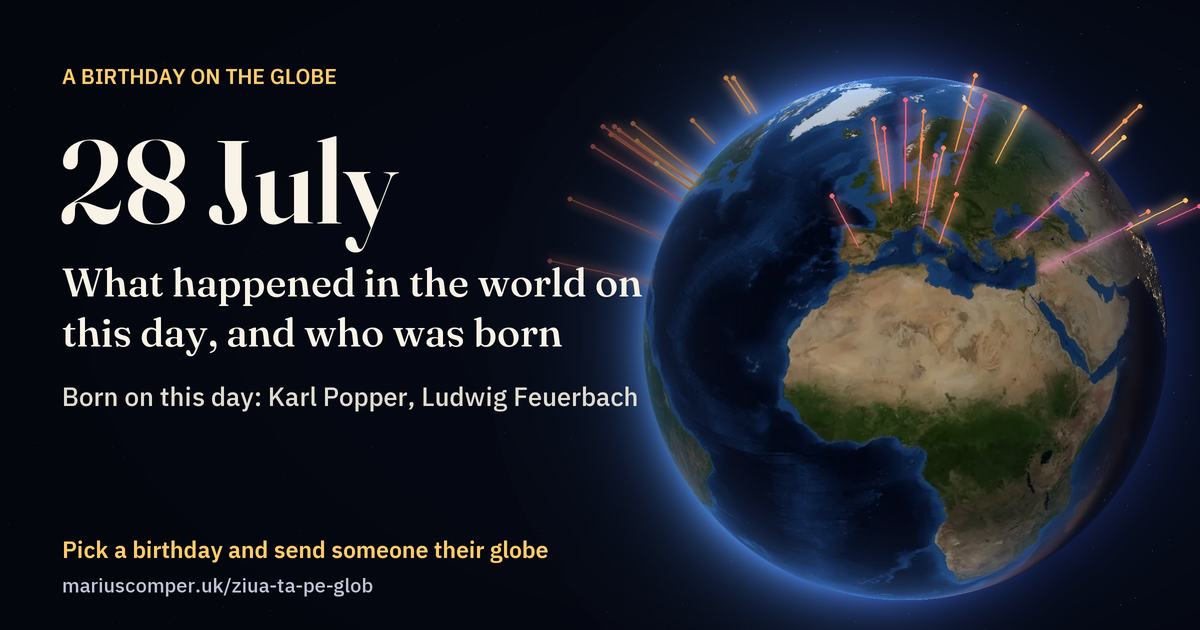
For 28 July, the English Wikipedia lists 54 events and 185 births. 33 of the events stand at their places as rays of light; six more are dashed circles, where the sentence links only to a country or a sea. The taller the ray, the longer ago it happened. The people born that day come further down, as blue points.
A birthday, yours or someone else’s:
Turn it into a greetingScroll: the globe turns to each place
The day you were born, on the globe.
Three things from your day
Scroll: your day first, then 28 July through the years
The Earth on 28 July
The picture on the globe was assembled by NASA from satellite photographs taken in July 2004: the snow, the ice and the green are those of the month.
On 28 July the Sun passes straight overhead at noon along the parallel of 19.0° north. In London, the day lasts about 15 hours 35 minutes.
Beyond 71° north the Sun no longer sets; beyond 71° south it no longer rises.
The line between day and night is tilted on the globe exactly as on this day of the year. On the dark side you can see the lights of towns.
Britain & Ireland · London
1911
The Australasian Antarctic Expedition began as the SY Aurora departed London.
On the map: London.
Europe · Salzburg
1940
At the Salzburg Conference, Adolf Hitler demanded the replacement of much of Slovakia's cabinet.
On the map: Salzburg.
Also on the day’s list of Wikipedia in Chinese.
Europe · Helsinki
1962
Beginning of the 8th World Festival of Youth and Students.
On the map: Helsinki.
Asia · Laguna
1571
La Laguna encomienda, known today as the Laguna province in the Philippines, is founded by the Spaniards as one of the oldest encomiendas (provinces) in the country.
On the map: Laguna.
Also on the day’s list of Wikipedia in Spanish.
North America · Port of Baltimore
1854
USS Constellation (1854), the last all-sail warship built by the United States Navy and current museum ship in Baltimore Harbor, is commissioned.
On the map: Port of Baltimore.
North America · Miami
1896
The city of Miami is incorporated.
On the map: Miami.
Also on the day’s list of Wikipedia in Chinese.
North America · Los Angeles
1984
Olympic Games: Games of the XXIII Olympiad: The summer Olympics were opened in Los Angeles.
On the map: Los Angeles.
Also on the day’s list of Wikipedia in Chinese.
28 July
What the other Wikipedias remember#
For these years the English list has nothing on this day. The events below come from the same day’s lists on Wikipedia in Chinese and were translated for this page.
From Wikipedia in Chinese · Amsterdam
1928
The 9th Olympic Games are held in Amsterdam, the Netherlands.
On the map: Amsterdam.
Translated from the list on Wikipedia in Chinese.
From Wikipedia in Chinese · 2012 Summer Olympics
2012
The 2012 Summer Olympic Games open.
On the map: 2012 Summer Olympics.
Translated from the list on Wikipedia in Chinese.
28 July
Born on 28 July#
The English Wikipedia lists 185 births for this day. The blue points are the birthplaces of 60 of these people: those written about in the most Wikipedia editions, where Wikidata gives a place of birth.
Born on 28 July
1902
Karl Popper, Austrian-English philosopher and academic (died 1994)
Place of birth: Vienna.
Born on 28 July
1804
Ludwig Feuerbach, German anthropologist and philosopher (died 1872)
Place of birth: Landshut.
Born on 28 July
1887
Marcel Duchamp, French-American painter and sculptor (died 1968)
Place of birth: Blainville-Crevon.
Born on 28 July
1866
Beatrix Potter, English children's book writer and illustrator (died 1943)
Place of birth: West Brompton.
Born in Britain and Ireland
1981
Michael Carrick, English footballer and coach
Place of birth: Wallsend.
Born in Britain and Ireland
1993
Cher Lloyd, English singer
Place of birth: Malvern.
Born in Britain and Ireland
1943
Richard Wright, English singer-songwriter and keyboard player (died 2008)
Place of birth: London.
28 July
Number one in the charts that week
At the cinema
An animal recorded that day
The record can be seen in GBIF, which brings together wildlife records from around the world.
All your birthdays
The weather that day
Data: Met Office Hadley Centre (HadCET); NOAA (GHCN-Daily, Mauna Loa).
Above the Earth
Sources: Jonathan McDowell, GCAT (launches); GFZ Potsdam (Kp index). Days are counted in Universal Time.
Football that day
International matches played that day:
Source: the “International football results” dataset kept by Mart Jürisoo (CC0).
Also that day
The earthquake’s page at the USGS
Source: the USGS catalogue. The day is counted in Universal Time (UTC).
In those days
Make a link for someone
Type the name, pick the day and the year of birth. The link opens straight on their day, with their name in the greeting.
The link carries the name, date and place typed here; anyone who gets it can see them.
Put another birthday beside it
Your mother’s, your child’s, a friend’s: the two days appear side by side.
Below: 28 July through the years.
The whole globe of the day
Drag the globe to turn it. Touch a ray or a point to read what happened there.
Everything Wikipedia lists for 28 July
The list is the English Wikipedia’s, in its own wording, as it stood in October 2026. 15 events have no place on the map: the sentence links to no place with coordinates, only to places too wide to mark, or to several countries.
- 484
Pope Felix III excommunicated patriarch Acacius of Constantinople for his support of the Henoticon and his support of the removal of patriarch John Talaia, leading to the Acacian schism.
no place on the mapWikipedia: Pope Felix III - 1148
Crusades: The siege of Damascus ended in a decisive victory for the Muslims, leading to the disintegration of the Second Crusade.
Asia · Siege of DamascusWikipedia: Siege of Damascus - 1364
Troops of the Republic of Pisa and the Republic of Florence clash in the Battle of Cascina.
Europe · CascinaWikipedia: Battle of Cascina - 1402
Ottoman-Timurid Wars: Battle of Ankara: Timur, ruler of Timurid Empire, defeats forces of the Ottoman Empire sultan Bayezid I.
Asia · Battle of AnkaraWikipedia: Battle of Ankara - 1540
Henry VIII of England marries his fifth wife, Catherine Howard.
no place on the mapWikipedia: Henry VIII - 1540
King Henry VIII of England had his chief minister Thomas Cromwell executed for treason and heresy.
no place on the mapWikipedia: Henry VIII - 1540
Thomas Cromwell is executed after having been condemned untried, using a bill of attainder which Cromwell had used against his opponents.
no place on the mapWikipedia: Thomas Cromwell - 1571
La Laguna encomienda, known today as the Laguna province in the Philippines, is founded by the Spaniards as one of the oldest encomiendas (provinces) in the country.
Asia · LagunaWikipedia: Encomienda - 1635
Eighty Years' War: The Spanish capture the strategic Dutch fortress of Schenkenschans.
Europe · Siege of SchenkenschansWikipedia: Eighty Years' War - 1656
Second Northern War: Battle of Warsaw begins.
Europe · Battle of WarsawWikipedia: Northern War of 1655–1660 - 1778
Constitution of the province of Cantabria ratified at the Assembly Hall in Bárcena la Puente, Reocín, Spain.
Europe · CantabriaWikipedia: Cantabria - 1794
French Revolution: Maximilien Robespierre and Louis Antoine de Saint-Just are executed by guillotine in Paris, France.
Europe · ParisWikipedia: French Revolution - 1808
Mahmud II became Sultan of the Ottoman Empire and Caliph of Islam.
no place on the mapWikipedia: Mahmud II - 1809
Peninsular War: Sir Arthur Wellesley's British, Portuguese and Spanish army repulse a French force led by Joseph Bonaparte in the Battle of Talavera.
Europe · Battle of TalaveraWikipedia: Peninsular War - 1821
José de San Martín declares the independence of Peru from Spain.
Latin America · PeruWikipedia: José de San Martín - 1854
USS Constellation (1854), the last all-sail warship built by the United States Navy and current museum ship in Baltimore Harbor, is commissioned.
North America · Port of BaltimoreWikipedia: United States Navy - 1864
American Civil War: In the Battle of Ezra Church, Confederate troops make a third unsuccessful attempt under General John Bell Hood to prevent Union forces led by General William T. Sherman from approaching Atlanta, Georgia.
North America · Battle of Ezra ChurchWikipedia: American Civil War - 1866
At the age of 18, Vinnie Ream becomes the first and youngest female artist to receive a commission from the United States government for a statue (of Abraham Lincoln).
no place on the mapWikipedia: Vinnie Ream - 1868
The 14th Amendment to the United States Constitution is certified, establishing African American citizenship and guaranteeing due process of law.
no place on the mapWikipedia: Fourteenth Amendment to the United States Constitution - 1883
A moderate earthquake measuring magnitude 4.3–5.2 strikes the Italian island of Ischia, killing over 2,300 people.
Europe · 1883 Casamicciola earthquakeWikipedia: 1883 Casamicciola earthquake - 1896
The city of Miami is incorporated.
North America · MiamiWikipedia: Miami - 1899
A Category 1 hurricane made landfall in Azua Province in the Dominican Republic, destroying three large schooners at Santo Domingo; only one crew member on the three vessels survived.
Latin America · Azua ProvinceWikipedia: 1899 Carrabelle hurricane - 1911
The Australasian Antarctic Expedition began as the SY Aurora departed London.
Britain & Ireland · LondonWikipedia: Australasian Antarctic Expedition - 1914
World War I: In the culmination of the July Crisis, Austria-Hungary declares war on the Kingdom of Serbia and begins the Great War.
Europe · July CrisisWikipedia: World War I - 1915
The United States begins a 19-year occupation of Haiti.
Latin America · HaitiWikipedia: United States occupation of Haiti - 1917
Anti-lynching movement: The Silent Parade takes place in New York City, in protest against murders, lynchings, and other violence directed towards African Americans.
North America · Silent ParadeWikipedia: Silent Parade - 1932
During the Great Depression, U.S. president Herbert Hoover orders the United States Army to forcibly evict the "Bonus Army" of World War I veterans gathered in Washington, D.C.
North America · Bonus ArmyWikipedia: Bonus Army - 1935
First flight of the Boeing B-17 Flying Fortress.
no place on the mapWikipedia: Boeing B-17 Flying Fortress - 1938
Hawaii Clipper disappears between Guam and Manila as the first loss of an airliner in trans-Pacific China Clipper service.
Oceans · Pan Am Flight 229Wikipedia: Pan Am Flight 229 - 1939
The Sutton Hoo helmet is discovered.
no place on the mapWikipedia: Sutton Hoo helmet - 1940
At the Salzburg Conference, Adolf Hitler demanded the replacement of much of Slovakia's cabinet.
Europe · SalzburgWikipedia: Salzburg Conference - 1942
World War II: Soviet leader Joseph Stalin issues Order No. 227. In response to alarming German advances, all those who retreat or otherwise leave their positions without orders to do so are to be tried in a military court, with punishment ranging from duty in a shtrafbat battalion, imprisonment in a Gulag, or execution.
Europe · Nazi GermanyWikipedia: World War II - 1943
World War II: Operation Gomorrah: The Royal Air Force bombs Hamburg, Germany causing a firestorm that kills 42,000 German civilians.
Europe · Bombing of Hamburg in World War IIWikipedia: Bombing of Hamburg in World War II - 1945
A U.S. Army B-25 bomber crashes into the 79th floor of the Empire State Building killing 14 and injuring 26.
North America · 1945 Empire State Building B-25 crashWikipedia: 1945 Empire State Building B-25 crash - 1957
Heavy rain and a mudslide in Isahaya, western Kyushu, Japan, kills 992.
Asia · Isahaya, NagasakiWikipedia: Kyushu - 1960
The German Volkswagen Act comes into force.
no place on the mapWikipedia: Volkswagen Act - 1962
Beginning of the 8th World Festival of Youth and Students.
Europe · HelsinkiWikipedia: 8th World Festival of Youth and Students - 1965
Vietnam War: U.S. president Lyndon B. Johnson announces his order to increase the number of United States troops in South Vietnam from 75,000 to 125,000.
Asia · South VietnamWikipedia: Vietnam War - 1973
Summer Jam at Watkins Glen: Nearly 600,000 people attend a rock festival at the Watkins Glen International Raceway.
North America · Watkins Glen InternationalWikipedia: Summer Jam at Watkins Glen - 1974
Spetsgruppa A, Russia's elite special force, was formed.
no place on the mapWikipedia: Alpha Group - 1976
The Tangshan earthquake measuring between 7.8 and 8.2 moment magnitude flattens Tangshan in the People's Republic of China, killing 242,769 and injuring 164,851.
Asia · 1976 Tangshan earthquakeWikipedia: 1976 Tangshan earthquake - 1984
Olympic Games: Games of the XXIII Olympiad: The summer Olympics were opened in Los Angeles.
North America · Los AngelesWikipedia: 1984 Summer Olympics - 1995
Two followers of the Indian mystic Rajneesh were convicted of a 1985 plot to assassinate Charles Turner, the U.S. attorney for the District of Oregon.
North America · 1985 Rajneeshee assassination plotWikipedia: 1985 Rajneeshee assassination plot - 1996
The remains of a prehistoric man are discovered near Kennewick, Washington. Such remains will be known as the Kennewick Man.
North America · Kennewick, WashingtonWikipedia: Prehistory - 2001
Australian Ian Thorpe becomes the first swimmer to win six gold medals at a single World Championship meeting.
no place on the mapWikipedia: Ian Thorpe - 2002
Nine coal miners trapped in the flooded Quecreek Mine in Somerset County, Pennsylvania, are rescued after 77 hours underground.
North America · Quecreek Mine rescueWikipedia: Quecreek Mine rescue - 2002
Pulkovo Aviation Enterprise Flight 9560 crashes after takeoff from Sheremetyevo International Airport in Moscow, Russia, killing 14 of the 16 people on board.
Europe · Pulkovo Aviation Enterprise Flight 9560Wikipedia: Pulkovo Aviation Enterprise Flight 9560 - 2005
Britain's costliest tornado struck Birmingham, injuring 39 people and causing £40 million of damage across the city.
no place on the mapWikipedia: 2005 Birmingham tornado - 2005
The Provisional Irish Republican Army calls an end to its thirty-year-long armed campaign against British rule in Northern Ireland.
Britain & Ireland · Northern IrelandWikipedia: Provisional Irish Republican Army - 2010
Airblue Flight 202 crashes into the Margalla Hills north of Islamabad, Pakistan, killing all 152 people aboard. It is the deadliest aviation accident in Pakistan history and the first involving an Airbus A321.
Asia · Airblue Flight 202Wikipedia: Airblue Flight 202 - 2011
While flying from Seoul, South Korea to Shanghai, China, Asiana Airlines Flight 991 develops an in-flight fire in the cargo hold. The Boeing 747-400F freighter attempts to divert to Jeju International Airport, but crashes into the sea South-West of Jeju island, killing both crew members on board.
Asia · Asiana Airlines Flight 991Wikipedia: Asiana Airlines Flight 991 - 2017
Nawaz Sharif was disqualified from office for life by Supreme Court of Pakistan after finding him guilty of corruption charges.
no place on the mapWikipedia: Nawaz Sharif - 2018
Australian Wendy Tuck becomes the first female skipper to win the Clipper Round the World Yacht Race.
no place on the mapWikipedia: Wendy Tuck - 2022
Catastrophic floods devastate Eastern Kentucky, resulting in 45 fatalities and causing damage to thousands of homes and businesses.
North America · Eastern Kentucky CoalfieldWikipedia: 2022 Appalachian floods
What the other Wikipedias remember
For these years the English list has nothing on this day. The events below come from the same day’s lists on Wikipedia in Chinese and were translated for this page.
- 1928
The 9th Olympic Games are held in Amsterdam, the Netherlands.
- 2012
The 2012 Summer Olympic Games open.
Britain & Ireland · 2012 Summer OlympicsTranslated from the list on Wikipedia in ChineseWikipedia: 2012年夏季奥林匹克运动会
Who was born on 28 July
In order of how many Wikipedia editions have an article about each. The first 60 of 185 are shown.
- 1954
Hugo Chávez, Venezuelan colonel and politician, President of Venezuela (died 2013)
SabanetaWikipedia: Hugo Chávez - 1902
Karl Popper, Austrian-English philosopher and academic (died 1994)
ViennaWikipedia: Karl Popper - 1804
Ludwig Feuerbach, German anthropologist and philosopher (died 1872)
LandshutWikipedia: Ludwig Feuerbach - 1952
Vajiralongkorn, King of Thailand
Amphorn Sathan Residential HallWikipedia: Vajiralongkorn - 1929
Jacqueline Kennedy Onassis, American journalist and socialite, 37th First Lady of the United States (died 1994)
SouthamptonWikipedia: Jacqueline Kennedy Onassis - 1971
Abu Bakr al-Baghdadi, Iraqi leader of the Islamic State of Iraq and the Levant (died 2019)
- 1993
Harry Kane, English footballer
WalthamstowWikipedia: Harry Kane - 1974
Alexis Tsipras, Greek engineer and politician, 186th Prime Minister of Greece
- 1887
Marcel Duchamp, French-American painter and sculptor (died 1968)
Blainville-CrevonWikipedia: Marcel Duchamp - 1866
Beatrix Potter, English children's book writer and illustrator (died 1943)
West BromptonWikipedia: Beatrix Potter - 1938
Alberto Fujimori, Peruvian engineer, academic, and politician, President of Peru (died 2024)
MirafloresWikipedia: Alberto Fujimori - 1915
Charles H. Townes, American physicist and academic, Nobel Prize laureate (died 2015)
GreenvilleWikipedia: Charles H. Townes - 1951
Santiago Calatrava, Spanish architect and engineer, designed the Athens Olympic Sports Complex
BenimàmetWikipedia: Santiago Calatrava - 1981
Michael Carrick, English footballer and coach
WallsendWikipedia: Michael Carrick - 1925
Baruch Samuel Blumberg, American physician and academic, Nobel Prize laureate (died 2011)
- 1874
Ernst Cassirer, Polish-American philosopher and academic (died 1945)
WrocławWikipedia: Ernst Cassirer - 1987
Pedro, Spanish footballer
Santa Cruz de TenerifeWikipedia: Pedro - 1938
Luis Aragonés, Spanish footballer, coach, and manager (died 2014)
MadridWikipedia: Luis Aragonés - 1993
Cher Lloyd, English singer
MalvernWikipedia: Cher Lloyd - 1943
Richard Wright, English singer-songwriter and keyboard player (died 2008)
- 1985
Mathieu Debuchy, French footballer
- 1958
Terry Fox, Canadian runner and activist (died 1981)
WinnipegWikipedia: Terry Fox - 1977
Manu Ginóbili, Argentinian basketball player
Bahía BlancaWikipedia: Manu Ginóbili - 1941
Peter Cullen, Canadian voice actor (died 2026)
MontrealWikipedia: Peter Cullen - 1954
Gerd Faltings, German mathematician and academic
- 1966
Liz Cheney, American politician, daughter of Dick Cheney
MadisonWikipedia: Liz Cheney - 1909
Malcolm Lowry, English novelist and poet (died 1957)
BirkenheadWikipedia: Malcolm Lowry - 1974
Elizabeth Berkley, American actress
Farmington HillsWikipedia: Elizabeth Berkley - 1609
Judith Leyster, Dutch painter (died 1660)
HaarlemWikipedia: Judith Leyster - 1844
Gerard Manley Hopkins, English poet (died 1889)
StratfordWikipedia: Gerard Manley Hopkins - 1969
Dana White, American businessman, president of the Ultimate Fighting Championship
ManchesterWikipedia: Dana White - 1941
Riccardo Muti, Italian conductor and educator
NaplesWikipedia: Riccardo Muti - 1945
Jim Davis, American cartoonist, created Garfield
FairmountWikipedia: Jim Davis - 1954
Steve Morse, American singer-songwriter and guitarist
HamiltonWikipedia: Steve Morse - 1922
Jacques Piccard, Belgian-Swiss oceanographer and engineer (died 2008)
Brussels metropolitan areaWikipedia: Jacques Piccard - 2000
Emile Smith Rowe, English footballer
CroydonWikipedia: Emile Smith Rowe - 1927
John Ashbery, American poet (died 2017)
RochesterWikipedia: John Ashbery - 1984
John David Washington, American actor and football player
Toluca LakeWikipedia: John David Washington - 1947
Peter Cosgrove, Australian general and politician, 26th Governor General of Australia
- 1966
Miguel Ángel Nadal, Spanish footballer
- 1987
Yevhen Khacheridi, Ukrainian-Greek footballer
MelitopolWikipedia: Yevhen Khacheridi - 1458
Jacopo Sannazaro, Italian poet, humanist and epigrammist (died 1530)
- 1937
Francis Veber, French director and screenwriter
Neuilly-sur-SeineWikipedia: Francis Veber - 1969
Alexis Arquette, American actress (died 2016)
Los AngelesWikipedia: Alexis Arquette - 1990
Soulja Boy, American rapper, producer, and actor
ChicagoWikipedia: Soulja Boy - 1938
Chuan Leekpai, Thai lawyer and politician, 20th Prime Minister of Thailand
- 1975
Leonor Watling, Spanish actress
- 1943
Bill Bradley, American basketball player and politician
Crystal CityWikipedia: Bill Bradley - 1964
Lori Loughlin, American actress
QueensWikipedia: Lori Loughlin - 1974
Afroman, American rapper and comedian
PalmdaleWikipedia: Afroman - 1976
Jacoby Shaddix, American singer-songwriter
MariposaWikipedia: Jacoby Shaddix - 1750
Fabre d'Églantine, French actor, playwright, and politician (died 1794)
CarcassonneWikipedia: Fabre d'Églantine - 1860
Grand Duchess Anastasia Mikhailovna of Russia (died 1922)
- 1938
Arsen Dedić, Croatian singer-songwriter and poet (died 2015)
ŠibenikWikipedia: Arsen Dedić - 1951
Ray Kennedy, English footballer (died 2021)
Seaton DelavalWikipedia: Ray Kennedy - 1872
Albert Sarraut, French journalist and politician, 106th Prime Minister of France (died 1962)
BordeauxWikipedia: Albert Sarraut - 1901
Rudy Vallée, American actor, singer, and saxophonist (died 1986)
Island PondWikipedia: Rudy Vallée - 1947
Sally Struthers, American actress
PortlandWikipedia: Sally Struthers - 1982
Cain Velasquez, Mexican-American mixed martial artist and wrestler
SalinasWikipedia: Cain Velasquez - 1984
Ali Krieger, American soccer player
AlexandriaWikipedia: Ali Krieger
What is celebrated on 28 July
- Christian feast day: Alphonsa Muttathupadathu (Syro-Malabar Catholic Church)
- Christian feast day: Botvid
- Christian feast day: Jaime Hilario Barbal
- Christian feast day: Johann Sebastian Bach, George Frederick Handel, Henry Purcell (Episcopal Church commemoration)
- Christian feast day: Johann Sebastian Bach, Heinrich Schütz, George Frederick Handel (Lutheran commemoration)
- Christian feast day: Nazarius and Celsus
- Christian feast day: Pedro Poveda Castroverde
- Christian feast day: Pope Victor I
- Christian feast day: Samson of Dol
- Christian feast day: July 28 (Eastern Orthodox liturgics)
- Day of Commemoration of the Great Upheaval (Canada)
- Fiestas Patrias, celebrates the independence of Peru from Spain by General José de San Martín in 1821.
- Liberation Day (San Marino)
- Ólavsøka Eve (Faroe Islands)
A greeting link for someone
Type a name and, if you like, the year of birth. The link opens with a greeting, and beside each event it says how old the person turned that day, or how many years before their birth it happened.
The name and the year go only into the link you send.
All 366 days
How the globe is made
Where the events come from
Each edition of this page uses the day’s list from Wikipedia in its own language: Romanian, English, Spanish, Chinese. The lists are written by volunteers and differ from one edition to the next; the text of each event is Wikipedia’s, with a link to the article. A row that appears twice in a list is shown once. The lists have not been checked event by event: they are Wikipedia’s, mistakes included.
For events before 1582, and for countries that moved to the Gregorian calendar later (Britain in 1752, Russia in 1918), the same day may be counted Old Style in one list and New Style in another.
The chapter “What the other Wikipedias remember” adds up to five events a day from the lists of the other three editions, only for years in which the English list has nothing on that day. They were translated for this page, passed the same filters as the tour, and are not counted among the events of the English list.
How an event gets onto the map
The place comes from Wikidata. If the sentence links to the article about the event itself (a battle, an opening, an earthquake), dated to the same year, the ray stands on its coordinates or on those of its location. Otherwise it stands on the first place the sentence links to: a town, a building, a mountain, an island. This second step can be wrong: sometimes the sentence only mentions the place. That is why the page says, under each event, which place the ray stands on.
When the sentence links to a single state or province, or to a single sea, lake or desert larger than 5,000 km², the globe shows a dashed circle, not a ray. The circle has the area Wikidata gives, with its radius kept between 1.2° and 16°, or a radius of 4.5° when Wikidata gives no area; it says only that the sentence links to that place. Organisations, ships, spacecraft, museum objects, rivers, mountain ranges, languages and continents are never used as places. When a sentence names several states and no exact place, the event stays in the list only.
What the height means
The height of a ray shows how many years have passed, on a logarithmic scale: 10 years, 100 years and 1,000 years are equal steps apart; anything older than about 2,600 years has the tallest ray. The colour runs from pale yellow for recent years to violet for antiquity.
Where the tour stops
In each region the tour stops at up to three events (five in Britain and Ireland), chosen mainly by three things: whether Wikipedia’s editors put the event in the “On this day” box of their main page (the English, Spanish and Chinese editions), how many Wikipedia editions have an article about it, and how many of the four lists include it. Events whose sentence or article is about a war, an attack, a crime or a disaster are left out of the tour; they stay in the whole list, in Wikipedia’s wording. The filter is a list of words and a list of Wikidata types, so it can miss some.
The tour of births names the people with articles in the most editions and leaves aside those whom the list or Wikidata describes as rulers, politicians, commanders, leaders of movements or criminals; they stay in the list.
The Earth and the Sun
The daytime images are NASA’s Blue Marble Next Generation mosaics, one for each month of 2004; the night side is Black Marble 2016. The tilt of the line between day and night is computed for the day; the hour is chosen so that the place being read is in daylight. The latitude where the Sun stands overhead is the average of the four years of the leap cycle; in a given year it can differ by up to 0.4°.
The day you were born
The number ones come from the weekly lists on Wikipedia: Billboard for the United States (from 1940; the Hot 100 from August 1958), the UK Singles Chart (from November 1952), Los 40 Principales for Spain (from July 1966) and, for Romania, the Romanian Top 100 and Airplay 100 (2001–2021, with missing weeks). The page shows the chart of the week in which the day of birth falls, with its date; Billboard and the UK chart are dated at the end of their week. For Romania before 2001 and for China these sources have no weekly chart.
The films are those that reached cinemas in the United States up to ten days before or three days after that day (some of them in a few cinemas at first), from the English Wikipedia’s yearly lists (from 1968), in order of how many editions have an article about them. The events “in those days” are the ones on the neighbouring days’ lists that carry the year of birth, passed through the same filter as the tour.
The day of birth, year included
The Moon, the star sign and the constellation are worked out by the page itself, for noon Universal Time on the day. The lit part of the Moon is rounded and can differ by a few per cent from that at the hour of birth. The sign follows the usual zodiac of twelve equal parts starting at the March equinox; the constellation is the one the Sun actually stood in front of, by the borders set by the International Astronomical Union, and within a day of a border the page does not name it. When the Sun changes sign while it is that day anywhere on Earth, the page gives the moment of crossing, rounded to ten minutes and accurate to within about a quarter of an hour, and the clock time in a few cities, with the time zone and summer time of that year.
The year in the Chinese calendar is the one your device’s own calendar gives for the date, checked against the Hong Kong Observatory’s tables. “All your birthdays” uses the same sources as the rest of the chapter for the same day in every year since the birth: the temperature, well-known launches that took place on that very day, matches of the teams the edition follows, snow deeper than 10 cm and strong geomagnetic storms. The three things at the top and the four on the picture are chosen in a fixed order (the song, the animal, a full Moon, a well-known launch before an ordinary earthquake); on the picture you can change them.
When the link carries a year of birth, the page adds a few things about that exact day. The weather is the Met Office’s Central England temperature record and the readings from New York’s Central Park; the “usual high” is the average of the daily highs of 1961–1990 for that date, with two days either side. The carbon dioxide figure is the monthly mean at the Mauna Loa observatory, where measurements begin in March 1958.
The earthquake is the one with the largest magnitude in the USGS catalogue for that day, counted in Universal Time. Before the 1960s the catalogue has gaps even above magnitude 5.5, so in the older years many days have no earthquake. The page gives only the magnitude and the place: the country the epicentre falls in or, when the epicentre is at sea within 300 km of a coast, the nearest country; farther out, only the ocean.
The launches are those that reached orbit or left for the Moon and the planets, from Jonathan McDowell’s GCAT catalogue. If nothing left that day, the page shows the nearest launch within three days before or after, and says how many days away it was. The geomagnetic storm appears only when the Kp index reached at least 5 in one of the day’s eight three-hour intervals.
The animal comes from GBIF: an observation made by a person (the animal seen or heard, or its tracks), dated to that exact day, with coordinates and a CC0 or CC BY licence. Only a few hundred well-known species are searched (mammals, birds, turtles, butterflies); of those noted that day, mammals and species with articles in many Wikipedia editions come first; birds noted almost every day, and species used recently, wait their turn. Observations dated 1 January are left out, because records without a day are often filed there. An observation shows that the animal was recorded there, not how many animals there were.
The matches are those between national teams. Only matches of England, Scotland, Wales, Northern Ireland, the Republic of Ireland, the United States, Canada and Australia are shown, along with those at the big final tournaments. The picture to send is drawn in the page from the day’s globe and the facts above, and stays on your device until you send it.
Sources
- Events, births and holidays: the day’s page on Wikipedia, text under CC BY-SA 4.0.
- Coordinates, places of birth and the number of editions: Wikidata (CC0).
- The Earth by day: NASA Blue Marble Next Generation. The Earth by night: NASA Black Marble 2016.
- Borders and regions: Natural Earth.
- World population and births per year: UN World Population Prospects 2024.
- Charts and films: Wikipedia’s lists for Billboard, the UK Singles Chart, Los 40 Principales, Romanian Top 100, Airplay 100 and American films by year (CC BY-SA 4.0).
- Weather: Met Office Hadley Centre, HadCET (Open Government Licence) and NOAA GHCN-Daily, New York Central Park. Carbon dioxide: NOAA Global Monitoring Laboratory, Mauna Loa.
- Earthquakes: the USGS catalogue. Launches: Jonathan McDowell, GCAT (CC BY). Kp index: GFZ Potsdam (CC BY 4.0). Matches: International football results, Mart Jürisoo (CC0).
- Animal observations: GBIF, with a link to each record; species names come from Wikidata.