A birthday on the globe
19 October on the globe: what happened in the world on this day, and who was born
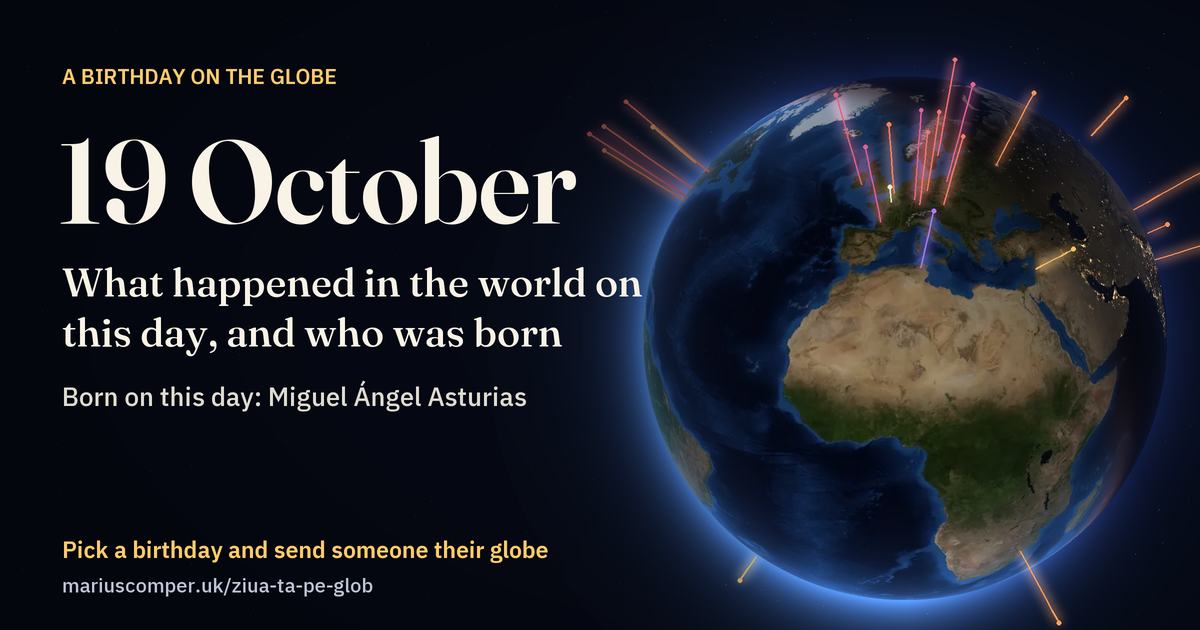
For 19 October, the English Wikipedia lists 61 events and 254 births. 24 of the events stand at their places as rays of light; two more are dashed circles, where the sentence links only to a country or a sea. The taller the ray, the longer ago it happened. The people born that day come further down, as blue points.
A birthday, yours or someone else’s:
Turn it into a greetingScroll: the globe turns to each place
The day you were born, on the globe.
Three things from your day
Scroll: your day first, then 19 October through the years
The Earth on 19 October
The picture on the globe was assembled by NASA from satellite photographs taken in October 2004: the snow, the ice and the green are those of the month.
On 19 October the Sun passes straight overhead at noon along the parallel of 9.9° south. In London, the day lasts about 10 hours 30 minutes.
Beyond 80° south the Sun no longer sets; beyond 80° north it no longer rises.
The line between day and night is tilted on the globe exactly as on this day of the year. On the dark side you can see the lights of towns.
Europe · Heidelberg University
1386
The Universität Heidelberg holds its first lecture, making it the oldest German university.
On the map: Heidelberg University.
Also on the day’s list of Wikipedia in Spanish.
Europe · Drottningholm
1791
Treaty of Drottningholm, between Sweden and Russia
On the map: Drottningholm.
North America · Presidents North Carolina Gave the Nation
1948
Presidents North Carolina Gave the Nation, a monument honoring three presidents of the United States, was dedicated at the North Carolina State Capitol in Raleigh, North Carolina.
On the map: Presidents North Carolina Gave the Nation.
19 October
What the other Wikipedias remember#
For these years the English list has nothing on this day. The events below come from the same day’s lists on Wikipedia in Romanian and were translated for this page.
From Wikipedia in Romanian · Dresden
1845
The opera Tannhäuser by the composer Richard Wagner premieres in Dresden, Germany.
On the map: Dresden.
Translated from the list on Wikipedia in Romanian.
19 October
Born on 19 October#
The English Wikipedia lists 254 births for this day. The blue points are the birthplaces of 60 of these people: those written about in the most Wikipedia editions, where Wikidata gives a place of birth.
Born on 19 October
1899
Miguel Ángel Asturias, Guatemalan journalist, author, and poet, Nobel Prize laureate (died 1974)
Place of birth: Guatemala City.
Born on 19 October
1910
Subrahmanyan Chandrasekhar, Indian-American astrophysicist, astronomer, and mathematician, Nobel Prize laureate (died 1995)
Place of birth: Lahore.
Born on 19 October
1946
Philip Pullman, English author and academic
Place of birth: Norwich.
Born on 19 October
1433
Marsilio Ficino, Italian astrologer and philosopher (died 1499)
Place of birth: Figline Valdarno.
Born on 19 October
1940
Michael Gambon, Irish-British actor (died 2023)
Place of birth: Dublin.
Born in Britain and Ireland
1945
Angus Deaton, Scottish-American economist and academic, Nobel Prize laureate
Place of birth: Edinburgh.
Born in Britain and Ireland
1605
Thomas Browne, English physician and author (died 1682)
Place of birth: London.
Born in Britain and Ireland
1954
Sam Allardyce, English footballer and manager
Place of birth: Dudley.
19 October
Number one in the charts that week
At the cinema
An animal recorded that day
The record can be seen in GBIF, which brings together wildlife records from around the world.
All your birthdays
The weather that day
Data: Met Office Hadley Centre (HadCET); NOAA (GHCN-Daily, Mauna Loa).
Above the Earth
Sources: Jonathan McDowell, GCAT (launches); GFZ Potsdam (Kp index). Days are counted in Universal Time.
Football that day
International matches played that day:
Source: the “International football results” dataset kept by Mart Jürisoo (CC0).
Also that day
The earthquake’s page at the USGS
Source: the USGS catalogue. The day is counted in Universal Time (UTC).
In those days
Make a link for someone
Type the name, pick the day and the year of birth. The link opens straight on their day, with their name in the greeting.
The link carries the name, date and place typed here; anyone who gets it can see them.
Put another birthday beside it
Your mother’s, your child’s, a friend’s: the two days appear side by side.
Below: 19 October through the years.
The whole globe of the day
Drag the globe to turn it. Touch a ray or a point to read what happened there.
Everything Wikipedia lists for 19 October
The list is the English Wikipedia’s, in its own wording, as it stood in October 2026. 35 events have no place on the map: the sentence links to no place with coordinates, only to places too wide to mark, or to several countries.
- 202 BC
Second Punic War: At the Battle of Zama, Roman legions under Scipio Africanus defeat Hannibal Barca, leader of the army defending Carthage.
Africa · Battle of ZamaWikipedia: Battle of Zama - 439
The Vandals, led by King Gaiseric, take Carthage in North Africa.
no place on the mapWikipedia: Gaiseric - 1386
The Universität Heidelberg holds its first lecture, making it the oldest German university.
Europe · Heidelberg UniversityWikipedia: Heidelberg University - 1453
Hundred Years' War: Three months after the Battle of Castillon, England loses its last possessions in southern France.
Europe · Battle of CastillonWikipedia: Battle of Castillon - 1466
The Thirteen Years' War between Poland and the Teutonic Order ends with the Second Treaty of Thorn.
Europe · ToruńWikipedia: Second Peace of Thorn - 1469
Ferdinand II of Aragon marries Isabella I of Castile, a marriage that paves the way to the unification of Aragon and Castile into a single country, Spain.
no place on the mapWikipedia: Ferdinand II of Aragon - 1512
Martin Luther becomes a doctor of theology.
no place on the mapWikipedia: Martin Luther - 1579
James VI of Scotland is celebrated as an adult ruler by a festival in Edinburgh.
no place on the mapWikipedia: Entry of James VI into Edinburgh - 1596
The Spanish ship San Felipe runs aground on the coast of Japan and its cargo is confiscated by local authorities.
Asia · ShikokuWikipedia: San Felipe incident - 1649
New Ross town in Ireland surrenders to Oliver Cromwell.
Britain & Ireland · New RossWikipedia: New Ross - 1662
An English Buccaneer force led by Royal Navy commodore Christopher Myngs launches an attack on Santiago de Cuba which is subsequently sacked.
no place on the mapWikipedia: Raid on Santiago de Cuba - 1752
The Pennsylvania Gazette published a statement by Benjamin Franklin describing a kite experiment to determine the electrical nature of lightning.
no place on the mapWikipedia: The Pennsylvania Gazette - 1781
American Revolutionary War: The siege of Yorktown comes to an end.
North America · Siege of YorktownWikipedia: Siege of Yorktown - 1789
John Jay is sworn in as the first Chief Justice of the United States.
no place on the mapWikipedia: John Jay - 1791
Treaty of Drottningholm, between Sweden and Russia
Europe · DrottningholmWikipedia: Treaty of Drottningholm - 1805
War of the Third Coalition: Austrian General Mack surrenders his army to Napoleon at the Battle of Ulm.
Europe · Battle of UlmWikipedia: Battle of Ulm - 1812
The French invasion of Russia fails when Napoleon begins his retreat from Moscow.
no place on the mapWikipedia: French invasion of Russia - 1813
War of the Sixth Coalition: Napoleon is forced to retreat from Germany after the Battle of Leipzig.
Europe · Battle of LeipzigWikipedia: Battle of Leipzig - 1847
The novel Jane Eyre is published in London.
no place on the mapWikipedia: Jane Eyre - 1864
American Civil War: Confederate agents based in Canada rob three banks in Saint Albans, Vermont.
North America · St. Albans RaidWikipedia: St. Albans Raid - 1864
American Civil War: The Battle of Cedar Creek ends the last Confederate threat to Washington, DC.
North America · Battle of Cedar CreekWikipedia: American Civil War - 1866
In accordance with the Treaty of Vienna, Austria cedes Veneto and Mantua to France, which immediately awards them to Italy in exchange for the earlier Italian acquiescence to the French annexation of Savoy and Nice.
Europe · ViennaWikipedia: Treaty of Vienna - 1900
Max Planck discovers Planck's law of black-body radiation.
no place on the mapWikipedia: Max Planck - 1912
Italo-Turkish War: Italy takes possession of what is now Libya from the Ottoman Empire.
no place on the mapWikipedia: Italo-Turkish War - 1914
World War I: The First Battle of Ypres begins.
Europe · First Battle of YpresWikipedia: World War I - 1921
The Portuguese Prime Minister and several officials are murdered in the Bloody Night coup.
no place on the mapWikipedia: Bloody Night - 1922
British Conservative MPs vote to terminate the coalition government with the Liberal Party.
no place on the mapWikipedia: Lloyd George ministry - 1935
The League of Nations places economic sanctions on Italy for its invasion of Ethiopia.
no place on the mapWikipedia: Second Italo-Ethiopian War - 1936
New York World-Telegram reporter Herbert Ekins won a race against two other New York newspaper journalists to travel around the world on commercial airline flights. He accomplished the feat in 18 ½ days. His opponents were New York Evening Journal reporter Dorothy Kilgallen, who finished in second place, and New York Times reporter Leo Kieran.
no place on the mapWikipedia: New York World-Telegram - 1943
Streptomycin, the first antibiotic remedy for tuberculosis, is isolated by researchers at Rutgers University.
no place on the mapWikipedia: Streptomycin - 1943
The cargo vessel Sinfra is attacked by Allied aircraft at Crete and sunk. Two thousand and ninety-eight Italian prisoners of war drown with it.
no place on the mapWikipedia: MS Sinfra - 1944
A coup is launched against Juan Federico Ponce Vaides, beginning the ten-year Guatemalan Revolution.
no place on the mapWikipedia: Guatemalan Revolution - 1944
United States forces land in the Philippines.
Asia · Battle of LeyteWikipedia: Battle of Leyte - 1948
Presidents North Carolina Gave the Nation, a monument honoring three presidents of the United States, was dedicated at the North Carolina State Capitol in Raleigh, North Carolina.
North America · Presidents North Carolina Gave the NationWikipedia: Presidents North Carolina Gave the Nation - 1950
China defeats the Tibetan Army at Chambo.
Asia · Battle of ChamdoWikipedia: Battle of Chamdo - 1950
Iran becomes the first country to accept technical assistance from the United States under the Point Four Program.
no place on the mapWikipedia: Point Four Program - 1950
Korean War: The Battle of Pyongyang ends in a United Nations victory. Hours later, the Chinese Army begins crossing the border into Korea.
Asia · Battle of PyongyangWikipedia: Battle of Pyongyang - 1953
Ray Bradbury's Fahrenheit 451 is published.
no place on the mapWikipedia: Ray Bradbury - 1955
The General Assembly of the European Broadcasting Union approves the staging of the first Eurovision Song Contest.
no place on the mapWikipedia: History of the Eurovision Song Contest - 1956
The Soviet Union and Japan sign a Joint Declaration, officially ending the state of war between the two countries that had existed since August 1945.
Europe · MoscowWikipedia: Soviet–Japanese Joint Declaration of 1956 - 1960
The United States imposes a near-total trade embargo against Cuba.
no place on the mapWikipedia: United States embargo against Cuba - 1965
A group of ethnic Hutu military officers failed in their attempt to overthrow the Burundian government.
no place on the mapWikipedia: 1965 Burundian coup attempt - 1965
Vietnam War: The Siege of Plei Me began with the first major confrontation between soldiers of the North Vietnamese Army and the U.S. Army.
Asia · Siege of Plei MeWikipedia: Vietnam War - 1973
President Nixon rejects an Appeals Court decision that he turn over the Watergate tapes.
no place on the mapWikipedia: Nixon White House tapes - 1974
Niue becomes a self-governing colony of New Zealand.
no place on the mapWikipedia: Niue Constitution Act - 1986
The president of Mozambique and a prominent leader of FRELIMO, along with 33 others, die when their aircraft crashes into the Lebombo Mountains.
Africa · 1986 Mozambican Tupolev Tu-134 crashWikipedia: 1986 Mozambican Tupolev Tu-134 crash - 1987
Black Monday: The Dow Jones Industrial Average falls by 22%, 508 points.
no place on the mapWikipedia: Black Monday - 1987
The United States Navy conducts Operation Nimble Archer, an attack on two Iranian oil platforms in the Persian Gulf.
Asia · Persian GulfWikipedia: Operation Nimble Archer - 1988
The British government imposes a broadcasting ban on television and radio interviews with members of Sinn Féin and eleven Irish republican and Ulster loyalist paramilitary groups.
no place on the mapWikipedia: 1988–1994 British broadcasting voice restrictions - 1989
The convictions of the Guildford Four are quashed by the Court of Appeal of England and Wales, after they had spent 15 years in prison.
no place on the mapWikipedia: Guildford Four and Maguire Seven - 2001
SIEV X, an Indonesian fishing boat en route to Christmas Island, carrying over 400 migrants, sinks in international waters with the loss of 353 people.
no place on the mapWikipedia: SIEV X - 2003
Mother Teresa is beatified by Pope John Paul II.
no place on the mapWikipedia: Mother Teresa - 2004
Thirteen people are killed when Corporate Airlines Flight 5966 crashes in Adair County, Missouri, while on approach to Kirksville Regional Airport.
North America · Corporate Airlines Flight 5966Wikipedia: Corporate Airlines Flight 5966 - 2005
Hurricane Wilma becomes the most intense Atlantic hurricane on record with a minimum pressure of 882 mb.
no place on the mapWikipedia: Hurricane Wilma - 2005
Saddam Hussein goes on trial in Baghdad for crimes against humanity.
no place on the mapWikipedia: Saddam Hussein - 2012
A bomb explosion kills eight people and injures 110 more in Lebanon.
Asia · BeirutWikipedia: Assassination of Wissam al-Hassan - 2013
British YouTube collective the Sidemen were formed as a Rockstar Games Social Club group in Grand Theft Auto Online.
no place on the mapWikipedia: YouTube - 2013
One hundred and five people are injured in a train crash in Buenos Aires.
no place on the mapWikipedia: 2013 Buenos Aires train crash - 2017
Canadian astronomer Robert Weryk discovered ʻOumuamua, the first known interstellar object detected passing through the Solar System.
no place on the mapWikipedia: Robert Weryk - 2019
Members of Parliament met at the House of Lords to discuss the United Kingdom's Brexit deal, this was the first Saturday sitting in Parliament since 3 April 1982 during the Falklands War.
Latin America · Falklands WarWikipedia: Falklands War - 2025
Pieces of the French Crown Jewels are successfully stolen during a heist on the Louvre Museum in Paris..
Europe · 2025 Louvre heistWikipedia: 2025 Louvre heist
What the other Wikipedias remember
For these years the English list has nothing on this day. The events below come from the same day’s lists on Wikipedia in Romanian and were translated for this page.
- 1845
The opera Tannhäuser by the composer Richard Wagner premieres in Dresden, Germany.
Who was born on 19 October
In order of how many Wikipedia editions have an article about each. The first 60 of 254 are shown.
- 1899
Miguel Ángel Asturias, Guatemalan journalist, author, and poet, Nobel Prize laureate (died 1974)
Guatemala CityWikipedia: Miguel Ángel Asturias - 1910
Subrahmanyan Chandrasekhar, Indian-American astrophysicist, astronomer, and mathematician, Nobel Prize laureate (died 1995)
- 1931
John le Carré, English intelligence officer and author (died 2020)
- 1946
Philip Pullman, English author and academic
NorwichWikipedia: Philip Pullman - 1433
Marsilio Ficino, Italian astrologer and philosopher (died 1499)
Figline ValdarnoWikipedia: Marsilio Ficino - 1940
Michael Gambon, Irish-British actor (died 2023)
- 1945
John Lithgow, American actor
RochesterWikipedia: John Lithgow - 1966
Jon Favreau, American actor, director, and screenwriter
QueensWikipedia: Jon Favreau - 1969
Pedro Castillo, Peruvian politician, President of Peru
- 1983
Rebecca Ferguson, Swedish actress
StockholmWikipedia: Rebecca Ferguson - 1945
Angus Deaton, Scottish-American economist and academic, Nobel Prize laureate
EdinburghWikipedia: Angus Deaton - 1605
Thomas Browne, English physician and author (died 1682)
LondonWikipedia: Thomas Browne - 1916
Jean Dausset, French-Spanish immunologist and academic, Nobel Prize laureate (died 2009)
ToulouseWikipedia: Jean Dausset - 1882
Umberto Boccioni, Italian painter and sculptor (died 1916)
Reggio CalabriaWikipedia: Umberto Boccioni - 1969
Trey Parker, American actor, animator, producer, and screenwriter
ConiferWikipedia: Trey Parker - 1981
Heikki Kovalainen, Finnish race car driver
SuomussalmiWikipedia: Heikki Kovalainen - 1958
Hiromi Hara, Japanese footballer and manager
KuroisoWikipedia: Hiromi Hara - 1944
Peter Tosh, Jamaican singer-songwriter and guitarist (died 1987)
Grange HillWikipedia: Peter Tosh - 1960
Takeshi Koshida, Japanese footballer
KanazawaWikipedia: Takeshi Koshida - 1895
Lewis Mumford, American historian, sociologist, and philosopher (died 1990)
FlushingWikipedia: Lewis Mumford - 1913
Vinicius de Moraes, Brazilian poet, playwright, and composer (died 1980)
Gávea DistrictWikipedia: Vinicius de Moraes - 1962
Evander Holyfield, American boxer and actor
- 1954
Sam Allardyce, English footballer and manager
DudleyWikipedia: Sam Allardyce - 1961
Sunny Deol, Indian actor and producer
SahnewalWikipedia: Sunny Deol - 1976
Omar Gooding, American actor and producer
Los AngelesWikipedia: Omar Gooding - 1945
Divine, American drag queen performer, and actor (died 1988)
BaltimoreWikipedia: Divine - 1934
Yakubu Gowon, Nigerian general and politician, 3rd Head of State of Nigeria
- 1977
Jason Reitman, Canadian-American director, producer, and screenwriter
MontrealWikipedia: Jason Reitman - 1989
Miroslav Stoch, Slovak footballer
- 1784
Leigh Hunt, English poet and critic (died 1859)
SouthgateWikipedia: Leigh Hunt - 1916
Emil Gilels, Ukrainian-Russian pianist (died 1985)
- 1858
George Albert Boulenger, Belgian-English zoologist and botanist (died 1937)
- 1909
Marguerite Perey, French physicist and academic (died 1975)
ChicagoWikipedia: Marguerite Perey - 1927
Pierre Alechinsky, Belgian painter and illustrator
BrusselsWikipedia: Pierre Alechinsky - 1973
Okan Buruk, Turkish footballer and manager
IstanbulWikipedia: Okan Buruk - 1952
Verónica Castro, Mexican actress and singer
Mexico CityWikipedia: Verónica Castro - 1962
Tracy Chevalier, American-English author
Washington, D.C.Wikipedia: Tracy Chevalier - 1959
Nir Barkat, Israeli businessman and politician, Mayor of Jerusalem
JerusalemWikipedia: Nir Barkat - 1976
Desmond Harrington, American actor
SavannahWikipedia: Desmond Harrington - 1977
Habib Beye, French-Senegalese footballer
SuresnesWikipedia: Habib Beye - 1982
Gillian Jacobs, American actress and director
PittsburghWikipedia: Gillian Jacobs - 1977
Raúl Tamudo, Spanish footballer
Santa Coloma de GramenetWikipedia: Raúl Tamudo - 1925
Czesław Kiszczak, Polish general and politician, 11th Prime Minister of the People's Republic of Poland (died 2015)
RoczynyWikipedia: Czesław Kiszczak - 1582
Dmitry of Uglich, Russian crown prince and saint (died 1591)
- 1910
Farid al-Atrash, Syrian actor and singer (died 1980)
SuwaydaWikipedia: Farid al-Atrash - 1914
Juanita Moore, American actress (died 2014)
GreenwoodWikipedia: Juanita Moore - 1918
Russell Kirk, American theorist and author (died 1994)
PlymouthWikipedia: Russell Kirk - 1956
Carlo Urbani, Italian physician (died 2003)
CastelplanioWikipedia: Carlo Urbani - 1978
Enrique Bernoldi, Brazilian race car driver
CuritibaWikipedia: Enrique Bernoldi - 1958
Michael Steele, American journalist and politician, 7th Lieutenant Governor of Maryland
Joint Base AndrewsWikipedia: Michael Steele - 1992
Lil Durk, American rapper
ChicagoWikipedia: Lil Durk - 1966
Dimitris Lyacos, Greek poet and playwright
- 1967
Yoko Shimomura, Japanese pianist and composer
Hyōgo PrefectureWikipedia: Yoko Shimomura - 1984
Danka Barteková, Slovak skeet shooter
TrenčínWikipedia: Danka Barteková - 1969
Erwin Sánchez, Bolivian footballer and manager
Santa Cruz de la SierraWikipedia: Erwin Sánchez - 1970
Chris Kattan, American actor, producer, and screenwriter
Culver CityWikipedia: Chris Kattan - 1976
Hiroshi Sakai, Japanese footballer
Mie PrefectureWikipedia: Hiroshi Sakai - 1989
Mindaugas Kuzminskas, Lithuanian basketball player
- 1276
Prince Hisaaki of Japan (died 1328)
Heian-kyōWikipedia: Prince Hisaaki - 1658
Adolphus Frederick II, Duke of Mecklenburg-Strelitz (died 1704)
What is celebrated on 19 October
- Christian feast day: Aaron (Coptic Orthodox Church of Alexandria)
- Christian feast day: Aquilinus of Évreux
- Christian feast day: Desiderius (Didier) of Auxerre
- Christian feast day: Frideswide
- Christian feast day: Henry Martyn (Anglican Communion)
- Christian feast day: Isaac Jogues, Jean de Brébeuf, and Companions
- Christian feast day: Blessed Jerzy Popiełuszko
- Christian feast day: Paul of the Cross
- Christian feast day: Ptolemaeus and Lucius
- Christian feast day: Varus
- Christian feast day: Veranus of Cavaillon
- Christian feast day: William Carey (Episcopal Church)
- Christian feast day: October 19 (Eastern Orthodox liturgics)
- Constitution Day, in honor of the country's independence (self-governing in free association with New Zealand) in 1974. (Niue)
A greeting link for someone
Type a name and, if you like, the year of birth. The link opens with a greeting, and beside each event it says how old the person turned that day, or how many years before their birth it happened.
The name and the year go only into the link you send.
All 366 days
How the globe is made
Where the events come from
Each edition of this page uses the day’s list from Wikipedia in its own language: Romanian, English, Spanish, Chinese. The lists are written by volunteers and differ from one edition to the next; the text of each event is Wikipedia’s, with a link to the article. A row that appears twice in a list is shown once. The lists have not been checked event by event: they are Wikipedia’s, mistakes included.
For events before 1582, and for countries that moved to the Gregorian calendar later (Britain in 1752, Russia in 1918), the same day may be counted Old Style in one list and New Style in another.
The chapter “What the other Wikipedias remember” adds up to five events a day from the lists of the other three editions, only for years in which the English list has nothing on that day. They were translated for this page, passed the same filters as the tour, and are not counted among the events of the English list.
How an event gets onto the map
The place comes from Wikidata. If the sentence links to the article about the event itself (a battle, an opening, an earthquake), dated to the same year, the ray stands on its coordinates or on those of its location. Otherwise it stands on the first place the sentence links to: a town, a building, a mountain, an island. This second step can be wrong: sometimes the sentence only mentions the place. That is why the page says, under each event, which place the ray stands on.
When the sentence links to a single state or province, or to a single sea, lake or desert larger than 5,000 km², the globe shows a dashed circle, not a ray. The circle has the area Wikidata gives, with its radius kept between 1.2° and 16°, or a radius of 4.5° when Wikidata gives no area; it says only that the sentence links to that place. Organisations, ships, spacecraft, museum objects, rivers, mountain ranges, languages and continents are never used as places. When a sentence names several states and no exact place, the event stays in the list only.
What the height means
The height of a ray shows how many years have passed, on a logarithmic scale: 10 years, 100 years and 1,000 years are equal steps apart; anything older than about 2,600 years has the tallest ray. The colour runs from pale yellow for recent years to violet for antiquity.
Where the tour stops
In each region the tour stops at up to three events (five in Britain and Ireland), chosen mainly by three things: whether Wikipedia’s editors put the event in the “On this day” box of their main page (the English, Spanish and Chinese editions), how many Wikipedia editions have an article about it, and how many of the four lists include it. Events whose sentence or article is about a war, an attack, a crime or a disaster are left out of the tour; they stay in the whole list, in Wikipedia’s wording. The filter is a list of words and a list of Wikidata types, so it can miss some.
The tour of births names the people with articles in the most editions and leaves aside those whom the list or Wikidata describes as rulers, politicians, commanders, leaders of movements or criminals; they stay in the list.
The Earth and the Sun
The daytime images are NASA’s Blue Marble Next Generation mosaics, one for each month of 2004; the night side is Black Marble 2016. The tilt of the line between day and night is computed for the day; the hour is chosen so that the place being read is in daylight. The latitude where the Sun stands overhead is the average of the four years of the leap cycle; in a given year it can differ by up to 0.4°.
The day you were born
The number ones come from the weekly lists on Wikipedia: Billboard for the United States (from 1940; the Hot 100 from August 1958), the UK Singles Chart (from November 1952), Los 40 Principales for Spain (from July 1966) and, for Romania, the Romanian Top 100 and Airplay 100 (2001–2021, with missing weeks). The page shows the chart of the week in which the day of birth falls, with its date; Billboard and the UK chart are dated at the end of their week. For Romania before 2001 and for China these sources have no weekly chart.
The films are those that reached cinemas in the United States up to ten days before or three days after that day (some of them in a few cinemas at first), from the English Wikipedia’s yearly lists (from 1968), in order of how many editions have an article about them. The events “in those days” are the ones on the neighbouring days’ lists that carry the year of birth, passed through the same filter as the tour.
The day of birth, year included
The Moon, the star sign and the constellation are worked out by the page itself, for noon Universal Time on the day. The lit part of the Moon is rounded and can differ by a few per cent from that at the hour of birth. The sign follows the usual zodiac of twelve equal parts starting at the March equinox; the constellation is the one the Sun actually stood in front of, by the borders set by the International Astronomical Union, and within a day of a border the page does not name it. When the Sun changes sign while it is that day anywhere on Earth, the page gives the moment of crossing, rounded to ten minutes and accurate to within about a quarter of an hour, and the clock time in a few cities, with the time zone and summer time of that year.
The year in the Chinese calendar is the one your device’s own calendar gives for the date, checked against the Hong Kong Observatory’s tables. “All your birthdays” uses the same sources as the rest of the chapter for the same day in every year since the birth: the temperature, well-known launches that took place on that very day, matches of the teams the edition follows, snow deeper than 10 cm and strong geomagnetic storms. The three things at the top and the four on the picture are chosen in a fixed order (the song, the animal, a full Moon, a well-known launch before an ordinary earthquake); on the picture you can change them.
When the link carries a year of birth, the page adds a few things about that exact day. The weather is the Met Office’s Central England temperature record and the readings from New York’s Central Park; the “usual high” is the average of the daily highs of 1961–1990 for that date, with two days either side. The carbon dioxide figure is the monthly mean at the Mauna Loa observatory, where measurements begin in March 1958.
The earthquake is the one with the largest magnitude in the USGS catalogue for that day, counted in Universal Time. Before the 1960s the catalogue has gaps even above magnitude 5.5, so in the older years many days have no earthquake. The page gives only the magnitude and the place: the country the epicentre falls in or, when the epicentre is at sea within 300 km of a coast, the nearest country; farther out, only the ocean.
The launches are those that reached orbit or left for the Moon and the planets, from Jonathan McDowell’s GCAT catalogue. If nothing left that day, the page shows the nearest launch within three days before or after, and says how many days away it was. The geomagnetic storm appears only when the Kp index reached at least 5 in one of the day’s eight three-hour intervals.
The animal comes from GBIF: an observation made by a person (the animal seen or heard, or its tracks), dated to that exact day, with coordinates and a CC0 or CC BY licence. Only a few hundred well-known species are searched (mammals, birds, turtles, butterflies); of those noted that day, mammals and species with articles in many Wikipedia editions come first; birds noted almost every day, and species used recently, wait their turn. Observations dated 1 January are left out, because records without a day are often filed there. An observation shows that the animal was recorded there, not how many animals there were.
The matches are those between national teams. Only matches of England, Scotland, Wales, Northern Ireland, the Republic of Ireland, the United States, Canada and Australia are shown, along with those at the big final tournaments. The picture to send is drawn in the page from the day’s globe and the facts above, and stays on your device until you send it.
Sources
- Events, births and holidays: the day’s page on Wikipedia, text under CC BY-SA 4.0.
- Coordinates, places of birth and the number of editions: Wikidata (CC0).
- The Earth by day: NASA Blue Marble Next Generation. The Earth by night: NASA Black Marble 2016.
- Borders and regions: Natural Earth.
- World population and births per year: UN World Population Prospects 2024.
- Charts and films: Wikipedia’s lists for Billboard, the UK Singles Chart, Los 40 Principales, Romanian Top 100, Airplay 100 and American films by year (CC BY-SA 4.0).
- Weather: Met Office Hadley Centre, HadCET (Open Government Licence) and NOAA GHCN-Daily, New York Central Park. Carbon dioxide: NOAA Global Monitoring Laboratory, Mauna Loa.
- Earthquakes: the USGS catalogue. Launches: Jonathan McDowell, GCAT (CC BY). Kp index: GFZ Potsdam (CC BY 4.0). Matches: International football results, Mart Jürisoo (CC0).
- Animal observations: GBIF, with a link to each record; species names come from Wikidata.