A birthday on the globe
20 August on the globe: what happened in the world on this day, and who was born
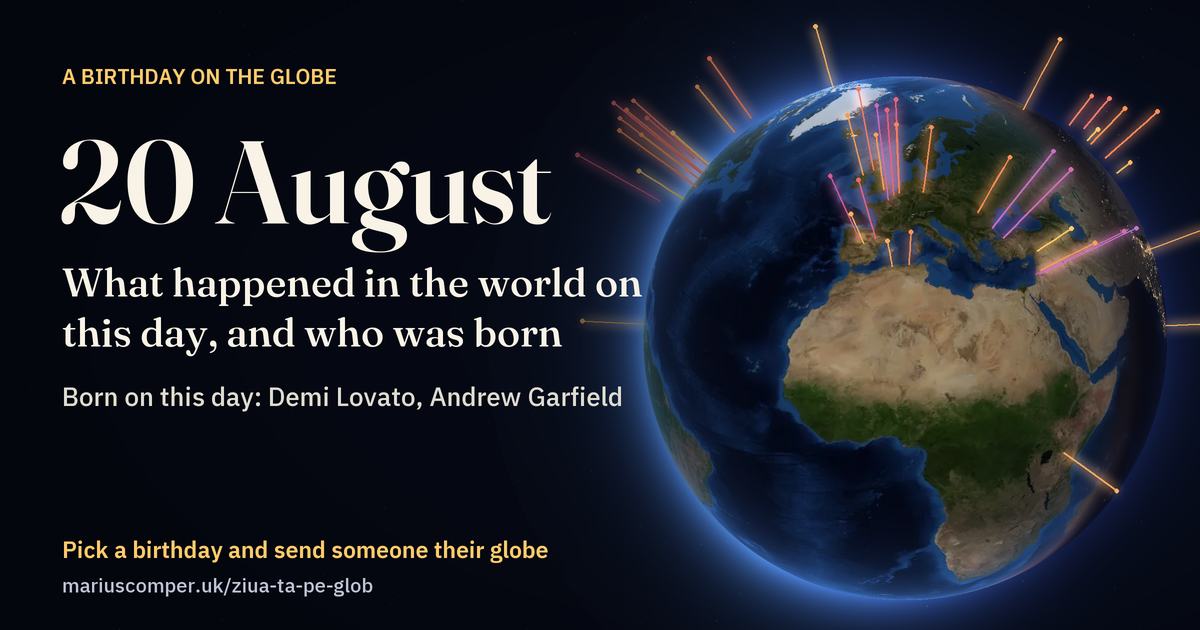
For 20 August, the English Wikipedia lists 67 events and 226 births. 45 of the events stand at their places as rays of light; five more are dashed circles, where the sentence links only to a country or a sea. The taller the ray, the longer ago it happened. The people born that day come further down, as blue points.
A birthday, yours or someone else’s:
Turn it into a greetingScroll: the globe turns to each place
The day you were born, on the globe.
Three things from your day
Scroll: your day first, then 20 August through the years
The Earth on 20 August
The picture on the globe was assembled by NASA from satellite photographs taken in August 2004: the snow, the ice and the green are those of the month.
On 20 August the Sun passes straight overhead at noon along the parallel of 12.4° north. In London, the day lasts about 14 hours 20 minutes.
Beyond 78° north the Sun no longer sets; beyond 78° south it no longer rises.
The line between day and night is tilted on the globe exactly as on this day of the year. On the dark side you can see the lights of towns.
Britain & Ireland · Celtic Park
1892
Celtic Park, the largest football stadium in Scotland and home of Celtic F.C., opened.
On the map: Celtic Park.
Also on the day’s list of Wikipedia in Chinese.
Asia · Tokyo
1905
Sun Yat-sen, Song Jiaoren, and others establish the Tongmenghui, a Republican, anti-Qing revolutionary organisation, in Tokyo, Japan.
On the map: Tokyo.
Also on the day’s list of Wikipedia in Spanish.
Oceania · O-Bahn Busway
1989
The final stage of the O-Bahn Busway in Adelaide, South Australia, was finished, completing at the time the world's longest and fastest guided busway, with buses travelling 12 km (7.5 mi) at speeds of up to 100 km/h (62 mph).
On the map: O-Bahn Busway.
Also on the day’s list of Wikipedia in Chinese.
North America · Yerkes Observatory
1909
Pluto was photographed for the first time at the Yerkes Observatory in Williams Bay, Wisconsin, U.S., 21 years before it was officially discovered by Clyde Tombaugh.
On the map: Yerkes Observatory.
Also on the day’s list of Wikipedia in Chinese.
North America · Canton, Ohio
1920
The National Football League is organized as the American Professional Football Conference in Canton, Ohio.
On the map: Canton, Ohio.
North America · WWJ
1920
The first commercial radio station, 8MK (now WWJ), begins operations in Detroit.
On the map: WWJ.
Also on the day’s list of Wikipedia in Spanish.
20 August
What the other Wikipedias remember#
For these years the English list has nothing on this day. The events below come from the same day’s lists on Wikipedia in Spanish and were translated for this page.
From Wikipedia in Spanish · Oslo
1993
In Washington, D.C. (United States), after a series of secret negotiations, representatives of Israel and Palestine sign the Oslo Accords in a public ceremony.
On the map: Oslo.
Translated from the list on Wikipedia in Spanish.
20 August
Born on 20 August#
The English Wikipedia lists 226 births for this day. The blue points are the birthplaces of 60 of these people: those written about in the most Wikipedia editions, where Wikidata gives a place of birth.
Born on 20 August
1992
Demi Lovato, American singer-songwriter and actress
Place of birth: Albuquerque.
Born on 20 August
1983
Andrew Garfield, American-English actor
Place of birth: Cedars-Sinai Medical Center.
Born on 20 August
1890
H. P. Lovecraft, American short story writer, editor, novelist (died 1937)
Place of birth: Providence.
Born on 20 August
1901
Salvatore Quasimodo, Italian novelist and poet, Nobel Prize laureate (died 1968)
Place of birth: Modica.
Born in Britain and Ireland
1948
Robert Plant, English singer-songwriter
Place of birth: West Bromwich.
Born in Britain and Ireland
1981
Ben Barnes, English actor
Place of birth: Cambridge.
Born in Britain and Ireland
1971
David Walliams, English comedian, actor, and author
Place of birth: Banstead.
20 August
Number one in the charts that week
At the cinema
An animal recorded that day
The record can be seen in GBIF, which brings together wildlife records from around the world.
All your birthdays
The weather that day
Data: Met Office Hadley Centre (HadCET); NOAA (GHCN-Daily, Mauna Loa).
Above the Earth
Sources: Jonathan McDowell, GCAT (launches); GFZ Potsdam (Kp index). Days are counted in Universal Time.
Football that day
International matches played that day:
Source: the “International football results” dataset kept by Mart Jürisoo (CC0).
Also that day
The earthquake’s page at the USGS
Source: the USGS catalogue. The day is counted in Universal Time (UTC).
In those days
Make a link for someone
Type the name, pick the day and the year of birth. The link opens straight on their day, with their name in the greeting.
The link carries the name, date and place typed here; anyone who gets it can see them.
Put another birthday beside it
Your mother’s, your child’s, a friend’s: the two days appear side by side.
Below: 20 August through the years.
The whole globe of the day
Drag the globe to turn it. Touch a ray or a point to read what happened there.
Everything Wikipedia lists for 20 August
The list is the English Wikipedia’s, in its own wording, as it stood in October 2026. 17 events have no place on the map: the sentence links to no place with coordinates, only to places too wide to mark, or to several countries.
- 14
Agrippa Postumus, maternal grandson of the late Roman emperor Augustus, is executed by his guards while in exile.
no place on the mapWikipedia: Agrippa Postumus - 636
Battle of the Yarmuk: Marking the first great wave of Muslim conquests and the rapid advance of Islam outside Arabia, Arab forces led by Khalid ibn al-Walid defeat the Byzantine Empire and take control of the Levant.
Asia · Battle of the YarmukWikipedia: Battle of the Yarmuk - 917
Battle of Acheloos: Tsar Simeon I of Bulgaria decisively defeats a Byzantine army.
Europe · Battle of AchelousWikipedia: Battle of Achelous - 1057
An army under Isaac I Komnenos defeat forces loyal to rival emperor Michael VI Bringas in the battle of Hades.
Asia · Battle of PetroeWikipedia: Battle of Petroe - 1083
The first King of Hungary, Stephen I, and his son, Prince Emeric, are canonized, a date now celebrated as a National Day in Hungary.
no place on the mapWikipedia: King of Hungary - 1119
King Henry I of England defeats king Louis VI of France in the battle of Brémule.
Europe · Battle of BrémuleWikipedia: Battle of Brémule - 1191
Believing Saladin had reneged on ransom promises, Richard I of England initiates the massacre at Ayyadieh, beheading 2,700 captive Muslim soldiers and another 300 women and children seized at the Fall of Acre.
Asia · AcreWikipedia: Massacre at Ayyadieh - 1308
At the conclusion of the interrogation of the leaders of the Knights Templar, the three papal investigators, Cardinals Bérenger Frédol, Etienne de Suisy and Landolfo Brancacci, write the "Chinon Parchment", in which they affirm that the accused Templars had confessed, done penance, and were absolved of heresy.
no place on the mapWikipedia: Knights Templar - 1467
The Second Battle of Olmedo takes places as part of a succession conflict between Henry IV of Castile and his half-brother Alfonso, Prince of Asturias.
Europe · OlmedoWikipedia: Second Battle of Olmedo - 1519
On the third day of battle, philosopher and general Wang Yangming defeats Zhu Chenhao, ending the Prince of Ning rebellion against the reign of the Ming dynasty's Zhengde Emperor.
Asia · Ming dynastyWikipedia: Wang Yangming - 1648
The Battle of Lens is the last major military confrontation of the Thirty Years' War, contributing to the signing of the Peace of Westphalia in October that year.
Europe · Battle of LensWikipedia: Battle of Lens - 1672
Former Grand Pensionary Johan de Witt and his brother Cornelis are lynched by a mob in The Hague.
Europe · The HagueWikipedia: Grand pensionary - 1707
The first Siege of Pensacola comes to an end with the failure of the British to capture Pensacola, Florida.
North America · Siege of PensacolaWikipedia: Siege of Pensacola - 1710
War of the Spanish Succession: A multinational army led by the Austrian commander Guido Starhemberg defeats the Spanish-Bourbon army commanded by Alexandre Maître, Marquis de Bay in the Battle of Saragossa.
Europe · Battle of SaragossaWikipedia: Battle of Saragossa - 1775
The Spanish establish the Presidio San Augustin del Tucson in the town that became Tucson, Arizona.
North America · Presidio San Agustín del TucsónWikipedia: Presidio San Agustín del Tucsón - 1794
Northwest Indian War: United States troops force the United Indian Nations, a confederacy of Shawnee, Mingo, Lenape, Wyandot, Miami, Odawa, Ojibwe, and Potawatomi warriors, into a disorganized retreat at the Battle of Fallen Timbers.
North America · Battle of Fallen TimbersWikipedia: Battle of Fallen Timbers - 1852
Steamboat Atlantic sinks on Lake Erie after a collision, with the loss of at least 150 lives.
no place on the mapWikipedia: Atlantic - 1858
Charles Darwin first publishes his theory of evolution through natural selection in The Journal of the Proceedings of the Linnean Society of London, alongside Alfred Russel Wallace's same theory.
no place on the mapWikipedia: Charles Darwin - 1864
Bakumatsu: Kinmon incident: The Chōshū Domain attempts to expel the Satsuma and Aizu Domains from Japan's imperial court.
Asia · Kinmon incidentWikipedia: Kinmon incident - 1866
President Andrew Johnson formally declares the American Civil War over.
no place on the mapWikipedia: American Civil War - 1882
Tchaikovsky's 1812 Overture debuts in Moscow, Russia.
no place on the mapWikipedia: Pyotr Ilyich Tchaikovsky - 1892
Celtic Park, the largest football stadium in Scotland and home of Celtic F.C., opened.
Britain & Ireland · Celtic ParkWikipedia: Celtic Park - 1905
Sun Yat-sen, Song Jiaoren, and others establish the Tongmenghui, a Republican, anti-Qing revolutionary organisation, in Tokyo, Japan.
Asia · TokyoWikipedia: Sun Yat-sen - 1909
Pluto was photographed for the first time at the Yerkes Observatory in Williams Bay, Wisconsin, U.S., 21 years before it was officially discovered by Clyde Tombaugh.
North America · Yerkes ObservatoryWikipedia: Pluto - 1910
Extreme fire weather in the Inland Northwest of the United States causes many small wildfires to coalesce into the Great Fire of 1910, burning approximately 3 million acres (12,000 km2) and killing 87 people.
North America · Great Fire of 1910Wikipedia: Great Fire of 1910 - 1914
World War I: Brussels is captured during the German invasion of Belgium.
Europe · BrusselsWikipedia: World War I - 1920
The National Football League is organized as the American Professional Football Conference in Canton, Ohio.
North America · Canton, OhioWikipedia: National Football League - 1920
The first commercial radio station, 8MK (now WWJ), begins operations in Detroit.
North America · WWJWikipedia: WWJ - 1926
Japan's public broadcasting company, Nippon Hōsō Kyōkai (NHK) is established.
no place on the mapWikipedia: Public broadcasting - 1940
In Mexico City, exiled Russian revolutionary Leon Trotsky is fatally wounded with an ice axe by Ramón Mercader. He dies the next day.
no place on the mapWikipedia: Leon Trotsky - 1940
World War II: British Prime Minister Winston Churchill makes the fourth of his famous wartime speeches, containing the line "Never was so much owed by so many to so few".
no place on the mapWikipedia: World War II - 1940
World War II: The Eighth Route Army launches the Hundred Regiments Offensive, a successful campaign to disrupt Japanese war infrastructure and logistics in occupied northern China.
Asia · Hundred Regiments OffensiveWikipedia: Hundred Regiments Offensive - 1944
World War II: One hundred sixty-eight captured allied airmen, including Phil Lamason, accused by the Gestapo of being "terror fliers", arrive at Buchenwald concentration camp.
Europe · Buchenwald concentration campWikipedia: Buchenwald concentration camp - 1944
World War II: The Battle of Romania begins with a major Soviet Union offensive.
Europe · Battle of RomaniaWikipedia: Battle of Romania - 1948
Soviet Consul General in New York, Jacob M. Lomakin is expelled by the United States, due to the Kasenkina Case.
North America · New York CityWikipedia: Kasenkina Case - 1949
Hungary adopts the Hungarian Constitution of 1949 and becomes a People's Republic.
no place on the mapWikipedia: Hungary - 1950
Korean War: United Nations forces repelled an attempt by North Korea to capture the city of Taegu.
Asia · Battle of TaeguWikipedia: Battle of Taegu - 1955
Battle of Philippeville: In Algeria, a force of Berbers from the Atlas Mountains region of Algeria raid two rural settlements and kill 77 French nationals.
Africa · Philippeville massacreWikipedia: Philippeville massacre - 1960
Senegal breaks from the Mali Federation, declaring its independence.
no place on the mapWikipedia: Senegal - 1962
The NS Savannah, the world's first nuclear-powered civilian ship, embarks on its maiden voyage.
no place on the mapWikipedia: NS Savannah - 1968
Cold War: Warsaw Pact troops invade Czechoslovakia, crushing the Prague Spring. East German participation is limited to a few specialists due to memories of the recent war. Only Albania and Romania refuse to participate.
Europe · CzechoslovakiaWikipedia: Warsaw Pact invasion of Czechoslovakia - 1975
Viking program: NASA launches the Viking 1 planetary probe toward Mars.
no place on the mapWikipedia: Viking program - 1975
ČSA Flight 540 crashes on approach to Damascus International Airport in Damascus, Syria, killing 126 people.
Asia · ČSA Flight 540Wikipedia: ČSA Flight 540 - 1977
Voyager program: NASA launches the Voyager 2 spacecraft.
no place on the mapWikipedia: Voyager program - 1986
In Edmond, Oklahoma, U.S. Postal employee Patrick Sherrill shoots and kills 14 of his co-workers and then commits suicide.
North America · Edmond post office shootingWikipedia: Edmond post office shooting - 1988
"Black Saturday" of the Yellowstone fire in Yellowstone National Park.
North America · Yellowstone fires of 1988Wikipedia: Yellowstone fires of 1988 - 1988
Iran–Iraq War: A ceasefire is agreed after almost eight years of war.
no place on the mapWikipedia: Iran–Iraq War - 1988
The Troubles: Eight British soldiers are killed and 28 wounded when their bus is hit by an IRA roadside bomb in Ballygawley, County Tyrone.
Britain & Ireland · Ballygawley bus bombingWikipedia: The Troubles - 1989
The final stage of the O-Bahn Busway in Adelaide, South Australia, was finished, completing at the time the world's longest and fastest guided busway, with buses travelling 12 km (7.5 mi) at speeds of up to 100 km/h (62 mph).
Oceania · O-Bahn BuswayWikipedia: O-Bahn Busway - 1989
The pleasure boat Marchioness sinks on the River Thames following a collision. Fifty-one people are killed.
Britain & Ireland · Marchioness disasterWikipedia: Marchioness disaster - 1991
Dissolution of the Soviet Union, August Coup: More than 100,000 people rally outside the Soviet Union's parliament building protesting the coup aiming to depose President Mikhail Gorbachev.
Asia · Dissolution of the Soviet UnionWikipedia: Dissolution of the Soviet Union - 1991
Estonia, occupied by and incorporated into the Soviet Union in 1940, issues a decision on the re-establishment of independence on the basis of legal continuity of its pre-occupation statehood.
Europe · EstoniaWikipedia: Estonia - 1992
In India, Meitei language (officially known as Manipuri language) is included in the scheduled languages' list and made one of the official languages of the Indian Government.
no place on the mapWikipedia: Meitei language - 1995
The Firozabad rail disaster kills 358 people in Firozabad, India.
Asia · FirozabadWikipedia: Firozabad rail collision - 1997
Souhane massacre in Algeria; over 60 people are killed and 15 kidnapped.
Africa · Souhane massacreWikipedia: Souhane massacre - 1998
The Supreme Court of Canada rules that Quebec cannot legally secede from Canada without the federal government's approval.
North America · QuebecWikipedia: Supreme Court of Canada - 1998
U.S. embassy bombings: The United States launches cruise missile attacks against alleged al-Qaeda camps in Afghanistan and a suspected chemical weapons plant in Sudan in retaliation for the August 7 bombings of American embassies in Kenya and Tanzania.
Africa · 1998 United States embassy bombingsWikipedia: 1998 United States embassy bombings - 2002
A group of Iraqis opposed to the regime of Saddam Hussein take over the Iraqi embassy in Berlin, Germany for five hours before releasing their hostages and surrendering.
Asia · Ba'athist IraqWikipedia: Saddam Hussein - 2006
Sri Lankan Civil War: Sri Lankan Tamil politician and former MP S. Sivamaharajah is shot dead at his home in Tellippalai.
Asia · TellippalaiWikipedia: Sri Lankan civil war - 2007
China Airlines Flight 120 catches fire and explodes after landing at Naha Airport in Okinawa, Japan.
Asia · Naha AirportWikipedia: China Airlines Flight 120 - 2008
Spanair Flight 5022, from Madrid, Spain to Gran Canaria, skids off the runway and crashes at Barajas Airport. Of the 172 people on board, 146 die immediately, and eight more later die of injuries sustained in the crash.
Europe · Spanair Flight 5022Wikipedia: Spanair Flight 5022 - 2011
First Air Flight 6560 crashes 1 mile (1.6 km) from the Resolute Bay runway, killing 12 of the 15 aboard.
North America · First Air Flight 6560Wikipedia: First Air Flight 6560 - 2012
A prison riot in the Venezuelan capital, Caracas, kills at least 20 people.
Latin America · CaracasWikipedia: 2012 Yare prison riot - 2014
Seventy-two people are killed in Japan's Hiroshima Prefecture by a series of landslides caused by a month's worth of rain that fell in one day.
Asia · 2014 Hiroshima landslidesWikipedia: 2014 Hiroshima landslides - 2016
Fifty-four people are killed when a suicide bomber detonates himself at a Kurdish wedding party in Gaziantep, Turkey.
Asia · August 2016 Gaziantep bombingWikipedia: August 2016 Gaziantep bombing - 2018
Silent Sam, a Confederate monument on the campus of the University of North Carolina at Chapel Hill, was toppled by protestors.
North America · Silent SamWikipedia: Silent Sam - 2020
Joe Biden gives his acceptance speech virtually for the 2020 Democratic presidential nomination at the 2020 Democratic National Convention.
North America · Wisconsin CenterWikipedia: 2020 Democratic National Convention
What the other Wikipedias remember
For these years the English list has nothing on this day. The events below come from the same day’s lists on Wikipedia in Spanish and were translated for this page.
- 1993
In Washington, D.C. (United States), after a series of secret negotiations, representatives of Israel and Palestine sign the Oslo Accords in a public ceremony.
Who was born on 20 August
In order of how many Wikipedia editions have an article about each. The first 60 of 226 are shown.
- 1833
Benjamin Harrison, American general, lawyer, and politician, 23rd President of the United States (died 1901)
North BendWikipedia: Benjamin Harrison - 1992
Demi Lovato, American singer-songwriter and actress
AlbuquerqueWikipedia: Demi Lovato - 1983
Andrew Garfield, American-English actor
Cedars-Sinai Medical CenterWikipedia: Andrew Garfield - 1890
H. P. Lovecraft, American short story writer, editor, novelist (died 1937)
ProvidenceWikipedia: H. P. Lovecraft - 1944
Rajiv Gandhi, Indian lawyer and politician, 6th Prime Minister of India (died 1991)
MumbaiWikipedia: Rajiv Gandhi - 1941
Slobodan Milošević, Serbian lawyer and politician, 1st President of Serbia (died 2006)
PožarevacWikipedia: Slobodan Milošević - 1974
Amy Adams, American actress
AvianoWikipedia: Amy Adams - 1901
Salvatore Quasimodo, Italian novelist and poet, Nobel Prize laureate (died 1968)
- 1779
Jöns Jacob Berzelius, Swedish chemist and academic (died 1848)
VäfversundaWikipedia: Jöns Jacob Berzelius - 1935
Ron Paul, American captain, physician, and politician
PittsburghWikipedia: Ron Paul - 1860
Raymond Poincaré, French lawyer and politician, 10th President of France (died 1934)
Bar-le-DucWikipedia: Raymond Poincaré - 1966
Enrico Letta, Italian lawyer and politician, 55th Prime Minister of Italy
- 1948
Robert Plant, English singer-songwriter
West BromwichWikipedia: Robert Plant - 1937
Andrei Konchalovsky, Russian director, producer, and screenwriter
- 1936
Hideki Shirakawa, Japanese chemist, engineer, and academic, Nobel Prize laureate
- 1847
Bolesław Prus, Polish journalist and author (died 1912)
HrubieszówWikipedia: Bolesław Prus - 1946
Laurent Fabius, French politician, 158th Prime Minister of France
16th arrondissement of ParisWikipedia: Laurent Fabius - 1778
Bernardo O'Higgins, Chilean general and politician, 2nd Supreme Director of Chile (died 1842)
- 1942
Isaac Hayes, American singer-songwriter, pianist, producer, and actor (died 2008)
CovingtonWikipedia: Isaac Hayes - 1983
Yuri Zhirkov, Russian footballer
TambovWikipedia: Yuri Zhirkov - 1956
Joan Allen, American actress
RochelleWikipedia: Joan Allen - 1913
Roger Wolcott Sperry, American neuropsychologist and neurobiologist, Nobel Prize laureate (died 1994)
HartfordWikipedia: Roger Wolcott Sperry - 1886
Paul Tillich, German-American philosopher and theologian (died 1965)
StarosiedleWikipedia: Paul Tillich - 1884
Rudolf Bultmann, German Lutheran theologian and professor of New Testament at the University of Marburg (died 1976)
WiefelstedeWikipedia: Rudolf Bultmann - 1982
Joshua Kennedy, Australian footballer
WodongaWikipedia: Joshua Kennedy - 1561
Jacopo Peri, Italian singer and composer (died 1633)
- 1910
Eero Saarinen, Finnish-American architect and furniture designer, designed the Gateway Arch (died 1961)
KirkkonummiWikipedia: Eero Saarinen - 1971
Ke Huy Quan, Vietnamese-American actor
Ho Chi Minh CityWikipedia: Ke Huy Quan - 1974
Misha Collins, American actor
- 1981
Ben Barnes, English actor
CambridgeWikipedia: Ben Barnes - 1958
David O. Russell, American director and screenwriter
ManhattanWikipedia: David O. Russell - 1970
Fred Durst, American singer-songwriter
- 1971
David Walliams, English comedian, actor, and author
BansteadWikipedia: David Walliams - 1982
Mijaín López, Cuban wrestler
HerraduraWikipedia: Mijaín López - 1932
Vasily Aksyonov, Russian physician, author, and academic (died 2009)
- 1873
Eliel Saarinen, Finnish architect and academic, co-designed the National Museum of Finland (died 1950)
RantasalmiWikipedia: Eliel Saarinen - 1377
Shahrukh Mirza, ruler of Persia and Transoxiania (died 1447)
SamarkandWikipedia: Shah Rukh - 1989
Judd Trump, English snooker player
WhitchurchWikipedia: Judd Trump - 1948
John Noble, Australian actor and director
Port PirieWikipedia: John Noble - 1659
Henry Every, English pirate (died 1696)
Newton FerrersWikipedia: Henry Every - 1951
Greg Bear, American author (died 2022)
San DiegoWikipedia: Greg Bear - 1962
James Marsters, American actor
GreenvilleWikipedia: James Marsters - 1966
Dimebag Darrell, American guitarist and songwriter (died 2004)
Grand PrairieWikipedia: Dimebag Darrell - 1995
Liana Liberato, American actress
GalvestonWikipedia: Liana Liberato - 1898
Leopold Infeld, Polish nuclear physicist, writer (died 1968)
- 1949
Phil Lynott, Irish singer-songwriter, bass player, and producer (died 1986)
West BromwichWikipedia: Phil Lynott - 1990
Ranomi Kromowidjojo, Dutch swimmer
- 1957
Simon Donaldson, English mathematician and academic
CambridgeWikipedia: Simon Donaldson - 1965
KRS-One, American rapper and producer
The BronxWikipedia: KRS-One - 1985
Stephen Ward, Irish footballer
DublinWikipedia: Stephen Ward - 1888
Tôn Đức Thắng, Vietnamese politician, 2nd President of Vietnam (died 1980)
Long XuyênWikipedia: Tôn Đức Thắng - 1897
Tarjei Vesaas, Norwegian author and poet (died 1970)
- 1946
N. R. Narayana Murthy, Indian businessman, co-founded Infosys
- 1938
Jean-Loup Chrétien, French military officer and astronaut
La RochelleWikipedia: Jean-Loup Chrétien - 1943
Sylvester McCoy, Scottish actor
- 1946
Ralf Hütter, German singer and keyboard player
KrefeldWikipedia: Ralf Hütter - 1947
Alan Lee, English painter and illustrator
LondonWikipedia: Alan Lee - 1947
Ray Wise, American actor
AkronWikipedia: Ray Wise - 1968
Klas Ingesson, Swedish footballer and manager (died 2014)
ÖdeshögWikipedia: Klas Ingesson - 1974
Maxim Vengerov, Russian-Israeli violinist and conductor
NovosibirskWikipedia: Maxim Vengerov
What is celebrated on 20 August
- Christian feast day: Amadour
- Christian feast day: Bernard of Clairvaux
- Christian feast day: Blessed Georg Häfner
- Christian feast day: Heliodorus of Bet Zabdai
- Christian feast day: Maria De Mattias
- Christian feast day: Oswine of Deira
- Christian feast day: Philibert of Jumièges
- Christian feast day: Samuel (prophet)
- Christian feast day: William and Catherine Booth (Church of England)
- Christian feast day: August 20 (Eastern Orthodox liturgics)
- Feast of Asmá’ (Baháʼí Faith, only if Baháʼí Naw-Rúz falls on March 21)
- Indian Akshay Urja Day (India)
- Independence Restoration Day (Estonia), re-declaration of the independence of Estonia from the Soviet Union in 1991.
- Meitei Language Day, also known as Manipuri Language Day, the day on which Meitei (Manipuri) was included in the scheduled languages' list and made one of the official languages of India.
A greeting link for someone
Type a name and, if you like, the year of birth. The link opens with a greeting, and beside each event it says how old the person turned that day, or how many years before their birth it happened.
The name and the year go only into the link you send.
All 366 days
How the globe is made
Where the events come from
Each edition of this page uses the day’s list from Wikipedia in its own language: Romanian, English, Spanish, Chinese. The lists are written by volunteers and differ from one edition to the next; the text of each event is Wikipedia’s, with a link to the article. A row that appears twice in a list is shown once. The lists have not been checked event by event: they are Wikipedia’s, mistakes included.
For events before 1582, and for countries that moved to the Gregorian calendar later (Britain in 1752, Russia in 1918), the same day may be counted Old Style in one list and New Style in another.
The chapter “What the other Wikipedias remember” adds up to five events a day from the lists of the other three editions, only for years in which the English list has nothing on that day. They were translated for this page, passed the same filters as the tour, and are not counted among the events of the English list.
How an event gets onto the map
The place comes from Wikidata. If the sentence links to the article about the event itself (a battle, an opening, an earthquake), dated to the same year, the ray stands on its coordinates or on those of its location. Otherwise it stands on the first place the sentence links to: a town, a building, a mountain, an island. This second step can be wrong: sometimes the sentence only mentions the place. That is why the page says, under each event, which place the ray stands on.
When the sentence links to a single state or province, or to a single sea, lake or desert larger than 5,000 km², the globe shows a dashed circle, not a ray. The circle has the area Wikidata gives, with its radius kept between 1.2° and 16°, or a radius of 4.5° when Wikidata gives no area; it says only that the sentence links to that place. Organisations, ships, spacecraft, museum objects, rivers, mountain ranges, languages and continents are never used as places. When a sentence names several states and no exact place, the event stays in the list only.
What the height means
The height of a ray shows how many years have passed, on a logarithmic scale: 10 years, 100 years and 1,000 years are equal steps apart; anything older than about 2,600 years has the tallest ray. The colour runs from pale yellow for recent years to violet for antiquity.
Where the tour stops
In each region the tour stops at up to three events (five in Britain and Ireland), chosen mainly by three things: whether Wikipedia’s editors put the event in the “On this day” box of their main page (the English, Spanish and Chinese editions), how many Wikipedia editions have an article about it, and how many of the four lists include it. Events whose sentence or article is about a war, an attack, a crime or a disaster are left out of the tour; they stay in the whole list, in Wikipedia’s wording. The filter is a list of words and a list of Wikidata types, so it can miss some.
The tour of births names the people with articles in the most editions and leaves aside those whom the list or Wikidata describes as rulers, politicians, commanders, leaders of movements or criminals; they stay in the list.
The Earth and the Sun
The daytime images are NASA’s Blue Marble Next Generation mosaics, one for each month of 2004; the night side is Black Marble 2016. The tilt of the line between day and night is computed for the day; the hour is chosen so that the place being read is in daylight. The latitude where the Sun stands overhead is the average of the four years of the leap cycle; in a given year it can differ by up to 0.4°.
The day you were born
The number ones come from the weekly lists on Wikipedia: Billboard for the United States (from 1940; the Hot 100 from August 1958), the UK Singles Chart (from November 1952), Los 40 Principales for Spain (from July 1966) and, for Romania, the Romanian Top 100 and Airplay 100 (2001–2021, with missing weeks). The page shows the chart of the week in which the day of birth falls, with its date; Billboard and the UK chart are dated at the end of their week. For Romania before 2001 and for China these sources have no weekly chart.
The films are those that reached cinemas in the United States up to ten days before or three days after that day (some of them in a few cinemas at first), from the English Wikipedia’s yearly lists (from 1968), in order of how many editions have an article about them. The events “in those days” are the ones on the neighbouring days’ lists that carry the year of birth, passed through the same filter as the tour.
The day of birth, year included
The Moon, the star sign and the constellation are worked out by the page itself, for noon Universal Time on the day. The lit part of the Moon is rounded and can differ by a few per cent from that at the hour of birth. The sign follows the usual zodiac of twelve equal parts starting at the March equinox; the constellation is the one the Sun actually stood in front of, by the borders set by the International Astronomical Union, and within a day of a border the page does not name it. When the Sun changes sign while it is that day anywhere on Earth, the page gives the moment of crossing, rounded to ten minutes and accurate to within about a quarter of an hour, and the clock time in a few cities, with the time zone and summer time of that year.
The year in the Chinese calendar is the one your device’s own calendar gives for the date, checked against the Hong Kong Observatory’s tables. “All your birthdays” uses the same sources as the rest of the chapter for the same day in every year since the birth: the temperature, well-known launches that took place on that very day, matches of the teams the edition follows, snow deeper than 10 cm and strong geomagnetic storms. The three things at the top and the four on the picture are chosen in a fixed order (the song, the animal, a full Moon, a well-known launch before an ordinary earthquake); on the picture you can change them.
When the link carries a year of birth, the page adds a few things about that exact day. The weather is the Met Office’s Central England temperature record and the readings from New York’s Central Park; the “usual high” is the average of the daily highs of 1961–1990 for that date, with two days either side. The carbon dioxide figure is the monthly mean at the Mauna Loa observatory, where measurements begin in March 1958.
The earthquake is the one with the largest magnitude in the USGS catalogue for that day, counted in Universal Time. Before the 1960s the catalogue has gaps even above magnitude 5.5, so in the older years many days have no earthquake. The page gives only the magnitude and the place: the country the epicentre falls in or, when the epicentre is at sea within 300 km of a coast, the nearest country; farther out, only the ocean.
The launches are those that reached orbit or left for the Moon and the planets, from Jonathan McDowell’s GCAT catalogue. If nothing left that day, the page shows the nearest launch within three days before or after, and says how many days away it was. The geomagnetic storm appears only when the Kp index reached at least 5 in one of the day’s eight three-hour intervals.
The animal comes from GBIF: an observation made by a person (the animal seen or heard, or its tracks), dated to that exact day, with coordinates and a CC0 or CC BY licence. Only a few hundred well-known species are searched (mammals, birds, turtles, butterflies); of those noted that day, mammals and species with articles in many Wikipedia editions come first; birds noted almost every day, and species used recently, wait their turn. Observations dated 1 January are left out, because records without a day are often filed there. An observation shows that the animal was recorded there, not how many animals there were.
The matches are those between national teams. Only matches of England, Scotland, Wales, Northern Ireland, the Republic of Ireland, the United States, Canada and Australia are shown, along with those at the big final tournaments. The picture to send is drawn in the page from the day’s globe and the facts above, and stays on your device until you send it.
Sources
- Events, births and holidays: the day’s page on Wikipedia, text under CC BY-SA 4.0.
- Coordinates, places of birth and the number of editions: Wikidata (CC0).
- The Earth by day: NASA Blue Marble Next Generation. The Earth by night: NASA Black Marble 2016.
- Borders and regions: Natural Earth.
- World population and births per year: UN World Population Prospects 2024.
- Charts and films: Wikipedia’s lists for Billboard, the UK Singles Chart, Los 40 Principales, Romanian Top 100, Airplay 100 and American films by year (CC BY-SA 4.0).
- Weather: Met Office Hadley Centre, HadCET (Open Government Licence) and NOAA GHCN-Daily, New York Central Park. Carbon dioxide: NOAA Global Monitoring Laboratory, Mauna Loa.
- Earthquakes: the USGS catalogue. Launches: Jonathan McDowell, GCAT (CC BY). Kp index: GFZ Potsdam (CC BY 4.0). Matches: International football results, Mart Jürisoo (CC0).
- Animal observations: GBIF, with a link to each record; species names come from Wikidata.