A birthday on the globe
6 April on the globe: what happened in the world on this day, and who was born
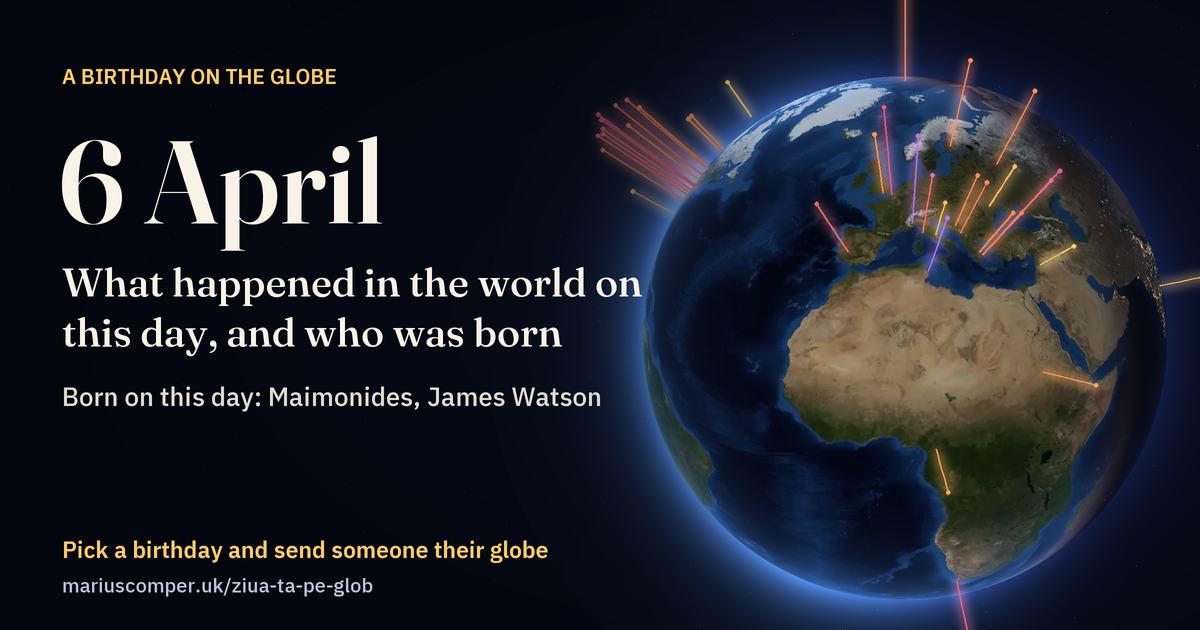
For 6 April, the English Wikipedia lists 64 events and 265 births. 37 of the events stand at their places as rays of light; eight more are dashed circles, where the sentence links only to a country or a sea. The taller the ray, the longer ago it happened. The people born that day come further down, as blue points.
A birthday, yours or someone else’s:
Turn it into a greetingScroll: the globe turns to each place
The day you were born, on the globe.
Three things from your day
Scroll: your day first, then 6 April through the years
The Earth on 6 April
The picture on the globe was assembled by NASA from satellite photographs taken in April 2004: the snow, the ice and the green are those of the month.
On 6 April the Sun passes straight overhead at noon along the parallel of 6.6° north. In London, the day lasts about 13 hours 20 minutes.
Beyond 83° north the Sun no longer sets; beyond 83° south it no longer rises.
The line between day and night is tilted on the globe exactly as on this day of the year. On the dark side you can see the lights of towns.
Britain & Ireland · Eurovision Song Contest 1974
1974
In Brighton, United Kingdom, ABBA wins the 1974 edition of the Eurovision Song Contest with "Waterloo", the first of a joint-record seven Swedish wins.
On the map: the coordinates Wikidata gives for the article “Eurovision Song Contest 1974”.
Also on the day’s list of Wikipedia in Spanish, Romanian and Chinese.
Europe · Moscow
1948
The Finno-Soviet Treaty is signed in Moscow.
On the map: Moscow.
North America · Church of Christ
1830
Church of Christ, the original church of the Latter Day Saint movement, is organized by Joseph Smith and others at either Fayette or Manchester, New York.
On the map: Church of Christ.
North America · Amboy, Illinois
1860
The Reorganized Church of Jesus Christ of Latter Day Saints, later renamed Community of Christ, is organized by Joseph Smith III and others at Amboy, Illinois.
On the map: Amboy, Illinois.
North America · Ontario Motor Speedway
1974
The first California Jam festival takes place at the Ontario Motor Speedway in Ontario, California. Co-headlined by Deep Purple and Emerson, Lake & Palmer. The festival set what were then records for the loudest amplification system ever installed, the highest paid attendance, and highest gross in history.
On the map: Ontario Motor Speedway.
Oceans · North Pole
1909
Robert Peary and Matthew Henson become the first people to reach the North Pole; Peary's claim has been disputed because of failings in his navigational ability.
On the map: North Pole.
Also on the day’s list of Wikipedia in Spanish and Romanian.
6 April
What the other Wikipedias remember#
For these years the English list has nothing on this day. The events below come from the same day’s lists on Wikipedia in Romanian and were translated for this page.
From Wikipedia in Romanian · Rijksmuseum
1990
Rembrandt's painting The Night Watch is sprayed with sulphuric acid by a disturbed man in the Rijksmuseum in Amsterdam.
On the map: Rijksmuseum.
Translated from the list on Wikipedia in Romanian.
6 April
Born on 6 April#
The English Wikipedia lists 265 births for this day. The blue points are the birthplaces of 60 of these people: those written about in the most Wikipedia editions, where Wikidata gives a place of birth.
Born on 6 April
1135
Maimonides, Jewish philosopher, Torah scholar, physician and astronomer (March 30 also proposed, died 1204)
Place of birth: Córdoba.
Born on 6 April
1928
James Watson, American biologist, geneticist, and zoologist, Nobel Prize laureate (died 2025)
Place of birth: Chicago.
Born on 6 April
1812
Alexander Herzen, Russian philosopher and author (died 1870)
Place of birth: Moscow.
Born on 6 April
1949
Horst Ludwig Störmer, German physicist and academic, Nobel Prize laureate
Place of birth: Frankfurt.
Born in Britain and Ireland
1773
James Mill, Scottish historian, economist, and philosopher (died 1836)
Place of birth: Angus.
Born in Britain and Ireland
1953
Patrick Doyle, Scottish actor and composer
Place of birth: Uddingston.
6 April
Number one in the charts that week
At the cinema
An animal recorded that day
The record can be seen in GBIF, which brings together wildlife records from around the world.
All your birthdays
The weather that day
Data: Met Office Hadley Centre (HadCET); NOAA (GHCN-Daily, Mauna Loa).
Above the Earth
Sources: Jonathan McDowell, GCAT (launches); GFZ Potsdam (Kp index). Days are counted in Universal Time.
Football that day
International matches played that day:
Source: the “International football results” dataset kept by Mart Jürisoo (CC0).
Also that day
The earthquake’s page at the USGS
Source: the USGS catalogue. The day is counted in Universal Time (UTC).
In those days
Make a link for someone
Type the name, pick the day and the year of birth. The link opens straight on their day, with their name in the greeting.
The link carries the name, date and place typed here; anyone who gets it can see them.
Put another birthday beside it
Your mother’s, your child’s, a friend’s: the two days appear side by side.
Below: 6 April through the years.
The whole globe of the day
Drag the globe to turn it. Touch a ray or a point to read what happened there.
Everything Wikipedia lists for 6 April
The list is the English Wikipedia’s, in its own wording, as it stood in October 2026. 19 events have no place on the map: the sentence links to no place with coordinates, only to places too wide to mark, or to several countries.
- 46 BC
Julius Caesar defeats Caecilius Metellus Scipio and Marcus Porcius Cato (Cato the Younger) at the Battle of Thapsus.
Africa · Battle of ThapsusWikipedia: Battle of Thapsus - 402
Stilicho defeats the Visigoths under Alaric in the Battle of Pollentia.
Europe · Battle of PollentiaWikipedia: Battle of Pollentia - 945
Byzantine Emperor Constantine VII crowns his son Romanos II as co-emperor.
no place on the mapWikipedia: List of Byzantine emperors - 1320
The Scots reaffirm their independence by signing the Declaration of Arbroath.
no place on the mapWikipedia: Declaration of Arbroath - 1453
Mehmed II begins his siege of Constantinople. The city falls on May 29 and is renamed Istanbul.
Asia · Fall of ConstantinopleWikipedia: Fall of Constantinople - 1580
One of the largest earthquakes recorded in the history of England, Flanders, or Northern France, takes place.
Europe · 1580 Dover Straits earthquakeWikipedia: 1580 Dover Straits earthquake - 1652
At the Cape of Good Hope, Dutch sailor Jan van Riebeeck establishes a resupply camp that eventually becomes Cape Town.
Africa · Cape TownWikipedia: Cape of Good Hope - 1712
The New York Slave Revolt of 1712 begins near Broadway.
North America · BroadwayWikipedia: New York Slave Revolt of 1712 - 1776
American Revolutionary War: Ships of the Continental Navy fail in their attempt to capture a Royal Navy dispatch boat.
North America · Battle of Block IslandWikipedia: Battle of Block Island - 1782
King Buddha Yodfa Chulaloke (Rama I) of Siam (modern day Thailand) establishes the Chakri dynasty.
Asia · ThailandWikipedia: Rama I - 1793
During the French Revolution, the Committee of Public Safety becomes the executive organ of the republic.
no place on the mapWikipedia: French Revolution - 1800
The Treaty of Constantinople establishes the Septinsular Republic, the first autonomous Greek state since the Fall of the Byzantine Empire. (Under the Old Style calendar then still in use in the Ottoman Empire, the treaty was signed on 21 March.)
Asia · ConstantinopleWikipedia: Treaty of Constantinople - 1808
John Jacob Astor incorporates the American Fur Company, that would eventually make him America's first millionaire.
no place on the mapWikipedia: John Jacob Astor - 1809
Napoleonic Wars: British forces captured the French frigate Niémen in the Bay of Biscay.
Oceans · Bay of BiscayWikipedia: Action of 6 April 1809 - 1812
British forces under the command of the Duke of Wellington assault the fortress of Badajoz. This would be the turning point in the Peninsular War against Napoleon-led France.
Europe · Siege of BadajozWikipedia: Siege of Badajoz - 1814
Nominal beginning of the Bourbon Restoration; anniversary date that Napoleon abdicates and is exiled to Elba.
Europe · ElbaWikipedia: Bourbon Restoration in France - 1830
Church of Christ, the original church of the Latter Day Saint movement, is organized by Joseph Smith and others at either Fayette or Manchester, New York.
North America · Church of ChristWikipedia: Church of Christ - 1841
U.S. President John Tyler is sworn in, two days after having become president upon William Henry Harrison's death.
no place on the mapWikipedia: John Tyler - 1860
The Reorganized Church of Jesus Christ of Latter Day Saints, later renamed Community of Christ, is organized by Joseph Smith III and others at Amboy, Illinois.
North America · Amboy, IllinoisWikipedia: Community of Christ - 1862
American Civil War: The Battle of Shiloh begins: In Tennessee, forces under Union General Ulysses S. Grant meet Confederate troops led by General Albert Sidney Johnston.
North America · Battle of ShilohWikipedia: American Civil War - 1865
American Civil War: The Battle of Sailor's Creek: Confederate General Robert E. Lee's Army of Northern Virginia fights and loses its last major battle while in retreat from Richmond, Virginia, during the Appomattox Campaign.
North America · Battle of Sailor's CreekWikipedia: Battle of Sailor's Creek - 1866
The Grand Army of the Republic, an American patriotic organization composed of Union veterans of the American Civil War, is founded. It lasts until 1956.
North America · Grand Army of the RepublicWikipedia: Grand Army of the Republic - 1896
In Athens, the opening of the first modern Olympic Games is celebrated, 1,500 years after the original games are banned by Roman emperor Theodosius I.
Europe · AthensWikipedia: 1896 Summer Olympics - 1909
Robert Peary and Matthew Henson become the first people to reach the North Pole; Peary's claim has been disputed because of failings in his navigational ability.
Oceans · North PoleWikipedia: Robert Peary - 1911
During the Battle of Deçiq, Dedë Gjon Luli Dedvukaj, leader of the Malësori Albanians, raises the Albanian flag in the town of Tuzi, Montenegro, for the first time after George Kastrioti (Skanderbeg).
Europe · Battle of DeçiqWikipedia: Battle of Deçiq - 1917
World War I: The United States declares war on Germany.
no place on the mapWikipedia: World War I - 1918
Finnish Civil War: The battle of Tampere ends.
Europe · Battle of TampereWikipedia: Finnish Civil War - 1926
Varney Airlines makes its first commercial flight (Varney is the root company of United Airlines).
no place on the mapWikipedia: Varney Air Lines - 1929
Huey P. Long, Governor of Louisiana, is impeached by the Louisiana House of Representatives.
no place on the mapWikipedia: Huey Long - 1930
At the end of the Salt March, Gandhi raises a lump of mud and salt and declares, "With this, I am shaking the foundations of the British Empire."
Britain & Ireland · British EmpireWikipedia: Salt March - 1936
Tupelo–Gainesville tornado outbreak: Another tornado from the same storm system as the Tupelo tornado hits Gainesville, Georgia, killing 203.
North America · Gainesville, GeorgiaWikipedia: 1936 Tupelo–Gainesville tornado outbreak - 1941
World War II: Nazi Germany launches Operation 25 (the invasion of Kingdom of Yugoslavia) and Operation Marita (the invasion of Greece).
Europe · German invasion of GreeceWikipedia: Invasion of Yugoslavia - 1945
World War II: Sarajevo is liberated from German and Croatian forces by the Yugoslav Partisans.
Europe · SarajevoWikipedia: Sarajevo - 1945
World War II: The Battle of Slater's Knoll on Bougainville comes to an end.
Oceania · Battle of Slater's KnollWikipedia: Battle of Slater's Knoll - 1947
The first Tony Awards are presented for theatrical achievement.
no place on the mapWikipedia: Tony Awards - 1948
The Finno-Soviet Treaty is signed in Moscow.
Europe · MoscowWikipedia: Finno-Soviet Treaty of 1948 - 1957
The flag carrier airline of Greece for decades, Olympic Airways, is founded by Aristotle Onassis following the acquisition of "TAE - Greek National Airlines".
Europe · GreeceWikipedia: Greece - 1958
Capital Airlines Flight 67 crashes in Tittabawassee Township, Michigan, near Freeland Tri-City Airport, killing 47.
North America · Capital Airlines Flight 67Wikipedia: Capital Airlines Flight 67 - 1965
Launch of Early Bird, the first commercial communications satellite to be placed in geosynchronous orbit.
no place on the mapWikipedia: Intelsat I - 1968
In the downtown district of Richmond, Indiana, a double explosion kills 41 and injures 150.
North America · Richmond, Indiana explosionWikipedia: Richmond, Indiana explosion - 1968
Pierre Elliott Trudeau wins the Liberal Party leadership election, and becomes Prime Minister of Canada soon afterward.
no place on the mapWikipedia: 1968 Liberal Party of Canada leadership election - 1970
Newhall massacre: Four California Highway Patrol officers are killed in a shootout.
North America · Newhall incidentWikipedia: Newhall incident - 1972
Vietnam War: Easter Offensive: American forces begin sustained air strikes and naval bombardments.
Asia · South VietnamWikipedia: Vietnam War - 1973
Launch of Pioneer 11 spacecraft.
no place on the mapWikipedia: Pioneer 11 - 1973
The American League of Major League Baseball begins using the designated hitter.
no place on the mapWikipedia: American League - 1974
In Brighton, United Kingdom, ABBA wins the 1974 edition of the Eurovision Song Contest with "Waterloo", the first of a joint-record seven Swedish wins.
Britain & Ireland · Eurovision Song Contest 1974Wikipedia: Eurovision Song Contest 1974 - 1974
The first California Jam festival takes place at the Ontario Motor Speedway in Ontario, California. Co-headlined by Deep Purple and Emerson, Lake & Palmer. The festival set what were then records for the loudest amplification system ever installed, the highest paid attendance, and highest gross in history.
North America · Ontario Motor SpeedwayWikipedia: California Jam - 1984
Members of Cameroon's Republican Guard unsuccessfully attempt to overthrow the government headed by Paul Biya.
Africa · YaoundéWikipedia: 1984 Cameroonian coup attempt - 1985
Sudanese President Gaafar Nimeiry is ousted from power in a coup d'état led by Field Marshal Abdel Rahman Swar al-Dahab.
Africa · 1985 Sudanese coup d'étatWikipedia: 1985 Sudanese coup d'état - 1992
The Bosnian War begins.
no place on the mapWikipedia: Bosnian War - 1994
The Rwandan genocide begins when the aircraft carrying Rwandan president Juvénal Habyarimana and Burundian president Cyprien Ntaryamira is shot down.
no place on the mapWikipedia: Rwandan genocide - 1997
In Greene County, Tennessee, the Lillelid murders occur.
no place on the mapWikipedia: Lillelid murders - 1998
Nuclear weapons testing: Pakistan tests medium-range missiles capable of reaching India.
Asia · PakistanWikipedia: Nuclear weapons testing - 2004
Rolandas Paksas becomes the first president of Lithuania to be peacefully removed from office by impeachment.
Europe · LithuaniaWikipedia: Rolandas Paksas - 2005
Kurdish leader Jalal Talabani becomes Iraqi president; Shiite Arab Ibrahim al-Jaafari is named premier the next day.
Asia · IraqWikipedia: Jalal Talabani - 2008
The 2008 Egyptian general strike starts led by Egyptian workers later to be adopted by April 6 Youth Movement and Egyptian activists.
no place on the mapWikipedia: 2008 Egyptian general strike - 2009
A 6.3 magnitude earthquake strikes near L'Aquila, Italy, killing 307.
Europe · 2009 L'Aquila earthquakeWikipedia: 2009 L'Aquila earthquake - 2009
Mass protests began across Moldova against the results of the parliamentary election.
Europe · April 2009 Moldovan parliamentary election protestsWikipedia: April 2009 Moldovan parliamentary election protests - 2010
Maoist rebels kill 76 CRPF officers in Dantewada district, India.
Asia · April 2010 Maoist attack in DantewadaWikipedia: April 2010 Maoist attack in Dantewada - 2011
In San Fernando, Tamaulipas, Mexico, over 193 victims of Los Zetas were exhumed from several mass graves.
Latin America · 2011 San Fernando massacreWikipedia: 2011 San Fernando massacre - 2012
Azawad declares itself independent from the Republic of Mali.
no place on the mapWikipedia: Azawadian declaration of independence - 2017
U.S. military launches 59 Tomahawk cruise missiles at an air base in Syria. Russia describes the strikes as an "aggression", adding they significantly damage US-Russia ties.
Asia · 2017 Shayrat missile strikeWikipedia: 2017 Shayrat missile strike - 2018
A bus carrying the Humboldt Broncos junior ice hockey team collides with a semi-truck in Saskatchewan, Canada, killing 16 people and injuring 13 others.
North America · Connaught No. 457Wikipedia: Humboldt Broncos bus crash - 2026
The crew of Artemis II makes the first crewed circumlunar flight since Apollo 17 in 1972, returning humanity to the Moon's vicinity and breaking Apollo 13's record by ~4,000 miles as the furthest crewed spaceflight.
no place on the mapWikipedia: Artemis II
What the other Wikipedias remember
For these years the English list has nothing on this day. The events below come from the same day’s lists on Wikipedia in Romanian and were translated for this page.
- 1990
Rembrandt's painting The Night Watch is sprayed with sulphuric acid by a disturbed man in the Rijksmuseum in Amsterdam.
Who was born on 6 April
In order of how many Wikipedia editions have an article about each. The first 60 of 265 are shown.
- 1963
Rafael Correa, Ecuadorian economist and politician, 54th President of Ecuador
GuayaquilWikipedia: Rafael Correa - 1135
Maimonides, Jewish philosopher, Torah scholar, physician and astronomer (March 30 also proposed, died 1204)
CórdobaWikipedia: Maimonides - 1928
James Watson, American biologist, geneticist, and zoologist, Nobel Prize laureate (died 2025)
ChicagoWikipedia: James Watson - 1812
Alexander Herzen, Russian philosopher and author (died 1870)
- 1904
Kurt Georg Kiesinger, German lawyer, politician and Chancellor of Germany (died 1988)
- 1969
Paul Rudd, American actor
PassaicWikipedia: Paul Rudd - 1964
Tim Walz, American politician, Governor of Minnesota & vice presidential candidate
West PointWikipedia: Tim Walz - 1949
Horst Ludwig Störmer, German physicist and academic, Nobel Prize laureate
FrankfurtWikipedia: Horst Ludwig Störmer - 1741
Nicolas Chamfort, French author and playwright (died 1794)
Clermont-FerrandWikipedia: Nicolas Chamfort - 1820
Nadar, French photographer, journalist, and author (died 1910)
rue Saint-HonoréWikipedia: Nadar - 1975
Zach Braff, American actor, director, producer, and screenwriter
South OrangeWikipedia: Zach Braff - 1773
James Mill, Scottish historian, economist, and philosopher (died 1836)
- 1826
Gustave Moreau, French painter and academic (died 1898)
- 1942
Barry Levinson, American actor, director, producer, and screenwriter
BaltimoreWikipedia: Barry Levinson - 1725
Pasquale Paoli, French soldier and politician (died 1807)
MorosagliaWikipedia: Pasquale Paoli - 1911
Feodor Felix Konrad Lynen, German biochemist and academic, Nobel Prize laureate (died 1979)
MunichWikipedia: Feodor Lynen - 1920
Edmond H. Fischer, Swiss-American biochemist and academic, Nobel Prize laureate (died 2021)
Shanghai French ConcessionWikipedia: Edmond H. Fischer - 2001
Oscar Piastri, Australian racing driver
MelbourneWikipedia: Oscar Piastri - 1983
Mitsuru Nagata, Japanese footballer
ShizuokaWikipedia: Mitsuru Nagata - 1986
Ryota Moriwaki, Japanese footballer
FukuyamaWikipedia: Ryota Moriwaki - 1956
Michele Bachmann, American lawyer and politician
WaterlooWikipedia: Michele Bachmann - 1998
Peyton List, American actress and model
FloridaWikipedia: Peyton List - 1998
Nahuel Molina, Argentine footballer
EmbalseWikipedia: Nahuel Molina - 1926
Ian Paisley, Northern Irish evangelical minister and politician, 2nd First Minister of Northern Ireland (died 2014)
ArmaghWikipedia: Ian Paisley - 1955
Michael Rooker, American actor, director, and producer
- 1998
Nicolás González, Argentine footballer
Belén de EscobarWikipedia: Nico González - 1929
André Previn, American pianist, composer, and conductor (died 2019)
BerlinWikipedia: André Previn - 1890
Anthony Fokker, Dutch engineer and businessman, founded Fokker Aircraft Manufacturer (died 1939)
- 1937
Merle Haggard, American singer-songwriter and guitarist (died 2016)
BakersfieldWikipedia: Merle Haggard - 1937
Billy Dee Williams, American actor, singer, and writer
New York CityWikipedia: Billy Dee Williams - 1886
Athenagoras I of Constantinople (died 1972)
- 1976
Candace Cameron Bure, American actress and talk show panelist
Panorama CityWikipedia: Candace Cameron Bure - 1886
Osman Ali Khan, Asaf Jah VII, Indian ruler (died 1967)
Hyderabad StateWikipedia: Mir Osman Ali Khan - 1988
Fabrice Muamba, Congolese-English footballer
KinshasaWikipedia: Fabrice Muamba - 2000
Maxence Lacroix, French footballer
Villeneuve-Saint-GeorgesWikipedia: Maxence Lacroix - 1941
Gheorghe Zamfir, Romanian flute player and composer
- 1860
René Lalique, French sculptor and jewellery designer (died 1945)
- 1901
Pier Giorgio Frassati, Italian activist (died 1925)
- 1927
Gerry Mulligan, American saxophonist, clarinet player, and composer (died 1996)
- 1929
Christos Sartzetakis, Greek jurist, supreme justice and President of Greece (died 2022)
- 1632
Maria Leopoldine of Austria (died 1649)
- 1947
John Ratzenberger, American actor and director
BridgeportWikipedia: John Ratzenberger - 1957
Paolo Nespoli, Italian soldier, engineer, and astronaut
- 1978
Igor Semshov, Russian footballer
MoscowWikipedia: Igor Semshov - 1984
Siboniso Gaxa, South African footballer
GqeberhaWikipedia: Siboniso Gaxa - 1953
Patrick Doyle, Scottish actor and composer
UddingstonWikipedia: Patrick Doyle - 1878
Erich Mühsam, German author, poet, and playwright (died 1934)
BerlinWikipedia: Erich Mühsam - 1942
Anita Pallenberg, Italian-English model, actress, and fashion designer (died 2017)
- 1973
Sun Wen, Chinese footballer
ShanghaiWikipedia: Sun Wen - 1671
Jean-Baptiste Rousseau, French poet and playwright (died 1741)
- 1851
Guillaume Bigourdan, French astronomer and academic (died 1932)
- 1898
Jeanne Hébuterne, French painter and author (died 1920)
- 1931
Ram Dass, American author and educator (died 2019)
- 1660
Johann Kuhnau, German organist and composer (died 1722)
GeisingWikipedia: Johann Kuhnau - 1915
Tadeusz Kantor, Polish director, painter, and set designer (died 1990)
Wielopole SkrzyńskieWikipedia: Tadeusz Kantor - 1980
Tanja Poutiainen, Finnish skier
RovaniemiWikipedia: Tanja Poutiainen - 1906
Virginia Hall, American who was a spy in France for the UK and US during WWII (died 1982)
BaltimoreWikipedia: Virginia Hall - 1918
Alfredo Ovando Candía, Bolivian general and politician, 56th President of Bolivia (died 1982)
- 1952
Udo Dirkschneider, German singer-songwriter
WuppertalWikipedia: Udo Dirkschneider - 1992
Julie Ertz, American soccer player
What is celebrated on 6 April
- Chakri Day, commemorating the establishment of the Chakri dynasty. (Thailand)
- Christian feast day: Albrecht Dürer and Lucas Cranach (Lutheran Church).
- Christian feast day: Brychan
- Christian feast day: Eutychius of Constantinople
- Christian feast day: Galla of Rome
- Christian feast day: Marcellinus of Carthage
- Christian feast day: Notker the Stammerer
- Christian feast day: Blessed Pierina Morosini
- Christian feast day: Pope Sixtus I
- Christian feast day: April 6 (Eastern Orthodox liturgics)
- International Day of Sport for Development and Peace
- National Fisherman Day (Indonesia)
- New Beer's Eve (United States)
- Tartan Day (United States & Canada)
A greeting link for someone
Type a name and, if you like, the year of birth. The link opens with a greeting, and beside each event it says how old the person turned that day, or how many years before their birth it happened.
The name and the year go only into the link you send.
All 366 days
How the globe is made
Where the events come from
Each edition of this page uses the day’s list from Wikipedia in its own language: Romanian, English, Spanish, Chinese. The lists are written by volunteers and differ from one edition to the next; the text of each event is Wikipedia’s, with a link to the article. A row that appears twice in a list is shown once. The lists have not been checked event by event: they are Wikipedia’s, mistakes included.
For events before 1582, and for countries that moved to the Gregorian calendar later (Britain in 1752, Russia in 1918), the same day may be counted Old Style in one list and New Style in another.
The chapter “What the other Wikipedias remember” adds up to five events a day from the lists of the other three editions, only for years in which the English list has nothing on that day. They were translated for this page, passed the same filters as the tour, and are not counted among the events of the English list.
How an event gets onto the map
The place comes from Wikidata. If the sentence links to the article about the event itself (a battle, an opening, an earthquake), dated to the same year, the ray stands on its coordinates or on those of its location. Otherwise it stands on the first place the sentence links to: a town, a building, a mountain, an island. This second step can be wrong: sometimes the sentence only mentions the place. That is why the page says, under each event, which place the ray stands on.
When the sentence links to a single state or province, or to a single sea, lake or desert larger than 5,000 km², the globe shows a dashed circle, not a ray. The circle has the area Wikidata gives, with its radius kept between 1.2° and 16°, or a radius of 4.5° when Wikidata gives no area; it says only that the sentence links to that place. Organisations, ships, spacecraft, museum objects, rivers, mountain ranges, languages and continents are never used as places. When a sentence names several states and no exact place, the event stays in the list only.
What the height means
The height of a ray shows how many years have passed, on a logarithmic scale: 10 years, 100 years and 1,000 years are equal steps apart; anything older than about 2,600 years has the tallest ray. The colour runs from pale yellow for recent years to violet for antiquity.
Where the tour stops
In each region the tour stops at up to three events (five in Britain and Ireland), chosen mainly by three things: whether Wikipedia’s editors put the event in the “On this day” box of their main page (the English, Spanish and Chinese editions), how many Wikipedia editions have an article about it, and how many of the four lists include it. Events whose sentence or article is about a war, an attack, a crime or a disaster are left out of the tour; they stay in the whole list, in Wikipedia’s wording. The filter is a list of words and a list of Wikidata types, so it can miss some.
The tour of births names the people with articles in the most editions and leaves aside those whom the list or Wikidata describes as rulers, politicians, commanders, leaders of movements or criminals; they stay in the list.
The Earth and the Sun
The daytime images are NASA’s Blue Marble Next Generation mosaics, one for each month of 2004; the night side is Black Marble 2016. The tilt of the line between day and night is computed for the day; the hour is chosen so that the place being read is in daylight. The latitude where the Sun stands overhead is the average of the four years of the leap cycle; in a given year it can differ by up to 0.4°.
The day you were born
The number ones come from the weekly lists on Wikipedia: Billboard for the United States (from 1940; the Hot 100 from August 1958), the UK Singles Chart (from November 1952), Los 40 Principales for Spain (from July 1966) and, for Romania, the Romanian Top 100 and Airplay 100 (2001–2021, with missing weeks). The page shows the chart of the week in which the day of birth falls, with its date; Billboard and the UK chart are dated at the end of their week. For Romania before 2001 and for China these sources have no weekly chart.
The films are those that reached cinemas in the United States up to ten days before or three days after that day (some of them in a few cinemas at first), from the English Wikipedia’s yearly lists (from 1968), in order of how many editions have an article about them. The events “in those days” are the ones on the neighbouring days’ lists that carry the year of birth, passed through the same filter as the tour.
The day of birth, year included
The Moon, the star sign and the constellation are worked out by the page itself, for noon Universal Time on the day. The lit part of the Moon is rounded and can differ by a few per cent from that at the hour of birth. The sign follows the usual zodiac of twelve equal parts starting at the March equinox; the constellation is the one the Sun actually stood in front of, by the borders set by the International Astronomical Union, and within a day of a border the page does not name it. When the Sun changes sign while it is that day anywhere on Earth, the page gives the moment of crossing, rounded to ten minutes and accurate to within about a quarter of an hour, and the clock time in a few cities, with the time zone and summer time of that year.
The year in the Chinese calendar is the one your device’s own calendar gives for the date, checked against the Hong Kong Observatory’s tables. “All your birthdays” uses the same sources as the rest of the chapter for the same day in every year since the birth: the temperature, well-known launches that took place on that very day, matches of the teams the edition follows, snow deeper than 10 cm and strong geomagnetic storms. The three things at the top and the four on the picture are chosen in a fixed order (the song, the animal, a full Moon, a well-known launch before an ordinary earthquake); on the picture you can change them.
When the link carries a year of birth, the page adds a few things about that exact day. The weather is the Met Office’s Central England temperature record and the readings from New York’s Central Park; the “usual high” is the average of the daily highs of 1961–1990 for that date, with two days either side. The carbon dioxide figure is the monthly mean at the Mauna Loa observatory, where measurements begin in March 1958.
The earthquake is the one with the largest magnitude in the USGS catalogue for that day, counted in Universal Time. Before the 1960s the catalogue has gaps even above magnitude 5.5, so in the older years many days have no earthquake. The page gives only the magnitude and the place: the country the epicentre falls in or, when the epicentre is at sea within 300 km of a coast, the nearest country; farther out, only the ocean.
The launches are those that reached orbit or left for the Moon and the planets, from Jonathan McDowell’s GCAT catalogue. If nothing left that day, the page shows the nearest launch within three days before or after, and says how many days away it was. The geomagnetic storm appears only when the Kp index reached at least 5 in one of the day’s eight three-hour intervals.
The animal comes from GBIF: an observation made by a person (the animal seen or heard, or its tracks), dated to that exact day, with coordinates and a CC0 or CC BY licence. Only a few hundred well-known species are searched (mammals, birds, turtles, butterflies); of those noted that day, mammals and species with articles in many Wikipedia editions come first; birds noted almost every day, and species used recently, wait their turn. Observations dated 1 January are left out, because records without a day are often filed there. An observation shows that the animal was recorded there, not how many animals there were.
The matches are those between national teams. Only matches of England, Scotland, Wales, Northern Ireland, the Republic of Ireland, the United States, Canada and Australia are shown, along with those at the big final tournaments. The picture to send is drawn in the page from the day’s globe and the facts above, and stays on your device until you send it.
Sources
- Events, births and holidays: the day’s page on Wikipedia, text under CC BY-SA 4.0.
- Coordinates, places of birth and the number of editions: Wikidata (CC0).
- The Earth by day: NASA Blue Marble Next Generation. The Earth by night: NASA Black Marble 2016.
- Borders and regions: Natural Earth.
- World population and births per year: UN World Population Prospects 2024.
- Charts and films: Wikipedia’s lists for Billboard, the UK Singles Chart, Los 40 Principales, Romanian Top 100, Airplay 100 and American films by year (CC BY-SA 4.0).
- Weather: Met Office Hadley Centre, HadCET (Open Government Licence) and NOAA GHCN-Daily, New York Central Park. Carbon dioxide: NOAA Global Monitoring Laboratory, Mauna Loa.
- Earthquakes: the USGS catalogue. Launches: Jonathan McDowell, GCAT (CC BY). Kp index: GFZ Potsdam (CC BY 4.0). Matches: International football results, Mart Jürisoo (CC0).
- Animal observations: GBIF, with a link to each record; species names come from Wikidata.