A birthday on the globe
27 September on the globe: what happened in the world on this day, and who was born
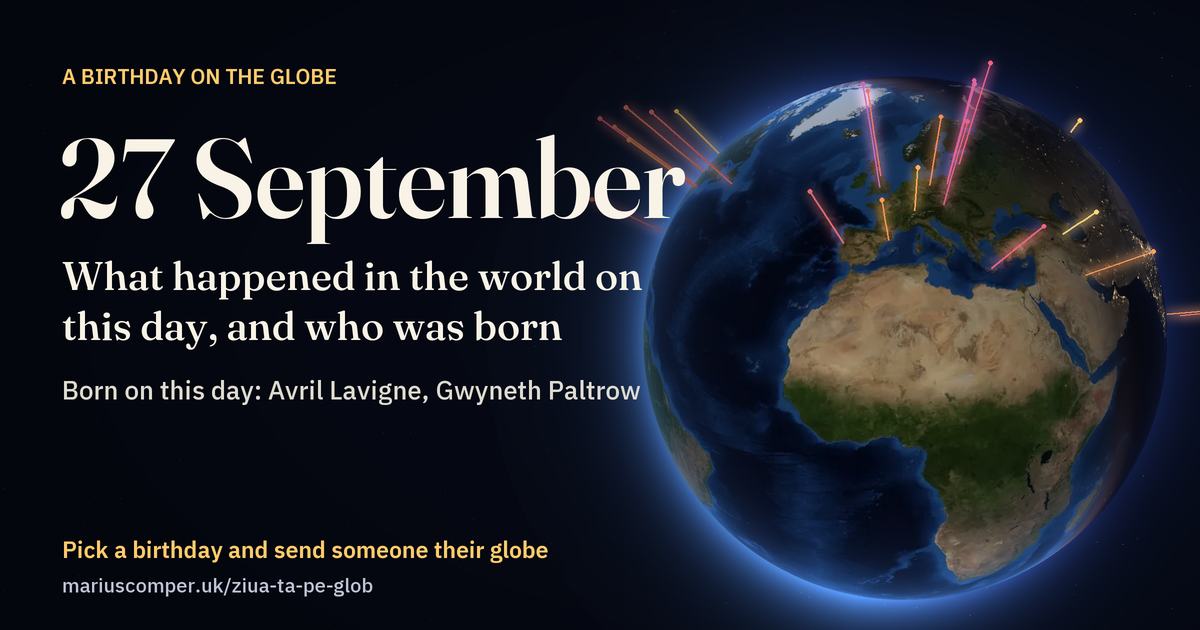
For 27 September, the English Wikipedia lists 55 events and 262 births. 24 of the events stand at their places as rays of light; three more are dashed circles, where the sentence links only to a country or a sea. The taller the ray, the longer ago it happened. The people born that day come further down, as blue points.
A birthday, yours or someone else’s:
Turn it into a greetingScroll: the globe turns to each place
The day you were born, on the globe.
Three things from your day
Scroll: your day first, then 27 September through the years
The Earth on 27 September
The picture on the globe was assembled by NASA from satellite photographs taken in September 2004: the snow, the ice and the green are those of the month.
On 27 September the Sun passes straight overhead at noon along the parallel of 1.6° south. In London, the day lasts about 11 hours 55 minutes.
The line between day and night is tilted on the globe exactly as on this day of the year. On the dark side you can see the lights of towns.
Britain & Ireland · Shildon
1825
The world's first public railway to use steam locomotives, the Stockton and Darlington Railway, is ceremonially opened with the engine Locomotion pulling wagons with coal and passengers from Shildon to Darlington to Stockton.
On the map: Shildon.
Also on the day’s list of Wikipedia in Romanian.
Asia · Pedra Branca, Singapore
1851
The British East India Company inaugurated the Horsburgh Lighthouse on the rocky outcrop of Pedra Branca, Singapore, which later became the subject of a territorial dispute.
On the map: Pedra Branca, Singapore.
Also on the day’s list of Wikipedia in Chinese.
North America · Lancaster, Pennsylvania
1777
American Revolution: Lancaster, Pennsylvania becomes the capital of the United States for one day after Congress evacuates Philadelphia.
On the map: Lancaster, Pennsylvania.
Also on the day’s list of Wikipedia in Romanian.
North America · Ford Piquette Avenue Plant
1908
Production of the Model T automobile begins at the Ford Piquette Avenue Plant in Detroit.
On the map: Ford Piquette Avenue Plant.
North America · Broadhurst Theatre
1917
The Broadhurst Theatre opened in New York City with a performance of Misalliance by George Bernard Shaw.
On the map: Broadhurst Theatre.
27 September
What the other Wikipedias remember#
For these years the English list has nothing on this day. The events below come from the same day’s lists on Wikipedia in Spanish and were translated for this page.
From Wikipedia in Spanish · University of Salamanca
1970
In Vatican City, Pope Paul VI declares Saint Teresa of Ávila (honorary doctor of the University of Salamanca) the first woman Doctor of the Church.
On the map: University of Salamanca.
Translated from the list on Wikipedia in Spanish.
The article on Wikipedia in Spanish: Universidad de Salamanca
27 September
Born on 27 September#
The English Wikipedia lists 262 births for this day. The blue points are the birthplaces of 60 of these people: those written about in the most Wikipedia editions, where Wikidata gives a place of birth.
Born on 27 September
1984
Avril Lavigne, Canadian singer-songwriter, actress, and fashion designer
Place of birth: Belleville.
Born on 27 September
1972
Gwyneth Paltrow, American actress, blogger, and businesswoman
Place of birth: Los Angeles.
Born on 27 September
1976
Francesco Totti, Italian footballer
Place of birth: Rome.
Born on 27 September
1871
Grazia Deledda, Italian novelist and poet, Nobel Prize laureate (died 1936)
Place of birth: Nuoro.
Born on 27 September
1982
Lil Wayne, American rapper, producer, and actor
Place of birth: New Orleans.
Born in Britain and Ireland
1918
Martin Ryle, English astronomer and author, Nobel Prize laureate (died 1984)
Place of birth: Brighton.
Born in Britain and Ireland
1958
Irvine Welsh, Scottish author and playwright
Place of birth: Leith.
Born in Britain and Ireland
1973
Indira Varma, British actress
Place of birth: Bath.
27 September
Number one in the charts that week
At the cinema
An animal recorded that day
The record can be seen in GBIF, which brings together wildlife records from around the world.
All your birthdays
The weather that day
Data: Met Office Hadley Centre (HadCET); NOAA (GHCN-Daily, Mauna Loa).
Above the Earth
Sources: Jonathan McDowell, GCAT (launches); GFZ Potsdam (Kp index). Days are counted in Universal Time.
Football that day
International matches played that day:
Source: the “International football results” dataset kept by Mart Jürisoo (CC0).
Also that day
The earthquake’s page at the USGS
Source: the USGS catalogue. The day is counted in Universal Time (UTC).
In those days
Make a link for someone
Type the name, pick the day and the year of birth. The link opens straight on their day, with their name in the greeting.
The link carries the name, date and place typed here; anyone who gets it can see them.
Put another birthday beside it
Your mother’s, your child’s, a friend’s: the two days appear side by side.
Below: 27 September through the years.
The whole globe of the day
Drag the globe to turn it. Touch a ray or a point to read what happened there.
Everything Wikipedia lists for 27 September
The list is the English Wikipedia’s, in its own wording, as it stood in October 2026. 28 events have no place on the map: the sentence links to no place with coordinates, only to places too wide to mark, or to several countries.
- 1066
William the Conqueror and his army set sail from the mouth of the Somme river, beginning the Norman conquest of England.
Britain & Ireland · Norman ConquestWikipedia: William the Conqueror - 1331
The Battle of Płowce is fought, between the Kingdom of Poland and the Teutonic Order. The Poles are defeated but their leaders escape capture.
Europe · Battle of PłowceWikipedia: Battle of Płowce - 1422
After the brief Gollub War, the Teutonic Knights sign the Treaty of Melno with Poland and Lithuania.
Europe · Treaty of MelnoWikipedia: Treaty of Melno - 1529
The Siege of Vienna begins when Suleiman I attacks the city.
Europe · Siege of ViennaWikipedia: Siege of Vienna - 1540
The Society of Jesus (Jesuits) receives its charter from Pope Paul III.
no place on the mapWikipedia: Jesuits - 1605
The armies of Sweden are defeated by the Polish–Lithuanian Commonwealth in the Battle of Kircholm.
Europe · Battle of KircholmWikipedia: Battle of Kircholm - 1669
The Venetians surrender the fortress of Candia to the Ottomans, thus ending the 21-year-long Siege of Candia. Crete would remain under Ottoman occupation until 1913.
Europe · Siege of CandiaWikipedia: Siege of Candia - 1777
American Revolution: Lancaster, Pennsylvania becomes the capital of the United States for one day after Congress evacuates Philadelphia.
North America · Lancaster, PennsylvaniaWikipedia: Lancaster, Pennsylvania - 1791
The National Assembly of France votes to award full citizenship to Jews.
no place on the mapWikipedia: History of the Jews in France - 1810
The French army under André Masséna fails to break British forces under the Arthur Wellesley in the battle of Bussaco.
Europe · Battle of BussacoWikipedia: Battle of Bussaco - 1821
The Army of the Three Guarantees triumphantly enters Mexico City, led by Agustín de Iturbide. The following day Mexico is declared independent.
Latin America · Mexico CityWikipedia: Army of the Three Guarantees - 1822
Jean-François Champollion officially informs the Académie des Inscriptions et Belles Lettres in France that he has deciphered the Rosetta Stone.
no place on the mapWikipedia: Rosetta Stone - 1825
The world's first public railway to use steam locomotives, the Stockton and Darlington Railway, is ceremonially opened with the engine Locomotion pulling wagons with coal and passengers from Shildon to Darlington to Stockton.
Britain & Ireland · ShildonWikipedia: Locomotion No. 1 - 1851
The British East India Company inaugurated the Horsburgh Lighthouse on the rocky outcrop of Pedra Branca, Singapore, which later became the subject of a territorial dispute.
Asia · Pedra Branca, SingaporeWikipedia: East India Company - 1854
The paddle steamer SS Arctic, owned by the Collins Line of New York, sinks off the coast of Newfoundland, following a collision with a smaller vessel, the SS Vesta. Only 88 of over 300 people on board survive. About a dozen of the occupants of the Vesta are killed when their lifeboat is hit by the Arctic.
North America · Sinking of the SS ArcticWikipedia: Sinking of the SS Arctic - 1875
The merchant sailing ship Ellen Southard is wrecked in a storm at Liverpool.
no place on the mapWikipedia: Ellen Southard - 1903
"Wreck of the Old 97": an American rail disaster, in which 11 people are killed; it later becomes the subject of a popular ballad.
no place on the mapWikipedia: Wreck of the Old 97 - 1908
Production of the Model T automobile begins at the Ford Piquette Avenue Plant in Detroit.
North America · Ford Piquette Avenue PlantWikipedia: Ford Piquette Avenue Plant - 1916
Iyasu V is proclaimed deposed as ruler of Ethiopia in a palace coup in favor of his aunt Zewditu.
no place on the mapWikipedia: Lij Iyasu - 1917
The Broadhurst Theatre opened in New York City with a performance of Misalliance by George Bernard Shaw.
North America · Broadhurst TheatreWikipedia: Broadhurst Theatre - 1922
King Constantine I of Greece abdicates his throne in favor of his eldest son, George II.
no place on the mapWikipedia: Constantine I of Greece - 1928
The Republic of China is recognized by the United States.
Asia · Republic of ChinaWikipedia: Republic of China - 1930
Bobby Jones wins the (pre-Masters) Grand Slam of golf.
no place on the mapWikipedia: Bobby Jones - 1938
The ocean liner Queen Elizabeth is launched in Glasgow.
no place on the mapWikipedia: RMS Queen Elizabeth - 1940
World War II: The Tripartite Pact is signed in Berlin by Germany, Japan and Italy.
Europe · BerlinWikipedia: Tripartite Pact - 1941
The SS Patrick Henry is launched, becoming the first of more than 2,700 Liberty ships.
no place on the mapWikipedia: SS Patrick Henry - 1941
World War II: The Greek National Liberation Front is established with Georgios Siantos as acting leader.
no place on the mapWikipedia: Georgios Siantos - 1942
World War II: Last day of the Matanikau action on Guadalcanal as United States Marines barely escape after being surrounded by Japanese forces.
Oceania · Actions along the MatanikauWikipedia: Actions along the Matanikau - 1944
World War II: The Kassel Mission results in the largest loss by a USAAF group on any mission during the war.
no place on the mapWikipedia: Kassel Mission - 1949
Zeng Liansong's design is chosen as the flag of the People's Republic of China.
no place on the mapWikipedia: Zeng Liansong - 1956
USAF Captain Milburn G. Apt becomes the first person to exceed Mach 3. Shortly thereafter, the Bell X-2 goes out of control and Captain Apt is killed.
no place on the mapWikipedia: Milburn G. Apt - 1959
Typhoon Vera kills nearly 5,000 people in Japan.
no place on the mapWikipedia: Typhoon Vera - 1962
Rachel Carson's book Silent Spring is published, inspiring an environmental movement and the creation of the U.S. Environmental Protection Agency.
no place on the mapWikipedia: Silent Spring - 1962
The Yemen Arab Republic is established.
Asia · Yemen Arab RepublicWikipedia: Yemen Arab Republic - 1964
The British TSR-2 aircraft XR219 makes its maiden flight.
no place on the mapWikipedia: BAC TSR-2 - 1973
Texas International Airlines Flight 655 crashes into the Black Fork Mountain Wilderness near Mena, Arkansas, killing all 11 people on board.
North America · Texas International Airlines Flight 655Wikipedia: Texas International Airlines Flight 655 - 1975
The last use of capital punishment in Spain sparks worldwide protests.
Europe · BarcelonaWikipedia: Last use of capital punishment in Spain - 1977
Japan Airlines Flight 715 crashes on approach to Sultan Abdul Aziz Shah Airport in Subang, Malaysia, killing 34 of the 79 people on board.
Asia · Japan Air Lines Flight 715Wikipedia: Japan Air Lines Flight 715 - 1981
Iran–Iraq War: Iran broke the Iraqi siege of Abadan by Operation Samen-ol-A'emeh.
Asia · Siege of AbadanWikipedia: Iran–Iraq War - 1983
American software developer Richard Stallman announced plans for the Unix-like operating system GNU, the first free software developed by the GNU Project.
no place on the mapWikipedia: Richard Stallman - 1988
The National League for Democracy is formed by Aung San Suu Kyi and others to fight dictatorship in Myanmar.
no place on the mapWikipedia: National League for Democracy - 1992
Palestinian prisoners went on a 15-day hunger strike.
no place on the mapWikipedia: Palestinians in Israeli custody - 1993
The Sukhumi massacre takes place in Abkhazia.
no place on the mapWikipedia: Ethnic cleansing of Georgians in Sukhumi - 1996
Confusion on a tanker ship results in the Julie N oil spill in Portland, Maine.
no place on the mapWikipedia: Julie N oil spill - 1996
The Battle of Kabul ends in a Taliban victory; an Islamic Emirate of Afghanistan is established.
Asia · Islamic Emirate of AfghanistanWikipedia: Battle of Kabul - 1998
The Google internet search engine retroactively claims this date as its birthday.
no place on the mapWikipedia: Google - 2001
In Switzerland, a gunman shoots 18 citizens, killing 14 and then himself.
Europe · Zug massacreWikipedia: Zug massacre - 2003
The SMART-1 satellite is launched.
no place on the mapWikipedia: SMART-1 - 2007
NASA launches the Dawn probe to the asteroid belt.
no place on the mapWikipedia: Dawn - 2008
CNSA astronaut Zhai Zhigang becomes the first Chinese person to perform a spacewalk.
no place on the mapWikipedia: Zhai Zhigang - 2012
In Minneapolis, a gunman shoots eight people, killing six and injuring 2 and then kills himself.
North America · Minneapolis firm shootingWikipedia: Minneapolis firm shooting - 2014
63 people are killed in an eruption of Mount Ontake in Japan.
Asia · 2014 Mount Ontake eruptionWikipedia: 2014 Mount Ontake eruption - 2019
Over two million people participated in worldwide strikes to protest climate change across 2,400 locations worldwide.
no place on the mapWikipedia: September 2019 climate strikes - 2020
Second Nagorno-Karabakh War: Azerbaijan launches an offensive against the self-proclaimed Republic of Artsakh in the Nagorno-Karabakh region, inhabited predominantly by ethnic Armenians.
Asia · Armenia–Azerbaijan borderWikipedia: Second Nagorno-Karabakh War - 2024
Hurricane Helene devastates the Carolinas as a tropical storm, killing hundreds and injuring more.
no place on the mapWikipedia: Hurricane Helene
What the other Wikipedias remember
For these years the English list has nothing on this day. The events below come from the same day’s lists on Wikipedia in Spanish and were translated for this page.
- 1970
In Vatican City, Pope Paul VI declares Saint Teresa of Ávila (honorary doctor of the University of Salamanca) the first woman Doctor of the Church.
Europe · University of SalamancaTranslated from the list on Wikipedia in SpanishWikipedia: Universidad de Salamanca
Who was born on 27 September
In order of how many Wikipedia editions have an article about each. The first 60 of 262 are shown.
- 1984
Avril Lavigne, Canadian singer-songwriter, actress, and fashion designer
BellevilleWikipedia: Avril Lavigne - 1972
Gwyneth Paltrow, American actress, blogger, and businesswoman
Los AngelesWikipedia: Gwyneth Paltrow - 1976
Francesco Totti, Italian footballer
- 1871
Grazia Deledda, Italian novelist and poet, Nobel Prize laureate (died 1936)
- 1601
Louis XIII of France (died 1643)
FontainebleauWikipedia: Louis XIII - 1982
Lil Wayne, American rapper, producer, and actor
New OrleansWikipedia: Lil Wayne - 2002
Jenna Ortega, American actress
Palm DesertWikipedia: Jenna Ortega - 1918
Martin Ryle, English astronomer and author, Nobel Prize laureate (died 1984)
BrightonWikipedia: Martin Ryle - 1934
Wilford Brimley, American actor (died 2020)
Salt Lake CityWikipedia: Wilford Brimley - 1925
Robert Edwards, English physiologist and academic, Nobel Prize laureate (died 2013)
- 1946
Nicos Anastasiades, Cypriot lawyer and politician, seventh President of Cyprus
Pera PediWikipedia: Nicos Anastasiades - 1991
Simona Halep, Romanian tennis player
ConstanțaWikipedia: Simona Halep - 1968
Mari Kiviniemi, Finnish politician, 41st Prime Minister of Finland
SeinäjokiWikipedia: Mari Kiviniemi - 1722
Samuel Adams, American philosopher and politician, fourth Governor of Massachusetts (died 1803)
- 1992
Granit Xhaka, Swiss footballer
- 1389
Cosimo de' Medici, ruler of Florence (died 1464)
FlorenceWikipedia: Cosimo de' Medici - 1947
Meat Loaf, American singer-songwriter, producer, and actor (died 2022)
DallasWikipedia: Meat Loaf - 1932
Oliver E. Williamson, American economist and academic, Nobel Prize laureate (died 2020)
SuperiorWikipedia: Oliver E. Williamson - 1627
Jacques-Bénigne Bossuet, French bishop and theologian (died 1704)
- 1821
Henri-Frédéric Amiel, Swiss philosopher, poet, and critic (died 1881)
- 1783
Agustín de Iturbide, Mexican royalist turned insurgent; first emperor of Mexico (died 1824)
- 1907
Bhagat Singh, Indian socialist revolutionary (disputed with 28 September) (died 1931)
British RajWikipedia: Bhagat Singh - 1947
Dick Advocaat, Dutch football manager and former player
The HagueWikipedia: Dick Advocaat - 1696
Alphonsus Maria de' Liguori, Italian bishop and saint (died 1787)
PiscinolaWikipedia: Alphonsus Liguori - 1958
Irvine Welsh, Scottish author and playwright
- 1913
Albert Ellis, American psychologist and author (died 2007)
PittsburghWikipedia: Albert Ellis - 1954
Larry Wall, American computer programmer and author
Los AngelesWikipedia: Larry Wall - 1657
Sofia Alekseyevna of Russia (died 1704)
- 1271
Wenceslaus II of Bohemia, King of Bohemia and Poland (died 1305)
- 1922
Arthur Penn, American director and producer (died 2010)
PhiladelphiaWikipedia: Arthur Penn - 1953
Claudio Gentile, Italian footballer and manager
TripoliWikipedia: Claudio Gentile - 1921
Miklós Jancsó, Hungarian director and screenwriter (died 2014)
- 1840
Alfred Thayer Mahan, American captain and historian (died 1914)
West PointWikipedia: Alfred Thayer Mahan - 1953
Mata Amritanandamayi, Indian guru and saint
- 1772
Martha Jefferson Randolph, daughter of Thomas Jefferson who had twelve children (died 1836)
MonticelloWikipedia: Martha Jefferson Randolph - 1818
Hermann Kolbe, German chemist and academic (died 1884)
ElliehausenWikipedia: Hermann Kolbe - 1965
Steve Kerr, American basketball player, coach and sportscaster
BeirutWikipedia: Steve Kerr - 1982
Anna Camp, American actress
AikenWikipedia: Anna Camp - 1950
Cary-Hiroyuki Tagawa, Japanese-American actor and martial artist (died 2025)
Higashi-AzabuWikipedia: Cary-Hiroyuki Tagawa - 1973
Indira Varma, British actress
- 1993
Monica Puig, Puerto Rican-American tennis player
San JuanWikipedia: Monica Puig - 1966
Stephanie Wilson, American engineer and astronaut
- 1941
Peter Bonetti, English footballer and coach (died 2020)
PutneyWikipedia: Peter Bonetti - 1973
Vratislav Lokvenc, Czech footballer
- 1982
Markus Rosenberg, Swedish footballer
- 808
Ninmyō, Japanese emperor (died 850)
Heian-kyōWikipedia: Emperor Ninmyō - 1924
Bud Powell, American pianist and composer (died 1966)
- 1840
Thomas Nast, German-American cartoonist (died 1902)
Landau in der PfalzWikipedia: Thomas Nast - 1862
Louis Botha, first Prime Minister of the self-governing Union of South Africa (died 1919)
GreytownWikipedia: Louis Botha - 1879
Hans Hahn, Austrian mathematician and philosopher (died 1934)
ViennaWikipedia: Hans Hahn - 1919
James H. Wilkinson, American mathematician and computer scientist (died 1986)
- 1924
Josef Škvorecký, Czech-Canadian author and publisher (died 2012)
- 1943
Prince Amedeo, Duke of Aosta (died 2021)
- 1952
Dumitru Prunariu, Romanian pilot, engineer and cosmonaut
- 1953
Diane Abbott, English journalist and politician, Shadow Secretary of State for International Development
PaddingtonWikipedia: Diane Abbott - 1984
Wouter Weylandt, Belgian cyclist (died 2011)
- 1987
Ádám Bogdán, Hungarian footballer
BudapestWikipedia: Ádám Bogdán - 1991
Thomas Mann, American actor
PortlandWikipedia: Thomas Mann - 1598
Robert Blake, English admiral (died 1657)
BridgwaterWikipedia: Robert Blake - 1920
William Conrad, American actor, director, and producer (died 1994)
LouisvilleWikipedia: William Conrad
What is celebrated on 27 September
- Christian feast days: Adheritus
- Christian feast days: Bonfilius
- Christian feast days: Caius of Milan
- Christian feast days: Hiltrude of Liessies
- Christian feast days: Vincent de Paul
- Christian feast days: Cosmas and Damian
- Christian feast days: September 27 (Eastern Orthodox liturgics)
- Consumación de la Independencia (Mexico)
- French Community Holiday (French community of Belgium)
- Independence Day (Turkmenistan), celebrates the independence of Turkmenistan from USSR in 1991.
- Meskel (Ethiopian and Eritrean Orthodox Church, following Julian calendar, September 28 on leap years)
- National Gay Men's HIV/AIDS Awareness Day (United States)
- Polish Underground State's Day (Poland)
- World Tourism Day (International)
A greeting link for someone
Type a name and, if you like, the year of birth. The link opens with a greeting, and beside each event it says how old the person turned that day, or how many years before their birth it happened.
The name and the year go only into the link you send.
All 366 days
How the globe is made
Where the events come from
Each edition of this page uses the day’s list from Wikipedia in its own language: Romanian, English, Spanish, Chinese. The lists are written by volunteers and differ from one edition to the next; the text of each event is Wikipedia’s, with a link to the article. A row that appears twice in a list is shown once. The lists have not been checked event by event: they are Wikipedia’s, mistakes included.
For events before 1582, and for countries that moved to the Gregorian calendar later (Britain in 1752, Russia in 1918), the same day may be counted Old Style in one list and New Style in another.
The chapter “What the other Wikipedias remember” adds up to five events a day from the lists of the other three editions, only for years in which the English list has nothing on that day. They were translated for this page, passed the same filters as the tour, and are not counted among the events of the English list.
How an event gets onto the map
The place comes from Wikidata. If the sentence links to the article about the event itself (a battle, an opening, an earthquake), dated to the same year, the ray stands on its coordinates or on those of its location. Otherwise it stands on the first place the sentence links to: a town, a building, a mountain, an island. This second step can be wrong: sometimes the sentence only mentions the place. That is why the page says, under each event, which place the ray stands on.
When the sentence links to a single state or province, or to a single sea, lake or desert larger than 5,000 km², the globe shows a dashed circle, not a ray. The circle has the area Wikidata gives, with its radius kept between 1.2° and 16°, or a radius of 4.5° when Wikidata gives no area; it says only that the sentence links to that place. Organisations, ships, spacecraft, museum objects, rivers, mountain ranges, languages and continents are never used as places. When a sentence names several states and no exact place, the event stays in the list only.
What the height means
The height of a ray shows how many years have passed, on a logarithmic scale: 10 years, 100 years and 1,000 years are equal steps apart; anything older than about 2,600 years has the tallest ray. The colour runs from pale yellow for recent years to violet for antiquity.
Where the tour stops
In each region the tour stops at up to three events (five in Britain and Ireland), chosen mainly by three things: whether Wikipedia’s editors put the event in the “On this day” box of their main page (the English, Spanish and Chinese editions), how many Wikipedia editions have an article about it, and how many of the four lists include it. Events whose sentence or article is about a war, an attack, a crime or a disaster are left out of the tour; they stay in the whole list, in Wikipedia’s wording. The filter is a list of words and a list of Wikidata types, so it can miss some.
The tour of births names the people with articles in the most editions and leaves aside those whom the list or Wikidata describes as rulers, politicians, commanders, leaders of movements or criminals; they stay in the list.
The Earth and the Sun
The daytime images are NASA’s Blue Marble Next Generation mosaics, one for each month of 2004; the night side is Black Marble 2016. The tilt of the line between day and night is computed for the day; the hour is chosen so that the place being read is in daylight. The latitude where the Sun stands overhead is the average of the four years of the leap cycle; in a given year it can differ by up to 0.4°.
The day you were born
The number ones come from the weekly lists on Wikipedia: Billboard for the United States (from 1940; the Hot 100 from August 1958), the UK Singles Chart (from November 1952), Los 40 Principales for Spain (from July 1966) and, for Romania, the Romanian Top 100 and Airplay 100 (2001–2021, with missing weeks). The page shows the chart of the week in which the day of birth falls, with its date; Billboard and the UK chart are dated at the end of their week. For Romania before 2001 and for China these sources have no weekly chart.
The films are those that reached cinemas in the United States up to ten days before or three days after that day (some of them in a few cinemas at first), from the English Wikipedia’s yearly lists (from 1968), in order of how many editions have an article about them. The events “in those days” are the ones on the neighbouring days’ lists that carry the year of birth, passed through the same filter as the tour.
The day of birth, year included
The Moon, the star sign and the constellation are worked out by the page itself, for noon Universal Time on the day. The lit part of the Moon is rounded and can differ by a few per cent from that at the hour of birth. The sign follows the usual zodiac of twelve equal parts starting at the March equinox; the constellation is the one the Sun actually stood in front of, by the borders set by the International Astronomical Union, and within a day of a border the page does not name it. When the Sun changes sign while it is that day anywhere on Earth, the page gives the moment of crossing, rounded to ten minutes and accurate to within about a quarter of an hour, and the clock time in a few cities, with the time zone and summer time of that year.
The year in the Chinese calendar is the one your device’s own calendar gives for the date, checked against the Hong Kong Observatory’s tables. “All your birthdays” uses the same sources as the rest of the chapter for the same day in every year since the birth: the temperature, well-known launches that took place on that very day, matches of the teams the edition follows, snow deeper than 10 cm and strong geomagnetic storms. The three things at the top and the four on the picture are chosen in a fixed order (the song, the animal, a full Moon, a well-known launch before an ordinary earthquake); on the picture you can change them.
When the link carries a year of birth, the page adds a few things about that exact day. The weather is the Met Office’s Central England temperature record and the readings from New York’s Central Park; the “usual high” is the average of the daily highs of 1961–1990 for that date, with two days either side. The carbon dioxide figure is the monthly mean at the Mauna Loa observatory, where measurements begin in March 1958.
The earthquake is the one with the largest magnitude in the USGS catalogue for that day, counted in Universal Time. Before the 1960s the catalogue has gaps even above magnitude 5.5, so in the older years many days have no earthquake. The page gives only the magnitude and the place: the country the epicentre falls in or, when the epicentre is at sea within 300 km of a coast, the nearest country; farther out, only the ocean.
The launches are those that reached orbit or left for the Moon and the planets, from Jonathan McDowell’s GCAT catalogue. If nothing left that day, the page shows the nearest launch within three days before or after, and says how many days away it was. The geomagnetic storm appears only when the Kp index reached at least 5 in one of the day’s eight three-hour intervals.
The animal comes from GBIF: an observation made by a person (the animal seen or heard, or its tracks), dated to that exact day, with coordinates and a CC0 or CC BY licence. Only a few hundred well-known species are searched (mammals, birds, turtles, butterflies); of those noted that day, mammals and species with articles in many Wikipedia editions come first; birds noted almost every day, and species used recently, wait their turn. Observations dated 1 January are left out, because records without a day are often filed there. An observation shows that the animal was recorded there, not how many animals there were.
The matches are those between national teams. Only matches of England, Scotland, Wales, Northern Ireland, the Republic of Ireland, the United States, Canada and Australia are shown, along with those at the big final tournaments. The picture to send is drawn in the page from the day’s globe and the facts above, and stays on your device until you send it.
Sources
- Events, births and holidays: the day’s page on Wikipedia, text under CC BY-SA 4.0.
- Coordinates, places of birth and the number of editions: Wikidata (CC0).
- The Earth by day: NASA Blue Marble Next Generation. The Earth by night: NASA Black Marble 2016.
- Borders and regions: Natural Earth.
- World population and births per year: UN World Population Prospects 2024.
- Charts and films: Wikipedia’s lists for Billboard, the UK Singles Chart, Los 40 Principales, Romanian Top 100, Airplay 100 and American films by year (CC BY-SA 4.0).
- Weather: Met Office Hadley Centre, HadCET (Open Government Licence) and NOAA GHCN-Daily, New York Central Park. Carbon dioxide: NOAA Global Monitoring Laboratory, Mauna Loa.
- Earthquakes: the USGS catalogue. Launches: Jonathan McDowell, GCAT (CC BY). Kp index: GFZ Potsdam (CC BY 4.0). Matches: International football results, Mart Jürisoo (CC0).
- Animal observations: GBIF, with a link to each record; species names come from Wikidata.