A birthday on the globe
28 June on the globe: what happened in the world on this day, and who was born
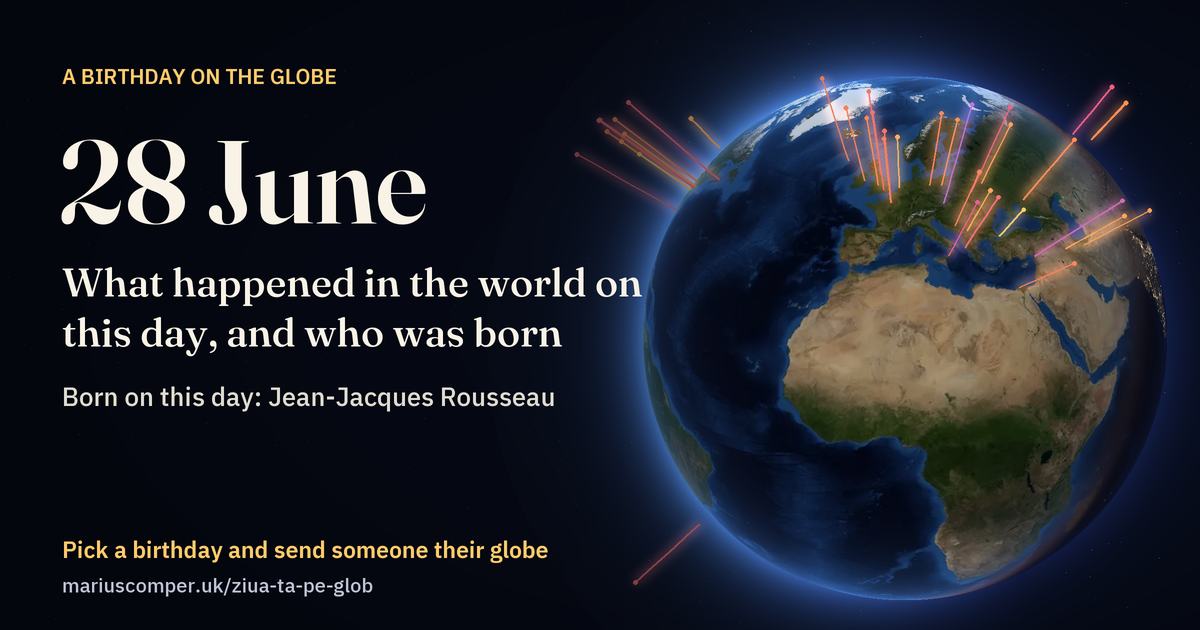
For 28 June, the English Wikipedia lists 66 events and 233 births. 38 of the events stand at their places as rays of light; 10 more are dashed circles, where the sentence links only to a country or a sea. The taller the ray, the longer ago it happened. The people born that day come further down, as blue points.
A birthday, yours or someone else’s:
Turn it into a greetingScroll: the globe turns to each place
The day you were born, on the globe.
Three things from your day
Scroll: your day first, then 28 June through the years
The Earth on 28 June
The picture on the globe was assembled by NASA from satellite photographs taken in June 2004: the snow, the ice and the green are those of the month.
On 28 June the Sun passes straight overhead at noon along the parallel of 23.3° north. In London, the day lasts about 16 hours 35 minutes.
Beyond 67° north the Sun no longer sets; beyond 67° south it no longer rises.
The line between day and night is tilted on the globe exactly as on this day of the year. On the dark side you can see the lights of towns.
Britain & Ireland · Westminster Abbey
1838
Coronation of Queen Victoria of the United Kingdom.
On the map: Westminster Abbey.
Britain & Ireland · Newcastle upon Tyne
1859
The first conformation dog show is held in Newcastle upon Tyne, England.
On the map: Newcastle upon Tyne.
Also on the day’s list of Wikipedia in Spanish.
Britain & Ireland · Villa Park
1948
Boxer Dick Turpin beats Vince Hawkins at Villa Park in Birmingham to become the first black British boxing champion in the modern era.
On the map: Villa Park.
Europe · Salle Le Peletier
1841
The Paris Opera Ballet premieres Giselle in the Salle Le Peletier.
On the map: Salle Le Peletier.
Also on the day’s list of Wikipedia in Spanish and Chinese.
Africa · Nakhla meteorite
1911
The Nakhla meteorite, the first one to suggest signs of aqueous processes on Mars, falls to Earth, landing in Egypt.
On the map: Nakhla meteorite.
North America · United States Declaration of Independence
1776
American Revolution: Thomas Jefferson and the Committee of Five present the draft of the United States Declaration of Independence to the Second Continental Congress, which orders it to "lie on the table" for further edits by the assembly.
On the map: the coordinates Wikidata gives for the article “United States Declaration of Independence”.
Also on the day’s list of Wikipedia in Chinese.
North America · United States Congress
1902
The U.S. Congress passes the Spooner Act, authorizing President Theodore Roosevelt to acquire rights from Colombia for the Panama Canal.
On the map: United States Congress.
Also on the day’s list of Wikipedia in Chinese.
North America · Supreme Court of the United States
1978
The United States Supreme Court, in Regents of the University of California v. Bakke, bars quota systems in college admissions.
On the map: Supreme Court of the United States.
28 June
What the other Wikipedias remember#
For these years the English list has nothing on this day. The events below come from the same day’s lists on Wikipedia in Spanish and Chinese and were translated for this page.
From Wikipedia in Spanish · Compromise of Caspe
1412
In Spain, it is made public that the Castilian infante Ferdinand of Trastámara is named king of Aragon, taking the name Ferdinand I (Compromise of Caspe).
On the map: Compromise of Caspe.
Translated from the list on Wikipedia in Spanish.
From Wikipedia in Chinese · Olympia
1958
Pelé leads the Brazilian football team to win the sixth World Cup.
On the map: Olympia.
Translated from the list on Wikipedia in Chinese.
From Wikipedia in Chinese · Supreme Court of the United States
1971
The US Supreme Court rules in Clay v. United States, the case of Ali's refusal of military service; the so-called claim that Muhammad Ali refused military service is unfounded.
On the map: Supreme Court of the United States.
Translated from the list on Wikipedia in Chinese.
From Wikipedia in Chinese · Shenzhen
1992
To promote reform and opening up, the government of the People's Republic of China hangs a portrait of Deng Xiaoping in Shenzhen, where Deng Xiaoping had made his Southern Tour speeches.
On the map: Shenzhen.
Translated from the list on Wikipedia in Chinese.
From Wikipedia in Chinese · Beijing
2008
The Bird's Nest, the main stadium of the Beijing Olympics, is completed.
On the map: Beijing.
Translated from the list on Wikipedia in Chinese.
28 June
Born on 28 June#
The English Wikipedia lists 233 births for this day. The blue points are the birthplaces of 59 of these people: those written about in the most Wikipedia editions, where Wikidata gives a place of birth.
Born on 28 June
1712
Jean-Jacques Rousseau, Swiss philosopher and polymath (died 1778)
Place of birth: Geneva.
Born on 28 June
1867
Luigi Pirandello, Italian dramatist, novelist, and poet, Nobel Prize laureate (died 1936)
Place of birth: Agrigento.
Born on 28 June
1940
Muhammad Yunus, Bangladeshi economist and academic, Nobel Prize laureate
Place of birth: Shikarpur Union.
Born on 28 June
1906
Maria Goeppert Mayer, German-American physicist and academic, Nobel Prize laureate (died 1972)
Place of birth: Katowice.
Born on 28 June
1991
Kevin De Bruyne, Belgian footballer
Place of birth: Drongen.
Born in Britain and Ireland
1703
John Wesley, English cleric and theologian (died 1791)
Place of birth: Epworth.
Born in Britain and Ireland
1930
William C. Campbell, Irish-American biologist and parasitologist, Nobel Prize laureate
Place of birth: Ramelton.
Born in Britain and Ireland
1985
Phil Bardsley, English footballer
Place of birth: Salford.
28 June
Number one in the charts that week
At the cinema
An animal recorded that day
The record can be seen in GBIF, which brings together wildlife records from around the world.
All your birthdays
The weather that day
Data: Met Office Hadley Centre (HadCET); NOAA (GHCN-Daily, Mauna Loa).
Above the Earth
Sources: Jonathan McDowell, GCAT (launches); GFZ Potsdam (Kp index). Days are counted in Universal Time.
Football that day
International matches played that day:
Source: the “International football results” dataset kept by Mart Jürisoo (CC0).
Also that day
The earthquake’s page at the USGS
Source: the USGS catalogue. The day is counted in Universal Time (UTC).
In those days
Make a link for someone
Type the name, pick the day and the year of birth. The link opens straight on their day, with their name in the greeting.
The link carries the name, date and place typed here; anyone who gets it can see them.
Put another birthday beside it
Your mother’s, your child’s, a friend’s: the two days appear side by side.
Below: 28 June through the years.
The whole globe of the day
Drag the globe to turn it. Touch a ray or a point to read what happened there.
Everything Wikipedia lists for 28 June
The list is the English Wikipedia’s, in its own wording, as it stood in October 2026. 18 events have no place on the map: the sentence links to no place with coordinates, only to places too wide to mark, or to several countries.
- 572
Alboin, the king of the Lombards, was assassinated in Verona in a coup d'état instigated by the Byzantines.
Europe · LombardsWikipedia: Alboin - 1098
Fighters of the First Crusade defeat Kerbogha of Mosul at the battle of Antioch.
Asia · AntiochWikipedia: First Crusade - 1360
Muhammed VI becomes the tenth Nasrid king of Granada after killing his brother-in-law Ismail II.
Europe · Emirate of GranadaWikipedia: Muhammad VI of Granada - 1461
Edward, Earl of March, is crowned King Edward IV of England.
no place on the mapWikipedia: Edward IV - 1495
A French force heavily defeats a much larger Neapolitan and Spanish army at the battle of Seminara, leading to the creation of the Tercios by Gonzalo de Córdoba.
Europe · Battle of SeminaraWikipedia: Battle of Seminara - 1519
Charles V is elected Emperor of the Holy Roman Empire.
Europe · Holy Roman EmpireWikipedia: Charles V, Holy Roman Emperor - 1575
Sengoku period of Japan: The combined forces of Oda Nobunaga and Tokugawa Ieyasu are victorious in the Battle of Nagashino.
Asia · Battle of NagashinoWikipedia: Battle of Nagashino - 1635
Guadeloupe becomes a French colony.
Europe · GuadeloupeWikipedia: Guadeloupe - 1651
The Battle of Berestechko between Poland and Ukraine starts.
Europe · Battle of BerestechkoWikipedia: Battle of Berestechko - 1745
A New England colonial army captures the French fortifications at Louisbourg (New Style).
North America · Siege of LouisbourgWikipedia: Siege of Louisbourg - 1776
American Revolution: Thomas Jefferson and the Committee of Five present the draft of the United States Declaration of Independence to the Second Continental Congress, which orders it to "lie on the table" for further edits by the assembly.
North America · United States Declaration of IndependenceWikipedia: American Revolution - 1776
American Revolutionary War: The Battle of Sullivan's Island ends with the American victory, leading to the commemoration of Carolina Day.
North America · Battle of Sullivan's IslandWikipedia: Battle of Sullivan's Island - 1776
American Revolutionary War: Thomas Hickey, Continental Army private and bodyguard to General George Washington, is hanged for mutiny and sedition.
no place on the mapWikipedia: Thomas Hickey - 1778
American Revolutionary War: The American Continentals engage the British in the Battle of Monmouth Courthouse resulting in standstill and British withdrawal under cover of darkness.
North America · Battle of MonmouthWikipedia: Battle of Monmouth - 1797
French troops disembark in Corfu, beginning the French rule in the Ionian Islands.
Europe · CorfuWikipedia: Corfu - 1807
Second British invasion of the Río de la Plata; John Whitelocke lands at Ensenada on an attempt to recapture Buenos Aires and is defeated by the locals.
Latin America · Ensenada, Buenos AiresWikipedia: British invasions of the River Plate - 1838
Coronation of Queen Victoria of the United Kingdom.
Britain & Ireland · Westminster AbbeyWikipedia: Coronation of Queen Victoria - 1841
The Paris Opera Ballet premieres Giselle in the Salle Le Peletier.
Europe · Salle Le PeletierWikipedia: Giselle - 1846
Belgian musician Adolphe Sax patented his design of the saxophone.
no place on the mapWikipedia: Adolphe Sax - 1855
Sigma Chi fraternity is founded in North America.
no place on the mapWikipedia: Sigma Chi - 1859
The first conformation dog show is held in Newcastle upon Tyne, England.
Britain & Ireland · Newcastle upon TyneWikipedia: Dog show - 1865
The Army of the Potomac is disbanded.
no place on the mapWikipedia: Army of the Potomac - 1870
The US Congress establishes the first federal holidays (New Year Day, July 4th, Thanksgiving, and Christmas).
no place on the map - 1880
Australian bushranger Ned Kelly is captured at Glenrowan.
Oceania · Glenrowan, VictoriaWikipedia: Bushranger - 1881
The Austro–Serbian Alliance of 1881 is secretly signed.
no place on the mapWikipedia: Austro-Serbian alliance of 1881 - 1882
The Anglo-French Convention of 1882 marks the territorial boundaries between Guinea and Sierra Leone.
no place on the mapWikipedia: Anglo-French Convention of 1882 - 1894
Labor Day becomes an official US holiday.
no place on the mapWikipedia: Labor Day - 1895
The United States Court of Private Land Claims rules James Reavis's claim to Barony of Arizona is "wholly fictitious and fraudulent."
no place on the mapWikipedia: United States Court of Private Land Claims - 1896
An explosion in the Newton Coal Company's Twin Shaft Mine in Pittston, Pennsylvania results in a massive cave-in that kills 58 miners.
North America · Twin Shaft disasterWikipedia: Twin Shaft disaster - 1902
The U.S. Congress passes the Spooner Act, authorizing President Theodore Roosevelt to acquire rights from Colombia for the Panama Canal.
North America · United States CongressWikipedia: United States Congress - 1904
The SS Norge runs aground on Hasselwood Rock in the North Atlantic 430 kilometres (270 mi) northwest of Ireland. More than 635 people die during the sinking.
Oceans · Hasselwood RockWikipedia: SS Norge - 1911
The Nakhla meteorite, the first one to suggest signs of aqueous processes on Mars, falls to Earth, landing in Egypt.
Africa · Nakhla meteoriteWikipedia: Nakhla meteorite - 1914
Causes of World War I: Archduke Franz Ferdinand of Austria and his wife Sophie are assassinated in Sarajevo, beginning the July Crisis and providing the casus belli of World War I.
Europe · Assassination of Archduke Franz FerdinandWikipedia: Assassination of Archduke Franz Ferdinand - 1916
First World War: Around 55,000 workers in Berlin went on strike to protest against the trial of anti-war campaigner Karl Liebknecht.
Europe · BerlinWikipedia: World War I - 1917
World War I: Greece joins the Allied powers.
no place on the mapWikipedia: Greece during World War I - 1919
The Treaty of Versailles is signed, ending the state of war between Germany and the Allies of World War I.
Europe · Palace of VersaillesWikipedia: Treaty of Versailles - 1921
Serbian King Alexander I proclaims the new constitution of the Kingdom of Serbs, Croats and Slovenes, known thereafter as the Vidovdan Constitution.
Europe · Kingdom of YugoslaviaWikipedia: Alexander I of Yugoslavia - 1922
The Irish Civil War begins with the shelling of the Four Courts in Dublin by Free State forces.
Britain & Ireland · Four CourtsWikipedia: Irish Civil War - 1926
Mercedes-Benz is formed by Gottlieb Daimler and Karl Benz merging their two companies.
no place on the mapWikipedia: Mercedes-Benz - 1936
The Japanese puppet state of Mengjiang is formed in northern China.
Asia · MengjiangWikipedia: Mengjiang - 1940
Romania cedes Bessarabia and Northern Bukovina to the Soviet Union after facing an ultimatum.
no place on the mapWikipedia: Soviet occupation of Bessarabia and Northern Bukovina - 1942
World War II: Nazi Germany starts its strategic summer offensive against the Soviet Union, codenamed Case Blue.
Europe · Case BlueWikipedia: Case Blue - 1945
Poland's Soviet-allied Provisional Government of National Unity is formed over a month after V-E Day.
no place on the mapWikipedia: Provisional Government of National Unity - 1948
Boxer Dick Turpin beats Vince Hawkins at Villa Park in Birmingham to become the first black British boxing champion in the modern era.
Britain & Ireland · Villa ParkWikipedia: Dick Turpin - 1948
Cold War: The Tito–Stalin Split results in the expulsion of the League of Communists of Yugoslavia from the Cominform.
no place on the mapWikipedia: Cold War - 1950
Korean War: Packed with its own refugees fleeing Seoul and leaving their 5th Division stranded, South Korean forces blow up the Hangang Bridge in an attempt to slow North Korea's offensive. The city falls later that day.
Asia · Hangang Bridge bombingWikipedia: Hangang Bridge bombing - 1950
Korean War: Suspected communist sympathizers (between 60,000 and 200,000) are executed in the Bodo League massacre.
Asia · First Republic of South KoreaWikipedia: Bodo League massacre - 1950
Korean War: The Korean People's Army kills almost a thousand doctors, nurses, inpatient civilians and wounded soldiers in the Seoul National University Hospital massacre.
Asia · Seoul National University HospitalWikipedia: Seoul National University Hospital massacre - 1956
In Poznań, workers from HCP factory go to the streets, sparking one of the first major protests against communist government both in Poland and Europe.
Europe · 1956 Poznań protestsWikipedia: 1956 Poznań protests - 1963
Profumo affair: During the trial of Stephen Ward, Mandy Rice-Davies uttered the phrase "Well he would, wouldn't he?"
no place on the mapWikipedia: Profumo affair - 1964
Malcolm X forms the Organization of Afro-American Unity.
no place on the mapWikipedia: Malcolm X - 1969
Stonewall riots begin in New York City, marking the start of the Gay Rights Movement.
North America · Stonewall riotsWikipedia: Stonewall riots - 1973
Elections are held for the Northern Ireland Assembly, which will lead to power-sharing between unionists and nationalists in Northern Ireland for the first time.
Britain & Ireland · Northern IrelandWikipedia: Northern Ireland Assembly - 1976
The Angolan court sentences US and UK mercenaries to death sentences and prison terms in the Luanda Trial.
Africa · AngolaWikipedia: Angola - 1978
The United States Supreme Court, in Regents of the University of California v. Bakke, bars quota systems in college admissions.
North America · Supreme Court of the United StatesWikipedia: Supreme Court of the United States - 1981
A powerful bomb explodes in Tehran, killing 73 officials of the Islamic Republican Party.
Asia · TehranWikipedia: Haft-e Tir bombing - 1982
Aeroflot Flight 8641 crashes in Mazyr, Belarus, killing 132 people.
Europe · Aeroflot Flight 8641Wikipedia: Aeroflot Flight 8641 - 1987
For the first time in military history, a civilian population is targeted for chemical attack when Iraqi warplanes bomb the Iranian town of Sardasht.
Asia · Chemical bombing of SardashtWikipedia: Chemical bombing of Sardasht - 1989
On the 600th anniversary of the Battle of Kosovo, Slobodan Milošević delivers the Gazimestan speech at the site of the historic battle.
Europe · Gazimestan speechWikipedia: Battle of Kosovo - 1990
Paperback Software, a company founded by Adam Osborne, was found guilty of copyright infringement for using Lotus 1-2-3's look-and-feel interface in its own spreadsheet program.
no place on the mapWikipedia: Paperback Software - 1997
Holyfield–Tyson II: Mike Tyson is disqualified in the third round for biting a piece off Evander Holyfield's ear.
North America · MGM Grand Garden ArenaWikipedia: Evander Holyfield vs. Mike Tyson II - 2001
Slobodan Milošević is extradited to the ICTY in The Hague to stand trial.
Europe · International Criminal Tribunal for the former YugoslaviaWikipedia: International Criminal Tribunal for the former Yugoslavia - 2004
Iraq War: Sovereign power is handed to the interim government of Iraq by the Coalition Provisional Authority, ending the U.S.-led rule of that nation.
Asia · Coalition Provisional AuthorityWikipedia: Iraq War - 2009
Honduran president Manuel Zelaya is ousted by a local military coup following a failed request to hold a referendum to rewrite the Honduran Constitution. This was the start of the 2009 Honduran constitutional crisis.
Latin America · HondurasWikipedia: 2009 Honduran coup d'état - 2012
The United States Supreme Court upholds the constitutionality of the Affordable Care Act's individual mandate in National Federation of Independent Business v. Sebelius.
North America · Supreme Court of the United StatesWikipedia: Supreme Court of the United States - 2016
A terrorist attack in Turkey's Istanbul Atatürk Airport kills 42 people and injures more than 230 others.
Asia · 2016 Atatürk Airport attackWikipedia: 2016 Atatürk Airport attack
What the other Wikipedias remember
For these years the English list has nothing on this day. The events below come from the same day’s lists on Wikipedia in Spanish and Chinese and were translated for this page.
- 1412
In Spain, it is made public that the Castilian infante Ferdinand of Trastámara is named king of Aragon, taking the name Ferdinand I (Compromise of Caspe).
Europe · Compromise of CaspeTranslated from the list on Wikipedia in SpanishWikipedia: Compromiso de Caspe - 1958
Pelé leads the Brazilian football team to win the sixth World Cup.
- 1971
The US Supreme Court rules in Clay v. United States, the case of Ali's refusal of military service; the so-called claim that Muhammad Ali refused military service is unfounded.
North America · Supreme Court of the United StatesTranslated from the list on Wikipedia in ChineseWikipedia: 美国最高法院 - 1992
To promote reform and opening up, the government of the People's Republic of China hangs a portrait of Deng Xiaoping in Shenzhen, where Deng Xiaoping had made his Southern Tour speeches.
- 2008
The Bird's Nest, the main stadium of the Beijing Olympics, is completed.
Who was born on 28 June
In order of how many Wikipedia editions have an article about each. The first 60 of 233 are shown.
- 1712
Jean-Jacques Rousseau, Swiss philosopher and polymath (died 1778)
- 1971
Elon Musk, South African-born American entrepreneur
PretoriaWikipedia: Elon Musk - 1577
Peter Paul Rubens, Flemish painter and diplomat (died 1640)
- 1867
Luigi Pirandello, Italian dramatist, novelist, and poet, Nobel Prize laureate (died 1936)
AgrigentoWikipedia: Luigi Pirandello - 1940
Muhammad Yunus, Bangladeshi economist and academic, Nobel Prize laureate
Shikarpur UnionWikipedia: Muhammad Yunus - 1491
Henry VIII, King of England (died 1547)
Palace of PlacentiaWikipedia: Henry VIII - 1906
Maria Goeppert Mayer, German-American physicist and academic, Nobel Prize laureate (died 1972)
KatowiceWikipedia: Maria Goeppert Mayer - 1991
Kevin De Bruyne, Belgian footballer
DrongenWikipedia: Kevin De Bruyne - 1873
Alexis Carrel, French surgeon and biologist, Nobel Prize laureate (died 1944)
Sainte-Foy-lès-LyonWikipedia: Alexis Carrel - 1948
Kathy Bates, American actress
MemphisWikipedia: Kathy Bates - 1476
Pope Paul IV (died 1559)
Capriglia IrpinaWikipedia: Pope Paul IV - 1926
Mel Brooks, American actor, director, producer, and screenwriter
BrownsvilleWikipedia: Mel Brooks - 1703
John Wesley, English cleric and theologian (died 1791)
EpworthWikipedia: John Wesley - 1943
Klaus von Klitzing, German physicist and academic, Nobel Prize laureate
Środa WielkopolskaWikipedia: Klaus von Klitzing - 1966
John Cusack, American actor and screenwriter
EvanstonWikipedia: John Cusack - 1957
Georgi Parvanov, Bulgarian historian and politician, 4th President of Bulgaria
SirishtnikWikipedia: Georgi Parvanov - 1921
P. V. Narasimha Rao, Indian lawyer and politician, 9th Prime Minister of India (died 2004)
LaknepalliWikipedia: P. V. Narasimha Rao - 1883
Pierre Laval, French soldier and politician, 101st Prime Minister of France (died 1945)
ChâteldonWikipedia: Pierre Laval - 1930
Itamar Franco, Brazilian engineer and politician, 33rd President of Brazil (died 2011)
Atlantic OceanWikipedia: Itamar Franco - 1971
Fabien Barthez, French footballer
LavelanetWikipedia: Fabien Barthez - 1927
Frank Sherwood Rowland, American chemist and academic, Nobel Prize laureate (died 2012)
DelawareWikipedia: F. Sherwood Rowland - 1930
William C. Campbell, Irish-American biologist and parasitologist, Nobel Prize laureate
RameltonWikipedia: William C. Campbell - 751
Carloman I, king of the Franks (died 771)
SoissonsWikipedia: Carloman I - 1934
Georges Wolinski, Tunisian-French journalist and cartoonist (died 2015)
- 1992
Elaine Thompson, Jamaican sprinter
Banana GroundWikipedia: Elaine Thompson-Herah - 1875
Henri Lebesgue, French mathematician and academic (died 1941)
BeauvaisWikipedia: Henri Lebesgue - 1912
Carl Friedrich von Weizsäcker, German physicist and philosopher (died 2007)
- 1902
Richard Rodgers, American playwright and composer (died 1979)
- 1938
Leon Panetta, American lawyer and politician, 23rd United States Secretary of Defense
MontereyWikipedia: Leon Panetta - 1928
Hans Blix, Swedish politician and diplomat, 33rd Swedish Minister of Foreign Affairs
UppsalaWikipedia: Hans Blix - 1989
Markiplier, American internet personality
HonoluluWikipedia: Markiplier - 1824
Paul Broca, French physician, anatomist, and anthropologist (died 1880)
Sainte-Foy-la-GrandeWikipedia: Paul Broca - 1952
Pietro Mennea, Italian sprinter and politician (died 2013)
BarlettaWikipedia: Pietro Mennea - 1999
Markéta Vondroušová, Czech tennis player
- 1932
Pat Morita, American actor (died 2005)
IsletonWikipedia: Pat Morita - 1972
Ngô Bảo Châu, Vietnamese-French mathematician and academic
- 1946
Bruce Davison, American actor and director
PhiladelphiaWikipedia: Bruce Davison - 1954
Alice Krige, South African actress
UpingtonWikipedia: Alice Krige - 1996
Donna Vekić, Croatian tennis player
OsijekWikipedia: Donna Vekić - 1941
David Johnston, Canadian academic, lawyer, and politician, 28th Governor General of Canada
Greater SudburyWikipedia: David Johnston - 1994
Hussein, Crown Prince of Jordan
- 1831
Joseph Joachim, Austrian violinist, composer, and conductor (died 1907)
KittseeWikipedia: Joseph Joachim - 1914
Aribert Heim, Austrian SS physician and Nazi war criminal (died 1992)
Bad RadkersburgWikipedia: Aribert Heim - 1946
Gilda Radner, American actress and comedian (died 1989)
DetroitWikipedia: Gilda Radner - 1985
Phil Bardsley, English footballer
SalfordWikipedia: Phil Bardsley - 1825
Emil Erlenmeyer, German chemist (died 1909)
- 1942
Chris Hani, South African politician (died 1993)
CofimvabaWikipedia: Chris Hani - 1972
Alessandro Nivola, American actor
- 1979
Felicia Day, American actress and writer
HuntsvilleWikipedia: Felicia Day - 1991
Seohyun, South Korean singer, dancer, and actress
SeoulWikipedia: Seohyun - 1992
Oscar Hiljemark, Swedish footballer
GislavedWikipedia: Oscar Hiljemark - 1490
Albert of Brandenburg, German archbishop (died 1545)
- 1945
Türkan Şoray, Turkish actress, director, and screenwriter
EyüpsultanWikipedia: Türkan Şoray - 2002
Marta Kostyuk, Ukrainian tennis player
- 1969
Stéphane Chapuisat, Swiss footballer
LausanneWikipedia: Stéphane Chapuisat - 1979
Florian Zeller, French author and playwright
16th arrondissement of ParisWikipedia: Florian Zeller - 1243
Emperor Go-Fukakusa of Japan (died 1304)
- 1653
Muhammad Azam Shah, Mughal emperor (died 1707)
BurhanpurWikipedia: Muhammad Azam Shah - 1934
Carl Levin, American lawyer and politician (died 2021)
DetroitWikipedia: Carl Levin - 1966
Mary Stuart Masterson, American actress
ManhattanWikipedia: Mary Stuart Masterson
What is celebrated on 28 June
- International LGBTQ Pride Day, marking the anniversary of Stonewall riots.
- Christian feast day: Basilides and Potamiana
- Christian feast day: Irenaeus of Lyon (Western Christianity)
- Christian feast day: Heimerad
- Christian feast day: Blessed Maria Pia Mastena
- Christian feast day: Paulus I
- Christian feast day: Vincenza Gerosa
- Christian feast day: June 28 (Eastern Orthodox liturgics)
- Constitution Day (Ukraine)
- Poznań Remembrance Day (Poland)
- Vidovdan, celebrating St. Vitus and an important day in Serbian history. (Eastern Orthodox Church)
- Tau Day
A greeting link for someone
Type a name and, if you like, the year of birth. The link opens with a greeting, and beside each event it says how old the person turned that day, or how many years before their birth it happened.
The name and the year go only into the link you send.
All 366 days
How the globe is made
Where the events come from
Each edition of this page uses the day’s list from Wikipedia in its own language: Romanian, English, Spanish, Chinese. The lists are written by volunteers and differ from one edition to the next; the text of each event is Wikipedia’s, with a link to the article. A row that appears twice in a list is shown once. The lists have not been checked event by event: they are Wikipedia’s, mistakes included.
For events before 1582, and for countries that moved to the Gregorian calendar later (Britain in 1752, Russia in 1918), the same day may be counted Old Style in one list and New Style in another.
The chapter “What the other Wikipedias remember” adds up to five events a day from the lists of the other three editions, only for years in which the English list has nothing on that day. They were translated for this page, passed the same filters as the tour, and are not counted among the events of the English list.
How an event gets onto the map
The place comes from Wikidata. If the sentence links to the article about the event itself (a battle, an opening, an earthquake), dated to the same year, the ray stands on its coordinates or on those of its location. Otherwise it stands on the first place the sentence links to: a town, a building, a mountain, an island. This second step can be wrong: sometimes the sentence only mentions the place. That is why the page says, under each event, which place the ray stands on.
When the sentence links to a single state or province, or to a single sea, lake or desert larger than 5,000 km², the globe shows a dashed circle, not a ray. The circle has the area Wikidata gives, with its radius kept between 1.2° and 16°, or a radius of 4.5° when Wikidata gives no area; it says only that the sentence links to that place. Organisations, ships, spacecraft, museum objects, rivers, mountain ranges, languages and continents are never used as places. When a sentence names several states and no exact place, the event stays in the list only.
What the height means
The height of a ray shows how many years have passed, on a logarithmic scale: 10 years, 100 years and 1,000 years are equal steps apart; anything older than about 2,600 years has the tallest ray. The colour runs from pale yellow for recent years to violet for antiquity.
Where the tour stops
In each region the tour stops at up to three events (five in Britain and Ireland), chosen mainly by three things: whether Wikipedia’s editors put the event in the “On this day” box of their main page (the English, Spanish and Chinese editions), how many Wikipedia editions have an article about it, and how many of the four lists include it. Events whose sentence or article is about a war, an attack, a crime or a disaster are left out of the tour; they stay in the whole list, in Wikipedia’s wording. The filter is a list of words and a list of Wikidata types, so it can miss some.
The tour of births names the people with articles in the most editions and leaves aside those whom the list or Wikidata describes as rulers, politicians, commanders, leaders of movements or criminals; they stay in the list.
The Earth and the Sun
The daytime images are NASA’s Blue Marble Next Generation mosaics, one for each month of 2004; the night side is Black Marble 2016. The tilt of the line between day and night is computed for the day; the hour is chosen so that the place being read is in daylight. The latitude where the Sun stands overhead is the average of the four years of the leap cycle; in a given year it can differ by up to 0.4°.
The day you were born
The number ones come from the weekly lists on Wikipedia: Billboard for the United States (from 1940; the Hot 100 from August 1958), the UK Singles Chart (from November 1952), Los 40 Principales for Spain (from July 1966) and, for Romania, the Romanian Top 100 and Airplay 100 (2001–2021, with missing weeks). The page shows the chart of the week in which the day of birth falls, with its date; Billboard and the UK chart are dated at the end of their week. For Romania before 2001 and for China these sources have no weekly chart.
The films are those that reached cinemas in the United States up to ten days before or three days after that day (some of them in a few cinemas at first), from the English Wikipedia’s yearly lists (from 1968), in order of how many editions have an article about them. The events “in those days” are the ones on the neighbouring days’ lists that carry the year of birth, passed through the same filter as the tour.
The day of birth, year included
The Moon, the star sign and the constellation are worked out by the page itself, for noon Universal Time on the day. The lit part of the Moon is rounded and can differ by a few per cent from that at the hour of birth. The sign follows the usual zodiac of twelve equal parts starting at the March equinox; the constellation is the one the Sun actually stood in front of, by the borders set by the International Astronomical Union, and within a day of a border the page does not name it. When the Sun changes sign while it is that day anywhere on Earth, the page gives the moment of crossing, rounded to ten minutes and accurate to within about a quarter of an hour, and the clock time in a few cities, with the time zone and summer time of that year.
The year in the Chinese calendar is the one your device’s own calendar gives for the date, checked against the Hong Kong Observatory’s tables. “All your birthdays” uses the same sources as the rest of the chapter for the same day in every year since the birth: the temperature, well-known launches that took place on that very day, matches of the teams the edition follows, snow deeper than 10 cm and strong geomagnetic storms. The three things at the top and the four on the picture are chosen in a fixed order (the song, the animal, a full Moon, a well-known launch before an ordinary earthquake); on the picture you can change them.
When the link carries a year of birth, the page adds a few things about that exact day. The weather is the Met Office’s Central England temperature record and the readings from New York’s Central Park; the “usual high” is the average of the daily highs of 1961–1990 for that date, with two days either side. The carbon dioxide figure is the monthly mean at the Mauna Loa observatory, where measurements begin in March 1958.
The earthquake is the one with the largest magnitude in the USGS catalogue for that day, counted in Universal Time. Before the 1960s the catalogue has gaps even above magnitude 5.5, so in the older years many days have no earthquake. The page gives only the magnitude and the place: the country the epicentre falls in or, when the epicentre is at sea within 300 km of a coast, the nearest country; farther out, only the ocean.
The launches are those that reached orbit or left for the Moon and the planets, from Jonathan McDowell’s GCAT catalogue. If nothing left that day, the page shows the nearest launch within three days before or after, and says how many days away it was. The geomagnetic storm appears only when the Kp index reached at least 5 in one of the day’s eight three-hour intervals.
The animal comes from GBIF: an observation made by a person (the animal seen or heard, or its tracks), dated to that exact day, with coordinates and a CC0 or CC BY licence. Only a few hundred well-known species are searched (mammals, birds, turtles, butterflies); of those noted that day, mammals and species with articles in many Wikipedia editions come first; birds noted almost every day, and species used recently, wait their turn. Observations dated 1 January are left out, because records without a day are often filed there. An observation shows that the animal was recorded there, not how many animals there were.
The matches are those between national teams. Only matches of England, Scotland, Wales, Northern Ireland, the Republic of Ireland, the United States, Canada and Australia are shown, along with those at the big final tournaments. The picture to send is drawn in the page from the day’s globe and the facts above, and stays on your device until you send it.
Sources
- Events, births and holidays: the day’s page on Wikipedia, text under CC BY-SA 4.0.
- Coordinates, places of birth and the number of editions: Wikidata (CC0).
- The Earth by day: NASA Blue Marble Next Generation. The Earth by night: NASA Black Marble 2016.
- Borders and regions: Natural Earth.
- World population and births per year: UN World Population Prospects 2024.
- Charts and films: Wikipedia’s lists for Billboard, the UK Singles Chart, Los 40 Principales, Romanian Top 100, Airplay 100 and American films by year (CC BY-SA 4.0).
- Weather: Met Office Hadley Centre, HadCET (Open Government Licence) and NOAA GHCN-Daily, New York Central Park. Carbon dioxide: NOAA Global Monitoring Laboratory, Mauna Loa.
- Earthquakes: the USGS catalogue. Launches: Jonathan McDowell, GCAT (CC BY). Kp index: GFZ Potsdam (CC BY 4.0). Matches: International football results, Mart Jürisoo (CC0).
- Animal observations: GBIF, with a link to each record; species names come from Wikidata.