A birthday on the globe
15 July on the globe: what happened in the world on this day, and who was born
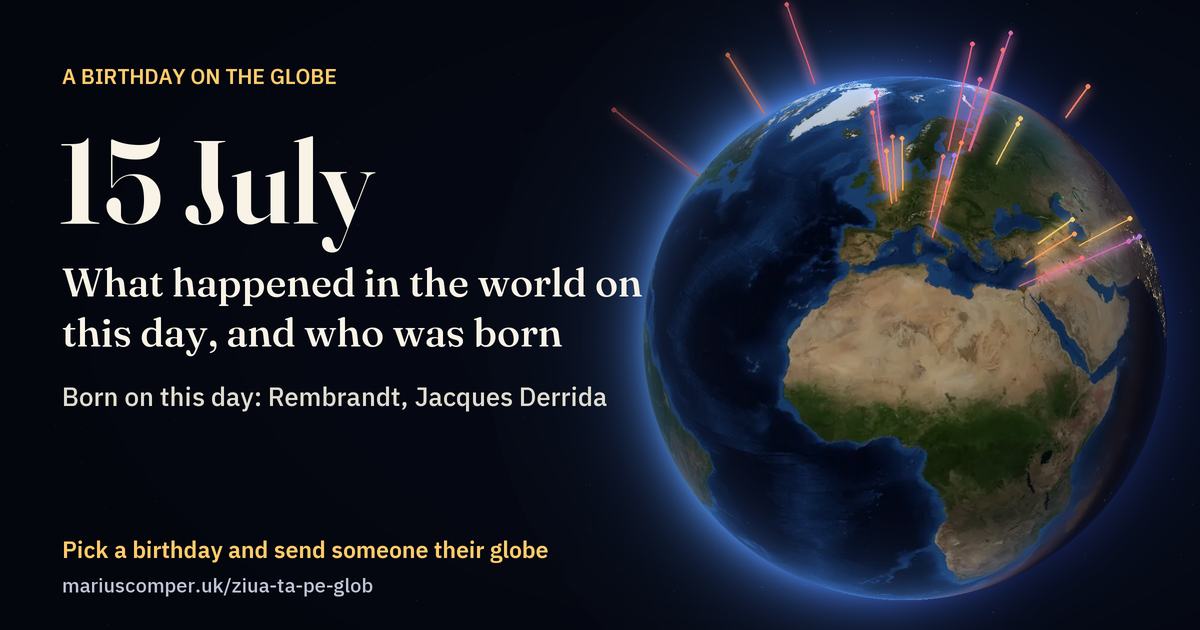
For 15 July, the English Wikipedia lists 57 events and 262 births. 27 of the events stand at their places as rays of light; seven more are dashed circles, where the sentence links only to a country or a sea. The taller the ray, the longer ago it happened. The people born that day come further down, as blue points.
A birthday, yours or someone else’s:
Turn it into a greetingScroll: the globe turns to each place
The day you were born, on the globe.
Three things from your day
Scroll: your day first, then 15 July through the years
The Earth on 15 July
The picture on the globe was assembled by NASA from satellite photographs taken in July 2004: the snow, the ice and the green are those of the month.
On 15 July the Sun passes straight overhead at noon along the parallel of 21.5° north. In London, the day lasts about 16 hours 10 minutes.
Beyond 68° north the Sun no longer sets; beyond 68° south it no longer rises.
The line between day and night is tilted on the globe exactly as on this day of the year. On the dark side you can see the lights of towns.
Britain & Ireland · London
1840
The Great Powers of Europe conclude the convention of London in order to stabilise the Near East.
On the map: London.
Europe · Temple of Castor and Pollux
484 BC
Dedication of the Temple of Castor and Pollux in ancient Rome.
On the map: Temple of Castor and Pollux.
Europe · Royal Academy of Turku
1640
The first university of Finland, the Royal Academy of Turku, is inaugurated in Turku.
On the map: Royal Academy of Turku.
Asia · Church of the Holy Sepulchre
1149
The reconstructed Church of the Holy Sepulchre is consecrated in Jerusalem.
On the map: Church of the Holy Sepulchre.
North America · Southeast Alaska
1741
Aleksei Chirikov sights land in Southeast Alaska. He sends men ashore in a longboat, making them the first Europeans to visit Alaska.
On the map: Southeast Alaska.
North America · Seattle
1916
In Seattle, Washington, William Boeing and George Conrad Westervelt incorporate Pacific Aero Products (later renamed Boeing).
On the map: Seattle.
Also on the day’s list of Wikipedia in Spanish.
15 July
What the other Wikipedias remember#
For these years the English list has nothing on this day. The events below come from the same day’s lists on Wikipedia in Spanish and were translated for this page.
From Wikipedia in Spanish · 2007 Copa América
2007
In Maracaibo (Venezuela), the Brazil national football team wins its eighth Copa América, beating Argentina 3-0 in the final of the 2007 Copa América at the Estadio José Encarnación Romero, with goals from Baptista and Dani Alves and an own goal by Ayala.
On the map: 2007 Copa América.
Translated from the list on Wikipedia in Spanish.
15 July
Born on 15 July#
The English Wikipedia lists 262 births for this day. The blue points are the birthplaces of 60 of these people: those written about in the most Wikipedia editions, where Wikidata gives a place of birth.
Born on 15 July
1606
Rembrandt, Dutch painter and etcher (died 1669)
Place of birth: Leiden.
Born on 15 July
1930
Jacques Derrida, Algerian-French philosopher and academic (died 2004)
Place of birth: El Biar.
Born on 15 July
1892
Walter Benjamin, German philosopher and critic (died 1940)
Place of birth: Berlin.
Born on 15 July
1848
Vilfredo Pareto, Italian economist and sociologist (died 1923)
Place of birth: Paris.
Born on 15 July
1961
Forest Whitaker, American actor
Place of birth: Longview.
Born in Britain and Ireland
1919
Iris Murdoch, Anglo-Irish British novelist and philosopher (died 1999)
Place of birth: Dublin.
Born in Britain and Ireland
1943
Jocelyn Bell Burnell, Northern Irish astrophysicist, astronomer, and academic
Place of birth: Lurgan.
Born in Britain and Ireland
1956
Ian Curtis, English singer-songwriter and guitarist (died 1980)
Place of birth: Stretford.
15 July
Number one in the charts that week
At the cinema
An animal recorded that day
The record can be seen in GBIF, which brings together wildlife records from around the world.
All your birthdays
The weather that day
Data: Met Office Hadley Centre (HadCET); NOAA (GHCN-Daily, Mauna Loa).
Above the Earth
Sources: Jonathan McDowell, GCAT (launches); GFZ Potsdam (Kp index). Days are counted in Universal Time.
Football that day
International matches played that day:
Source: the “International football results” dataset kept by Mart Jürisoo (CC0).
Also that day
The earthquake’s page at the USGS
Source: the USGS catalogue. The day is counted in Universal Time (UTC).
In those days
Make a link for someone
Type the name, pick the day and the year of birth. The link opens straight on their day, with their name in the greeting.
The link carries the name, date and place typed here; anyone who gets it can see them.
Put another birthday beside it
Your mother’s, your child’s, a friend’s: the two days appear side by side.
Below: 15 July through the years.
The whole globe of the day
Drag the globe to turn it. Touch a ray or a point to read what happened there.
Everything Wikipedia lists for 15 July
The list is the English Wikipedia’s, in its own wording, as it stood in October 2026. 23 events have no place on the map: the sentence links to no place with coordinates, only to places too wide to mark, or to several countries.
- 484 BC
Dedication of the Temple of Castor and Pollux in ancient Rome.
Europe · Temple of Castor and PolluxWikipedia: Temple of Castor and Pollux - 70
First Jewish–Roman War: Titus and his armies breach the walls of Jerusalem. (17th of Tammuz in the Hebrew calendar).
Asia · Siege of JerusalemWikipedia: First Jewish–Roman War - 756
An Lushan Rebellion: Emperor Xuanzong of Tang is ordered by his Imperial Guards to execute chancellor Yang Guozhong by forcing him to commit suicide or face a mutiny. General An Lushan has other members of the emperor's family killed.
no place on the mapWikipedia: An Lushan rebellion - 1099
First Crusade: Christian soldiers take the Church of the Holy Sepulchre in Jerusalem after the final assault of a difficult siege.
Asia · Church of the Holy SepulchreWikipedia: First Crusade - 1149
The reconstructed Church of the Holy Sepulchre is consecrated in Jerusalem.
Asia · Church of the Holy SepulchreWikipedia: Church of the Holy Sepulchre - 1207
King John of England expels Canterbury monks for supporting Archbishop Stephen Langton.
Britain & Ireland · CanterburyWikipedia: John, King of England - 1240
Swedish–Novgorodian Wars: A Novgorodian army led by Alexander Nevsky defeats the Swedes in the Battle of the Neva.
Europe · Battle of the NevaWikipedia: Battle of the Neva - 1381
John Ball, a leader in the Peasants' Revolt, is hanged, drawn and quartered in the presence of King Richard II of England.
Britain & Ireland · EnglandWikipedia: Peasants' Revolt - 1410
Polish–Lithuanian–Teutonic War: Battle of Grunwald: The allied forces of the Kingdom of Poland and the Grand Duchy of Lithuania defeat the army of the Teutonic Order.
Europe · Battle of GrunwaldWikipedia: Battle of Grunwald - 1482
Muhammad XI is crowned the twenty-second and last Nasrid king of Granada.
Europe · Emirate of GranadaWikipedia: Muhammad XI of Granada - 1640
The first university of Finland, the Royal Academy of Turku, is inaugurated in Turku.
Europe · Royal Academy of TurkuWikipedia: Royal Academy of Turku - 1738
Baruch Laibov and Alexander Voznitsyn are burned alive in St. Petersburg, Russia. Vonitzin had converted to Judaism with Laibov's help, with the consent of Empress Anna Ivanovna.
Europe · Saint PetersburgWikipedia: Baruch Leibov - 1741
Aleksei Chirikov sights land in Southeast Alaska. He sends men ashore in a longboat, making them the first Europeans to visit Alaska.
North America · Southeast AlaskaWikipedia: Aleksei Chirikov - 1789
French Revolution: Gilbert du Motier, Marquis de Lafayette, is named by acclamation Colonel General of the new National Guard of Paris.
Europe · FranceWikipedia: French Revolution - 1799
The Rosetta Stone is found in the Egyptian village of Rosetta by French Captain Pierre-François Bouchard during Napoleon's Egyptian Campaign.
Africa · RosettaWikipedia: Rosetta Stone - 1806
Pike Expedition: United States Army Lieutenant Zebulon Pike begins an expedition from Fort Bellefontaine near St. Louis, Missouri, to explore the west.
North America · Fort Belle FontaineWikipedia: Fort Belle Fontaine - 1815
Napoleonic Wars: Napoleon Bonaparte surrenders aboard HMS Bellerophon.
no place on the mapWikipedia: Napoleonic Wars - 1823
A fire destroys the ancient Basilica of Saint Paul Outside the Walls in Rome, Italy.
Europe · Basilica of Saint Paul Outside the WallsWikipedia: Basilica of Saint Paul Outside the Walls - 1834
The Spanish Inquisition is officially disbanded after nearly 356 years.
no place on the mapWikipedia: Spanish Inquisition - 1838
Ralph Waldo Emerson delivers the Divinity School Address at Harvard Divinity School, discounting Biblical miracles and declaring Jesus a great man, but not God. The Protestant community reacts with outrage.
no place on the mapWikipedia: Divinity School Address - 1840
The Great Powers of Europe conclude the convention of London in order to stabilise the Near East.
Britain & Ireland · LondonWikipedia: Convention of London - 1849
The first air raid in history occurs; Austria launches pilotless balloons against the city of Venice.
Europe · VeniceWikipedia: Airstrike - 1862
American Civil War: The CSS Arkansas, the most effective ironclad on the Mississippi River, battles with Union Navy ships commanded by Admiral David Farragut, severely damaging three ships and sustaining heavy damage herself.
no place on the mapWikipedia: American Civil War - 1870
Canadian Confederation: Rupert's Land and the North-Western Territory are transferred to Canada from the Hudson's Bay Company, and the province of Manitoba and the Northwest Territories are established from these vast territories.
no place on the mapWikipedia: Canadian Confederation - 1870
Reconstruction Era of the United States: Georgia becomes the last of the former Confederate states to be readmitted to the Union.
North America · GeorgiaWikipedia: Reconstruction era - 1888
The stratovolcano Mount Bandai erupts, killing approximately 500 people in Fukushima Prefecture, Japan.
Asia · Mount BandaiWikipedia: Mount Bandai - 1910
In his book Clinical Psychiatry, Emil Kraepelin gives a name to Alzheimer's disease, naming it after his colleague Alois Alzheimer.
no place on the mapWikipedia: Emil Kraepelin - 1916
In Seattle, Washington, William Boeing and George Conrad Westervelt incorporate Pacific Aero Products (later renamed Boeing).
North America · SeattleWikipedia: Seattle - 1918
World War I: The Second Battle of the Marne begins near the River Marne with a German attack.
Europe · Second Battle of the MarneWikipedia: World War I - 1920
Aftermath of World War I: The Parliament of Poland establishes Silesian Voivodeship before the Polish-German plebiscite.
Europe · Silesian VoivodeshipWikipedia: 1921 Upper Silesia plebiscite - 1922
The Japanese Communist Party is established in Japan.
no place on the mapWikipedia: Japanese Communist Party - 1927
Massacre of July 15, 1927: Eighty-nine protesters are killed by Austrian police in Vienna.
Europe · Palace of JusticeWikipedia: July Revolt of 1927 - 1942
The Holocaust: Nazi Germany begins the deportation of 100,000 Jews from the occupied Netherlands to extermination camps.
Europe · Nazi GermanyWikipedia: The Holocaust - 1943
The all-female Emilia Plater Independent Women's Battalion was formed in the Soviet Union's First Polish Army.
no place on the mapWikipedia: Emilia Plater Independent Women's Battalion - 1946
The State of North Borneo, now Sabah, Malaysia, is annexed by the United Kingdom.
no place on the mapWikipedia: North Borneo - 1954
The Boeing 367-80, the prototype for both the Boeing 707 and C-135 series, takes its first flight.
no place on the mapWikipedia: Boeing 367-80 - 1955
Eighteen Nobel laureates sign the Mainau Declaration against nuclear weapons, later co-signed by thirty-four others.
no place on the mapWikipedia: Nobel Prize - 1966
Vietnam War: The United States and South Vietnam begin Operation Hastings to push the North Vietnamese out of the Vietnamese Demilitarized Zone.
no place on the mapWikipedia: Vietnam War - 1971
The United Red Army is founded in Japan.
no place on the mapWikipedia: United Red Army - 1974
In Nicosia, Cyprus, Greek junta-sponsored nationalists launch a coup d'état, deposing Makarios III and installing Nikos Sampson as the president of Cyprus.
Asia · NicosiaWikipedia: Greek junta - 1975
Space Race: Apollo–Soyuz Test Project features the dual launch of an Apollo spacecraft and a Soyuz spacecraft on the first Soviet-United States human-crewed flight. It was the last launch of both an Apollo spacecraft, and the Saturn family of rockets.
no place on the mapWikipedia: Space Race - 1979
U.S. president Jimmy Carter gives his "malaise speech".
no place on the mapWikipedia: President of the United States - 1983
An attack at Orly Airport in Paris is launched by Armenian militant organisation ASALA, leaving eight people dead and 55 injured.
Europe · 1983 Orly Airport attackWikipedia: 1983 Orly Airport attack - 1983
Nintendo and Sega enter the console market with the respective releases of the Famicom and SG-1000 in Japan.
no place on the mapWikipedia: Nintendo - 1996
A Belgian Air Force C-130 Hercules carrying the Royal Netherlands Army marching band crashes on landing at Eindhoven Airport.
Europe · 1996 Belgian Air Force Hercules accidentWikipedia: 1996 Belgian Air Force Hercules accident - 1998
Sri Lankan Civil War: Sri Lankan Tamil MP S. Shanmuganathan is killed by a claymore mine.
no place on the mapWikipedia: Sri Lankan civil war - 2002
"American Taliban" John Walker Lindh pleads guilty to supplying aid to the enemy and possession of explosives during the commission of a felony.
no place on the mapWikipedia: Taliban - 2002
The Anti-Terrorism Court of Pakistan sentences British-born Ahmed Omar Saeed Sheikh to death, and three others suspected of murdering The Wall Street Journal reporter Daniel Pearl to life.
Asia · PakistanWikipedia: Anti-Terrorism Court of Pakistan - 2003
AOL Time Warner disbands Netscape. The Mozilla Foundation is established on the same day.
no place on the mapWikipedia: WarnerMedia - 2006
Twitter, later one of the largest social media platforms in the world, is launched.
no place on the mapWikipedia: X - 2009
A Mw 7.8 earthquake struck a remote region of Fiordland, New Zealand, the country's largest earthquake magnitude since the 1931 Hawke's Bay earthquake.
Oceania · 2009 Dusky Sound earthquakeWikipedia: 2009 Dusky Sound earthquake - 2009
Caspian Airlines Flight 7908 crashes near Jannatabad, Qazvin, Iran, killing 168.
Asia · Caspian Airlines Flight 7908Wikipedia: Caspian Airlines Flight 7908 - 2009
Space Shuttle program: Endeavour is launched on STS-127 to complete assembly of the International Space Station's Kibō module.
no place on the mapWikipedia: Space Shuttle program - 2012
South Korean rapper Psy releases his hit single Gangnam Style.
no place on the mapWikipedia: Psy - 2014
A train derails on the Moscow Metro, killing at least 24 and injuring more than 160 others.
Europe · Moscow MetroWikipedia: 2014 Moscow Metro derailment - 2016
Factions of the Turkish Armed Forces attempt a coup.
Asia · MalatyaWikipedia: 2016 Turkish coup d'état attempt - 2018
France win their second World Cup title, defeating Croatia 4–2.
Europe · 2018 FIFA World Cup finalWikipedia: 2018 FIFA World Cup final
What the other Wikipedias remember
For these years the English list has nothing on this day. The events below come from the same day’s lists on Wikipedia in Spanish and were translated for this page.
- 2007
In Maracaibo (Venezuela), the Brazil national football team wins its eighth Copa América, beating Argentina 3-0 in the final of the 2007 Copa América at the Estadio José Encarnación Romero, with goals from Baptista and Dani Alves and an own goal by Ayala.
Latin America · 2007 Copa AméricaTranslated from the list on Wikipedia in SpanishWikipedia: Copa América 2007
Who was born on 15 July
In order of how many Wikipedia editions have an article about each. The first 60 of 262 are shown.
- 1606
Rembrandt, Dutch painter and etcher (died 1669)
LeidenWikipedia: Rembrandt - 1930
Jacques Derrida, Algerian-French philosopher and academic (died 2004)
El BiarWikipedia: Jacques Derrida - 1892
Walter Benjamin, German philosopher and critic (died 1940)
- 1946
Hassanal Bolkiah, Sultan of Brunei
Bandar Seri BegawanWikipedia: Hassanal Bolkiah - 1848
Vilfredo Pareto, Italian economist and sociologist (died 1923)
- 1858
Emmeline Pankhurst, English political activist and suffragist (died 1928)
Moss SideWikipedia: Emmeline Pankhurst - 1961
Forest Whitaker, American actor
LongviewWikipedia: Forest Whitaker - 1976
Diane Kruger, German actress and model
AlgermissenWikipedia: Diane Kruger - 1919
Iris Murdoch, Anglo-Irish British novelist and philosopher (died 1999)
DublinWikipedia: Iris Murdoch - 1922
Leon M. Lederman, American physicist and mathematician, Nobel Prize laureate (died 2018)
New York CityWikipedia: Leon M. Lederman - 1939
Aníbal Cavaco Silva, Portuguese economist and politician, 19th President of the Portuguese Republic
BoliqueimeWikipedia: Aníbal Cavaco Silva - 1954
Mario Kempes, Argentinian footballer and manager
Bell VilleWikipedia: Mario Kempes - 1943
Jocelyn Bell Burnell, Northern Irish astrophysicist, astronomer, and academic
- 1918
Bertram Brockhouse, Canadian physicist and academic, Nobel Prize laureate (died 2003)
LethbridgeWikipedia: Bertram Brockhouse - 1946
Linda Ronstadt, American singer-songwriter, producer, and actress
- 1949
Carl Bildt, Swedish politician and diplomat, Prime Minister of Sweden
Halmstad parishWikipedia: Carl Bildt - 1933
John Hopfield, American physicist and neuroscientist, 2024 Nobel laureate
ChicagoWikipedia: John Hopfield - 1917
Nur Muhammad Taraki, Afghan journalist and politician (died 1979)
Nawa DistrictWikipedia: Nur Muhammad Taraki - 1991
Danilo, Brazilian footballer
BicasWikipedia: Danilo - 1573
Inigo Jones, English architect, designed the Queen's House (died 1652)
SmithfieldWikipedia: Inigo Jones - 1926
Leopoldo Galtieri, Argentinian general and politician, 44th President of Argentina (died 2003)
CaserosWikipedia: Leopoldo Galtieri - 1956
Joe Satriani, American singer-songwriter and guitarist
WestburyWikipedia: Joe Satriani - 1921
Robert Bruce Merrifield, American biochemist and academic, Nobel Prize laureate (died 2006)
Fort WorthWikipedia: Robert Bruce Merrifield - 1956
Ian Curtis, English singer-songwriter and guitarist (died 1980)
StretfordWikipedia: Ian Curtis - 1953
Jean-Bertrand Aristide, Haitian priest and politician, 49th President of Haiti
Port-SalutWikipedia: Jean-Bertrand Aristide - 1950
Arianna Huffington, Greek-American journalist and publisher
- 1979
Alexander Frei, Swiss footballer
- 1963
Brigitte Nielsen, Danish-Italian actress
RødovreWikipedia: Brigitte Nielsen - 1990
Damian Lillard, American basketball player
OaklandWikipedia: Damian Lillard - 1967
Adam Savage, American actor and special effects designer
New York CityWikipedia: Adam Savage - 1917
Robert Conquest, English-American historian, poet, and academic (died 2015)
MalvernWikipedia: Robert Conquest - 1951
Jesse Ventura, American wrestler, actor, and politician, 38th Governor of Minnesota
MinneapolisWikipedia: Jesse Ventura - 1952
Terry O'Quinn, American actor
Sault Ste. MarieWikipedia: Terry O'Quinn - 1972
John Dolmayan, Armenian-American drummer
BeirutWikipedia: John Dolmayan - 1992
Wayde van Niekerk, South African sprinter
Cape TownWikipedia: Wayde van Niekerk - 1976
Gabriel Iglesias, Mexican-American comedian and voice actor
San DiegoWikipedia: Gabriel Iglesias - 1977
Lana Parrilla, American actress
BrooklynWikipedia: Lana Parrilla - 1981
Alou Diarra, French footballer
VillepinteWikipedia: Alou Diarra - 1928
Carl Woese, American microbiologist and biophysicist (died 2012)
SyracuseWikipedia: Carl Woese - 1966
Irène Jacob, French-Swiss actress
SuresnesWikipedia: Irène Jacob - 1973
Brian Austin Green, American actor
Van NuysWikipedia: Brian Austin Green - 1979
Travis Fimmel, Australian actor
EchucaWikipedia: Travis Fimmel - 1986
Yahya Abdul-Mateen II, American actor
New OrleansWikipedia: Yahya Abdul-Mateen II - 1930
Stephen Smale, American mathematician and computer scientist
- 1947
Lydia Davis, American short story writer, novelist, and essayist
NorthamptonWikipedia: Lydia Davis - 1959
Vincent Lindon, French actor, director, and screenwriter
Boulogne-BillancourtWikipedia: Vincent Lindon - 1996
Vivianne Miedema, Dutch football player
HoogeveenWikipedia: Vivianne Miedema - 1931
Clive Cussler, American archaeologist and author (died 2020)
AuroraWikipedia: Clive Cussler - 1945
David Arthur Granger, Guyanese politician, 9th President of Guyana
GeorgetownWikipedia: David A. Granger - 1965
David Miliband, English politician, Secretary of State for Foreign and Commonwealth Affairs
- 1976
Marco Di Vaio, Italian footballer
- 1972
Scott Foley, American actor
Kansas CityWikipedia: Scott Foley - 1979
Laura Benanti, American actress and singer
New York CityWikipedia: Laura Benanti - 2008
Iain Armitage, American actor
GeorgiaWikipedia: Iain Armitage - 1850
Frances Xavier Cabrini, Italian-American nun and saint (died 1917)
Sant'Angelo LodigianoWikipedia: Frances Xavier Cabrini - 1867
Jean-Baptiste Charcot, French physician and explorer (died 1936)
Neuilly-sur-SeineWikipedia: Jean-Baptiste Charcot - 1990
Olly Alexander, English singer and actor
HarrogateWikipedia: Olly Alexander - 1904
Rudolf Arnheim, German-American psychologist and author (died 2007)
- 980
Ichijō, Japanese emperor (died 1011)
- 1902
Jean Rey, Belgian lawyer and politician, 2nd President of the European Commission (died 1983)
LiègeWikipedia: Jean Rey
What is celebrated on 15 July
- Christian feast day: Abhai (Syriac Orthodox Church)
- Christian feast day: Anne-Marie Javouhey
- Christian feast day: Bernhard II, Margrave of Baden-Baden
- Christian feast day: Bonaventure
- Christian feast day: Ceslaus
- Christian feast day: Dispersion of the Apostles (formerly by the Catholic Church)
- Christian feast day: Donald of Ogilvy
- Christian feast day: Edith of Polesworth
- Christian feast day: Blessed Inácio de Azevedo
- Christian feast day: Plechelm
- Christian feast day: Quriaqos and Julietta (Eastern Orthodox, Oriental Orthodox)
- Christian feast day: Swithun
- Christian feast day: Vladimir the Great (Eastern Orthodox; Catholic Church)
- Christian feast day: July 15 (Eastern Orthodox liturgics)
A greeting link for someone
Type a name and, if you like, the year of birth. The link opens with a greeting, and beside each event it says how old the person turned that day, or how many years before their birth it happened.
The name and the year go only into the link you send.
All 366 days
How the globe is made
Where the events come from
Each edition of this page uses the day’s list from Wikipedia in its own language: Romanian, English, Spanish, Chinese. The lists are written by volunteers and differ from one edition to the next; the text of each event is Wikipedia’s, with a link to the article. A row that appears twice in a list is shown once. The lists have not been checked event by event: they are Wikipedia’s, mistakes included.
For events before 1582, and for countries that moved to the Gregorian calendar later (Britain in 1752, Russia in 1918), the same day may be counted Old Style in one list and New Style in another.
The chapter “What the other Wikipedias remember” adds up to five events a day from the lists of the other three editions, only for years in which the English list has nothing on that day. They were translated for this page, passed the same filters as the tour, and are not counted among the events of the English list.
How an event gets onto the map
The place comes from Wikidata. If the sentence links to the article about the event itself (a battle, an opening, an earthquake), dated to the same year, the ray stands on its coordinates or on those of its location. Otherwise it stands on the first place the sentence links to: a town, a building, a mountain, an island. This second step can be wrong: sometimes the sentence only mentions the place. That is why the page says, under each event, which place the ray stands on.
When the sentence links to a single state or province, or to a single sea, lake or desert larger than 5,000 km², the globe shows a dashed circle, not a ray. The circle has the area Wikidata gives, with its radius kept between 1.2° and 16°, or a radius of 4.5° when Wikidata gives no area; it says only that the sentence links to that place. Organisations, ships, spacecraft, museum objects, rivers, mountain ranges, languages and continents are never used as places. When a sentence names several states and no exact place, the event stays in the list only.
What the height means
The height of a ray shows how many years have passed, on a logarithmic scale: 10 years, 100 years and 1,000 years are equal steps apart; anything older than about 2,600 years has the tallest ray. The colour runs from pale yellow for recent years to violet for antiquity.
Where the tour stops
In each region the tour stops at up to three events (five in Britain and Ireland), chosen mainly by three things: whether Wikipedia’s editors put the event in the “On this day” box of their main page (the English, Spanish and Chinese editions), how many Wikipedia editions have an article about it, and how many of the four lists include it. Events whose sentence or article is about a war, an attack, a crime or a disaster are left out of the tour; they stay in the whole list, in Wikipedia’s wording. The filter is a list of words and a list of Wikidata types, so it can miss some.
The tour of births names the people with articles in the most editions and leaves aside those whom the list or Wikidata describes as rulers, politicians, commanders, leaders of movements or criminals; they stay in the list.
The Earth and the Sun
The daytime images are NASA’s Blue Marble Next Generation mosaics, one for each month of 2004; the night side is Black Marble 2016. The tilt of the line between day and night is computed for the day; the hour is chosen so that the place being read is in daylight. The latitude where the Sun stands overhead is the average of the four years of the leap cycle; in a given year it can differ by up to 0.4°.
The day you were born
The number ones come from the weekly lists on Wikipedia: Billboard for the United States (from 1940; the Hot 100 from August 1958), the UK Singles Chart (from November 1952), Los 40 Principales for Spain (from July 1966) and, for Romania, the Romanian Top 100 and Airplay 100 (2001–2021, with missing weeks). The page shows the chart of the week in which the day of birth falls, with its date; Billboard and the UK chart are dated at the end of their week. For Romania before 2001 and for China these sources have no weekly chart.
The films are those that reached cinemas in the United States up to ten days before or three days after that day (some of them in a few cinemas at first), from the English Wikipedia’s yearly lists (from 1968), in order of how many editions have an article about them. The events “in those days” are the ones on the neighbouring days’ lists that carry the year of birth, passed through the same filter as the tour.
The day of birth, year included
The Moon, the star sign and the constellation are worked out by the page itself, for noon Universal Time on the day. The lit part of the Moon is rounded and can differ by a few per cent from that at the hour of birth. The sign follows the usual zodiac of twelve equal parts starting at the March equinox; the constellation is the one the Sun actually stood in front of, by the borders set by the International Astronomical Union, and within a day of a border the page does not name it. When the Sun changes sign while it is that day anywhere on Earth, the page gives the moment of crossing, rounded to ten minutes and accurate to within about a quarter of an hour, and the clock time in a few cities, with the time zone and summer time of that year.
The year in the Chinese calendar is the one your device’s own calendar gives for the date, checked against the Hong Kong Observatory’s tables. “All your birthdays” uses the same sources as the rest of the chapter for the same day in every year since the birth: the temperature, well-known launches that took place on that very day, matches of the teams the edition follows, snow deeper than 10 cm and strong geomagnetic storms. The three things at the top and the four on the picture are chosen in a fixed order (the song, the animal, a full Moon, a well-known launch before an ordinary earthquake); on the picture you can change them.
When the link carries a year of birth, the page adds a few things about that exact day. The weather is the Met Office’s Central England temperature record and the readings from New York’s Central Park; the “usual high” is the average of the daily highs of 1961–1990 for that date, with two days either side. The carbon dioxide figure is the monthly mean at the Mauna Loa observatory, where measurements begin in March 1958.
The earthquake is the one with the largest magnitude in the USGS catalogue for that day, counted in Universal Time. Before the 1960s the catalogue has gaps even above magnitude 5.5, so in the older years many days have no earthquake. The page gives only the magnitude and the place: the country the epicentre falls in or, when the epicentre is at sea within 300 km of a coast, the nearest country; farther out, only the ocean.
The launches are those that reached orbit or left for the Moon and the planets, from Jonathan McDowell’s GCAT catalogue. If nothing left that day, the page shows the nearest launch within three days before or after, and says how many days away it was. The geomagnetic storm appears only when the Kp index reached at least 5 in one of the day’s eight three-hour intervals.
The animal comes from GBIF: an observation made by a person (the animal seen or heard, or its tracks), dated to that exact day, with coordinates and a CC0 or CC BY licence. Only a few hundred well-known species are searched (mammals, birds, turtles, butterflies); of those noted that day, mammals and species with articles in many Wikipedia editions come first; birds noted almost every day, and species used recently, wait their turn. Observations dated 1 January are left out, because records without a day are often filed there. An observation shows that the animal was recorded there, not how many animals there were.
The matches are those between national teams. Only matches of England, Scotland, Wales, Northern Ireland, the Republic of Ireland, the United States, Canada and Australia are shown, along with those at the big final tournaments. The picture to send is drawn in the page from the day’s globe and the facts above, and stays on your device until you send it.
Sources
- Events, births and holidays: the day’s page on Wikipedia, text under CC BY-SA 4.0.
- Coordinates, places of birth and the number of editions: Wikidata (CC0).
- The Earth by day: NASA Blue Marble Next Generation. The Earth by night: NASA Black Marble 2016.
- Borders and regions: Natural Earth.
- World population and births per year: UN World Population Prospects 2024.
- Charts and films: Wikipedia’s lists for Billboard, the UK Singles Chart, Los 40 Principales, Romanian Top 100, Airplay 100 and American films by year (CC BY-SA 4.0).
- Weather: Met Office Hadley Centre, HadCET (Open Government Licence) and NOAA GHCN-Daily, New York Central Park. Carbon dioxide: NOAA Global Monitoring Laboratory, Mauna Loa.
- Earthquakes: the USGS catalogue. Launches: Jonathan McDowell, GCAT (CC BY). Kp index: GFZ Potsdam (CC BY 4.0). Matches: International football results, Mart Jürisoo (CC0).
- Animal observations: GBIF, with a link to each record; species names come from Wikidata.