A birthday on the globe
15 March on the globe: what happened in the world on this day, and who was born
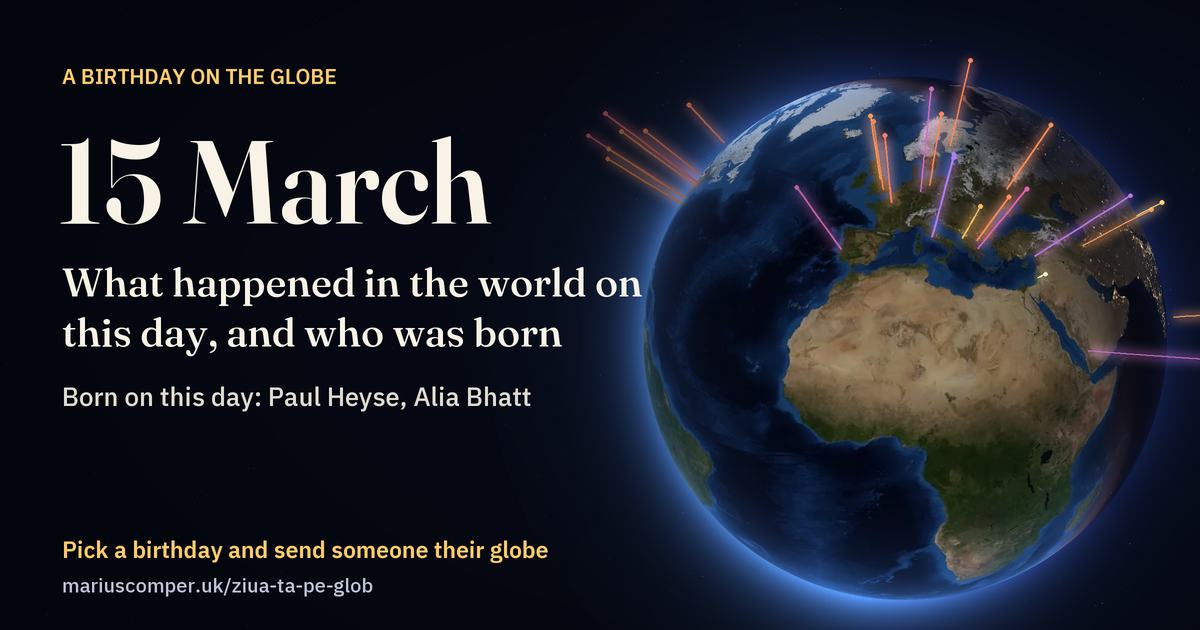
For 15 March, the English Wikipedia lists 59 events and 189 births. 29 of the events stand at their places as rays of light; nine more are dashed circles, where the sentence links only to a country or a sea. The taller the ray, the longer ago it happened. The people born that day come further down, as blue points.
A birthday, yours or someone else’s:
Turn it into a greetingScroll: the globe turns to each place
The day you were born, on the globe.
Three things from your day
Scroll: your day first, then 15 March through the years
The Earth on 15 March
The picture on the globe was assembled by NASA from satellite photographs taken in March 2004: the snow, the ice and the green are those of the month.
On 15 March the Sun passes straight overhead at noon along the parallel of 1.9° south. In London, the day lasts about 11 hours 50 minutes.
The line between day and night is tilted on the globe exactly as on this day of the year. On the dark side you can see the lights of towns.
Britain & Ireland · Women's Boat Race
1927
The first Women's Boat Race between the University of Oxford and the University of Cambridge takes place on The Isis in Oxford.
On the map: Women's Boat Race.
Britain & Ireland · Leeds
1974
Transvestism and Transsexualism in Modern Society, the UK's first trans-rights conference, opened with an evening reception in Leeds.
On the map: Leeds.
Wikipedia: Transvestism and Transsexualism in Modern Society
Asia · Antioch
351
Constantius Gallus is elevated as Caesar and then sent to Antioch to govern the Roman East.
On the map: Antioch.
Asia · Saada
897
Al-Hadi ila'l-Haqq Yahya enters Sa'dah and founds the Zaydi Imamate of Yemen.
On the map: Saada.
Oceania · Melbourne Cricket Ground
1877
First ever official cricket test match is played: Australia vs England at the MCG Stadium, in Melbourne, Australia.
On the map: Melbourne Cricket Ground.
North America · Mark Hellinger Theatre
1956
The musical My Fair Lady, based on George Bernard Shaw's play Pygmalion, debuted at the Mark Hellinger Theatre in New York City.
On the map: Mark Hellinger Theatre.
15 March
What the other Wikipedias remember#
For these years the English list has nothing on this day. The events below come from the same day’s lists on Wikipedia in Romanian and Chinese and were translated for this page.
From Wikipedia in Romanian · University of Toronto
1827
On the initiative of the Anglican Bishop of Toronto, John Strachan, the University of Toronto is founded.
On the map: University of Toronto.
Translated from the list on Wikipedia in Romanian.
The article on Wikipedia in Romanian: Universitatea din Toronto
From Wikipedia in Chinese · United States Congress
1962
The then US President John F. Kennedy delivers to the US Congress his "Special Message to the Congress on Protecting the Consumer Interest", in which the four rights of consumers are first set out; this is why the day was chosen as World Consumer Rights Day.
On the map: United States Congress.
Translated from the list on Wikipedia in Chinese.
15 March
Born on 15 March#
The English Wikipedia lists 189 births for this day. The blue points are the birthplaces of 60 of these people: those written about in the most Wikipedia editions, where Wikidata gives a place of birth.
Born on 15 March
1830
Paul Heyse, German author, poet, and playwright, Nobel Prize laureate (died 1914)
Place of birth: Berlin.
Born on 15 March
1993
Paul Pogba, French footballer
Place of birth: Lagny-sur-Marne.
Born on 15 March
1854
Emil von Behring, German physiologist and physician, Nobel Prize laureate (died 1917)
Place of birth: Ławice.
Born on 15 March
1933
Ruth Bader Ginsburg, American lawyer and judge (died 2020)
Place of birth: Brooklyn.
Born in Britain and Ireland
1813
John Snow, English physician and epidemiologist (died 1858)
Place of birth: York.
Born in Britain and Ireland
1852
Augusta, Lady Gregory, Anglo-Irish landowner, playwright, and translator (died 1932)
Place of birth: Loughrea.
15 March
Number one in the charts that week
At the cinema
An animal recorded that day
The record can be seen in GBIF, which brings together wildlife records from around the world.
All your birthdays
The weather that day
Data: Met Office Hadley Centre (HadCET); NOAA (GHCN-Daily, Mauna Loa).
Above the Earth
Sources: Jonathan McDowell, GCAT (launches); GFZ Potsdam (Kp index). Days are counted in Universal Time.
Football that day
International matches played that day:
Source: the “International football results” dataset kept by Mart Jürisoo (CC0).
Also that day
The earthquake’s page at the USGS
Source: the USGS catalogue. The day is counted in Universal Time (UTC).
In those days
Make a link for someone
Type the name, pick the day and the year of birth. The link opens straight on their day, with their name in the greeting.
The link carries the name, date and place typed here; anyone who gets it can see them.
Put another birthday beside it
Your mother’s, your child’s, a friend’s: the two days appear side by side.
Below: 15 March through the years.
The whole globe of the day
Drag the globe to turn it. Touch a ray or a point to read what happened there.
Everything Wikipedia lists for 15 March
The list is the English Wikipedia’s, in its own wording, as it stood in October 2026. 21 events have no place on the map: the sentence links to no place with coordinates, only to places too wide to mark, or to several countries.
- 474 BC
Roman consul Aulus Manlius Vulso celebrates an ovation for concluding the war against Veii and securing a forty years' truce.
Europe · VeiiWikipedia: Roman–Etruscan Wars - 200 BC
The Roman Republic under its new consuls Publius Sulpicius Galba and Gaius Aurelius Cotta declares war on Philip V of Macedon, starting the Second Macedonian War.
Europe · Roman RepublicWikipedia: Second Macedonian War - 44 BC
The assassination of Julius Caesar, the dictator of the Roman Republic, by a group of senators takes place on the Ides of March.
Europe · Assassination of Julius CaesarWikipedia: Assassination of Julius Caesar - 351
Constantius Gallus is elevated as Caesar and then sent to Antioch to govern the Roman East.
Asia · AntiochWikipedia: Constantius Gallus - 493
Odoacer, the first barbarian King of Italy after the fall of the Western Roman Empire, is slain by Theoderic the Great, king of the Ostrogoths, while the two kings were feasting together.
Europe · Western Roman EmpireWikipedia: Odoacer - 856
Michael III, emperor of the Byzantine Empire, overthrows the regency of his mother, empress Theodora (wife of Theophilos) with support of the Byzantine nobility.
Asia · Byzantine EmpireWikipedia: Michael III - 897
Al-Hadi ila'l-Haqq Yahya enters Sa'dah and founds the Zaydi Imamate of Yemen.
Asia · SaadaWikipedia: Al-Hadi ila'l-Haqq Yahya - 933
After a ten-year truce, German King Henry the Fowler defeats a Hungarian army at the Battle of Riade near the Unstrut river.
Europe · Central GermanyWikipedia: Battle of Riade - 1147
Afonso I of Portugal captures in a surprise attack the city of Santarem from the Almoravids.
Europe · Conquest of SantarémWikipedia: Conquest of Santarém - 1311
Battle of Halmyros: The Catalan Company defeats Walter V, Count of Brienne to take control of the Duchy of Athens, a Crusader state in Greece.
Europe · Battle of HalmyrosWikipedia: Battle of Halmyros - 1412
Treaty of Lublowa: After the Peace of Thorn, Grand Master Heinrich von Plauen asks Sigismund of Hungary for economic aid. Sigismund agrees to mediate reduction to the third installment, demarcation of the Samogitian border, and other matters with a grand tournament. Hunts and lavish feasts were also organized. Sigismund invited, among others, polish king Wladyslaw Jagiello, Heinrich von Plauen and bosnian king Tvrtko II. There were people from 17 countries and languages - 40.000 nobles and 2000 knights were present from all over Europe, even England.
no place on the mapWikipedia: Treaty of Lubowla - 1564
Mughal Emperor Akbar abolishes the jizya tax on non-Muslim subjects.
no place on the mapWikipedia: Akbar - 1626
A dam failure causes the sudden flooding of the mining city of Potosí in present-day Bolivia leading to the death of thousands and the massive release of toxic mercury into the environment.
no place on the mapWikipedia: Dam failure - 1672
King Charles II of England issues the Royal Declaration of Indulgence, granting limited religious freedom to all Christians.
no place on the mapWikipedia: Declaration of Indulgence - 1781
The British under Charles Cornwallis defeat American forces under Nathanael Greene in the battle of Guilford Court House.
North America · Battle of Guilford Court HouseWikipedia: Battle of Guilford Court House - 1783
In an emotional speech in Newburgh, New York, George Washington asks his officers not to support the Newburgh Conspiracy. The plea is successful, and the threatened coup d'état never takes place.
North America · Newburgh, New YorkWikipedia: Newburgh Conspiracy - 1820
Maine is admitted as the twenty-third U.S. state.
North America · MaineWikipedia: Maine - 1823
Sailor Benjamin Morrell erroneously reports the existence of the island of New South Greenland near Antarctica.
Oceans · AntarcticaWikipedia: Benjamin Morrell - 1848
A revolution breaks out in Hungary, and the Habsburg rulers are compelled to meet the demands of the reform party.
Europe · Kingdom of HungaryWikipedia: Hungarian Revolution of 1848 - 1874
France and Vietnam sign the Second Treaty of Saigon, further recognizing the full sovereignty of France over Cochinchina.
no place on the mapWikipedia: French Third Republic - 1875
Archbishop of New York John McCloskey is named the first cardinal in the United States.
no place on the mapWikipedia: List of archbishops of New York - 1877
First ever official cricket test match is played: Australia vs England at the MCG Stadium, in Melbourne, Australia.
Oceania · Melbourne Cricket GroundWikipedia: Melbourne Cricket Ground - 1888
Start of the Anglo-Tibetan War of 1888.
no place on the mapWikipedia: Sikkim expedition - 1892
The Lobau bombing is one of the first attacks of the Ère des attentats (1892-1894).
Europe · Lobau bombingWikipedia: Lobau bombing - 1894
Madeleine bombing by Désiré Pauwels during the Ère des attentats.
Europe · Madeleine bombingWikipedia: Madeleine bombing - 1907
The first parliamentary elections of Finland (at the time the Grand Duchy of Finland) are held.
no place on the mapWikipedia: 1907 Finnish parliamentary election - 1910
Prospectors drilled into a pressurized deposit within the Midway-Sunset Oil Field in California, resulting in the largest accidental oil spill in history, which eventually released 9 million barrels (1.4 million m3) of crude oil over 18 months.
North America · Midway-Sunset Oil FieldWikipedia: Midway-Sunset Oil Field - 1916
Six days after Pancho Villa and his cross-border raiders attacked Columbus, New Mexico, U.S. general John J. Pershing led a punitive expedition into Mexico to pursue him.
North America · Columbus, New MexicoWikipedia: Pancho Villa Expedition - 1917
Tsar Nicholas II of Russia abdicates the Russian throne, ending the 304-year Romanov dynasty.
no place on the mapWikipedia: Tsar - 1918
Finnish Civil War: The battle of Tampere begins.
Europe · Battle of TampereWikipedia: Finnish Civil War - 1919
The American Legion is founded.
no place on the mapWikipedia: American Legion - 1919
Ukrainian War of Independence: The Kontrrazvedka is established as the counterintelligence division of the Revolutionary Insurgent Army of Ukraine.
no place on the mapWikipedia: Ukrainian War of Independence - 1921
Talaat Pasha, former Grand Vizir of the Ottoman Empire and chief architect of the Armenian genocide, is assassinated in Berlin by a 23-year-old Armenian, Soghomon Tehlirian.
Europe · Assassination of Talaat PashaWikipedia: Armenian genocide - 1922
After Egypt gains nominal independence from the United Kingdom, Fuad I becomes King of Egypt.
Africa · EgyptWikipedia: Egypt - 1927
The first Women's Boat Race between the University of Oxford and the University of Cambridge takes place on The Isis in Oxford.
Britain & Ireland · Women's Boat RaceWikipedia: University of Oxford - 1931
Sing-Song Girl Red Peony, one of the first sound films produced in China, was released in Shanghai.
no place on the mapWikipedia: Sing-Song Girl Red Peony - 1939
Carpatho-Ukraine declares itself an independent republic, but is annexed by Hungary the next day.
Europe · Carpatho-UkraineWikipedia: Carpatho-Ukraine - 1939
Germany occupies Czechoslovakia.
no place on the mapWikipedia: Occupation of Czechoslovakia - 1943
The deportation of 50,000 Jews from the Greek city of Thessaloniki began.
Europe · ThessalonikiWikipedia: The Holocaust in Greece - 1943
World War II: Third Battle of Kharkiv: The Germans retake the city of Kharkiv from the Soviet armies.
Europe · Third Battle of KharkovWikipedia: World War II - 1951
The Iranian oil industry is nationalized.
no place on the mapWikipedia: Nationalization of the Iranian oil industry - 1956
The musical My Fair Lady, based on George Bernard Shaw's play Pygmalion, debuted at the Mark Hellinger Theatre in New York City.
North America · Mark Hellinger TheatreWikipedia: My Fair Lady - 1960
Students from the Atlanta University Center, inspired by similar actions in Greensboro, North Carolina, began occupying lunch counters in Atlanta, Georgia.
North America · Greensboro sit-insWikipedia: Greensboro sit-ins - 1961
At the 1961 Commonwealth Prime Ministers' Conference, South Africa announces that it will withdraw from the Commonwealth when the South African Constitution of 1961 comes into effect.
no place on the mapWikipedia: 1961 Commonwealth Prime Ministers' Conference - 1965
President Lyndon B. Johnson, responding to the Selma crisis, tells the U.S. Congress "We shall overcome" while advocating the Voting Rights Act.
North America · Selma, AlabamaWikipedia: United States Congress - 1974
Fifteen people are killed when Sterling Airways Flight 901, a Sud Aviation Caravelle, catches fire following a landing gear collapse at Mehrabad International Airport in Tehran, Iran.
Asia · Sterling Airways Flight 901Wikipedia: Sterling Airways Flight 901 - 1974
Transvestism and Transsexualism in Modern Society, the UK's first trans-rights conference, opened with an evening reception in Leeds.
Britain & Ireland · LeedsWikipedia: Transvestism and Transsexualism in Modern Society - 1978
Somalia and Ethiopia sign a truce to end the Ethio-Somali War.
no place on the mapWikipedia: Ogaden War - 1986
Collapse of Hotel New World: Thirty-three people die when the Hotel New World in Singapore collapses.
Asia · Collapse of Hotel New WorldWikipedia: Collapse of Hotel New World - 1990
Iraqi authorities hanged Iranian freelance reporter Farzad Bazoft on charges of spying for Israel.
no place on the mapWikipedia: Farzad Bazoft - 1990
Mikhail Gorbachev is elected as the first and only President of the Soviet Union.
no place on the mapWikipedia: Mikhail Gorbachev - 1991
Cold War: The Treaty on the Final Settlement with Respect to Germany comes into effect, granting full sovereignty to the Federal Republic of Germany.
- 2008
Stockpiles of obsolete ammunition explode at an ex-military ammunition depot in the village of Gërdec, Albania, killing 26 people.
Europe · 2008 Gërdec explosionsWikipedia: 2008 Gërdec explosions - 2011
Beginning of the Syrian revolution.
no place on the mapWikipedia: Syrian revolution - 2019
Approximately 1.4 million young people in 123 countries go on strike to protest climate change.
no place on the mapWikipedia: Fridays for Future - 2019
Beginning of the 2019–20 Hong Kong protests.
Asia · 2019–2020 Hong Kong protestsWikipedia: 2019–2020 Hong Kong protests - 2019
Fifty-one people are killed in the Christchurch mosque shootings, which remains the deadliest terror attack in New Zealand history.
Oceania · Christchurch mosque shootingsWikipedia: Christchurch mosque shootings - 2022
The 2022 Sri Lankan protests begins amidst Sri Lanka's economic collapse.
no place on the mapWikipedia: 2022 Sri Lankan protests - 2026
Four members of a Palestinian family are shot dead in Tammun by the Israeli military.
What the other Wikipedias remember
For these years the English list has nothing on this day. The events below come from the same day’s lists on Wikipedia in Romanian and Chinese and were translated for this page.
- 1827
On the initiative of the Anglican Bishop of Toronto, John Strachan, the University of Toronto is founded.
North America · University of TorontoTranslated from the list on Wikipedia in RomanianWikipedia: Universitatea din Toronto - 1962
The then US President John F. Kennedy delivers to the US Congress his "Special Message to the Congress on Protecting the Consumer Interest", in which the four rights of consumers are first set out; this is why the day was chosen as World Consumer Rights Day.
North America · United States CongressTranslated from the list on Wikipedia in ChineseWikipedia: 美国国会
Who was born on 15 March
In order of how many Wikipedia editions have an article about each. The first 60 of 189 are shown.
- 1767
Andrew Jackson, American general, judge, and politician, 7th President of the United States (died 1845)
WaxhawsWikipedia: Andrew Jackson - 1830
Paul Heyse, German author, poet, and playwright, Nobel Prize laureate (died 1914)
BerlinWikipedia: Paul Heyse - 1993
Alia Bhatt, British actress
MumbaiWikipedia: Alia Bhatt - 1993
Paul Pogba, French footballer
Lagny-sur-MarneWikipedia: Paul Pogba - 1854
Emil von Behring, German physiologist and physician, Nobel Prize laureate (died 1917)
- 1933
Ruth Bader Ginsburg, American lawyer and judge (died 2020)
BrooklynWikipedia: Ruth Bader Ginsburg - 1878
Reza Shah, Iranian Shah (died 1944)
AlashtWikipedia: Reza Shah - 1975
Eva Longoria, American actress
Corpus ChristiWikipedia: Eva Longoria - 1930
Zhores Alferov, Belarusian-Russian physicist and academic, Nobel Prize laureate (died 2019)
VitebskWikipedia: Zhores Alferov - 1943
David Cronenberg, Canadian actor, director, and screenwriter
TorontoWikipedia: David Cronenberg - 1932
Alan Bean, American astronaut and pilot (died 2018)
WheelerWikipedia: Alan Bean - 1975
will.i.am, American rapper, producer, and actor
Los AngelesWikipedia: Will.i.am - 1830
Élisée Reclus, French geographer and anarchist (died 1905)
Sainte-Foy-la-GrandeWikipedia: Élisée Reclus - 1638
Shunzhi Emperor of China (died 1661)
Mukden PalaceWikipedia: Shunzhi Emperor - 1857
Christian Michelsen, Norwegian businessman and politician, 1st Prime Minister of Norway (died 1925)
- 1920
E. Donnall Thomas, American physician and academic, Nobel Prize laureate (died 2012)
- 1779
William Lamb, 2nd Viscount Melbourne, English politician, Prime Minister of the United Kingdom (died 1848)
- 1985
Kellan Lutz, American actor and model
DickinsonWikipedia: Kellan Lutz - 1959
Ben Okri, Nigerian poet and author
MinnaWikipedia: Ben Okri - 1813
John Snow, English physician and epidemiologist (died 1858)
- 1852
Augusta, Lady Gregory, Anglo-Irish landowner, playwright, and translator (died 1932)
LoughreaWikipedia: Lady Gregory - 1977
Joe Hahn, American musician, DJ, director, and visual artist
DallasWikipedia: Joe Hahn - 2000
Kristian Kostov, Russian-Bulgarian singer-songwriter
- 1953
Frances Conroy, American actress
- 1986
Jai Courtney, Australian actor
SydneyWikipedia: Jai Courtney - 1989
Adrien Silva, Portuguese footballer
AngoulêmeWikipedia: Adrien Silva - 1809
Joseph Jenkins Roberts, American-Liberian historian and politician, 1st President of Liberia (died 1876)
- 1907
Zarah Leander, Swedish actress and singer (died 1981)
Karlstad church parishWikipedia: Zarah Leander - 1968
Sabrina Salerno, Italian singer-songwriter
- 1886
Gerda Wegener, Danish artist (died 1940)
HammelevWikipedia: Gerda Wegener - 1937
Valentin Rasputin, Russian environmentalist and author (died 2015)
Ust'-UdaWikipedia: Valentin Rasputin - 1947
Ry Cooder, American singer-songwriter and guitarist
Los AngelesWikipedia: Ry Cooder - 1985
Eva Amurri, American actress
New York CityWikipedia: Eva Amurri - 1821
Johann Josef Loschmidt, Austrian physicist and chemist (died 1895)
- 1959
Renny Harlin, Finnish director and producer
RiihimäkiWikipedia: Renny Harlin - 1972
Mark Hoppus, American singer-songwriter and musician
RidgecrestWikipedia: Mark Hoppus - 1591
Alexandre de Rhodes, French missionary (died 1660)
- 1933
Philippe de Broca, French actor, director, and screenwriter (died 2004)
12th arrondissement of ParisWikipedia: Philippe de Broca - 1943
Sly Stone, American musician and record producer (died 2025)
DentonWikipedia: Sly Stone - 1957
Steve Witkoff, American real estate investor, former lawyer, and diplomat
The BronxWikipedia: Steve Witkoff - 1967
Naoko Takeuchi, Japanese manga artist and creator of Sailor Moon
- 1869
Stanisław Wojciechowski, Polish scholar and politician, President of the Republic of Poland (died 1953)
- 1935
Judd Hirsch, American actor
The BronxWikipedia: Judd Hirsch - 1957
Joaquim de Almeida, Portuguese-American actor
- 1955
Dee Snider, American singer-songwriter
AstoriaWikipedia: Dee Snider - 1963
Bret Michaels, American singer-songwriter, musician, and television personality
ButlerWikipedia: Bret Michaels - 1969
Kim Raver, American actress
New York CityWikipedia: Kim Raver - 1835
Eduard Strauss, Austrian composer and conductor (died 1916)
LeopoldstadtWikipedia: Eduard Strauss - 1948
Sérgio Vieira de Mello, Brazilian diplomat (died 2003)
Rio de JaneiroWikipedia: Sérgio Vieira de Mello - 1981
Young Buck, American rapper
NashvilleWikipedia: Young Buck - 1858
Liberty Hyde Bailey, American botanist and academic, co-founded the American Society for Horticultural Science (died 1954)
South HavenWikipedia: Liberty Hyde Bailey - 1993
Aleksandra Krunić, Serbian tennis player
- 1981
Mikael Forssell, German-Finnish footballer
SteinfurtWikipedia: Mikael Forssell - 1493
Anne de Montmorency, French captain and diplomat (died 1567)
- 1989
Sandro, Brazilian footballer
RiachinhoWikipedia: Sandro - 1916
Harry James, American trumpet player, bandleader, and actor (died 1983)
AlbanyWikipedia: Harry James - 1912
Louis Paul Boon, Flemish journalist and author (died 1979)
- 1912
Lightnin' Hopkins, American blues singer-songwriter and guitarist (died 1982)
CentervilleWikipedia: Lightnin' Hopkins - 1944
Jacques Doillon, French director and screenwriter
- 1982
Wilson Kipsang Kiprotich, Kenyan runner
Keiyo DistrictWikipedia: Wilson Kipsang Kiprotich
What is celebrated on 15 March
- Ancient Roman religious observance: Ides of March
- Christian feast day: Aristobulus of Britannia (Roman Catholic Church)
- Christian feast day: Artémides Zatti
- Christian feast day: Clement Mary Hofbauer
- Christian feast day: Leocritia
- Christian feast day: Saint Longinus
- Christian feast day: Louise de Marillac
- Christian feast day: Blessed William Hart
- Christian feast day: March 15 (Eastern Orthodox liturgics)
- Constitution Day (Belarus)
- International Day To Combat Islamophobia
- Joseph Jenkins Roberts' Birthday (Liberia)
- National Day, celebrating the Hungarian Revolution of 1848 (Hungary)
- World Consumer Rights Day (International)
A greeting link for someone
Type a name and, if you like, the year of birth. The link opens with a greeting, and beside each event it says how old the person turned that day, or how many years before their birth it happened.
The name and the year go only into the link you send.
All 366 days
How the globe is made
Where the events come from
Each edition of this page uses the day’s list from Wikipedia in its own language: Romanian, English, Spanish, Chinese. The lists are written by volunteers and differ from one edition to the next; the text of each event is Wikipedia’s, with a link to the article. A row that appears twice in a list is shown once. The lists have not been checked event by event: they are Wikipedia’s, mistakes included.
For events before 1582, and for countries that moved to the Gregorian calendar later (Britain in 1752, Russia in 1918), the same day may be counted Old Style in one list and New Style in another.
The chapter “What the other Wikipedias remember” adds up to five events a day from the lists of the other three editions, only for years in which the English list has nothing on that day. They were translated for this page, passed the same filters as the tour, and are not counted among the events of the English list.
How an event gets onto the map
The place comes from Wikidata. If the sentence links to the article about the event itself (a battle, an opening, an earthquake), dated to the same year, the ray stands on its coordinates or on those of its location. Otherwise it stands on the first place the sentence links to: a town, a building, a mountain, an island. This second step can be wrong: sometimes the sentence only mentions the place. That is why the page says, under each event, which place the ray stands on.
When the sentence links to a single state or province, or to a single sea, lake or desert larger than 5,000 km², the globe shows a dashed circle, not a ray. The circle has the area Wikidata gives, with its radius kept between 1.2° and 16°, or a radius of 4.5° when Wikidata gives no area; it says only that the sentence links to that place. Organisations, ships, spacecraft, museum objects, rivers, mountain ranges, languages and continents are never used as places. When a sentence names several states and no exact place, the event stays in the list only.
What the height means
The height of a ray shows how many years have passed, on a logarithmic scale: 10 years, 100 years and 1,000 years are equal steps apart; anything older than about 2,600 years has the tallest ray. The colour runs from pale yellow for recent years to violet for antiquity.
Where the tour stops
In each region the tour stops at up to three events (five in Britain and Ireland), chosen mainly by three things: whether Wikipedia’s editors put the event in the “On this day” box of their main page (the English, Spanish and Chinese editions), how many Wikipedia editions have an article about it, and how many of the four lists include it. Events whose sentence or article is about a war, an attack, a crime or a disaster are left out of the tour; they stay in the whole list, in Wikipedia’s wording. The filter is a list of words and a list of Wikidata types, so it can miss some.
The tour of births names the people with articles in the most editions and leaves aside those whom the list or Wikidata describes as rulers, politicians, commanders, leaders of movements or criminals; they stay in the list.
The Earth and the Sun
The daytime images are NASA’s Blue Marble Next Generation mosaics, one for each month of 2004; the night side is Black Marble 2016. The tilt of the line between day and night is computed for the day; the hour is chosen so that the place being read is in daylight. The latitude where the Sun stands overhead is the average of the four years of the leap cycle; in a given year it can differ by up to 0.4°.
The day you were born
The number ones come from the weekly lists on Wikipedia: Billboard for the United States (from 1940; the Hot 100 from August 1958), the UK Singles Chart (from November 1952), Los 40 Principales for Spain (from July 1966) and, for Romania, the Romanian Top 100 and Airplay 100 (2001–2021, with missing weeks). The page shows the chart of the week in which the day of birth falls, with its date; Billboard and the UK chart are dated at the end of their week. For Romania before 2001 and for China these sources have no weekly chart.
The films are those that reached cinemas in the United States up to ten days before or three days after that day (some of them in a few cinemas at first), from the English Wikipedia’s yearly lists (from 1968), in order of how many editions have an article about them. The events “in those days” are the ones on the neighbouring days’ lists that carry the year of birth, passed through the same filter as the tour.
The day of birth, year included
The Moon, the star sign and the constellation are worked out by the page itself, for noon Universal Time on the day. The lit part of the Moon is rounded and can differ by a few per cent from that at the hour of birth. The sign follows the usual zodiac of twelve equal parts starting at the March equinox; the constellation is the one the Sun actually stood in front of, by the borders set by the International Astronomical Union, and within a day of a border the page does not name it. When the Sun changes sign while it is that day anywhere on Earth, the page gives the moment of crossing, rounded to ten minutes and accurate to within about a quarter of an hour, and the clock time in a few cities, with the time zone and summer time of that year.
The year in the Chinese calendar is the one your device’s own calendar gives for the date, checked against the Hong Kong Observatory’s tables. “All your birthdays” uses the same sources as the rest of the chapter for the same day in every year since the birth: the temperature, well-known launches that took place on that very day, matches of the teams the edition follows, snow deeper than 10 cm and strong geomagnetic storms. The three things at the top and the four on the picture are chosen in a fixed order (the song, the animal, a full Moon, a well-known launch before an ordinary earthquake); on the picture you can change them.
When the link carries a year of birth, the page adds a few things about that exact day. The weather is the Met Office’s Central England temperature record and the readings from New York’s Central Park; the “usual high” is the average of the daily highs of 1961–1990 for that date, with two days either side. The carbon dioxide figure is the monthly mean at the Mauna Loa observatory, where measurements begin in March 1958.
The earthquake is the one with the largest magnitude in the USGS catalogue for that day, counted in Universal Time. Before the 1960s the catalogue has gaps even above magnitude 5.5, so in the older years many days have no earthquake. The page gives only the magnitude and the place: the country the epicentre falls in or, when the epicentre is at sea within 300 km of a coast, the nearest country; farther out, only the ocean.
The launches are those that reached orbit or left for the Moon and the planets, from Jonathan McDowell’s GCAT catalogue. If nothing left that day, the page shows the nearest launch within three days before or after, and says how many days away it was. The geomagnetic storm appears only when the Kp index reached at least 5 in one of the day’s eight three-hour intervals.
The animal comes from GBIF: an observation made by a person (the animal seen or heard, or its tracks), dated to that exact day, with coordinates and a CC0 or CC BY licence. Only a few hundred well-known species are searched (mammals, birds, turtles, butterflies); of those noted that day, mammals and species with articles in many Wikipedia editions come first; birds noted almost every day, and species used recently, wait their turn. Observations dated 1 January are left out, because records without a day are often filed there. An observation shows that the animal was recorded there, not how many animals there were.
The matches are those between national teams. Only matches of England, Scotland, Wales, Northern Ireland, the Republic of Ireland, the United States, Canada and Australia are shown, along with those at the big final tournaments. The picture to send is drawn in the page from the day’s globe and the facts above, and stays on your device until you send it.
Sources
- Events, births and holidays: the day’s page on Wikipedia, text under CC BY-SA 4.0.
- Coordinates, places of birth and the number of editions: Wikidata (CC0).
- The Earth by day: NASA Blue Marble Next Generation. The Earth by night: NASA Black Marble 2016.
- Borders and regions: Natural Earth.
- World population and births per year: UN World Population Prospects 2024.
- Charts and films: Wikipedia’s lists for Billboard, the UK Singles Chart, Los 40 Principales, Romanian Top 100, Airplay 100 and American films by year (CC BY-SA 4.0).
- Weather: Met Office Hadley Centre, HadCET (Open Government Licence) and NOAA GHCN-Daily, New York Central Park. Carbon dioxide: NOAA Global Monitoring Laboratory, Mauna Loa.
- Earthquakes: the USGS catalogue. Launches: Jonathan McDowell, GCAT (CC BY). Kp index: GFZ Potsdam (CC BY 4.0). Matches: International football results, Mart Jürisoo (CC0).
- Animal observations: GBIF, with a link to each record; species names come from Wikidata.