A birthday on the globe
6 December on the globe: what happened in the world on this day, and who was born
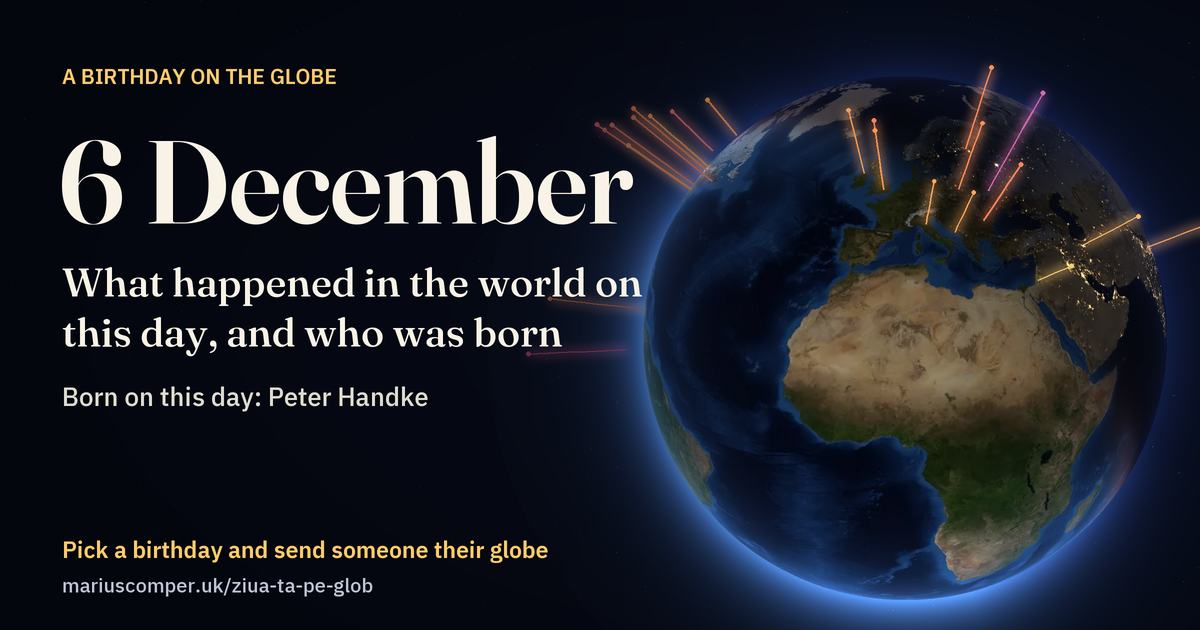
For 6 December, the English Wikipedia lists 50 events and 251 births. 25 of the events stand at their places as rays of light; four more are dashed circles, where the sentence links only to a country or a sea. The taller the ray, the longer ago it happened. The people born that day come further down, as blue points.
A birthday, yours or someone else’s:
Turn it into a greetingScroll: the globe turns to each place
The day you were born, on the globe.
Three things from your day
Scroll: your day first, then 6 December through the years
The Earth on 6 December
The picture on the globe was assembled by NASA from satellite photographs taken in December 2004: the snow, the ice and the green are those of the month.
On 6 December the Sun passes straight overhead at noon along the parallel of 22.5° south. In London, the day lasts about 8 hours 5 minutes.
Beyond 68° south the Sun no longer sets; beyond 68° north it no longer rises.
The line between day and night is tilted on the globe exactly as on this day of the year. On the dark side you can see the lights of towns.
Britain & Ireland · London
1921
The Anglo-Irish Treaty is signed in London by British and Irish representatives.
On the map: London.
Also on the day’s list of Wikipedia in Chinese.
Asia · Jerusalem
2017
Donald Trump's administration officially announces the recognition of Jerusalem as the capital of Israel.
On the map: Jerusalem.
Also on the day’s list of Wikipedia in Chinese.
Wikipedia: United States recognition of Jerusalem as capital of Israel
Oceania · Australian Capital Territory
1988
Self-government was granted to the Australian Capital Territory.
On the map: Australian Capital Territory.
Latin America · Quito
1534
The city of Quito in Ecuador is founded by Spanish settlers led by Sebastián de Belalcázar.
On the map: Quito.
Also on the day’s list of Wikipedia in Spanish and Chinese.
North America · United States Congress
1790
The U.S. Congress moves from New York City to Philadelphia.
On the map: United States Congress.
Also on the day’s list of Wikipedia in Chinese.
North America · Washington Monument
1884
The Washington Monument in Washington, D.C., is completed.
On the map: Washington Monument.
6 December
What the other Wikipedias remember#
For these years the English list has nothing on this day. The events below come from the same day’s lists on Wikipedia in Chinese and were translated for this page.
From Wikipedia in Chinese · Site of the Ministry of Education of Qing Dynasty
1905
The Qing government of China, by imperial decree, establishes the Ministry of Education and decides to abolish, from the following year, the thousand-year-old imperial examination system.
On the map: Site of the Ministry of Education of Qing Dynasty.
Translated from the list on Wikipedia in Chinese.
6 December
Born on 6 December#
The English Wikipedia lists 251 births for this day. The blue points are the birthplaces of 60 of these people: those written about in the most Wikipedia editions, where Wikidata gives a place of birth.
Born on 6 December
1942
Peter Handke, Austrian author and playwright, Nobel Prize laureate
Place of birth: Griffen.
Born on 6 December
1778
Joseph Louis Gay-Lussac, French physicist and chemist (died 1850)
Place of birth: Saint-Léonard-de-Noblat.
Born on 6 December
1898
Gunnar Myrdal, Swedish sociologist and economist, Nobel Prize laureate (died 1987)
Place of birth: Skattunge Parish.
Born on 6 December
1823
Max Müller, German-English philologist and orientalist (died 1900)
Place of birth: Dessau.
Born on 6 December
1947
Geoffrey Hinton, British-Canadian computer scientist, cognitive scientist, and cognitive psychologist, Nobel Prize laureate
Place of birth: Wimbledon.
Born in Britain and Ireland
1920
George Porter, English chemist and academic, Nobel Prize laureate (died 2002)
Place of birth: Stainforth.
Born in Britain and Ireland
1958
Nick Park, English animator, director, producer, and screenwriter
Place of birth: 5 and 7 Weavers Yard.
Born in Britain and Ireland
1887
Lynn Fontanne, British actress (died 1983)
Place of birth: Woodford.
6 December
Number one in the charts that week
At the cinema
An animal recorded that day
The record can be seen in GBIF, which brings together wildlife records from around the world.
All your birthdays
The weather that day
Data: Met Office Hadley Centre (HadCET); NOAA (GHCN-Daily, Mauna Loa).
Above the Earth
Sources: Jonathan McDowell, GCAT (launches); GFZ Potsdam (Kp index). Days are counted in Universal Time.
Football that day
International matches played that day:
Source: the “International football results” dataset kept by Mart Jürisoo (CC0).
Also that day
The earthquake’s page at the USGS
Source: the USGS catalogue. The day is counted in Universal Time (UTC).
In those days
Make a link for someone
Type the name, pick the day and the year of birth. The link opens straight on their day, with their name in the greeting.
The link carries the name, date and place typed here; anyone who gets it can see them.
Put another birthday beside it
Your mother’s, your child’s, a friend’s: the two days appear side by side.
Below: 6 December through the years.
The whole globe of the day
Drag the globe to turn it. Touch a ray or a point to read what happened there.
Everything Wikipedia lists for 6 December
The list is the English Wikipedia’s, in its own wording, as it stood in October 2026. 21 events have no place on the map: the sentence links to no place with coordinates, only to places too wide to mark, or to several countries.
- 963
Leo VIII was ordained a bishop, claiming the Holy See as an antipope supported by Otto the Great.
no place on the mapWikipedia: Pope Leo VIII - 1060
Béla I is crowned king of Hungary.
Europe · Kingdom of HungaryWikipedia: Béla I of Hungary - 1240
Mongol invasion of Rus': Kyiv, defended by Voivode Dmytro, falls to the Mongols under Batu Khan.
Europe · Siege of KievWikipedia: Siege of Kiev - 1492
After exploring the island of Cuba (which he had mistaken for Japan) for gold, Christopher Columbus lands on an island he names Hispaniola.
no place on the mapWikipedia: Hispaniola - 1534
The city of Quito in Ecuador is founded by Spanish settlers led by Sebastián de Belalcázar.
Latin America · QuitoWikipedia: Quito - 1648
Pride's Purge removes royalist sympathizers from Parliament so that the High Court of Justice could put the King on trial.
no place on the mapWikipedia: Pride's Purge - 1745
Charles Edward Stuart's army begins retreat during the second Jacobite Rising.
no place on the mapWikipedia: Jacobite rising of 1745 - 1790
The U.S. Congress moves from New York City to Philadelphia.
North America · United States CongressWikipedia: United States Congress - 1803
Five French warships attempting to escape the Royal Naval blockade of Saint-Domingue are all seized by British warships, signifying the end of the Haitian Revolution.
no place on the mapWikipedia: Haitian Revolution - 1846
Mexican–American War: American and Mexican forces clashed at the Battle of San Pasqual, a series of skirmishes near San Diego, California.
North America · Battle of San PasqualWikipedia: Mexican–American War - 1865
Georgia ratifies the 13th Amendment to the U.S. Constitution.
North America · GeorgiaWikipedia: Georgia - 1882
Transit of Venus, second and last of the 19th century.
no place on the mapWikipedia: 1882 transit of Venus - 1884
The Washington Monument in Washington, D.C., is completed.
North America · Washington MonumentWikipedia: Washington Monument - 1897
London becomes the world's first city to host licensed taxicabs.
no place on the mapWikipedia: Taxi - 1904
Theodore Roosevelt articulated his "Corollary" to the Monroe Doctrine, stating that the U.S. would intervene in the Western Hemisphere should Latin American governments prove incapable or unstable.
no place on the mapWikipedia: Theodore Roosevelt - 1907
A coal mine explosion at Monongah, West Virginia, kills 362 workers.
North America · Monongah mining disasterWikipedia: Monongah mining disaster - 1912
The Nefertiti Bust is discovered.
no place on the mapWikipedia: Nefertiti Bust - 1916
World War I: The Central Powers capture Bucharest.
Europe · BucharestWikipedia: World War I - 1917
Finland declares independence from the Russian Empire.
Asia · Russian EmpireWikipedia: Finnish Declaration of Independence - 1917
Halifax Explosion: A munitions explosion near Halifax, Nova Scotia kills more than 1,900 people in the largest artificial explosion up to that time.
North America · Halifax ExplosionWikipedia: Halifax Explosion - 1917
World War I: USS Jacob Jones is the first American destroyer to be sunk by enemy action when it is torpedoed by German submarine SM U-53.
no place on the mapWikipedia: USS Jacob Jones - 1921
The Anglo-Irish Treaty is signed in London by British and Irish representatives.
Britain & Ireland · LondonWikipedia: Anglo-Irish Treaty - 1922
Ireland is partitioned, with Northern Ireland and the Irish Free State coming into existence, one year to the day after the signing of the Anglo-Irish Treaty.
no place on the mapWikipedia: Partition of Ireland - 1928
The government of Colombia sends military forces to suppress a month-long strike by United Fruit Company workers, resulting in an unknown number of deaths.
Latin America · Banana MassacreWikipedia: Banana Massacre - 1933
In United States v. One Book Called Ulysses Judge John M. Woolsey rules that James Joyce's novel Ulysses is not obscene despite coarse language and sexual content, a leading decision affirming free expression.
no place on the mapWikipedia: John M. Woolsey - 1939
Winter War: The Red Army's advance on the Karelian Isthmus is stopped by Finns at the Mannerheim Line during the Battle of Taipale.
Europe · Mannerheim LineWikipedia: Winter War - 1941
World War II: Camp X opens in Canada to begin training Allied secret agents for the war.
North America · Camp XWikipedia: World War II - 1942
The Holocaust: Members of the German Ordnungspolizei massacred 31 people in Stary Ciepielów and Rekówka within occupied Poland for helping Jews.
Europe · Stary Ciepielów and Rekówka massacreWikipedia: Stary Ciepielów and Rekówka massacre - 1956
A violent water polo match between Hungary and the USSR takes place during the 1956 Summer Olympics in Melbourne, against the backdrop of the Hungarian Revolution of 1956.
Oceania · MelbourneWikipedia: Blood in the Water match - 1957
Project Vanguard: A launchpad explosion of Vanguard TV3 thwarts the first United States attempt to launch a satellite into Earth orbit.
no place on the mapWikipedia: Project Vanguard - 1967
Adrian Kantrowitz performs the first human heart transplant in the United States.
no place on the mapWikipedia: Adrian Kantrowitz - 1969
Altamont Free Concert: At a free concert performed by the Rolling Stones, eighteen-year old Meredith Hunter is stabbed to death by Hells Angels security guards.
North America · Altamont Free ConcertWikipedia: Altamont Free Concert - 1971
Pakistan severs diplomatic relations with India, initiating the Indo-Pakistani War of 1971.
no place on the mapWikipedia: India–Pakistan war of 1971 - 1973
The Twenty-fifth Amendment: The United States House of Representatives votes 387–35 to confirm Gerald Ford as Vice President of the United States. (On November 27, the Senate confirmed him 92–3.)
no place on the mapWikipedia: Twenty-fifth Amendment to the United States Constitution - 1975
The Troubles: Fleeing from the police, a Provisional IRA unit takes a British couple hostage in their flat on Balcombe Street, London, beginning a six-day siege.
Britain & Ireland · Balcombe Street siegeWikipedia: The Troubles - 1977
South Africa grants independence to Bophuthatswana, although it is not recognized by any other country.
no place on the mapWikipedia: Bophuthatswana - 1978
Spain ratifies the Spanish Constitution of 1978 in a referendum.
no place on the mapWikipedia: Constitution of Spain - 1982
The Troubles: The Irish National Liberation Army bombs a pub frequented by British soldiers in Ballykelly, Northern Ireland, killing eleven soldiers and six civilians.
Britain & Ireland · Droppin Well bombingWikipedia: Droppin Well bombing - 1988
Self-government was granted to the Australian Capital Territory.
Oceania · Australian Capital TerritoryWikipedia: History of the Australian Capital Territory - 1989
The École Polytechnique massacre (or Montreal Massacre): Marc Lépine, an anti-feminist gunman, murders 14 young women at the École Polytechnique in Montreal.
North America · École Polytechnique massacreWikipedia: École Polytechnique massacre - 1990
A military jet of the Italian Air Force, abandoned by its pilot after an on-board fire, crashed into a high school near Bologna, Italy, killing 12 students and injuring 88 other people.
Europe · 1990 Italian Air Force MB-326 crashWikipedia: 1990 Italian Air Force MB-326 crash - 1991
Yugoslav Wars: In Croatia, forces of the Serb-dominated Yugoslav People's Army (JNA) heaviest bombardment of Dubrovnik during a siege of seven months.
Europe · DubrovnikWikipedia: Yugoslav Wars - 1992
The Babri Masjid in Ayodhya, India, is demolished, leading to widespread riots causing the death of over 1,500 people.
Asia · AyodhyaWikipedia: Demolition of the Babri Masjid - 1995
The United States Food and Drug Administration approves Saquinavir, the first protease inhibitor to treat HIV/AIDS. Within 2 years of its approval, annual deaths from AIDS in the United States fall from over 50,000 to approximately 18,000.
North America · Food and Drug AdministrationWikipedia: Food and Drug Administration - 1998
in Venezuela, Hugo Chávez is victorious in presidential elections.
Latin America · VenezuelaWikipedia: Venezuela - 1999
A&M Records, Inc. v. Napster, Inc.: The Recording Industry Association of America sues the peer-to-peer file-sharing service Napster, alleging copyright infringement.
no place on the mapWikipedia: Recording Industry Association of America - 2005
An Iranian Air Force C-130 military transport aircraft crashes into a ten-floor apartment building in a residential area of Tehran, killing all 94 on board and 12 more on the ground.
Asia · 2005 Iranian Air Force C-130 crashWikipedia: 2005 Iranian Air Force C-130 crash - 2006
NASA reveals photographs taken by Mars Global Surveyor suggesting the presence of liquid water on Mars.
no place on the mapWikipedia: NASA - 2015
Venezuelan parliamentary election: For the first time in 17 years, the United Socialist Party of Venezuela loses its majority in parliament.
no place on the mapWikipedia: 2015 Venezuelan parliamentary election - 2017
Donald Trump's administration officially announces the recognition of Jerusalem as the capital of Israel.
What the other Wikipedias remember
For these years the English list has nothing on this day. The events below come from the same day’s lists on Wikipedia in Chinese and were translated for this page.
- 1905
The Qing government of China, by imperial decree, establishes the Ministry of Education and decides to abolish, from the following year, the thousand-year-old imperial examination system.
Asia · Site of the Ministry of Education of Qing DynastyTranslated from the list on Wikipedia in ChineseWikipedia: 中国
Who was born on 6 December
In order of how many Wikipedia editions have an article about each. The first 60 of 251 are shown.
- 1942
Peter Handke, Austrian author and playwright, Nobel Prize laureate
GriffenWikipedia: Peter Handke - 1778
Joseph Louis Gay-Lussac, French physicist and chemist (died 1850)
Saint-Léonard-de-NoblatWikipedia: Joseph Louis Gay-Lussac - 1898
Gunnar Myrdal, Swedish sociologist and economist, Nobel Prize laureate (died 1987)
Skattunge ParishWikipedia: Gunnar Myrdal - 1421
Henry VI of England (died 1471)
Windsor CastleWikipedia: Henry VI of England - 1823
Max Müller, German-English philologist and orientalist (died 1900)
DessauWikipedia: Max Müller - 1947
Geoffrey Hinton, British-Canadian computer scientist, cognitive scientist, and cognitive psychologist, Nobel Prize laureate
WimbledonWikipedia: Geoffrey Hinton - 1982
Alberto Contador, Spanish cyclist
- 1979
Tim Cahill, Australian footballer
SydneyWikipedia: Tim Cahill - 1994
Giannis Antetokounmpo, Greek-Nigerian basketball player
- 1478
Baldassare Castiglione, Italian courtier, diplomat, and author (died 1529)
- 1920
George Porter, English chemist and academic, Nobel Prize laureate (died 2002)
StainforthWikipedia: George Porter - 1920
Dave Brubeck, American pianist and composer (died 2012)
ConcordWikipedia: Dave Brubeck - 1792
William II of the Netherlands (died 1849)
- 1841
Frédéric Bazille, French painter and soldier (died 1870)
MontpellierWikipedia: Frédéric Bazille - 1950
Joe Hisaishi, Japanese pianist, composer, and conductor
NakanoWikipedia: Joe Hisaishi - 1957
Andrew Cuomo, American politician, 56th Governor of New York
QueensWikipedia: Andrew Cuomo - 1848
Johann Palisa, Austrian astronomer (died 1925)
- 1948
Keke Rosberg, Finnish racing driver
Solna MunicipalityWikipedia: Keke Rosberg - 1849
August von Mackensen, German field marshal (died 1945)
LeipnitzWikipedia: August von Mackensen - 1959
Satoru Iwata, Japanese game programmer and businessman (died 2015)
SapporoWikipedia: Satoru Iwata - 1981
Federico Balzaretti, Italian footballer
- 1904
Ève Curie, French-American journalist and pianist (died 2007)
13th arrondissement of ParisWikipedia: Ève Curie - 1933
Henryk Górecki, Polish composer and academic (died 2010)
CzernicaWikipedia: Henryk Górecki - 1732
Warren Hastings, British colonial administrator of India (died 1818)
ChurchillWikipedia: Warren Hastings - 1900
Agnes Moorehead, American actress (died 1974)
ClintonWikipedia: Agnes Moorehead - 1916
Kristján Eldjárn, Icelandic educator and politician, 3rd President of Iceland (died 1982)
DalvíkurbyggðWikipedia: Kristján Eldjárn - 846
Hasan al-Askari, Arabian 11th of the Twelve Imams (died 874)
- 1984
Princess Sofia, Duchess of Värmland
Danderyd HospitalWikipedia: Princess Sofia, Duchess of Värmland - 1991
Coco Vandeweghe, American tennis player
New York CityWikipedia: CoCo Vandeweghe - 1929
Nikolaus Harnoncourt, German-Austrian cellist and conductor (died 2016)
- 1956
Randy Rhoads, American guitarist, songwriter, and producer (died 1982)
Santa MonicaWikipedia: Randy Rhoads - 1967
Judd Apatow, American director, producer, and screenwriter
SyossetWikipedia: Judd Apatow - 1968
Karl Ove Knausgård, Norwegian author
- 1996
Davide Calabria, Italian footballer
BresciaWikipedia: Davide Calabria - 1953
Tom Hulce, American actor
DetroitWikipedia: Tom Hulce - 1971
Richard Krajicek, Dutch tennis player
RotterdamWikipedia: Richard Krajicek - 1608
George Monck, 1st Duke of Albemarle, English general and politician, Lord Lieutenant of Ireland (died 1670)
London Borough of MertonWikipedia: George Monck, 1st Duke of Albemarle - 1896
Ira Gershwin, American songwriter (died 1983)
ManhattanWikipedia: Ira Gershwin - 1958
Nick Park, English animator, director, producer, and screenwriter
5 and 7 Weavers YardWikipedia: Nick Park - 1685
Marie Adélaïde of Savoy (died 1712)
- 1996
Stefanie Scott, American actress and singer
ChicagoWikipedia: Stefanie Scott - 1285
Ferdinand IV of Castile (died 1312)
- 1971
Ryan White, American activist (died 1990)
KokomoWikipedia: Ryan White - 1991
Milica Mandić, Serbian taekwondo athlete
BelgradeWikipedia: Milica Mandić - 1887
Lynn Fontanne, British actress (died 1983)
WoodfordWikipedia: Lynn Fontanne - 1945
Shekhar Kapur, Indian director, producer, and screenwriter
LahoreWikipedia: Shekhar Kapur - 1955
Steven Wright, American actor, comedian, and screenwriter
CambridgeWikipedia: Steven Wright - 1520
Barbara Radziwiłł, queen of Poland (died 1551)
VilniusWikipedia: Barbara Radziwiłł - 1898
Alfred Eisenstaedt, German-American photographer and journalist (died 1995)
- 1988
Nils Petersen, German footballer
WernigerodeWikipedia: Nils Petersen - 1803
Maria Josepha Amalia of Saxony (died 1829)
- 1929
Alain Tanner, Swiss director, producer, and screenwriter (died 2022)
GenevaWikipedia: Alain Tanner - 1956
Peter Buck, American guitarist, songwriter, and producer
BerkeleyWikipedia: Peter Buck - 1917
Kamal Jumblatt, Lebanese lawyer and politician (died 1977)
MoukhtaraWikipedia: Kamal Jumblatt - 1937
Alberto Spencer, Ecuadorian-American soccer player (died 2006)
- 1941
Bruce Nauman, American sculptor and illustrator
Fort WayneWikipedia: Bruce Nauman - 1948
JoBeth Williams, American actress
HoustonWikipedia: JoBeth Williams - 1955
Tony Woodcock, English footballer
EastwoodWikipedia: Tony Woodcock - 1963
Ulrich Thomsen, Danish actor and producer
- 1969
Torri Higginson, Canadian actress
BurlingtonWikipedia: Torri Higginson
What is celebrated on 6 December
- Anniversary of the Founding of Quito (Ecuador)
- Armed Forces Day (Ukraine)
- Christian feast day: Abraham of Kratia
- Christian feast day: Aemilianus (Roman Catholic Church)
- Christian feast day: Denise and companions
- Christian feast day: Blessed János Scheffler
- Christian feast day: María del Monte Carmelo Sallés y Barangueras
- Christian feast day: Nicholas of Myra, and its related observances: Saint Nicholas Day, where Saint Nicholas/Santa Claus leaves little presents in children's shoes. (International)
- Christian feast day: December 6 (Eastern Orthodox liturgics)
- Constitution Day (Spain)
- Day of the Ministry of Communications and Information Technologies of Azerbaijan
- Independence Day, celebrates the independence of Finland from Russia in 1917.
- National Day of Remembrance and Action on Violence Against Women (Canada)
A greeting link for someone
Type a name and, if you like, the year of birth. The link opens with a greeting, and beside each event it says how old the person turned that day, or how many years before their birth it happened.
The name and the year go only into the link you send.
All 366 days
How the globe is made
Where the events come from
Each edition of this page uses the day’s list from Wikipedia in its own language: Romanian, English, Spanish, Chinese. The lists are written by volunteers and differ from one edition to the next; the text of each event is Wikipedia’s, with a link to the article. A row that appears twice in a list is shown once. The lists have not been checked event by event: they are Wikipedia’s, mistakes included.
For events before 1582, and for countries that moved to the Gregorian calendar later (Britain in 1752, Russia in 1918), the same day may be counted Old Style in one list and New Style in another.
The chapter “What the other Wikipedias remember” adds up to five events a day from the lists of the other three editions, only for years in which the English list has nothing on that day. They were translated for this page, passed the same filters as the tour, and are not counted among the events of the English list.
How an event gets onto the map
The place comes from Wikidata. If the sentence links to the article about the event itself (a battle, an opening, an earthquake), dated to the same year, the ray stands on its coordinates or on those of its location. Otherwise it stands on the first place the sentence links to: a town, a building, a mountain, an island. This second step can be wrong: sometimes the sentence only mentions the place. That is why the page says, under each event, which place the ray stands on.
When the sentence links to a single state or province, or to a single sea, lake or desert larger than 5,000 km², the globe shows a dashed circle, not a ray. The circle has the area Wikidata gives, with its radius kept between 1.2° and 16°, or a radius of 4.5° when Wikidata gives no area; it says only that the sentence links to that place. Organisations, ships, spacecraft, museum objects, rivers, mountain ranges, languages and continents are never used as places. When a sentence names several states and no exact place, the event stays in the list only.
What the height means
The height of a ray shows how many years have passed, on a logarithmic scale: 10 years, 100 years and 1,000 years are equal steps apart; anything older than about 2,600 years has the tallest ray. The colour runs from pale yellow for recent years to violet for antiquity.
Where the tour stops
In each region the tour stops at up to three events (five in Britain and Ireland), chosen mainly by three things: whether Wikipedia’s editors put the event in the “On this day” box of their main page (the English, Spanish and Chinese editions), how many Wikipedia editions have an article about it, and how many of the four lists include it. Events whose sentence or article is about a war, an attack, a crime or a disaster are left out of the tour; they stay in the whole list, in Wikipedia’s wording. The filter is a list of words and a list of Wikidata types, so it can miss some.
The tour of births names the people with articles in the most editions and leaves aside those whom the list or Wikidata describes as rulers, politicians, commanders, leaders of movements or criminals; they stay in the list.
The Earth and the Sun
The daytime images are NASA’s Blue Marble Next Generation mosaics, one for each month of 2004; the night side is Black Marble 2016. The tilt of the line between day and night is computed for the day; the hour is chosen so that the place being read is in daylight. The latitude where the Sun stands overhead is the average of the four years of the leap cycle; in a given year it can differ by up to 0.4°.
The day you were born
The number ones come from the weekly lists on Wikipedia: Billboard for the United States (from 1940; the Hot 100 from August 1958), the UK Singles Chart (from November 1952), Los 40 Principales for Spain (from July 1966) and, for Romania, the Romanian Top 100 and Airplay 100 (2001–2021, with missing weeks). The page shows the chart of the week in which the day of birth falls, with its date; Billboard and the UK chart are dated at the end of their week. For Romania before 2001 and for China these sources have no weekly chart.
The films are those that reached cinemas in the United States up to ten days before or three days after that day (some of them in a few cinemas at first), from the English Wikipedia’s yearly lists (from 1968), in order of how many editions have an article about them. The events “in those days” are the ones on the neighbouring days’ lists that carry the year of birth, passed through the same filter as the tour.
The day of birth, year included
The Moon, the star sign and the constellation are worked out by the page itself, for noon Universal Time on the day. The lit part of the Moon is rounded and can differ by a few per cent from that at the hour of birth. The sign follows the usual zodiac of twelve equal parts starting at the March equinox; the constellation is the one the Sun actually stood in front of, by the borders set by the International Astronomical Union, and within a day of a border the page does not name it. When the Sun changes sign while it is that day anywhere on Earth, the page gives the moment of crossing, rounded to ten minutes and accurate to within about a quarter of an hour, and the clock time in a few cities, with the time zone and summer time of that year.
The year in the Chinese calendar is the one your device’s own calendar gives for the date, checked against the Hong Kong Observatory’s tables. “All your birthdays” uses the same sources as the rest of the chapter for the same day in every year since the birth: the temperature, well-known launches that took place on that very day, matches of the teams the edition follows, snow deeper than 10 cm and strong geomagnetic storms. The three things at the top and the four on the picture are chosen in a fixed order (the song, the animal, a full Moon, a well-known launch before an ordinary earthquake); on the picture you can change them.
When the link carries a year of birth, the page adds a few things about that exact day. The weather is the Met Office’s Central England temperature record and the readings from New York’s Central Park; the “usual high” is the average of the daily highs of 1961–1990 for that date, with two days either side. The carbon dioxide figure is the monthly mean at the Mauna Loa observatory, where measurements begin in March 1958.
The earthquake is the one with the largest magnitude in the USGS catalogue for that day, counted in Universal Time. Before the 1960s the catalogue has gaps even above magnitude 5.5, so in the older years many days have no earthquake. The page gives only the magnitude and the place: the country the epicentre falls in or, when the epicentre is at sea within 300 km of a coast, the nearest country; farther out, only the ocean.
The launches are those that reached orbit or left for the Moon and the planets, from Jonathan McDowell’s GCAT catalogue. If nothing left that day, the page shows the nearest launch within three days before or after, and says how many days away it was. The geomagnetic storm appears only when the Kp index reached at least 5 in one of the day’s eight three-hour intervals.
The animal comes from GBIF: an observation made by a person (the animal seen or heard, or its tracks), dated to that exact day, with coordinates and a CC0 or CC BY licence. Only a few hundred well-known species are searched (mammals, birds, turtles, butterflies); of those noted that day, mammals and species with articles in many Wikipedia editions come first; birds noted almost every day, and species used recently, wait their turn. Observations dated 1 January are left out, because records without a day are often filed there. An observation shows that the animal was recorded there, not how many animals there were.
The matches are those between national teams. Only matches of England, Scotland, Wales, Northern Ireland, the Republic of Ireland, the United States, Canada and Australia are shown, along with those at the big final tournaments. The picture to send is drawn in the page from the day’s globe and the facts above, and stays on your device until you send it.
Sources
- Events, births and holidays: the day’s page on Wikipedia, text under CC BY-SA 4.0.
- Coordinates, places of birth and the number of editions: Wikidata (CC0).
- The Earth by day: NASA Blue Marble Next Generation. The Earth by night: NASA Black Marble 2016.
- Borders and regions: Natural Earth.
- World population and births per year: UN World Population Prospects 2024.
- Charts and films: Wikipedia’s lists for Billboard, the UK Singles Chart, Los 40 Principales, Romanian Top 100, Airplay 100 and American films by year (CC BY-SA 4.0).
- Weather: Met Office Hadley Centre, HadCET (Open Government Licence) and NOAA GHCN-Daily, New York Central Park. Carbon dioxide: NOAA Global Monitoring Laboratory, Mauna Loa.
- Earthquakes: the USGS catalogue. Launches: Jonathan McDowell, GCAT (CC BY). Kp index: GFZ Potsdam (CC BY 4.0). Matches: International football results, Mart Jürisoo (CC0).
- Animal observations: GBIF, with a link to each record; species names come from Wikidata.