A birthday on the globe
31 March on the globe: what happened in the world on this day, and who was born
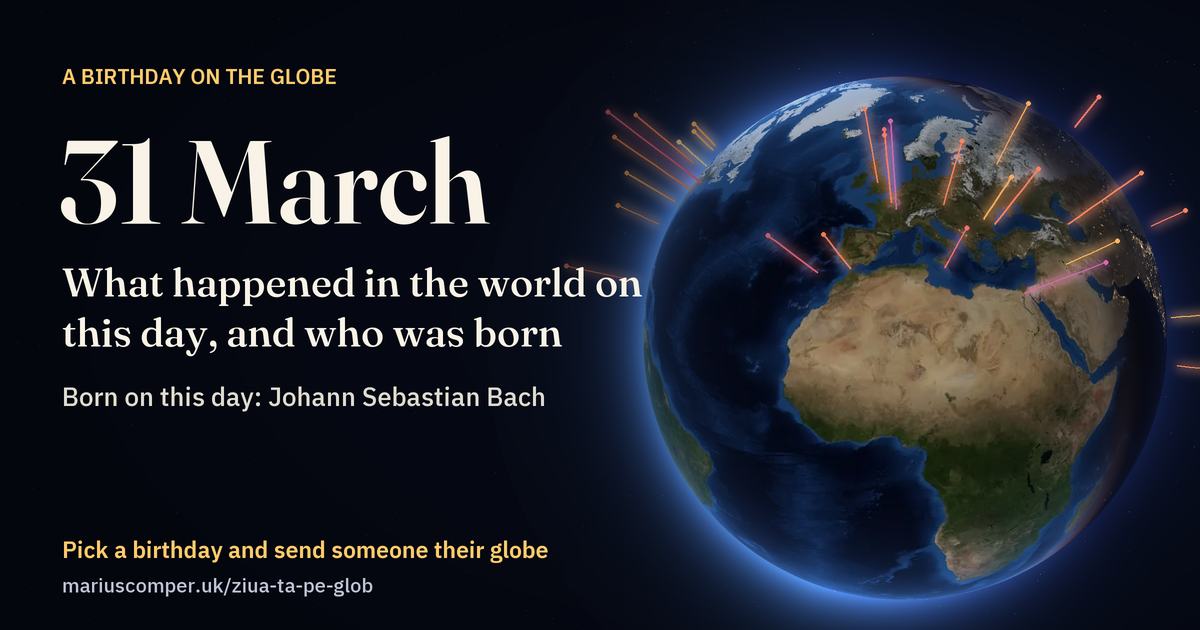
For 31 March, the English Wikipedia lists 63 events and 306 births. 27 of the events stand at their places as rays of light; eight more are dashed circles, where the sentence links only to a country or a sea. The taller the ray, the longer ago it happened. The people born that day come further down, as blue points.
A birthday, yours or someone else’s:
Turn it into a greetingScroll: the globe turns to each place
The day you were born, on the globe.
Three things from your day
Scroll: your day first, then 31 March through the years
The Earth on 31 March
The picture on the globe was assembled by NASA from satellite photographs taken in March 2004: the snow, the ice and the green are those of the month.
On 31 March the Sun passes straight overhead at noon along the parallel of 4.3° north. In London, the day lasts about 12 hours 55 minutes.
Beyond 86° north the Sun no longer sets; beyond 86° south it no longer rises.
The line between day and night is tilted on the globe exactly as on this day of the year. On the dark side you can see the lights of towns.
Britain & Ireland · Stoke-on-Trent
1910
Six English towns amalgamated to form a single county borough called Stoke-on-Trent, the first union of its type.
On the map: Stoke-on-Trent.
Europe · Eiffel Tower
1889
The Eiffel Tower is officially opened.
On the map: Eiffel Tower.
Also on the day’s list of Wikipedia in Spanish, Romanian and Chinese.
Europe · Moscow
1992
The Treaty of Federation is signed in Moscow.
On the map: Moscow.
Asia · Shimoda, Shizuoka
1854
Commodore Matthew Perry signs the Convention of Kanagawa with the Tokugawa Shogunate, opening the ports of Shimoda and Hakodate to American trade.
On the map: Shimoda, Shizuoka.
Also on the day’s list of Wikipedia in Chinese.
North America · Boston
1774
American Revolution: The Kingdom of Great Britain orders the port of Boston, Massachusetts closed pursuant to the Boston Port Act.
On the map: Boston.
Also on the day’s list of Wikipedia in Spanish.
North America · United States Census Bureau
1951
Remington Rand delivers the first UNIVAC I computer to the United States Census Bureau.
On the map: United States Census Bureau.
North America · Palomar Observatory
2005
The dwarf planet Makemake is discovered by a team led by astronomer Michael E. Brown at the Palomar Observatory.
On the map: Palomar Observatory.
31 March
What the other Wikipedias remember#
For these years the English list has nothing on this day. The events below come from the same day’s lists on Wikipedia in Chinese and Spanish and were translated for this page.
From Wikipedia in Chinese · Peking University
1920
Li Dazhao founds the Marxist Theory Research Society at Peking University.
On the map: Peking University.
Translated from the list on Wikipedia in Chinese.
From Wikipedia in Spanish · Jerusalem
1979
In Jerusalem, the song "Hallelujah" by Gali Atari and Milk and Honey wins the 24th Eurovision Song Contest for Israel.
On the map: Jerusalem.
Translated from the list on Wikipedia in Spanish.
From Wikipedia in Spanish · Tenerife
2002
In Tenerife (Canary Islands), the metropolitan area of Santa Cruz de Tenerife is hit by torrential rains, causing the loss of both homes and human lives.
On the map: Tenerife.
Translated from the list on Wikipedia in Spanish.
From Wikipedia in Chinese · Stanford University
2006
Part of the diaries of Chiang Kai-shek, held at the Hoover Institution at Stanford University in California, are formally opened to the public.
On the map: Stanford University.
Translated from the list on Wikipedia in Chinese.
31 March
Born on 31 March#
The English Wikipedia lists 306 births for this day. The blue points are the birthplaces of 60 of these people: those written about in the most Wikipedia editions, where Wikidata gives a place of birth.
Born on 31 March
1685
Johann Sebastian Bach, German composer (died 1750)
Place of birth: Eisenach.
Born on 31 March
1596
René Descartes, French mathematician and philosopher (died 1650)
Place of birth: Descartes.
Born on 31 March
1732
Joseph Haydn, Austrian pianist and composer (died 1809)
Place of birth: Rohrau.
Born on 31 March
1675
Pope Benedict XIV (died 1758)
Place of birth: Bologna.
Born on 31 March
1890
William Lawrence Bragg, Australian-English physicist and academic, Nobel Prize laureate (died 1971)
Place of birth: Adelaide.
Born in Britain and Ireland
1971
Ewan McGregor, Scottish actor
Place of birth: Perth.
Born in Britain and Ireland
1955
Angus Young, Scottish-Australian guitarist and songwriter
Place of birth: Glasgow.
Born in Britain and Ireland
1926
John Fowles, English novelist (died 2005)
Place of birth: Leigh-on-Sea.
31 March
Number one in the charts that week
At the cinema
An animal recorded that day
The record can be seen in GBIF, which brings together wildlife records from around the world.
All your birthdays
The weather that day
Data: Met Office Hadley Centre (HadCET); NOAA (GHCN-Daily, Mauna Loa).
Above the Earth
Sources: Jonathan McDowell, GCAT (launches); GFZ Potsdam (Kp index). Days are counted in Universal Time.
Football that day
International matches played that day:
Source: the “International football results” dataset kept by Mart Jürisoo (CC0).
Also that day
The earthquake’s page at the USGS
Source: the USGS catalogue. The day is counted in Universal Time (UTC).
In those days
Make a link for someone
Type the name, pick the day and the year of birth. The link opens straight on their day, with their name in the greeting.
The link carries the name, date and place typed here; anyone who gets it can see them.
Put another birthday beside it
Your mother’s, your child’s, a friend’s: the two days appear side by side.
Below: 31 March through the years.
The whole globe of the day
Drag the globe to turn it. Touch a ray or a point to read what happened there.
Everything Wikipedia lists for 31 March
The list is the English Wikipedia’s, in its own wording, as it stood in October 2026. 28 events have no place on the map: the sentence links to no place with coordinates, only to places too wide to mark, or to several countries.
- 307
After divorcing his wife Minervina, Constantine marries Fausta, daughter of the retired Roman emperor Maximian.
no place on the mapWikipedia: Minervina - 1146
Bernard of Clairvaux preaches his famous sermon in a field at Vézelay, urging the necessity of a Second Crusade. Louis VII is present, and joins the Crusade.
Europe · VézelayWikipedia: Second Crusade - 1174
A conspiracy against Saladin, aiming to restore the Fatimid Caliphate, is revealed in Cairo, involving senior figures of the former Fatimid regime and the poet Umara al-Yamani. Modern historians doubt the extent and danger of the conspiracy reported in official sources, but its ringleaders will be publicly executed over the following weeks.
Africa · CairoWikipedia: Pro-Fatimid conspiracy against Saladin - 1272
Pope Gregory X calls for a General Church Council to discuss reunion of Churches, Crusade to the Holy Land and Church reform.
no place on the mapWikipedia: Second Council of Lyon - 1492
Ferdinand II of Aragon and Isabella I of Castile sign the Edict of Expulsion of the Jews from Spain, ordering all Jews in their kingdoms to either convert to Christianity or leave the country.
no place on the mapWikipedia: Expulsion of Jews from Spain - 1521
Ferdinand Magellan and fifty of his men came ashore to present-day Limasawa to participate in the first Catholic mass in the Philippines.
Asia · LimasawaWikipedia: First Mass in the Philippines - 1657
The Long Parliament presents the Humble Petition and Advice offering Oliver Cromwell the British throne, which he eventually declines.
no place on the mapWikipedia: Long Parliament - 1706
The last session of history of the Catalan Courts, the parliament of the Principality of Catalonia, ends. Catalonia's constitutional modernisation passed by the Courts aims to improve the guarantee of individual, political and economic rights (such as the secrecy of correspondence).
no place on the mapWikipedia: General Court of Catalonia - 1717
A sermon on "The Nature of the Kingdom of Christ" by Benjamin Hoadly, the Bishop of Bangor, preached in the presence of King George I of Great Britain, provokes the Bangorian Controversy.
no place on the mapWikipedia: Benjamin Hoadly - 1761
The 1761 Lisbon earthquake strikes off the Iberian Peninsula with an estimated magnitude of 8.5, six years after another quake destroyed the city.
Oceans · 1761 Lisbon earthquakeWikipedia: 1761 Lisbon earthquake - 1774
American Revolution: The Kingdom of Great Britain orders the port of Boston, Massachusetts closed pursuant to the Boston Port Act.
North America · BostonWikipedia: American Revolution - 1800
After fighting through the night, the French Navy ship of the line Guillaume Tell surrendered to a British squadron in the Malta Channel.
Europe · Action of 31 March 1800Wikipedia: Action of 31 March 1800 - 1814
The Sixth Coalition occupies Paris after Napoleon's Grande Armée capitulates.
Europe · Battle of ParisWikipedia: War of the Sixth Coalition - 1854
Commodore Matthew Perry signs the Convention of Kanagawa with the Tokugawa Shogunate, opening the ports of Shimoda and Hakodate to American trade.
Asia · Shimoda, ShizuokaWikipedia: Convention of Kanagawa - 1885
The United Kingdom establishes the Bechuanaland Protectorate.
no place on the mapWikipedia: United Kingdom of Great Britain and Ireland - 1889
The Eiffel Tower is officially opened.
Europe · Eiffel TowerWikipedia: Eiffel Tower - 1899
Philippine–American War: Malolos, capital of the First Philippine Republic, is captured by American forces.
Asia · MalolosWikipedia: Capture of Malolos - 1901
A magnitude 7.2 earthquake struck the Black Sea, the most powerful ever recorded in the area.
Europe · 1901 Black Sea earthquakeWikipedia: 1901 Black Sea earthquake - 1901
Rusalka by Antonín Dvořák premieres at the National Opera House in Prague.
no place on the mapWikipedia: Rusalka - 1905
Kaiser Wilhelm II of Germany declares his support for Moroccan independence in Tangier, beginning the First Moroccan Crisis.
Africa · TangierWikipedia: First Moroccan Crisis - 1906
The Intercollegiate Athletic Association of the United States (later the National Collegiate Athletic Association) is established to set rules for college sports in the United States.
no place on the mapWikipedia: National Collegiate Athletic Association - 1909
Serbia formally withdraws its opposition to Austro-Hungarian actions in the Bosnian Crisis.
no place on the mapWikipedia: Bosnian Crisis - 1910
Six English towns amalgamated to form a single county borough called Stoke-on-Trent, the first union of its type.
Britain & Ireland · Stoke-on-TrentWikipedia: Federation of Stoke-on-Trent - 1913
The Vienna Concert Society rioted during a performance of modernist music by Arnold Schoenberg, Alban Berg, Alexander von Zemlinsky, and Anton von Webern, causing a premature end to the concert due to violence; this concert became known as the Skandalkonzert.
Europe · MusikvereinWikipedia: Skandalkonzert - 1917
According to the terms of the Treaty of the Danish West Indies, the islands become American possessions.
no place on the mapWikipedia: Treaty of the Danish West Indies - 1918
Daylight saving time goes into effect in the United States for the first time.
no place on the mapWikipedia: Daylight saving time - 1918
Massacre of ethnic Azerbaijanis is committed by allied armed groups of Armenian Revolutionary Federation and Bolsheviks. Nearly 12,000 Azerbaijani Muslims are killed.
Asia · BakuWikipedia: March Days - 1921
The Royal Australian Air Force is formed.
no place on the mapWikipedia: Royal Australian Air Force - 1930
The Motion Picture Production Code is instituted, imposing strict guidelines on the treatment of sex, crime, religion and violence in film, in the U.S., for the next thirty-eight years.
no place on the mapWikipedia: Hays Code - 1931
A Transcontinental & Western Air airliner crashes near Bazaar, Kansas, killing eight, including University of Notre Dame head football coach Knute Rockne.
North America · 1931 Transcontinental & Western Air Fokker F-10 crashWikipedia: 1931 Transcontinental & Western Air Fokker F-10 crash - 1931
An earthquake in Nicaragua destroys Managua; killing 2,000.
Latin America · 1931 Nicaragua earthquakeWikipedia: 1931 Nicaragua earthquake - 1933
The Civilian Conservation Corps is established with the mission of relieving rampant unemployment in the United States.
North America · United StatesWikipedia: Civilian Conservation Corps - 1939
Events preceding World War II in Europe: Prime Minister Neville Chamberlain pledges British military support to the Second Polish Republic in the event of an invasion by Nazi Germany.
no place on the mapWikipedia: Events preceding World War II in Europe - 1942
World War II: Japanese forces invade Christmas Island, then a British possession.
Asia · Battle of Christmas IslandWikipedia: World War II - 1945
World War II: A defecting German pilot delivers a Messerschmitt Me 262A-1, the world's first operational jet-powered fighter aircraft, to the Americans, the first to fall into Allied hands.
Europe · Nazi GermanyWikipedia: Nazi Germany - 1949
The Dominion of Newfoundland joins the Canadian Confederation and becomes the 10th Province of Canada.
no place on the mapWikipedia: Dominion of Newfoundland - 1951
Remington Rand delivers the first UNIVAC I computer to the United States Census Bureau.
North America · United States Census BureauWikipedia: Remington Rand - 1957
Elections to the Territorial Assembly of the French colony Upper Volta are held. After the elections PDU and MDV form a government.
Africa · French Upper VoltaWikipedia: 1957 Upper Voltan Territorial Assembly election - 1958
In the Canadian federal election, the Progressive Conservatives, led by John Diefenbaker, win the largest percentage of seats in Canadian history, with 208 seats of 265.
no place on the mapWikipedia: 1958 Canadian federal election - 1959
The 14th Dalai Lama crosses the border into India and is granted political asylum.
no place on the mapWikipedia: 14th Dalai Lama - 1964
Brazilian General Olímpio Mourão Filho orders his troops to move towards Rio de Janeiro, beginning the coup d'état and 21 years of military dictatorship.
Latin America · BrazilWikipedia: 1964 Brazilian coup d'état - 1966
The Labour Party under Harold Wilson wins the 1966 United Kingdom general election.
no place on the mapWikipedia: 1966 United Kingdom general election - 1966
The Soviet Union launches Luna 10 which later becomes the first space probe to enter orbit around the Moon.
Asia · Soviet UnionWikipedia: Soviet Union - 1968
American President Lyndon B. Johnson speaks to the nation of "Steps to Limit the War in Vietnam" in a television address. At the conclusion of his speech, he announces: "I shall not seek, and I will not accept, the nomination of my party for another term as your President."
- 1970
Explorer 1 re-enters the Earth's atmosphere after 12 years in orbit.
no place on the mapWikipedia: Explorer 1 - 1980
The Chicago, Rock Island and Pacific Railroad operates its final train after being ordered to liquidate its assets because of bankruptcy and debts owed to creditors.
no place on the mapWikipedia: Chicago, Rock Island and Pacific Railroad - 1986
Mexicana de Aviación Flight 940 crashes into the Sierra Madre Oriental mountain range near the Mexican town of Maravatío, killing 167.
Latin America · Mexicana de Aviación Flight 940Wikipedia: Mexicana de Aviación Flight 940 - 1990
Approximately 200,000 protesters take to the streets of London to protest against the newly introduced Poll Tax.
no place on the mapWikipedia: Poll tax riots - 1991
Georgian independence referendum: Nearly 99 percent of the voters support the country's independence from the Soviet Union.
Asia · Soviet UnionWikipedia: 1991 Georgian independence referendum - 1991
The Warsaw Pact formally disbands.
no place on the mapWikipedia: Warsaw Pact - 1992
The Treaty of Federation is signed in Moscow.
Europe · MoscowWikipedia: Treaty of Federation - 1992
The USS Missouri, the last active United States Navy battleship, is decommissioned in Long Beach, California.
North America · Long Beach, CaliforniaWikipedia: United States Navy - 1993
The Macao Basic Law is adopted by the Eighth National People's Congress of China to take effect December 20, 1999. Resumption by China of the Exercise of Sovereignty over Macao
no place on the mapWikipedia: Macao Basic Law - 1995
Selena is murdered by her fan club president Yolanda Saldívar at a Days Inn in Corpus Christi, Texas.
North America · Murder of SelenaWikipedia: Murder of Selena - 1995
TAROM Flight 371, an Airbus A310-300, crashes near Balotesti, Romania, killing all 60 people on board.
Europe · TAROM Flight 371Wikipedia: TAROM Flight 371 - 1998
Netscape releases Mozilla source code under an open source license.
no place on the mapWikipedia: Netscape - 2004
Iraq War in Anbar Province: In Fallujah, Iraq, four American private military contractors working for Blackwater USA, are killed after being ambushed.
Asia · FallujahWikipedia: 2004 Fallujah ambush - 2004
The Old National Library Building in Singapore was closed to make way for a tunnel, despite widespread protests.
Asia · Old National Library BuildingWikipedia: Old National Library Building - 2005
The dwarf planet Makemake is discovered by a team led by astronomer Michael E. Brown at the Palomar Observatory.
North America · Palomar ObservatoryWikipedia: Makemake - 2016
NASA astronaut Scott Kelly and Roscosmos cosmonaut Mikhail Kornienko return to Earth after a yearlong mission at the International Space Station.
no place on the mapWikipedia: NASA - 2018
Start of the 2018 Armenian revolution.
Asia · ArmeniaWikipedia: 2018 Armenian Revolution - 2023
A historic tornado outbreak occurs in the American Midwest and South.
no place on the mapWikipedia: Tornado outbreak of March 31 – April 1, 2023 - 2023
A tornado caused the collapse of a venue hosting a sold-out concert in Belvidere, Illinois, United States, resulting in one death and 48 injuries.
North America · Belvidere, IllinoisWikipedia: Belvidere Apollo Theatre collapse
What the other Wikipedias remember
For these years the English list has nothing on this day. The events below come from the same day’s lists on Wikipedia in Chinese and Spanish and were translated for this page.
- 1920
Li Dazhao founds the Marxist Theory Research Society at Peking University.
- 1979
In Jerusalem, the song "Hallelujah" by Gali Atari and Milk and Honey wins the 24th Eurovision Song Contest for Israel.
- 2002
In Tenerife (Canary Islands), the metropolitan area of Santa Cruz de Tenerife is hit by torrential rains, causing the loss of both homes and human lives.
- 2006
Part of the diaries of Chiang Kai-shek, held at the Hoover Institution at Stanford University in California, are formally opened to the public.
Who was born on 31 March
In order of how many Wikipedia editions have an article about each. The first 60 of 306 are shown.
- 1685
Johann Sebastian Bach, German composer (died 1750)
EisenachWikipedia: Johann Sebastian Bach - 1596
René Descartes, French mathematician and philosopher (died 1650)
DescartesWikipedia: René Descartes - 1732
Joseph Haydn, Austrian pianist and composer (died 1809)
RohrauWikipedia: Joseph Haydn - 1948
Al Gore, American soldier and politician, 45th Vice President of the United States and Nobel Prize laureate
Washington, D.C.Wikipedia: Al Gore - 1914
Octavio Paz, Mexican poet and diplomat, Nobel Prize laureate (died 1998)
MixcoacWikipedia: Octavio Paz - 1675
Pope Benedict XIV (died 1758)
BolognaWikipedia: Pope Benedict XIV - 1890
William Lawrence Bragg, Australian-English physicist and academic, Nobel Prize laureate (died 1971)
AdelaideWikipedia: Lawrence Bragg - 1971
Ewan McGregor, Scottish actor
- 1499
Pope Pius IV (died 1565)
- 1906
Sin-Itiro Tomonaga, Japanese physicist and academic, Nobel Prize laureate (died 1979)
- 1934
Carlo Rubbia, Italian physicist and academic, Nobel Prize laureate
GoriziaWikipedia: Carlo Rubbia - 1939
Zviad Gamsakhurdia, Georgian anthropologist and politician, 1st President of Georgia (died 1993)
- 1943
Christopher Walken, American actor
- 1519
Henry II of France (died 1559)
Château de Saint-Germain-en-LayeWikipedia: Henry II of France - 1955
Angus Young, Scottish-Australian guitarist and songwriter
GlasgowWikipedia: Angus Young - 1926
John Fowles, English novelist (died 2005)
Leigh-on-SeaWikipedia: John Fowles - 1934
Richard Chamberlain, American actor (died 2025)
Beverly HillsWikipedia: Richard Chamberlain - 1723
Frederick V of Denmark (died 1766)
Copenhagen CastleWikipedia: Frederick V of Denmark - 1934
Shirley Jones, American actress and singer
CharleroiWikipedia: Shirley Jones - 1970
Alenka Bratušek, Slovenian politician, 7th Prime Minister of Slovenia
- 1968
César Sampaio, Brazilian footballer
São PauloWikipedia: César Sampaio - 1872
Sergei Diaghilev, Russian ballet manager and critic, founded the Ballets Russes (died 1929)
SelischiWikipedia: Sergei Diaghilev - 1987
Humpy Koneru, Indian chess player
VijayawadaWikipedia: Koneru Humpy - 1778
Coenraad Jacob Temminck, Dutch zoologist and ornithologist (died 1858)
AmsterdamWikipedia: Coenraad Jacob Temminck - 1621
Andrew Marvell, English poet and politician (died 1678)
WinesteadWikipedia: Andrew Marvell - 1819
Chlodwig, Prince of Hohenlohe-Schillingsfürst (died 1901)
Rotenburg an der FuldaWikipedia: Chlodwig, Prince of Hohenlohe-Schillingsfürst - 1927
Cesar Chavez, American labor union leader and activist (died 1993)
- 1962
Olli Rehn, Finnish footballer and politician
MikkeliWikipedia: Olli Rehn - 1972
Alejandro Amenábar, Chilean-Spanish director and screenwriter
SantiagoWikipedia: Alejandro Amenábar - 1865
Anandi Gopal Joshi, Indian physician (died 1887)
- 1928
Gordie Howe, Canadian ice hockey player (died 2016)
FloralWikipedia: Gordie Howe - 1940
Patrick Leahy, American lawyer and politician
MontpelierWikipedia: Patrick Leahy - 1932
Nagisa Oshima, Japanese director and screenwriter (died 2013)
- 1939
Volker Schlöndorff, German director and producer
WiesbadenWikipedia: Volker Schlöndorff - 1360
Philippa of Lancaster (died 1415)
Leicester CastleWikipedia: Philippa of Lancaster - 1943
Roy Andersson, Swedish director and screenwriter
GothenburgWikipedia: Roy Andersson - 1947
César Gaviria, Colombian economist and politician, 36th President of Colombia
PereiraWikipedia: César Gaviria - 1987
Nordin Amrabat, Dutch footballer
NaardenWikipedia: Nordin Amrabat - 1871
Arthur Griffith, Irish journalist and politician, 3rd President of Dáil Éireann (died 1922)
- 1878
Jack Johnson, American boxer (died 1946)
GalvestonWikipedia: Jack Johnson - 1809
Edward FitzGerald, English poet and translator (died 1883)
Bredfield HouseWikipedia: Edward FitzGerald - 1944
Angus King, American politician
AlexandriaWikipedia: Angus King - 1948
Rhea Perlman, American actress
BrooklynWikipedia: Rhea Perlman - 1983
Ashleigh Ball, Canadian voice actress and musician
VancouverWikipedia: Ashleigh Ball - 1730
Étienne Bézout, French mathematician and theorist (died 1783)
NemoursWikipedia: Étienne Bézout - 1900
Prince Henry, Duke of Gloucester (died 1974)
York CottageWikipedia: Prince Henry, Duke of Gloucester - 1504
Guru Angad, Indian religious leader (died 1552)
Sarai NagaWikipedia: Guru Angad - 1718
Mariana Victoria of Spain (died 1781)
- 1939
Karl-Heinz Schnellinger, German footballer (died 2024)
- 1982
Brian Tyree Henry, American actor
FayettevilleWikipedia: Brian Tyree Henry - 1945
Edwin Catmull, American computer scientist and engineer
ParkersburgWikipedia: Edwin Catmull - 1982
Tal Ben Haim, Israeli footballer
Rishon LeZionWikipedia: Tal Ben Haim - 1987
Hugo Ayala, Mexican footballer
MoreliaWikipedia: Hugo Ayala - 1915
Shoichi Yokoi, Japanese sergeant (died 1997)
- 1934
Kamala Surayya, Indian poet and author (died 2009)
PunnayurkulamWikipedia: Kamala Surayya - 1935
Herb Alpert, American singer-songwriter, trumpet player, and producer
Los AngelesWikipedia: Herb Alpert - 1978
Jérôme Rothen, French footballer
Châtenay-MalabryWikipedia: Jérôme Rothen - 1996
Liza Koshy, American actress, comedian, and television host
HoustonWikipedia: Liza Koshy - 1893
Clemens Krauss, Austrian conductor and manager (died 1954)
- 1924
Leo Buscaglia, American author and academic (died 1998)
Los AngelesWikipedia: Leo Buscaglia
What is celebrated on 31 March
- Cesar Chavez Day (California, Washington (state))
- Christian feast day Abdas of Susa
- Christian feast day Acathius of Melitene (Eastern Orthodox Church)
- Christian feast day Anesius and companions
- Christian feast day Benjamin
- Christian feast day Balbina
- Christian feast day John Donne (Anglican Communion, Lutheran)
- Christian feast day Natalia Tułasiewicz
- Christian feast day March 31 (Eastern Orthodox liturgics)
- Freedom Day (Malta)
- International Transgender Day of Visibility
- King Nangklao Memorial Day (Thailand)
- Thomas Mundy Peterson Day (New Jersey, United States)
- Transfer Day (US Virgin Islands)
A greeting link for someone
Type a name and, if you like, the year of birth. The link opens with a greeting, and beside each event it says how old the person turned that day, or how many years before their birth it happened.
The name and the year go only into the link you send.
All 366 days
How the globe is made
Where the events come from
Each edition of this page uses the day’s list from Wikipedia in its own language: Romanian, English, Spanish, Chinese. The lists are written by volunteers and differ from one edition to the next; the text of each event is Wikipedia’s, with a link to the article. A row that appears twice in a list is shown once. The lists have not been checked event by event: they are Wikipedia’s, mistakes included.
For events before 1582, and for countries that moved to the Gregorian calendar later (Britain in 1752, Russia in 1918), the same day may be counted Old Style in one list and New Style in another.
The chapter “What the other Wikipedias remember” adds up to five events a day from the lists of the other three editions, only for years in which the English list has nothing on that day. They were translated for this page, passed the same filters as the tour, and are not counted among the events of the English list.
How an event gets onto the map
The place comes from Wikidata. If the sentence links to the article about the event itself (a battle, an opening, an earthquake), dated to the same year, the ray stands on its coordinates or on those of its location. Otherwise it stands on the first place the sentence links to: a town, a building, a mountain, an island. This second step can be wrong: sometimes the sentence only mentions the place. That is why the page says, under each event, which place the ray stands on.
When the sentence links to a single state or province, or to a single sea, lake or desert larger than 5,000 km², the globe shows a dashed circle, not a ray. The circle has the area Wikidata gives, with its radius kept between 1.2° and 16°, or a radius of 4.5° when Wikidata gives no area; it says only that the sentence links to that place. Organisations, ships, spacecraft, museum objects, rivers, mountain ranges, languages and continents are never used as places. When a sentence names several states and no exact place, the event stays in the list only.
What the height means
The height of a ray shows how many years have passed, on a logarithmic scale: 10 years, 100 years and 1,000 years are equal steps apart; anything older than about 2,600 years has the tallest ray. The colour runs from pale yellow for recent years to violet for antiquity.
Where the tour stops
In each region the tour stops at up to three events (five in Britain and Ireland), chosen mainly by three things: whether Wikipedia’s editors put the event in the “On this day” box of their main page (the English, Spanish and Chinese editions), how many Wikipedia editions have an article about it, and how many of the four lists include it. Events whose sentence or article is about a war, an attack, a crime or a disaster are left out of the tour; they stay in the whole list, in Wikipedia’s wording. The filter is a list of words and a list of Wikidata types, so it can miss some.
The tour of births names the people with articles in the most editions and leaves aside those whom the list or Wikidata describes as rulers, politicians, commanders, leaders of movements or criminals; they stay in the list.
The Earth and the Sun
The daytime images are NASA’s Blue Marble Next Generation mosaics, one for each month of 2004; the night side is Black Marble 2016. The tilt of the line between day and night is computed for the day; the hour is chosen so that the place being read is in daylight. The latitude where the Sun stands overhead is the average of the four years of the leap cycle; in a given year it can differ by up to 0.4°.
The day you were born
The number ones come from the weekly lists on Wikipedia: Billboard for the United States (from 1940; the Hot 100 from August 1958), the UK Singles Chart (from November 1952), Los 40 Principales for Spain (from July 1966) and, for Romania, the Romanian Top 100 and Airplay 100 (2001–2021, with missing weeks). The page shows the chart of the week in which the day of birth falls, with its date; Billboard and the UK chart are dated at the end of their week. For Romania before 2001 and for China these sources have no weekly chart.
The films are those that reached cinemas in the United States up to ten days before or three days after that day (some of them in a few cinemas at first), from the English Wikipedia’s yearly lists (from 1968), in order of how many editions have an article about them. The events “in those days” are the ones on the neighbouring days’ lists that carry the year of birth, passed through the same filter as the tour.
The day of birth, year included
The Moon, the star sign and the constellation are worked out by the page itself, for noon Universal Time on the day. The lit part of the Moon is rounded and can differ by a few per cent from that at the hour of birth. The sign follows the usual zodiac of twelve equal parts starting at the March equinox; the constellation is the one the Sun actually stood in front of, by the borders set by the International Astronomical Union, and within a day of a border the page does not name it. When the Sun changes sign while it is that day anywhere on Earth, the page gives the moment of crossing, rounded to ten minutes and accurate to within about a quarter of an hour, and the clock time in a few cities, with the time zone and summer time of that year.
The year in the Chinese calendar is the one your device’s own calendar gives for the date, checked against the Hong Kong Observatory’s tables. “All your birthdays” uses the same sources as the rest of the chapter for the same day in every year since the birth: the temperature, well-known launches that took place on that very day, matches of the teams the edition follows, snow deeper than 10 cm and strong geomagnetic storms. The three things at the top and the four on the picture are chosen in a fixed order (the song, the animal, a full Moon, a well-known launch before an ordinary earthquake); on the picture you can change them.
When the link carries a year of birth, the page adds a few things about that exact day. The weather is the Met Office’s Central England temperature record and the readings from New York’s Central Park; the “usual high” is the average of the daily highs of 1961–1990 for that date, with two days either side. The carbon dioxide figure is the monthly mean at the Mauna Loa observatory, where measurements begin in March 1958.
The earthquake is the one with the largest magnitude in the USGS catalogue for that day, counted in Universal Time. Before the 1960s the catalogue has gaps even above magnitude 5.5, so in the older years many days have no earthquake. The page gives only the magnitude and the place: the country the epicentre falls in or, when the epicentre is at sea within 300 km of a coast, the nearest country; farther out, only the ocean.
The launches are those that reached orbit or left for the Moon and the planets, from Jonathan McDowell’s GCAT catalogue. If nothing left that day, the page shows the nearest launch within three days before or after, and says how many days away it was. The geomagnetic storm appears only when the Kp index reached at least 5 in one of the day’s eight three-hour intervals.
The animal comes from GBIF: an observation made by a person (the animal seen or heard, or its tracks), dated to that exact day, with coordinates and a CC0 or CC BY licence. Only a few hundred well-known species are searched (mammals, birds, turtles, butterflies); of those noted that day, mammals and species with articles in many Wikipedia editions come first; birds noted almost every day, and species used recently, wait their turn. Observations dated 1 January are left out, because records without a day are often filed there. An observation shows that the animal was recorded there, not how many animals there were.
The matches are those between national teams. Only matches of England, Scotland, Wales, Northern Ireland, the Republic of Ireland, the United States, Canada and Australia are shown, along with those at the big final tournaments. The picture to send is drawn in the page from the day’s globe and the facts above, and stays on your device until you send it.
Sources
- Events, births and holidays: the day’s page on Wikipedia, text under CC BY-SA 4.0.
- Coordinates, places of birth and the number of editions: Wikidata (CC0).
- The Earth by day: NASA Blue Marble Next Generation. The Earth by night: NASA Black Marble 2016.
- Borders and regions: Natural Earth.
- World population and births per year: UN World Population Prospects 2024.
- Charts and films: Wikipedia’s lists for Billboard, the UK Singles Chart, Los 40 Principales, Romanian Top 100, Airplay 100 and American films by year (CC BY-SA 4.0).
- Weather: Met Office Hadley Centre, HadCET (Open Government Licence) and NOAA GHCN-Daily, New York Central Park. Carbon dioxide: NOAA Global Monitoring Laboratory, Mauna Loa.
- Earthquakes: the USGS catalogue. Launches: Jonathan McDowell, GCAT (CC BY). Kp index: GFZ Potsdam (CC BY 4.0). Matches: International football results, Mart Jürisoo (CC0).
- Animal observations: GBIF, with a link to each record; species names come from Wikidata.