A birthday on the globe
21 July on the globe: what happened in the world on this day, and who was born
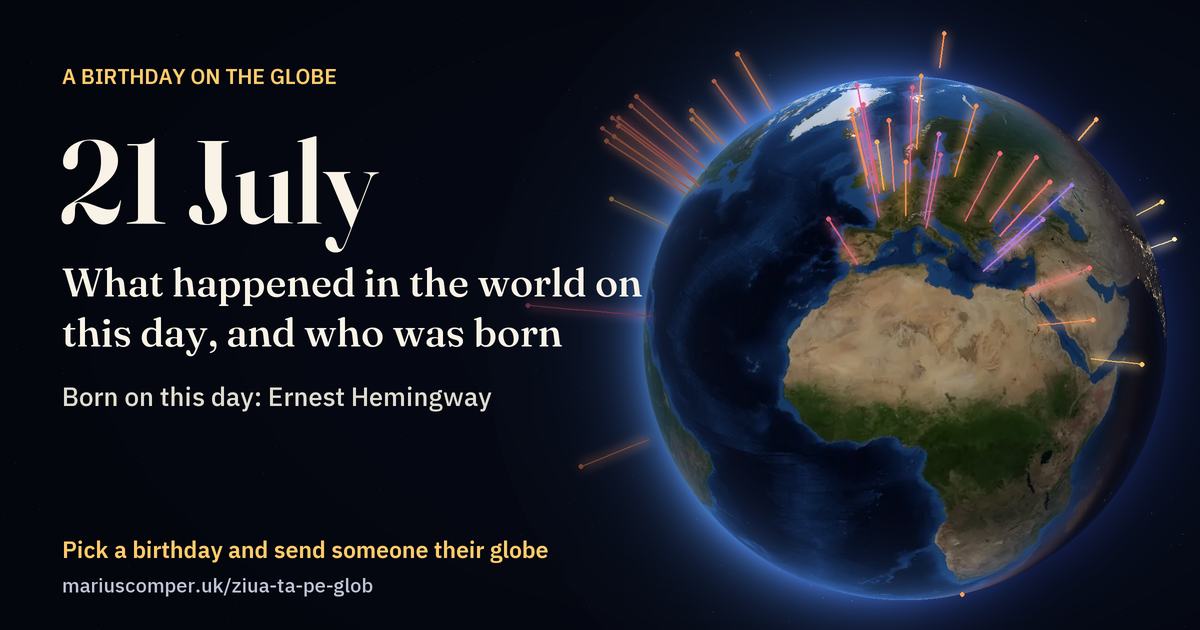
For 21 July, the English Wikipedia lists 67 events and 245 births. 43 of the events stand at their places as rays of light; four more are dashed circles, where the sentence links only to a country or a sea. The taller the ray, the longer ago it happened. The people born that day come further down, as blue points.
A birthday, yours or someone else’s:
Turn it into a greetingScroll: the globe turns to each place
The day you were born, on the globe.
Three things from your day
Scroll: your day first, then 21 July through the years
The Earth on 21 July
The picture on the globe was assembled by NASA from satellite photographs taken in July 2004: the snow, the ice and the green are those of the month.
On 21 July the Sun passes straight overhead at noon along the parallel of 20.5° north. In London, the day lasts about 15 hours 55 minutes.
Beyond 70° north the Sun no longer sets; beyond 70° south it no longer rises.
The line between day and night is tilted on the globe exactly as on this day of the year. On the dark side you can see the lights of towns.
Britain & Ireland · Pendine Sands
1925
Malcolm Campbell becomes the first man to exceed 150 mph (241 km/h) on land. At Pendine Sands in Wales, he drives Sunbeam 350HP built by Sunbeam at a two-way average speed of 150.33 mph (242 km/h).
On the map: Pendine Sands.
Europe · Požarevac
1718
The Treaty of Passarowitz between the Ottoman Empire, Austria and the Republic of Venice is signed.
On the map: Požarevac.
Also on the day’s list of Wikipedia in Spanish and Romanian.
Europe · Ostend
1904
Louis Rigolly, a Frenchman, becomes the first man to break the 100 mph (161 km/h) barrier on land. He drove a 15-liter Gobron-Brillié in Ostend, Belgium.
On the map: Ostend.
Africa · Aswan High Dam
1970
After 11 years of construction, the Aswan High Dam in Egypt is completed.
On the map: Aswan High Dam.
Also on the day’s list of Wikipedia in Spanish, Romanian and Chinese.
Asia · Constantinople
1832
Signing of the treaty of Constantinople between Britain, France, Russia and the Ottoman Empire, which outlines the borders of the new kingdom of Greece.
On the map: Constantinople.
North America · Washington, D.C.
1949
The United States Senate ratifies the North Atlantic Treaty.
On the map: Washington, D.C..
Also on the day’s list of Wikipedia in Chinese.
North America · Hollywood Walk of Fame
1979
Jay Silverheels, a Mohawk actor, becomes the first Native American to have a star commemorated in the Hollywood Walk of Fame.
On the map: Hollywood Walk of Fame.
Also on the day’s list of Wikipedia in Chinese.
North America · Kennedy Space Center
2011
NASA's Space Shuttle program ends with the landing of Space Shuttle Atlantis on mission STS-135 at NASA's Kennedy Space Center.
On the map: Kennedy Space Center.
Also on the day’s list of Wikipedia in Chinese.
Oceans · Vostok Station
1983
The world's lowest temperature in an inhabited location is recorded at Vostok Station, Antarctica at −89.2 °C (−128.6 °F).
On the map: Vostok Station.
Also on the day’s list of Wikipedia in Spanish, Romanian and Chinese.
21 July
What the other Wikipedias remember#
For these years the English list has nothing on this day. The events below come from the same day’s lists on Wikipedia in Chinese and were translated for this page.
From Wikipedia in Chinese · Saint Petersburg
1917
Russian February Revolution: Kerensky becomes prime minister and forms a government.
On the map: Saint Petersburg.
Translated from the list on Wikipedia in Chinese.
21 July
Born on 21 July#
The English Wikipedia lists 245 births for this day. The blue points are the birthplaces of 60 of these people: those written about in the most Wikipedia editions, where Wikidata gives a place of birth.
Born on 21 July
1899
Ernest Hemingway, American novelist, short story writer, and journalist, Nobel Prize laureate (died 1961)
Place of birth: Oak Park.
Born on 21 July
1951
Robin Williams, American actor and comedian (died 2014)
Place of birth: Chicago.
Born on 21 July
2000
Erling Haaland, Norwegian footballer
Place of birth: Leeds.
Born on 21 July
1911
Marshall McLuhan, Canadian author and theorist (died 1980)
Place of birth: Edmonton.
Born in Britain and Ireland
1948
Cat Stevens, English singer-songwriter and guitarist
Place of birth: Marylebone.
Born in Britain and Ireland
1971
Charlotte Gainsbourg, English-French actress and singer
Place of birth: Marylebone.
Born in Britain and Ireland
1989
Juno Temple, English actress
Place of birth: London.
21 July
Number one in the charts that week
At the cinema
An animal recorded that day
The record can be seen in GBIF, which brings together wildlife records from around the world.
All your birthdays
The weather that day
Data: Met Office Hadley Centre (HadCET); NOAA (GHCN-Daily, Mauna Loa).
Above the Earth
Sources: Jonathan McDowell, GCAT (launches); GFZ Potsdam (Kp index). Days are counted in Universal Time.
Football that day
International matches played that day:
Source: the “International football results” dataset kept by Mart Jürisoo (CC0).
Also that day
The earthquake’s page at the USGS
Source: the USGS catalogue. The day is counted in Universal Time (UTC).
In those days
Make a link for someone
Type the name, pick the day and the year of birth. The link opens straight on their day, with their name in the greeting.
The link carries the name, date and place typed here; anyone who gets it can see them.
Put another birthday beside it
Your mother’s, your child’s, a friend’s: the two days appear side by side.
Below: 21 July through the years.
The whole globe of the day
Drag the globe to turn it. Touch a ray or a point to read what happened there.
Everything Wikipedia lists for 21 July
The list is the English Wikipedia’s, in its own wording, as it stood in October 2026. 20 events have no place on the map: the sentence links to no place with coordinates, only to places too wide to mark, or to several countries.
- 356 BC
The Temple of Artemis in Ephesus, one of the Seven Wonders of the World, is destroyed by arson.
Asia · Temple of ArtemisWikipedia: Temple of Artemis - 230
Pope Pontian succeeds Urban I as the eighteenth pope. After being exiled to Sardinia, he became the first pope to resign his office.
no place on the mapWikipedia: Pope Pontian - 285
Diocletian appoints Maximian as Caesar and co-ruler.
no place on the mapWikipedia: Diocletian - 365
The Crete earthquake occurs with a maximum Mercalli intensity of XI (Extreme), causing a destructive tsunami that affects the coasts of Libya and Egypt, especially Alexandria. Many thousands are killed.
Europe · 365 Crete earthquakeWikipedia: 365 Crete earthquake - 625
Paulinus was consecrated as the first bishop of York by Justus, the archbishop of Canterbury.
no place on the mapWikipedia: Paulinus of York - 905
King Berengar I of Italy and a hired Hungarian army defeat the Frankish forces at Verona. King Louis III is captured and blinded for breaking the oath he gave in 902 to not return to Italy.
Europe · VeronaWikipedia: Berengar I of Italy - 1242
Battle of Taillebourg: Louis IX of France puts an end to the revolt of his vassals Henry III of England and Hugh X of Lusignan.
Europe · Battle of TaillebourgWikipedia: Battle of Taillebourg - 1378
Unrepresented labourers revolted and violently took over the government of the Republic of Florence, demanding that they be granted political office.
Europe · Ciompi RevoltWikipedia: Ciompi Revolt - 1403
Battle of Shrewsbury: King Henry IV of England defeats rebels to the north of the county town of Shropshire, England.
Britain & Ireland · Battle of ShrewsburyWikipedia: Battle of Shrewsbury - 1545
The first landing of French troops on the coast of the Isle of Wight during the French invasion of the Isle of Wight.
Britain & Ireland · Isle of WightWikipedia: French invasion of the Isle of Wight - 1568
Eighty Years' War: in the Battle of Jemmingen, Fernando Álvarez de Toledo, Duke of Alva defeats Louis of Nassau.
Europe · Battle of JemmingenWikipedia: Battle of Jemmingen - 1645
Qing dynasty regent Dorgon issues an edict ordering all Han Chinese men to shave their forehead and braid the rest of their hair into a queue identical to those of the Manchus.
Asia · Qing dynastyWikipedia: Qing dynasty - 1656
The Raid on Málaga takes place during the Anglo-Spanish War.
Europe · Raid on MálagaWikipedia: Raid on Málaga - 1674
A Dutch assault on the French island of Martinique is repulsed against all odds.
Europe · Invasion of MartiniqueWikipedia: Invasion of Martinique - 1718
The Treaty of Passarowitz between the Ottoman Empire, Austria and the Republic of Venice is signed.
Europe · PožarevacWikipedia: Treaty of Passarowitz - 1774
Russo-Turkish War (1768–74): Russia and the Ottoman Empire sign the Treaty of Küçük Kaynarca ending the war. It is the first time that an Ottoman ruler surrendered territory largely populated by Muslims and the first time that a separation of secular and spiritual authority in the Ottoman Empire was established.
Europe · Treaty of Küçük KaynarcaWikipedia: Russo-Turkish War - 1798
French campaign in Egypt and Syria: Napoleon's forces defeat an Ottoman-Mamluk army near Cairo in the Battle of the Pyramids.
Africa · Battle of the PyramidsWikipedia: Battle of the Pyramids - 1831
Inauguration of Leopold I of Belgium, first king of the Belgians.
no place on the mapWikipedia: Leopold I of Belgium - 1832
Signing of the treaty of Constantinople between Britain, France, Russia and the Ottoman Empire, which outlines the borders of the new kingdom of Greece.
Asia · ConstantinopleWikipedia: Treaty of Constantinople - 1861
American Civil War: First Battle of Bull Run: At Manassas Junction, Virginia, the first major battle of the war begins and ends in a victory for the Confederate army.
North America · First Battle of Bull RunWikipedia: American Civil War - 1865
In the market square of Springfield, Missouri, Wild Bill Hickok shoots and kills Davis Tutt in what is regarded as the first western showdown.
North America · SpringfieldWikipedia: Hickok–Tutt shootout - 1873
At Adair, Iowa, Jesse James and the James–Younger Gang pull off the first successful train robbery in the American Old West.
North America · Adair, IowaWikipedia: Adair, Iowa - 1877
After rioting by Baltimore and Ohio Railroad workers and the deaths of nine rail workers at the hands of the Maryland militia, workers in Pittsburgh, Pennsylvania, stage a sympathy strike that is met with an assault by the state militia.
North America · PittsburghWikipedia: Great Railroad Strike of 1877 - 1904
Louis Rigolly, a Frenchman, becomes the first man to break the 100 mph (161 km/h) barrier on land. He drove a 15-liter Gobron-Brillié in Ostend, Belgium.
Europe · OstendWikipedia: Louis Rigolly - 1907
The passenger steamer SS Columbia sinks after colliding with the steam schooner San Pedro off Shelter Cove, California, killing 88 people.
North America · Shelter Cove, CaliforniaWikipedia: SS Columbia - 1918
World War I: An Imperial German Navy U-boat opened fire on a small convoy of barges and defending aircraft near the American town of Orleans, Massachusetts.
North America · Attack on OrleansWikipedia: World War I - 1919
The dirigible Wingfoot Air Express crashes into the Illinois Trust and Savings Building in Chicago, killing 12 people.
North America · Wingfoot Air Express crashWikipedia: Wingfoot Air Express crash - 1920
The "Belfast Pogrom" begins two years of violence with the expulsion of thousands of Catholic shipyard, factory and linen mill workers from their jobs.
no place on the mapWikipedia: The Troubles in Ulster - 1925
Malcolm Campbell becomes the first man to exceed 150 mph (241 km/h) on land. At Pendine Sands in Wales, he drives Sunbeam 350HP built by Sunbeam at a two-way average speed of 150.33 mph (242 km/h).
Britain & Ireland · Pendine SandsWikipedia: Malcolm Campbell - 1925
Scopes Trial: In Dayton, Tennessee, high school biology teacher John T. Scopes is found guilty of teaching human evolution in class and fined $100.
North America · Dayton, TennesseeWikipedia: Dayton, Tennessee - 1936
Spanish Civil War: The Central Committee of Antifascist Militias of Catalonia is constituted, establishing an anarcho-syndicalist economy in Catalonia.
no place on the mapWikipedia: Spanish Civil War - 1944
World War II: Battle of Guam: American troops land on Guam, starting a battle that will end on August 10.
Oceania · Battle of GuamWikipedia: Battle of Guam - 1944
World War II: Claus von Stauffenberg and four fellow conspirators are executed for the July 20 plot to assassinate Adolf Hitler.
Europe · 20 July plotWikipedia: 20 July plot - 1946
After weeks of unrest, rioters lynched Bolivian president Gualberto Villarroel, desecrating and hanging his corpse in the streets of La Paz.
Latin America · La PazWikipedia: 1946 La Paz riots - 1949
The United States Senate ratifies the North Atlantic Treaty.
North America · Washington, D.C.Wikipedia: North Atlantic Treaty - 1951
Canadian Pacific Air Lines Flight 3505 disappears while flying from Vancouver to Tokyo. The aircraft and its 37 occupants are never found.
North America · VancouverWikipedia: Canadian Pacific Air Lines Flight 3505 - 1952
The 7.3 Mw Kern County earthquake strikes Southern California with a maximum Mercalli intensity of XI (Extreme), killing 12 and injuring hundreds.
North America · 1952 Kern County earthquakeWikipedia: 1952 Kern County earthquake - 1954
First Indochina War: The Geneva Conference partitions Vietnam into North Vietnam and South Vietnam.
Europe · GenevaWikipedia: 1954 Geneva Conference - 1959
Elijah Jerry "Pumpsie" Green becomes the first African-American to play for the Boston Red Sox, the last team to integrate. He came in as a pinch runner for Vic Wertz and stayed in as shortstop in a 2–1 loss to the Chicago White Sox.
no place on the mapWikipedia: Pumpsie Green - 1959
NS Savannah, the first nuclear-powered cargo-passenger ship, is launched as a showcase for Dwight D. Eisenhower's "Atoms for Peace" initiative.
no place on the mapWikipedia: Atoms for Peace - 1959
The inaugural International Mathematical Olympiad, the leading mathematical competition for pre-university students, began in Romania.
no place on the mapWikipedia: International Mathematical Olympiad - 1960
Sirimavo Bandaranaike is sworn in as prime minister of Ceylon, becoming the world's first democratically elected female head of government.
no place on the mapWikipedia: Sirimavo Bandaranaike - 1961
Alaska Airlines Flight 779 crashes near Shemya Air Force Base in Shemya, Alaska, killing six.
North America · Alaska Airlines Flight 779Wikipedia: Alaska Airlines Flight 779 - 1961
Mercury program: Mercury-Redstone 4 mission: Gus Grissom piloting Liberty Bell 7 becomes the second American to go into space (in a suborbital mission).
no place on the mapWikipedia: Project Mercury - 1964
A series of racial riots break out in Singapore. In the next six weeks, 23 die with 454 others injured.
no place on the mapWikipedia: 1964 race riots in Singapore - 1969
Apollo program: At 02:56 UTC, astronaut Neil Armstrong becomes the first person to walk on the Moon, followed 19 minutes later by Edwin "Buzz" Aldrin.
no place on the mapWikipedia: Apollo program - 1970
After 11 years of construction, the Aswan High Dam in Egypt is completed.
Africa · Aswan High DamWikipedia: Aswan High Dam - 1972
The Troubles: Bloody Friday: The Provisional IRA detonate 22 bombs in central Belfast, Northern Ireland, United Kingdom in the space of 80 minutes, killing nine and injuring 130.
Britain & Ireland · BelfastWikipedia: The Troubles - 1973
In Lillehammer, Norway, Mossad agents kill a waiter whom they mistakenly thought was involved in the 1972 Munich Olympics Massacre.
Europe · LillehammerWikipedia: Lillehammer affair - 1976
Christopher Ewart-Biggs, the British ambassador to the Republic of Ireland, is assassinated by the Provisional IRA.
Britain & Ireland · Republic of IrelandWikipedia: Christopher Ewart-Biggs - 1977
The start of the four-day-long Libyan–Egyptian War.
no place on the mapWikipedia: Egyptian–Libyan War - 1979
Jay Silverheels, a Mohawk actor, becomes the first Native American to have a star commemorated in the Hollywood Walk of Fame.
North America · Hollywood Walk of FameWikipedia: Native Americans in the United States - 1983
The world's lowest temperature in an inhabited location is recorded at Vostok Station, Antarctica at −89.2 °C (−128.6 °F).
Oceans · Vostok StationWikipedia: Lowest temperature recorded on Earth - 1990
Taiwan's military police forces mainland Chinese illegal immigrants into sealed holds of a fishing boat Min Ping Yu No. 5540 for repatriation to Fujian, causing 25 people to die from suffocation.
Asia · FujianWikipedia: Republic of China Military Police - 1995
Third Taiwan Strait Crisis: The People's Liberation Army begins firing missiles into the waters north of Taiwan.
Asia · TaiwanWikipedia: Third Taiwan Strait Crisis - 2001
At the conclusion of a fireworks display on Okura Beach in Akashi, Hyōgo, Japan, 11 people are killed and more than 120 are injured when a pedestrian footbridge connecting the beach to JR Asagiri Station becomes overcrowded and people leaving the event fall down in a domino effect.
Asia · Akashi pedestrian bridge accidentWikipedia: Akashi pedestrian bridge accident - 2005
Four attempted bomb attacks by Islamist extremists disrupt part of London's public transport system.
Britain & Ireland · 21 July 2005 London attempted bombingsWikipedia: 21 July 2005 London attempted bombings - 2007
Harry Potter and the Deathly Hallows, the final book in the popular Harry Potter series by J. K. Rowling, was released and sold 15 million copies in its first 24 hours, making it the fastest-selling book in history.
no place on the mapWikipedia: Harry Potter and the Deathly Hallows - 2008
Ram Baran Yadav is declared the first President of Nepal.
no place on the mapWikipedia: Ram Baran Yadav - 2010
U.S. President Barack Obama signs the Dodd–Frank Wall Street Reform and Consumer Protection Act.
no place on the mapWikipedia: Barack Obama - 2011
NASA's Space Shuttle program ends with the landing of Space Shuttle Atlantis on mission STS-135 at NASA's Kennedy Space Center.
North America · Kennedy Space CenterWikipedia: NASA - 2012
Erden Eruç completes the first solo human-powered circumnavigation of the world.
no place on the mapWikipedia: Erden Eruç - 2013
Nour Ahmad Nikbakht, an Iranian diplomat in Yemen, was kidnapped by al-Qaeda militants and held hostage for the next two years.
Asia · 2013 Iranian diplomat kidnappingWikipedia: 2013 Iranian diplomat kidnapping - 2019
Yuen Long attack or "721 incident" in Hong Kong. Triad members indiscriminately beat civilians returning from protests while police failed to take action.
Asia · 2019 Yuen Long attackWikipedia: 2019 Yuen Long attack - 2023
The Barbenheimer phenomenon begins as two major motion pictures, Greta Gerwig's fantasy comedy Barbie and Christopher Nolan's epic biographical thriller Oppenheimer, are released in theaters on the same day and audiences, instead of creating a rivalry between the extremely dissimilar films, instead attend and praise both as an informal, surreal double feature.
no place on the mapWikipedia: Barbenheimer - 2024
U.S. President Joe Biden announces he will no longer seek a second term and withdraws from the 2024 election, endorsing Vice President Kamala Harris as she launches her own presidential campaign.
- 2025
A Bangladesh Air Force Chengdu FT-7BGI crashes shortly after takeoff into Milestone School campus in Dhaka, Bangladesh, killing 35 people and injuring 173.
Asia · 2025 Dhaka Chengdu J-7 crashWikipedia: 2025 Dhaka Chengdu J-7 crash
What the other Wikipedias remember
For these years the English list has nothing on this day. The events below come from the same day’s lists on Wikipedia in Chinese and were translated for this page.
- 1917
Russian February Revolution: Kerensky becomes prime minister and forms a government.
Who was born on 21 July
In order of how many Wikipedia editions have an article about each. The first 60 of 245 are shown.
- 1899
Ernest Hemingway, American novelist, short story writer, and journalist, Nobel Prize laureate (died 1961)
Oak ParkWikipedia: Ernest Hemingway - 1951
Robin Williams, American actor and comedian (died 2014)
ChicagoWikipedia: Robin Williams - 2000
Erling Haaland, Norwegian footballer
- 1911
Marshall McLuhan, Canadian author and theorist (died 1980)
EdmontonWikipedia: Marshall McLuhan - 1414
Pope Sixtus IV (died 1484)
Celle LigureWikipedia: Pope Sixtus IV - 1957
Stefan Löfven, Swedish trade union leader and politician, 33rd Prime Minister of Sweden
Hägerstens församlingWikipedia: Stefan Löfven - 1944
John Atta Mills, Ghanaian lawyer and politician, 3rd President of Ghana (died 2012)
- 1948
Cat Stevens, English singer-songwriter and guitarist
MaryleboneWikipedia: Cat Stevens - 1971
Charlotte Gainsbourg, English-French actress and singer
MaryleboneWikipedia: Charlotte Gainsbourg - 1978
Josh Hartnett, American actor
Saint PaulWikipedia: Josh Hartnett - 1923
Rudolph A. Marcus, Canadian-American chemist and academic, Nobel Prize laureate (died 2026)
MontrealWikipedia: Rudolph A. Marcus - 1924
Don Knotts, American actor, comedian, and screenwriter (died 2006)
MorgantownWikipedia: Don Knotts - 1693
Thomas Pelham-Holles, 1st Duke of Newcastle, English politician, Prime Minister of Great Britain (died 1768)
- 1858
Lovis Corinth, German painter (died 1925)
GvardeyskWikipedia: Lovis Corinth - 1893
Hans Fallada, German author (died 1947)
GreifswaldWikipedia: Hans Fallada - 1955
Béla Tarr, Hungarian film director, producer, and screenwriter (died 2026)
- 1926
Norman Jewison, Canadian actor, director, and producer (died 2024)
TorontoWikipedia: Norman Jewison - 1989
Juno Temple, English actress
LondonWikipedia: Juno Temple - 1957
Jon Lovitz, American comedian, actor, and producer
TarzanaWikipedia: Jon Lovitz - 2006
Endrick, Brazilian footballer
TaguatingaWikipedia: Endrick - 1944
Buchi Emecheta, Nigerian author and academic (died 2017)
- 1981
Joaquín, Spanish footballer
El Puerto de Santa MaríaWikipedia: Joaquín - 1858
Maria Christina of Austria, Queen Consort of King Alfonso XII of Spain, Queen Regent of Spain (died 1929)
Židlochovice CastleWikipedia: Maria Christina of Austria - 1880
Milan Rastislav Štefánik, Slovak astronomer, general, and politician (died 1919)
KošariskáWikipedia: Milan Rastislav Štefánik - 541
Emperor Wen of Sui, emperor of the Sui dynasty (died 604)
Chang'anWikipedia: Emperor Wen of Sui - 1966
Sarah Waters, Welsh author
NeylandWikipedia: Sarah Waters - 1979
Andriy Voronin, Ukrainian footballer
- 1899
Hart Crane, American poet (died 1932)
GarrettsvilleWikipedia: Hart Crane - 1956
Michael Connelly, American author
PhiladelphiaWikipedia: Michael Connelly - 1978
Justin Bartha, American actor
Fort LauderdaleWikipedia: Justin Bartha - 1920
Isaac Stern, Russian-American violinist and conductor (died 2001)
KremenetsWikipedia: Isaac Stern - 1950
Ubaldo Fillol, Argentinian footballer and coach
San Miguel del MonteWikipedia: Ubaldo Fillol - 1810
Henri Victor Regnault, French chemist and physicist (died 1878)
- 1816
Paul Reuter, German-English journalist, founded Reuters (died 1899)
KasselWikipedia: Paul Reuter - 1938
Janet Reno, American lawyer and politician, 79th United States Attorney General (died 2016)
- 1978
Damian Marley, Jamaican singer-songwriter and producer
KingstonWikipedia: Damian Marley - 1937
Eduard Streltsov, Soviet footballer (died 1990)
- 1952
John Barrasso, American physician and politician
ReadingWikipedia: John Barrasso - 1972
Catherine Ndereba, Kenyan marathon runner
- 1981
Paloma Faith, English singer-songwriter and actress
London Borough of HackneyWikipedia: Paloma Faith - 1882
David Burliuk, Ukrainian author and illustrator (died 1967)
Lebedyn RaionWikipedia: David Burliuk - 1620
Jean Picard, French astronomer (died 1682)
La FlècheWikipedia: Jean Picard - 1926
Karel Reisz, Czech-English director and producer (died 2002)
Moravská OstravaWikipedia: Karel Reisz - 1943
Edward Herrmann, American actor (died 2014)
Washington, D.C.Wikipedia: Edward Herrmann - 1964
Jens Weißflog, German ski jumper and journalist
ErlabrunnWikipedia: Jens Weißflog - 1986
Anthony Annan, Ghanaian footballer
- 1988
DeAndre Jordan, American basketball player
HoustonWikipedia: DeAndre Jordan - 1989
Rory Culkin, American actor
New York CityWikipedia: Rory Culkin - 1975
David Dastmalchian, American actor
AllentownWikipedia: David Dastmalchian - 1989
Marco Fabián, Mexican footballer
GuadalajaraWikipedia: Marco Fabián - 1885
Jacques Feyder, Belgian actor, director, and screenwriter (died 1948)
- 1976
Jaime Murray, English actress
- 1986
Betty Gilpin, American actress
New York CityWikipedia: Betty Gilpin - 1992
Jessica Barden, English actress
NorthallertonWikipedia: Jessica Barden - 1863
C. Aubrey Smith, English-American cricketer and actor (died 1948)
- 1969
Isabell Werth, German equestrian
- 1984
Liam Ridgewell, English footballer
BexleyheathWikipedia: Liam Ridgewell - 1476
Alfonso I d'Este, Duke of Ferrara (died 1534)
FerraraWikipedia: Alfonso I d'Este - 1946
Ken Starr, American lawyer and judge, 39th Solicitor General of the United States (died 2022)
VernonWikipedia: Ken Starr - 1981
Romeo Santos, American singer-songwriter
The BronxWikipedia: Romeo Santos
What is celebrated on 21 July
- Christian feast day: Alberic Crescitelli
- Christian feast day: Albert John Luthuli (Episcopal Church)
- Christian feast day: Arbogast
- Christian feast day: Barhadbesciabas
- Christian feast day: Carlos of Brazil (Brazilian Catholic Apostolic Church)
- Christian feast day: Daniel (Catholic Church)
- Christian feast day: Lawrence of Brindisi
- Christian feast day: Praxedes
- Christian feast day: Victor of Marseilles
- Christian feast day: July 21 (Eastern Orthodox liturgics)
- Liberation Day in 1944 (Guam)
- Belgian National Day (Belgium)
- Racial Harmony Day (Singapore)
- Summer Kazanskaya (Russia)
A greeting link for someone
Type a name and, if you like, the year of birth. The link opens with a greeting, and beside each event it says how old the person turned that day, or how many years before their birth it happened.
The name and the year go only into the link you send.
All 366 days
How the globe is made
Where the events come from
Each edition of this page uses the day’s list from Wikipedia in its own language: Romanian, English, Spanish, Chinese. The lists are written by volunteers and differ from one edition to the next; the text of each event is Wikipedia’s, with a link to the article. A row that appears twice in a list is shown once. The lists have not been checked event by event: they are Wikipedia’s, mistakes included.
For events before 1582, and for countries that moved to the Gregorian calendar later (Britain in 1752, Russia in 1918), the same day may be counted Old Style in one list and New Style in another.
The chapter “What the other Wikipedias remember” adds up to five events a day from the lists of the other three editions, only for years in which the English list has nothing on that day. They were translated for this page, passed the same filters as the tour, and are not counted among the events of the English list.
How an event gets onto the map
The place comes from Wikidata. If the sentence links to the article about the event itself (a battle, an opening, an earthquake), dated to the same year, the ray stands on its coordinates or on those of its location. Otherwise it stands on the first place the sentence links to: a town, a building, a mountain, an island. This second step can be wrong: sometimes the sentence only mentions the place. That is why the page says, under each event, which place the ray stands on.
When the sentence links to a single state or province, or to a single sea, lake or desert larger than 5,000 km², the globe shows a dashed circle, not a ray. The circle has the area Wikidata gives, with its radius kept between 1.2° and 16°, or a radius of 4.5° when Wikidata gives no area; it says only that the sentence links to that place. Organisations, ships, spacecraft, museum objects, rivers, mountain ranges, languages and continents are never used as places. When a sentence names several states and no exact place, the event stays in the list only.
What the height means
The height of a ray shows how many years have passed, on a logarithmic scale: 10 years, 100 years and 1,000 years are equal steps apart; anything older than about 2,600 years has the tallest ray. The colour runs from pale yellow for recent years to violet for antiquity.
Where the tour stops
In each region the tour stops at up to three events (five in Britain and Ireland), chosen mainly by three things: whether Wikipedia’s editors put the event in the “On this day” box of their main page (the English, Spanish and Chinese editions), how many Wikipedia editions have an article about it, and how many of the four lists include it. Events whose sentence or article is about a war, an attack, a crime or a disaster are left out of the tour; they stay in the whole list, in Wikipedia’s wording. The filter is a list of words and a list of Wikidata types, so it can miss some.
The tour of births names the people with articles in the most editions and leaves aside those whom the list or Wikidata describes as rulers, politicians, commanders, leaders of movements or criminals; they stay in the list.
The Earth and the Sun
The daytime images are NASA’s Blue Marble Next Generation mosaics, one for each month of 2004; the night side is Black Marble 2016. The tilt of the line between day and night is computed for the day; the hour is chosen so that the place being read is in daylight. The latitude where the Sun stands overhead is the average of the four years of the leap cycle; in a given year it can differ by up to 0.4°.
The day you were born
The number ones come from the weekly lists on Wikipedia: Billboard for the United States (from 1940; the Hot 100 from August 1958), the UK Singles Chart (from November 1952), Los 40 Principales for Spain (from July 1966) and, for Romania, the Romanian Top 100 and Airplay 100 (2001–2021, with missing weeks). The page shows the chart of the week in which the day of birth falls, with its date; Billboard and the UK chart are dated at the end of their week. For Romania before 2001 and for China these sources have no weekly chart.
The films are those that reached cinemas in the United States up to ten days before or three days after that day (some of them in a few cinemas at first), from the English Wikipedia’s yearly lists (from 1968), in order of how many editions have an article about them. The events “in those days” are the ones on the neighbouring days’ lists that carry the year of birth, passed through the same filter as the tour.
The day of birth, year included
The Moon, the star sign and the constellation are worked out by the page itself, for noon Universal Time on the day. The lit part of the Moon is rounded and can differ by a few per cent from that at the hour of birth. The sign follows the usual zodiac of twelve equal parts starting at the March equinox; the constellation is the one the Sun actually stood in front of, by the borders set by the International Astronomical Union, and within a day of a border the page does not name it. When the Sun changes sign while it is that day anywhere on Earth, the page gives the moment of crossing, rounded to ten minutes and accurate to within about a quarter of an hour, and the clock time in a few cities, with the time zone and summer time of that year.
The year in the Chinese calendar is the one your device’s own calendar gives for the date, checked against the Hong Kong Observatory’s tables. “All your birthdays” uses the same sources as the rest of the chapter for the same day in every year since the birth: the temperature, well-known launches that took place on that very day, matches of the teams the edition follows, snow deeper than 10 cm and strong geomagnetic storms. The three things at the top and the four on the picture are chosen in a fixed order (the song, the animal, a full Moon, a well-known launch before an ordinary earthquake); on the picture you can change them.
When the link carries a year of birth, the page adds a few things about that exact day. The weather is the Met Office’s Central England temperature record and the readings from New York’s Central Park; the “usual high” is the average of the daily highs of 1961–1990 for that date, with two days either side. The carbon dioxide figure is the monthly mean at the Mauna Loa observatory, where measurements begin in March 1958.
The earthquake is the one with the largest magnitude in the USGS catalogue for that day, counted in Universal Time. Before the 1960s the catalogue has gaps even above magnitude 5.5, so in the older years many days have no earthquake. The page gives only the magnitude and the place: the country the epicentre falls in or, when the epicentre is at sea within 300 km of a coast, the nearest country; farther out, only the ocean.
The launches are those that reached orbit or left for the Moon and the planets, from Jonathan McDowell’s GCAT catalogue. If nothing left that day, the page shows the nearest launch within three days before or after, and says how many days away it was. The geomagnetic storm appears only when the Kp index reached at least 5 in one of the day’s eight three-hour intervals.
The animal comes from GBIF: an observation made by a person (the animal seen or heard, or its tracks), dated to that exact day, with coordinates and a CC0 or CC BY licence. Only a few hundred well-known species are searched (mammals, birds, turtles, butterflies); of those noted that day, mammals and species with articles in many Wikipedia editions come first; birds noted almost every day, and species used recently, wait their turn. Observations dated 1 January are left out, because records without a day are often filed there. An observation shows that the animal was recorded there, not how many animals there were.
The matches are those between national teams. Only matches of England, Scotland, Wales, Northern Ireland, the Republic of Ireland, the United States, Canada and Australia are shown, along with those at the big final tournaments. The picture to send is drawn in the page from the day’s globe and the facts above, and stays on your device until you send it.
Sources
- Events, births and holidays: the day’s page on Wikipedia, text under CC BY-SA 4.0.
- Coordinates, places of birth and the number of editions: Wikidata (CC0).
- The Earth by day: NASA Blue Marble Next Generation. The Earth by night: NASA Black Marble 2016.
- Borders and regions: Natural Earth.
- World population and births per year: UN World Population Prospects 2024.
- Charts and films: Wikipedia’s lists for Billboard, the UK Singles Chart, Los 40 Principales, Romanian Top 100, Airplay 100 and American films by year (CC BY-SA 4.0).
- Weather: Met Office Hadley Centre, HadCET (Open Government Licence) and NOAA GHCN-Daily, New York Central Park. Carbon dioxide: NOAA Global Monitoring Laboratory, Mauna Loa.
- Earthquakes: the USGS catalogue. Launches: Jonathan McDowell, GCAT (CC BY). Kp index: GFZ Potsdam (CC BY 4.0). Matches: International football results, Mart Jürisoo (CC0).
- Animal observations: GBIF, with a link to each record; species names come from Wikidata.