A birthday on the globe
28 February on the globe: what happened in the world on this day, and who was born
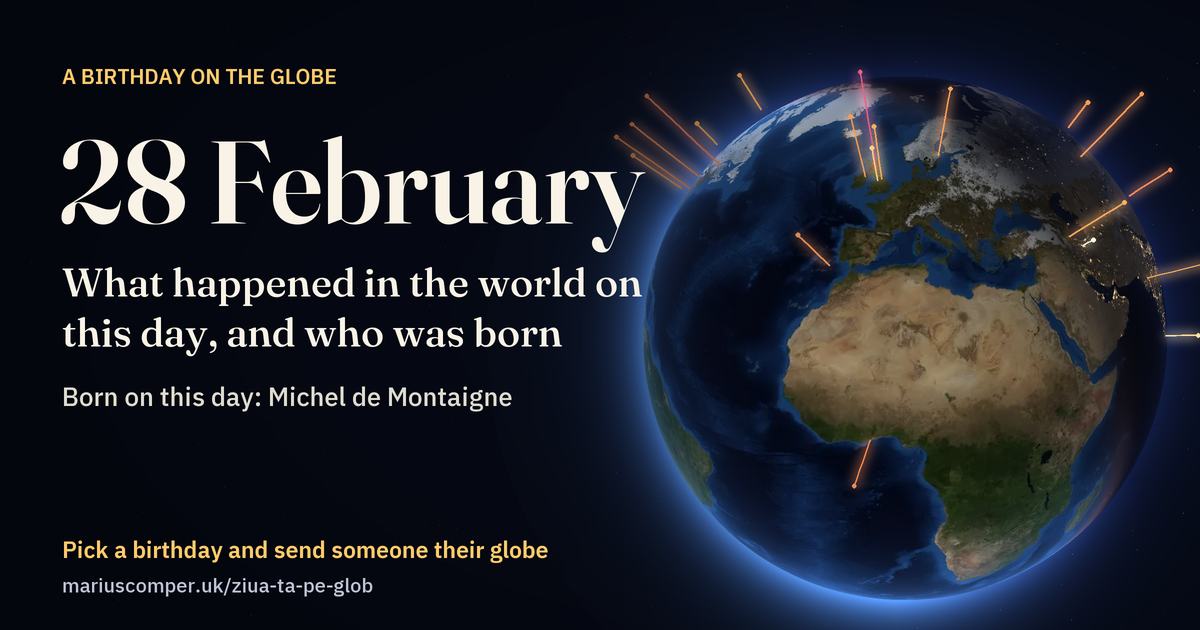
For 28 February, the English Wikipedia lists 43 events and 148 births. 20 of the events stand at their places as rays of light; five more are dashed circles, where the sentence links only to a country or a sea. The taller the ray, the longer ago it happened. The people born that day come further down, as blue points.
A birthday, yours or someone else’s:
Turn it into a greetingScroll: the globe turns to each place
The day you were born, on the globe.
Three things from your day
Scroll: your day first, then 28 February through the years
The Earth on 28 February
The picture on the globe was assembled by NASA from satellite photographs taken in February 2004: the snow, the ice and the green are those of the month.
On 28 February the Sun passes straight overhead at noon along the parallel of 8.1° south. In London, the day lasts about 10 hours 50 minutes.
Beyond 82° south the Sun no longer sets; beyond 82° north it no longer rises.
The line between day and night is tilted on the globe exactly as on this day of the year. On the dark side you can see the lights of towns.
Britain & Ireland · Edinburgh
1638
The Scottish National Covenant is signed in Edinburgh.
On the map: Edinburgh.
Asia · SSLV Launch Complex
2024
Prime Minister Modi of India inaugurates the 2nd Space Port of India - Kulasekarapattinam Spaceport.
On the map: SSLV Launch Complex.
28 February
What the other Wikipedias remember#
For these years the English list has nothing on this day. The events below come from the same day’s lists on Wikipedia in Spanish and Chinese and were translated for this page.
From Wikipedia in Spanish · Cry of Asencio
1811
In the Banda Oriental (present-day Uruguay), the patriot Venancio Benavides issues the Grito de Asencio, beginning the Eastern Revolution.
On the map: Cry of Asencio.
Translated from the list on Wikipedia in Spanish.
From Wikipedia in Chinese · White House
2018
The United States Senate unanimously passes the Taiwan Travel Act and sends it to the White House. US President Donald Trump formally signs it on 16 March, making it US law, and the Taiwan Travel Act formally takes effect.
On the map: White House.
Translated from the list on Wikipedia in Chinese.
28 February
Born on 28 February#
The English Wikipedia lists 148 births for this day. The blue points are the birthplaces of 60 of these people: those written about in the most Wikipedia editions, where Wikidata gives a place of birth.
Born on 28 February
1533
Michel de Montaigne, French philosopher and author (died 1592)
Place of birth: Château de Montaigne.
Born on 28 February
1901
Linus Pauling, American chemist and activist, Nobel Prize laureate (died 1994)
Place of birth: Portland.
Born on 28 February
1953
Paul Krugman, American economist and academic, Nobel Prize laureate
Place of birth: Albany.
Born on 28 February
1929
Frank Gehry, Canadian-American architect and designer (died 2025)
Place of birth: Toronto.
Born on 28 February
1955
Gilbert Gottfried, American comedian, actor, and singer (died 2022)
Place of birth: Coney Island.
Born in Britain and Ireland
1942
Brian Jones, English guitarist, songwriter, and producer (died 1969)
Place of birth: Cheltenham.
Born in Britain and Ireland
1909
Stephen Spender, English author and poet (died 1995)
Place of birth: Kensington.
Born in Britain and Ireland
1944
Storm Thorgerson, English graphic designer (died 2013)
Place of birth: Potters Bar.
28 February
Number one in the charts that week
At the cinema
An animal recorded that day
The record can be seen in GBIF, which brings together wildlife records from around the world.
All your birthdays
The weather that day
Data: Met Office Hadley Centre (HadCET); NOAA (GHCN-Daily, Mauna Loa).
Above the Earth
Sources: Jonathan McDowell, GCAT (launches); GFZ Potsdam (Kp index). Days are counted in Universal Time.
Football that day
International matches played that day:
Source: the “International football results” dataset kept by Mart Jürisoo (CC0).
Also that day
The earthquake’s page at the USGS
Source: the USGS catalogue. The day is counted in Universal Time (UTC).
In those days
Make a link for someone
Type the name, pick the day and the year of birth. The link opens straight on their day, with their name in the greeting.
The link carries the name, date and place typed here; anyone who gets it can see them.
Put another birthday beside it
Your mother’s, your child’s, a friend’s: the two days appear side by side.
Below: 28 February through the years.
The whole globe of the day
Drag the globe to turn it. Touch a ray or a point to read what happened there.
Everything Wikipedia lists for 28 February
The list is the English Wikipedia’s, in its own wording, as it stood in October 2026. 18 events have no place on the map: the sentence links to no place with coordinates, only to places too wide to mark, or to several countries.
- 202 BC
Liu Bang is enthroned as the Emperor of China, beginning four centuries of rule by the Han dynasty.
Asia · Han dynastyWikipedia: Emperor Gaozu of Han - 870
The Fourth Council of Constantinople closes.
no place on the mapWikipedia: Fourth Council of Constantinople - 1525
Aztec king Cuauhtémoc is executed on the order of conquistador Hernán Cortés.
no place on the mapWikipedia: Aztecs - 1638
The Scottish National Covenant is signed in Edinburgh.
Britain & Ireland · EdinburghWikipedia: National Covenant - 1835
Elias Lönnrot signs and dates the foreword to the first version of the Kalevala, the so-called Old Kalevala.
no place on the mapWikipedia: Elias Lönnrot - 1844
A gun explodes on board the steam warship USS Princeton during a pleasure cruise down the Potomac River, killing six, including Secretary of State Abel Upshur. President John Tyler, who is also on board, is not injured from the blast.
no place on the mapWikipedia: USS Princeton - 1874
In one of the longest cases ever heard in an English court, the claimant in the Tichborne case was convicted of perjury for attempting to assume the identity of the missing heir to the Tichborne baronetcy.
no place on the mapWikipedia: Tichborne case - 1893
USS Indiana, the lead ship of her class and the first battleship in the United States Navy comparable to foreign battleships of the time, was launched.
no place on the mapWikipedia: United States Navy - 1897
Ranavalona III, the last sovereign ruler of the Kingdom of Madagascar, was deposed by French military forces.
Africa · ImerinaWikipedia: Ranavalona III - 1904
The most successful football club in Portugal, S.L. Benfica, was founded in Lisbon as Sport Lisboa.
no place on the mapWikipedia: Association football - 1914
In the aftermath of the Balkan Wars, Greeks living in southern Albania proclaimed the short-lived Autonomous Republic of Northern Epirus.
Europe · Autonomous Republic of Northern EpirusWikipedia: Balkan Wars - 1922
The United Kingdom ends its protectorate over Egypt through a Unilateral Declaration of Independence.
- 1925
The Charlevoix-Kamouraska earthquake strikes northeastern North America.
North America · 1925 Charlevoix–Kamouraska earthquakeWikipedia: 1925 Charlevoix–Kamouraska earthquake - 1928
Indian physicist C. V. Raman and his colleagues discovered what is now known as Raman scattering, for which he later became the first Asian to win the Nobel Prize in Physics.
no place on the mapWikipedia: Nobel Prize in Physics - 1939
In one of the most famous errors in lexicography, the erroneous word dord was discovered in Webster's New International Dictionary by an editor.
no place on the mapWikipedia: Dord - 1947
February 28 incident: In Taiwan, civil disorder is put down with the death of an estimated 18,000 - 28,000 civilians.
Asia · February 28 incidentWikipedia: February 28 incident - 1948
The 1948 Accra riots erupt following a march by ex-servicemen of the Gold Coast Regiment towards the seat of the colonial government at Christiansborg Castle, where they were fired upon by Superintendent Colin Imray, leading to the killing of Sergeant Adjetey, Corporal Attipoe and Private Odartey Lamptey and the arrest of the Big Six in the Gold Coast.
Africa · AccraWikipedia: 1948 Accra riots - 1958
A school bus in Floyd County, Kentucky hits a wrecker truck and plunges down an embankment into the rain-swollen Levisa Fork river. The driver and 26 children die in one of the worst school bus accidents in U.S. history.
North America · Prestonsburg, Kentucky, bus crashWikipedia: Prestonsburg, Kentucky, bus crash - 1959
Discoverer 1, an American spy satellite that is the first object intended to achieve a polar orbit, is launched but fails to achieve orbit.
no place on the mapWikipedia: Discoverer 1 - 1963
Chicago alderman Benjamin F. Lewis was murdered in his office by unknown assailants two days after having been reelected.
no place on the mapWikipedia: Benjamin F. Lewis - 1966
A NASA T-38 Talon crashes into the McDonnell Aircraft factory while attempting a poor-visibility landing at Lambert Field, St. Louis, killing astronauts Elliot See and Charles Bassett.
North America · 1966 NASA T-38 crashWikipedia: 1966 NASA T-38 crash - 1969
The 1969 Portugal earthquake hits Portugal, Spain and Morocco.
Oceans · 1969 Portugal earthquakeWikipedia: 1969 Portugal earthquake - 1972
Japanese police stormed a mountain lodge near Karuizawa, Nagano Prefecture, to end a ten-day siege by members of the paramilitary group United Red Army.
Asia · Karuizawa, NaganoWikipedia: Law enforcement in Japan - 1973
Aeroflot Flight X-167 crashes during takeoff from Semey Airport, killing 32 people.
Asia · Aeroflot Flight X-167Wikipedia: Aeroflot Flight X-167 - 1974
The British election ends in a hung parliament after the Jeremy Thorpe-led Liberal Party achieved their biggest vote share since 1929.
no place on the mapWikipedia: February 1974 United Kingdom general election - 1975
In London, an underground train fails to stop at Moorgate terminus station and crashes into the end of the tunnel, killing 43 people.
no place on the mapWikipedia: Moorgate tube crash - 1983
The final episode of M*A*S*H airs, with almost 110 million viewers.
no place on the mapWikipedia: Goodbye, Farewell and Amen - 1985
The Provisional Irish Republican Army carries out a mortar attack on the Royal Ulster Constabulary police station at Newry, killing nine officers.
Britain & Ireland · 1985 Newry mortar attackWikipedia: 1985 Newry mortar attack - 1986
Olof Palme, 26th Prime Minister of Sweden, is assassinated in Stockholm.
Europe · Assassination of Olof PalmeWikipedia: Assassination of Olof Palme - 1990
Space Shuttle Atlantis is launched on STS-36.
no place on the mapWikipedia: Space Shuttle Atlantis - 1993
Bureau of Alcohol, Tobacco and Firearms (ATF) agents raid the Branch Davidian church in Waco, Texas with a warrant to arrest the group's leader David Koresh, starting a 51-day standoff.
North America · Waco siegeWikipedia: Waco siege - 1997
A Turkish military memorandum results in the collapse of the coalition government in Turkey.
no place on the mapWikipedia: 1997 Turkish military memorandum - 1997
An earthquake in northern Iran is responsible for about 1,100 deaths.
Asia · 1997 Ardabil earthquakeWikipedia: 1997 Ardabil earthquake - 1997
GRB 970228, a highly luminous 80-second flash of gamma rays, was detected on Earth, providing early evidence that gamma-ray bursts occur well beyond the Milky Way.
no place on the mapWikipedia: GRB 970228 - 1997
Two heavily armed bank robbers exchanged gunfire with officers of the Los Angeles Police Department in North Hollywood, in one of the most intense gun battles in American police history.
North America · North Hollywood shootoutWikipedia: North Hollywood shootout - 2001
A high-speed train crash occurred near Selby in North Yorkshire, England, killing 10 and injuring 82.
Britain & Ireland · SelbyWikipedia: Selby rail crash - 2001
The 2001 Nisqually earthquake, having a moment magnitude of 6.8, with epicenter in southern Puget Sound, damages the Seattle metropolitan area.
North America · 2001 Nisqually earthquakeWikipedia: 2001 Nisqually earthquake - 2002
During the religious violence in Gujarat, 97 people are killed in the Naroda Patiya massacre and 69 in the Gulbarg Society massacre.
Asia · Naroda Patiya massacreWikipedia: 2002 Gujarat violence - 2013
Pope Benedict XVI resigns as the pope of the Catholic Church, becoming the first pope to do so voluntarily since Pope Gregory XII in 1415.
no place on the mapWikipedia: Resignation of Pope Benedict XVI - 2021
Bus drivers in Greater Manchester began an eleven-week strike, one of the longest in British transportation history.
Britain & Ireland · Greater ManchesterWikipedia: 2021 Go North West strike - 2023
Two trains collide south of the Vale of Tempe in Greece, leading to the deaths of at least 57 people and leaving 58 missing and 85 injured.
Europe · GreeceWikipedia: Tempi train crash - 2024
Prime Minister Modi of India inaugurates the 2nd Space Port of India - Kulasekarapattinam Spaceport.
Asia · SSLV Launch ComplexWikipedia: Prime minister - 2026
The United States and Israel launch attacks across Iran, assassinating Supreme Leader Ali Khamenei. Retaliatory strikes are launched by Iran against US military bases in the Gulf, with explosions reported in Bahrain, Kuwait, Qatar and the UAE.
Asia · Assassination of Ali KhameneiWikipedia: Assassination of Ali Khamenei
What the other Wikipedias remember
For these years the English list has nothing on this day. The events below come from the same day’s lists on Wikipedia in Spanish and Chinese and were translated for this page.
- 1811
In the Banda Oriental (present-day Uruguay), the patriot Venancio Benavides issues the Grito de Asencio, beginning the Eastern Revolution.
Latin America · Cry of AsencioTranslated from the list on Wikipedia in SpanishWikipedia: Grito de Asencio - 2018
The United States Senate unanimously passes the Taiwan Travel Act and sends it to the White House. US President Donald Trump formally signs it on 16 March, making it US law, and the Taiwan Travel Act formally takes effect.
Who was born on 28 February
In order of how many Wikipedia editions have an article about each. The first 60 of 148 are shown.
- 1533
Michel de Montaigne, French philosopher and author (died 1592)
Château de MontaigneWikipedia: Michel de Montaigne - 1901
Linus Pauling, American chemist and activist, Nobel Prize laureate (died 1994)
PortlandWikipedia: Linus Pauling - 1953
Paul Krugman, American economist and academic, Nobel Prize laureate
AlbanyWikipedia: Paul Krugman - 1929
Frank Gehry, Canadian-American architect and designer (died 2025)
TorontoWikipedia: Frank Gehry - 1955
Gilbert Gottfried, American comedian, actor, and singer (died 2022)
Coney IslandWikipedia: Gilbert Gottfried - 1948
Steven Chu, American physicist and politician, 12th United States Secretary of Energy, Nobel Prize laureate
St. LouisWikipedia: Steven Chu - 1930
Leon Cooper, American physicist and academic, Nobel Prize laureate (died 2024)
New York CityWikipedia: Leon Cooper - 1942
Dino Zoff, Italian footballer
Mariano del FriuliWikipedia: Dino Zoff - 1939
Daniel C. Tsui, Chinese-American physicist and academic, Nobel Prize laureate
Baofeng CountyWikipedia: Daniel C. Tsui - 1915
Peter Medawar, Brazilian-English biologist and immunologist, Nobel Prize laureate (died 1987)
PetrópolisWikipedia: Peter Medawar - 1940
Mario Andretti, Italian-American racing driver
MotovunWikipedia: Mario Andretti - 1976
Ali Larter, American actress and model
Cherry HillWikipedia: Ali Larter - 1985
Jelena Janković, Serbian tennis player
BelgradeWikipedia: Jelena Janković - 1957
John Turturro, American actor and director
BrooklynWikipedia: John Turturro - 1999
Luka Dončić, Slovenian basketball player
LjubljanaWikipedia: Luka Dončić - 1994
Arkadiusz Milik, Polish footballer
- 1896
Philip Showalter Hench, American physician and endocrinologist, Nobel Prize laureate (died 1965)
PittsburghWikipedia: Philip Showalter Hench - 1942
Brian Jones, English guitarist, songwriter, and producer (died 1969)
CheltenhamWikipedia: Brian Jones - 1982
Natalia Vodianova, Russian-French model and actress
Nizhny NovgorodWikipedia: Natalia Vodianova - 1944
Sepp Maier, German footballer and manager
MettenWikipedia: Sepp Maier - 1966
Paulo Futre, Portuguese footballer
MontijoWikipedia: Paulo Futre - 1969
Robert Sean Leonard, American actor
WestwoodWikipedia: Robert Sean Leonard - 1833
Alfred von Schlieffen, German military strategist (died 1913)
- 1948
Mercedes Ruehl, American actress
- 1987
Antonio Candreva, Italian footballer
- 2000
Moise Kean, Italian footballer
VercelliWikipedia: Moise Kean - 1980
Christian Poulsen, Danish footballer
- 1690
Alexei Petrovich, Tsarevich of Russia, eldest son of Peter the Great (died 1718)
- 1948
Bernadette Peters, American actress, singer, and author
- 1984
Karolína Kurková, Czech model and actress
- 1985
Diego, Brazilian footballer
Ribeirão PretoWikipedia: Diego - 1990
Sebastian Rudy, German footballer
Villingen-SchwenningenWikipedia: Sebastian Rudy - 1998
Teun Koopmeiners, Dutch footballer
CastricumWikipedia: Teun Koopmeiners - 1683
René Antoine Ferchault de Réaumur, French entomologist and academic (died 1757)
La RochelleWikipedia: René Antoine Ferchault de Réaumur - 1946
Robin Cook, Scottish educator and politician, Secretary of State for Foreign and Commonwealth Affairs (died 2005)
BellshillWikipedia: Robin Cook - 1979
Sébastien Bourdais, French race car driver
- 1552
Jost Bürgi, Swiss mathematician and clockmaker (died 1632)
LichtensteigWikipedia: Jost Bürgi - 1866
Vyacheslav Ivanov, Russian poet and playwright (died 1949)
- 1979
Ivo Karlović, Croatian tennis player
ZagrebWikipedia: Ivo Karlović - 1894
Ben Hecht, American director, producer, and screenwriter (died 1964)
New York CityWikipedia: Ben Hecht - 1980
Tayshaun Prince, American basketball player
ComptonWikipedia: Tayshaun Prince - 1942
Oliviero Toscani, Italian photographer (died 2025)
- 1970
Noureddine Morceli, Algerian runner
- 1909
Stephen Spender, English author and poet (died 1995)
KensingtonWikipedia: Stephen Spender - 1944
Storm Thorgerson, English graphic designer (died 2013)
Potters BarWikipedia: Storm Thorgerson - 1978
Benjamin Raich, Austrian skier
Arzl im PitztalWikipedia: Benjamin Raich - 2005
Vitor Roque, Brazilian footballer
TimóteoWikipedia: Vitor Roque - 1906
Bugsy Siegel, American gangster (died 1947)
New York CityWikipedia: Bugsy Siegel - 2000
Josip Šutalo, Croatian footballer
ČapljinaWikipedia: Josip Šutalo - 1944
Kelly Bishop, American actress
Colorado SpringsWikipedia: Kelly Bishop - 1945
Bubba Smith, American football player and actor (died 2011)
BeaumontWikipedia: Bubba Smith - 1949
Zoia Ceaușescu, Romanian mathematician, daughter of Communist leader Nicolae Ceaușescu and his wife Elena Ceaușescu (died 2006)
BucharestWikipedia: Zoia Ceaușescu - 1974
Lee Carsley, English-Irish footballer and manager
BirminghamWikipedia: Lee Carsley - 1993
Éder Álvarez Balanta, Colombian footballer
- 1996
Lucas Boyé, Argentinian footballer
San GregorioWikipedia: Lucas Boyé - 1884
Ants Piip, Estonian lawyer and politician, 7th Prime Minister of Estonia (died 1942)
TuhalaaneWikipedia: Ants Piip - 1994
Alex Caruso, American basketball player
College StationWikipedia: Alex Caruso - 1518
Francis III, Duke of Brittany, Duke of Brittany (died 1536)
Château d'AmboiseWikipedia: Francis III of Brittany - 1931
Gavin MacLeod, American actor, Christian activist, and author (died 2021)
Mount KiscoWikipedia: Gavin MacLeod - 1953
Ricky Steamboat, American professional wrestler
West PointWikipedia: Ricky Steamboat
What is celebrated on 28 February
- Christian feast day: February 28 (Eastern Orthodox liturgics)
- Kalevala Day, also known as the Finnish Culture Day (Finland)
- National Science Day (India)
- Peace Memorial Day (Taiwan)
- Andalusia Day (Spain)
A greeting link for someone
Type a name and, if you like, the year of birth. The link opens with a greeting, and beside each event it says how old the person turned that day, or how many years before their birth it happened.
The name and the year go only into the link you send.
All 366 days
How the globe is made
Where the events come from
Each edition of this page uses the day’s list from Wikipedia in its own language: Romanian, English, Spanish, Chinese. The lists are written by volunteers and differ from one edition to the next; the text of each event is Wikipedia’s, with a link to the article. A row that appears twice in a list is shown once. The lists have not been checked event by event: they are Wikipedia’s, mistakes included.
For events before 1582, and for countries that moved to the Gregorian calendar later (Britain in 1752, Russia in 1918), the same day may be counted Old Style in one list and New Style in another.
The chapter “What the other Wikipedias remember” adds up to five events a day from the lists of the other three editions, only for years in which the English list has nothing on that day. They were translated for this page, passed the same filters as the tour, and are not counted among the events of the English list.
How an event gets onto the map
The place comes from Wikidata. If the sentence links to the article about the event itself (a battle, an opening, an earthquake), dated to the same year, the ray stands on its coordinates or on those of its location. Otherwise it stands on the first place the sentence links to: a town, a building, a mountain, an island. This second step can be wrong: sometimes the sentence only mentions the place. That is why the page says, under each event, which place the ray stands on.
When the sentence links to a single state or province, or to a single sea, lake or desert larger than 5,000 km², the globe shows a dashed circle, not a ray. The circle has the area Wikidata gives, with its radius kept between 1.2° and 16°, or a radius of 4.5° when Wikidata gives no area; it says only that the sentence links to that place. Organisations, ships, spacecraft, museum objects, rivers, mountain ranges, languages and continents are never used as places. When a sentence names several states and no exact place, the event stays in the list only.
What the height means
The height of a ray shows how many years have passed, on a logarithmic scale: 10 years, 100 years and 1,000 years are equal steps apart; anything older than about 2,600 years has the tallest ray. The colour runs from pale yellow for recent years to violet for antiquity.
Where the tour stops
In each region the tour stops at up to three events (five in Britain and Ireland), chosen mainly by three things: whether Wikipedia’s editors put the event in the “On this day” box of their main page (the English, Spanish and Chinese editions), how many Wikipedia editions have an article about it, and how many of the four lists include it. Events whose sentence or article is about a war, an attack, a crime or a disaster are left out of the tour; they stay in the whole list, in Wikipedia’s wording. The filter is a list of words and a list of Wikidata types, so it can miss some.
The tour of births names the people with articles in the most editions and leaves aside those whom the list or Wikidata describes as rulers, politicians, commanders, leaders of movements or criminals; they stay in the list.
The Earth and the Sun
The daytime images are NASA’s Blue Marble Next Generation mosaics, one for each month of 2004; the night side is Black Marble 2016. The tilt of the line between day and night is computed for the day; the hour is chosen so that the place being read is in daylight. The latitude where the Sun stands overhead is the average of the four years of the leap cycle; in a given year it can differ by up to 0.4°.
The day you were born
The number ones come from the weekly lists on Wikipedia: Billboard for the United States (from 1940; the Hot 100 from August 1958), the UK Singles Chart (from November 1952), Los 40 Principales for Spain (from July 1966) and, for Romania, the Romanian Top 100 and Airplay 100 (2001–2021, with missing weeks). The page shows the chart of the week in which the day of birth falls, with its date; Billboard and the UK chart are dated at the end of their week. For Romania before 2001 and for China these sources have no weekly chart.
The films are those that reached cinemas in the United States up to ten days before or three days after that day (some of them in a few cinemas at first), from the English Wikipedia’s yearly lists (from 1968), in order of how many editions have an article about them. The events “in those days” are the ones on the neighbouring days’ lists that carry the year of birth, passed through the same filter as the tour.
The day of birth, year included
The Moon, the star sign and the constellation are worked out by the page itself, for noon Universal Time on the day. The lit part of the Moon is rounded and can differ by a few per cent from that at the hour of birth. The sign follows the usual zodiac of twelve equal parts starting at the March equinox; the constellation is the one the Sun actually stood in front of, by the borders set by the International Astronomical Union, and within a day of a border the page does not name it. When the Sun changes sign while it is that day anywhere on Earth, the page gives the moment of crossing, rounded to ten minutes and accurate to within about a quarter of an hour, and the clock time in a few cities, with the time zone and summer time of that year.
The year in the Chinese calendar is the one your device’s own calendar gives for the date, checked against the Hong Kong Observatory’s tables. “All your birthdays” uses the same sources as the rest of the chapter for the same day in every year since the birth: the temperature, well-known launches that took place on that very day, matches of the teams the edition follows, snow deeper than 10 cm and strong geomagnetic storms. The three things at the top and the four on the picture are chosen in a fixed order (the song, the animal, a full Moon, a well-known launch before an ordinary earthquake); on the picture you can change them.
When the link carries a year of birth, the page adds a few things about that exact day. The weather is the Met Office’s Central England temperature record and the readings from New York’s Central Park; the “usual high” is the average of the daily highs of 1961–1990 for that date, with two days either side. The carbon dioxide figure is the monthly mean at the Mauna Loa observatory, where measurements begin in March 1958.
The earthquake is the one with the largest magnitude in the USGS catalogue for that day, counted in Universal Time. Before the 1960s the catalogue has gaps even above magnitude 5.5, so in the older years many days have no earthquake. The page gives only the magnitude and the place: the country the epicentre falls in or, when the epicentre is at sea within 300 km of a coast, the nearest country; farther out, only the ocean.
The launches are those that reached orbit or left for the Moon and the planets, from Jonathan McDowell’s GCAT catalogue. If nothing left that day, the page shows the nearest launch within three days before or after, and says how many days away it was. The geomagnetic storm appears only when the Kp index reached at least 5 in one of the day’s eight three-hour intervals.
The animal comes from GBIF: an observation made by a person (the animal seen or heard, or its tracks), dated to that exact day, with coordinates and a CC0 or CC BY licence. Only a few hundred well-known species are searched (mammals, birds, turtles, butterflies); of those noted that day, mammals and species with articles in many Wikipedia editions come first; birds noted almost every day, and species used recently, wait their turn. Observations dated 1 January are left out, because records without a day are often filed there. An observation shows that the animal was recorded there, not how many animals there were.
The matches are those between national teams. Only matches of England, Scotland, Wales, Northern Ireland, the Republic of Ireland, the United States, Canada and Australia are shown, along with those at the big final tournaments. The picture to send is drawn in the page from the day’s globe and the facts above, and stays on your device until you send it.
Sources
- Events, births and holidays: the day’s page on Wikipedia, text under CC BY-SA 4.0.
- Coordinates, places of birth and the number of editions: Wikidata (CC0).
- The Earth by day: NASA Blue Marble Next Generation. The Earth by night: NASA Black Marble 2016.
- Borders and regions: Natural Earth.
- World population and births per year: UN World Population Prospects 2024.
- Charts and films: Wikipedia’s lists for Billboard, the UK Singles Chart, Los 40 Principales, Romanian Top 100, Airplay 100 and American films by year (CC BY-SA 4.0).
- Weather: Met Office Hadley Centre, HadCET (Open Government Licence) and NOAA GHCN-Daily, New York Central Park. Carbon dioxide: NOAA Global Monitoring Laboratory, Mauna Loa.
- Earthquakes: the USGS catalogue. Launches: Jonathan McDowell, GCAT (CC BY). Kp index: GFZ Potsdam (CC BY 4.0). Matches: International football results, Mart Jürisoo (CC0).
- Animal observations: GBIF, with a link to each record; species names come from Wikidata.