A birthday on the globe
9 June on the globe: what happened in the world on this day, and who was born
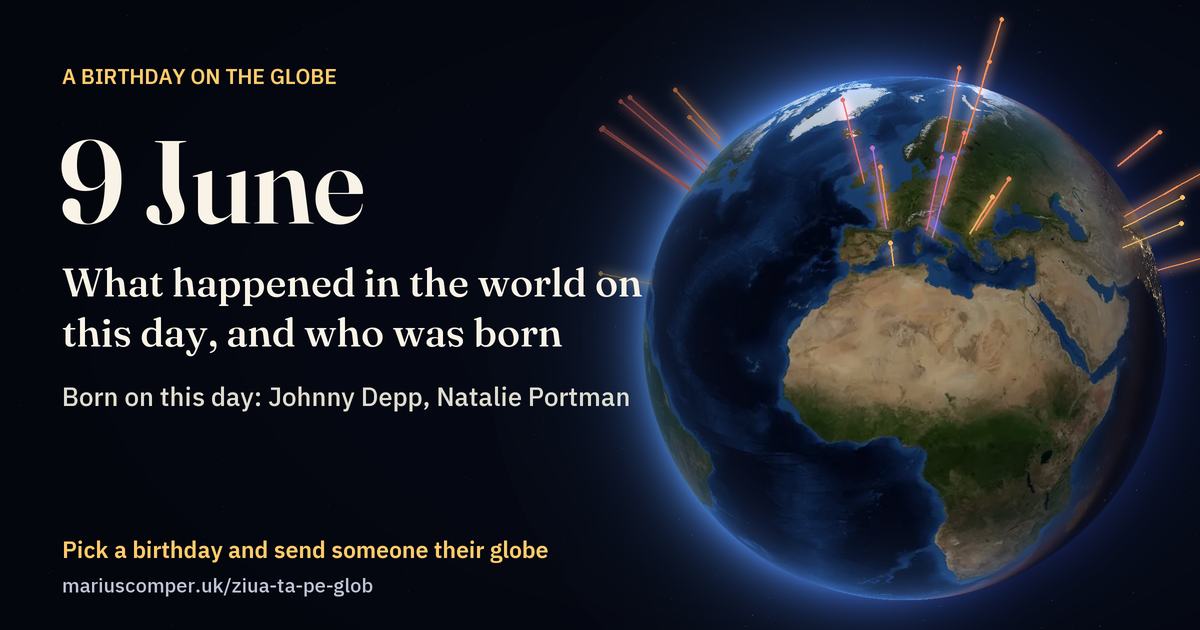
For 9 June, the English Wikipedia lists 49 events and 231 births. 26 of the events stand at their places as rays of light; six more are dashed circles, where the sentence links only to a country or a sea. The taller the ray, the longer ago it happened. The people born that day come further down, as blue points.
A birthday, yours or someone else’s:
Turn it into a greetingScroll: the globe turns to each place
The day you were born, on the globe.
Three things from your day
Scroll: your day first, then 9 June through the years
The Earth on 9 June
The picture on the globe was assembled by NASA from satellite photographs taken in June 2004: the snow, the ice and the green are those of the month.
On 9 June the Sun passes straight overhead at noon along the parallel of 23.0° north. In London, the day lasts about 16 hours 30 minutes.
Beyond 67° north the Sun no longer sets; beyond 67° south it no longer rises.
The line between day and night is tilted on the globe exactly as on this day of the year. On the dark side you can see the lights of towns.
Europe · Siena Cathedral
1311
Duccio's Maestà, a seminal artwork of the early Italian Renaissance, is unveiled and installed in Siena Cathedral in Siena, Italy.
On the map: Siena Cathedral.
Europe · Congress of Vienna
1815
End of the Congress of Vienna: The new European political situation is set.
On the map: the coordinates Wikidata gives for the article “Congress of Vienna”.
Also on the day’s list of Wikipedia in Spanish, Romanian and Chinese.
Europe · Åland
1922
Åland's Regional Assembly convenes for its first plenary session in Mariehamn, Åland; today, the day is celebrated as Self-Government Day of Åland.
On the map: Åland.
North America · Hamilton, Ontario
1846
Hamilton, Ontario, was granted city status by the Parliament of the Province of Canada.
On the map: Hamilton, Ontario.
North America · Iowa City, Iowa
1856
Five hundred Mormons leave Iowa City, Iowa for the Mormon Trail.
On the map: Iowa City, Iowa.
Also on the day’s list of Wikipedia in Chinese.
9 June
What the other Wikipedias remember#
For these years the English list has nothing on this day. The events below come from the same day’s lists on Wikipedia in Chinese and were translated for this page.
From Wikipedia in Chinese · 2006 FIFA World Cup
2006
The 18th FIFA World Cup opens in Munich, Germany.
On the map: 2006 FIFA World Cup.
Translated from the list on Wikipedia in Chinese.
9 June
Born on 9 June#
The English Wikipedia lists 231 births for this day. The blue points are the birthplaces of 60 of these people: those written about in the most Wikipedia editions, where Wikidata gives a place of birth.
Born on 9 June
1981
Natalie Portman, Israeli-American actress
Place of birth: Hadassah University Hospital, Mt. Scopus.
Born on 9 June
1843
Bertha von Suttner, Austrian journalist and author, Nobel Prize laureate (died 1914)
Place of birth: Prague.
Born on 9 June
1961
Michael J. Fox, Canadian-American actor, producer, and author
Place of birth: Edmonton.
Born in Britain and Ireland
1781
George Stephenson, English engineer, designed the Liverpool and Manchester Railway (died 1848)
Place of birth: Wylam.
Born in Britain and Ireland
1875
Henry Hallett Dale, English pharmacologist and physiologist, Nobel Prize laureate (died 1968)
Place of birth: Islington.
Born in Britain and Ireland
1941
Jon Lord, English singer-songwriter and keyboard player (died 2012)
Place of birth: Leicester.
9 June
Number one in the charts that week
At the cinema
An animal recorded that day
The record can be seen in GBIF, which brings together wildlife records from around the world.
All your birthdays
The weather that day
Data: Met Office Hadley Centre (HadCET); NOAA (GHCN-Daily, Mauna Loa).
Above the Earth
Sources: Jonathan McDowell, GCAT (launches); GFZ Potsdam (Kp index). Days are counted in Universal Time.
Football that day
International matches played that day:
Source: the “International football results” dataset kept by Mart Jürisoo (CC0).
Also that day
The earthquake’s page at the USGS
Source: the USGS catalogue. The day is counted in Universal Time (UTC).
In those days
Make a link for someone
Type the name, pick the day and the year of birth. The link opens straight on their day, with their name in the greeting.
The link carries the name, date and place typed here; anyone who gets it can see them.
Put another birthday beside it
Your mother’s, your child’s, a friend’s: the two days appear side by side.
Below: 9 June through the years.
The whole globe of the day
Drag the globe to turn it. Touch a ray or a point to read what happened there.
Everything Wikipedia lists for 9 June
The list is the English Wikipedia’s, in its own wording, as it stood in October 2026. 17 events have no place on the map: the sentence links to no place with coordinates, only to places too wide to mark, or to several countries.
- 411 BC
The Athenian coup succeeds, forming a short-lived oligarchy.
no place on the mapWikipedia: Athenian coup of 411 BC - 53
The Roman emperor Nero marries Claudia Octavia.
no place on the mapWikipedia: Roman emperor - 68
Nero dies by suicide after quoting Vergil's Aeneid, thus ending the Julio-Claudian dynasty and starting the civil war known as the Year of the Four Emperors.
Europe · Year of the Four EmperorsWikipedia: Year of the Four Emperors - 721
Odo of Aquitaine defeats the Moors in the Battle of Toulouse.
Europe · Battle of ToulouseWikipedia: Battle of Toulouse - 747
Abbasid Revolution: Abu Muslim Khorasani begins an open revolt against Umayyad rule, which is carried out under the sign of the Black Standard.
Asia · Umayyad CaliphateWikipedia: Abbasid revolution - 1311
Duccio's Maestà, a seminal artwork of the early Italian Renaissance, is unveiled and installed in Siena Cathedral in Siena, Italy.
Europe · Siena CathedralWikipedia: Maestà - 1523
The Parisian Faculty of Theology fines Simon de Colines for publishing the Biblical commentary Commentarii initiatorii in quatuor Evangelia by Jacques Lefèvre d'Étaples.
no place on the mapWikipedia: Simon de Colines - 1534
Jacques Cartier is the first European to describe and map the Saint Lawrence River.
no place on the mapWikipedia: Jacques Cartier - 1549
The first Book of Common Prayer was legally mandated by Parliament, introducing a fully vernacular Protestant liturgy to the Church of England.
no place on the mapWikipedia: Church of England - 1732
James Oglethorpe is granted a royal charter for the colony of the future U.S. state of Georgia.
North America · GeorgiaWikipedia: James Oglethorpe - 1772
The British schooner Gaspee is burned in Narragansett Bay, Rhode Island.
no place on the mapWikipedia: Gaspee affair - 1798
Irish Rebellion of 1798: Battles of Arklow and Saintfield.
Britain & Ireland · Battle of ArklowWikipedia: Battle of Arklow - 1815
End of the Congress of Vienna: The new European political situation is set.
Europe · Congress of ViennaWikipedia: Congress of Vienna - 1846
Hamilton, Ontario, was granted city status by the Parliament of the Province of Canada.
North America · Hamilton, OntarioWikipedia: Hamilton, Ontario - 1856
Five hundred Mormons leave Iowa City, Iowa for the Mormon Trail.
North America · Iowa City, IowaWikipedia: Mormon handcart pioneers - 1861
The Beyoglu Protocol turns the district of Mount Lebanon into an autonomous region within the Ottoman Empire and grants the Christians more power over the Druze.
Asia · Ottoman EmpireWikipedia: Règlement Organique - 1862
American Civil War: Stonewall Jackson concludes his successful Shenandoah Valley Campaign with a victory in the Battle of Port Republic.
North America · Jackson's Valley campaignWikipedia: American Civil War - 1863
American Civil War: The Battle of Brandy Station in Virginia, the largest cavalry battle on American soil, ends Confederate cavalry dominance in the eastern theater.
North America · Battle of Brandy StationWikipedia: Battle of Brandy Station - 1885
Treaty of Tientsin is signed to end the Sino-French War, with China eventually giving up Tonkin and Annam – most of present-day Vietnam – to France.
no place on the mapWikipedia: Treaty of Tianjin - 1900
Indian nationalist Birsa Munda dies of cholera in a British prison.
no place on the mapWikipedia: Birsa Munda - 1915
William Jennings Bryan resigns as Woodrow Wilson's Secretary of State over a disagreement regarding the United States' handling of the sinking of the RMS Lusitania.
no place on the mapWikipedia: William Jennings Bryan - 1920
The courtesan Wang Lianying was murdered in Shanghai, leading to months of media and literary coverage.
Asia · ShanghaiWikipedia: Murder of Wang Lianying - 1922
Åland's Regional Assembly convenes for its first plenary session in Mariehamn, Åland; today, the day is celebrated as Self-Government Day of Åland.
Europe · ÅlandWikipedia: Åland's Autonomy Day - 1923
Bulgaria's military takes over the government in a coup.
Europe · SofiaWikipedia: 1923 Bulgarian coup d'état - 1928
Charles Kingsford Smith completes the first trans-Pacific flight in a Fokker Trimotor monoplane, the Southern Cross.
no place on the mapWikipedia: Charles Kingsford Smith - 1930
A Chicago Tribune reporter, Jake Lingle, is killed during rush hour at the Illinois Central train station by Leo Vincent Brothers, allegedly over a $100,000 gambling debt owed to Al Capone.
North America · IllinoisWikipedia: Chicago Tribune - 1944
World War II: Ninety-nine civilians are hanged from lampposts and balconies by German troops in Tulle, France, in reprisal for maquisards attacks.
Europe · Tulle massacreWikipedia: Tulle massacre - 1944
World War II: The Soviet Union invades East Karelia and the previously Finnish part of Karelia, occupied by Finland since 1941.
Europe · KareliaWikipedia: Soviet Union - 1948
Foundation of the International Council on Archives under the auspices of the UNESCO.
no place on the mapWikipedia: International Council on Archives - 1953
The Flint–Worcester tornado outbreak sequence kills 94 people in Massachusetts.
North America · MassachusettsWikipedia: Tornado outbreak of June 7–9, 1953 - 1954
Joseph N. Welch, special counsel for the United States Army, lashes out at Senator Joseph McCarthy during the Army–McCarthy hearings, giving McCarthy the famous rebuke, "You've done enough. Have you no sense of decency, sir, at long last? Have you left no sense of decency?"
no place on the mapWikipedia: Joseph N. Welch - 1957
First ascent of Broad Peak by Fritz Wintersteller, Marcus Schmuck, Kurt Diemberger, and Hermann Buhl.
Asia · Broad PeakWikipedia: Broad Peak - 1958
Aeroflot Flight 105 crashes on approach to Magdan-13 Airport, killing 24.
Asia · Magadan-13 AirportWikipedia: Magadan-13 Airport - 1959
The USS George Washington is launched. It is the first nuclear-powered ballistic missile submarine.
no place on the mapWikipedia: USS George Washington - 1965
The civilian Prime Minister of South Vietnam, Phan Huy Quát, resigns after being unable to work with a junta led by Nguyễn Cao Kỳ.
Asia · South VietnamWikipedia: South Vietnam - 1965
Vietnam War: The Viet Cong commences combat with the Army of the Republic of Vietnam in the Battle of Đồng Xoài, one of the largest battles in the war.
Asia · Battle of Đồng XoàiWikipedia: Vietnam War - 1967
Six-Day War: Israel captures the Golan Heights from Syria.
no place on the mapWikipedia: Six-Day War - 1968
U.S. President Lyndon B. Johnson declares a national day of mourning following the assassination of Senator Robert F. Kennedy.
North America · Assassination of Robert F. KennedyWikipedia: Assassination of Robert F. Kennedy - 1972
Severe rainfall causes a dam in the Black Hills of South Dakota to burst, creating a flood that kills 238 people and causes $160 million in damage.
North America · 1972 Black Hills floodWikipedia: Black Hills - 1973
In horse racing, Secretariat wins the U.S. Triple Crown.
no place on the mapWikipedia: Secretariat - 1978
The Church of Jesus Christ of Latter-day Saints opens its priesthood to "all worthy men", ending a 148-year-old policy of excluding black men.
no place on the mapWikipedia: The Church of Jesus Christ of Latter-day Saints - 1979
The Ghost Train fire at Luna Park Sydney, Australia, kills seven.
Oceania · Luna Park SydneyWikipedia: Sydney Ghost Train fire - 1982
Lebanon War: The Israeli Air Force carried out Operation Mole Cricket 19, successfully suppressing Syrian air defenses in the Beqaa Valley, Lebanon.
no place on the mapWikipedia: Operation Mole Cricket 19 - 1995
Ansett New Zealand Flight 703 crashes into the Tararua Range during approach to Palmerston North Airport on the North Island of New Zealand, killing four.
Oceania · Ansett New Zealand Flight 703Wikipedia: Ansett New Zealand Flight 703 - 1999
Kosovo War: The Federal Republic of Yugoslavia and NATO sign a peace treaty.
Europe · Kumanovo AgreementWikipedia: Kosovo War - 2008
Two bombs explode at a train station near Algiers, Algeria, killing at least 13 people.
Africa · Beni AmraneWikipedia: 2008 Beni Amrane bombings - 2009
An explosion kills 17 people and injures at least 46 at a hotel in Peshawar, Pakistan.
Asia · Pearl Continental hotel bombingWikipedia: Pearl Continental hotel bombing - 2010
At least 40 people are killed and more than 70 wounded in a suicide bombing at a wedding party in Arghandab, Kandahar.
Asia · 2010 Nadahan bombingWikipedia: 2010 Nadahan bombing - 2019
Dominican-American retired baseball player David Ortiz was shot and severely wounded while at a bar in Santo Domingo.
Latin America · Shooting of David OrtizWikipedia: Shooting of David Ortiz
What the other Wikipedias remember
For these years the English list has nothing on this day. The events below come from the same day’s lists on Wikipedia in Chinese and were translated for this page.
- 2006
The 18th FIFA World Cup opens in Munich, Germany.
Who was born on 9 June
In order of how many Wikipedia editions have an article about each. The first 60 of 231 are shown.
- 1672
Peter the Great, Russian emperor (died 1725)
- 1963
Johnny Depp, American actor
OwensboroWikipedia: Johnny Depp - 1981
Natalie Portman, Israeli-American actress
Hadassah University Hospital, Mt. ScopusWikipedia: Natalie Portman - 1843
Bertha von Suttner, Austrian journalist and author, Nobel Prize laureate (died 1914)
- 1978
Miroslav Klose, German footballer
- 1961
Michael J. Fox, Canadian-American actor, producer, and author
EdmontonWikipedia: Michael J. Fox - 1984
Wesley Sneijder, Dutch footballer
UtrechtWikipedia: Wesley Sneijder - 1917
Eric Hobsbawm, Egyptian-English historian and author (died 2012)
AlexandriaWikipedia: Eric Hobsbawm - 1781
George Stephenson, English engineer, designed the Liverpool and Manchester Railway (died 1848)
- 1640
Leopold I, Holy Roman Emperor (died 1705)
- 1812
Johann Gottfried Galle, German astronomer and academic (died 1910)
- 1915
Les Paul, American guitarist and songwriter (died 2009)
WaukeshaWikipedia: Les Paul - 1661
Feodor III of Russia (died 1682)
- 1875
Henry Hallett Dale, English pharmacologist and physiologist, Nobel Prize laureate (died 1968)
IslingtonWikipedia: Henry Hallett Dale - 1916
Robert McNamara, American businessman and politician, 8th United States Secretary of Defense (died 2009)
San FranciscoWikipedia: Robert McNamara - 1941
Jon Lord, English singer-songwriter and keyboard player (died 2012)
LeicesterWikipedia: Jon Lord - 1982
Yoshito Ōkubo, Japanese footballer
- 1891
Cole Porter, American composer and songwriter (died 1964)
- 1595
Władysław IV Vasa, Polish king (died 1648)
- 1978
Matt Bellamy, English singer, musician and songwriter
CambridgeWikipedia: Matt Bellamy - 1988
Sokratis Papastathopoulos, Greek footballer
- 1961
Aaron Sorkin, American screenwriter, producer, and playwright
New York CityWikipedia: Aaron Sorkin - 1985
Sonam Kapoor, Indian model and actress
ChemburWikipedia: Sonam Kapoor - 1865
Carl Nielsen, Danish violinist, composer, and conductor (died 1931)
SortelungWikipedia: Carl Nielsen - 1951
James Newton Howard, American composer, conductor, and producer
Los AngelesWikipedia: James Newton Howard - 1975
Ameesha Patel, Indian actress and model
- 1956
Patricia Cornwell, American journalist and author
- 1977
Peja Stojaković, Serbian basketball player
- 1861
Pierre Duhem, French physicist, mathematician, and historian (died 1916)
2nd arrondissement of ParisWikipedia: Pierre Duhem - 1980
Marcin Wasilewski, Polish footballer and pundit
- 1930
Barbara, French singer (died 1997)
17th arrondissement of ParisWikipedia: Barbara - 1988
Mae Whitman, American actress
Los AngelesWikipedia: Mae Whitman - 1836
Elizabeth Garrett Anderson, English physician and politician (died 1917)
WhitechapelWikipedia: Elizabeth Garrett Anderson - 1934
Jackie Wilson, American singer-songwriter (died 1984)
DetroitWikipedia: Jackie Wilson - 1963
David Koepp, American director, producer, and screenwriter
PewaukeeWikipedia: David Koepp - 1984
Masoud Shojaei, Iranian footballer
- 1424
Blanche II of Navarre (died 1464)
Olite/ErriberriWikipedia: Blanche II of Navarre - 1910
Robert Cummings, American actor, singer, and director (died 1990)
- 1982
Christina Stürmer, Austrian singer-songwriter
Altenberg bei LinzWikipedia: Christina Stürmer - 1990
Matthias Mayer, Austrian skier
St. Veit an der GlanWikipedia: Matthias Mayer - 2001
Xolo Maridueña, American actor.
Los AngelesWikipedia: Xolo Maridueña - 1810
Otto Nicolai, German composer and conductor (died 1849)
KönigsbergWikipedia: Otto Nicolai - 1849
Michael Ancher, Danish painter and academic (died 1927)
BornholmWikipedia: Michael Ancher - 1943
Joe Haldeman, American sci-fi author
Oklahoma CityWikipedia: Joe Haldeman - 1975
Otto Addo, German-Ghanaian footballer and manager
HamburgWikipedia: Otto Addo - 1949
Kiran Bedi, Indian police officer and activist
AmritsarWikipedia: Kiran Bedi - 1898
Luigi Fagioli, Italian race car driver (died 1952)
- 1916
Jurij Brězan, German soldier and author (died 2006)
RäckelwitzWikipedia: Jurij Brězan - 1989
Logan Browning, American actress
AtlantaWikipedia: Logan Browning - 1992
Yannick Agnel, French swimmer
- 1930
Jordi Pujol, Spanish physician and politician, 126th President of the Generalitat de Catalunya
BarcelonaWikipedia: Jordi Pujol - 1989
Dídac Vilà, Spanish footballer
MataróWikipedia: Dídac Vilà - 1945
Faina Melnik, Soviet discus thrower (died 2016)
BakotaWikipedia: Faina Melnik - 1874
Launceston Elliot, Scottish weightlifter and wrestler (died 1930)
- 1902
Skip James, American singer-songwriter and guitarist (died 1969)
BentoniaWikipedia: Skip James - 1948
Gudrun Schyman, Swedish social worker and politician
Täby parishWikipedia: Gudrun Schyman - 1980
Udonis Haslem, American basketball player
- 2000
Diego Lainez, Mexican footballer
VillahermosaWikipedia: Diego Lainez - 1597
Pieter Jansz. Saenredam, Dutch painter (died 1665)
AssendelftWikipedia: Pieter Jansz. Saenredam - 1931
Jackie Mason, American stand-up comedian (died 2021)
SheboyganWikipedia: Jackie Mason
What is celebrated on 9 June
- Anniversary of the Accession of King Abdullah II (Jordan)
- Autonomy Day (Åland)
- Christian feast day: Aidan of Lindisfarne (Evangelical Lutheran Church in America)
- Christian feast day: Blessed Anna Maria Taigi
- Christian feast day: Baithéne mac Brénaind
- Christian feast day: Bede (Evangelical Lutheran Church in America)
- Christian feast day: Columba
- Christian feast day: Ephrem the Syrian (Roman Catholic Church and Church of England)
- Christian feast day: José de Anchieta
- Christian feast day: Primus and Felician
- Christian feast day: June 9 (Eastern Orthodox liturgics)
- Coral Triangle Day
- Don Young Day (Alaska, United States)
- La Rioja Day (La Rioja)
A greeting link for someone
Type a name and, if you like, the year of birth. The link opens with a greeting, and beside each event it says how old the person turned that day, or how many years before their birth it happened.
The name and the year go only into the link you send.
All 366 days
How the globe is made
Where the events come from
Each edition of this page uses the day’s list from Wikipedia in its own language: Romanian, English, Spanish, Chinese. The lists are written by volunteers and differ from one edition to the next; the text of each event is Wikipedia’s, with a link to the article. A row that appears twice in a list is shown once. The lists have not been checked event by event: they are Wikipedia’s, mistakes included.
For events before 1582, and for countries that moved to the Gregorian calendar later (Britain in 1752, Russia in 1918), the same day may be counted Old Style in one list and New Style in another.
The chapter “What the other Wikipedias remember” adds up to five events a day from the lists of the other three editions, only for years in which the English list has nothing on that day. They were translated for this page, passed the same filters as the tour, and are not counted among the events of the English list.
How an event gets onto the map
The place comes from Wikidata. If the sentence links to the article about the event itself (a battle, an opening, an earthquake), dated to the same year, the ray stands on its coordinates or on those of its location. Otherwise it stands on the first place the sentence links to: a town, a building, a mountain, an island. This second step can be wrong: sometimes the sentence only mentions the place. That is why the page says, under each event, which place the ray stands on.
When the sentence links to a single state or province, or to a single sea, lake or desert larger than 5,000 km², the globe shows a dashed circle, not a ray. The circle has the area Wikidata gives, with its radius kept between 1.2° and 16°, or a radius of 4.5° when Wikidata gives no area; it says only that the sentence links to that place. Organisations, ships, spacecraft, museum objects, rivers, mountain ranges, languages and continents are never used as places. When a sentence names several states and no exact place, the event stays in the list only.
What the height means
The height of a ray shows how many years have passed, on a logarithmic scale: 10 years, 100 years and 1,000 years are equal steps apart; anything older than about 2,600 years has the tallest ray. The colour runs from pale yellow for recent years to violet for antiquity.
Where the tour stops
In each region the tour stops at up to three events (five in Britain and Ireland), chosen mainly by three things: whether Wikipedia’s editors put the event in the “On this day” box of their main page (the English, Spanish and Chinese editions), how many Wikipedia editions have an article about it, and how many of the four lists include it. Events whose sentence or article is about a war, an attack, a crime or a disaster are left out of the tour; they stay in the whole list, in Wikipedia’s wording. The filter is a list of words and a list of Wikidata types, so it can miss some.
The tour of births names the people with articles in the most editions and leaves aside those whom the list or Wikidata describes as rulers, politicians, commanders, leaders of movements or criminals; they stay in the list.
The Earth and the Sun
The daytime images are NASA’s Blue Marble Next Generation mosaics, one for each month of 2004; the night side is Black Marble 2016. The tilt of the line between day and night is computed for the day; the hour is chosen so that the place being read is in daylight. The latitude where the Sun stands overhead is the average of the four years of the leap cycle; in a given year it can differ by up to 0.4°.
The day you were born
The number ones come from the weekly lists on Wikipedia: Billboard for the United States (from 1940; the Hot 100 from August 1958), the UK Singles Chart (from November 1952), Los 40 Principales for Spain (from July 1966) and, for Romania, the Romanian Top 100 and Airplay 100 (2001–2021, with missing weeks). The page shows the chart of the week in which the day of birth falls, with its date; Billboard and the UK chart are dated at the end of their week. For Romania before 2001 and for China these sources have no weekly chart.
The films are those that reached cinemas in the United States up to ten days before or three days after that day (some of them in a few cinemas at first), from the English Wikipedia’s yearly lists (from 1968), in order of how many editions have an article about them. The events “in those days” are the ones on the neighbouring days’ lists that carry the year of birth, passed through the same filter as the tour.
The day of birth, year included
The Moon, the star sign and the constellation are worked out by the page itself, for noon Universal Time on the day. The lit part of the Moon is rounded and can differ by a few per cent from that at the hour of birth. The sign follows the usual zodiac of twelve equal parts starting at the March equinox; the constellation is the one the Sun actually stood in front of, by the borders set by the International Astronomical Union, and within a day of a border the page does not name it. When the Sun changes sign while it is that day anywhere on Earth, the page gives the moment of crossing, rounded to ten minutes and accurate to within about a quarter of an hour, and the clock time in a few cities, with the time zone and summer time of that year.
The year in the Chinese calendar is the one your device’s own calendar gives for the date, checked against the Hong Kong Observatory’s tables. “All your birthdays” uses the same sources as the rest of the chapter for the same day in every year since the birth: the temperature, well-known launches that took place on that very day, matches of the teams the edition follows, snow deeper than 10 cm and strong geomagnetic storms. The three things at the top and the four on the picture are chosen in a fixed order (the song, the animal, a full Moon, a well-known launch before an ordinary earthquake); on the picture you can change them.
When the link carries a year of birth, the page adds a few things about that exact day. The weather is the Met Office’s Central England temperature record and the readings from New York’s Central Park; the “usual high” is the average of the daily highs of 1961–1990 for that date, with two days either side. The carbon dioxide figure is the monthly mean at the Mauna Loa observatory, where measurements begin in March 1958.
The earthquake is the one with the largest magnitude in the USGS catalogue for that day, counted in Universal Time. Before the 1960s the catalogue has gaps even above magnitude 5.5, so in the older years many days have no earthquake. The page gives only the magnitude and the place: the country the epicentre falls in or, when the epicentre is at sea within 300 km of a coast, the nearest country; farther out, only the ocean.
The launches are those that reached orbit or left for the Moon and the planets, from Jonathan McDowell’s GCAT catalogue. If nothing left that day, the page shows the nearest launch within three days before or after, and says how many days away it was. The geomagnetic storm appears only when the Kp index reached at least 5 in one of the day’s eight three-hour intervals.
The animal comes from GBIF: an observation made by a person (the animal seen or heard, or its tracks), dated to that exact day, with coordinates and a CC0 or CC BY licence. Only a few hundred well-known species are searched (mammals, birds, turtles, butterflies); of those noted that day, mammals and species with articles in many Wikipedia editions come first; birds noted almost every day, and species used recently, wait their turn. Observations dated 1 January are left out, because records without a day are often filed there. An observation shows that the animal was recorded there, not how many animals there were.
The matches are those between national teams. Only matches of England, Scotland, Wales, Northern Ireland, the Republic of Ireland, the United States, Canada and Australia are shown, along with those at the big final tournaments. The picture to send is drawn in the page from the day’s globe and the facts above, and stays on your device until you send it.
Sources
- Events, births and holidays: the day’s page on Wikipedia, text under CC BY-SA 4.0.
- Coordinates, places of birth and the number of editions: Wikidata (CC0).
- The Earth by day: NASA Blue Marble Next Generation. The Earth by night: NASA Black Marble 2016.
- Borders and regions: Natural Earth.
- World population and births per year: UN World Population Prospects 2024.
- Charts and films: Wikipedia’s lists for Billboard, the UK Singles Chart, Los 40 Principales, Romanian Top 100, Airplay 100 and American films by year (CC BY-SA 4.0).
- Weather: Met Office Hadley Centre, HadCET (Open Government Licence) and NOAA GHCN-Daily, New York Central Park. Carbon dioxide: NOAA Global Monitoring Laboratory, Mauna Loa.
- Earthquakes: the USGS catalogue. Launches: Jonathan McDowell, GCAT (CC BY). Kp index: GFZ Potsdam (CC BY 4.0). Matches: International football results, Mart Jürisoo (CC0).
- Animal observations: GBIF, with a link to each record; species names come from Wikidata.