A birthday on the globe
20 June on the globe: what happened in the world on this day, and who was born
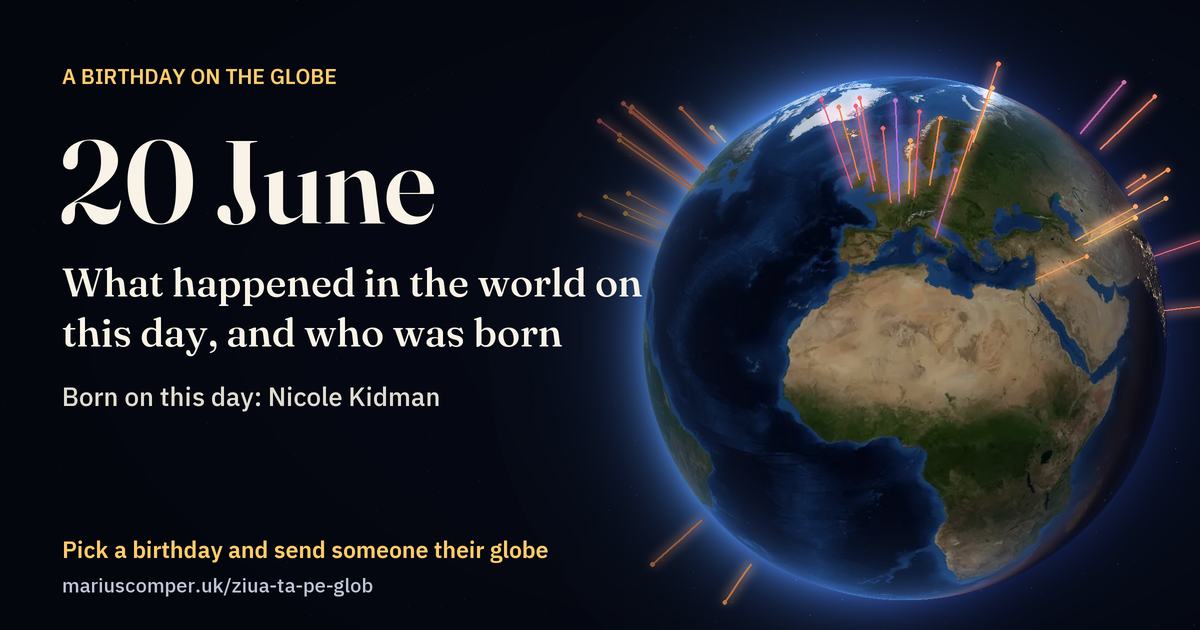
For 20 June, the English Wikipedia lists 59 events and 219 births. 37 of the events stand at their places as rays of light; five more are dashed circles, where the sentence links only to a country or a sea. The taller the ray, the longer ago it happened. The people born that day come further down, as blue points.
A birthday, yours or someone else’s:
Turn it into a greetingScroll: the globe turns to each place
The day you were born, on the globe.
Three things from your day
Scroll: your day first, then 20 June through the years
The Earth on 20 June
The picture on the globe was assembled by NASA from satellite photographs taken in June 2004: the snow, the ice and the green are those of the month.
On 20 June the Sun passes straight overhead at noon along the parallel of 23.5° north. In London, the day lasts about 16 hours 40 minutes.
Beyond 67° north the Sun no longer sets; beyond 67° south it no longer rises.
The line between day and night is tilted on the globe exactly as on this day of the year. On the dark side you can see the lights of towns.
Britain & Ireland · Liverpool
1819
The U.S. vessel SS Savannah arrives at Liverpool, United Kingdom. It is the first steam-propelled vessel to cross the Atlantic, although most of the journey is made under sail.
On the map: Liverpool.
Europe · Versailles
1789
Deputies of the French Third Estate take the Tennis Court Oath.
On the map: Versailles.
Also on the day’s list of Wikipedia in Spanish and Chinese.
Europe · Bonn
1991
The German Bundestag votes to move seat of government from the former West German capital of Bonn to the present capital of Berlin.
On the map: Bonn.
Also on the day’s list of Wikipedia in Chinese.
North America · Constitutional Convention
1787
Oliver Ellsworth moves at the Federal Convention to call the government the 'United States'.
On the map: the coordinates Wikidata gives for the article “Constitutional Convention”.
North America · Hamilton, Ontario
1877
Alexander Graham Bell installs the world's first commercial telephone service in Hamilton, Ontario, Canada.
On the map: Hamilton, Ontario.
Also on the day’s list of Wikipedia in Chinese.
North America · Chicago
1926
The 28th International Eucharistic Congress begins in Chicago, with over 250,000 spectators attending the opening procession.
On the map: Chicago.
20 June
Born on 20 June#
The English Wikipedia lists 219 births for this day. The blue points are the birthplaces of 60 of these people: those written about in the most Wikipedia editions, where Wikidata gives a place of birth.
Born on 20 June
1967
Nicole Kidman, American-Australian actress
Place of birth: Honolulu.
Born on 20 June
1819
Jacques Offenbach, German-French cellist and composer (died 1880)
Place of birth: Cologne.
Born on 20 June
1978
Frank Lampard, English footballer
Place of birth: Romford.
Born on 20 June
1928
Martin Landau, American actor and producer (died 2017)
Place of birth: Brooklyn.
Born in Britain and Ireland
1861
Frederick Gowland Hopkins, English biochemist and academic, Nobel Prize laureate (died 1947)
Place of birth: Eastbourne.
Born in Britain and Ireland
1723
(O.S.) Adam Ferguson, Scottish philosopher and historian (died 1816)
Place of birth: Logierait.
Born in Britain and Ireland
1941
Stephen Frears, English actor, director, and producer
Place of birth: Leicester.
20 June
Number one in the charts that week
At the cinema
An animal recorded that day
The record can be seen in GBIF, which brings together wildlife records from around the world.
All your birthdays
The weather that day
Data: Met Office Hadley Centre (HadCET); NOAA (GHCN-Daily, Mauna Loa).
Above the Earth
Sources: Jonathan McDowell, GCAT (launches); GFZ Potsdam (Kp index). Days are counted in Universal Time.
Football that day
International matches played that day:
Source: the “International football results” dataset kept by Mart Jürisoo (CC0).
Also that day
The earthquake’s page at the USGS
Source: the USGS catalogue. The day is counted in Universal Time (UTC).
In those days
Make a link for someone
Type the name, pick the day and the year of birth. The link opens straight on their day, with their name in the greeting.
The link carries the name, date and place typed here; anyone who gets it can see them.
Put another birthday beside it
Your mother’s, your child’s, a friend’s: the two days appear side by side.
Below: 20 June through the years.
The whole globe of the day
Drag the globe to turn it. Touch a ray or a point to read what happened there.
Everything Wikipedia lists for 20 June
The list is the English Wikipedia’s, in its own wording, as it stood in October 2026. 17 events have no place on the map: the sentence links to no place with coordinates, only to places too wide to mark, or to several countries.
- 451
Battle of Chalons: Flavius Aetius battles Attila the Hun. After the battle, which was inconclusive, Attila retreats. Despite suffering catastrophic losses that led to the collapse of their alliance with the Goths and the destruction of much of the Roman army, the Romans nevertheless proclaimed victory despite the lack of any clear military success.
Europe · Battle of the Catalaunian PlainsWikipedia: Battle of the Catalaunian Plains - 1180
First Battle of Uji, starting the Genpei War in Japan.
Asia · Battle of UjiWikipedia: Battle of Uji - 1210
Michael I Komnenos Doukas, the first ruler of the despotate of Epirus, signs a treaty with the Republic of Venice and becomes their vassal.
Europe · Republic of VeniceWikipedia: Michael I Komnenos Doukas - 1295
The Treaty of Anagni, an attempt mediated by the papacy to end the War of the Sicilian Vespers, is signed by the crown of Aragon, the kingdom of France and kingdom of Naples.
Europe · AnagniWikipedia: Treaty of Anagni - 1622
The Battle of Höchst takes place during the Thirty Years' War.
Europe · Battle of HöchstWikipedia: Battle of Höchst - 1631
The Sack of Baltimore: The Irish village of Baltimore is attacked by Barbary slave traders.
Britain & Ireland · Sack of BaltimoreWikipedia: Sack of Baltimore - 1652
Tarhoncu Ahmed Pasha is appointed Grand Vizier of the Ottoman Empire.
Asia · Ottoman EmpireWikipedia: Tarhoncu Ahmed Pasha - 1685
Monmouth Rebellion: James Scott, 1st Duke of Monmouth declares himself King of England at Bridgwater.
Britain & Ireland · Monmouth RebellionWikipedia: Monmouth Rebellion - 1756
A British garrison is imprisoned in the Black Hole of Calcutta.
Asia · Black Hole of CalcuttaWikipedia: Black Hole of Calcutta - 1782
The U.S. Congress adopts the Great Seal of the United States.
no place on the mapWikipedia: Congress of the Confederation - 1787
Oliver Ellsworth moves at the Federal Convention to call the government the 'United States'.
North America · Constitutional ConventionWikipedia: Constitutional Convention - 1789
Deputies of the French Third Estate take the Tennis Court Oath.
Europe · VersaillesWikipedia: Estates General of 1789 - 1791
King Louis XVI, disguised as a valet, and the French royal family attempt to flee Paris during the French Revolution.
no place on the mapWikipedia: Flight to Varennes - 1819
The U.S. vessel SS Savannah arrives at Liverpool, United Kingdom. It is the first steam-propelled vessel to cross the Atlantic, although most of the journey is made under sail.
Britain & Ireland · LiverpoolWikipedia: SS Savannah - 1837
King William IV dies, and is succeeded by his niece, Victoria.
no place on the mapWikipedia: William IV - 1840
Samuel Morse receives the patent for the telegraph.
no place on the mapWikipedia: Samuel Morse - 1862
Barbu Catargiu, the Prime Minister of Romania, is assassinated.
no place on the mapWikipedia: Barbu Catargiu - 1863
American Civil War: West Virginia is admitted as the 35th U.S. state.
North America · West VirginiaWikipedia: American Civil War - 1877
Alexander Graham Bell installs the world's first commercial telephone service in Hamilton, Ontario, Canada.
North America · Hamilton, OntarioWikipedia: Alexander Graham Bell - 1893
Lizzie Borden is acquitted of the murders of her father and stepmother.
no place on the mapWikipedia: Lizzie Borden - 1895
The Kiel Canal, crossing the base of the Jutland peninsula and the busiest artificial waterway in the world, is officially opened.
no place on the mapWikipedia: Kiel Canal - 1900
Baron Eduard Toll, leader of the Russian Polar Expedition of 1900, departs Saint Petersburg in Russia on the explorer ship Zarya, never to return.
Europe · Saint PetersburgWikipedia: Russian polar expedition of 1900–1902 - 1900
Boxer Rebellion: The Imperial Chinese Army begins a 55-day siege of the Legation Quarter in Beijing, China.
Asia · Siege of the International LegationsWikipedia: Boxer Rebellion - 1921
British Army officer Thomas Stanton Lambert was assassinated by the Irish Republican Army near Moydrum, Ireland.
Britain & Ireland · MoydrumWikipedia: Thomas Stanton Lambert - 1921
Workers of Buckingham and Carnatic Mills in the city of Chennai, India, begin a four-month strike.
Asia · ChennaiWikipedia: 1921 Buckingham and Carnatic Mills strike - 1926
The 28th International Eucharistic Congress begins in Chicago, with over 250,000 spectators attending the opening procession.
North America · ChicagoWikipedia: 28th International Eucharistic Congress - 1942
The Holocaust: Kazimierz Piechowski and three others, dressed as members of the SS-Totenkopfverbände, steal an SS staff car and escape from the Auschwitz concentration camp.
Europe · Auschwitz concentration campWikipedia: The Holocaust - 1943
The Detroit race riot breaks out and continues for three more days.
North America · 1943 Detroit race riotWikipedia: 1943 Detroit race riot - 1943
World War II: The Royal Air Force launches Operation Bellicose, the first shuttle bombing raid of the war. Avro Lancaster bombers damage the V-2 rocket production facilities at the Zeppelin Works while en route to an air base in Algeria.
no place on the mapWikipedia: World War II - 1944
The experimental MW 18014 V-2 rocket reaches an altitude of 176 km, becoming the first man-made object to reach outer space.
no place on the mapWikipedia: MW 18014 - 1944
World War II: During the Continuation War, the Soviet Union demands unconditional surrender from Finland during the beginning of partially successful Vyborg–Petrozavodsk Offensive. The Finnish government refuses.
Asia · Soviet UnionWikipedia: Continuation War - 1944
World War II: The Battle of the Philippine Sea concludes with a decisive U.S. naval victory. The lopsided naval air battle is also known as the "Great Marianas Turkey Shoot".
Oceans · Battle of the Philippine SeaWikipedia: Battle of the Philippine Sea - 1945
The United States Secretary of State approves the transfer of Wernher von Braun and his team of Nazi rocket scientists to the U.S. under Operation Paperclip.
no place on the mapWikipedia: United States Secretary of State - 1947
A Mafia hitman murdered gangster Bugsy Siegel, one of the driving forces in the development of the Las Vegas Strip, in Beverly Hills, California.
North America · Las Vegas StripWikipedia: Las Vegas Strip - 1948
In Western Allied-occupied Germany, the Currency Reform of 1948 goes into effect, introducing the Deutsche Mark. The Soviet Military Administration in Germany responded by imposing the Berlin Blockade four days later.
Europe · Berlin BlockadeWikipedia: Currency Reform of 1948 - 1956
A Venezuelan Super-Constellation crashes in the Atlantic Ocean off Asbury Park, New Jersey, killing 74 people.
North America · Linea Aeropostal Venezolana Flight 253Wikipedia: Linea Aeropostal Venezolana Flight 253 - 1959
A rare June hurricane strikes Canada's Gulf of St. Lawrence killing 35.
North America · Gulf of St. LawrenceWikipedia: 1959 Escuminac disaster - 1960
The Mali Federation gains independence from France (it later splits into Mali and Senegal).
no place on the mapWikipedia: Mali Federation - 1963
Following the Cuban Missile Crisis, the Soviet Union and the United States sign an agreement to establish the so-called "red telephone" link between Washington, D.C., and Moscow.
Latin America · Cuban Missile CrisisWikipedia: Cuban Missile Crisis - 1964
A Curtiss C-46 Commando crashes in the Shengang District of Taiwan, killing 57 people.
Asia · Shengang DistrictWikipedia: Civil Air Transport Flight 106 - 1972
Watergate scandal: An 18+1⁄2-minute gap appears in the tape recording of the conversations between U.S. President Richard Nixon and his advisers regarding the recent arrests of his operatives while breaking into the Watergate complex.
North America · Watergate complexWikipedia: Watergate scandal - 1973
Aeroméxico Flight 229 crashes on approach to Licenciado Gustavo Díaz Ordaz International Airport, killing all 27 people on board.
Latin America · Aeroméxico Flight 229Wikipedia: Aeroméxico Flight 229 - 1973
Snipers fire upon left-wing Peronists in Buenos Aires, Argentina, in what is known as the Ezeiza massacre. At least 13 are killed and more than 300 are injured.
Latin America · Ezeiza massacreWikipedia: Ezeiza massacre - 1975
The film Jaws is released in the United States, becoming the highest-grossing film of that time and starting the trend of films known as "summer blockbusters".
no place on the mapWikipedia: Jaws - 1979
ABC News correspondent Bill Stewart is shot dead by a Nicaraguan National Guard soldier under the regime of Anastasio Somoza Debayle during the Nicaraguan Revolution. The murder is caught on tape and sparks an international outcry against the regime.
no place on the mapWikipedia: Nicaraguan Revolution - 1982
The Argentine Corbeta Uruguay base on Southern Thule surrenders to Royal Marine commandos in the final action of the Falklands War.
Latin America · Falklands WarWikipedia: Falklands War - 1982
The International Conference on the Holocaust and Genocide opens in Tel Aviv, despite attempts by the Turkish government to cancel it, as it included presentations on the Armenian genocide.
Asia · Tel AvivWikipedia: Armenian genocide - 1988
Haitian president Leslie Manigat is ousted from power in a coup d'état led by Lieutenant General Henri Namphy.
no place on the mapWikipedia: June 1988 Haitian coup d'état - 1990
Asteroid Eureka is discovered.
no place on the mapWikipedia: Asteroid - 1990
The 7.4 Mw Manjil–Rudbar earthquake affects northern Iran with a maximum Mercalli intensity of X (Extreme), killing 35,000–50,000, and injuring 60,000–105,000.
Asia · 1990 Manjil–Rudbar earthquakeWikipedia: 1990 Manjil–Rudbar earthquake - 1991
The German Bundestag votes to move seat of government from the former West German capital of Bonn to the present capital of Berlin.
Europe · BonnWikipedia: Decision on the Capital of Germany - 1994
The 1994 Imam Reza shrine bomb explosion in Iran leaves at least 25 dead and 70 to 300 injured.
Asia · Imam Reza ShrineWikipedia: Imam Reza Shrine bombing - 1996
Space Shuttle Columbia launches on STS-78 to conduct life science and microgravity research aboard the Spacelab module.
no place on the mapWikipedia: Space Shuttle Columbia - 2003
The Wikimedia Foundation is founded in St. Petersburg, Florida.
North America · St. Petersburg, FloridaWikipedia: Wikimedia Foundation - 2008
Twelve people are killed, including nine clubgoers and three police officers, during a crowd crush in Mexico City.
Latin America · New's Divine nightclub tragedyWikipedia: New's Divine nightclub tragedy - 2009
Iranian student Neda Agha-Soltan was shot dead in Tehran during the presidential election protests; footage of her death was widely distributed over the Internet, making it "probably the most widely witnessed death in human history".
Asia · Killing of Neda Agha-SoltanWikipedia: Killing of Neda Agha-Soltan - 2011
RusAir Flight 9605 crashes in Besovets during approach to Petrozavodsk Airport, killing 47.
Europe · RusAir Flight 9605Wikipedia: RusAir Flight 9605 - 2019
Iran's Air Defense Forces shoot down an American surveillance drone over the Strait of Hormuz amid rising tensions between the two countries.
no place on the mapWikipedia: 2019 Iranian shoot-down of American drone - 2025
The first EF5 tornado in 12 years occurs in Enderlin, North Dakota.
North America · 2025 Enderlin tornadoWikipedia: 2025 Enderlin tornado
Who was born on 20 June
In order of how many Wikipedia editions have an article about each. The first 60 of 219 are shown.
- 1967
Nicole Kidman, American-Australian actress
HonoluluWikipedia: Nicole Kidman - 1819
Jacques Offenbach, German-French cellist and composer (died 1880)
CologneWikipedia: Jacques Offenbach - 1978
Frank Lampard, English footballer
RomfordWikipedia: Frank Lampard - 1952
John Goodman, American actor
AfftonWikipedia: John Goodman - 1928
Martin Landau, American actor and producer (died 2017)
BrooklynWikipedia: Martin Landau - 1928
Jean-Marie Le Pen, French intelligence officer and politician (died 2025)
La Trinité-sur-MerWikipedia: Jean-Marie Le Pen - 1909
Errol Flynn, Australian-American actor (died 1959)
Battery PointWikipedia: Errol Flynn - 1949
Lionel Richie, American singer, songwriter, pianist, producer, and actor
TuskegeeWikipedia: Lionel Richie - 1566
Sigismund III Vasa, Polish and Swedish king (died 1632)
Gripsholm CastleWikipedia: Sigismund III Vasa - 1968
Mateusz Morawiecki, Polish banker, economist, and politician
- 1861
Frederick Gowland Hopkins, English biochemist and academic, Nobel Prize laureate (died 1947)
EastbourneWikipedia: Frederick Gowland Hopkins - 1942
Brian Wilson, American singer, songwriter and producer (died 2025)
Centinela Hospital Medical CenterWikipedia: Brian Wilson - 1946
Xanana Gusmão, Timorese soldier and politician, 1st President of East Timor
LaleiaWikipedia: Xanana Gusmão - 1950
Nouri al-Maliki, Iraqi politician, 76th Prime Minister of Iraq
Al-HindiyaWikipedia: Nouri al-Maliki - 1968
Robert Rodriguez, American director, producer, and screenwriter
San AntonioWikipedia: Robert Rodriguez - 1931
Olympia Dukakis, American actress (died 2021)
- 1989
Javier Pastore, Argentinian footballer
CórdobaWikipedia: Javier Pastore - 1991
Kalidou Koulibaly, Senegalese footballer
Saint-Dié-des-VosgesWikipedia: Kalidou Koulibaly - 1993
Sead Kolašinac, Bosnian footballer
KarlsruheWikipedia: Sead Kolašinac - 1954
Ilan Ramon, Israeli colonel, pilot, and astronaut (died 2003)
Ramat GanWikipedia: Ilan Ramon - 1949
Gotabaya Rajapaksa, 8th president of Sri Lanka
Matara DistrictWikipedia: Gotabaya Rajapaksa - 1982
Vasili Berezutski, Russian footballer
- 1987
Asmir Begović, Bosnian footballer
TrebinjeWikipedia: Asmir Begović - 1925
Audie Murphy, American lieutenant and actor, Medal of Honor recipient (died 1971)
KingstonWikipedia: Audie Murphy - 1952
Vikram Seth, Indian author and poet
KolkataWikipedia: Vikram Seth - 1982
Aleksei Berezutski, Russian footballer
- 2001
Gonçalo Ramos, Portuguese footballer
- 1723
(O.S.) Adam Ferguson, Scottish philosopher and historian (died 1816)
LogieraitWikipedia: Adam Ferguson - 1887
Kurt Schwitters, German painter and illustrator (died 1948)
HanoverWikipedia: Kurt Schwitters - 1933
Danny Aiello, American actor (died 2019)
ManhattanWikipedia: Danny Aiello - 1941
Stephen Frears, English actor, director, and producer
LeicesterWikipedia: Stephen Frears - 1976
Juliano Belletti, Brazilian footballer
CascavelWikipedia: Juliano Belletti - 1930
Magdalena Abakanowicz, Polish sculptor and academic (died 2017)
- 1940
John Mahoney, English-born American actor (died 2018)
BlackpoolWikipedia: John Mahoney - 1905
Lillian Hellman, American playwright and screenwriter (died 1984)
New OrleansWikipedia: Lillian Hellman - 2001
Nicolas Jackson, Senegalese footballer
SenegalWikipedia: Nicolas Jackson - 1786
Marceline Desbordes-Valmore, French poet and author (died 1859)
- 1899
Jean Moulin, French soldier and engineer (died 1943)
BéziersWikipedia: Jean Moulin - 2002
Hugo Ekitike, French footballer
- 1924
Chet Atkins, American guitarist and record producer (died 2001)
LuttrellWikipedia: Chet Atkins - 1970
Andrea Nahles, German politician, German Minister of Labour and Social Affairs
MendigWikipedia: Andrea Nahles - 1469
Gian Galeazzo Sforza, duke of Milan (died 1494)
AbbiategrassoWikipedia: Gian Galeazzo Sforza - 1969
Paulo Bento, Portuguese footballer and manager
LisbonWikipedia: Paulo Bento - 1634
Charles Emmanuel II, duke of Savoy (died 1675)
- 1915
Terence Young, Chinese-English director and screenwriter (died 1994)
ShanghaiWikipedia: Terence Young - 2003
Marc Pubill, Spanish footballer
TerrassaWikipedia: Marc Pubill - 1948
Ludwig Scotty, Nauruan politician, 10th President of Nauru (died 2026)
Anabar DistrictWikipedia: Ludwig Scotty - 1951
Tress MacNeille, American voice actress
ChicagoWikipedia: Tress MacNeille - 1647
(O.S.) John George III, Elector of Saxony (died 1691)
- 1925
Doris Hart, American tennis player and educator (died 2015)
St. LouisWikipedia: Doris Hart - 1389
John of Lancaster, 1st Duke of Bedford, English statesman (died 1435)
- 1763
Wolfe Tone, Irish rebel leader (died 1798)
DublinWikipedia: Wolfe Tone - 1931
James Tolkan, American actor and director (died 2026)
CalumetWikipedia: James Tolkan - 1985
Aurélien Chedjou, Cameroonian footballer
- 1989
Christopher Mintz-Plasse, American actor
Woodland HillsWikipedia: Christopher Mintz-Plasse - 1941
Ulf Merbold, German physicist and astronaut
- 1981
Brede Hangeland, Norwegian footballer
HoustonWikipedia: Brede Hangeland - 1945
Anne Murray, Canadian singer and guitarist
SpringhillWikipedia: Anne Murray - 1982
Example, English singer/rapper
FulhamWikipedia: Example - 1990
Ding Ning, Chinese table tennis player
DaqingWikipedia: Ding Ning
What is celebrated on 20 June
- Christian feast day: Adalbert of Magdeburg
- Christian feast day: Blessed Dermot O'Hurley
- Christian feast day: Florentina
- Christian feast day: John of Matera
- Christian feast day: Blessed Margareta Ebner
- Christian feast day: Methodius of Olympus
- Christian feast day: Pope Silverius
- Christian feast day: June 20 (Eastern Orthodox liturgics)
- Day of the National Flag (Argentina)
- Gas Sector Day (Azerbaijan)
- Martyrs' Day (Eritrea)
- West Virginia Day (West Virginia)
- World Refugee Day (International)
A greeting link for someone
Type a name and, if you like, the year of birth. The link opens with a greeting, and beside each event it says how old the person turned that day, or how many years before their birth it happened.
The name and the year go only into the link you send.
All 366 days
How the globe is made
Where the events come from
Each edition of this page uses the day’s list from Wikipedia in its own language: Romanian, English, Spanish, Chinese. The lists are written by volunteers and differ from one edition to the next; the text of each event is Wikipedia’s, with a link to the article. A row that appears twice in a list is shown once. The lists have not been checked event by event: they are Wikipedia’s, mistakes included.
For events before 1582, and for countries that moved to the Gregorian calendar later (Britain in 1752, Russia in 1918), the same day may be counted Old Style in one list and New Style in another.
The chapter “What the other Wikipedias remember” adds up to five events a day from the lists of the other three editions, only for years in which the English list has nothing on that day. They were translated for this page, passed the same filters as the tour, and are not counted among the events of the English list.
How an event gets onto the map
The place comes from Wikidata. If the sentence links to the article about the event itself (a battle, an opening, an earthquake), dated to the same year, the ray stands on its coordinates or on those of its location. Otherwise it stands on the first place the sentence links to: a town, a building, a mountain, an island. This second step can be wrong: sometimes the sentence only mentions the place. That is why the page says, under each event, which place the ray stands on.
When the sentence links to a single state or province, or to a single sea, lake or desert larger than 5,000 km², the globe shows a dashed circle, not a ray. The circle has the area Wikidata gives, with its radius kept between 1.2° and 16°, or a radius of 4.5° when Wikidata gives no area; it says only that the sentence links to that place. Organisations, ships, spacecraft, museum objects, rivers, mountain ranges, languages and continents are never used as places. When a sentence names several states and no exact place, the event stays in the list only.
What the height means
The height of a ray shows how many years have passed, on a logarithmic scale: 10 years, 100 years and 1,000 years are equal steps apart; anything older than about 2,600 years has the tallest ray. The colour runs from pale yellow for recent years to violet for antiquity.
Where the tour stops
In each region the tour stops at up to three events (five in Britain and Ireland), chosen mainly by three things: whether Wikipedia’s editors put the event in the “On this day” box of their main page (the English, Spanish and Chinese editions), how many Wikipedia editions have an article about it, and how many of the four lists include it. Events whose sentence or article is about a war, an attack, a crime or a disaster are left out of the tour; they stay in the whole list, in Wikipedia’s wording. The filter is a list of words and a list of Wikidata types, so it can miss some.
The tour of births names the people with articles in the most editions and leaves aside those whom the list or Wikidata describes as rulers, politicians, commanders, leaders of movements or criminals; they stay in the list.
The Earth and the Sun
The daytime images are NASA’s Blue Marble Next Generation mosaics, one for each month of 2004; the night side is Black Marble 2016. The tilt of the line between day and night is computed for the day; the hour is chosen so that the place being read is in daylight. The latitude where the Sun stands overhead is the average of the four years of the leap cycle; in a given year it can differ by up to 0.4°.
The day you were born
The number ones come from the weekly lists on Wikipedia: Billboard for the United States (from 1940; the Hot 100 from August 1958), the UK Singles Chart (from November 1952), Los 40 Principales for Spain (from July 1966) and, for Romania, the Romanian Top 100 and Airplay 100 (2001–2021, with missing weeks). The page shows the chart of the week in which the day of birth falls, with its date; Billboard and the UK chart are dated at the end of their week. For Romania before 2001 and for China these sources have no weekly chart.
The films are those that reached cinemas in the United States up to ten days before or three days after that day (some of them in a few cinemas at first), from the English Wikipedia’s yearly lists (from 1968), in order of how many editions have an article about them. The events “in those days” are the ones on the neighbouring days’ lists that carry the year of birth, passed through the same filter as the tour.
The day of birth, year included
The Moon, the star sign and the constellation are worked out by the page itself, for noon Universal Time on the day. The lit part of the Moon is rounded and can differ by a few per cent from that at the hour of birth. The sign follows the usual zodiac of twelve equal parts starting at the March equinox; the constellation is the one the Sun actually stood in front of, by the borders set by the International Astronomical Union, and within a day of a border the page does not name it. When the Sun changes sign while it is that day anywhere on Earth, the page gives the moment of crossing, rounded to ten minutes and accurate to within about a quarter of an hour, and the clock time in a few cities, with the time zone and summer time of that year.
The year in the Chinese calendar is the one your device’s own calendar gives for the date, checked against the Hong Kong Observatory’s tables. “All your birthdays” uses the same sources as the rest of the chapter for the same day in every year since the birth: the temperature, well-known launches that took place on that very day, matches of the teams the edition follows, snow deeper than 10 cm and strong geomagnetic storms. The three things at the top and the four on the picture are chosen in a fixed order (the song, the animal, a full Moon, a well-known launch before an ordinary earthquake); on the picture you can change them.
When the link carries a year of birth, the page adds a few things about that exact day. The weather is the Met Office’s Central England temperature record and the readings from New York’s Central Park; the “usual high” is the average of the daily highs of 1961–1990 for that date, with two days either side. The carbon dioxide figure is the monthly mean at the Mauna Loa observatory, where measurements begin in March 1958.
The earthquake is the one with the largest magnitude in the USGS catalogue for that day, counted in Universal Time. Before the 1960s the catalogue has gaps even above magnitude 5.5, so in the older years many days have no earthquake. The page gives only the magnitude and the place: the country the epicentre falls in or, when the epicentre is at sea within 300 km of a coast, the nearest country; farther out, only the ocean.
The launches are those that reached orbit or left for the Moon and the planets, from Jonathan McDowell’s GCAT catalogue. If nothing left that day, the page shows the nearest launch within three days before or after, and says how many days away it was. The geomagnetic storm appears only when the Kp index reached at least 5 in one of the day’s eight three-hour intervals.
The animal comes from GBIF: an observation made by a person (the animal seen or heard, or its tracks), dated to that exact day, with coordinates and a CC0 or CC BY licence. Only a few hundred well-known species are searched (mammals, birds, turtles, butterflies); of those noted that day, mammals and species with articles in many Wikipedia editions come first; birds noted almost every day, and species used recently, wait their turn. Observations dated 1 January are left out, because records without a day are often filed there. An observation shows that the animal was recorded there, not how many animals there were.
The matches are those between national teams. Only matches of England, Scotland, Wales, Northern Ireland, the Republic of Ireland, the United States, Canada and Australia are shown, along with those at the big final tournaments. The picture to send is drawn in the page from the day’s globe and the facts above, and stays on your device until you send it.
Sources
- Events, births and holidays: the day’s page on Wikipedia, text under CC BY-SA 4.0.
- Coordinates, places of birth and the number of editions: Wikidata (CC0).
- The Earth by day: NASA Blue Marble Next Generation. The Earth by night: NASA Black Marble 2016.
- Borders and regions: Natural Earth.
- World population and births per year: UN World Population Prospects 2024.
- Charts and films: Wikipedia’s lists for Billboard, the UK Singles Chart, Los 40 Principales, Romanian Top 100, Airplay 100 and American films by year (CC BY-SA 4.0).
- Weather: Met Office Hadley Centre, HadCET (Open Government Licence) and NOAA GHCN-Daily, New York Central Park. Carbon dioxide: NOAA Global Monitoring Laboratory, Mauna Loa.
- Earthquakes: the USGS catalogue. Launches: Jonathan McDowell, GCAT (CC BY). Kp index: GFZ Potsdam (CC BY 4.0). Matches: International football results, Mart Jürisoo (CC0).
- Animal observations: GBIF, with a link to each record; species names come from Wikidata.