A birthday on the globe
2 December on the globe: what happened in the world on this day, and who was born
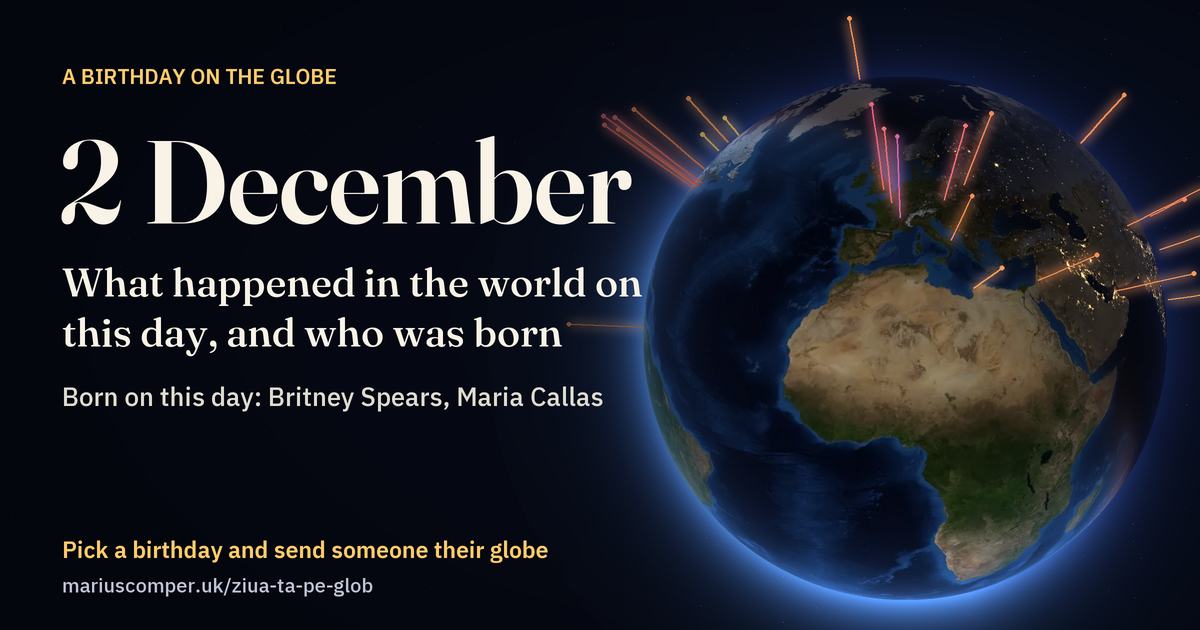
For 2 December, the English Wikipedia lists 55 events and 230 births. 24 of the events stand at their places as rays of light; seven more are dashed circles, where the sentence links only to a country or a sea. The taller the ray, the longer ago it happened. The people born that day come further down, as blue points.
A birthday, yours or someone else’s:
Turn it into a greetingScroll: the globe turns to each place
The day you were born, on the globe.
Three things from your day
Scroll: your day first, then 2 December through the years
The Earth on 2 December
The picture on the globe was assembled by NASA from satellite photographs taken in December 2004: the snow, the ice and the green are those of the month.
On 2 December the Sun passes straight overhead at noon along the parallel of 21.9° south. In London, the day lasts about 8 hours 10 minutes.
Beyond 68° south the Sun no longer sets; beyond 68° north it no longer rises.
The line between day and night is tilted on the globe exactly as on this day of the year. On the dark side you can see the lights of towns.
Europe · Lyon
1244
Pope Innocent IV arrives at Lyon for the First Council of Lyon.
On the map: Lyon.
Also on the day’s list of Wikipedia in Spanish and Chinese.
Europe · Coronation of Napoleon
1804
At Notre Dame Cathedral in Paris, Napoleon Bonaparte crowns himself Emperor of the French.
On the map: the coordinates Wikidata gives for the article “Coronation of Napoleon”.
Also on the day’s list of Wikipedia in Romanian and Chinese.
Asia · Ajman
1971
Abu Dhabi, Ajman, Fujairah, Sharjah, Dubai, and Umm al-Quwain form the United Arab Emirates.
On the map: Ajman.
Also on the day’s list of Wikipedia in Romanian.
Asia · Hat Yai
1989
The Peace Agreement of Hat Yai is signed and ratified by the Malayan Communist Party (MCP) and the governments of Malaysia and Thailand, ending the over two-decade-long communist insurgency in Malaysia.
On the map: Hat Yai.
Also on the day’s list of Wikipedia in Chinese.
North America · Touro Synagogue
1763
Dedication of the Touro Synagogue, in Newport, Rhode Island, the first synagogue in what will become the United States.
On the map: Touro Synagogue.
Also on the day’s list of Wikipedia in Spanish and Chinese.
North America · Tremont Temple
1867
At Tremont Temple in Boston, British author Charles Dickens gives his first public reading in the United States.
On the map: Tremont Temple.
Also on the day’s list of Wikipedia in Spanish.
North America · LaGuardia Airport
1939
New York City's LaGuardia Airport opens.
On the map: LaGuardia Airport.
Also on the day’s list of Wikipedia in Spanish and Chinese.
2 December
Born on 2 December#
The English Wikipedia lists 230 births for this day. The blue points are the birthplaces of 60 of these people: those written about in the most Wikipedia editions, where Wikidata gives a place of birth.
Born on 2 December
1981
Britney Spears, American singer-songwriter, dancer, and actress
Place of birth: McComb.
Born on 2 December
1923
Maria Callas, American-Greek soprano and actress (died 1977)
Place of birth: New York City.
Born on 2 December
1978
Nelly Furtado, Canadian singer-songwriter, producer, and actress
Place of birth: Victoria.
Born on 2 December
1968
Lucy Liu, American actress and producer
Place of birth: Jackson Heights.
Born on 2 December
1859
Georges Seurat, French painter (died 1891)
Place of birth: former 5th arrondissement of Paris.
Born in Britain and Ireland
1978
Christopher Wolstenholme, English singer-songwriter and bass player
Place of birth: Rotherham.
Born in Britain and Ireland
1988
Alfred Enoch, English actor
Place of birth: London.
Born in Britain and Ireland
1759
James Edward Smith, English botanist and mycologist, founded the Linnean Society (died 1828)
Place of birth: Norwich.
2 December
Number one in the charts that week
At the cinema
An animal recorded that day
The record can be seen in GBIF, which brings together wildlife records from around the world.
All your birthdays
The weather that day
Data: Met Office Hadley Centre (HadCET); NOAA (GHCN-Daily, Mauna Loa).
Above the Earth
Sources: Jonathan McDowell, GCAT (launches); GFZ Potsdam (Kp index). Days are counted in Universal Time.
Football that day
International matches played that day:
Source: the “International football results” dataset kept by Mart Jürisoo (CC0).
Also that day
The earthquake’s page at the USGS
Source: the USGS catalogue. The day is counted in Universal Time (UTC).
In those days
Make a link for someone
Type the name, pick the day and the year of birth. The link opens straight on their day, with their name in the greeting.
The link carries the name, date and place typed here; anyone who gets it can see them.
Put another birthday beside it
Your mother’s, your child’s, a friend’s: the two days appear side by side.
Below: 2 December through the years.
The whole globe of the day
Drag the globe to turn it. Touch a ray or a point to read what happened there.
Everything Wikipedia lists for 2 December
The list is the English Wikipedia’s, in its own wording, as it stood in October 2026. 24 events have no place on the map: the sentence links to no place with coordinates, only to places too wide to mark, or to several countries.
- 1244
Pope Innocent IV arrives at Lyon for the First Council of Lyon.
Europe · LyonWikipedia: Pope Innocent IV - 1409
The University of Leipzig opens.
no place on the mapWikipedia: Leipzig University - 1697
St Paul's Cathedral, rebuilt to the design of Sir Christopher Wren following the Great Fire of London, is consecrated.
Britain & Ireland · St Paul's CathedralWikipedia: Great Fire of London - 1763
Dedication of the Touro Synagogue, in Newport, Rhode Island, the first synagogue in what will become the United States.
North America · Touro SynagogueWikipedia: Touro Synagogue - 1766
Swedish parliament approves the Swedish Freedom of the Press Act and implements it as a ground law, thus being first in the world with freedom of speech.
no place on the mapWikipedia: Swedish Freedom of the Press Act - 1804
At Notre Dame Cathedral in Paris, Napoleon Bonaparte crowns himself Emperor of the French.
Europe · Coronation of NapoleonWikipedia: Coronation of Napoleon - 1805
War of the Third Coalition: Battle of Austerlitz: French troops under Napoleon decisively defeat a joint Russo-Austrian force.
Europe · Battle of AusterlitzWikipedia: Battle of Austerlitz - 1823
Monroe Doctrine: In a State of the Union message, U.S. President James Monroe proclaims American neutrality in future European conflicts, and warns European powers not to interfere in the Americas.
no place on the mapWikipedia: State of the Union - 1845
Manifest Destiny: In a State of the Union message, U.S. President James K. Polk proposes that the United States should aggressively expand into the West.
no place on the mapWikipedia: State of the Union - 1848
Franz Joseph I becomes Emperor of Austria.
no place on the mapWikipedia: Franz Joseph I - 1851
French President Louis-Napoléon Bonaparte overthrows the Second Republic.
Europe · French Second RepublicWikipedia: Napoleon III - 1852
Louis-Napoléon Bonaparte becomes Emperor of the French as Napoleon III.
no place on the mapWikipedia: Napoleon III - 1859
Origins of the American Civil War: Militant abolitionist leader John Brown is hanged for his October raid on Harpers Ferry, Virginia (now West Virginia).
North America · John Brown's raid on Harpers FerryWikipedia: John Brown's raid on Harpers Ferry - 1865
Alabama ratifies the 13th Amendment to the U.S. Constitution, followed by North Carolina, then Georgia; U.S. slaves were legally free within two weeks.
North America · AlabamaWikipedia: Alabama - 1867
At Tremont Temple in Boston, British author Charles Dickens gives his first public reading in the United States.
North America · Tremont TempleWikipedia: Tremont Temple - 1899
Philippine–American War: The Battle of Tirad Pass, known as the "Filipino Thermopylae", is fought.
Asia · Battle of Tirad PassWikipedia: Battle of Tirad Pass - 1908
Puyi becomes Emperor of China at the age of two.
no place on the mapWikipedia: Puyi - 1917
World War I: Russia and the Central Powers sign an armistice at Brest-Litovsk, and peace talks leading to the Treaty of Brest-Litovsk begin.
Europe · Brest, BelarusWikipedia: World War I - 1919
Ukrainian War of Independence: Ukrainian Bolsheviks attempt to assassinate Nestor Makhno as part of the Polonsky conspiracy.
no place on the mapWikipedia: Ukrainian War of Independence - 1927
Following 19 years of Ford Model T production, the Ford Motor Company unveils the Ford Model A as its new automobile.
no place on the mapWikipedia: Ford Model T - 1930
Great Depression: In a State of the Union message, U.S. President Herbert Hoover proposes a $150 million public works program to help generate jobs and stimulate the economy.
no place on the mapWikipedia: State of the Union - 1939
New York City's LaGuardia Airport opens.
North America · LaGuardia AirportWikipedia: LaGuardia Airport - 1942
World War II: During the Manhattan Project, a team led by Enrico Fermi initiates the first artificial self-sustaining nuclear chain reaction.
North America · Chicago Pile-1Wikipedia: World War II - 1943
World War II: A Luftwaffe bombing raid on the harbour of Bari, Italy, sinks numerous cargo and transport ships, including the American SS John Harvey, which is carrying a stockpile of mustard gas.
Europe · Air raid on BariWikipedia: Air raid on Bari - 1947
Jerusalem Riots of 1947: Arabs riot in Jerusalem in response to the United Nations Partition Plan for Palestine.
Asia · 1947 Jerusalem riotsWikipedia: 1947 Jerusalem riots - 1949
Convention for the Suppression of the Traffic in Persons and of the Exploitation of the Prostitution of Others is adopted.
- 1950
Korean War: The Battle of the Ch'ongch'on River ends with a decisive Chinese victory and UN forces are completely expelled from North Korea.
Asia · Battle of the Ch'ongch'on RiverWikipedia: Korean War - 1954
Cold War: The United States Senate votes 65 to 22 to censure Joseph McCarthy for "conduct that tends to bring the Senate into dishonor and disrepute".
no place on the mapWikipedia: McCarthyism - 1954
The Sino-American Mutual Defense Treaty, between the United States and Taiwan, is signed in Washington, D.C.
- 1956
The Granma reaches the shores of Cuba's Oriente Province. Fidel Castro, Che Guevara and 80 other members of the 26th of July Movement disembark to initiate the Cuban Revolution.
Latin America · CubaWikipedia: Cuban Revolution - 1957
United Nations Security Council Resolution 126 relating to the Kashmir conflict is adopted.
Asia · Kashmir conflictWikipedia: Kashmir conflict - 1961
In a nationally broadcast speech, Cuban leader Fidel Castro declares that he is a Marxist–Leninist and that Cuba will adopt Communism.
Latin America · CubaWikipedia: Cuba - 1962
Vietnam War: After a trip to Vietnam at the request of U.S. President John F. Kennedy, U.S. Senate Majority Leader Mike Mansfield becomes the first American official to comment adversely on the war's progress.
Asia · VietnamWikipedia: Vietnam War - 1968
Wien Consolidated Airlines Flight 55 crashes into Pedro Bay, Alaska, killing all 39 people on board.
North America · Wien Consolidated Airlines Flight 55Wikipedia: Wien Consolidated Airlines Flight 55 - 1970
The United States Environmental Protection Agency begins operations.
no place on the mapWikipedia: United States Environmental Protection Agency - 1971
Abu Dhabi, Ajman, Fujairah, Sharjah, Dubai, and Umm al-Quwain form the United Arab Emirates.
Asia · AjmanWikipedia: Emirate of Abu Dhabi - 1972
Gough Whitlam is elected the 21st Prime Minister of Australia in the 1972 Australian federal election, defeating William McMahon and leading the Australian Labor Party back into office after 23 years in Opposition.
no place on the mapWikipedia: 1972 Australian federal election - 1975
Laotian Civil War: The Pathet Lao seizes the Laotian capital of Vientiane, forces the abdication of King Sisavang Vatthana, and proclaims the Lao People's Democratic Republic.
Asia · VientianeWikipedia: Laotian Civil War - 1976
Fidel Castro becomes President of Cuba, replacing Osvaldo Dorticós Torrado.
no place on the mapWikipedia: Fidel Castro - 1977
A Tupolev Tu-154 crashes near Benghazi, Libya, killing 59.
Africa · 1977 Libyan Arab Airlines Tu-154 crashWikipedia: 1977 Libyan Arab Airlines Tu-154 crash - 1980
Salvadoran Civil War: Four American missionaries are raped and murdered by a death squad.
no place on the mapWikipedia: Salvadoran Civil War - 1982
At the University of Utah, Barney Clark becomes the first person to receive a permanent artificial heart.
North America · University of UtahWikipedia: University of Utah - 1988
Benazir Bhutto is sworn in as Prime Minister of Pakistan, becoming the first woman to head the government of a Muslim-majority state.
no place on the mapWikipedia: Benazir Bhutto - 1988
Space Shuttle Atlantis is launched on STS-27, a classified mission for the United States Department of Defense.
no place on the mapWikipedia: Space Shuttle Atlantis - 1989
The Peace Agreement of Hat Yai is signed and ratified by the Malayan Communist Party (MCP) and the governments of Malaysia and Thailand, ending the over two-decade-long communist insurgency in Malaysia.
Asia · Hat YaiWikipedia: Hat Yai Peace Agreement - 1990
Space Shuttle Columbia is launched on STS-35, carrying the ASTRO-1 spacelab observatory.
no place on the mapWikipedia: Space Shuttle Columbia - 1991
Canada and Poland become the first nations to recognize the independence of Ukraine from the Soviet Union.
no place on the mapWikipedia: Ukraine - 1992
Space Shuttle Discovery is launched on STS-53 for the United States Department of Defense.
no place on the mapWikipedia: Space Shuttle Discovery - 1993
Colombian drug lord Pablo Escobar is shot and killed by police in Medellín.
Latin America · MedellínWikipedia: Colombia - 1993
Space Shuttle program: STS-61: NASA launches the Space Shuttle Endeavour on a mission to repair the Hubble Space Telescope.
no place on the mapWikipedia: Space Shuttle program - 1999
The United Kingdom devolves political power in Northern Ireland to the Northern Ireland Executive following the Good Friday Agreement.
Britain & Ireland · Northern IrelandWikipedia: Good Friday Agreement - 2001
Enron files for Chapter 11 bankruptcy.
no place on the mapWikipedia: Enron scandal - 2015
San Bernardino attack: Syed Rizwan Farook and Tashfeen Malik kill 14 people and wound 22 at the Inland Regional Center in San Bernardino, California.
North America · 2015 San Bernardino attackWikipedia: 2015 San Bernardino attack - 2016
Thirty-six people die in a fire at a converted Oakland, California, warehouse serving as an artist collective.
North America · Ghost Ship warehouse fireWikipedia: Ghost Ship warehouse fire - 2020
Cannabis is removed from the list of most dangerous drugs of the international drug control treaty by the UN Commission on Narcotic Drugs.
no place on the mapWikipedia: Single Convention on Narcotic Drugs
Who was born on 2 December
In order of how many Wikipedia editions have an article about each. The first 60 of 230 are shown.
- 1981
Britney Spears, American singer-songwriter, dancer, and actress
- 1923
Maria Callas, American-Greek soprano and actress (died 1977)
New York CityWikipedia: Maria Callas - 1978
Nelly Furtado, Canadian singer-songwriter, producer, and actress
VictoriaWikipedia: Nelly Furtado - 1825
Pedro II of Brazil (died 1891)
Rio de JaneiroWikipedia: Pedro II of Brazil - 1968
Lucy Liu, American actress and producer
Jackson HeightsWikipedia: Lucy Liu - 1859
Georges Seurat, French painter (died 1891)
former 5th arrondissement of ParisWikipedia: Georges Seurat - 1891
Otto Dix, German painter and illustrator (died 1969)
UntermhausWikipedia: Otto Dix - 1930
Gary Becker, American economist and academic, Nobel Prize laureate (died 2014)
PottsvilleWikipedia: Gary Becker - 1973
Monica Seles, Serbian-American tennis player
Novi SadWikipedia: Monica Seles - 1944
Ibrahim Rugova, Kosovan journalist and politician, 1st President of Kosovo (died 2006)
- 1946
Gianni Versace, Italian fashion designer, founded Versace (died 1997)
Reggio CalabriaWikipedia: Gianni Versace - 1991
Charlie Puth, American singer-songwriter and pianist
RumsonWikipedia: Charlie Puth - 1885
George Minot, American physician and academic, Nobel Prize laureate (died 1950)
- 1897
Ivan Bagramyan, Russian general (died 1982)
ÇardaqlıWikipedia: Ivan Bagramyan - 1989
Matteo Darmian, Italian footballer
LegnanoWikipedia: Matteo Darmian - 1934
Tarcisio Bertone, Italian cardinal
Romano CanaveseWikipedia: Tarcisio Bertone - 1998
Juice Wrld, American rapper, singer and songwriter (died 2019)
ChicagoWikipedia: Juice Wrld - 1939
Harry Reid, American lawyer and politician, 25th Lieutenant Governor of Nevada (died 2021)
SearchlightWikipedia: Harry Reid - 1971
Francesco Toldo, Italian footballer
- 1948
Antonín Panenka, Czech footballer
- 1973
Jan Ullrich, German cyclist
RostockWikipedia: Jan Ullrich - 1925
Julie Harris, American actress (died 2013)
Grosse PointeWikipedia: Julie Harris - 1924
Alexander Haig, American general and politician, 59th United States Secretary of State (died 2010)
PhiladelphiaWikipedia: Alexander Haig - 1960
Deb Haaland, American politician, 54th United States Secretary of the Interior
WinslowWikipedia: Deb Haaland - 1981
Danijel Pranjić, Croatian footballer
- 1978
Christopher Wolstenholme, English singer-songwriter and bass player
RotherhamWikipedia: Chris Wolstenholme - 1901
Raimundo Orsi, Argentinian-Italian footballer (died 1986)
AvellanedaWikipedia: Raimundo Orsi - 1958
George Saunders, American short story writer and essayist
AmarilloWikipedia: George Saunders - 1990
Gastón Ramírez, Uruguayan footballer
Fray BentosWikipedia: Gastón Ramírez - 1950
Paul Watson, Canadian activist, founded the Sea Shepherd Conservation Society
TorontoWikipedia: Paul Watson - 1983
Aaron Rodgers, American football player
- 1988
Alfred Enoch, English actor
LondonWikipedia: Alfred Enoch - 1983
Daniela Ruah, Portuguese-American actress
- 1846
Pierre Waldeck-Rousseau, French lawyer and politician, 68th Prime Minister of France (died 1904)
- 1956
Steven Bauer, Cuban-American actor and producer
HavanaWikipedia: Steven Bauer - 1977
Siyabonga Nomvethe, South African footballer
KwaMashuWikipedia: Siyabonga Nomvethe - 1990
Emmanuel Agyemang-Badu, Ghanaian footballer
- 1759
James Edward Smith, English botanist and mycologist, founded the Linnean Society (died 1828)
- 1963
Ann Patchett, American author
Los AngelesWikipedia: Ann Patchett - 1970
Joe Lo Truglio, American actor and comedian
Ozone ParkWikipedia: Joe Lo Truglio - 1915
Takahito, Prince Mikasa of Japan (died 2016)
- 1978
Jason Collins, American basketball player (died 2026)
NorthridgeWikipedia: Jason Collins - 1998
Anna Kalinskaya, Russian tennis player
- 1899
John Barbirolli, English cellist and conductor (died 1970)
- 1924
Vilgot Sjöman, Swedish actor, director, producer, and screenwriter (died 2006)
StockholmWikipedia: Vilgot Sjöman - 1954
Dan Butler, American actor, director, and screenwriter
HuntingtonWikipedia: Dan Butler - 1979
Yvonne Catterfeld, German singer-songwriter and actress
- 2004
Ilia Malinin, American competitive figure skater
FairfaxWikipedia: Ilia Malinin - 1876
Yusuf Akçura, Tatar-Turkish activist and ideologue of Turanism (died 1935)
UlyanovskWikipedia: Yusuf Akçura - 1968
David Batty, English footballer
- 1968
Rena Sofer, American actress
ArcadiaWikipedia: Rena Sofer - 1986
Claudiu Keșerü, Romanian footballer
- 1993
Kostas Stafylidis, Greek footballer
ThessalonikiWikipedia: Kostas Stafylidis - 1998
Annalise Basso, American actress
St. LouisWikipedia: Annalise Basso - 1944
Botho Strauß, German author and playwright
NaumburgWikipedia: Botho Strauss - 1884
Yahya Kemal Beyatlı, Turkish poet and author (died 1958)
- 1931
Wynton Kelly, American pianist and composer (died 1971)
BrooklynWikipedia: Wynton Kelly - 1933
Mike Larrabee, American sprinter and educator (died 2003)
Los AngelesWikipedia: Mike Larrabee - 1960
Silk Smitha, Indian film actress
- 1738
Richard Montgomery, Irish-American general (died 1775)
What is celebrated on 2 December
- Armed Forces Day (Cuba)
- Christian feast day: Avitus of Rouen
- Christian feast day: Bibiana
- Christian feast day: Channing Moore Williams (Anglicanism)
- Christian feast day: Chromatius
- Christian feast day: Habakkuk
- Christian feast day: Blessed Ivan Slezyuk
- Christian feast day: Blessed Maria Angela Astorch
- Christian feast day: December 2 (Eastern Orthodox liturgics)
- International Day for the Abolition of Slavery (United Nations)
- Lao National Day
- National Day (United Arab Emirates)
- Chichibu Night Festival
A greeting link for someone
Type a name and, if you like, the year of birth. The link opens with a greeting, and beside each event it says how old the person turned that day, or how many years before their birth it happened.
The name and the year go only into the link you send.
All 366 days
How the globe is made
Where the events come from
Each edition of this page uses the day’s list from Wikipedia in its own language: Romanian, English, Spanish, Chinese. The lists are written by volunteers and differ from one edition to the next; the text of each event is Wikipedia’s, with a link to the article. A row that appears twice in a list is shown once. The lists have not been checked event by event: they are Wikipedia’s, mistakes included.
For events before 1582, and for countries that moved to the Gregorian calendar later (Britain in 1752, Russia in 1918), the same day may be counted Old Style in one list and New Style in another.
The chapter “What the other Wikipedias remember” adds up to five events a day from the lists of the other three editions, only for years in which the English list has nothing on that day. They were translated for this page, passed the same filters as the tour, and are not counted among the events of the English list.
How an event gets onto the map
The place comes from Wikidata. If the sentence links to the article about the event itself (a battle, an opening, an earthquake), dated to the same year, the ray stands on its coordinates or on those of its location. Otherwise it stands on the first place the sentence links to: a town, a building, a mountain, an island. This second step can be wrong: sometimes the sentence only mentions the place. That is why the page says, under each event, which place the ray stands on.
When the sentence links to a single state or province, or to a single sea, lake or desert larger than 5,000 km², the globe shows a dashed circle, not a ray. The circle has the area Wikidata gives, with its radius kept between 1.2° and 16°, or a radius of 4.5° when Wikidata gives no area; it says only that the sentence links to that place. Organisations, ships, spacecraft, museum objects, rivers, mountain ranges, languages and continents are never used as places. When a sentence names several states and no exact place, the event stays in the list only.
What the height means
The height of a ray shows how many years have passed, on a logarithmic scale: 10 years, 100 years and 1,000 years are equal steps apart; anything older than about 2,600 years has the tallest ray. The colour runs from pale yellow for recent years to violet for antiquity.
Where the tour stops
In each region the tour stops at up to three events (five in Britain and Ireland), chosen mainly by three things: whether Wikipedia’s editors put the event in the “On this day” box of their main page (the English, Spanish and Chinese editions), how many Wikipedia editions have an article about it, and how many of the four lists include it. Events whose sentence or article is about a war, an attack, a crime or a disaster are left out of the tour; they stay in the whole list, in Wikipedia’s wording. The filter is a list of words and a list of Wikidata types, so it can miss some.
The tour of births names the people with articles in the most editions and leaves aside those whom the list or Wikidata describes as rulers, politicians, commanders, leaders of movements or criminals; they stay in the list.
The Earth and the Sun
The daytime images are NASA’s Blue Marble Next Generation mosaics, one for each month of 2004; the night side is Black Marble 2016. The tilt of the line between day and night is computed for the day; the hour is chosen so that the place being read is in daylight. The latitude where the Sun stands overhead is the average of the four years of the leap cycle; in a given year it can differ by up to 0.4°.
The day you were born
The number ones come from the weekly lists on Wikipedia: Billboard for the United States (from 1940; the Hot 100 from August 1958), the UK Singles Chart (from November 1952), Los 40 Principales for Spain (from July 1966) and, for Romania, the Romanian Top 100 and Airplay 100 (2001–2021, with missing weeks). The page shows the chart of the week in which the day of birth falls, with its date; Billboard and the UK chart are dated at the end of their week. For Romania before 2001 and for China these sources have no weekly chart.
The films are those that reached cinemas in the United States up to ten days before or three days after that day (some of them in a few cinemas at first), from the English Wikipedia’s yearly lists (from 1968), in order of how many editions have an article about them. The events “in those days” are the ones on the neighbouring days’ lists that carry the year of birth, passed through the same filter as the tour.
The day of birth, year included
The Moon, the star sign and the constellation are worked out by the page itself, for noon Universal Time on the day. The lit part of the Moon is rounded and can differ by a few per cent from that at the hour of birth. The sign follows the usual zodiac of twelve equal parts starting at the March equinox; the constellation is the one the Sun actually stood in front of, by the borders set by the International Astronomical Union, and within a day of a border the page does not name it. When the Sun changes sign while it is that day anywhere on Earth, the page gives the moment of crossing, rounded to ten minutes and accurate to within about a quarter of an hour, and the clock time in a few cities, with the time zone and summer time of that year.
The year in the Chinese calendar is the one your device’s own calendar gives for the date, checked against the Hong Kong Observatory’s tables. “All your birthdays” uses the same sources as the rest of the chapter for the same day in every year since the birth: the temperature, well-known launches that took place on that very day, matches of the teams the edition follows, snow deeper than 10 cm and strong geomagnetic storms. The three things at the top and the four on the picture are chosen in a fixed order (the song, the animal, a full Moon, a well-known launch before an ordinary earthquake); on the picture you can change them.
When the link carries a year of birth, the page adds a few things about that exact day. The weather is the Met Office’s Central England temperature record and the readings from New York’s Central Park; the “usual high” is the average of the daily highs of 1961–1990 for that date, with two days either side. The carbon dioxide figure is the monthly mean at the Mauna Loa observatory, where measurements begin in March 1958.
The earthquake is the one with the largest magnitude in the USGS catalogue for that day, counted in Universal Time. Before the 1960s the catalogue has gaps even above magnitude 5.5, so in the older years many days have no earthquake. The page gives only the magnitude and the place: the country the epicentre falls in or, when the epicentre is at sea within 300 km of a coast, the nearest country; farther out, only the ocean.
The launches are those that reached orbit or left for the Moon and the planets, from Jonathan McDowell’s GCAT catalogue. If nothing left that day, the page shows the nearest launch within three days before or after, and says how many days away it was. The geomagnetic storm appears only when the Kp index reached at least 5 in one of the day’s eight three-hour intervals.
The animal comes from GBIF: an observation made by a person (the animal seen or heard, or its tracks), dated to that exact day, with coordinates and a CC0 or CC BY licence. Only a few hundred well-known species are searched (mammals, birds, turtles, butterflies); of those noted that day, mammals and species with articles in many Wikipedia editions come first; birds noted almost every day, and species used recently, wait their turn. Observations dated 1 January are left out, because records without a day are often filed there. An observation shows that the animal was recorded there, not how many animals there were.
The matches are those between national teams. Only matches of England, Scotland, Wales, Northern Ireland, the Republic of Ireland, the United States, Canada and Australia are shown, along with those at the big final tournaments. The picture to send is drawn in the page from the day’s globe and the facts above, and stays on your device until you send it.
Sources
- Events, births and holidays: the day’s page on Wikipedia, text under CC BY-SA 4.0.
- Coordinates, places of birth and the number of editions: Wikidata (CC0).
- The Earth by day: NASA Blue Marble Next Generation. The Earth by night: NASA Black Marble 2016.
- Borders and regions: Natural Earth.
- World population and births per year: UN World Population Prospects 2024.
- Charts and films: Wikipedia’s lists for Billboard, the UK Singles Chart, Los 40 Principales, Romanian Top 100, Airplay 100 and American films by year (CC BY-SA 4.0).
- Weather: Met Office Hadley Centre, HadCET (Open Government Licence) and NOAA GHCN-Daily, New York Central Park. Carbon dioxide: NOAA Global Monitoring Laboratory, Mauna Loa.
- Earthquakes: the USGS catalogue. Launches: Jonathan McDowell, GCAT (CC BY). Kp index: GFZ Potsdam (CC BY 4.0). Matches: International football results, Mart Jürisoo (CC0).
- Animal observations: GBIF, with a link to each record; species names come from Wikidata.