A birthday on the globe
2 March on the globe: what happened in the world on this day, and who was born
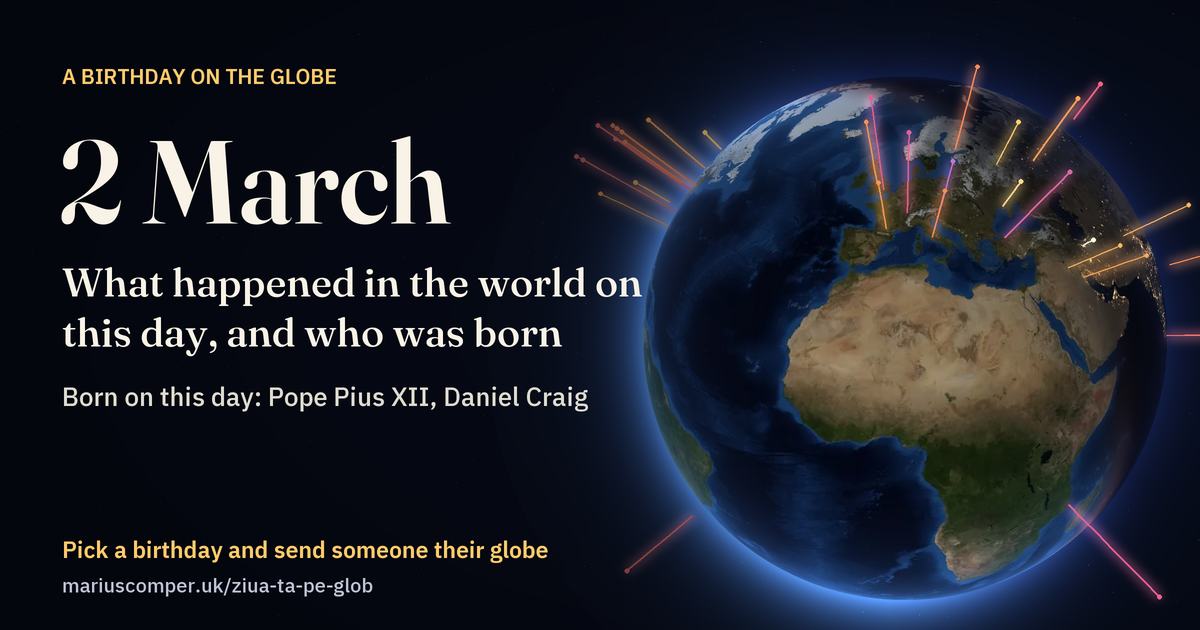
For 2 March, the English Wikipedia lists 67 events and 222 births. 33 of the events stand at their places as rays of light; 11 more are dashed circles, where the sentence links only to a country or a sea. The taller the ray, the longer ago it happened. The people born that day come further down, as blue points.
A birthday, yours or someone else’s:
Turn it into a greetingScroll: the globe turns to each place
The day you were born, on the globe.
Three things from your day
Scroll: your day first, then 2 March through the years
The Earth on 2 March
The picture on the globe was assembled by NASA from satellite photographs taken in March 2004: the snow, the ice and the green are those of the month.
On 2 March the Sun passes straight overhead at noon along the parallel of 7.0° south. In London, the day lasts about 11 hours.
Beyond 83° south the Sun no longer sets; beyond 83° north it no longer rises.
The line between day and night is tilted on the globe exactly as on this day of the year. On the dark side you can see the lights of towns.
Britain & Ireland · College of Arms
1484
The College of Arms is formally incorporated by Royal Charter signed by King Richard III of England.
On the map: College of Arms.
Britain & Ireland · Baggeridge Colliery
1968
Baggeridge Colliery closes, marking the end of over 300 years of coal mining in the Black Country.
On the map: Baggeridge Colliery.
Europe · 1939 conclave
1939
Cardinal Eugenio Pacelli is elected Pope and takes the name Pius XII.
On the map: 1939 conclave.
Europe · Toulouse
1969
In Toulouse, France, the first test flight of the Anglo-French Concorde is conducted.
On the map: Toulouse.
Also on the day’s list of Wikipedia in Spanish.
Europe · Moscow
2017
The elements Moscovium, Tennessine, and Oganesson are officially added to the periodic table at a conference in Moscow, Russia.
On the map: Moscow.
Africa · Island of Mozambique
1498
Vasco da Gama's fleet visits the Island of Mozambique.
On the map: Island of Mozambique.
North America · Fort Worth, Texas
1949
Captain James Gallagher lands his B-50 Superfortress Lucky Lady II in Fort Worth, Texas, after completing the first non-stop around-the-world airplane flight in 94 hours and one minute.
On the map: Fort Worth, Texas.
Also on the day’s list of Wikipedia in Spanish.
North America · Hersheypark Arena
1962
Wilt Chamberlain sets the single-game scoring record in the National Basketball Association by scoring 100 points.
On the map: Hersheypark Arena.
North America · Dolby Theatre
2014
The Oscar Selfie, regarded as one of the most influential and important images of all time, is taken at the 86th Academy Awards.
On the map: Dolby Theatre.
2 March
What the other Wikipedias remember#
For these years the English list has nothing on this day. The events below come from the same day’s lists on Wikipedia in Spanish and were translated for this page.
From Wikipedia in Spanish · Álava
1332
In what is now Spain, Álava is incorporated into Castile.
On the map: Álava.
Translated from the list on Wikipedia in Spanish.
From Wikipedia in Spanish · University of Oxford
1940
In England, the traditional Oxford-Cambridge Boat Race is held. Cambridge wins.
On the map: University of Oxford.
Translated from the list on Wikipedia in Spanish.
2 March
Born on 2 March#
The English Wikipedia lists 222 births for this day. The blue points are the birthplaces of 60 of these people: those written about in the most Wikipedia editions, where Wikidata gives a place of birth.
Born on 2 March
1968
Daniel Craig, English actor and producer
Place of birth: Chester.
Born on 2 March
1824
Bedřich Smetana, Czech pianist and composer (died 1884)
Place of birth: Litomyšl.
Born on 2 March
480
Benedict of Nursia, Italian Christian saint (died 543 or 547)
Place of birth: Norcia.
Born in Britain and Ireland
1977
Chris Martin, English singer-songwriter (Coldplay)
Place of birth: Exeter.
Born in Britain and Ireland
1947
Harry Redknapp, English footballer and manager
Place of birth: Poplar.
Born in Britain and Ireland
1979
Damien Duff, Irish footballer
Place of birth: Ballyboden.
2 March
Number one in the charts that week
At the cinema
An animal recorded that day
The record can be seen in GBIF, which brings together wildlife records from around the world.
All your birthdays
The weather that day
Data: Met Office Hadley Centre (HadCET); NOAA (GHCN-Daily, Mauna Loa).
Above the Earth
Sources: Jonathan McDowell, GCAT (launches); GFZ Potsdam (Kp index). Days are counted in Universal Time.
Football that day
International matches played that day:
Source: the “International football results” dataset kept by Mart Jürisoo (CC0).
Also that day
The earthquake’s page at the USGS
Source: the USGS catalogue. The day is counted in Universal Time (UTC).
In those days
Make a link for someone
Type the name, pick the day and the year of birth. The link opens straight on their day, with their name in the greeting.
The link carries the name, date and place typed here; anyone who gets it can see them.
Put another birthday beside it
Your mother’s, your child’s, a friend’s: the two days appear side by side.
Below: 2 March through the years.
The whole globe of the day
Drag the globe to turn it. Touch a ray or a point to read what happened there.
Everything Wikipedia lists for 2 March
The list is the English Wikipedia’s, in its own wording, as it stood in October 2026. 23 events have no place on the map: the sentence links to no place with coordinates, only to places too wide to mark, or to several countries.
- 537
Siege of Rome: The Ostrogoth army under king Vitiges begins the siege of the capital. Belisarius conducts a delaying action outside the Flaminian Gate; he and a detachment of his bucellarii are almost cut off.
Europe · Siege of RomeWikipedia: Siege of Rome - 986
Louis V becomes the last Carolingian king of West Francia after the death of his father, Lothaire.
no place on the mapWikipedia: Louis V of France - 1331
Fall of Nicaea to the Ottoman Turks after a siege.
Asia · Siege of NicaeaWikipedia: Siege of Nicaea - 1444
Skanderbeg organizes a group of Albanian nobles to form the League of Lezhë.
no place on the mapWikipedia: Skanderbeg - 1458
George of Poděbrady is chosen as the king of Bohemia.
Europe · Kingdom of BohemiaWikipedia: George of Poděbrady - 1476
Burgundian Wars: The Old Swiss Confederacy hands Charles the Bold, Duke of Burgundy, a major defeat in the Battle of Grandson in Canton of Neuchâtel.
Europe · Battle of GrandsonWikipedia: Battle of Grandson - 1484
The College of Arms is formally incorporated by Royal Charter signed by King Richard III of England.
Britain & Ireland · College of ArmsWikipedia: College of Arms - 1498
Vasco da Gama's fleet visits the Island of Mozambique.
Africa · Island of MozambiqueWikipedia: Vasco da Gama - 1657
The Great Fire of Meireki begins in Edo (now Tokyo), Japan, causing more than 100,000 deaths before it exhausts itself three days later.
Asia · Great Fire of MeirekiWikipedia: Great Fire of Meireki - 1776
American Revolutionary War: Patriot militia units attempt to prevent capture of supply ships in and around the Savannah River by a small fleet of the Royal Navy in the Battle of the Rice Boats.
North America · Battle of the Rice BoatsWikipedia: Battle of the Rice Boats - 1791
Claude Chappe demonstrates the first semaphore line near Paris.
no place on the mapWikipedia: Claude Chappe - 1796
Napoleon Bonaparte is appointed to command the Army of Italy.
no place on the mapWikipedia: Napoleon - 1797
The Bank of England issues the first one-pound and two-pound banknotes.
no place on the mapWikipedia: Bank of England - 1807
The U.S. Congress passes the Act Prohibiting Importation of Slaves, disallowing the importation of new slaves into the country.
North America · United States CongressWikipedia: United States Congress - 1811
Argentine War of Independence: A royalist fleet defeats a small flotilla of revolutionary ships in the Battle of San Nicolás on the River Plate.
Latin America · Battle of San NicolásWikipedia: May Revolution - 1815
Signing of the Kandyan Convention treaty by British invaders and the leaders of the Kingdom of Kandy.
Asia · Temple of the ToothWikipedia: Kandyan Convention - 1836
Texas Revolution: The Declaration of independence of the Republic of Texas from Mexico is adopted.
North America · Texas RevolutionWikipedia: Texas Declaration of Independence - 1855
Alexander II becomes Tsar of Russia.
no place on the mapWikipedia: Alexander II of Russia - 1859
The two-day Great Slave Auction, once thought to be the largest such auction in United States history, begins.
North America · Great Slave AuctionWikipedia: Great Slave Auction - 1864
Ulysses S. Grant is promoted to lieutenant general, giving him command of all Union Armies.
no place on the mapWikipedia: Ulysses S. Grant - 1865
East Cape War: The Völkner Incident in New Zealand.
Oceania · New ZealandWikipedia: East Cape War - 1867
The U.S. Congress passes the first Reconstruction Act.
no place on the mapWikipedia: Reconstruction Acts - 1877
Just two days before inauguration, the U.S. Congress declares Rutherford B. Hayes the winner of the 1876 U.S. presidential election even though Samuel J. Tilden had won the popular vote.
no place on the mapWikipedia: 1876 United States presidential election - 1882
Queen Victoria narrowly escapes an assassination attempt by Roderick Maclean in Windsor.
no place on the mapWikipedia: Queen Victoria - 1901
The U.S. Congress passes the Platt Amendment limiting the autonomy of Cuba, as a condition of the withdrawal of American troops.
Latin America · CubaWikipedia: Platt Amendment - 1901
United States Steel Corporation is founded as a result of a merger between Carnegie Steel Company and Federal Steel Company which became the first corporation in the world with a market capital over $1 billion.
no place on the mapWikipedia: U.S. Steel - 1903
In New York City the Martha Washington Hotel opens, becoming the first hotel exclusively for women.
North America · Martha Washington HotelWikipedia: Martha Washington Hotel - 1917
The enactment of the Jones–Shafroth Act grants Puerto Ricans United States citizenship.
Latin America · Puerto RicoWikipedia: Jones–Shafroth Act - 1919
The first Communist International meets in Moscow.
no place on the mapWikipedia: Communist International - 1932
Finnish president P. E. Svinhufvud gives a radio speech, which four days later finally ends the Mäntsälä Rebellion and the far-right Lapua Movement that started it.
Europe · MäntsäläWikipedia: Mäntsälä rebellion - 1933
The film King Kong premieres in Radio City Music Hall and RKO Roxy in New York City.
North America · Radio City Music HallWikipedia: King Kong - 1937
The Steel Workers Organizing Committee signs a collective bargaining agreement with U.S. Steel, leading to unionization of the United States steel industry.
no place on the mapWikipedia: Steel Workers Organizing Committee - 1939
Cardinal Eugenio Pacelli is elected Pope and takes the name Pius XII.
Europe · 1939 conclaveWikipedia: 1939 conclave - 1941
World War II: First German military units enter Bulgaria after it joins the Axis Pact.
no place on the mapWikipedia: World War II - 1943
World War II: During the Battle of the Bismarck Sea Allied aircraft defeat a Japanese attempt to ship troops to New Guinea.
Oceania · Battle of the Bismarck SeaWikipedia: Battle of the Bismarck Sea - 1949
Captain James Gallagher lands his B-50 Superfortress Lucky Lady II in Fort Worth, Texas, after completing the first non-stop around-the-world airplane flight in 94 hours and one minute.
North America · Fort Worth, TexasWikipedia: Captain - 1955
Norodom Sihanouk, king of Cambodia, abdicates the throne in favor of his father, Norodom Suramarit.
Asia · CambodiaWikipedia: Norodom Sihanouk - 1962
In Burma, the army led by General Ne Win seizes power in a coup d'état.
Asia · YangonWikipedia: 1962 Burmese coup d'état - 1962
Wilt Chamberlain sets the single-game scoring record in the National Basketball Association by scoring 100 points.
North America · Hersheypark ArenaWikipedia: Wilt Chamberlain's 100-point game - 1965
The Sound of Music was released in American theatres; it became the highest-grossing film until 1971.
no place on the mapWikipedia: The Sound of Music - 1965
The US and Republic of Vietnam Air Force begin Operation Rolling Thunder, a sustained bombing campaign against North Vietnam.
Asia · North VietnamWikipedia: South Vietnam Air Force - 1968
Baggeridge Colliery closes, marking the end of over 300 years of coal mining in the Black Country.
Britain & Ireland · Baggeridge CollieryWikipedia: Baggeridge Colliery - 1969
In Toulouse, France, the first test flight of the Anglo-French Concorde is conducted.
Europe · ToulouseWikipedia: Toulouse - 1970
Rhodesia declares itself a republic, breaking its last links with the British crown.
Africa · RhodesiaWikipedia: Rhodesia - 1972
The Pioneer 10 space probe is launched from Cape Canaveral, Florida with a mission to explore the outer planets.
North America · FloridaWikipedia: Pioneer 10 - 1977
Libya becomes the Socialist People's Libyan Arab Jamahiriya as the General People's Congress adopts the "Declaration on the Establishment of the Authority of the People".
Africa · LibyaWikipedia: Libya - 1978
Czech Vladimír Remek becomes the first non-Soviet or non-American to go into space, when he is launched aboard Soyuz 28.
Europe · CzechoslovakiaWikipedia: Czechoslovakia - 1978
The late iconic actor Charlie Chaplin's coffin is stolen from his grave in Switzerland.
no place on the mapWikipedia: Charlie Chaplin - 1983
Compact discs and players are released for the first time in the United States and other markets. They had previously been available only in Japan.
no place on the mapWikipedia: Compact disc - 1986
Aeroflot Flight F-77 crashes near Bugulma Airport, killing all 38 people aboard.
Europe · Bugulma AirportWikipedia: Bugulma Airport - 1989
Twelve European Community nations agree to ban the production of all chlorofluorocarbons (CFCs) by the end of the century.
no place on the mapWikipedia: European Economic Community - 1990
Nelson Mandela is elected deputy president of the African National Congress.
no place on the mapWikipedia: Nelson Mandela - 1991
Battle at Rumaila oil field brings an end to the 1991 Gulf War.
Asia · Rumaila oil fieldWikipedia: Gulf War - 1991
Establishment of Kuwait Democratic Forum, center-left political organization in Kuwait.
Asia · KuwaitWikipedia: Kuwait Democratic Forum - 1992
Armenia, Azerbaijan, Kazakhstan, Kyrgyzstan, Moldova, San Marino, Tajikistan, Turkmenistan and Uzbekistan, all of which (except San Marino) were former Soviet republics, join the United Nations.
no place on the mapWikipedia: Armenia - 1992
Start of the war in Transnistria.
no place on the mapWikipedia: Transnistrian War - 1995
Researchers at Fermilab announce the discovery of the top quark.
North America · Fermi National Accelerator LaboratoryWikipedia: Fermi National Accelerator Laboratory - 1995
Space Shuttle Endeavour launches from the Kennedy Space Center on STS-67, carrying the ASTRO-2 spacelab observatory.
North America · Kennedy Space CenterWikipedia: Space Shuttle Endeavour - 1998
Data sent from the Galileo spacecraft indicates that Jupiter's moon Europa has a liquid ocean under a thick crust of ice.
no place on the mapWikipedia: Galileo - 2002
U.S. invasion of Afghanistan: Operation Anaconda begins, (ending on March 19 after killing 500 Taliban and al-Qaeda fighters, with 11 Western troop fatalities).
Asia · Operation AnacondaWikipedia: Operation Anaconda - 2004
War in Iraq: Al-Qaeda carries out the Ashoura Massacre in Iraq, killing 170 and wounding over 500.
Asia · KarbalaWikipedia: 2004 Ashura massacre - 2006
In Monterrey, Mexico, a man identified as Diego Santoy Riveroll commits a double murder against two children, followed by an attempted murder of his ex-partner, Erika. The incident is popularly known as the Cumbres case.
Latin America · MonterreyWikipedia: Cumbres case - 2012
A tornado outbreak occurs over a large section of the Southern United States and into the Ohio Valley region, resulting in 40 tornado-related fatalities.
no place on the mapWikipedia: Tornado outbreak of March 2–3, 2012 - 2014
The Oscar Selfie, regarded as one of the most influential and important images of all time, is taken at the 86th Academy Awards.
North America · Dolby TheatreWikipedia: 86th Academy Awards - 2017
The elements Moscovium, Tennessine, and Oganesson are officially added to the periodic table at a conference in Moscow, Russia.
Europe · MoscowWikipedia: Moscovium - 2022
Russian forces capture the city of Kherson during the Russian invasion of Ukraine, which subsequently began the start of the Russian occupation and military-civilian administration in Kherson. Kherson is the only regional capital in Ukraine that Russia captured.
Europe · Battle of KhersonWikipedia: Russo-Ukrainian war - 2026
The Lebanese militant group Hezbollah launches several projectiles into northern Israel as a response to the assassination of Ali Khamenei, formally initiating the 2026 Lebanon War.
Asia · Assassination of Ali KhameneiWikipedia: Assassination of Ali Khamenei
What the other Wikipedias remember
For these years the English list has nothing on this day. The events below come from the same day’s lists on Wikipedia in Spanish and were translated for this page.
- 1332
In what is now Spain, Álava is incorporated into Castile.
- 1940
In England, the traditional Oxford-Cambridge Boat Race is held. Cambridge wins.
Britain & Ireland · University of OxfordTranslated from the list on Wikipedia in SpanishWikipedia: Universidad de Oxford
Who was born on 2 March
In order of how many Wikipedia editions have an article about each. The first 60 of 222 are shown.
- 1931
Mikhail Gorbachev, Russian lawyer and politician, the 8th and final leader of the Soviet Union, Nobel Prize laureate (died 2022)
PrivolnoyeWikipedia: Mikhail Gorbachev - 1876
Pope Pius XII (died 1958)
- 1810
Pope Leo XIII (died 1903)
Carpineto RomanoWikipedia: Pope Leo XIII - 1937
Abdelaziz Bouteflika, Algerian soldier and politician, 5th President of Algeria (died 2021)
- 1968
Daniel Craig, English actor and producer
ChesterWikipedia: Daniel Craig - 1824
Bedřich Smetana, Czech pianist and composer (died 1884)
LitomyšlWikipedia: Bedřich Smetana - 480
Benedict of Nursia, Italian Christian saint (died 543 or 547)
- 1459
Pope Adrian VI (died 1523)
UtrechtWikipedia: Pope Adrian VI - 1963
Anthony Albanese, Australian politician, 31st Prime Minister of Australia
DarlinghurstWikipedia: Anthony Albanese - 1904
Dr. Seuss, American children's book writer, poet, and illustrator (died 1991)
SpringfieldWikipedia: Dr. Seuss - 1942
Lou Reed, American singer-songwriter, guitarist, producer, and actor (died 2013)
Brookdale University Hospital and Medical CenterWikipedia: Lou Reed - 1962
Jon Bon Jovi, American singer-songwriter, guitarist, producer, and actor
Perth AmboyWikipedia: Jon Bon Jovi - 1977
Chris Martin, English singer-songwriter (Coldplay)
ExeterWikipedia: Chris Martin - 1859
Sholem Aleichem, Ukrainian-American author and playwright (died 1916)
PereiaslavWikipedia: Sholem Aleichem - 1919
Jennifer Jones, American actress (died 2009)
- 1820
Multatuli, Dutch writer (died 1887)
Korsjespoortsteeg 20Wikipedia: Multatuli - 1989
Toby Alderweireld, Belgian footballer
WilrijkWikipedia: Toby Alderweireld - 1972
Mauricio Pochettino, Argentinian footballer and manager
- 1981
Bryce Dallas Howard, American actress
Los AngelesWikipedia: Bryce Dallas Howard - 1793
Sam Houston, American soldier and politician, 1st President of the Republic of Texas (died 1863)
Rockbridge CountyWikipedia: Sam Houston - 1926
Murray Rothbard, American economist and historian (died 1995)
New York CityWikipedia: Murray Rothbard - 1942
John Irving, American novelist and screenwriter
ExeterWikipedia: John Irving - 1950
Karen Carpenter, American singer (died 1983)
Yale – New Haven HospitalWikipedia: Karen Carpenter - 1316
Robert II of Scotland (died 1390)
Paisley AbbeyWikipedia: Robert II of Scotland - 1760
Camille Desmoulins, French journalist and politician (died 1794)
- 1817
János Arany, Hungarian journalist and poet (died 1882)
SalontaWikipedia: János Arany - 1938
Ricardo Lagos, Chilean economist, lawyer, and politician, 33rd President of Chile
SantiagoWikipedia: Ricardo Lagos - 1900
Kurt Weill, German-American pianist and composer (died 1950)
DessauWikipedia: Kurt Weill - 1930
Tom Wolfe, American journalist and author (died 2018)
RichmondWikipedia: Tom Wolfe - 1942
Mir-Hossein Mousavi, Iranian architect and politician, 79th Prime Minister of Iran
- 1982
Kevin Kurányi, German footballer
Rio de JaneiroWikipedia: Kevin Kurányi - 1947
Harry Redknapp, English footballer and manager
- 1990
Tiger Shroff, Indian actor
MumbaiWikipedia: Tiger Shroff - 1997
Becky G, American singer and actress
InglewoodWikipedia: Becky G - 1800
Yevgeny Baratynsky, Russian-Italian poet and philosopher (died 1844)
VyazhlyaWikipedia: Yevgeny Baratynsky - 1971
Method Man, American rapper, record producer and actor
HempsteadWikipedia: Method Man - 1979
Damien Duff, Irish footballer
BallybodenWikipedia: Damien Duff - 1980
Rebel Wilson, Australian actress and screenwriter
SydneyWikipedia: Rebel Wilson - 1948
Rory Gallagher, Irish singer-songwriter, guitarist, and producer (died 1995)
BallyshannonWikipedia: Rory Gallagher - 1989
Nathalie Emmanuel, English actress
Southend-on-SeaWikipedia: Nathalie Emmanuel - 1988
James Arthur, English singer-songwriter
MiddlesbroughWikipedia: James Arthur - 1989
Marcel Hirscher, Austrian skier
HalleinWikipedia: Marcel Hirscher - 2016
Prince Oscar, Duke of Skåne
Karolinska University HospitalWikipedia: Prince Oscar, Duke of Skåne - 1999
Iñaki Peña, Spanish footballer
AlicanteWikipedia: Iñaki Peña - 1973
Dejan Bodiroga, Serbian basketball player
ZrenjaninWikipedia: Dejan Bodiroga - 1983
Lisandro López, Argentine footballer
Buenos AiresWikipedia: Lisandro López - 1770
Louis-Gabriel Suchet, French general (died 1826)
- 1917
Desi Arnaz, Cuban-American actor, singer, and producer (died 1986)
Santiago de CubaWikipedia: Desi Arnaz - 1829
Carl Schurz, German-American general, lawyer, and politician, 13th United States Secretary of the Interior (died 1906)
LiblarWikipedia: Carl Schurz - 1914
Martin Ritt, American actor and film director (died 1990)
New York CityWikipedia: Martin Ritt - 1966
Ann Leckie, American author
ToledoWikipedia: Ann Leckie - 1953
Russ Feingold, American lawyer and politician
JanesvilleWikipedia: Russ Feingold - 1955
Ken Salazar, American lawyer and politician, 50th United States Secretary of the Interior
AlamosaWikipedia: Ken Salazar - 1988
Matthew Mitcham, Australian diver
BrisbaneWikipedia: Matthew Mitcham - 1970
Ciriaco Sforza, Swiss footballer and manager
- 1987
Jonas Jerebko, Swedish basketball player
- 1990
Luke Combs, American singer-songwriter
HuntersvilleWikipedia: Luke Combs - 1944
Leif Segerstam, Finnish conductor and composer (died 2024)
- 1958
Kevin Curren, South African-American tennis player
DurbanWikipedia: Kevin Curren - 2000
Illan Meslier, French footballer
LorientWikipedia: Illan Meslier
What is celebrated on 2 March
- Air Force Day (Sri Lanka)
- Baloch Culture Day (Balochistan)
- Christian feast day: Agnes of Bohemia
- Christian feast day: Angela of the Cross
- Christian feast day: Blessed Charles the Good, Count of Flanders
- Christian feast day: Chad of Mercia (Catholic Church, Anglican Communion, Eastern Orthodox Church)
- Christian feast day: John Maron
- Christian feast day: March 2 (Eastern Orthodox liturgics)
- Feast of 'Alá (Loftiness), First day of the 19th month of the Baháʼí calendar (Baháʼí Faith) and first day of the Baháʼí Nineteen Day Fast
- National Read Across America Day (United States)
- Peasants' Day (Myanmar)
- Texas Independence Day
- Adwa Victory Day (Ethiopia)
A greeting link for someone
Type a name and, if you like, the year of birth. The link opens with a greeting, and beside each event it says how old the person turned that day, or how many years before their birth it happened.
The name and the year go only into the link you send.
All 366 days
How the globe is made
Where the events come from
Each edition of this page uses the day’s list from Wikipedia in its own language: Romanian, English, Spanish, Chinese. The lists are written by volunteers and differ from one edition to the next; the text of each event is Wikipedia’s, with a link to the article. A row that appears twice in a list is shown once. The lists have not been checked event by event: they are Wikipedia’s, mistakes included.
For events before 1582, and for countries that moved to the Gregorian calendar later (Britain in 1752, Russia in 1918), the same day may be counted Old Style in one list and New Style in another.
The chapter “What the other Wikipedias remember” adds up to five events a day from the lists of the other three editions, only for years in which the English list has nothing on that day. They were translated for this page, passed the same filters as the tour, and are not counted among the events of the English list.
How an event gets onto the map
The place comes from Wikidata. If the sentence links to the article about the event itself (a battle, an opening, an earthquake), dated to the same year, the ray stands on its coordinates or on those of its location. Otherwise it stands on the first place the sentence links to: a town, a building, a mountain, an island. This second step can be wrong: sometimes the sentence only mentions the place. That is why the page says, under each event, which place the ray stands on.
When the sentence links to a single state or province, or to a single sea, lake or desert larger than 5,000 km², the globe shows a dashed circle, not a ray. The circle has the area Wikidata gives, with its radius kept between 1.2° and 16°, or a radius of 4.5° when Wikidata gives no area; it says only that the sentence links to that place. Organisations, ships, spacecraft, museum objects, rivers, mountain ranges, languages and continents are never used as places. When a sentence names several states and no exact place, the event stays in the list only.
What the height means
The height of a ray shows how many years have passed, on a logarithmic scale: 10 years, 100 years and 1,000 years are equal steps apart; anything older than about 2,600 years has the tallest ray. The colour runs from pale yellow for recent years to violet for antiquity.
Where the tour stops
In each region the tour stops at up to three events (five in Britain and Ireland), chosen mainly by three things: whether Wikipedia’s editors put the event in the “On this day” box of their main page (the English, Spanish and Chinese editions), how many Wikipedia editions have an article about it, and how many of the four lists include it. Events whose sentence or article is about a war, an attack, a crime or a disaster are left out of the tour; they stay in the whole list, in Wikipedia’s wording. The filter is a list of words and a list of Wikidata types, so it can miss some.
The tour of births names the people with articles in the most editions and leaves aside those whom the list or Wikidata describes as rulers, politicians, commanders, leaders of movements or criminals; they stay in the list.
The Earth and the Sun
The daytime images are NASA’s Blue Marble Next Generation mosaics, one for each month of 2004; the night side is Black Marble 2016. The tilt of the line between day and night is computed for the day; the hour is chosen so that the place being read is in daylight. The latitude where the Sun stands overhead is the average of the four years of the leap cycle; in a given year it can differ by up to 0.4°.
The day you were born
The number ones come from the weekly lists on Wikipedia: Billboard for the United States (from 1940; the Hot 100 from August 1958), the UK Singles Chart (from November 1952), Los 40 Principales for Spain (from July 1966) and, for Romania, the Romanian Top 100 and Airplay 100 (2001–2021, with missing weeks). The page shows the chart of the week in which the day of birth falls, with its date; Billboard and the UK chart are dated at the end of their week. For Romania before 2001 and for China these sources have no weekly chart.
The films are those that reached cinemas in the United States up to ten days before or three days after that day (some of them in a few cinemas at first), from the English Wikipedia’s yearly lists (from 1968), in order of how many editions have an article about them. The events “in those days” are the ones on the neighbouring days’ lists that carry the year of birth, passed through the same filter as the tour.
The day of birth, year included
The Moon, the star sign and the constellation are worked out by the page itself, for noon Universal Time on the day. The lit part of the Moon is rounded and can differ by a few per cent from that at the hour of birth. The sign follows the usual zodiac of twelve equal parts starting at the March equinox; the constellation is the one the Sun actually stood in front of, by the borders set by the International Astronomical Union, and within a day of a border the page does not name it. When the Sun changes sign while it is that day anywhere on Earth, the page gives the moment of crossing, rounded to ten minutes and accurate to within about a quarter of an hour, and the clock time in a few cities, with the time zone and summer time of that year.
The year in the Chinese calendar is the one your device’s own calendar gives for the date, checked against the Hong Kong Observatory’s tables. “All your birthdays” uses the same sources as the rest of the chapter for the same day in every year since the birth: the temperature, well-known launches that took place on that very day, matches of the teams the edition follows, snow deeper than 10 cm and strong geomagnetic storms. The three things at the top and the four on the picture are chosen in a fixed order (the song, the animal, a full Moon, a well-known launch before an ordinary earthquake); on the picture you can change them.
When the link carries a year of birth, the page adds a few things about that exact day. The weather is the Met Office’s Central England temperature record and the readings from New York’s Central Park; the “usual high” is the average of the daily highs of 1961–1990 for that date, with two days either side. The carbon dioxide figure is the monthly mean at the Mauna Loa observatory, where measurements begin in March 1958.
The earthquake is the one with the largest magnitude in the USGS catalogue for that day, counted in Universal Time. Before the 1960s the catalogue has gaps even above magnitude 5.5, so in the older years many days have no earthquake. The page gives only the magnitude and the place: the country the epicentre falls in or, when the epicentre is at sea within 300 km of a coast, the nearest country; farther out, only the ocean.
The launches are those that reached orbit or left for the Moon and the planets, from Jonathan McDowell’s GCAT catalogue. If nothing left that day, the page shows the nearest launch within three days before or after, and says how many days away it was. The geomagnetic storm appears only when the Kp index reached at least 5 in one of the day’s eight three-hour intervals.
The animal comes from GBIF: an observation made by a person (the animal seen or heard, or its tracks), dated to that exact day, with coordinates and a CC0 or CC BY licence. Only a few hundred well-known species are searched (mammals, birds, turtles, butterflies); of those noted that day, mammals and species with articles in many Wikipedia editions come first; birds noted almost every day, and species used recently, wait their turn. Observations dated 1 January are left out, because records without a day are often filed there. An observation shows that the animal was recorded there, not how many animals there were.
The matches are those between national teams. Only matches of England, Scotland, Wales, Northern Ireland, the Republic of Ireland, the United States, Canada and Australia are shown, along with those at the big final tournaments. The picture to send is drawn in the page from the day’s globe and the facts above, and stays on your device until you send it.
Sources
- Events, births and holidays: the day’s page on Wikipedia, text under CC BY-SA 4.0.
- Coordinates, places of birth and the number of editions: Wikidata (CC0).
- The Earth by day: NASA Blue Marble Next Generation. The Earth by night: NASA Black Marble 2016.
- Borders and regions: Natural Earth.
- World population and births per year: UN World Population Prospects 2024.
- Charts and films: Wikipedia’s lists for Billboard, the UK Singles Chart, Los 40 Principales, Romanian Top 100, Airplay 100 and American films by year (CC BY-SA 4.0).
- Weather: Met Office Hadley Centre, HadCET (Open Government Licence) and NOAA GHCN-Daily, New York Central Park. Carbon dioxide: NOAA Global Monitoring Laboratory, Mauna Loa.
- Earthquakes: the USGS catalogue. Launches: Jonathan McDowell, GCAT (CC BY). Kp index: GFZ Potsdam (CC BY 4.0). Matches: International football results, Mart Jürisoo (CC0).
- Animal observations: GBIF, with a link to each record; species names come from Wikidata.