A birthday on the globe
18 February on the globe: what happened in the world on this day, and who was born
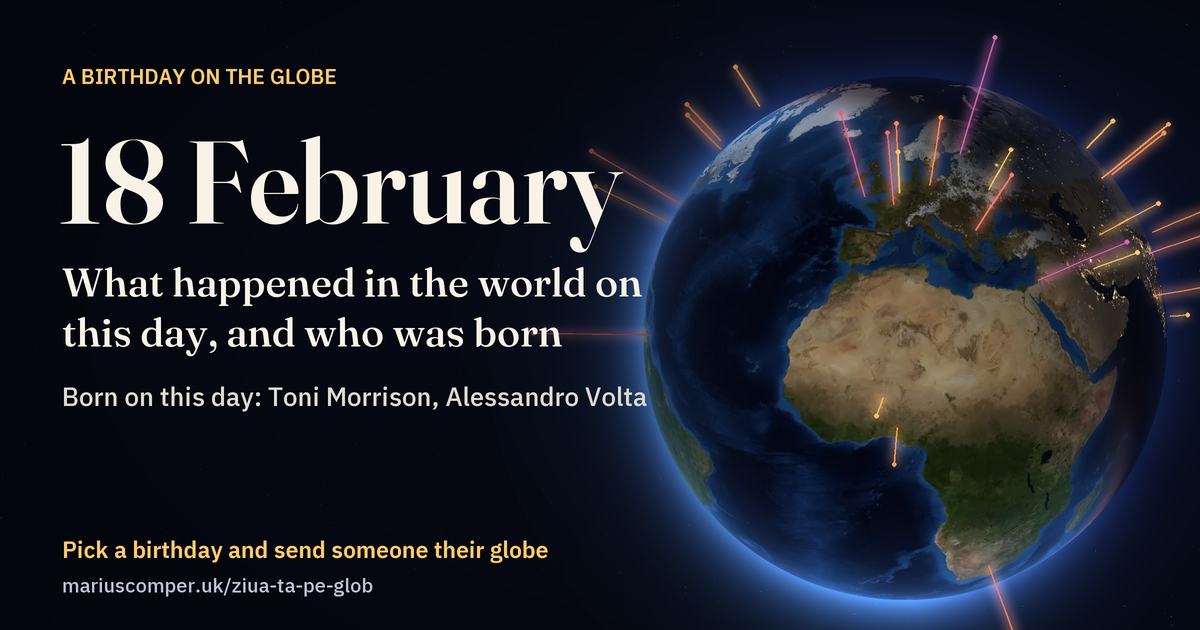
For 18 February, the English Wikipedia lists 54 events and 145 births. 27 of the events stand at their places as rays of light; four more are dashed circles, where the sentence links only to a country or a sea. The taller the ray, the longer ago it happened. The people born that day come further down, as blue points.
A birthday, yours or someone else’s:
Turn it into a greetingScroll: the globe turns to each place
The day you were born, on the globe.
Three things from your day
Scroll: your day first, then 18 February through the years
The Earth on 18 February
The picture on the globe was assembled by NASA from satellite photographs taken in February 2004: the snow, the ice and the green are those of the month.
On 18 February the Sun passes straight overhead at noon along the parallel of 11.8° south. In London, the day lasts about 10 hours 10 minutes.
Beyond 78° south the Sun no longer sets; beyond 78° north it no longer rises.
The line between day and night is tilted on the globe exactly as on this day of the year. On the dark side you can see the lights of towns.
Europe · Brussels
1906
Édouard de Laveleye forms the Belgian Olympic Committee in Brussels.
On the map: Brussels.
Asia · Prayagraj
1911
The first official flight with airmail takes place from Allahabad, United Provinces, British India (now India), when Henri Pequet, a 23-year-old pilot, delivers 6,500 letters to Naini, about 10 kilometres (6.2 mi) away.
On the map: Prayagraj.
Also on the day’s list of Wikipedia in Spanish and Chinese.
North America · Montgomery, Alabama
1861
In Montgomery, Alabama, Jefferson Davis is inaugurated as the provisional President of the Confederate States of America.
On the map: Montgomery, Alabama.
Also on the day’s list of Wikipedia in Spanish.
North America · Los Angeles
1954
The first Church of Scientology is established in Los Angeles.
On the map: Los Angeles.
18 February
What the other Wikipedias remember#
For these years the English list has nothing on this day. The events below come from the same day’s lists on Wikipedia in Spanish and were translated for this page.
From Wikipedia in Spanish · 1968 Winter Olympics
1968
In Grenoble (France), the French skier Jean-Claude Killy wins three gold medals at the Olympic Games.
On the map: 1968 Winter Olympics.
Translated from the list on Wikipedia in Spanish.
The article on Wikipedia in Spanish: Juegos Olímpicos de Grenoble 1968
From Wikipedia in Spanish · Berlin
1994
In Berlin (Germany), Sophia Loren receives a special Golden Bear from the International Film Festival in recognition of her film career.
On the map: Berlin.
Translated from the list on Wikipedia in Spanish.
The article on Wikipedia in Spanish: Festival Internacional de Cine de Berlín
18 February
Born on 18 February#
The English Wikipedia lists 145 births for this day. The blue points are the birthplaces of 60 of these people: those written about in the most Wikipedia editions, where Wikidata gives a place of birth.
Born on 18 February
1931
Toni Morrison, American novelist and editor, Nobel Prize laureate (died 2019).
Place of birth: Lorain.
Born on 18 February
1745
Alessandro Volta, Italian physicist, invented the battery (died 1827)
Place of birth: Como.
Born on 18 February
1954
John Travolta, American actor, singer and producer
Place of birth: Englewood.
Born on 18 February
1836
Ramakrishna Paramahamsa, Indian mystic and yogi (died 1886)
Place of birth: Kamarpukur.
Born on 18 February
1933
Yoko Ono, Japanese-American multimedia artist and musician
Place of birth: Tokyo.
Born in Britain and Ireland
1975
Gary Neville, English footballer
Place of birth: Bury.
Born in Britain and Ireland
1933
Bobby Robson, English footballer and manager (died 2009)
Place of birth: Sacriston.
Born in Britain and Ireland
1929
Len Deighton, English historian and author (died 2026)
Place of birth: Marylebone.
18 February
Number one in the charts that week
At the cinema
An animal recorded that day
The record can be seen in GBIF, which brings together wildlife records from around the world.
All your birthdays
The weather that day
Data: Met Office Hadley Centre (HadCET); NOAA (GHCN-Daily, Mauna Loa).
Above the Earth
Sources: Jonathan McDowell, GCAT (launches); GFZ Potsdam (Kp index). Days are counted in Universal Time.
Football that day
International matches played that day:
Source: the “International football results” dataset kept by Mart Jürisoo (CC0).
Also that day
The earthquake’s page at the USGS
Source: the USGS catalogue. The day is counted in Universal Time (UTC).
In those days
Make a link for someone
Type the name, pick the day and the year of birth. The link opens straight on their day, with their name in the greeting.
The link carries the name, date and place typed here; anyone who gets it can see them.
Put another birthday beside it
Your mother’s, your child’s, a friend’s: the two days appear side by side.
Below: 18 February through the years.
The whole globe of the day
Drag the globe to turn it. Touch a ray or a point to read what happened there.
Everything Wikipedia lists for 18 February
The list is the English Wikipedia’s, in its own wording, as it stood in October 2026. 23 events have no place on the map: the sentence links to no place with coordinates, only to places too wide to mark, or to several countries.
- 3102 BC
Kali Yuga, the fourth and final yuga of Hinduism, starts with the death of Krishna.
no place on the mapWikipedia: Kali Yuga - 1229
The Sixth Crusade: Frederick II, Holy Roman Emperor, signs a ten-year truce with al-Kamil, regaining Jerusalem, Nazareth, and Bethlehem with neither military engagements nor support from the papacy.
Asia · JerusalemWikipedia: Sixth Crusade - 1268
The Battle of Wesenberg is fought between the Livonian Order and Dovmont of Pskov.
Europe · Battle of WesenbergWikipedia: Battle of Wesenberg - 1332
Amda Seyon I, Emperor of Ethiopia begins his campaigns in the southern Muslim provinces.
no place on the mapWikipedia: Amda Seyon I - 1637
Eighty Years' War: Off the coast of Cornwall, England, a Spanish fleet intercepts an important Anglo-Dutch merchant convoy of 44 vessels escorted by six warships, destroying or capturing 20 of them.
Britain & Ireland · Battle off Lizard PointWikipedia: Battle off Lizard Point - 1735
The ballad opera called Flora, or Hob in the Well went down in history as the first opera of any kind to be produced in North America (Charleston, S.C.)
no place on the map - 1766
Enslaved Malagasy captives on the Dutch East India Company slave ship Meermin began a mutiny that led to the ship's destruction on Cape Agulhas in present-day South Africa and the recapture of the instigators.
no place on the mapWikipedia: Meermin slave mutiny - 1781
Fourth Anglo-Dutch War: Captain Thomas Shirley opens his expedition against Dutch colonial outposts on the Gold Coast of Africa (present-day Ghana).
no place on the mapWikipedia: Fourth Anglo-Dutch War - 1791
Congress passes a law admitting the state of Vermont to the Union, effective 4 March, after that state had existed for 14 years as a de facto independent largely unrecognized state.
no place on the mapWikipedia: Admission to the Union - 1797
French Revolutionary Wars: Sir Ralph Abercromby and a fleet of 18 British warships invade Trinidad.
Latin America · TrinidadWikipedia: Capture of Trinidad - 1814
Napoleonic Wars: The Battle of Montereau.
Europe · Battle of MontereauWikipedia: Battle of Montereau - 1861
In Montgomery, Alabama, Jefferson Davis is inaugurated as the provisional President of the Confederate States of America.
North America · Montgomery, AlabamaWikipedia: Montgomery, Alabama - 1861
With Italian unification almost complete, Victor Emmanuel II of Piedmont, Savoy and Sardinia assumes the title of King of Italy.
no place on the mapWikipedia: Unification of Italy - 1873
Bulgarian revolutionary leader Vasil Levski is executed by hanging in Sofia by the Ottoman authorities.
Europe · SofiaWikipedia: Bulgaria - 1878
John Tunstall is murdered by outlaw Jesse Evans, sparking the Lincoln County War in Lincoln County, New Mexico.
North America · Lincoln County, New MexicoWikipedia: Lincoln County War - 1885
Adventures of Huckleberry Finn by Mark Twain is published in the United States.
no place on the mapWikipedia: Adventures of Huckleberry Finn - 1900
Second Boer War: Imperial forces suffer their worst single-day loss of life on Bloody Sunday, the first day of the Battle of Paardeberg.
Africa · Bloody SundayWikipedia: Bloody Sunday - 1906
Édouard de Laveleye forms the Belgian Olympic Committee in Brussels.
Europe · BrusselsWikipedia: Édouard de Laveleye - 1911
The first official flight with airmail takes place from Allahabad, United Provinces, British India (now India), when Henri Pequet, a 23-year-old pilot, delivers 6,500 letters to Naini, about 10 kilometres (6.2 mi) away.
Asia · PrayagrajWikipedia: Airmail - 1915
U-boat Campaign: The Imperial German Navy institutes unrestricted submarine warfare in the waters around Great Britain and Ireland.
no place on the mapWikipedia: U-boat campaign - 1930
Elm Farm Ollie becomes the first cow to fly in a fixed-wing aircraft and also the first cow to be milked in an aircraft.
no place on the mapWikipedia: Elm Farm Ollie - 1930
While studying photographs taken in January, Clyde Tombaugh discovers Pluto.
no place on the mapWikipedia: January - 1932
The Empire of Japan creates the independent state of Manzhouguo (the obsolete Chinese name for Manchuria) free from the Republic of China and installed former Chinese Emperor Puyi as Chief Executive of the State.
no place on the mapWikipedia: Empire of Japan - 1938
Second Sino-Japanese War: During the Nanking Massacre, the Nanking Safety Zone International Committee is renamed "Nanking International Rescue Committee", and the safety zone in place for refugees falls apart.
Asia · Nanjing MassacreWikipedia: Nanjing Massacre - 1942
World War II: The Imperial Japanese Army begins the systematic extermination of perceived hostile elements among the Chinese in Singapore.
no place on the mapWikipedia: Sook Ching - 1943
World War II: Joseph Goebbels delivers his Sportpalast speech.
Europe · Berlin SportpalastWikipedia: Sportpalast speech - 1943
World War II: The Nazis arrest the members of the White Rose movement.
no place on the mapWikipedia: Nazism - 1945
World War II: American and Brazilian troops kick off Operation Encore in Northern Italy, a successful limited action in the Northern Apennines that prepares for the western portion of the Allied Spring offensive.
no place on the mapWikipedia: Spring 1945 offensive in Italy - 1946
President Harry S. Truman signed the Rescission Act, annulling benefits payable to Filipino troops who fought for the U.S. during World War II.
no place on the mapWikipedia: Harry S. Truman - 1946
Sailors of the Royal Indian Navy mutiny in Bombay harbour, from where the action spreads throughout the Provinces of British India, involving 78 ships, twenty shore establishments and 20,000 sailors
Asia · MumbaiWikipedia: Royal Indian Navy - 1947
First Indochina War: The French gain complete control of Hanoi after forcing the Viet Minh to withdraw to the mountains.
Asia · Battle of HanoiWikipedia: First Indochina War - 1954
The first Church of Scientology is established in Los Angeles.
North America · Los AngelesWikipedia: Church of Scientology - 1955
Operation Teapot: Teapot test shot "Wasp" is successfully detonated at the Nevada Test Site with a yield of 1.2 kilotons. Wasp is the first of fourteen shots in the Teapot series.
North America · Operation TeapotWikipedia: Operation Teapot - 1957
Kenyan rebel leader Dedan Kimathi is executed by the British colonial government.
Africa · KenyaWikipedia: Kenya - 1957
Walter James Bolton becomes the last person legally executed in New Zealand.
no place on the mapWikipedia: Capital punishment in New Zealand - 1965
The Gambia becomes independent from the United Kingdom.
Africa · The GambiaWikipedia: The Gambia - 1970
The Chicago Seven are found not guilty of conspiring to incite riots at the 1968 Democratic National Convention.
no place on the mapWikipedia: 1968 Democratic National Convention - 1972
The California Supreme Court in the case of People v. Anderson, (6 Cal.3d 628) invalidates the state's death penalty and commutes the sentences of all death row inmates to life imprisonment.
no place on the mapWikipedia: Supreme Court of California - 1977
A thousand armed soldiers raid Kalakuta Republic, the commune of Nigerian singer Fela Kuti, leading to the death of Funmilayo Anikulapo Kuti.
Africa · Kalakuta RepublicWikipedia: Kalakuta Republic - 1977
The Space Shuttle Enterprise test vehicle is carried on its maiden "flight" on top of a Boeing 747.
no place on the mapWikipedia: Space Shuttle Enterprise - 1977
The Xinjiang 61st Regiment Farm fire started during Chinese New Year when a firecracker ignited memorial wreaths of the late Mao Zedong, killing 694 personnel. It remains the deadliest fireworks accident in the world.
Asia · Xinjiang 61st Regiment Farm fireWikipedia: Xinjiang 61st Regiment Farm fire - 1979
Richard Petty wins a then-record sixth Daytona 500 after leaders Donnie Allison and Cale Yarborough crash on the final lap of the first NASCAR race televised live flag-to-flag.
North America · Daytona International SpeedwayWikipedia: 1979 Daytona 500 - 1983
Thirteen people die and one is seriously injured in the Wah Mee massacre in Seattle. It is said to be the largest robbery-motivated mass-murder in U.S. history.
North America · Wah Mee massacreWikipedia: Wah Mee massacre - 1991
The IRA explodes bombs in the early morning at Paddington station and Victoria station in London.
no place on the mapWikipedia: Bombings of Paddington and Victoria stations - 2001
FBI agent Robert Hanssen is arrested for spying for the Soviet Union. He is ultimately convicted and sentenced to life imprisonment.
Asia · Soviet UnionWikipedia: Federal Bureau of Investigation - 2001
Sampit conflict: Inter-ethnic violence between Dayaks and Madurese breaks out in Sampit, Central Kalimantan, Indonesia, ultimately resulting in more than 500 deaths and 100,000 Madurese displaced from their homes.
Asia · SampitWikipedia: Sampit conflict - 2003
192 people die when an arsonist sets fire to a subway train in Daegu, South Korea.
Asia · Daegu subway fireWikipedia: Daegu subway fire - 2004
Up to 295 people, 182 of which being rescue workers, die near Nishapur, Iran, when a runaway freight train carrying sulfur, petrol and fertilizer catches fire and explodes.
Asia · NishapurWikipedia: Nishapur train disaster - 2010
In a coup d'état, military rebels attacked the presidential palace in Niamey, Niger, and replaced President Mamadou Tandja with a ruling junta, the Supreme Council for the Restoration of Democracy.
Africa · 2010 Nigerien coup d'étatWikipedia: 2010 Nigerien coup d'état - 2010
WikiLeaks publishes the first of hundreds of thousands of classified documents disclosed by the soldier now known as Chelsea Manning.
no place on the mapWikipedia: WikiLeaks - 2013
Armed robbers steal a haul of diamonds worth $50 million during a raid at Brussels Airport in Belgium.
Europe · Brussels Airport diamond heistWikipedia: Brussels Airport diamond heist - 2014
Revolution of Dignity: At least 76 people are killed and hundreds are injured in clashes between riot police and demonstrators in Kyiv, Ukraine.
Europe · Revolution of DignityWikipedia: Revolution of Dignity - 2018
Iran Aseman Airlines Flight 3704 crashes in the Dena sub-range in the Zagros Mountains of Iran, Resulting in 66 Deaths
Asia · Iran Aseman Airlines Flight 3704Wikipedia: Iran Aseman Airlines Flight 3704 - 2021
Perseverance, a Mars rover designed to explore Jezero crater on Mars, as part of NASA's Mars 2020 mission, lands successfully.
no place on the mapWikipedia: Perseverance
What the other Wikipedias remember
For these years the English list has nothing on this day. The events below come from the same day’s lists on Wikipedia in Spanish and were translated for this page.
- 1968
In Grenoble (France), the French skier Jean-Claude Killy wins three gold medals at the Olympic Games.
Europe · 1968 Winter OlympicsTranslated from the list on Wikipedia in SpanishWikipedia: Juegos Olímpicos de Grenoble 1968 - 1994
In Berlin (Germany), Sophia Loren receives a special Golden Bear from the International Film Festival in recognition of her film career.
Europe · BerlinTranslated from the list on Wikipedia in SpanishWikipedia: Festival Internacional de Cine de Berlín
Who was born on 18 February
In order of how many Wikipedia editions have an article about each. The first 60 of 145 are shown.
- 1931
Toni Morrison, American novelist and editor, Nobel Prize laureate (died 2019).
LorainWikipedia: Toni Morrison - 1745
Alessandro Volta, Italian physicist, invented the battery (died 1827)
- 1954
John Travolta, American actor, singer and producer
EnglewoodWikipedia: John Travolta - 1836
Ramakrishna Paramahamsa, Indian mystic and yogi (died 1886)
KamarpukurWikipedia: Ramakrishna - 1516
Mary I, Queen of England (died 1558)
Palace of PlacentiaWikipedia: Mary I - 1933
Yoko Ono, Japanese-American multimedia artist and musician
TokyoWikipedia: Yoko Ono - 1965
Dr. Dre, American rapper, record producer, and entrepreneur
ComptonWikipedia: Dr. Dre - 1838
Ernst Mach, Austrian physicist and philosopher (died 1916)
Brno-ChrliceWikipedia: Ernst Mach - 1967
Roberto Baggio, Italian footballer
CaldognoWikipedia: Roberto Baggio - 1883
Nikos Kazantzakis, Greek philosopher, author, and playwright (died 1957)
HeraklionWikipedia: Nikos Kazantzakis - 1932
Miloš Forman, Czech-American actor, director, and screenwriter (died 2018)
ČáslavWikipedia: Miloš Forman - 1201
Nasir al-Din al-Tusi, Persian scientist and writer (died 1274)
- 1975
Gary Neville, English footballer
- 1486
Chaitanya Mahaprabhu, Indian monk and saint (died 1534)
NabadwipWikipedia: Chaitanya Mahaprabhu - 1933
Bobby Robson, English footballer and manager (died 2009)
SacristonWikipedia: Bobby Robson - 1964
Matt Dillon, American actor
New RochelleWikipedia: Matt Dillon - 1919
Jack Palance, American boxer and actor (died 2006)
LattimerWikipedia: Jack Palance - 1934
Audre Lorde, American writer and activist (died 1992)
- 1925
George Kennedy, American actor (died 2016)
New York CityWikipedia: George Kennedy - 1860
Anders Zorn, Swedish artist (died 1920)
Mora ParishWikipedia: Anders Zorn - 1626
Francesco Redi, Italian physician (died 1697)
- 1950
Cybill Shepherd, American actress
MemphisWikipedia: Cybill Shepherd - 1994
J-Hope, South Korean rapper, singer-songwriter, dancer, and record producer
GwangjuWikipedia: J-Hope - 1849
Alexander Kielland, Norwegian author, playwright, and politician (died 1906)
StavangerWikipedia: Alexander Kielland - 1995
Nathan Aké, Dutch footballer
The HagueWikipedia: Nathan Aké - 1903
Nikolai Podgorny, Ukrainian engineer and politician (died 1983)
KarlivkaWikipedia: Nikolai Podgorny - 1906
Hans Asperger, Austrian pediatrician and academic (died 1980)
ViennaWikipedia: Hans Asperger - 1968
Molly Ringwald, American actress
RosevilleWikipedia: Molly Ringwald - 1980
Regina Spektor, Russian-American musician and songwriter
- 1372
Ibn Hajar al-Asqalani, Egyptian jurist and scholar (died 1448)
Old CairoWikipedia: Ibn Hajar al-Asqalani - 1984
Carlos Kameni, Cameroonian footballer
DoualaWikipedia: Carlos Kameni - 1940
Fabrizio De André, Italian singer-songwriter and guitarist (died 1999)
- 1981
Andrei Kirilenko, Russian-American basketball player
IzhevskWikipedia: Andrei Kirilenko - 1950
John Hughes, American director, producer, and screenwriter (died 2009)
LansingWikipedia: John Hughes - 1957
Marita Koch, German sprinter
WismarWikipedia: Marita Koch - 2002
Manu Bhaker, Indian sports shooter
JhajjarWikipedia: Manu Bhaker - 1530
Uesugi Kenshin, Japanese daimyō (died 1578)
Kasugayama CastleWikipedia: Uesugi Kenshin - 1960
Greta Scacchi, Italian-Australian actress
- 1929
Len Deighton, English historian and author (died 2026)
MaryleboneWikipedia: Len Deighton - 2000
Giacomo Raspadori, Italian footballer
BentivoglioWikipedia: Giacomo Raspadori - 1848
Louis Comfort Tiffany, American stained glass artist (died 1933)
New York CityWikipedia: Louis Comfort Tiffany - 1983
Jermaine Jenas, English footballer
NottinghamWikipedia: Jermaine Jenas - 2000
Zakaria Aboukhlal, Moroccan footballer
RotterdamWikipedia: Zakaria Aboukhlal - 1890
Adolphe Menjou, American actor (died 1963)
PittsburghWikipedia: Adolphe Menjou - 1936
Jean M. Auel, American author
ChicagoWikipedia: Jean M. Auel - 1977
Ike Barinholtz, American actor and comedian
ChicagoWikipedia: Ike Barinholtz - 1988
Roman Neustädter, German-Russian footballer
- 1967
Colin Jackson, Welsh sprinter and hurdler
CardiffWikipedia: Colin Jackson - 1988
Maiara Walsh, American-Brazilian actress
SeattleWikipedia: Maiara Walsh - 1990
Bryan Oviedo, Costa Rican footballer
San JoséWikipedia: Bryan Oviedo - 1892
Wendell Willkie, American captain, lawyer, and politician (died 1944)
- 1909
Wallace Stegner, American novelist, short story writer, and essayist (died 1993)
Lake MillsWikipedia: Wallace Stegner - 1974
Julia Butterfly Hill, American environmentalist and author
Mount VernonWikipedia: Julia Butterfly Hill - 1952
Randy Crawford, American jazz and R&B singer
- 1993
Kentavious Caldwell-Pope, American basketball player
ThomastonWikipedia: Kentavious Caldwell-Pope - 1609
Edward Hyde, 1st Earl of Clarendon, English historian and politician, Chancellor of the Exchequer (died 1674)
- 1871
Harry Brearley, English inventor (died 1948)
SheffieldWikipedia: Harry Brearley - 1890
Edward Arnold, American actor (died 1956)
ManhattanWikipedia: Edward Arnold - 1959
Jayne Atkinson, English-American actress
BournemouthWikipedia: Jayne Atkinson - 1543
Charles III, Duke of Lorraine (died 1608)
What is celebrated on 18 February
- Christian feast day: Bernadette Soubirous (France)
- Christian feast day: Colmán of Lindisfarne
- Christian feast day: Flavian of Constantinople
- Christian feast day: Geltrude Comensoli
- Christian feast day: Simeon of Jerusalem (Western Christianity)
- Christian feast day: February 18 (Eastern Orthodox liturgics)
- Dialect Day (Amami Islands, Japan)
- Independence Day, celebrates the independence of the Gambia from the United Kingdom in 1965
- Kurdish Students Union Day (Iraqi Kurdistan)
- National Democracy Day, celebrates the 1951 overthrow of the Rana dynasty (Nepal)
A greeting link for someone
Type a name and, if you like, the year of birth. The link opens with a greeting, and beside each event it says how old the person turned that day, or how many years before their birth it happened.
The name and the year go only into the link you send.
All 366 days
How the globe is made
Where the events come from
Each edition of this page uses the day’s list from Wikipedia in its own language: Romanian, English, Spanish, Chinese. The lists are written by volunteers and differ from one edition to the next; the text of each event is Wikipedia’s, with a link to the article. A row that appears twice in a list is shown once. The lists have not been checked event by event: they are Wikipedia’s, mistakes included.
For events before 1582, and for countries that moved to the Gregorian calendar later (Britain in 1752, Russia in 1918), the same day may be counted Old Style in one list and New Style in another.
The chapter “What the other Wikipedias remember” adds up to five events a day from the lists of the other three editions, only for years in which the English list has nothing on that day. They were translated for this page, passed the same filters as the tour, and are not counted among the events of the English list.
How an event gets onto the map
The place comes from Wikidata. If the sentence links to the article about the event itself (a battle, an opening, an earthquake), dated to the same year, the ray stands on its coordinates or on those of its location. Otherwise it stands on the first place the sentence links to: a town, a building, a mountain, an island. This second step can be wrong: sometimes the sentence only mentions the place. That is why the page says, under each event, which place the ray stands on.
When the sentence links to a single state or province, or to a single sea, lake or desert larger than 5,000 km², the globe shows a dashed circle, not a ray. The circle has the area Wikidata gives, with its radius kept between 1.2° and 16°, or a radius of 4.5° when Wikidata gives no area; it says only that the sentence links to that place. Organisations, ships, spacecraft, museum objects, rivers, mountain ranges, languages and continents are never used as places. When a sentence names several states and no exact place, the event stays in the list only.
What the height means
The height of a ray shows how many years have passed, on a logarithmic scale: 10 years, 100 years and 1,000 years are equal steps apart; anything older than about 2,600 years has the tallest ray. The colour runs from pale yellow for recent years to violet for antiquity.
Where the tour stops
In each region the tour stops at up to three events (five in Britain and Ireland), chosen mainly by three things: whether Wikipedia’s editors put the event in the “On this day” box of their main page (the English, Spanish and Chinese editions), how many Wikipedia editions have an article about it, and how many of the four lists include it. Events whose sentence or article is about a war, an attack, a crime or a disaster are left out of the tour; they stay in the whole list, in Wikipedia’s wording. The filter is a list of words and a list of Wikidata types, so it can miss some.
The tour of births names the people with articles in the most editions and leaves aside those whom the list or Wikidata describes as rulers, politicians, commanders, leaders of movements or criminals; they stay in the list.
The Earth and the Sun
The daytime images are NASA’s Blue Marble Next Generation mosaics, one for each month of 2004; the night side is Black Marble 2016. The tilt of the line between day and night is computed for the day; the hour is chosen so that the place being read is in daylight. The latitude where the Sun stands overhead is the average of the four years of the leap cycle; in a given year it can differ by up to 0.4°.
The day you were born
The number ones come from the weekly lists on Wikipedia: Billboard for the United States (from 1940; the Hot 100 from August 1958), the UK Singles Chart (from November 1952), Los 40 Principales for Spain (from July 1966) and, for Romania, the Romanian Top 100 and Airplay 100 (2001–2021, with missing weeks). The page shows the chart of the week in which the day of birth falls, with its date; Billboard and the UK chart are dated at the end of their week. For Romania before 2001 and for China these sources have no weekly chart.
The films are those that reached cinemas in the United States up to ten days before or three days after that day (some of them in a few cinemas at first), from the English Wikipedia’s yearly lists (from 1968), in order of how many editions have an article about them. The events “in those days” are the ones on the neighbouring days’ lists that carry the year of birth, passed through the same filter as the tour.
The day of birth, year included
The Moon, the star sign and the constellation are worked out by the page itself, for noon Universal Time on the day. The lit part of the Moon is rounded and can differ by a few per cent from that at the hour of birth. The sign follows the usual zodiac of twelve equal parts starting at the March equinox; the constellation is the one the Sun actually stood in front of, by the borders set by the International Astronomical Union, and within a day of a border the page does not name it. When the Sun changes sign while it is that day anywhere on Earth, the page gives the moment of crossing, rounded to ten minutes and accurate to within about a quarter of an hour, and the clock time in a few cities, with the time zone and summer time of that year.
The year in the Chinese calendar is the one your device’s own calendar gives for the date, checked against the Hong Kong Observatory’s tables. “All your birthdays” uses the same sources as the rest of the chapter for the same day in every year since the birth: the temperature, well-known launches that took place on that very day, matches of the teams the edition follows, snow deeper than 10 cm and strong geomagnetic storms. The three things at the top and the four on the picture are chosen in a fixed order (the song, the animal, a full Moon, a well-known launch before an ordinary earthquake); on the picture you can change them.
When the link carries a year of birth, the page adds a few things about that exact day. The weather is the Met Office’s Central England temperature record and the readings from New York’s Central Park; the “usual high” is the average of the daily highs of 1961–1990 for that date, with two days either side. The carbon dioxide figure is the monthly mean at the Mauna Loa observatory, where measurements begin in March 1958.
The earthquake is the one with the largest magnitude in the USGS catalogue for that day, counted in Universal Time. Before the 1960s the catalogue has gaps even above magnitude 5.5, so in the older years many days have no earthquake. The page gives only the magnitude and the place: the country the epicentre falls in or, when the epicentre is at sea within 300 km of a coast, the nearest country; farther out, only the ocean.
The launches are those that reached orbit or left for the Moon and the planets, from Jonathan McDowell’s GCAT catalogue. If nothing left that day, the page shows the nearest launch within three days before or after, and says how many days away it was. The geomagnetic storm appears only when the Kp index reached at least 5 in one of the day’s eight three-hour intervals.
The animal comes from GBIF: an observation made by a person (the animal seen or heard, or its tracks), dated to that exact day, with coordinates and a CC0 or CC BY licence. Only a few hundred well-known species are searched (mammals, birds, turtles, butterflies); of those noted that day, mammals and species with articles in many Wikipedia editions come first; birds noted almost every day, and species used recently, wait their turn. Observations dated 1 January are left out, because records without a day are often filed there. An observation shows that the animal was recorded there, not how many animals there were.
The matches are those between national teams. Only matches of England, Scotland, Wales, Northern Ireland, the Republic of Ireland, the United States, Canada and Australia are shown, along with those at the big final tournaments. The picture to send is drawn in the page from the day’s globe and the facts above, and stays on your device until you send it.
Sources
- Events, births and holidays: the day’s page on Wikipedia, text under CC BY-SA 4.0.
- Coordinates, places of birth and the number of editions: Wikidata (CC0).
- The Earth by day: NASA Blue Marble Next Generation. The Earth by night: NASA Black Marble 2016.
- Borders and regions: Natural Earth.
- World population and births per year: UN World Population Prospects 2024.
- Charts and films: Wikipedia’s lists for Billboard, the UK Singles Chart, Los 40 Principales, Romanian Top 100, Airplay 100 and American films by year (CC BY-SA 4.0).
- Weather: Met Office Hadley Centre, HadCET (Open Government Licence) and NOAA GHCN-Daily, New York Central Park. Carbon dioxide: NOAA Global Monitoring Laboratory, Mauna Loa.
- Earthquakes: the USGS catalogue. Launches: Jonathan McDowell, GCAT (CC BY). Kp index: GFZ Potsdam (CC BY 4.0). Matches: International football results, Mart Jürisoo (CC0).
- Animal observations: GBIF, with a link to each record; species names come from Wikidata.