A birthday on the globe
2 February on the globe: what happened in the world on this day, and who was born
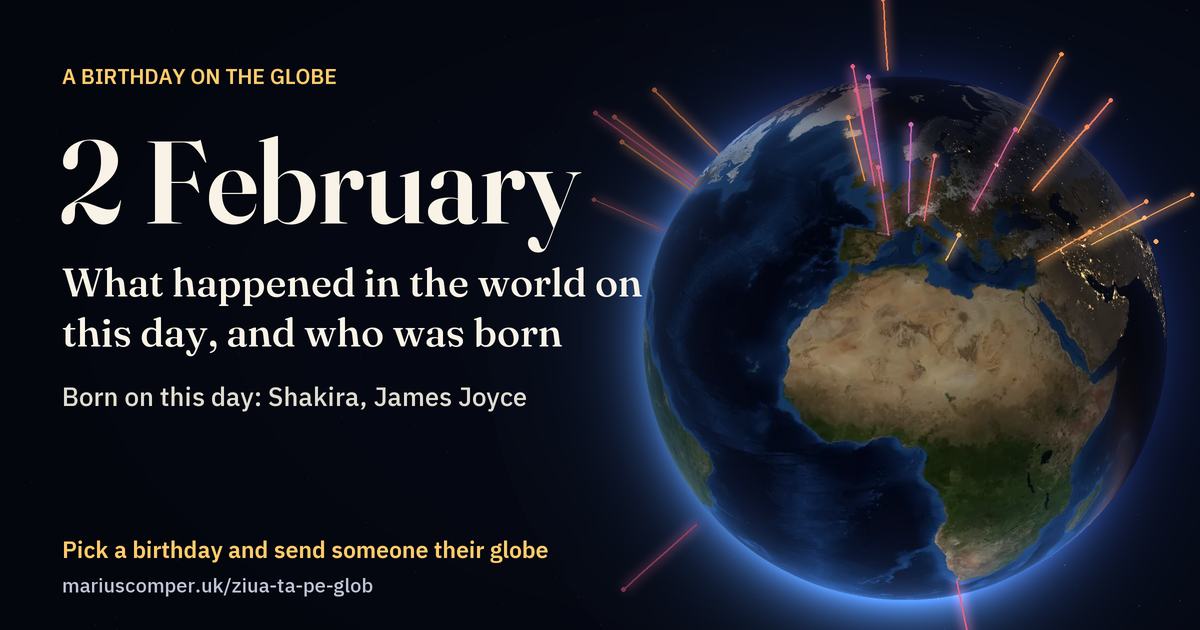
For 2 February, the English Wikipedia lists 61 events and 335 births. 27 of the events stand at their places as rays of light; six more are dashed circles, where the sentence links only to a country or a sea. The taller the ray, the longer ago it happened. The people born that day come further down, as blue points.
A birthday, yours or someone else’s:
Turn it into a greetingScroll: the globe turns to each place
The day you were born, on the globe.
Three things from your day
Scroll: your day first, then 2 February through the years
The Earth on 2 February
The picture on the globe was assembled by NASA from satellite photographs taken in February 2004: the snow, the ice and the green are those of the month.
On 2 February the Sun passes straight overhead at noon along the parallel of 16.9° south. In London, the day lasts about 9 hours 10 minutes.
Beyond 73° south the Sun no longer sets; beyond 73° north it no longer rises.
The line between day and night is tilted on the globe exactly as on this day of the year. On the dark side you can see the lights of towns.
Europe · Payerne Priory
1033
An assembly at the Abbey of Payerne crowned Conrad II king of Burgundy.
On the map: Payerne Priory.
Africa · Cape Town
1659
Jan van Riebeeck, the founder of Cape Town, produced the first bottle of South African wine.
On the map: Cape Town.
Asia · Ramsar Convention
1971
The international Ramsar Convention for the conservation and sustainable utilization of wetlands is signed in Ramsar, Mazandaran, Iran.
On the map: the coordinates Wikidata gives for the article “Ramsar Convention”.
Also on the day’s list of Wikipedia in Spanish and Chinese.
Asia · Semnan Space Center
2009
Omid, Iran's first domestically made satellite, was launched from Semnan Space Center.
On the map: Semnan Space Center.
Oceania · Melbourne
1899
The Australian Premiers' Conference held in Melbourne decides to locate Australia's capital city, Canberra, between Sydney and Melbourne.
On the map: Melbourne.
Latin America · Buenos Aires
1536
Spaniard Pedro de Mendoza founds Buenos Aires, Argentina.
On the map: Buenos Aires.
Also on the day’s list of Wikipedia in Spanish, Romanian and Chinese.
North America · New Amsterdam
1653
New Amsterdam (later renamed The City of New York) is incorporated.
On the map: New Amsterdam.
Also on the day’s list of Wikipedia in Spanish.
North America · Punxsutawney, Pennsylvania
1887
In Punxsutawney, Pennsylvania, the first Groundhog Day is observed.
On the map: Punxsutawney, Pennsylvania.
Also on the day’s list of Wikipedia in Spanish.
North America · United States Congress
1980
Reports surface that the FBI is targeting allegedly corrupt Congressmen in the Abscam operation.
On the map: United States Congress.
2 February
What the other Wikipedias remember#
For these years the English list has nothing on this day. The events below come from the same day’s lists on Wikipedia in Chinese and Romanian and were translated for this page.
From Wikipedia in Chinese · Beijing
1421
The Ming dynasty formally moves its capital to Beijing.
On the map: Beijing.
Translated from the list on Wikipedia in Chinese.
From Wikipedia in Romanian · Élysée Palace
2008
French President Nicolas Sarkozy marries the singer Carla Bruni at the Élysée Palace in Paris.
On the map: Élysée Palace.
Translated from the list on Wikipedia in Romanian.
2 February
Born on 2 February#
The English Wikipedia lists 335 births for this day. The blue points are the birthplaces of 60 of these people: those written about in the most Wikipedia editions, where Wikidata gives a place of birth.
Born on 2 February
1977
Shakira, Colombian singer-songwriter, producer, and actress
Place of birth: Barranquilla.
Born on 2 February
1882
James Joyce, Irish novelist, short story writer, and poet (died 1941)
Place of birth: Rathgar.
Born on 2 February
1905
Ayn Rand, Russian-born American novelist and philosopher (died 1982)
Place of birth: Saint Petersburg.
Born on 2 February
1987
Gerard Piqué, Spanish footballer
Place of birth: Barcelona.
Born on 2 February
1650
Pope Benedict XIII (died 1730)
Place of birth: Gravina in Puglia.
Born in Britain and Ireland
1996
Paul Mescal, Irish actor
Place of birth: Maynooth.
Born in Britain and Ireland
1986
Gemma Arterton, English actress and singer
Place of birth: Gravesend.
Born in Britain and Ireland
1996
Harry Winks, English footballer
Place of birth: Hemel Hempstead.
2 February
Number one in the charts that week
At the cinema
An animal recorded that day
The record can be seen in GBIF, which brings together wildlife records from around the world.
All your birthdays
The weather that day
Data: Met Office Hadley Centre (HadCET); NOAA (GHCN-Daily, Mauna Loa).
Above the Earth
Sources: Jonathan McDowell, GCAT (launches); GFZ Potsdam (Kp index). Days are counted in Universal Time.
Football that day
International matches played that day:
Source: the “International football results” dataset kept by Mart Jürisoo (CC0).
Also that day
The earthquake’s page at the USGS
Source: the USGS catalogue. The day is counted in Universal Time (UTC).
In those days
Make a link for someone
Type the name, pick the day and the year of birth. The link opens straight on their day, with their name in the greeting.
The link carries the name, date and place typed here; anyone who gets it can see them.
Put another birthday beside it
Your mother’s, your child’s, a friend’s: the two days appear side by side.
Below: 2 February through the years.
The whole globe of the day
Drag the globe to turn it. Touch a ray or a point to read what happened there.
Everything Wikipedia lists for 2 February
The list is the English Wikipedia’s, in its own wording, as it stood in October 2026. 28 events have no place on the map: the sentence links to no place with coordinates, only to places too wide to mark, or to several countries.
- 506
Alaric II, eighth king of the Visigoths, promulgates the Breviary of Alaric (Breviarium Alaricianum or Lex Romana Visigothorum), a collection of "Roman law".
no place on the mapWikipedia: Alaric II - 880
Battle of Lüneburg Heath: King Louis III of France is defeated by the Norse Great Heathen Army at Lüneburg Heath in Saxony.
no place on the mapWikipedia: Battle of Lüneburg Heath - 962
Translatio imperii: Pope John XII crowns Otto I, Holy Roman Emperor, the first Holy Roman Emperor in nearly 40 years.
no place on the mapWikipedia: Translatio imperii - 1032
Conrad II, Holy Roman Emperor becomes king of Burgundy.
Europe · Kingdom of BurgundyWikipedia: Conrad II, Holy Roman Emperor - 1033
An assembly at the Abbey of Payerne crowned Conrad II king of Burgundy.
Europe · Payerne PrioryWikipedia: Payerne Priory - 1141
The Battle of Lincoln, at which Stephen, King of England is defeated and captured by the allies of Empress Matilda.
Britain & Ireland · Battle of LincolnWikipedia: Battle of Lincoln - 1207
Terra Mariana, eventually comprising present-day Latvia and Estonia, is established.
no place on the mapWikipedia: Terra Mariana - 1347
Byzantine Empress Anna convenes a synod to depose patriarch Joseph XIV in Constantinople. The same night, conspirators let in her rival John VI Kantakouzenos which ends the Byzantine civil war of 1341–1347.
no place on the mapWikipedia: Byzantine civil war of 1341–1347 - 1428
An intense earthquake struck the Principality of Catalonia, with the epicenter near Camprodon. Widespread destruction and heavy casualties were reported.
Europe · 1428 Catalonia earthquakeWikipedia: 1428 Catalonia earthquake - 1438
Nine leaders of the Transylvanian peasant revolt are executed at Torda.
Europe · TurdaWikipedia: Transylvanian peasant revolt - 1461
Wars of the Roses: The Battle of Mortimer's Cross results in the death of Owen Tudor.
Britain & Ireland · Battle of Mortimer's CrossWikipedia: Battle of Mortimer's Cross - 1536
Spaniard Pedro de Mendoza founds Buenos Aires, Argentina.
Latin America · Buenos AiresWikipedia: Pedro de Mendoza - 1594
Giovanni Pierluigi da Palestrina dies at the age of 68.
no place on the mapWikipedia: Giovanni Pierluigi da Palestrina - 1645
Wars of the Three Kingdoms: In Scotland, the Battle of Inverlochy results in a Royalist/Irish victory.
Britain & Ireland · Battle of InverlochyWikipedia: Battle of Inverlochy - 1653
New Amsterdam (later renamed The City of New York) is incorporated.
North America · New AmsterdamWikipedia: New Amsterdam - 1659
Jan van Riebeeck, the founder of Cape Town, produced the first bottle of South African wine.
Africa · Cape TownWikipedia: Jan van Riebeeck - 1709
Alexander Selkirk is rescued after being shipwrecked on a desert island, inspiring Daniel Defoe's adventure book Robinson Crusoe.
no place on the mapWikipedia: Alexander Selkirk - 1725
J. S. Bach leads the first performance of his chorale cantata Mit Fried und Freud ich fahr dahin, BWV 125, based on Luther's paraphrase of the Nunc dimittis.
no place on the mapWikipedia: Johann Sebastian Bach - 1797
The siege of Mantua ends after eight months when Count Dagobert Sigmund von Wurmser surrenders the fortress of Mantua to Napoleon Bonaparte. The fall of Mantua secures French control over Northern Italy and marks the beginning of the conclusion of the Italian campaign of 1796-1797, and sets the stage for the end of the War of the First Coalition.
Europe · Siege of MantuaWikipedia: Siege of Mantua - 1814
The last of the River Thames frost fairs comes to an end.
no place on the mapWikipedia: River Thames frost fairs - 1848
Mexican–American War: The Treaty of Guadalupe Hidalgo is signed.
Latin America · Villa de Guadalupe HidalgoWikipedia: Mexican–American War - 1850
Brigham Young declares war on Timpanogos in the Battle at Fort Utah.
no place on the mapWikipedia: Battle at Fort Utah - 1868
Pro-Imperial forces capture Osaka Castle from the Tokugawa shogunate and burn it to the ground.
Asia · Fall of Osaka CastleWikipedia: Fall of Osaka Castle - 1870
The Seven Brothers (Seitsemän veljestä), a novel by Finnish author Aleksis Kivi, is published first time in several thin booklets.
no place on the mapWikipedia: Seitsemän veljestä - 1876
The National League of Professional Baseball Clubs of Major League Baseball is formed.
no place on the mapWikipedia: National League - 1881
The sentences of the trial of the warlocks of Chiloé are imparted.
no place on the mapWikipedia: Sentence - 1887
In Punxsutawney, Pennsylvania, the first Groundhog Day is observed.
North America · Punxsutawney, PennsylvaniaWikipedia: Punxsutawney, Pennsylvania - 1899
The Australian Premiers' Conference held in Melbourne decides to locate Australia's capital city, Canberra, between Sydney and Melbourne.
Oceania · MelbourneWikipedia: Melbourne - 1901
Funeral of Queen Victoria.
no place on the mapWikipedia: Queen Victoria - 1909
The Paris Film Congress opens, an attempt by European producers to form an equivalent to the MPPC cartel in the United States.
no place on the mapWikipedia: Paris Film Congress - 1913
Grand Central Terminal opens in New York City.
no place on the mapWikipedia: Grand Central Terminal - 1920
The Tartu Peace Treaty is signed between Estonia and Russia.
Europe · EstoniaWikipedia: Treaty of Tartu - 1922
The uprising called the "pork mutiny" starts in the region between Kuolajärvi and Savukoski in Finland.
no place on the mapWikipedia: Pork mutiny - 1922
Ulysses by James Joyce is published.
no place on the mapWikipedia: Ulysses - 1925
Serum run to Nome: Dog sleds reach Nome, Alaska with diphtheria serum, inspiring the Iditarod race.
North America · Nome, AlaskaWikipedia: 1925 serum run to Nome - 1934
The Export-Import Bank of the United States is incorporated.
no place on the mapWikipedia: Export–Import Bank of the United States - 1935
Leonarde Keeler administers polygraph tests to two murder suspects, the first time polygraph evidence was admitted in U.S. courts.
no place on the mapWikipedia: Leonarde Keeler - 1942
The Osvald Group is responsible for the first, active event of anti-Nazi resistance in Norway, to protest the inauguration of Vidkun Quisling.
no place on the mapWikipedia: Osvald Group - 1943
World War II: The Battle of Stalingrad comes to an end when Soviet troops accept the surrender of the last organized German troops in the city.
Europe · Battle of StalingradWikipedia: World War II - 1954
The Detroit Red Wings played in the first outdoor hockey game by any NHL team in an exhibition against the Marquette Branch Prison Pirates in Marquette, Michigan.
North America · Marquette Branch PrisonWikipedia: 1954 Detroit Red Wings prison game - 1959
Nine experienced ski hikers in the northern Ural Mountains in the Soviet Union die under mysterious circumstances.
Europe · Dyatlov Pass incidentWikipedia: Dyatlov Pass incident - 1963
Cold War in Asia: 113 alleged communists were arrested and detained without trial by Singapore's security agencies.
no place on the mapWikipedia: Cold War in Asia - 1966
Pakistan suggests a six-point agenda with Kashmir after the Indo-Pakistani war of 1965.
Asia · KashmirWikipedia: India–Pakistan war of 1965 - 1971
Idi Amin replaces President Milton Obote as leader of Uganda.
Africa · UgandaWikipedia: Idi Amin - 1971
The international Ramsar Convention for the conservation and sustainable utilization of wetlands is signed in Ramsar, Mazandaran, Iran.
Asia · Ramsar ConventionWikipedia: Ramsar Convention - 1972
The Troubles: Protestors burned the British Embassy in Ireland following the massacre of 14 civilians in Derry by British forces.
Britain & Ireland · Burning of the British Embassy in DublinWikipedia: The Troubles - 1974
The F-16 Fighting Falcon, the most numerous fixed-wing aircraft currently in military service, made its first flight.
no place on the mapWikipedia: General Dynamics F-16 Fighting Falcon - 1980
Reports surface that the FBI is targeting allegedly corrupt Congressmen in the Abscam operation.
North America · United States CongressWikipedia: United States Congress - 1982
Hama massacre: The government of Syria attacks the town of Hama.
Asia · 1982 Hama massacreWikipedia: 1982 Hama massacre - 1987
After the 1986 People Power Revolution, the Philippines enacts a new constitution.
Asia · PhilippinesWikipedia: People Power Revolution - 1989
Soviet–Afghan War: The last Soviet armoured column leaves Kabul.
Asia · KabulWikipedia: Soviet withdrawal from Afghanistan - 1990
Apartheid: F. W. de Klerk announces the unbanning of the African National Congress and promises to release Nelson Mandela.
no place on the mapWikipedia: Apartheid - 1998
Cebu Pacific Flight 387 crashes into Mount Sumagaya in the Philippines, killing all 104 people on board.
Asia · Cebu Pacific Flight 387Wikipedia: Cebu Pacific Flight 387 - 2000
First digital cinema projection in Europe (Paris) realized by Philippe Binant with the DLP CINEMA technology developed by Texas Instruments.
no place on the mapWikipedia: Digital cinema - 2004
Swiss tennis player Roger Federer becomes the No. 1 ranked men's singles player, a position he will hold for a record 237 weeks.
no place on the mapWikipedia: Tennis - 2005
The Government of Canada introduces the Civil Marriage Act. This legislation would become law on July 20, 2005, legalizing same-sex marriage.
no place on the mapWikipedia: Government of Canada - 2007
Police officer Filippo Raciti is killed when a clash breaks out in the Sicily derby between Catania and Palermo, in the Serie A, the top flight of Italian football. This event led to major changes in stadium regulations in Italy.
Europe · Stadio Angelo MassiminoWikipedia: Catania football riot - 2009
Omid, Iran's first domestically made satellite, was launched from Semnan Space Center.
Asia · Semnan Space CenterWikipedia: Omid - 2012
The ferry MV Rabaul Queen sinks off the coast of Papua New Guinea near the Finschhafen District, with an estimated 146–165 dead.
Oceania · Finschhafen DistrictWikipedia: MV Rabaul Queen - 2021
The Burmese military establishes the State Administration Council, the military junta, after deposing the democratically elected government in the 2021 Myanmar coup d'état.
no place on the mapWikipedia: 2021 Myanmar coup d'état - 2025
Slovenian NBA player Luka Doncic is traded from the Dallas Mavericks to the Los Angeles Lakers in exchange for Anthony Davis in one of the largest trades in American sports history.
Europe · SloveniaWikipedia: Luka Dončić–Anthony Davis trade
What the other Wikipedias remember
For these years the English list has nothing on this day. The events below come from the same day’s lists on Wikipedia in Chinese and Romanian and were translated for this page.
- 1421
The Ming dynasty formally moves its capital to Beijing.
- 2008
French President Nicolas Sarkozy marries the singer Carla Bruni at the Élysée Palace in Paris.
Who was born on 2 February
In order of how many Wikipedia editions have an article about each. The first 60 of 335 are shown.
- 1977
Shakira, Colombian singer-songwriter, producer, and actress
BarranquillaWikipedia: Shakira - 1882
James Joyce, Irish novelist, short story writer, and poet (died 1941)
RathgarWikipedia: James Joyce - 1905
Ayn Rand, Russian-born American novelist and philosopher (died 1982)
Saint PetersburgWikipedia: Ayn Rand - 1926
Valéry Giscard d'Estaing, French academic and politician, 20th President of France (died 2020)
- 1952
Park Geun-hye, South Korean politician, 11th President of South Korea
- 1754
Charles Maurice de Talleyrand-Périgord, French politician, Prime Minister of France (died 1838)
- 1987
Gerard Piqué, Spanish footballer
BarcelonaWikipedia: Gerard Piqué - 1650
Pope Benedict XIII (died 1730)
Gravina in PugliaWikipedia: Pope Benedict XIII - 1947
Farrah Fawcett, American actress and producer (died 2009)
Corpus ChristiWikipedia: Farrah Fawcett - 1946
Blake Clark, American comedian and actor
- 1963
Andrej Kiska, Slovak entrepreneur and philanthropist, President of Slovakia
PopradWikipedia: Andrej Kiska - 1885
Mikhail Frunze, Soviet revolutionary, politician, army officer and military theorist (died 1925)
BishkekWikipedia: Mikhail Frunze - 1969
Dana International, Israeli singer-songwriter
Tel AvivWikipedia: Dana International - 1208
James I of Aragon (died 1276)
MontpellierWikipedia: James I of Aragon - 1996
Paul Mescal, Irish actor
MaynoothWikipedia: Paul Mescal - 1933
Than Shwe, Burmese general and politician, 8th Prime Minister of Burma
KyaukseWikipedia: Than Shwe - 1873
Konstantin von Neurath, German politician and diplomat, 13th German Minister of Foreign Affairs (died 1956)
KleinglattbachWikipedia: Konstantin von Neurath - 1970
Erik ten Hag, Dutch footballer and manager
HaaksbergenWikipedia: Erik ten Hag - 1986
Gemma Arterton, English actress and singer
GravesendWikipedia: Gemma Arterton - 1901
Jascha Heifetz, Lithuanian-American violinist and educator (died 1987)
VilniusWikipedia: Jascha Heifetz - 1927
Stan Getz, American saxophonist (died 1991)
PhiladelphiaWikipedia: Stan Getz - 1455
John, King of Denmark (died 1513)
- 1882
Prince Andrew of Greece and Denmark (died 1944)
Tatoi PalaceWikipedia: Prince Andrew of Greece and Denmark - 1912
Millvina Dean, English civil servant and cartographer (died 2009)
BranscombeWikipedia: Millvina Dean - 1931
Dries van Agt, Dutch politician, diplomat and jurist, Prime Minister of the Netherlands (died 2024)
GeldropWikipedia: Dries van Agt - 1939
Dale T. Mortensen, American economist and academic, Nobel Prize laureate (died 2014)
EnterpriseWikipedia: Dale T. Mortensen - 1928
Ciriaco De Mita, 47th Prime minister of Italy (died 2022)
- 1946
Alpha Oumar Konaré, Malian academic and politician, 3rd President of Mali
- 1956
Adnan Oktar, Turkish cult leader
AnkaraWikipedia: Adnan Oktar - 1969
Valeri Karpin, Estonian-Russian footballer and manager
- 1700
Johann Christoph Gottsched, German author and critic (died 1766)
KönigsbergWikipedia: Johann Christoph Gottsched - 1915
Abba Eban, South African-Israeli politician and diplomat, 1st Israel Ambassador to the United Nations (died 2002)
Cape TownWikipedia: Abba Eban - 1949
Brent Spiner, American actor and singer
HoustonWikipedia: Brent Spiner - 1985
Silvestre Varela, Portuguese footballer
- 1896
Kazimierz Kuratowski, Polish mathematician and logician (died 1980)
- 1494
Bona Sforza, queen of Sigismund I of Poland (died 1557)
VigevanoWikipedia: Bona Sforza - 1829
Alfred Brehm, German zoologist and illustrator (died 1884)
RenthendorfWikipedia: Alfred Brehm - 1875
Fritz Kreisler, Austrian-American violinist and composer (died 1962)
- 1983
Carolina Klüft, Swedish heptathlete and jumper
SjömarkenWikipedia: Carolina Klüft - 1929
Věra Chytilová, Czech actress, director, and screenwriter (died 2014)
KunčiceWikipedia: Věra Chytilová - 1996
Harry Winks, English footballer
Hemel HempsteadWikipedia: Harry Winks - 1522
Lodovico Ferrari, Italian mathematician and academic (died 1565)
BolognaWikipedia: Lodovico Ferrari - 1963
Eva Cassidy, American singer and guitarist (died 1996)
Washington Hospital CenterWikipedia: Eva Cassidy - 1866
Enrique Simonet, Spanish painter and academic (died 1927)
ValenciaWikipedia: Enrique Simonet - 2006
Lucas Bergvall, Swedish footballer
StockholmWikipedia: Lucas Bergvall - 1889
Jean de Lattre de Tassigny, French general (died 1952)
Mouilleron-en-ParedsWikipedia: Jean de Lattre de Tassigny - 1923
Svetozar Gligorić, Serbian and Yugoslav chess grandmaster (died 2012)
BelgradeWikipedia: Svetozar Gligorić - 1979
Shamita Shetty, Indian actress
MangaluruWikipedia: Shamita Shetty - 1893
Damdin Sükhbaatar, Mongolian soldier and politician (died 1924)
UlaanbaatarWikipedia: Damdin Sükhbaatar - 1955
Leszek Engelking, Polish poet and author (died 2022)
- 1650
Nell Gwyn, English actress, mistress of King Charles II of England (died 1687)
LondonWikipedia: Nell Gwyn - 1918
Hella Haasse, Indonesian-Dutch author (died 2011)
JakartaWikipedia: Hella Haasse - 1923
Bonita Granville, American actress and producer (died 1988)
ChicagoWikipedia: Bonita Granville - 1952
John Cornyn, American lawyer and politician, 49th Attorney General of Texas
HoustonWikipedia: John Cornyn - 1954
Christie Brinkley, American actress, model, and businesswoman
- 1977
Libor Sionko, Czech footballer
OstravaWikipedia: Libor Sionko - 1717
Ernst Gideon von Laudon, Austrian field marshal (died 1790)
- 1962
Philippe Claudel, French author, director, and screenwriter
Dombasle-sur-MeurtheWikipedia: Philippe Claudel - 1915
Khushwant Singh, Indian journalist and author (died 2014)
- 1942
Graham Nash, English-American singer-songwriter and guitarist
BlackpoolWikipedia: Graham Nash
What is celebrated on 2 February
- Groundhog Day
- Anniversary of Treaty of Tartu (Estonia)
- Christian Feast Day: Adalbard
- Christian Feast Day: Catherine de' Ricci
- Christian Feast Day: Jeanne de Lestonnac
- Christian Feast Day: Martyrs of Ebsdorf
- Christian Feast Day: Presentation of Jesus
- Christian Feast Day: February 2 (Eastern Orthodox liturgics)
- Feast of the Presentation of Jesus at the Temple or Candlemas (Western Christianity), and its related observances: A quarter day in the Christian liturgical calendar (due to Candlemas). (Scotland)
- Feast of the Presentation of Jesus at the Temple or Candlemas (Western Christianity), and its related observances: Celebration of Yemanja or Our Lady of Navigators (Candomblé)
- Feast of the Presentation of Jesus at the Temple or Candlemas (Western Christianity), and its related observances: Chandeleur (France)
- Feast of the Presentation of Jesus at the Temple or Candlemas (Western Christianity), and its related observances: Liichtmëssdag (Luxembourg)
- Feast of the Presentation of Jesus at the Temple or Candlemas (Western Christianity), and its related observances: Our Lady of the Candles (Filipino Catholics)
- Feast of the Presentation of Jesus at the Temple or Candlemas (Western Christianity), and its related observances: Virgin of Candelaria (Tenerife, Spain)
A greeting link for someone
Type a name and, if you like, the year of birth. The link opens with a greeting, and beside each event it says how old the person turned that day, or how many years before their birth it happened.
The name and the year go only into the link you send.
All 366 days
How the globe is made
Where the events come from
Each edition of this page uses the day’s list from Wikipedia in its own language: Romanian, English, Spanish, Chinese. The lists are written by volunteers and differ from one edition to the next; the text of each event is Wikipedia’s, with a link to the article. A row that appears twice in a list is shown once. The lists have not been checked event by event: they are Wikipedia’s, mistakes included.
For events before 1582, and for countries that moved to the Gregorian calendar later (Britain in 1752, Russia in 1918), the same day may be counted Old Style in one list and New Style in another.
The chapter “What the other Wikipedias remember” adds up to five events a day from the lists of the other three editions, only for years in which the English list has nothing on that day. They were translated for this page, passed the same filters as the tour, and are not counted among the events of the English list.
How an event gets onto the map
The place comes from Wikidata. If the sentence links to the article about the event itself (a battle, an opening, an earthquake), dated to the same year, the ray stands on its coordinates or on those of its location. Otherwise it stands on the first place the sentence links to: a town, a building, a mountain, an island. This second step can be wrong: sometimes the sentence only mentions the place. That is why the page says, under each event, which place the ray stands on.
When the sentence links to a single state or province, or to a single sea, lake or desert larger than 5,000 km², the globe shows a dashed circle, not a ray. The circle has the area Wikidata gives, with its radius kept between 1.2° and 16°, or a radius of 4.5° when Wikidata gives no area; it says only that the sentence links to that place. Organisations, ships, spacecraft, museum objects, rivers, mountain ranges, languages and continents are never used as places. When a sentence names several states and no exact place, the event stays in the list only.
What the height means
The height of a ray shows how many years have passed, on a logarithmic scale: 10 years, 100 years and 1,000 years are equal steps apart; anything older than about 2,600 years has the tallest ray. The colour runs from pale yellow for recent years to violet for antiquity.
Where the tour stops
In each region the tour stops at up to three events (five in Britain and Ireland), chosen mainly by three things: whether Wikipedia’s editors put the event in the “On this day” box of their main page (the English, Spanish and Chinese editions), how many Wikipedia editions have an article about it, and how many of the four lists include it. Events whose sentence or article is about a war, an attack, a crime or a disaster are left out of the tour; they stay in the whole list, in Wikipedia’s wording. The filter is a list of words and a list of Wikidata types, so it can miss some.
The tour of births names the people with articles in the most editions and leaves aside those whom the list or Wikidata describes as rulers, politicians, commanders, leaders of movements or criminals; they stay in the list.
The Earth and the Sun
The daytime images are NASA’s Blue Marble Next Generation mosaics, one for each month of 2004; the night side is Black Marble 2016. The tilt of the line between day and night is computed for the day; the hour is chosen so that the place being read is in daylight. The latitude where the Sun stands overhead is the average of the four years of the leap cycle; in a given year it can differ by up to 0.4°.
The day you were born
The number ones come from the weekly lists on Wikipedia: Billboard for the United States (from 1940; the Hot 100 from August 1958), the UK Singles Chart (from November 1952), Los 40 Principales for Spain (from July 1966) and, for Romania, the Romanian Top 100 and Airplay 100 (2001–2021, with missing weeks). The page shows the chart of the week in which the day of birth falls, with its date; Billboard and the UK chart are dated at the end of their week. For Romania before 2001 and for China these sources have no weekly chart.
The films are those that reached cinemas in the United States up to ten days before or three days after that day (some of them in a few cinemas at first), from the English Wikipedia’s yearly lists (from 1968), in order of how many editions have an article about them. The events “in those days” are the ones on the neighbouring days’ lists that carry the year of birth, passed through the same filter as the tour.
The day of birth, year included
The Moon, the star sign and the constellation are worked out by the page itself, for noon Universal Time on the day. The lit part of the Moon is rounded and can differ by a few per cent from that at the hour of birth. The sign follows the usual zodiac of twelve equal parts starting at the March equinox; the constellation is the one the Sun actually stood in front of, by the borders set by the International Astronomical Union, and within a day of a border the page does not name it. When the Sun changes sign while it is that day anywhere on Earth, the page gives the moment of crossing, rounded to ten minutes and accurate to within about a quarter of an hour, and the clock time in a few cities, with the time zone and summer time of that year.
The year in the Chinese calendar is the one your device’s own calendar gives for the date, checked against the Hong Kong Observatory’s tables. “All your birthdays” uses the same sources as the rest of the chapter for the same day in every year since the birth: the temperature, well-known launches that took place on that very day, matches of the teams the edition follows, snow deeper than 10 cm and strong geomagnetic storms. The three things at the top and the four on the picture are chosen in a fixed order (the song, the animal, a full Moon, a well-known launch before an ordinary earthquake); on the picture you can change them.
When the link carries a year of birth, the page adds a few things about that exact day. The weather is the Met Office’s Central England temperature record and the readings from New York’s Central Park; the “usual high” is the average of the daily highs of 1961–1990 for that date, with two days either side. The carbon dioxide figure is the monthly mean at the Mauna Loa observatory, where measurements begin in March 1958.
The earthquake is the one with the largest magnitude in the USGS catalogue for that day, counted in Universal Time. Before the 1960s the catalogue has gaps even above magnitude 5.5, so in the older years many days have no earthquake. The page gives only the magnitude and the place: the country the epicentre falls in or, when the epicentre is at sea within 300 km of a coast, the nearest country; farther out, only the ocean.
The launches are those that reached orbit or left for the Moon and the planets, from Jonathan McDowell’s GCAT catalogue. If nothing left that day, the page shows the nearest launch within three days before or after, and says how many days away it was. The geomagnetic storm appears only when the Kp index reached at least 5 in one of the day’s eight three-hour intervals.
The animal comes from GBIF: an observation made by a person (the animal seen or heard, or its tracks), dated to that exact day, with coordinates and a CC0 or CC BY licence. Only a few hundred well-known species are searched (mammals, birds, turtles, butterflies); of those noted that day, mammals and species with articles in many Wikipedia editions come first; birds noted almost every day, and species used recently, wait their turn. Observations dated 1 January are left out, because records without a day are often filed there. An observation shows that the animal was recorded there, not how many animals there were.
The matches are those between national teams. Only matches of England, Scotland, Wales, Northern Ireland, the Republic of Ireland, the United States, Canada and Australia are shown, along with those at the big final tournaments. The picture to send is drawn in the page from the day’s globe and the facts above, and stays on your device until you send it.
Sources
- Events, births and holidays: the day’s page on Wikipedia, text under CC BY-SA 4.0.
- Coordinates, places of birth and the number of editions: Wikidata (CC0).
- The Earth by day: NASA Blue Marble Next Generation. The Earth by night: NASA Black Marble 2016.
- Borders and regions: Natural Earth.
- World population and births per year: UN World Population Prospects 2024.
- Charts and films: Wikipedia’s lists for Billboard, the UK Singles Chart, Los 40 Principales, Romanian Top 100, Airplay 100 and American films by year (CC BY-SA 4.0).
- Weather: Met Office Hadley Centre, HadCET (Open Government Licence) and NOAA GHCN-Daily, New York Central Park. Carbon dioxide: NOAA Global Monitoring Laboratory, Mauna Loa.
- Earthquakes: the USGS catalogue. Launches: Jonathan McDowell, GCAT (CC BY). Kp index: GFZ Potsdam (CC BY 4.0). Matches: International football results, Mart Jürisoo (CC0).
- Animal observations: GBIF, with a link to each record; species names come from Wikidata.