A birthday on the globe
15 April on the globe: what happened in the world on this day, and who was born
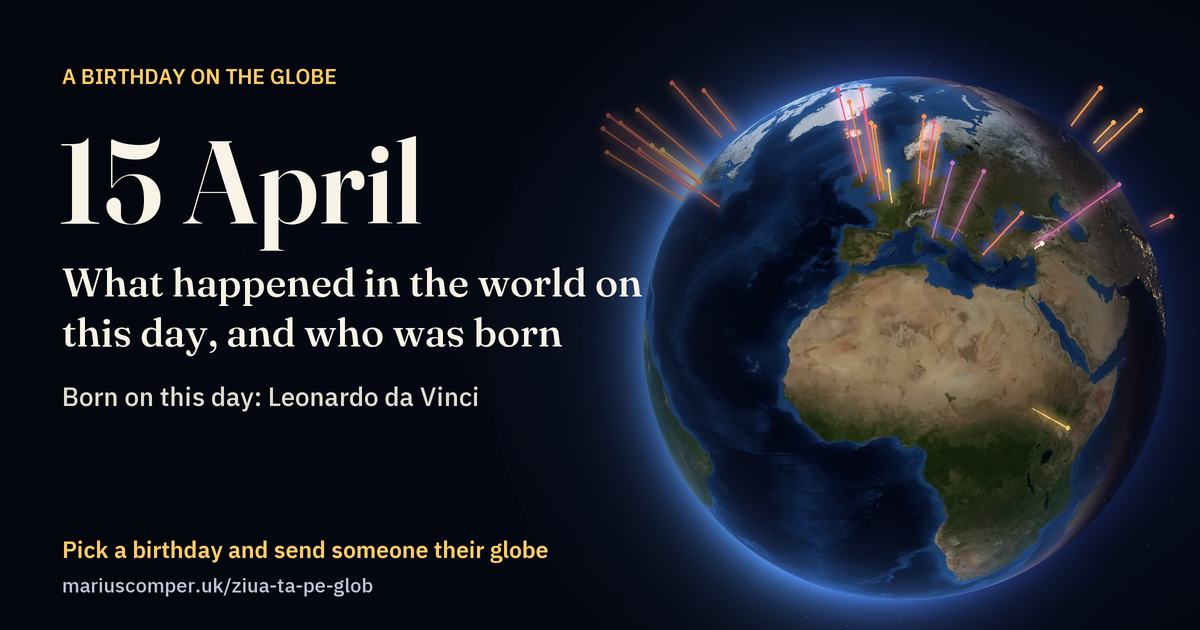
For 15 April, the English Wikipedia lists 48 events and 258 births. 30 of the events stand at their places as rays of light; three more are dashed circles, where the sentence links only to a country or a sea. The taller the ray, the longer ago it happened. The people born that day come further down, as blue points.
A birthday, yours or someone else’s:
Turn it into a greetingScroll: the globe turns to each place
The day you were born, on the globe.
Three things from your day
Scroll: your day first, then 15 April through the years
The Earth on 15 April
The picture on the globe was assembled by NASA from satellite photographs taken in April 2004: the snow, the ice and the green are those of the month.
On 15 April the Sun passes straight overhead at noon along the parallel of 9.9° north. In London, the day lasts about 13 hours 55 minutes.
Beyond 80° north the Sun no longer sets; beyond 80° south it no longer rises.
The line between day and night is tilted on the globe exactly as on this day of the year. On the dark side you can see the lights of towns.
Britain & Ireland · Ullswater
1802
English poet William Wordsworth and his sister Dorothy encountered a "long belt" of daffodils near Ullswater, inspiring him to pen his best-known work, "I Wandered Lonely as a Cloud".
On the map: Ullswater.
Britain & Ireland · Victoria Coach Station
1957
The Indiaman departed Victoria Coach Station, London, as part of the first UK–India bus service.
On the map: Victoria Coach Station.
Europe · Athens
1896
Closing ceremony of the Games of the I Olympiad in Athens, Greece.
On the map: Athens.
Also on the day’s list of Wikipedia in Spanish and Romanian.
North America · American School for the Deaf
1817
Thomas Hopkins Gallaudet and Laurent Clerc found the American School for the Deaf (then called the Connecticut Asylum for the Education and Instruction of Deaf and Dumb Persons), the first American school for deaf students, in Hartford, Connecticut.
On the map: American School for the Deaf.
North America · Des Plaines, Illinois
1955
McDonald's restaurant dates its founding to the opening of a franchised restaurant by Ray Kroc, in Des Plaines, Illinois.
On the map: Des Plaines, Illinois.
North America · Shaw University
1960
At Shaw University in Raleigh, North Carolina, Ella Baker leads a conference that results in the creation of the Student Nonviolent Coordinating Committee, one of the principal organizations of the civil rights movement in the 1960s.
On the map: Shaw University.
15 April
What the other Wikipedias remember#
For these years the English list has nothing on this day. The events below come from the same day’s lists on Wikipedia in Spanish and Romanian and were translated for this page.
From Wikipedia in Spanish · Seville
1493
In Seville, Christopher Columbus arrives after the first crossing of the Atlantic Ocean; he is received in triumph.
On the map: Seville.
Translated from the list on Wikipedia in Spanish.
From Wikipedia in Romanian · Orlat
1762
By an imperial decree signed by Empress Maria Theresa, the Romanian border regiments are established: the 1st at Orlat and the 2nd at Năsăud.
On the map: Orlat.
Translated from the list on Wikipedia in Romanian.
The article on Wikipedia in Romanian: Maria Terezia a Austriei
From Wikipedia in Spanish · London
1829
In London (England), the bill to create the Scotland Yard police is presented to the House.
On the map: London.
Translated from the list on Wikipedia in Spanish.
15 April
Born on 15 April#
The English Wikipedia lists 258 births for this day. The blue points are the birthplaces of 60 of these people: those written about in the most Wikipedia editions, where Wikidata gives a place of birth.
Born on 15 April
1452
Leonardo da Vinci, Italian painter, sculptor, and architect (died 1519)
Place of birth: Anchiano.
Born on 15 April
1707
Leonhard Euler, Swiss mathematician and physicist (died 1783)
Place of birth: Basel.
Born on 15 April
1858
Émile Durkheim, French sociologist, psychologist, and philosopher (died 1917)
Place of birth: Épinal.
Born on 15 April
1949
Alla Pugacheva, Russian singer-songwriter and actress
Place of birth: Moscow.
Born in Britain and Ireland
1959
Emma Thompson, English actress, comedian, author, activist and screenwriter
Place of birth: Paddington.
Born in Britain and Ireland
1997
Maisie Williams, English actress
Place of birth: Bristol.
Born in Britain and Ireland
1800
James Clark Ross, English captain and explorer (died 1862)
Place of birth: Finsbury Square.
15 April
Number one in the charts that week
At the cinema
An animal recorded that day
The record can be seen in GBIF, which brings together wildlife records from around the world.
All your birthdays
The weather that day
Data: Met Office Hadley Centre (HadCET); NOAA (GHCN-Daily, Mauna Loa).
Above the Earth
Sources: Jonathan McDowell, GCAT (launches); GFZ Potsdam (Kp index). Days are counted in Universal Time.
Football that day
International matches played that day:
Source: the “International football results” dataset kept by Mart Jürisoo (CC0).
Also that day
The earthquake’s page at the USGS
Source: the USGS catalogue. The day is counted in Universal Time (UTC).
In those days
Make a link for someone
Type the name, pick the day and the year of birth. The link opens straight on their day, with their name in the greeting.
The link carries the name, date and place typed here; anyone who gets it can see them.
Put another birthday beside it
Your mother’s, your child’s, a friend’s: the two days appear side by side.
Below: 15 April through the years.
The whole globe of the day
Drag the globe to turn it. Touch a ray or a point to read what happened there.
Everything Wikipedia lists for 15 April
The list is the English Wikipedia’s, in its own wording, as it stood in October 2026. 15 events have no place on the map: the sentence links to no place with coordinates, only to places too wide to mark, or to several countries.
- 769
The Lateran Council ends by condemning the Council of Hieria and anathematizing its iconoclastic rulings.
Europe · RomeWikipedia: Lateran Council - 1071
Bari, the last Byzantine possession in southern Italy, is surrendered to the Norman Robert Guiscard.
Europe · BariWikipedia: Siege of Bari - 1071
The sharif of Mecca changes the khutbah from the Shiite Fatimid caliph in Cairo to the Sunni Abbasid Caliph in Bagdhad.
no place on the mapWikipedia: Sharif of Mecca - 1191
Henry VI, King of Germany, is crowned Holy Roman Emperor by pope Celestine III.
no place on the mapWikipedia: Henry VI, Holy Roman Emperor - 1277
The Mamluk Sultanate defeats the Mongols in the battle of Elbistan.
Asia · Battle of ElbistanWikipedia: Battle of Elbistan - 1450
Battle of Formigny: Toward the end of the Hundred Years' War, the French attack and nearly annihilate English forces, ending English domination in Northern France.
Europe · Battle of FormignyWikipedia: Battle of Formigny - 1632
Battle of Rain: Swedes under Gustavus Adolphus defeat the Holy Roman Empire during the Thirty Years' War.
Europe · Battle of RainWikipedia: Battle of Rain - 1642
Irish Confederate Wars: A Confederate Irish militia is routed in the Battle of Kilrush when it attempts to halt the progress of a Royalist Army.
Britain & Ireland · Battle of KilrushWikipedia: Irish Confederate Wars - 1715
The Pocotaligo Massacre triggers the start of the Yamasee War in colonial South Carolina.
no place on the mapWikipedia: Yamasee War - 1736
Foundation of the short-lived Kingdom of Corsica.
Europe · Kingdom of CorsicaWikipedia: Kingdom of Corsica - 1738
Serse, an Italian opera by George Frideric Handel, receives its premiere performance in London, England.
no place on the mapWikipedia: Serse - 1755
Samuel Johnson's A Dictionary of the English Language is published in London.
no place on the mapWikipedia: Samuel Johnson - 1802
English poet William Wordsworth and his sister Dorothy encountered a "long belt" of daffodils near Ullswater, inspiring him to pen his best-known work, "I Wandered Lonely as a Cloud".
Britain & Ireland · UllswaterWikipedia: William Wordsworth - 1817
Thomas Hopkins Gallaudet and Laurent Clerc found the American School for the Deaf (then called the Connecticut Asylum for the Education and Instruction of Deaf and Dumb Persons), the first American school for deaf students, in Hartford, Connecticut.
North America · American School for the DeafWikipedia: Thomas Hopkins Gallaudet - 1861
President Abraham Lincoln calls for 75,000 militiamen to quell the insurrection that soon became the American Civil War.
no place on the mapWikipedia: American Civil War - 1865
President Abraham Lincoln dies after being shot the previous evening by actor John Wilkes Booth. Vice President Andrew Johnson becomes president.
North America · Assassination of Abraham LincolnWikipedia: Assassination of Abraham Lincoln - 1892
The General Electric Company is formed.
no place on the mapWikipedia: General Electric - 1896
Closing ceremony of the Games of the I Olympiad in Athens, Greece.
Europe · AthensWikipedia: 1896 Summer Olympics - 1900
Philippine–American War: Filipino guerrillas launch a surprise attack on U.S. infantry and begin a four-day siege of Catubig, Philippines.
Asia · Siege of CatubigWikipedia: Siege of Catubig - 1912
The British passenger liner RMS Titanic sinks in the North Atlantic at 2:20 a.m., two hours and forty minutes after hitting an iceberg. Only 712 of 2,207 passengers and crew on board survive.
Oceans · Sinking of the TitanicWikipedia: Sinking of the Titanic - 1920
Two security guards are murdered during a robbery in South Braintree, Massachusetts. Anarchists Sacco and Vanzetti would be convicted of and executed for the crime, amid much controversy.
North America · Braintree, MassachusettsWikipedia: Sacco and Vanzetti - 1922
U.S. Senator John B. Kendrick of Wyoming introduces a resolution calling for an investigation of a secret land deal, which leads to the discovery of the Teapot Dome scandal.
North America · Teapot Dome scandalWikipedia: John B. Kendrick - 1923
Insulin becomes generally available for use by people with diabetes.
no place on the mapWikipedia: Insulin - 1923
Racially motivated Nihon Shōgakkō fire lit by a serial arsonist kills 10 children in Sacramento, California.
North America · Japanese mission school fireWikipedia: Japanese mission school fire - 1927
Torrential rains caused the Mississippi River to break out of its levee system in at least 145 places, resulting in the worst flooding in the history of the United States.
no place on the mapWikipedia: Great Mississippi Flood of 1927 - 1936
First day of the Arab revolt in Mandatory Palestine.
Asia · Mandatory PalestineWikipedia: 1936–1939 Arab revolt in Palestine - 1941
World War II: In the Belfast Blitz, 200 bombers of the German Luftwaffe attack Belfast, killing some 1,000 people.
Britain & Ireland · County AntrimWikipedia: Belfast Blitz - 1942
World War II: The George Cross is awarded "to the island fortress of Malta" by King George VI.
no place on the mapWikipedia: Award of the George Cross to Malta - 1945
Bergen-Belsen concentration camp is liberated.
Europe · Bergen-Belsen concentration campWikipedia: Bergen-Belsen concentration camp - 1947
Jackie Robinson debuts for the Brooklyn Dodgers, breaking baseball's color line.
no place on the mapWikipedia: Jackie Robinson - 1952
First flight of the Boeing B-52 Stratofortress.
no place on the mapWikipedia: Boeing B-52 Stratofortress - 1955
McDonald's restaurant dates its founding to the opening of a franchised restaurant by Ray Kroc, in Des Plaines, Illinois.
North America · Des Plaines, IllinoisWikipedia: McDonald's - 1957
The Indiaman departed Victoria Coach Station, London, as part of the first UK–India bus service.
Britain & Ireland · Victoria Coach StationWikipedia: Victoria Coach Station - 1958
On Walter O'Malley's initiative, the Los Angeles Dodgers and San Francisco Giants played the first Major League Baseball game on the U.S. West Coast.
no place on the mapWikipedia: Walter O'Malley - 1960
At Shaw University in Raleigh, North Carolina, Ella Baker leads a conference that results in the creation of the Student Nonviolent Coordinating Committee, one of the principal organizations of the civil rights movement in the 1960s.
North America · Shaw UniversityWikipedia: Shaw University - 1969
The EC-121 shootdown incident: North Korea shoots down a United States Navy aircraft over the Sea of Japan, killing all 31 on board.
Oceans · 1969 EC-121 shootdown incidentWikipedia: 1969 EC-121 shootdown incident - 1970
During the Cambodian Civil War, massacre of the Vietnamese minority results in 800 bodies flowing down the Mekong river into South Vietnam.
Asia · South VietnamWikipedia: Cambodian Civil War - 1986
The United States launches Operation El Dorado Canyon, its bombing raids against Libyan targets in response to a discotheque bombing in West Germany that killed two U.S. servicemen.
Europe · West Berlin discotheque bombingWikipedia: 1986 United States bombing of Libya - 1989
Hillsborough disaster: A human crush occurs at Hillsborough Stadium, home of Sheffield Wednesday, in the FA Cup Semi-final, resulting in the deaths of 97 Liverpool fans.
Britain & Ireland · Hillsborough disasterWikipedia: Hillsborough disaster - 1989
Upon Hu Yaobang's death, the Tiananmen Square protests of 1989 begin in China.
Asia · 1989 Tiananmen Square protests and massacreWikipedia: 1989 Tiananmen Square protests and massacre - 1994
Marrakesh Agreement relating to foundation of World Trade Organization is adopted.
no place on the mapWikipedia: Marrakesh Agreement - 2002
Air China Flight 129 crashes on approach to Gimhae International Airport in Busan, South Korea, killing 129 people.
Asia · Air China Flight 129Wikipedia: Air China Flight 129 - 2013
A wave of bombings across Iraq kills at least 75 people.
no place on the mapWikipedia: 15 April 2013 Iraq attacks - 2013
Two bombs explode near the finish line at the Boston Marathon in Boston, Massachusetts, killing three people and injuring over 500 others.
North America · Boston Marathon bombingWikipedia: Boston Marathon bombing - 2014
In the worst massacre of the South Sudanese Civil War, more than 400 civilians are gunned down after seeking refuge in houses of worship as well as hospitals.
Africa · Bentiu massacreWikipedia: Bentiu massacre - 2019
The cathedral of Notre-Dame de Paris in France is seriously damaged by a large fire.
Europe · Notre-Dame de ParisWikipedia: Notre-Dame de Paris - 2021
A mass shooting occurs at a FedEx Ground facility in Indianapolis, Indiana, killing nine and injuring seven.
North America · 2021 Indianapolis FedEx shootingWikipedia: 2021 Indianapolis FedEx shooting - 2026
Twelve people and the perpetrator are killed and twelve others injured in a mass shooting at a school in Onikişubat, Turkey.
Asia · 2026 Onikişubat school shootingWikipedia: 2026 Onikişubat school shooting
What the other Wikipedias remember
For these years the English list has nothing on this day. The events below come from the same day’s lists on Wikipedia in Spanish and Romanian and were translated for this page.
- 1493
In Seville, Christopher Columbus arrives after the first crossing of the Atlantic Ocean; he is received in triumph.
- 1762
By an imperial decree signed by Empress Maria Theresa, the Romanian border regiments are established: the 1st at Orlat and the 2nd at Năsăud.
- 1829
In London (England), the bill to create the Scotland Yard police is presented to the House.
Who was born on 15 April
In order of how many Wikipedia editions have an article about each. The first 60 of 258 are shown.
- 1452
Leonardo da Vinci, Italian painter, sculptor, and architect (died 1519)
AnchianoWikipedia: Leonardo da Vinci - 1707
Leonhard Euler, Swiss mathematician and physicist (died 1783)
- 1894
Nikita Khrushchev, Russian general and politician, 7th Premier of the Soviet Union (died 1971)
KalinovkaWikipedia: Nikita Khrushchev - 1912
Kim Il Sung, North Korean general and politician, 1st Supreme Leader of North Korea (died 1994)
MangyŏngdaeWikipedia: Kim Il Sung - 1990
Emma Watson, English actress
- 1858
Émile Durkheim, French sociologist, psychologist, and philosopher (died 1917)
- 1949
Alla Pugacheva, Russian singer-songwriter and actress
- 1469
Guru Nanak, the first Sikh guru (died 1539)
Nankana SahibWikipedia: Guru Nanak - 1931
Tomas Tranströmer, Swedish poet, translator, and psychologist Nobel Prize laureate (died 2015)
StockholmWikipedia: Tomas Tranströmer - 1843
Henry James, American novelist, short story writer, and critic (died 1916)
New York CityWikipedia: Henry James - 1938
Claudia Cardinale, Italian actress (died 2025)
La GouletteWikipedia: Claudia Cardinale - 1959
Emma Thompson, English actress, comedian, author, activist and screenwriter
PaddingtonWikipedia: Emma Thompson - 1874
Johannes Stark, German physicist and academic, Nobel Prize laureate (died 1957)
FreihungWikipedia: Johannes Stark - 1920
Richard von Weizsäcker, German soldier and politician, 6th President of Germany (died 2015)
New PalaceWikipedia: Richard von Weizsäcker - 1961
Carol W. Greider, American molecular biologist
San DiegoWikipedia: Carol W. Greider - 1684
Catherine I of Russia (died 1727)
KrustpilsWikipedia: Catherine I of Russia - 1930
Vigdís Finnbogadóttir, Icelandic educator and politician, 4th President of Iceland
ReykjavíkWikipedia: Vigdís Finnbogadóttir - 1642
Suleiman II, Ottoman sultan (died 1691)
ConstantinopleWikipedia: Suleiman II - 1896
Nikolay Semyonov, Russian physicist and chemist, Nobel Prize laureate (died 1986)
SaratovWikipedia: Nikolay Semyonov - 1832
Wilhelm Busch, German poet, painter, and illustrator (died 1908)
WiedensahlWikipedia: Wilhelm Busch - 1907
Nikolaas Tinbergen, Dutch-English ethologist and ornithologist, Nobel Prize laureate (died 1988)
The HagueWikipedia: Nikolaas Tinbergen - 1943
Robert Lefkowitz, American physician and biochemist, Nobel Prize laureate
The BronxWikipedia: Robert Lefkowitz - 1997
Maisie Williams, English actress
BristolWikipedia: Maisie Williams - 1982
Seth Rogen, Canadian-American actor, director, producer, and screenwriter
VancouverWikipedia: Seth Rogen - 1800
James Clark Ross, English captain and explorer (died 1862)
Finsbury SquareWikipedia: James Clark Ross - 1894
Bessie Smith, African-American singer and actress (died 1937)
ChattanoogaWikipedia: Bessie Smith - 1978
Luis Fonsi, Puerto Rican-American singer-songwriter and dancer
San JuanWikipedia: Luis Fonsi - 68 BC
Gaius Maecenas, Roman politician (died 8 BC)
- 1793
Friedrich Georg Wilhelm von Struve, German astronomer and academic (died 1864)
- 1772
Étienne Geoffroy Saint-Hilaire, French biologist and zoologist (died 1844)
- 1940
Jeffrey Archer, English author, playwright, and politician (died 2026)
City of London Maternity HospitalWikipedia: Jeffrey Archer - 1979
Luke Evans, Welsh actor and singer
PontypoolWikipedia: Luke Evans - 1878
Robert Walser, Swiss author and playwright (died 1956)
Biel/BienneWikipedia: Robert Walser - 1966
Samantha Fox, English singer-songwriter and actress
LondonWikipedia: Samantha Fox - 1983
Dudu Cearense, Brazilian footballer
FortalezaWikipedia: Dudu Cearense - 1646
Christian V of Denmark (died 1699)
FlensburgWikipedia: Christian V of Denmark - 1920
Thomas Szasz, Hungarian-American psychiatrist and academic (died 2012)
BudapestWikipedia: Thomas Szasz - 1992
Remo Freuler, Swiss footballer
EnnendaWikipedia: Remo Freuler - 1809
Hermann Grassmann, German linguist and mathematician (died 1877)
SzczecinWikipedia: Hermann Grassmann - 1986
Tom Heaton, English footballer
ChesterWikipedia: Tom Heaton - 1563
Guru Arjan Dev, fifth Sikh leader (died 1606)
Goindwal SahibWikipedia: Guru Arjan - 1904
Arshile Gorky, Armenian-American painter and illustrator (died 1948)
DilkayaWikipedia: Arshile Gorky - 1962
Nawal El Moutawakel, Moroccan athlete and politician
CasablancaWikipedia: Nawal El Moutawakel - 1982
Albert Riera, Spanish footballer and manager
ManacorWikipedia: Albert Riera - 1922
Michael Ansara, Syrian-American actor (died 2013)
- 1948
Michael Kamen, American composer and conductor (died 2003)
New York CityWikipedia: Michael Kamen - 1992
John Guidetti, Swedish footballer
VästerledWikipedia: John Guidetti - 1993
Felipe Anderson, Brazilian footballer
Santa MariaWikipedia: Felipe Anderson - 1883
Stanley Bruce, Australian captain and politician, 8th Prime Minister of Australia (died 1967)
MelbourneWikipedia: Stanley Bruce - 1921
Georgy Beregovoy, Ukrainian-Russian general, pilot, and astronaut (died 1995)
FedorivkaWikipedia: Georgy Beregovoy - 1910
Miguel Najdorf, Polish-Argentinian chess player and theoretician (died 1997)
Grodzisk MazowieckiWikipedia: Miguel Najdorf - 1960
Susanne Bier, Danish director and screenwriter
CopenhagenWikipedia: Susanne Bier - 1995
Leander Dendoncker, Belgian footballer
PassendaleWikipedia: Leander Dendoncker - 1965
Soichi Noguchi, Japanese engineer and astronaut
YokohamaWikipedia: Soichi Noguchi - 1856
Jean Moréas, Greek poet and critic (died 1910)
AthensWikipedia: Jean Moréas - 1957
Evelyn Ashford, American runner and coach
ShreveportWikipedia: Evelyn Ashford - 1968
Ed O'Brien, English guitarist
OxfordWikipedia: Ed O'Brien - 1983
Alice Braga, Brazilian actress
São PauloWikipedia: Alice Braga - 1889
Thomas Hart Benton, American painter and educator (died 1975)
- 1908
Lita Grey, American actress (died 1995)
HollywoodWikipedia: Lita Grey
What is celebrated on 15 April
- Christian feast day: Abbo II of Metz
- Christian feast day: Blessed César de Bus
- Christian feast day: Father Damien (Catholic and Episcopal Church)
- Christian feast day: Hunna
- Christian feast day: Paternus of Avranches
- Christian feast day: April 15 (Eastern Orthodox liturgics)
- Day of the Sun (North Korea)
- Father Damien Day (Hawaii)
- Hillsborough Disaster Memorial (Liverpool, England)
- Jackie Robinson Day (United States)
- National American Sign Language Day (United States)
- Pohela Boishakh (Bengali New Year; India)
- Tax Day, the official deadline for filing an individual tax return (or requesting an extension). (United States, Philippines)
- Universal Day of Culture
A greeting link for someone
Type a name and, if you like, the year of birth. The link opens with a greeting, and beside each event it says how old the person turned that day, or how many years before their birth it happened.
The name and the year go only into the link you send.
All 366 days
How the globe is made
Where the events come from
Each edition of this page uses the day’s list from Wikipedia in its own language: Romanian, English, Spanish, Chinese. The lists are written by volunteers and differ from one edition to the next; the text of each event is Wikipedia’s, with a link to the article. A row that appears twice in a list is shown once. The lists have not been checked event by event: they are Wikipedia’s, mistakes included.
For events before 1582, and for countries that moved to the Gregorian calendar later (Britain in 1752, Russia in 1918), the same day may be counted Old Style in one list and New Style in another.
The chapter “What the other Wikipedias remember” adds up to five events a day from the lists of the other three editions, only for years in which the English list has nothing on that day. They were translated for this page, passed the same filters as the tour, and are not counted among the events of the English list.
How an event gets onto the map
The place comes from Wikidata. If the sentence links to the article about the event itself (a battle, an opening, an earthquake), dated to the same year, the ray stands on its coordinates or on those of its location. Otherwise it stands on the first place the sentence links to: a town, a building, a mountain, an island. This second step can be wrong: sometimes the sentence only mentions the place. That is why the page says, under each event, which place the ray stands on.
When the sentence links to a single state or province, or to a single sea, lake or desert larger than 5,000 km², the globe shows a dashed circle, not a ray. The circle has the area Wikidata gives, with its radius kept between 1.2° and 16°, or a radius of 4.5° when Wikidata gives no area; it says only that the sentence links to that place. Organisations, ships, spacecraft, museum objects, rivers, mountain ranges, languages and continents are never used as places. When a sentence names several states and no exact place, the event stays in the list only.
What the height means
The height of a ray shows how many years have passed, on a logarithmic scale: 10 years, 100 years and 1,000 years are equal steps apart; anything older than about 2,600 years has the tallest ray. The colour runs from pale yellow for recent years to violet for antiquity.
Where the tour stops
In each region the tour stops at up to three events (five in Britain and Ireland), chosen mainly by three things: whether Wikipedia’s editors put the event in the “On this day” box of their main page (the English, Spanish and Chinese editions), how many Wikipedia editions have an article about it, and how many of the four lists include it. Events whose sentence or article is about a war, an attack, a crime or a disaster are left out of the tour; they stay in the whole list, in Wikipedia’s wording. The filter is a list of words and a list of Wikidata types, so it can miss some.
The tour of births names the people with articles in the most editions and leaves aside those whom the list or Wikidata describes as rulers, politicians, commanders, leaders of movements or criminals; they stay in the list.
The Earth and the Sun
The daytime images are NASA’s Blue Marble Next Generation mosaics, one for each month of 2004; the night side is Black Marble 2016. The tilt of the line between day and night is computed for the day; the hour is chosen so that the place being read is in daylight. The latitude where the Sun stands overhead is the average of the four years of the leap cycle; in a given year it can differ by up to 0.4°.
The day you were born
The number ones come from the weekly lists on Wikipedia: Billboard for the United States (from 1940; the Hot 100 from August 1958), the UK Singles Chart (from November 1952), Los 40 Principales for Spain (from July 1966) and, for Romania, the Romanian Top 100 and Airplay 100 (2001–2021, with missing weeks). The page shows the chart of the week in which the day of birth falls, with its date; Billboard and the UK chart are dated at the end of their week. For Romania before 2001 and for China these sources have no weekly chart.
The films are those that reached cinemas in the United States up to ten days before or three days after that day (some of them in a few cinemas at first), from the English Wikipedia’s yearly lists (from 1968), in order of how many editions have an article about them. The events “in those days” are the ones on the neighbouring days’ lists that carry the year of birth, passed through the same filter as the tour.
The day of birth, year included
The Moon, the star sign and the constellation are worked out by the page itself, for noon Universal Time on the day. The lit part of the Moon is rounded and can differ by a few per cent from that at the hour of birth. The sign follows the usual zodiac of twelve equal parts starting at the March equinox; the constellation is the one the Sun actually stood in front of, by the borders set by the International Astronomical Union, and within a day of a border the page does not name it. When the Sun changes sign while it is that day anywhere on Earth, the page gives the moment of crossing, rounded to ten minutes and accurate to within about a quarter of an hour, and the clock time in a few cities, with the time zone and summer time of that year.
The year in the Chinese calendar is the one your device’s own calendar gives for the date, checked against the Hong Kong Observatory’s tables. “All your birthdays” uses the same sources as the rest of the chapter for the same day in every year since the birth: the temperature, well-known launches that took place on that very day, matches of the teams the edition follows, snow deeper than 10 cm and strong geomagnetic storms. The three things at the top and the four on the picture are chosen in a fixed order (the song, the animal, a full Moon, a well-known launch before an ordinary earthquake); on the picture you can change them.
When the link carries a year of birth, the page adds a few things about that exact day. The weather is the Met Office’s Central England temperature record and the readings from New York’s Central Park; the “usual high” is the average of the daily highs of 1961–1990 for that date, with two days either side. The carbon dioxide figure is the monthly mean at the Mauna Loa observatory, where measurements begin in March 1958.
The earthquake is the one with the largest magnitude in the USGS catalogue for that day, counted in Universal Time. Before the 1960s the catalogue has gaps even above magnitude 5.5, so in the older years many days have no earthquake. The page gives only the magnitude and the place: the country the epicentre falls in or, when the epicentre is at sea within 300 km of a coast, the nearest country; farther out, only the ocean.
The launches are those that reached orbit or left for the Moon and the planets, from Jonathan McDowell’s GCAT catalogue. If nothing left that day, the page shows the nearest launch within three days before or after, and says how many days away it was. The geomagnetic storm appears only when the Kp index reached at least 5 in one of the day’s eight three-hour intervals.
The animal comes from GBIF: an observation made by a person (the animal seen or heard, or its tracks), dated to that exact day, with coordinates and a CC0 or CC BY licence. Only a few hundred well-known species are searched (mammals, birds, turtles, butterflies); of those noted that day, mammals and species with articles in many Wikipedia editions come first; birds noted almost every day, and species used recently, wait their turn. Observations dated 1 January are left out, because records without a day are often filed there. An observation shows that the animal was recorded there, not how many animals there were.
The matches are those between national teams. Only matches of England, Scotland, Wales, Northern Ireland, the Republic of Ireland, the United States, Canada and Australia are shown, along with those at the big final tournaments. The picture to send is drawn in the page from the day’s globe and the facts above, and stays on your device until you send it.
Sources
- Events, births and holidays: the day’s page on Wikipedia, text under CC BY-SA 4.0.
- Coordinates, places of birth and the number of editions: Wikidata (CC0).
- The Earth by day: NASA Blue Marble Next Generation. The Earth by night: NASA Black Marble 2016.
- Borders and regions: Natural Earth.
- World population and births per year: UN World Population Prospects 2024.
- Charts and films: Wikipedia’s lists for Billboard, the UK Singles Chart, Los 40 Principales, Romanian Top 100, Airplay 100 and American films by year (CC BY-SA 4.0).
- Weather: Met Office Hadley Centre, HadCET (Open Government Licence) and NOAA GHCN-Daily, New York Central Park. Carbon dioxide: NOAA Global Monitoring Laboratory, Mauna Loa.
- Earthquakes: the USGS catalogue. Launches: Jonathan McDowell, GCAT (CC BY). Kp index: GFZ Potsdam (CC BY 4.0). Matches: International football results, Mart Jürisoo (CC0).
- Animal observations: GBIF, with a link to each record; species names come from Wikidata.