A birthday on the globe
26 September on the globe: what happened in the world on this day, and who was born
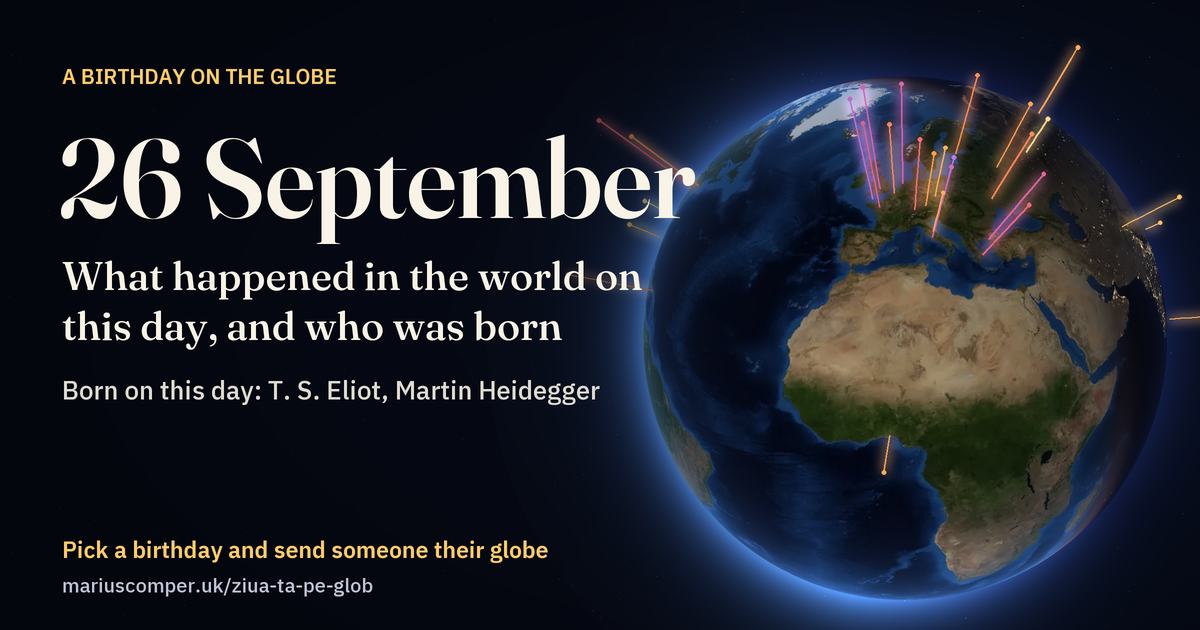
For 26 September, the English Wikipedia lists 58 events and 265 births. 27 of the events stand at their places as rays of light; one more is a dashed circle, where the sentence links only to a country or a sea. The taller the ray, the longer ago it happened. The people born that day come further down, as blue points.
A birthday, yours or someone else’s:
Turn it into a greetingScroll: the globe turns to each place
The day you were born, on the globe.
Three things from your day
Scroll: your day first, then 26 September through the years
The Earth on 26 September
The picture on the globe was assembled by NASA from satellite photographs taken in September 2004: the snow, the ice and the green are those of the month.
On 26 September the Sun passes straight overhead at noon along the parallel of 1.2° south. In London, the day lasts about 12 hours.
The line between day and night is tilted on the globe exactly as on this day of the year. On the dark side you can see the lights of towns.
North America · Newport
1983
The racing yacht Australia II, captained by John Bertrand, won the America's Cup and ended the New York Yacht Club's 132-year defence of the trophy.
On the map: Newport.
26 September
What the other Wikipedias remember#
For these years the English list has nothing on this day. The events below come from the same day’s lists on Wikipedia in Romanian and Spanish and were translated for this page.
From Wikipedia in Romanian · Paris
1815
The act founding the "Holy Alliance" is signed in Paris by Alexander I, Tsar of Russia (1801-1825), Francis I, Emperor of Austria (1804-1835), and Frederick William III, King of Prussia (1797-1840).
On the map: Paris.
Translated from the list on Wikipedia in Romanian.
From Wikipedia in Spanish · Maipú, Buenos Aires
1878
In the province of Buenos Aires (Argentina), Francisco Bernabé Madero founds the town of Maipú.
On the map: Maipú, Buenos Aires.
Translated from the list on Wikipedia in Spanish.
The article on Wikipedia in Spanish: Francisco Bernabé Madero
From Wikipedia in Spanish · athletics at the 1988 Summer Olympics
1988
In South Korea, the athlete Ben Johnson has to return his 100 metres gold medal won at the Seoul Olympics after testing positive in the doping control.
On the map: athletics at the 1988 Summer Olympics.
Translated from the list on Wikipedia in Spanish.
The article on Wikipedia in Spanish: Anexo:Atletismo en los Juegos Olímpicos de Seúl 1988
26 September
Born on 26 September#
The English Wikipedia lists 265 births for this day. The blue points are the birthplaces of 60 of these people: those written about in the most Wikipedia editions, where Wikidata gives a place of birth.
Born on 26 September
1888
T. S. Eliot, English poet, playwright, critic, Nobel Prize laureate (died 1965)
Place of birth: St. Louis.
Born on 26 September
1889
Martin Heidegger, German philosopher and academic (died 1976)
Place of birth: Meßkirch.
Born on 26 September
1981
Serena Williams, American tennis player
Place of birth: Saginaw.
Born on 26 September
1849
Ivan Pavlov, Russian physiologist and physician, Nobel Prize laureate (died 1936)
Place of birth: Ryazan.
Born on 26 September
1898
George Gershwin, American pianist and composer (died 1937)
Place of birth: Brooklyn.
Born in Britain and Ireland
1948
Olivia Newton-John, English-Australian singer-songwriter and actress (died 2022)
Place of birth: Cambridge.
Born in Britain and Ireland
1945
Bryan Ferry, English singer-songwriter
Place of birth: Washington.
Born in Britain and Ireland
1875
Edmund Gwenn, English-American actor (died 1959)
Place of birth: London.
26 September
Number one in the charts that week
At the cinema
An animal recorded that day
The record can be seen in GBIF, which brings together wildlife records from around the world.
All your birthdays
The weather that day
Data: Met Office Hadley Centre (HadCET); NOAA (GHCN-Daily, Mauna Loa).
Above the Earth
Sources: Jonathan McDowell, GCAT (launches); GFZ Potsdam (Kp index). Days are counted in Universal Time.
Football that day
International matches played that day:
Source: the “International football results” dataset kept by Mart Jürisoo (CC0).
Also that day
The earthquake’s page at the USGS
Source: the USGS catalogue. The day is counted in Universal Time (UTC).
In those days
Make a link for someone
Type the name, pick the day and the year of birth. The link opens straight on their day, with their name in the greeting.
The link carries the name, date and place typed here; anyone who gets it can see them.
Put another birthday beside it
Your mother’s, your child’s, a friend’s: the two days appear side by side.
Below: 26 September through the years.
The whole globe of the day
Drag the globe to turn it. Touch a ray or a point to read what happened there.
Everything Wikipedia lists for 26 September
The list is the English Wikipedia’s, in its own wording, as it stood in October 2026. 30 events have no place on the map: the sentence links to no place with coordinates, only to places too wide to mark, or to several countries.
- 46 BC
Julius Caesar dedicates a temple to Venus Genetrix, fulfilling a vow he made at the Battle of Pharsalus.
Europe · Temple of Venus GenetrixWikipedia: Battle of Pharsalus - 715
Ragenfrid defeats Theudoald at the Battle of Compiègne.
Britain & Ireland · Battle of CompiègneWikipedia: Battle of Compiègne - 1087
William II is crowned King of England, and reigns until 1100.
no place on the mapWikipedia: William II of England - 1142
Stephen of Blois's army approaches Oxford, beginning the siege of Oxford.
Britain & Ireland · Siege of OxfordWikipedia: Siege of Oxford - 1143
Election of pope Celestine II following the death of pope Innocent II.
Europe · 1143 papal electionWikipedia: 1143 papal election - 1212
The Golden Bull of Sicily is issued to confirm the hereditary royal title in Bohemia for the Přemyslid dynasty.
no place on the mapWikipedia: Golden Bull of Sicily - 1345
Friso-Hollandic Wars: Frisians defeat Holland in the Battle of Warns.
Europe · StaverenWikipedia: Battle of Staveren - 1371
Serbian–Turkish wars: Ottoman Turks fight against a Serbian army at the Battle of Maritsa.
Europe · Battle of MaritsaWikipedia: Battle of Maritsa - 1423
Hundred Years' War: A French army defeats the English at the Battle of La Brossinière.
Europe · Battle of La BrossinièreWikipedia: Battle of La Brossinière - 1493
Pope Alexander VI issues the papal bull Dudum siquidem to the Spanish, extending the grant of new lands he made them in Inter caetera.
no place on the mapWikipedia: Pope Alexander VI - 1580
Francis Drake finishes his circumnavigation of the Earth in Plymouth, England.
no place on the mapWikipedia: Francis Drake - 1687
Morean War: The Parthenon in Athens, used as a gunpowder depot by the Ottoman garrison, is partially destroyed after being bombarded during the Siege of the Acropolis by Venetian forces.
Europe · ParthenonWikipedia: Morean War - 1688
The city council of Amsterdam votes to support William of Orange's invasion of England, which became the Glorious Revolution.
Britain & Ireland · British IslesWikipedia: Glorious Revolution - 1777
American Revolutionary War: British troops capture and begin the occupation of Philadelphia, which had been serving as the American capital city, during the Philadelphia campaign.
North America · PhiladelphiaWikipedia: American Revolutionary War - 1789
George Washington appoints Thomas Jefferson the first United States Secretary of State.
no place on the mapWikipedia: George Washington - 1799
War of the 2nd Coalition: French troops defeat Austro-Russian forces, leading to the collapse of Suvorov's campaign.
Europe · Second Battle of ZurichWikipedia: War of the Second Coalition - 1810
A new Act of Succession is adopted by the Riksdag of the Estates, and Jean Baptiste Bernadotte becomes heir to the Swedish throne.
no place on the mapWikipedia: Swedish Act of Succession - 1905
Albert Einstein publishes the third of his Annus Mirabilis papers, introducing the special theory of relativity.
no place on the mapWikipedia: Albert Einstein - 1907
Four months after the 1907 Imperial Conference, New Zealand and Newfoundland are promoted from colonies to dominions within the British Empire.
no place on the mapWikipedia: 1907 Imperial Conference - 1907
The British colony of New Zealand officially became a dominion to reflect its political independence since the 1850s.
no place on the mapWikipedia: Colony of New Zealand - 1914
The United States Federal Trade Commission is established by the Federal Trade Commission Act.
no place on the mapWikipedia: Federal Trade Commission Act of 1914 - 1917
World War I: The Battle of Polygon Wood begins.
Europe · Battle of Polygon WoodWikipedia: World War I - 1918
World War I: The Meuse-Argonne Offensive began which would last until the total surrender of German forces.
no place on the mapWikipedia: Meuse–Argonne offensive - 1919
Ukrainian War of Independence: The Revolutionary Insurgent Army of Ukraine defeats the White Russian Volunteer Army at the Battle of Peregonovka.
Europe · Battle of PeregonovkaWikipedia: Battle of Peregonovka - 1923
The German government calls off the passive resistance to the French and Belgian occupation of the Ruhr.
no place on the mapWikipedia: Occupation of the Ruhr - 1928
The Republic of China adopted Gwoyeu Romatzyh as the official system for romanization of Mandarin Chinese.
no place on the mapWikipedia: Nationalist government - 1933
As gangster Machine Gun Kelly surrenders to the FBI, he shouts out, "Don't shoot, G-Men!", which becomes a nickname for FBI agents.
no place on the mapWikipedia: Machine Gun Kelly - 1936
Spanish Civil War: Lluis Companys reshuffles the Generalitat de Catalunya, with the marxist POUM and anarcho-syndicalist CNT joining the government.
no place on the mapWikipedia: Spanish Civil War - 1942
Holocaust: Senior SS official August Frank issues a memorandum detailing how Jews should be "evacuated".
no place on the mapWikipedia: The Holocaust - 1944
World War II: The Soviet Red Army completed the Tallinn offensive, driving German forces out of Estonia.
Europe · Tallinn offensiveWikipedia: Tallinn offensive - 1950
Korean War: United Nations troops recapture Seoul from North Korean forces.
no place on the mapWikipedia: Korean War - 1953
Rationing of sugar in the United Kingdom ends.
no place on the mapWikipedia: Rationing in the United Kingdom - 1954
The Japanese rail ferry Tōya Maru sinks during a typhoon in the Tsugaru Strait, Japan, killing 1,172.
no place on the mapWikipedia: Tōya Maru - 1959
The Cambodian–Vietnamese War formally ended with the withdrawal of Vietnamese forces from the People's Republic of Kampuchea, a client state it had implemented to overthrow Democratic Kampuchea and the Khmer Rouge.
no place on the mapWikipedia: Cambodian–Vietnamese War - 1959
Typhoon Vera, the strongest typhoon to hit Japan in recorded history, makes landfall, killing 4,580 people and leaving nearly 1.6 million others homeless.
no place on the mapWikipedia: Typhoon Vera - 1960
In Chicago, the first televised debate takes place between presidential candidates Richard M. Nixon and John F. Kennedy.
no place on the mapWikipedia: United States presidential debates - 1968
The Beatles completed the recording of John Lennon's song "Happiness Is a Warm Gun", regarded by all the band members as their favourite on the album The Beatles.
no place on the mapWikipedia: The Beatles - 1978
Air Caribbean Flight 309 crashes in Residencial Las Casas in San Juan, Puerto Rico, killing six.
Latin America · Air Caribbean Flight 309Wikipedia: Air Caribbean Flight 309 - 1980
A terrorist bombing at the Oktoberfest in Munich, Germany, kills 13 people and injures 213 others.
Europe · Oktoberfest bombingWikipedia: Oktoberfest bombing - 1983
Soviet Air Force officer Stanislav Petrov identifies a report of an incoming nuclear missile as a computer error and not an American first strike, thus preventing nuclear war.
Europe · 1983 Soviet nuclear false alarm incidentWikipedia: 1983 Soviet nuclear false alarm incident - 1983
Soyuz 7K-ST No. 16L, intended to launch a crew to the Salyut 7 space station, explodes on the launch pad. The launch escape system is activated before the Soyuz-U rocket explodes, saving the crew.
no place on the mapWikipedia: Soyuz 7K-ST No.16L - 1983
The racing yacht Australia II, captained by John Bertrand, won the America's Cup and ended the New York Yacht Club's 132-year defence of the trophy.
North America · NewportWikipedia: 1983 America's Cup - 1984
The United Kingdom and China agree to a transfer of sovereignty over Hong Kong, to take place in 1997.
no place on the mapWikipedia: Handover of Hong Kong - 1992
A Nigerian Air Force Lockheed C-130 Hercules crashes in Ejigbo, Lagos, killing 159.
Africa · 1992 Nigerian Air Force C-130 crashWikipedia: 1992 Nigerian Air Force C-130 crash - 1994
A Yakovlev Yak-40 crashes into a river near Vanavara, Russia, killing 24.
Asia · 1994 Vanavara Yakovlev Yak-40 crashWikipedia: 1994 Vanavara Yakovlev Yak-40 crash - 1997
A Garuda Indonesia Airbus A300 crashes near Medan airport, killing 234.
Asia · Garuda Indonesia Flight 152Wikipedia: Garuda Indonesia Flight 152 - 1997
An earthquake strikes the Italian regions of Umbria and the Marche, causing part of the Basilica of St. Francis at Assisi to collapse.
Europe · 1997 Umbria–Marche earthquakesWikipedia: 1997 Umbria–Marche earthquakes - 2000
Anti-globalization protests in Prague (some 20,000 protesters) turn violent during the IMF and World Bank summits.
Europe · PragueWikipedia: 2000 Prague anti-globalization protests - 2000
The MS Express Samina sinks off Paros in the Aegean Sea killing 80 passengers.
no place on the mapWikipedia: MS Express Samina - 2002
The overcrowded Senegalese ferry, MV Le Joola, capsizes off the coast of the Gambia killing more than 1,000.
no place on the mapWikipedia: MV Le Joola - 2008
Swiss pilot and inventor Yves Rossy flew a wingpack powered by jet engines across the English Channel.
no place on the mapWikipedia: Yves Rossy - 2009
Typhoon Ketsana hits the Philippines, China, Vietnam, Cambodia, Laos and Thailand, causing 700 fatalities.
no place on the mapWikipedia: Typhoon Ketsana - 2010
Scottish aid worker Linda Norgrove and three Afghan colleagues were kidnapped by members of the Taliban in Kunar Province, Afghanistan.
Asia · Korangal ValleyWikipedia: Death of Linda Norgrove - 2010
The Philippine Bar exam bombing occurs near the De La Salle University in Taft Avenue, Manila injuring 47 people.
Asia · 2010 Philippine Bar exam bombingWikipedia: 2010 Philippine Bar exam bombing - 2014
A mass kidnapping of 43 students from a teaching college occurs in Iguala, Mexico.
Latin America · Iguala mass kidnappingWikipedia: Iguala mass kidnapping - 2016
The Ecnomiohyla rabborum became extinct when the last known surviving member died in captivity.
no place on the mapWikipedia: Ecnomiohyla rabborum - 2022
A mass shooting occurs at a school in Izhevsk, Udmurtia, Russia, resulting in the deaths of 18 people, including 11 children.
Europe · Izhevsk school shootingWikipedia: Izhevsk school shooting - 2024
Hurricane Helene makes landfall in Perry, Florida as a Category 4 hurricane, killing over 250 people, causing US$78.7 billion in damage and becoming the deadliest hurricane in the mainland United States since Katrina.
North America · Perry, FloridaWikipedia: Hurricane Katrina
What the other Wikipedias remember
For these years the English list has nothing on this day. The events below come from the same day’s lists on Wikipedia in Romanian and Spanish and were translated for this page.
- 1815
The act founding the "Holy Alliance" is signed in Paris by Alexander I, Tsar of Russia (1801-1825), Francis I, Emperor of Austria (1804-1835), and Frederick William III, King of Prussia (1797-1840).
- 1878
In the province of Buenos Aires (Argentina), Francisco Bernabé Madero founds the town of Maipú.
Latin America · Maipú, Buenos AiresTranslated from the list on Wikipedia in SpanishWikipedia: Francisco Bernabé Madero - 1988
In South Korea, the athlete Ben Johnson has to return his 100 metres gold medal won at the Seoul Olympics after testing positive in the doping control.
Asia · athletics at the 1988 Summer OlympicsTranslated from the list on Wikipedia in SpanishWikipedia: Anexo:Atletismo en los Juegos Olímpicos de Seúl 1988
Who was born on 26 September
In order of how many Wikipedia editions have an article about each. The first 60 of 265 are shown.
- 1888
T. S. Eliot, English poet, playwright, critic, Nobel Prize laureate (died 1965)
St. LouisWikipedia: T. S. Eliot - 1889
Martin Heidegger, German philosopher and academic (died 1976)
MeßkirchWikipedia: Martin Heidegger - 1897
Pope Paul VI (died 1978)
ConcesioWikipedia: Pope Paul VI - 1981
Serena Williams, American tennis player
SaginawWikipedia: Serena Williams - 1849
Ivan Pavlov, Russian physiologist and physician, Nobel Prize laureate (died 1936)
RyazanWikipedia: Ivan Pavlov - 1965
Petro Poroshenko, Ukrainian businessman and politician, 5th President of Ukraine
BolhradWikipedia: Petro Poroshenko - 1932
Manmohan Singh, Indian economist and politician, 13th Prime Minister of India (died 2024)
- 1898
George Gershwin, American pianist and composer (died 1937)
BrooklynWikipedia: George Gershwin - 1976
Michael Ballack, German footballer
GörlitzWikipedia: Michael Ballack - 1948
Olivia Newton-John, English-Australian singer-songwriter and actress (died 2022)
CambridgeWikipedia: Olivia Newton-John - 1791
Théodore Géricault, French painter and lithographer (died 1824)
- 1936
Winnie Madikizela-Mandela, South African academic and politician, 8th First Lady of South Africa (died 2018)
- 1914
Jack LaLanne, American fitness expert (died 2011)
San FranciscoWikipedia: Jack LaLanne - 1870
Christian X of Denmark (died 1947)
Charlottenlund PalaceWikipedia: Christian X - 1886
Archibald Hill, English physiologist, academic, and politician, Nobel Prize laureate (died 1977)
BristolWikipedia: Archibald Hill - 1983
Ricardo Quaresma, Portuguese footballer
- 1956
Linda Hamilton, American actress
SalisburyWikipedia: Linda Hamilton - 1968
Jim Caviezel, American actor
Mount VernonWikipedia: Jim Caviezel - 1946
Andrea Dworkin, American activist and author (died 2005)
- 1869
Komitas, Armenian-French priest and composer (died 1935)
KütahyaWikipedia: Komitas - 1919
Matilde Camus, Spanish poet and author (died 2012)
SantanderWikipedia: Matilde Camus - 1960
Uwe Bein, German footballer and manager
LengersWikipedia: Uwe Bein - 1945
Bryan Ferry, English singer-songwriter
WashingtonWikipedia: Bryan Ferry - 1979
Taavi Rõivas, Estonian politician, 16th Prime Minister of Estonia
TallinnWikipedia: Taavi Rõivas - 1923
Dev Anand, Indian actor, director, producer, and screenwriter (died 2011)
Shakargarh TehsilWikipedia: Dev Anand - 1927
Enzo Bearzot, Italian footballer and manager (died 2010)
Aiello del FriuliWikipedia: Enzo Bearzot - 1957
Klaus Augenthaler, German footballer and manager
FürstenzellWikipedia: Klaus Augenthaler - 1875
Edmund Gwenn, English-American actor (died 1959)
LondonWikipedia: Edmund Gwenn - 1981
Christina Milian, American singer-songwriter, dancer, and actress
Jersey CityWikipedia: Christina Milian - 1985
Talulah Riley, English actress
HertfordWikipedia: Talulah Riley - 1901
George Raft, American actor, singer, and dancer (died 1980)
New York CityWikipedia: George Raft - 1877
Alfred Cortot, Swiss pianist and conductor (died 1962)
- 1891
Hans Reichenbach, German philosopher from the Vienna Circle (died 1953)
HamburgWikipedia: Hans Reichenbach - 2001
João Pedro, Brazilian footballer
Ribeirão PretoWikipedia: João Pedro - 1874
Lewis Hine, American photographer and activist (died 1940)
OshkoshWikipedia: Lewis Hine - 1926
Julie London, American singer and actress (died 2000)
Santa RosaWikipedia: Julie London - 1949
Clodoaldo, Brazilian footballer and manager
AracajuWikipedia: Clodoaldo - 1995
Miloš Veljković, Serbian footballer
BelgradeWikipedia: Miloš Veljković - 1932
Vladimir Voinovich, Russian author and poet (died 2018)
DushanbeWikipedia: Vladimir Voinovich - 1937
Valentin Pavlov, Russian banker and politician, 11th Premier of the Soviet Union (died 2003)
- 1945
Gal Costa, Brazilian singer (died 2022)
SalvadorWikipedia: Gal Costa - 1944
Jan Brewer, American politician, 22nd Governor of Arizona
HollywoodWikipedia: Jan Brewer - 1972
Beto O'Rourke, American politician
El PasoWikipedia: Beto O'Rourke - 932
Al-Mu'izz li-Din Allah, Arab caliph (died 975)
- 1820
Ishwar Chandra Vidyasagar, Indian philosopher, painter, and academic (died 1891)
BirsinghaWikipedia: Ishwar Chandra Vidyasagar - 1932
Donna Douglas, American actress (died 2015)
East Baton Rouge ParishWikipedia: Donna Douglas - 1948
Vladimír Remek, Czech politician, diplomat, cosmonaut and military pilot
České BudějoviceWikipedia: Vladimír Remek - 1962
Mark Haddon, English author and poet
NorthamptonWikipedia: Mark Haddon - 1988
James Blake, English singer-songwriter and producer
LondonWikipedia: James Blake - 1980
Patrick Friesacher, Austrian racing driver
WolfsbergWikipedia: Patrick Friesacher - 2006
Myles Lewis-Skelly, English footballer
IslingtonWikipedia: Myles Lewis-Skelly - 1947
Lynn Anderson, American singer and actress (died 2015)
Grand ForksWikipedia: Lynn Anderson - 1774
Johnny Appleseed, American gardener and environmentalist (died 1845)
LeominsterWikipedia: Johnny Appleseed - 1942
Gloria E. Anzaldúa, American scholar of Chicana cultural theory (died 2004)
RaymondvilleWikipedia: Gloria Anzaldúa - 1962
Melissa Sue Anderson, American-Canadian actress
BerkeleyWikipedia: Melissa Sue Anderson - 1887
Barnes Wallis, English scientist and engineer, invented the Bouncing bomb (died 1979)
RipleyWikipedia: Barnes Wallis - 1895
Jürgen Stroop, German general (died 1952)
DetmoldWikipedia: Jürgen Stroop - 1907
Anthony Blunt, English historian and spy (died 1983)
BournemouthWikipedia: Anthony Blunt - 1914
Achille Compagnoni, Italian skier and mountaineer (died 2009)
Santa Caterina di ValfurvaWikipedia: Achille Compagnoni - 1958
Robert Kagan, Greek-American historian and author
AthensWikipedia: Robert Kagan
What is celebrated on 26 September
- Christian feast days: Canadian Martyrs (Catholic Church in Canada)
- Christian feast days: Cosmas and Damian
- Christian feast days: Blessed Crescencia Valls Espí
- Christian feast days: John of Meda
- Christian feast days: Blessed Kaspar Stanggassinger
- Christian feast days: Blessed Luigi Tezza
- Christian feast days: Nilus the Younger
- Christian feast days: Thérèse Couderc
- Christian feast days: Wilson Carlile (Anglican)
- Christian feast days: September 26 (Eastern Orthodox liturgics)
- Day of the National Flag (Ecuador)
- Dominion Day (New Zealand)
- European Day of Languages (European Union)
- International Day for the Total Elimination of Nuclear Weapons
A greeting link for someone
Type a name and, if you like, the year of birth. The link opens with a greeting, and beside each event it says how old the person turned that day, or how many years before their birth it happened.
The name and the year go only into the link you send.
All 366 days
How the globe is made
Where the events come from
Each edition of this page uses the day’s list from Wikipedia in its own language: Romanian, English, Spanish, Chinese. The lists are written by volunteers and differ from one edition to the next; the text of each event is Wikipedia’s, with a link to the article. A row that appears twice in a list is shown once. The lists have not been checked event by event: they are Wikipedia’s, mistakes included.
For events before 1582, and for countries that moved to the Gregorian calendar later (Britain in 1752, Russia in 1918), the same day may be counted Old Style in one list and New Style in another.
The chapter “What the other Wikipedias remember” adds up to five events a day from the lists of the other three editions, only for years in which the English list has nothing on that day. They were translated for this page, passed the same filters as the tour, and are not counted among the events of the English list.
How an event gets onto the map
The place comes from Wikidata. If the sentence links to the article about the event itself (a battle, an opening, an earthquake), dated to the same year, the ray stands on its coordinates or on those of its location. Otherwise it stands on the first place the sentence links to: a town, a building, a mountain, an island. This second step can be wrong: sometimes the sentence only mentions the place. That is why the page says, under each event, which place the ray stands on.
When the sentence links to a single state or province, or to a single sea, lake or desert larger than 5,000 km², the globe shows a dashed circle, not a ray. The circle has the area Wikidata gives, with its radius kept between 1.2° and 16°, or a radius of 4.5° when Wikidata gives no area; it says only that the sentence links to that place. Organisations, ships, spacecraft, museum objects, rivers, mountain ranges, languages and continents are never used as places. When a sentence names several states and no exact place, the event stays in the list only.
What the height means
The height of a ray shows how many years have passed, on a logarithmic scale: 10 years, 100 years and 1,000 years are equal steps apart; anything older than about 2,600 years has the tallest ray. The colour runs from pale yellow for recent years to violet for antiquity.
Where the tour stops
In each region the tour stops at up to three events (five in Britain and Ireland), chosen mainly by three things: whether Wikipedia’s editors put the event in the “On this day” box of their main page (the English, Spanish and Chinese editions), how many Wikipedia editions have an article about it, and how many of the four lists include it. Events whose sentence or article is about a war, an attack, a crime or a disaster are left out of the tour; they stay in the whole list, in Wikipedia’s wording. The filter is a list of words and a list of Wikidata types, so it can miss some.
The tour of births names the people with articles in the most editions and leaves aside those whom the list or Wikidata describes as rulers, politicians, commanders, leaders of movements or criminals; they stay in the list.
The Earth and the Sun
The daytime images are NASA’s Blue Marble Next Generation mosaics, one for each month of 2004; the night side is Black Marble 2016. The tilt of the line between day and night is computed for the day; the hour is chosen so that the place being read is in daylight. The latitude where the Sun stands overhead is the average of the four years of the leap cycle; in a given year it can differ by up to 0.4°.
The day you were born
The number ones come from the weekly lists on Wikipedia: Billboard for the United States (from 1940; the Hot 100 from August 1958), the UK Singles Chart (from November 1952), Los 40 Principales for Spain (from July 1966) and, for Romania, the Romanian Top 100 and Airplay 100 (2001–2021, with missing weeks). The page shows the chart of the week in which the day of birth falls, with its date; Billboard and the UK chart are dated at the end of their week. For Romania before 2001 and for China these sources have no weekly chart.
The films are those that reached cinemas in the United States up to ten days before or three days after that day (some of them in a few cinemas at first), from the English Wikipedia’s yearly lists (from 1968), in order of how many editions have an article about them. The events “in those days” are the ones on the neighbouring days’ lists that carry the year of birth, passed through the same filter as the tour.
The day of birth, year included
The Moon, the star sign and the constellation are worked out by the page itself, for noon Universal Time on the day. The lit part of the Moon is rounded and can differ by a few per cent from that at the hour of birth. The sign follows the usual zodiac of twelve equal parts starting at the March equinox; the constellation is the one the Sun actually stood in front of, by the borders set by the International Astronomical Union, and within a day of a border the page does not name it. When the Sun changes sign while it is that day anywhere on Earth, the page gives the moment of crossing, rounded to ten minutes and accurate to within about a quarter of an hour, and the clock time in a few cities, with the time zone and summer time of that year.
The year in the Chinese calendar is the one your device’s own calendar gives for the date, checked against the Hong Kong Observatory’s tables. “All your birthdays” uses the same sources as the rest of the chapter for the same day in every year since the birth: the temperature, well-known launches that took place on that very day, matches of the teams the edition follows, snow deeper than 10 cm and strong geomagnetic storms. The three things at the top and the four on the picture are chosen in a fixed order (the song, the animal, a full Moon, a well-known launch before an ordinary earthquake); on the picture you can change them.
When the link carries a year of birth, the page adds a few things about that exact day. The weather is the Met Office’s Central England temperature record and the readings from New York’s Central Park; the “usual high” is the average of the daily highs of 1961–1990 for that date, with two days either side. The carbon dioxide figure is the monthly mean at the Mauna Loa observatory, where measurements begin in March 1958.
The earthquake is the one with the largest magnitude in the USGS catalogue for that day, counted in Universal Time. Before the 1960s the catalogue has gaps even above magnitude 5.5, so in the older years many days have no earthquake. The page gives only the magnitude and the place: the country the epicentre falls in or, when the epicentre is at sea within 300 km of a coast, the nearest country; farther out, only the ocean.
The launches are those that reached orbit or left for the Moon and the planets, from Jonathan McDowell’s GCAT catalogue. If nothing left that day, the page shows the nearest launch within three days before or after, and says how many days away it was. The geomagnetic storm appears only when the Kp index reached at least 5 in one of the day’s eight three-hour intervals.
The animal comes from GBIF: an observation made by a person (the animal seen or heard, or its tracks), dated to that exact day, with coordinates and a CC0 or CC BY licence. Only a few hundred well-known species are searched (mammals, birds, turtles, butterflies); of those noted that day, mammals and species with articles in many Wikipedia editions come first; birds noted almost every day, and species used recently, wait their turn. Observations dated 1 January are left out, because records without a day are often filed there. An observation shows that the animal was recorded there, not how many animals there were.
The matches are those between national teams. Only matches of England, Scotland, Wales, Northern Ireland, the Republic of Ireland, the United States, Canada and Australia are shown, along with those at the big final tournaments. The picture to send is drawn in the page from the day’s globe and the facts above, and stays on your device until you send it.
Sources
- Events, births and holidays: the day’s page on Wikipedia, text under CC BY-SA 4.0.
- Coordinates, places of birth and the number of editions: Wikidata (CC0).
- The Earth by day: NASA Blue Marble Next Generation. The Earth by night: NASA Black Marble 2016.
- Borders and regions: Natural Earth.
- World population and births per year: UN World Population Prospects 2024.
- Charts and films: Wikipedia’s lists for Billboard, the UK Singles Chart, Los 40 Principales, Romanian Top 100, Airplay 100 and American films by year (CC BY-SA 4.0).
- Weather: Met Office Hadley Centre, HadCET (Open Government Licence) and NOAA GHCN-Daily, New York Central Park. Carbon dioxide: NOAA Global Monitoring Laboratory, Mauna Loa.
- Earthquakes: the USGS catalogue. Launches: Jonathan McDowell, GCAT (CC BY). Kp index: GFZ Potsdam (CC BY 4.0). Matches: International football results, Mart Jürisoo (CC0).
- Animal observations: GBIF, with a link to each record; species names come from Wikidata.