A birthday on the globe
18 April on the globe: what happened in the world on this day, and who was born
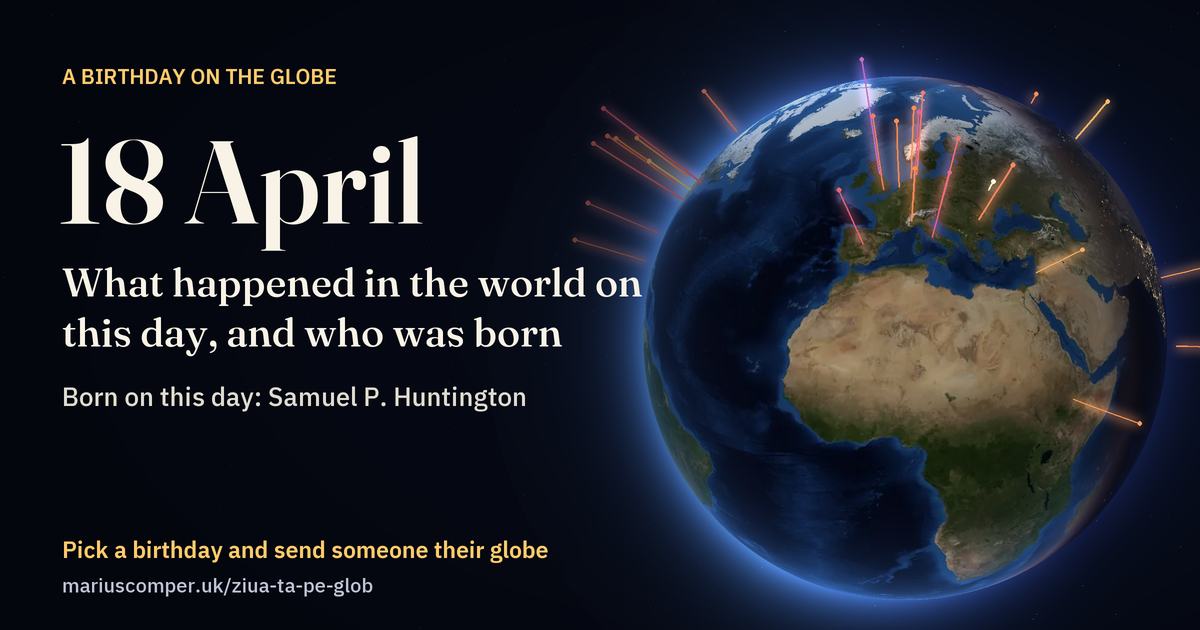
For 18 April, the English Wikipedia lists 54 events and 137 births. 28 of the events stand at their places as rays of light; five more are dashed circles, where the sentence links only to a country or a sea. The taller the ray, the longer ago it happened. The people born that day come further down, as blue points.
A birthday, yours or someone else’s:
Turn it into a greetingScroll: the globe turns to each place
The day you were born, on the globe.
Three things from your day
Scroll: your day first, then 18 April through the years
The Earth on 18 April
The picture on the globe was assembled by NASA from satellite photographs taken in April 2004: the snow, the ice and the green are those of the month.
On 18 April the Sun passes straight overhead at noon along the parallel of 11.0° north. In London, the day lasts about 14 hours 5 minutes.
Beyond 79° north the Sun no longer sets; beyond 79° south it no longer rises.
The line between day and night is tilted on the globe exactly as on this day of the year. On the dark side you can see the lights of towns.
Britain & Ireland · Ceilings of the Natural History Museum, London
1881
The painted ceilings of the Natural History Museum, London, were unveiled when the building opened its doors to the public.
On the map: Ceilings of the Natural History Museum, London.
Also on the day’s list of Wikipedia in Chinese.
Europe · St. Peter's Basilica
1506
The cornerstone of the current St. Peter's Basilica is laid.
On the map: St. Peter's Basilica.
Also on the day’s list of Wikipedia in Spanish, Romanian and Chinese.
Europe · Madrid
1738
Real Academia de la Historia ("Royal Academy of History") is founded in Madrid.
On the map: Madrid.
Also on the day’s list of Wikipedia in Spanish.
Europe · International Court of Justice
1946
The International Court of Justice holds its inaugural meeting in The Hague, Netherlands.
On the map: International Court of Justice.
Also on the day’s list of Wikipedia in Spanish.
Asia · Bandung
1955
Twenty-nine nations meet at Bandung, Indonesia, for the first Asian-African Conference.
On the map: Bandung.
Also on the day’s list of Wikipedia in Spanish and Chinese.
North America · University of Alabama
1831
The University of Alabama is founded in Tuscaloosa, Alabama.
On the map: University of Alabama.
North America · St. Elizabeths Hospital
1958
Controversial American poet Ezra Pound was released from St. Elizabeths Hospital, a psychiatric hospital in Washington, D.C., in which he had been incarcerated for twelve years.
On the map: St. Elizabeths Hospital.
North America · United States Congress
2019
A redacted version of the Mueller report is released to the United States Congress and the public.
On the map: United States Congress.
18 April
What the other Wikipedias remember#
For these years the English list has nothing on this day. The events below come from the same day’s lists on Wikipedia in Chinese and Spanish and were translated for this page.
From Wikipedia in Chinese · Gniezno
1025
Bolesław I, Grand Duke of Poland, is crowned in Gniezno as the first King of Poland, establishing the Kingdom of Poland.
On the map: Gniezno.
Translated from the list on Wikipedia in Chinese.
From Wikipedia in Spanish · Vienna Convention on Diplomatic Relations
1961
The rules of the Vienna Convention on Diplomatic Relations begin to be adopted.
On the map: Vienna Convention on Diplomatic Relations.
Translated from the list on Wikipedia in Spanish.
The article on Wikipedia in Spanish: Convención de Viena sobre Relaciones Diplomáticas
18 April
Born on 18 April#
The English Wikipedia lists 137 births for this day. The blue points are the birthplaces of 60 of these people: those written about in the most Wikipedia editions, where Wikidata gives a place of birth.
Born on 18 April
1927
Samuel P. Huntington, American political scientist, author, and academic (died 2008)
Place of birth: New York City.
Born on 18 April
1947
James Woods, American actor and producer
Place of birth: Vernal.
Born on 18 April
1990
Wojciech Szczęsny, Polish footballer
Place of birth: Warsaw.
Born on 18 April
1963
Conan O'Brien, American television host, comedian, and writer
Place of birth: Brookline.
Born in Britain and Ireland
1971
David Tennant, Scottish actor
Place of birth: Bathgate.
Born in Britain and Ireland
1988
Vanessa Kirby, English actress
Place of birth: Wimbledon.
Born in Britain and Ireland
1964
Niall Ferguson, Scottish historian and academic
Place of birth: Glasgow.
18 April
Number one in the charts that week
At the cinema
An animal recorded that day
The record can be seen in GBIF, which brings together wildlife records from around the world.
All your birthdays
The weather that day
Data: Met Office Hadley Centre (HadCET); NOAA (GHCN-Daily, Mauna Loa).
Above the Earth
Sources: Jonathan McDowell, GCAT (launches); GFZ Potsdam (Kp index). Days are counted in Universal Time.
Football that day
International matches played that day:
Source: the “International football results” dataset kept by Mart Jürisoo (CC0).
Also that day
The earthquake’s page at the USGS
Source: the USGS catalogue. The day is counted in Universal Time (UTC).
In those days
Make a link for someone
Type the name, pick the day and the year of birth. The link opens straight on their day, with their name in the greeting.
The link carries the name, date and place typed here; anyone who gets it can see them.
Put another birthday beside it
Your mother’s, your child’s, a friend’s: the two days appear side by side.
Below: 18 April through the years.
The whole globe of the day
Drag the globe to turn it. Touch a ray or a point to read what happened there.
Everything Wikipedia lists for 18 April
The list is the English Wikipedia’s, in its own wording, as it stood in October 2026. 21 events have no place on the map: the sentence links to no place with coordinates, only to places too wide to mark, or to several countries.
- 796
King Æthelred I of Northumbria is murdered in Corbridge by a group led by his ealdormen, Ealdred and Wada. The patrician Osbald is crowned, but abdicates within 27 days.
Britain & Ireland · CoriaWikipedia: Æthelred I of Northumbria - 1428
Peace of Ferrara between Republic of Venice, Duchy of Milan, Republic of Florence and House of Gonzaga: ending of the second campaign of the Wars in Lombardy fought until the Treaty of Lodi in 1454, which will then guarantee the conditions for the development of the Italian Renaissance.
no place on the mapWikipedia: Treaty of Lodi - 1506
The cornerstone of the current St. Peter's Basilica is laid.
Europe · St. Peter's BasilicaWikipedia: Cornerstone - 1518
Bona Sforza is crowned as queen consort of Poland.
no place on the mapWikipedia: Bona Sforza - 1521
Trial of Martin Luther begins its second day during the assembly of the Diet of Worms. He refuses to recant his teachings despite the risk of excommunication.
Europe · Diet of WormsWikipedia: Diet of Worms - 1689
Bostonians rise up in rebellion against Sir Edmund Andros.
North America · 1689 Boston revoltWikipedia: 1689 Boston revolt - 1738
Real Academia de la Historia ("Royal Academy of History") is founded in Madrid.
Europe · MadridWikipedia: Royal Academy of History - 1775
American Revolution: The British Army advances up the Charles River in Massachusetts to destroy supplies of American militias, while Paul Revere and other riders rapidly warn the countryside.
no place on the mapWikipedia: American Revolution - 1783
Three-Fifths Compromise: The first instance of black slaves in the United States of America being counted as three-fifths of persons (for the purpose of taxation), in a resolution of the Congress of the Confederation. This was later adopted in the 1787 Constitution.
no place on the mapWikipedia: Three-fifths Compromise - 1797
War of the First Coalition: The Peace of Leoben is signed by Napoleon Bonaparte and Maximilian, Count of Merveldt, creating an armistice between France and Austria, setting the stage for the Treaty of Campo Formio and ending the War of the First Coalition.
Europe · LeobenWikipedia: Peace of Leoben - 1831
The University of Alabama is founded in Tuscaloosa, Alabama.
North America · University of AlabamaWikipedia: University of Alabama - 1847
American victory at the battle of Cerro Gordo opens the way for invasion of Mexico.
Latin America · Battle of Cerro GordoWikipedia: Battle of Cerro Gordo - 1857
The Spirits Book by Allan Kardec is published, marking the birth of Spiritualism in France.
no place on the mapWikipedia: The Spirits Book - 1864
American Civil War: African-American Union soldiers were massacred and mutilated during and after the Battle of Poison Spring.
North America · Battle of Poison SpringWikipedia: American Civil War - 1864
Battle of Dybbøl: A Prussian-Austrian army defeats Denmark and gains control of Schleswig. Denmark surrenders the province in the following peace settlement.
Europe · Battle of DybbølWikipedia: Battle of Dybbøl - 1881
The painted ceilings of the Natural History Museum, London, were unveiled when the building opened its doors to the public.
Britain & Ireland · Ceilings of the Natural History Museum, LondonWikipedia: Ceilings of the Natural History Museum, London - 1897
The Greco-Turkish War is declared between Greece and the Ottoman Empire.
no place on the mapWikipedia: Greco-Turkish War - 1899
The St. Andrew's Ambulance Association is granted a royal charter by Queen Victoria.
no place on the mapWikipedia: St Andrew's First Aid - 1902
The 7.5 Mw Guatemala earthquake shakes Guatemala with a maximum Mercalli intensity of VIII (Severe), killing between 800 and 2,000.
Latin America · 1902 Guatemala earthquakeWikipedia: 1902 Guatemala earthquake - 1906
The 7.9 Mwearthquake and fire destroy much of San Francisco, California, killing more than 3,000 people, making one of the worst natural disasters in American history.
North America · 1906 San Francisco earthquakeWikipedia: 1906 San Francisco earthquake - 1909
Joan of Arc is beatified in Rome.
no place on the mapWikipedia: Joan of Arc - 1912
The Cunard liner RMS Carpathia brings 705 survivors from the RMS Titanic to New York City.
no place on the mapWikipedia: Titanic - 1915
World War I: French pilot Roland Garros is shot down and glides to a landing on the German side of the lines.
no place on the mapWikipedia: World War I - 1916
World War I: During a mine warfare in high altitude on the Dolomites, the Italian troops conquer the Col di Lana held by the Austrian army.
Europe · DolomitesWikipedia: Mines on the Italian front - 1930
A fire kills 118 people at a wooden church in the small Romanian town of Costești, most of them schoolchildren, after starting during Good Friday services.
Europe · 1930 Costești wooden church fireWikipedia: 1930 Costești wooden church fire - 1938
Superman debuts in Action Comics #1 (cover dated June 1938).
no place on the mapWikipedia: Superman - 1939
Robert Menzies, who became Australia's longest-serving prime minister, is elected as leader of the United Australia Party after the death of Prime Minister Joseph Lyons.
no place on the mapWikipedia: 1939 United Australia Party leadership election - 1942
Pierre Laval becomes Prime Minister of Vichy France.
Europe · Vichy FranceWikipedia: Vichy France - 1942
World War II: The Doolittle Raid on Japan: Tokyo, Yokohama, Kobe and Nagoya are bombed.
Oceans · Doolittle RaidWikipedia: Doolittle Raid - 1943
World War II: Operation Vengeance, Admiral Isoroku Yamamoto is killed when his aircraft is shot down by U.S. fighters over Bougainville Island.
Oceania · Bougainville IslandWikipedia: Operation Vengeance - 1945
Italian resistance movement: In Turin, despite the harsh repressive measures adopted by Nazi-fascists, a great pre-insurrectional strike begins.
Europe · TurinWikipedia: Italian resistance movement - 1945
World War II: Over 1,000 bombers attack the small island of Heligoland, Germany.
Europe · HeligolandWikipedia: Bomber - 1946
Jackie Robinson makes his regular season debut for the Montreal Royals of the International League, to make them the first integrated modern professional baseball team.
no place on the mapWikipedia: Jackie Robinson - 1946
The International Court of Justice holds its inaugural meeting in The Hague, Netherlands.
Europe · International Court of JusticeWikipedia: International Court of Justice - 1946
The final session of the League of Nations concluded in Geneva, with delegates agreeing to transfer much of its assets to the United Nations.
no place on the mapWikipedia: League of Nations - 1947
The Operation Big Bang, the largest non-nuclear man-made explosion to that time, destroys bunkers and military installations on the North Sea island of Heligoland, Germany.
Europe · Operation Big BangWikipedia: Operation Big Bang - 1949
The Republic of Ireland Act comes into force, declaring Éire to be a republic and severing Ireland's "association" with the Commonwealth of Nations.
no place on the mapWikipedia: The Republic of Ireland Act 1948 - 1954
Gamal Abdel Nasser seizes power in Egypt.
Africa · EgyptWikipedia: Gamal Abdel Nasser - 1955
Twenty-nine nations meet at Bandung, Indonesia, for the first Asian-African Conference.
Asia · BandungWikipedia: Bandung Conference - 1958
Controversial American poet Ezra Pound was released from St. Elizabeths Hospital, a psychiatric hospital in Washington, D.C., in which he had been incarcerated for twelve years.
North America · St. Elizabeths HospitalWikipedia: Ezra Pound - 1972
East African Airways Flight 720 crashes during a rejected takeoff from Addis Ababa Bole International Airport in Addis Ababa, Ethiopia, killing 43.
Africa · Addis Ababa Bole International AirportWikipedia: East African Airways Flight 720 - 1978
The Ba Chúc massacre begins, which precipitates the Cambodian–Vietnamese War the same year.
Asia · Ba Chúc massacreWikipedia: Ba Chúc massacre - 1980
Robert Mugabe became the first prime minister of Zimbabwe, beginning a 37-year period in power.
no place on the mapWikipedia: Robert Mugabe - 1980
The Republic of Zimbabwe (formerly Rhodesia) comes into being, with Canaan Banana as the country's first President. The Zimbabwean dollar replaces the Rhodesian dollar as the official currency.
no place on the mapWikipedia: Zimbabwe - 1980
The town of Elmore City, Oklahoma holds its first dance in the town's history.
North America · Elmore City, OklahomaWikipedia: Elmore City, Oklahoma - 1988
In Israel John Demjanjuk is sentenced to death for war crimes committed in World War II, although the verdict is later overturned.
no place on the mapWikipedia: John Demjanjuk - 1988
The United States launches Operation Praying Mantis against Iranian naval forces in the largest naval battle since World War II.
no place on the mapWikipedia: Operation Praying Mantis - 1996
The Israeli military commits the Qana massacre in a deliberate shelling of a United Nations compound near the village of Qana in southern Lebanon, killing 106 Lebanese civilians who were taking shelter there and wounding over 100 more.
Asia · Qana massacreWikipedia: Qana massacre - 2007
A ladle spilled 30 tonnes (33 tons) of molten steel in a factory in Liaoning, China, killing 32 workers.
Asia · Qinghe Special Steel Corporation disasterWikipedia: Qinghe Special Steel Corporation disaster - 2018
Anti-government protests start in Nicaragua.
no place on the mapWikipedia: Protests against Daniel Ortega - 2018
King Mswati III of Swaziland announces that his country's name will change to Eswatini.
Africa · EswatiniWikipedia: King of Eswatini - 2019
A redacted version of the Mueller report is released to the United States Congress and the public.
North America · United States CongressWikipedia: United States Congress - 2023
Fox News agreed to pay Dominion Voting Systems a $787 million settlement over defamation claims related to the 2020 U.S. presidential election.
no place on the mapWikipedia: 2020 United States presidential election - 2026
Seven people are killed and fourteen others are injured in a mass shooting in Kyiv, Ukraine
Europe · 2026 Kyiv shootingWikipedia: 2026 Kyiv shooting
What the other Wikipedias remember
For these years the English list has nothing on this day. The events below come from the same day’s lists on Wikipedia in Chinese and Spanish and were translated for this page.
- 1025
Bolesław I, Grand Duke of Poland, is crowned in Gniezno as the first King of Poland, establishing the Kingdom of Poland.
- 1961
The rules of the Vienna Convention on Diplomatic Relations begin to be adopted.
Europe · Vienna Convention on Diplomatic RelationsTranslated from the list on Wikipedia in SpanishWikipedia: Convención de Viena sobre Relaciones Diplomáticas
Who was born on 18 April
In order of how many Wikipedia editions have an article about each. The first 60 of 137 are shown.
- 1772
David Ricardo, British economist and politician (died 1823)
LondonWikipedia: David Ricardo - 1941
Michael D. Higgins, Irish sociologist and politician, 9th President of Ireland
LimerickWikipedia: Michael D. Higgins - 1927
Samuel P. Huntington, American political scientist, author, and academic (died 2008)
New York CityWikipedia: Samuel P. Huntington - 1947
James Woods, American actor and producer
VernalWikipedia: James Woods - 1480
Lucrezia Borgia, daughter of Pope Alexander VI (died 1519)
SubiacoWikipedia: Lucrezia Borgia - 1590
Ahmed I, Ottoman Emperor (died 1617)
ManisaWikipedia: Ahmed I - 1990
Wojciech Szczęsny, Polish footballer
- 1963
Conan O'Brien, American television host, comedian, and writer
BrooklineWikipedia: Conan O'Brien - 1995
Divock Origi, Belgian footballer
OstendWikipedia: Divock Origi - 1973
Haile Gebrselassie, Ethiopian runner
- 1970
Saad Hariri, Saudi Arabian-Lebanese businessman and politician, 33rd Prime Minister of Lebanon
RiyadhWikipedia: Saad Hariri - 359
Gratian, Roman emperor (died 383)
SirmiumWikipedia: Gratian - 1971
David Tennant, Scottish actor
BathgateWikipedia: David Tennant - 1984
America Ferrera, American actress
Los AngelesWikipedia: America Ferrera - 1927
Tadeusz Mazowiecki, Polish journalist and politician, Prime Minister of Poland (died 2013)
- 1979
Kourtney Kardashian, American television personality
Los AngelesWikipedia: Kourtney Kardashian - 1985
Łukasz Fabiański, Polish footballer
Kostrzyn nad OdrąWikipedia: Łukasz Fabiański - 1988
Vanessa Kirby, English actress
WimbledonWikipedia: Vanessa Kirby - 1976
Melissa Joan Hart, American actress
SmithtownWikipedia: Melissa Joan Hart - 1905
George H. Hitchings, American physician and pharmacologist, Nobel Prize laureate (died 1998)
- 1942
Jochen Rindt, German-Austrian racing driver (died 1970)
- 1947
Jerzy Stuhr, Polish actor, director, and screenwriter (died 2024)
KrakówWikipedia: Jerzy Stuhr - 1857
Clarence Darrow, American lawyer (died 1938)
Kinsman TownshipWikipedia: Clarence Darrow - 1907
Miklós Rózsa, Hungarian-American composer and conductor (died 1995)
BudapestWikipedia: Miklós Rózsa - 1940
Joseph L. Goldstein, American biochemist and geneticist, Nobel Prize laureate
KingstreeWikipedia: Joseph L. Goldstein - 1962
Jeff Dunham, American ventriloquist and comedian
DallasWikipedia: Jeff Dunham - 1964
Niall Ferguson, Scottish historian and academic
GlasgowWikipedia: Niall Ferguson - 1874
Ivana Brlić-Mažuranić, Croatian author and poet (died 1938)
- 1882
Leopold Stokowski, English conductor (died 1977)
- 1953
Rick Moranis, Canadian-American actor, comedian, singer and screenwriter
TorontoWikipedia: Rick Moranis - 1972
Eli Roth, American actor, director, producer, and screenwriter
NewtonWikipedia: Eli Roth - 812
Al-Wathiq, Abbasid caliph (died 847)
MeccaWikipedia: Al-Wathiq - 1992
Chloe Bennet, American actress
ChicagoWikipedia: Chloe Bennet - 1503
Henry II of Navarre (died 1555)
Sangüesa/ZangozaWikipedia: Henry II of Navarre - 1944
Kathy Acker, American author and poet (died 1997)
New York CityWikipedia: Kathy Acker - 1819
Franz von Suppé, Austrian composer and conductor (died 1895)
- 1902
Giuseppe Pella, Italian politician, 32nd Prime Minister of Italy (died 1981)
ValdengoWikipedia: Giuseppe Pella - 1942
Robert Christgau, American journalist and critic
Greenwich VillageWikipedia: Robert Christgau - 1974
Edgar Wright, English filmmaker
- 1838
Paul-Émile Lecoq de Boisbaudran, French chemist and academic (died 1912)
- 1981
Audrey Tang, Taiwanese Minister of Digital Affairs and programmer
TaipeiWikipedia: Audrey Tang - 1771
Karl Philipp, Prince of Schwarzenberg (died 1820)
- 1918
André Bazin, French critic and theorist (died 1958)
AngersWikipedia: André Bazin - 1946
Hayley Mills, English actress
MaryleboneWikipedia: Hayley Mills - 1976
Andrew Ng, British-born American artificial intelligence researcher
LondonWikipedia: Andrew Ng - 1989
Alia Shawkat, American actress
RiversideWikipedia: Alia Shawkat - 1580
Thomas Middleton, English Jacobean playwright and poet (died 1627)
- 1918
Gabriel Axel, Danish-French actor, director, and producer (died 2014)
AarhusWikipedia: Gabriel Axel - 1922
Barbara Hale, American actress (died 2017)
DeKalbWikipedia: Barbara Hale - 1819
Carlos Manuel de Céspedes, Cuban lawyer and activist (died 1874)
- 1605
Giacomo Carissimi, Italian priest and composer (died 1674)
- 1863
Count Leopold Berchtold, Austrian-Hungarian politician and diplomat, Joint Foreign Minister of Austria-Hungary (died 1942)
- 1961
Jane Leeves, English actress and dancer
IlfordWikipedia: Jane Leeves - 1950
Grigory Sokolov, Russian pianist and composer
Saint PetersburgWikipedia: Grigory Sokolov - 1947
Moses Blah, Liberian general and politician, 23rd President of Liberia (died 2013)
- 1959
Susan Faludi, American journalist, author and feminist
QueensWikipedia: Susan Faludi - 1996
Ski Mask the Slump God, American rapper
Fort LauderdaleWikipedia: Ski Mask the Slump God - 1934
James Drury, American actor (died 2020)
New York CityWikipedia: James Drury - 1937
Keiko Abe, Japanese marimba player and composer
TokyoWikipedia: Keiko Abe - 1897
Ardito Desio, Italian geologist and cartographer (died 2001)
PalmanovaWikipedia: Ardito Desio
What is celebrated on 18 April
- Christian feast day: Anthusa of Constantinople
- Christian feast day: Cyril VI of Constantinople (Eastern Orthodox Church)
- Christian feast day: Eleutherius and Antia
- Christian feast day: Galdino della Sala
- Christian feast day: Blessed Marie of the Incarnation
- Christian feast day: Molaise of Leighlin
- Christian feast day: Perfectus
- Christian feast day: Blessed Savina Petrilli
- Christian feast day: April 18 (Eastern Orthodox liturgics)
- Army Day (Iran)
- Coma Patients' Day (Poland)
- Friend's Day (Brazil)
- Independence Day (Zimbabwe)
- International Day For Monuments and Sites
A greeting link for someone
Type a name and, if you like, the year of birth. The link opens with a greeting, and beside each event it says how old the person turned that day, or how many years before their birth it happened.
The name and the year go only into the link you send.
All 366 days
How the globe is made
Where the events come from
Each edition of this page uses the day’s list from Wikipedia in its own language: Romanian, English, Spanish, Chinese. The lists are written by volunteers and differ from one edition to the next; the text of each event is Wikipedia’s, with a link to the article. A row that appears twice in a list is shown once. The lists have not been checked event by event: they are Wikipedia’s, mistakes included.
For events before 1582, and for countries that moved to the Gregorian calendar later (Britain in 1752, Russia in 1918), the same day may be counted Old Style in one list and New Style in another.
The chapter “What the other Wikipedias remember” adds up to five events a day from the lists of the other three editions, only for years in which the English list has nothing on that day. They were translated for this page, passed the same filters as the tour, and are not counted among the events of the English list.
How an event gets onto the map
The place comes from Wikidata. If the sentence links to the article about the event itself (a battle, an opening, an earthquake), dated to the same year, the ray stands on its coordinates or on those of its location. Otherwise it stands on the first place the sentence links to: a town, a building, a mountain, an island. This second step can be wrong: sometimes the sentence only mentions the place. That is why the page says, under each event, which place the ray stands on.
When the sentence links to a single state or province, or to a single sea, lake or desert larger than 5,000 km², the globe shows a dashed circle, not a ray. The circle has the area Wikidata gives, with its radius kept between 1.2° and 16°, or a radius of 4.5° when Wikidata gives no area; it says only that the sentence links to that place. Organisations, ships, spacecraft, museum objects, rivers, mountain ranges, languages and continents are never used as places. When a sentence names several states and no exact place, the event stays in the list only.
What the height means
The height of a ray shows how many years have passed, on a logarithmic scale: 10 years, 100 years and 1,000 years are equal steps apart; anything older than about 2,600 years has the tallest ray. The colour runs from pale yellow for recent years to violet for antiquity.
Where the tour stops
In each region the tour stops at up to three events (five in Britain and Ireland), chosen mainly by three things: whether Wikipedia’s editors put the event in the “On this day” box of their main page (the English, Spanish and Chinese editions), how many Wikipedia editions have an article about it, and how many of the four lists include it. Events whose sentence or article is about a war, an attack, a crime or a disaster are left out of the tour; they stay in the whole list, in Wikipedia’s wording. The filter is a list of words and a list of Wikidata types, so it can miss some.
The tour of births names the people with articles in the most editions and leaves aside those whom the list or Wikidata describes as rulers, politicians, commanders, leaders of movements or criminals; they stay in the list.
The Earth and the Sun
The daytime images are NASA’s Blue Marble Next Generation mosaics, one for each month of 2004; the night side is Black Marble 2016. The tilt of the line between day and night is computed for the day; the hour is chosen so that the place being read is in daylight. The latitude where the Sun stands overhead is the average of the four years of the leap cycle; in a given year it can differ by up to 0.4°.
The day you were born
The number ones come from the weekly lists on Wikipedia: Billboard for the United States (from 1940; the Hot 100 from August 1958), the UK Singles Chart (from November 1952), Los 40 Principales for Spain (from July 1966) and, for Romania, the Romanian Top 100 and Airplay 100 (2001–2021, with missing weeks). The page shows the chart of the week in which the day of birth falls, with its date; Billboard and the UK chart are dated at the end of their week. For Romania before 2001 and for China these sources have no weekly chart.
The films are those that reached cinemas in the United States up to ten days before or three days after that day (some of them in a few cinemas at first), from the English Wikipedia’s yearly lists (from 1968), in order of how many editions have an article about them. The events “in those days” are the ones on the neighbouring days’ lists that carry the year of birth, passed through the same filter as the tour.
The day of birth, year included
The Moon, the star sign and the constellation are worked out by the page itself, for noon Universal Time on the day. The lit part of the Moon is rounded and can differ by a few per cent from that at the hour of birth. The sign follows the usual zodiac of twelve equal parts starting at the March equinox; the constellation is the one the Sun actually stood in front of, by the borders set by the International Astronomical Union, and within a day of a border the page does not name it. When the Sun changes sign while it is that day anywhere on Earth, the page gives the moment of crossing, rounded to ten minutes and accurate to within about a quarter of an hour, and the clock time in a few cities, with the time zone and summer time of that year.
The year in the Chinese calendar is the one your device’s own calendar gives for the date, checked against the Hong Kong Observatory’s tables. “All your birthdays” uses the same sources as the rest of the chapter for the same day in every year since the birth: the temperature, well-known launches that took place on that very day, matches of the teams the edition follows, snow deeper than 10 cm and strong geomagnetic storms. The three things at the top and the four on the picture are chosen in a fixed order (the song, the animal, a full Moon, a well-known launch before an ordinary earthquake); on the picture you can change them.
When the link carries a year of birth, the page adds a few things about that exact day. The weather is the Met Office’s Central England temperature record and the readings from New York’s Central Park; the “usual high” is the average of the daily highs of 1961–1990 for that date, with two days either side. The carbon dioxide figure is the monthly mean at the Mauna Loa observatory, where measurements begin in March 1958.
The earthquake is the one with the largest magnitude in the USGS catalogue for that day, counted in Universal Time. Before the 1960s the catalogue has gaps even above magnitude 5.5, so in the older years many days have no earthquake. The page gives only the magnitude and the place: the country the epicentre falls in or, when the epicentre is at sea within 300 km of a coast, the nearest country; farther out, only the ocean.
The launches are those that reached orbit or left for the Moon and the planets, from Jonathan McDowell’s GCAT catalogue. If nothing left that day, the page shows the nearest launch within three days before or after, and says how many days away it was. The geomagnetic storm appears only when the Kp index reached at least 5 in one of the day’s eight three-hour intervals.
The animal comes from GBIF: an observation made by a person (the animal seen or heard, or its tracks), dated to that exact day, with coordinates and a CC0 or CC BY licence. Only a few hundred well-known species are searched (mammals, birds, turtles, butterflies); of those noted that day, mammals and species with articles in many Wikipedia editions come first; birds noted almost every day, and species used recently, wait their turn. Observations dated 1 January are left out, because records without a day are often filed there. An observation shows that the animal was recorded there, not how many animals there were.
The matches are those between national teams. Only matches of England, Scotland, Wales, Northern Ireland, the Republic of Ireland, the United States, Canada and Australia are shown, along with those at the big final tournaments. The picture to send is drawn in the page from the day’s globe and the facts above, and stays on your device until you send it.
Sources
- Events, births and holidays: the day’s page on Wikipedia, text under CC BY-SA 4.0.
- Coordinates, places of birth and the number of editions: Wikidata (CC0).
- The Earth by day: NASA Blue Marble Next Generation. The Earth by night: NASA Black Marble 2016.
- Borders and regions: Natural Earth.
- World population and births per year: UN World Population Prospects 2024.
- Charts and films: Wikipedia’s lists for Billboard, the UK Singles Chart, Los 40 Principales, Romanian Top 100, Airplay 100 and American films by year (CC BY-SA 4.0).
- Weather: Met Office Hadley Centre, HadCET (Open Government Licence) and NOAA GHCN-Daily, New York Central Park. Carbon dioxide: NOAA Global Monitoring Laboratory, Mauna Loa.
- Earthquakes: the USGS catalogue. Launches: Jonathan McDowell, GCAT (CC BY). Kp index: GFZ Potsdam (CC BY 4.0). Matches: International football results, Mart Jürisoo (CC0).
- Animal observations: GBIF, with a link to each record; species names come from Wikidata.