A birthday on the globe
10 January on the globe: what happened in the world on this day, and who was born
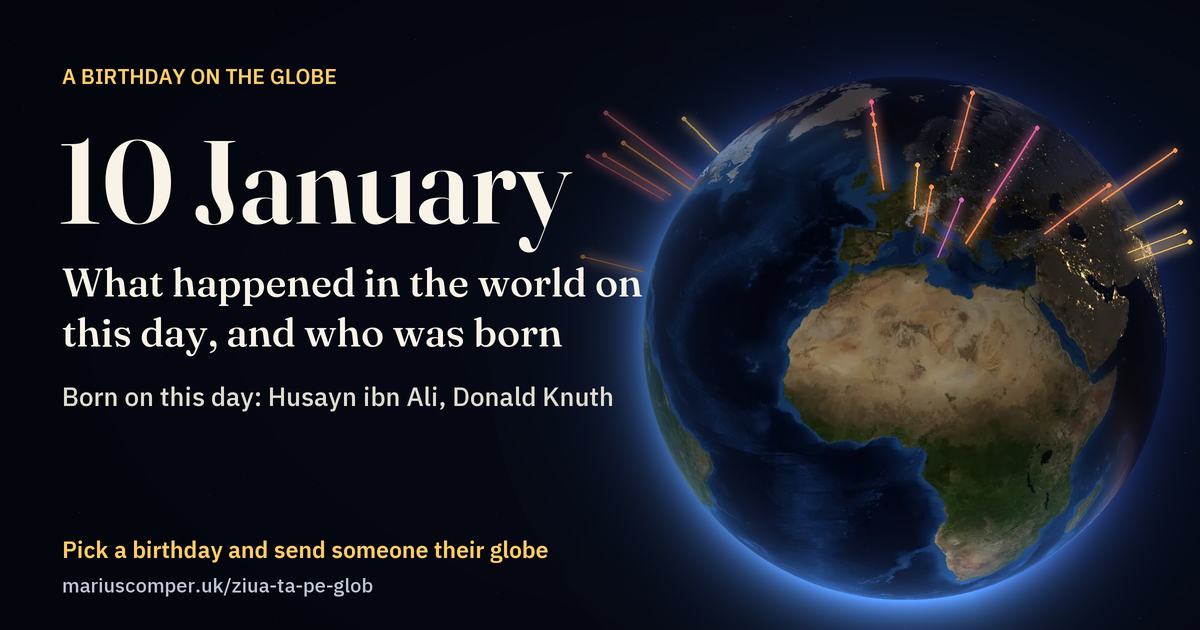
For 10 January, the English Wikipedia lists 46 events and 210 births. 20 of the events stand at their places as rays of light; eight more are dashed circles, where the sentence links only to a country or a sea. The taller the ray, the longer ago it happened. The people born that day come further down, as blue points.
A birthday, yours or someone else’s:
Turn it into a greetingScroll: the globe turns to each place
The day you were born, on the globe.
Three things from your day
Scroll: your day first, then 10 January through the years
The Earth on 10 January
The picture on the globe was assembled by NASA from satellite photographs taken in January 2004: the snow, the ice and the green are those of the month.
On 10 January the Sun passes straight overhead at noon along the parallel of 22.0° south. In London, the day lasts about 8 hours 10 minutes.
Beyond 68° south the Sun no longer sets; beyond 68° north it no longer rises.
The line between day and night is tilted on the globe exactly as on this day of the year. On the dark side you can see the lights of towns.
Britain & Ireland · Paddington tube station
1863
The Metropolitan Railway, the world's oldest underground railway, opens between Paddington and Farringdon, marking the beginning of the London Underground.
On the map: Paddington tube station.
Also on the day’s list of Wikipedia in Spanish, Romanian and Chinese.
Britain & Ireland · Methodist Central Hall, Westminster
1946
The first General Assembly of the United Nations assembles in the Methodist Central Hall, Westminster. Fifty-one nations are represented.
On the map: Methodist Central Hall, Westminster.
North America · New Orleans
1812
The first steamboat on the Ohio River or the Mississippi River arrives in New Orleans, 82 days after departing from Pittsburgh.
On the map: New Orleans.
North America · Spindletop
1901
The first great Texas oil gusher is discovered at Spindletop in Beaumont, Texas.
On the map: Spindletop.
Also on the day’s list of Wikipedia in Spanish.
North America · United States Congress
1984
Holy See–United States relations: The United States and Holy See (Vatican City) re-establish full diplomatic relations after almost 117 years, overturning the United States Congress's 1867 ban on public funding for such a diplomatic envoy.
On the map: United States Congress.
Also on the day’s list of Wikipedia in Romanian.
10 January
What the other Wikipedias remember#
For these years the English list has nothing on this day. The events below come from the same day’s lists on Wikipedia in Chinese and Spanish and were translated for this page.
From Wikipedia in Chinese · Nuremberg
1356
Charles IV of Luxembourg, King of Bohemia, promulgates the Golden Bull in Nuremberg.
On the map: Nuremberg.
Translated from the list on Wikipedia in Chinese.
From Wikipedia in Spanish · Seville
1503
In Seville (Spain), the Casa de Contratación de Indias is created, intended as a depository for goods imported from and exported to the Americas, by royal decrees of 10 January and 14 February.
On the map: Seville.
Translated from the list on Wikipedia in Spanish.
10 January
Born on 10 January#
The English Wikipedia lists 210 births for this day. The blue points are the birthplaces of 60 of these people: those written about in the most Wikipedia editions, where Wikidata gives a place of birth.
Born on 10 January
626
Husayn ibn Ali, the third Shia Imam (died 680)
Place of birth: Medina.
Born on 10 January
1938
Donald Knuth, American computer scientist and mathematician
Place of birth: Milwaukee.
Born on 10 January
1936
Robert Woodrow Wilson, American physicist and astronomer, Nobel Prize laureate
Place of birth: Houston.
Born on 10 January
1883
Aleksey Nikolayevich Tolstoy, Russian journalist, author, and poet (died 1945)
Place of birth: Pugachyov.
Born on 10 January
1945
Rod Stewart, British singer-songwriter
Place of birth: London.
Born in Britain and Ireland
1999
Mason Mount, English footballer
Place of birth: Portsmouth.
Born in Britain and Ireland
1903
Barbara Hepworth, English sculptor (died 1975)
Place of birth: Wakefield.
Born in Britain and Ireland
1908
Bernard Lee, English actor (died 1981)
Place of birth: Brentford.
10 January
Number one in the charts that week
At the cinema
An animal recorded that day
The record can be seen in GBIF, which brings together wildlife records from around the world.
All your birthdays
The weather that day
Data: Met Office Hadley Centre (HadCET); NOAA (GHCN-Daily, Mauna Loa).
Above the Earth
Sources: Jonathan McDowell, GCAT (launches); GFZ Potsdam (Kp index). Days are counted in Universal Time.
Football that day
International matches played that day:
Source: the “International football results” dataset kept by Mart Jürisoo (CC0).
Also that day
The earthquake’s page at the USGS
Source: the USGS catalogue. The day is counted in Universal Time (UTC).
In those days
Make a link for someone
Type the name, pick the day and the year of birth. The link opens straight on their day, with their name in the greeting.
The link carries the name, date and place typed here; anyone who gets it can see them.
Put another birthday beside it
Your mother’s, your child’s, a friend’s: the two days appear side by side.
Below: 10 January through the years.
The whole globe of the day
Drag the globe to turn it. Touch a ray or a point to read what happened there.
Everything Wikipedia lists for 10 January
The list is the English Wikipedia’s, in its own wording, as it stood in October 2026. 18 events have no place on the map: the sentence links to no place with coordinates, only to places too wide to mark, or to several countries.
- 49 BC
Julius Caesar crosses the Rubicon, signalling the start of civil war.
no place on the mapWikipedia: Caesar's civil war - 9
The Western Han dynasty ends when Wang Mang claims that the divine Mandate of Heaven called for the end of the dynasty and the beginning of his own, the Xin dynasty.
Asia · Han dynastyWikipedia: Han dynasty - 69
Lucius Calpurnius Piso Licinianus is appointed by Galba as deputy Roman Emperor.
no place on the mapWikipedia: Lucius Calpurnius Piso Frugi Licinianus - 236
Pope Fabian succeeds Anterus to become the twentieth pope of Rome.
Europe · Ancient RomeWikipedia: Pope Fabian - 976
After the death of his guardian John I Tzimiskes, Basil II became the effective ruler and senior emperor of the Byzantine Empire.
Asia · Byzantine EmpireWikipedia: John I Tzimiskes - 1072
Robert Guiscard conquers Palermo in Sicily for the Normans.
Europe · PalermoWikipedia: Robert Guiscard - 1430
Philip the Good, the Duke of Burgundy, establishes the Order of the Golden Fleece, the most prestigious, exclusive, and expensive order of chivalry in the world.
no place on the mapWikipedia: Philip the Good - 1475
Stephen III of Moldavia defeats the Ottoman Empire at the Battle of Vaslui.
Europe · Battle of VasluiWikipedia: Battle of Vaslui - 1645
Archbishop William Laud is beheaded for treason at the Tower of London.
Britain & Ireland · Tower of LondonWikipedia: William Laud - 1776
American Revolution: Thomas Paine publishes his pamphlet Common Sense.
no place on the mapWikipedia: Thomas Paine - 1791
The Siege of Dunlap's Station begins near Cincinnati during the Northwest Indian War.
North America · Siege of Dunlap's StationWikipedia: Siege of Dunlap's Station - 1812
The first steamboat on the Ohio River or the Mississippi River arrives in New Orleans, 82 days after departing from Pittsburgh.
North America · New OrleansWikipedia: New Orleans - 1861
American Civil War: Florida becomes the third state to secede from the Union.
North America · FloridaWikipedia: American Civil War - 1863
The Metropolitan Railway, the world's oldest underground railway, opens between Paddington and Farringdon, marking the beginning of the London Underground.
Britain & Ireland · Paddington tube stationWikipedia: Metropolitan Railway - 1870
John D. Rockefeller incorporates Standard Oil.
no place on the mapWikipedia: John D. Rockefeller - 1876
The Plan of Tuxtepec is announced.
no place on the mapWikipedia: Plan of Tuxtepec - 1901
New York: Automobile Club of America installs signs on major highways.
no place on the mapWikipedia: Automobile Club of America - 1901
The first great Texas oil gusher is discovered at Spindletop in Beaumont, Texas.
North America · SpindletopWikipedia: Texas - 1916
World War I: Imperial Russia begins the Erzurum Offensive, leading to the defeat of the Ottoman Empire's Third Army.
Asia · Erzurum offensiveWikipedia: World War I - 1917
Imperial Trans-Antarctic Expedition: Seven survivors of the Ross Sea party are rescued after being stranded for several months.
no place on the mapWikipedia: Imperial Trans-Antarctic Expedition - 1920
League of Nations Covenant automatically enters into force after the Treaty of Versailles is ratified by Germany.
Europe · GermanyWikipedia: Treaty of Versailles - 1920
The Treaty of Versailles takes effect, officially ending World War I for all combatant nations except the United States.
no place on the mapWikipedia: Treaty of Versailles - 1923
Lithuanian residents of the Klaipėda Region began a revolt, ahead of a League of Nations decision on their future which they expected to be against their interest.
Europe · Klaipėda RevoltWikipedia: Klaipėda Revolt - 1927
Fritz Lang's futuristic film Metropolis is released in Germany.
no place on the mapWikipedia: Fritz Lang - 1929
Tintin in the Land of the Soviets, the first volume of The Adventures of Tintin by the Belgian cartoonist Hergé, began serialisation.
no place on the mapWikipedia: Tintin in the Land of the Soviets - 1941
World War II: The Greek army captures Kleisoura.
Europe · Capture of Klisura PassWikipedia: Capture of Klisura Pass - 1946
The United States Army Signal Corps successfully conducts Project Diana, bouncing radio waves off the Moon and receiving the reflected signals.
no place on the mapWikipedia: United States Army Signal Corps - 1946
The first General Assembly of the United Nations assembles in the Methodist Central Hall, Westminster. Fifty-one nations are represented.
Britain & Ireland · Methodist Central Hall, WestminsterWikipedia: Methodist Central Hall, Westminster - 1946
The first session of the United Nations General Assembly convened in London with representatives from the original 51 member states.
no place on the mapWikipedia: First session of the United Nations General Assembly - 1954
BOAC Flight 781, a de Havilland DH.106 Comet 1, explodes and falls into the Tyrrhenian Sea, killing 35 people.
Europe · BOAC Flight 781Wikipedia: BOAC Flight 781 - 1966
Tashkent Declaration, a peace agreement between India and Pakistan signed that resolved the Indo-Pakistani War of 1965.
Asia · TashkentWikipedia: Tashkent Declaration - 1972
Sheikh Mujibur Rahman returns to the newly independent Bangladesh as president after spending over nine months in prison in Pakistan.
no place on the mapWikipedia: Sheikh Mujibur Rahman - 1980
The New England Journal of Medicine publishes the letter Addiction Rare in Patients Treated with Narcotics, which is later misused to downplay the general risk of addiction to opioids.
no place on the mapWikipedia: The New England Journal of Medicine - 1981
Salvadoran Civil War: The FMLN launches its first major offensive, gaining control of most of Morazán and Chalatenango departments.
Latin America · Morazán DepartmentWikipedia: Salvadoran Civil War - 1984
Holy See–United States relations: The United States and Holy See (Vatican City) re-establish full diplomatic relations after almost 117 years, overturning the United States Congress's 1867 ban on public funding for such a diplomatic envoy.
North America · United States CongressWikipedia: United States Congress - 1985
Sandinista Daniel Ortega becomes president of Nicaragua and vows to continue the transformation to socialism and alliance with the Soviet Union and Cuba.
Latin America · NicaraguaWikipedia: Sandinista National Liberation Front - 1985
Sir Clive Sinclair launched the Sinclair C5 personal electric vehicle, "one of the great marketing bombs of postwar British industry", which later became a cult collectable despite its commercial failure.
no place on the mapWikipedia: Clive Sinclair - 1990
Time Warner is formed by the merger of Time Inc. and Warner Communications.
no place on the mapWikipedia: WarnerMedia - 1993
The Braer Storm, the strongest extratropical cyclone ever recorded in the North Atlantic, reached peak intensity.
no place on the mapWikipedia: Braer Storm - 2000
Crossair Flight 498, a Saab 340 aircraft, crashes in Niederhasli, Switzerland, after taking off from Zurich Airport, killing 13 people.
Europe · Crossair Flight 498Wikipedia: Crossair Flight 498 - 2003
North Korea withdraws from the Treaty on the Non-Proliferation of Nuclear Weapons, making it the first state to withdraw from the treaty.
Asia · North KoreaWikipedia: Treaty on the Non-Proliferation of Nuclear Weapons - 2007
A general strike begins in Guinea in an attempt to get President Lansana Conté to resign.
Africa · GuineaWikipedia: 2007 Guinean general strike - 2012
A bombing at Jamrud in Pakistan, kills at least 30 people and injures 78 others.
Asia · JamrudWikipedia: 2012 Khyber Agency bombing - 2013
More than 100 people are killed and 270 injured in several bomb blasts in the Quetta area of Pakistan.
Asia · January 2013 Pakistan bombingsWikipedia: January 2013 Pakistan bombings - 2015
A traffic accident between an oil tanker truck and passenger coach en route to Shikarpur from Karachi on the Pakistan National Highway Link Road near Gulshan-e-Hadeed, Karachi, killing at least 62 people.
Asia · Shikarpur, SindhWikipedia: Gulshan-e-Hadeed - 2019
A 13-year-old American girl, Jayme Closs, is found alive in Gordon, Wisconsin, having been kidnapped 88 days earlier from her parents' home whilst they were murdered.
North America · Kidnapping of Jayme ClossWikipedia: Kidnapping of Jayme Closs
What the other Wikipedias remember
For these years the English list has nothing on this day. The events below come from the same day’s lists on Wikipedia in Chinese and Spanish and were translated for this page.
- 1356
Charles IV of Luxembourg, King of Bohemia, promulgates the Golden Bull in Nuremberg.
- 1503
In Seville (Spain), the Casa de Contratación de Indias is created, intended as a depository for goods imported from and exported to the Americas, by royal decrees of 10 January and 14 February.
Who was born on 10 January
In order of how many Wikipedia editions have an article about each. The first 60 of 210 are shown.
- 626
Husayn ibn Ali, the third Shia Imam (died 680)
- 1938
Donald Knuth, American computer scientist and mathematician
MilwaukeeWikipedia: Donald Knuth - 1934
Leonid Kravchuk, Ukrainian politician, 1st President of Ukraine (died 2022)
Velykyi ZhytynWikipedia: Leonid Kravchuk - 1936
Robert Woodrow Wilson, American physicist and astronomer, Nobel Prize laureate
- 1883
Aleksey Nikolayevich Tolstoy, Russian journalist, author, and poet (died 1945)
- 1945
Rod Stewart, British singer-songwriter
LondonWikipedia: Rod Stewart - 1974
Hrithik Roshan, Indian actor
- 1913
Gustáv Husák, Slovak politician, 9th President of Czechoslovakia (died 1991)
DúbravkaWikipedia: Gustáv Husák - 1949
George Foreman, American boxer, actor, and businessman (died 2025)
MarshallWikipedia: George Foreman - 1880
Manuel Azaña, Spanish jurist and politician, 7th President of Spain (died 1940)
Casa natal de Manuel AzañaWikipedia: Manuel Azaña - 1769
Michel Ney, French general (died 1815)
SaarlouisWikipedia: Michel Ney - 1981
Jared Kushner, American real estate investor and political figure
LivingstonWikipedia: Jared Kushner - 1999
Mason Mount, English footballer
PortsmouthWikipedia: Mason Mount - 1949
Linda Lovelace, American pornographic actress and activist (died 2002)
The BronxWikipedia: Linda Lovelace - 1916
Sune Bergström, Swedish biochemist and academic, Nobel Prize laureate (died 2004)
Kungsholm parishWikipedia: Sune Bergström - 1834
John Dalberg-Acton, 1st Baron Acton, Italian-English historian and politician (died 1902)
- 1960
Brian Cowen, Irish lawyer and politician, 12th Taoiseach of Ireland
TullamoreWikipedia: Brian Cowen - 1974
Jemaine Clement, New Zealand comedian, actor, and musician
MastertonWikipedia: Jemaine Clement - 1953
Pat Benatar, American singer-songwriter
BrooklynWikipedia: Pat Benatar - 1984
Marouane Chamakh, Moroccan footballer
TonneinsWikipedia: Marouane Chamakh - 1480
Margaret of Austria, Duchess of Savoy (died 1530)
- 1980
Sarah Shahi, American actress
EulessWikipedia: Sarah Shahi - 1984
Kalki Koechlin, Indian actress
PondicherryWikipedia: Kalki Koechlin - 1903
Barbara Hepworth, English sculptor (died 1975)
WakefieldWikipedia: Barbara Hepworth - 1999
Youssouf Fofana, French footballer
- 1944
William Sanderson, American actor
MemphisWikipedia: William Sanderson - 1859
Francesc Ferrer i Guàrdia, Spanish philosopher and academic (died 1909)
- 1939
Sal Mineo, American actor (died 1976)
New York CityWikipedia: Sal Mineo - 1947
Peer Steinbrück, German politician, German Minister of Finance
HamburgWikipedia: Peer Steinbrück - 1913
Mehmet Shehu, Albanian soldier and politician, 22nd Prime Minister of Albania (died 1981)
ÇorrushWikipedia: Mehmet Shehu - 1780
Martin Lichtenstein, German physician and explorer (died 1857)
- 1918
Arthur Chung, Guyanese lawyer and politician, 1st President of Guyana (died 2008)
Windsor ForestWikipedia: Arthur Chung - 1943
Jim Croce, American singer-songwriter (died 1973)
South PhiladelphiaWikipedia: Jim Croce - 1986
Kirsten Flipkens, Belgian tennis player
- 1956
Antonio Muñoz Molina, Spanish author
- 1987
César Cielo, Brazilian swimmer
Santa Bárbara d'OesteWikipedia: César Cielo - 1898
Katharine Burr Blodgett, American physicist and engineer (died 1979)
SchenectadyWikipedia: Katharine Burr Blodgett - 1908
Paul Henreid, Italian-American actor and director (died 1992)
TriesteWikipedia: Paul Henreid - 1908
Bernard Lee, English actor (died 1981)
BrentfordWikipedia: Bernard Lee - 1939
Scott McKenzie, American singer-songwriter and guitarist (died 2012)
- 1875
Issai Schur, German mathematician and academic (died 1941)
MahilyowWikipedia: Issai Schur - 1887
Robinson Jeffers, American poet and philosopher (died 1962)
PittsburghWikipedia: Robinson Jeffers - 1930
Roy E. Disney, American businessman (died 2009)
Los AngelesWikipedia: Roy E. Disney - 1936
Stephen E. Ambrose, American historian and author (died 2002)
- 1959
Chris Van Hollen, American lawyer and politician
KarachiWikipedia: Chris Van Hollen - 1959
Fran Walsh, New Zealand screenwriter and producer
WellingtonWikipedia: Fran Walsh - 1944
Frank Sinatra, Jr., American singer and actor (died 2016)
Jersey CityWikipedia: Frank Sinatra Jr. - 1947
Tiit Vähi, Estonian engineer and politician, 11th Prime Minister of Estonia
ValgaWikipedia: Tiit Vähi - 1955
Michael Schenker, German musician and songwriter
SarstedtWikipedia: Michael Schenker - 1802
Carl Ritter von Ghega, Italian-Austrian engineer, designed the Semmering railway (died 1860)
- 1904
Ray Bolger, American actor and dancer (died 1987)
DorchesterWikipedia: Ray Bolger - 1920
Roberto M. Levingston, Argentinian general and politician, 36th President of Argentina (died 2015)
- 1912
Maria Mandl, Austrian Lagerführerin at Auschwitz koncentration camp (died 1948)
MünzkirchenWikipedia: Maria Mandl - 1928
Philip Levine, American poet and academic (died 2015)
DetroitWikipedia: Philip Levine - 1948
Bernard Thévenet, French cyclist and sportscaster
Saint-Julien-de-CivryWikipedia: Bernard Thévenet - 1989
Ali Gabr, Egyptian footballer
TantaWikipedia: Ali Gabr - 1935
Ronnie Hawkins, American rockabilly singer-songwriter and guitarist (died 2022)
HuntsvilleWikipedia: Ronnie Hawkins - 1864
Grand Duke Peter Nikolaevich of Russia (died 1931)
Saint PetersburgWikipedia: Grand Duke Peter Nikolaevich of Russia - 1945
Gunther von Hagens, German anatomist, invented plastination
Skalmierzyce, Greater Poland VoivodeshipWikipedia: Gunther von Hagens - 1960
Gurinder Chadha, Kenyan-English director, producer, and screenwriter
NairobiWikipedia: Gurinder Chadha
What is celebrated on 10 January
- Christian feast day: Behnam, Sarah, and the Forty Martyrs (Armenian Apostolic Church)
- Christian feast day: Gregory of Nyssa
- Christian feast day: Leonie Aviat
- Christian feast day: Obadiah (Coptic Church)
- Christian feast day: Peter Orseolo
- Christian feast day: Pope Agatho (Roman Catholic)
- Christian feast day: William Laud (Anglican Communion)
- Christian feast day: William of Donjeon
- Christian feast day: January 10 (Eastern Orthodox liturgics)
- Fête du Vodoun (Benin)
- Margaret Thatcher Day (Falkland Islands)
- Majority Rule Day (Bahamas)
A greeting link for someone
Type a name and, if you like, the year of birth. The link opens with a greeting, and beside each event it says how old the person turned that day, or how many years before their birth it happened.
The name and the year go only into the link you send.
All 366 days
How the globe is made
Where the events come from
Each edition of this page uses the day’s list from Wikipedia in its own language: Romanian, English, Spanish, Chinese. The lists are written by volunteers and differ from one edition to the next; the text of each event is Wikipedia’s, with a link to the article. A row that appears twice in a list is shown once. The lists have not been checked event by event: they are Wikipedia’s, mistakes included.
For events before 1582, and for countries that moved to the Gregorian calendar later (Britain in 1752, Russia in 1918), the same day may be counted Old Style in one list and New Style in another.
The chapter “What the other Wikipedias remember” adds up to five events a day from the lists of the other three editions, only for years in which the English list has nothing on that day. They were translated for this page, passed the same filters as the tour, and are not counted among the events of the English list.
How an event gets onto the map
The place comes from Wikidata. If the sentence links to the article about the event itself (a battle, an opening, an earthquake), dated to the same year, the ray stands on its coordinates or on those of its location. Otherwise it stands on the first place the sentence links to: a town, a building, a mountain, an island. This second step can be wrong: sometimes the sentence only mentions the place. That is why the page says, under each event, which place the ray stands on.
When the sentence links to a single state or province, or to a single sea, lake or desert larger than 5,000 km², the globe shows a dashed circle, not a ray. The circle has the area Wikidata gives, with its radius kept between 1.2° and 16°, or a radius of 4.5° when Wikidata gives no area; it says only that the sentence links to that place. Organisations, ships, spacecraft, museum objects, rivers, mountain ranges, languages and continents are never used as places. When a sentence names several states and no exact place, the event stays in the list only.
What the height means
The height of a ray shows how many years have passed, on a logarithmic scale: 10 years, 100 years and 1,000 years are equal steps apart; anything older than about 2,600 years has the tallest ray. The colour runs from pale yellow for recent years to violet for antiquity.
Where the tour stops
In each region the tour stops at up to three events (five in Britain and Ireland), chosen mainly by three things: whether Wikipedia’s editors put the event in the “On this day” box of their main page (the English, Spanish and Chinese editions), how many Wikipedia editions have an article about it, and how many of the four lists include it. Events whose sentence or article is about a war, an attack, a crime or a disaster are left out of the tour; they stay in the whole list, in Wikipedia’s wording. The filter is a list of words and a list of Wikidata types, so it can miss some.
The tour of births names the people with articles in the most editions and leaves aside those whom the list or Wikidata describes as rulers, politicians, commanders, leaders of movements or criminals; they stay in the list.
The Earth and the Sun
The daytime images are NASA’s Blue Marble Next Generation mosaics, one for each month of 2004; the night side is Black Marble 2016. The tilt of the line between day and night is computed for the day; the hour is chosen so that the place being read is in daylight. The latitude where the Sun stands overhead is the average of the four years of the leap cycle; in a given year it can differ by up to 0.4°.
The day you were born
The number ones come from the weekly lists on Wikipedia: Billboard for the United States (from 1940; the Hot 100 from August 1958), the UK Singles Chart (from November 1952), Los 40 Principales for Spain (from July 1966) and, for Romania, the Romanian Top 100 and Airplay 100 (2001–2021, with missing weeks). The page shows the chart of the week in which the day of birth falls, with its date; Billboard and the UK chart are dated at the end of their week. For Romania before 2001 and for China these sources have no weekly chart.
The films are those that reached cinemas in the United States up to ten days before or three days after that day (some of them in a few cinemas at first), from the English Wikipedia’s yearly lists (from 1968), in order of how many editions have an article about them. The events “in those days” are the ones on the neighbouring days’ lists that carry the year of birth, passed through the same filter as the tour.
The day of birth, year included
The Moon, the star sign and the constellation are worked out by the page itself, for noon Universal Time on the day. The lit part of the Moon is rounded and can differ by a few per cent from that at the hour of birth. The sign follows the usual zodiac of twelve equal parts starting at the March equinox; the constellation is the one the Sun actually stood in front of, by the borders set by the International Astronomical Union, and within a day of a border the page does not name it. When the Sun changes sign while it is that day anywhere on Earth, the page gives the moment of crossing, rounded to ten minutes and accurate to within about a quarter of an hour, and the clock time in a few cities, with the time zone and summer time of that year.
The year in the Chinese calendar is the one your device’s own calendar gives for the date, checked against the Hong Kong Observatory’s tables. “All your birthdays” uses the same sources as the rest of the chapter for the same day in every year since the birth: the temperature, well-known launches that took place on that very day, matches of the teams the edition follows, snow deeper than 10 cm and strong geomagnetic storms. The three things at the top and the four on the picture are chosen in a fixed order (the song, the animal, a full Moon, a well-known launch before an ordinary earthquake); on the picture you can change them.
When the link carries a year of birth, the page adds a few things about that exact day. The weather is the Met Office’s Central England temperature record and the readings from New York’s Central Park; the “usual high” is the average of the daily highs of 1961–1990 for that date, with two days either side. The carbon dioxide figure is the monthly mean at the Mauna Loa observatory, where measurements begin in March 1958.
The earthquake is the one with the largest magnitude in the USGS catalogue for that day, counted in Universal Time. Before the 1960s the catalogue has gaps even above magnitude 5.5, so in the older years many days have no earthquake. The page gives only the magnitude and the place: the country the epicentre falls in or, when the epicentre is at sea within 300 km of a coast, the nearest country; farther out, only the ocean.
The launches are those that reached orbit or left for the Moon and the planets, from Jonathan McDowell’s GCAT catalogue. If nothing left that day, the page shows the nearest launch within three days before or after, and says how many days away it was. The geomagnetic storm appears only when the Kp index reached at least 5 in one of the day’s eight three-hour intervals.
The animal comes from GBIF: an observation made by a person (the animal seen or heard, or its tracks), dated to that exact day, with coordinates and a CC0 or CC BY licence. Only a few hundred well-known species are searched (mammals, birds, turtles, butterflies); of those noted that day, mammals and species with articles in many Wikipedia editions come first; birds noted almost every day, and species used recently, wait their turn. Observations dated 1 January are left out, because records without a day are often filed there. An observation shows that the animal was recorded there, not how many animals there were.
The matches are those between national teams. Only matches of England, Scotland, Wales, Northern Ireland, the Republic of Ireland, the United States, Canada and Australia are shown, along with those at the big final tournaments. The picture to send is drawn in the page from the day’s globe and the facts above, and stays on your device until you send it.
Sources
- Events, births and holidays: the day’s page on Wikipedia, text under CC BY-SA 4.0.
- Coordinates, places of birth and the number of editions: Wikidata (CC0).
- The Earth by day: NASA Blue Marble Next Generation. The Earth by night: NASA Black Marble 2016.
- Borders and regions: Natural Earth.
- World population and births per year: UN World Population Prospects 2024.
- Charts and films: Wikipedia’s lists for Billboard, the UK Singles Chart, Los 40 Principales, Romanian Top 100, Airplay 100 and American films by year (CC BY-SA 4.0).
- Weather: Met Office Hadley Centre, HadCET (Open Government Licence) and NOAA GHCN-Daily, New York Central Park. Carbon dioxide: NOAA Global Monitoring Laboratory, Mauna Loa.
- Earthquakes: the USGS catalogue. Launches: Jonathan McDowell, GCAT (CC BY). Kp index: GFZ Potsdam (CC BY 4.0). Matches: International football results, Mart Jürisoo (CC0).
- Animal observations: GBIF, with a link to each record; species names come from Wikidata.