A birthday on the globe
23 December on the globe: what happened in the world on this day, and who was born
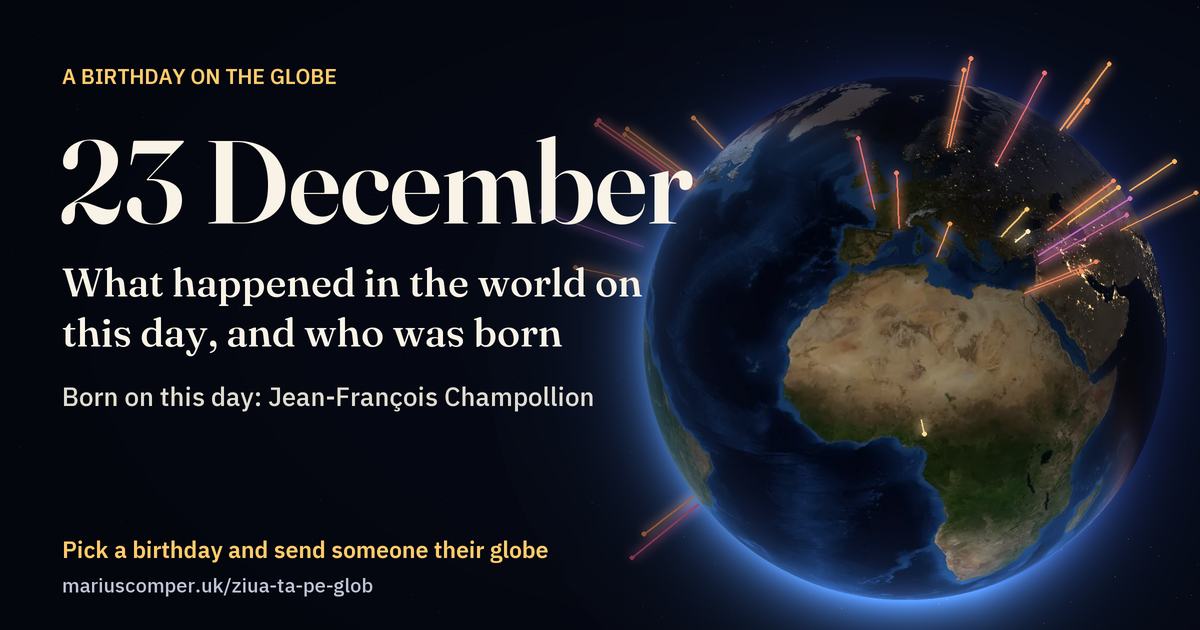
For 23 December, the English Wikipedia lists 53 events and 224 births. 30 of the events stand at their places as rays of light; seven more are dashed circles, where the sentence links only to a country or a sea. The taller the ray, the longer ago it happened. The people born that day come further down, as blue points.
A birthday, yours or someone else’s:
Turn it into a greetingScroll: the globe turns to each place
The day you were born, on the globe.
Three things from your day
Scroll: your day first, then 23 December through the years
The Earth on 23 December
The picture on the globe was assembled by NASA from satellite photographs taken in December 2004: the snow, the ice and the green are those of the month.
On 23 December the Sun passes straight overhead at noon along the parallel of 23.4° south. In London, the day lasts about 7 hours 50 minutes.
Beyond 67° south the Sun no longer sets; beyond 67° north it no longer rises.
The line between day and night is tilted on the globe exactly as on this day of the year. On the dark side you can see the lights of towns.
Europe · Moscow State Academy of Choreography
1773
Moscow State Academy of Choreography is founded under the reign of Catherine II. It is the second ballet school in Russia after Vaganova Academy of Russian Ballet.
On the map: Moscow State Academy of Choreography.
Europe · Arles
1888
During a bout of mental illness, Dutch painter Vincent van Gogh severed part of his left ear and gave it to a woman in a brothel in Arles, France.
On the map: Arles.
Europe · Tampere
1905
The Tampere conference, where Vladimir Lenin and Joseph Stalin meet for the first time, is held in Tampere, Finland.
On the map: Tampere.
Asia · Tokyo Tower
1958
Tokyo Tower, then the world's tallest freestanding tower, opened.
On the map: Tokyo Tower.
Also on the day’s list of Wikipedia in Chinese.
Latin America · Palenque
583
Maya queen Yohl Ik'nal is crowned ruler of Palenque.
On the map: Palenque.
North America · 1 World Trade Center
1970
The North Tower of the World Trade Center in Manhattan, New York, New York is topped out at 417 metres (1,368 ft), making it the tallest building in the world.
On the map: 1 World Trade Center.
Also on the day’s list of Wikipedia in Romanian.
North America · Edwards Air Force Base
1986
Voyager, piloted by Dick Rutan and Jeana Yeager, lands at Edwards Air Force Base in California becoming the first aircraft to fly non-stop around the world without aerial or ground refueling.
On the map: Edwards Air Force Base.
23 December
What the other Wikipedias remember#
For these years the English list has nothing on this day. The events below come from the same day’s lists on Wikipedia in Chinese and were translated for this page.
From Wikipedia in Chinese · East London
1938
Fishermen in East London, South Africa, catch a living coelacanth, later identified as a coelacanth fish long believed to be totally extinct.
On the map: East London.
Translated from the list on Wikipedia in Chinese.
23 December
Born on 23 December#
The English Wikipedia lists 224 births for this day. The blue points are the birthplaces of 60 of these people: those written about in the most Wikipedia editions, where Wikidata gives a place of birth.
Born on 23 December
1790
Jean-François Champollion, French philologist, orientalist, and scholar (died 1832)
Place of birth: Figeac.
Born on 23 December
1967
Carla Bruni, Italian-French singer-songwriter and model
Place of birth: Turin.
Born on 23 December
1804
Charles Augustin Sainte-Beuve, French author, critic, and academic (died 1869)
Place of birth: Boulogne-sur-Mer.
Born on 23 December
1896
Giuseppe Tomasi di Lampedusa, Italian lieutenant and author (died 1957)
Place of birth: Palermo.
Born on 23 December
1950
Vicente del Bosque, Spanish footballer and manager
Place of birth: Salamanca.
Born in Britain and Ireland
1911
Niels Kaj Jerne, English-Danish physician and immunologist, Nobel Prize laureate (died 1994)
Place of birth: London.
Born in Britain and Ireland
1812
Samuel Smiles, Scottish-English author (died 1904)
Place of birth: Haddington.
Born in Britain and Ireland
1732
Richard Arkwright, English businessman and inventor, invented the Water frame and Spinning frame (died 1792)
Place of birth: Preston.
23 December
Number one in the charts that week
At the cinema
An animal recorded that day
The record can be seen in GBIF, which brings together wildlife records from around the world.
All your birthdays
The weather that day
Data: Met Office Hadley Centre (HadCET); NOAA (GHCN-Daily, Mauna Loa).
Above the Earth
Sources: Jonathan McDowell, GCAT (launches); GFZ Potsdam (Kp index). Days are counted in Universal Time.
Football that day
International matches played that day:
Source: the “International football results” dataset kept by Mart Jürisoo (CC0).
Also that day
The earthquake’s page at the USGS
Source: the USGS catalogue. The day is counted in Universal Time (UTC).
In those days
Make a link for someone
Type the name, pick the day and the year of birth. The link opens straight on their day, with their name in the greeting.
The link carries the name, date and place typed here; anyone who gets it can see them.
Put another birthday beside it
Your mother’s, your child’s, a friend’s: the two days appear side by side.
Below: 23 December through the years.
The whole globe of the day
Drag the globe to turn it. Touch a ray or a point to read what happened there.
Everything Wikipedia lists for 23 December
The list is the English Wikipedia’s, in its own wording, as it stood in October 2026. 16 events have no place on the map: the sentence links to no place with coordinates, only to places too wide to mark, or to several countries.
- 484
The Arian Vandal Kingdom ceases its persecution of Nicene Christianity.
Africa · Vandal KingdomWikipedia: Arianism - 558
Chlothar I is crowned King of the Franks.
no place on the mapWikipedia: Chlothar I - 583
Maya queen Yohl Ik'nal is crowned ruler of Palenque.
Latin America · PalenqueWikipedia: Yohl Ikʼnal - 962
The Sack of Aleppo as part of the Arab–Byzantine wars: Under the future Emperor Nicephorus Phocas, Byzantine troops storm the city of Aleppo.
Asia · Sack of AleppoWikipedia: Sack of Aleppo - 1299
The Ilkhanate ruler Ghazan defeats a Mamluk army that opposes his invasion into Syria in the Battle of Wadi al-Khaznadar near Homs.
Asia · Battle of Wadi al-KhaznadarWikipedia: Battle of Wadi al-Khaznadar - 1598
Arauco War: Governor of Chile Martín García Óñez de Loyola is killed in the Battle of Curalaba by Mapuches led by Pelantaru.
Latin America · Battle of CuralabaWikipedia: Arauco War - 1688
As part of the Glorious Revolution, King James II of England flees from England to Paris after being deposed in favor of his son-in-law and nephew, William of Orange and his daughter Mary.
Britain & Ireland · British IslesWikipedia: Glorious Revolution - 1773
Moscow State Academy of Choreography is founded under the reign of Catherine II. It is the second ballet school in Russia after Vaganova Academy of Russian Ballet.
Europe · Moscow State Academy of ChoreographyWikipedia: Moscow State Academy of Choreography - 1776
American Revolutionary War: American troops, overwhelmed by British reinforcements, retreated from the Battle of Iron Works Hill.
North America · Battle of Iron Works HillWikipedia: Battle of Iron Works Hill - 1783
George Washington resigns as commander-in-chief of the Continental Army at the Maryland State House in Annapolis, Maryland.
North America · George Washington's resignation as commander-in-chiefWikipedia: George Washington's resignation as commander-in-chief - 1793
The Battle of Savenay: A decisive defeat of the royalist counter-revolutionaries in War in the Vendée during the French Revolution.
Europe · Battle of SavenayWikipedia: Battle of Savenay - 1815
The novel Emma by Jane Austen is first published.
no place on the mapWikipedia: Emma - 1823
The poem "Account of a Visit from St. Nicholas," also known as "'Twas the Night Before Christmas," is published anonymously in the Troy Sentinel.
no place on the mapWikipedia: A Visit from St. Nicholas - 1876
First day of the Constantinople Conference which resulted in agreement for political reforms in the Balkans.
no place on the mapWikipedia: Constantinople Conference - 1888
During a bout of mental illness, Dutch painter Vincent van Gogh severed part of his left ear and gave it to a woman in a brothel in Arles, France.
Europe · ArlesWikipedia: Mental disorder - 1893
The opera Hansel and Gretel by Engelbert Humperdinck is first performed.
no place on the mapWikipedia: Hansel and Gretel - 1905
The Tampere conference, where Vladimir Lenin and Joseph Stalin meet for the first time, is held in Tampere, Finland.
Europe · TampereWikipedia: Tampere conference of 1905 - 1913
The Federal Reserve Act is signed into law by President Woodrow Wilson, creating the Federal Reserve System.
no place on the mapWikipedia: Federal Reserve Act - 1914
World War I: Australian and New Zealand troops arrive in Cairo, Egypt.
Africa · CairoWikipedia: World War I - 1914
World War I: During the Battle of Sarikamish, Ottoman forces mistook one another for Russian troops. The following friendly fire incident leaves 2,000 Ottomans dead and many more wounded.
Asia · Battle of SarikamishWikipedia: Battle of Sarikamish - 1916
World War I: Battle of Magdhaba: Allied forces defeat Turkish forces in the Sinai Peninsula.
Africa · Battle of MagdhabaWikipedia: Battle of Magdhaba - 1919
Sex Disqualification (Removal) Act 1919 becomes law in the United Kingdom, allowing women to serve as lawyers, civil servants, and in other professions, as well as to serve on juries.
no place on the mapWikipedia: Sex Disqualification (Removal) Act 1919 - 1936
Colombia becomes a signatory to the Buenos Aires copyright treaty.
Latin America · ColombiaWikipedia: Buenos Aires Convention - 1936
Spanish Civil War: The Spanish Republic legalizes the Regional Defence Council of Aragon.
no place on the mapWikipedia: Spanish Civil War - 1941
World War II: After 15 days of fighting, the Imperial Japanese Army occupies Wake Island.
Oceans · Battle of Wake IslandWikipedia: World War II - 1947
The transistor is first demonstrated at Bell Laboratories.
no place on the mapWikipedia: Transistor - 1948
Seven Japanese military and political leaders convicted of war crimes by the International Military Tribunal for the Far East are executed by Allied occupation authorities at Sugamo Prison in Tokyo, Japan.
Asia · Sugamo PrisonWikipedia: Japan - 1950
Korean War: General Walton Walker dies in a jeep accident and is replaced by General Matthew Ridgway in the Eighth United States Army.
no place on the mapWikipedia: Korean War - 1954
First successful kidney transplant is performed by J. Hartwell Harrison and Joseph Murray.
no place on the mapWikipedia: Kidney transplantation - 1955
The first film adaptation of Väinö Linna's novel The Unknown Soldier, directed by Edvin Laine, premieres.
no place on the mapWikipedia: The Unknown Soldier - 1957
Leading the Australia national cricket team, Ian Craig became the youngest-ever Test cricket captain at the time.
no place on the mapWikipedia: Australia national cricket team - 1958
Tokyo Tower, then the world's tallest freestanding tower, opened.
Asia · Tokyo TowerWikipedia: Tokyo Tower - 1960
Hilkka Saarinen née Pylkkänen is murdered in the so-called "oven homicide" case in Krootila, Kokemäki, Finland.
Europe · Oven homicideWikipedia: Oven homicide - 1968
The 82 sailors from the USS Pueblo are released after eleven months of internment in North Korea.
Asia · North KoreaWikipedia: USS Pueblo - 1970
The Democratic Republic of the Congo officially becomes a one-party state.
Africa · Democratic Republic of the CongoWikipedia: Democratic Republic of the Congo - 1970
The North Tower of the World Trade Center in Manhattan, New York, New York is topped out at 417 metres (1,368 ft), making it the tallest building in the world.
North America · 1 World Trade CenterWikipedia: 1 World Trade Center - 1972
A 6.5 magnitude earthquake strikes the Nicaraguan capital of Managua killing more than 10,000.
Latin America · 1972 Nicaragua earthquakeWikipedia: 1972 Nicaragua earthquake - 1972
The 16 survivors of the Andes flight disaster are rescued after 73 days, surviving by cannibalism.
Latin America · Uruguayan Air Force Flight 571Wikipedia: Uruguayan Air Force Flight 571 - 1972
The Immaculate Reception is caught by Franco Harris to win the Pittsburgh Steelers their first ever playoff victory, after defeating the Oakland Raiders.
North America · Three Rivers StadiumWikipedia: Immaculate Reception - 1978
Alitalia Flight 4128 crashes into the Tyrrhenian Sea while on approach to Falcone Borsellino Airport in Palermo, Italy, killing 108.
Europe · Alitalia Flight 4128Wikipedia: Alitalia Flight 4128 - 1979
Soviet–Afghan War: Soviet Union forces occupy Kabul, the Afghan capital.
Asia · KabulWikipedia: Soviet–Afghan War - 1984
After experiencing an engine fire, Aeroflot Flight 3519 attempts to make an emergency landing at Krasnoyarsk International Airport but crashes, killing 110 of the 111 people on board.
Asia · Aeroflot Flight 3519Wikipedia: Aeroflot Flight 3519 - 1986
Voyager, piloted by Dick Rutan and Jeana Yeager, lands at Edwards Air Force Base in California becoming the first aircraft to fly non-stop around the world without aerial or ground refueling.
North America · Edwards Air Force BaseWikipedia: Rutan Voyager - 1990
History of Slovenia: In a referendum, 88.5% of Slovenia's overall electorate vote for independence from Yugoslavia.
no place on the mapWikipedia: 1990 Slovenian independence referendum - 1997
The Pioneer Helmet, one of only six Anglo-Saxon helmets to be discovered, was first placed on public display.
no place on the mapWikipedia: Pioneer Helmet - 2002
A U.S. MQ-1 Predator is shot down by an Iraqi MiG-25 in the first combat engagement between a drone and conventional aircraft.
no place on the mapWikipedia: General Atomics MQ-1 Predator - 2003
An explosion at the PetroChina Chuandongbei natural gas field in Kai County, Chongqing, China, kills at least 234.
Asia · Kaizhou, ChongqingWikipedia: PetroChina - 2005
An Antonov An-140, Azerbaijan Airlines Flight 217 from Baku, Azerbaijan, to Aktau, Kazakhstan, heading across the Caspian Sea, crashes, killing 23 people.
Asia · Azerbaijan Airlines Flight 217Wikipedia: Azerbaijan Airlines Flight 217 - 2007
An agreement is made for the Kingdom of Nepal to be abolished and the country to become a federal republic with the Prime Minister becoming head of state.
Asia · Kingdom of NepalWikipedia: Kingdom of Nepal - 2008
A coup d'état occurs in Guinea hours after the death of President Lansana Conté.
Africa · GuineaWikipedia: 2008 Guinean coup d'état - 2015
A bomb explodes at Istanbul's Sabiha Gökçen Airport, killing one airport cleaner. The Kurdistan Freedom Hawks claim responsibility for the attack four days later.
Asia · 2015 Sabiha Gökçen Airport bombingWikipedia: 2015 Sabiha Gökçen Airport bombing - 2023
A series of massacres targeting Berom civilians unfold in the Plateau State in Nigeria, killing over 200 people and further injuring over 500. No group claims responsibility.
Africa · 2023 Plateau State massacresWikipedia: 2023 Plateau State massacres - 2025
The crash of Harmony Jets Flight 185 killed all eight people on board, including the Libyan Army chief Mohammed al-Haddad in Ankara, Turkey.
Asia · Harmony Jets Flight 185Wikipedia: Harmony Jets Flight 185
What the other Wikipedias remember
For these years the English list has nothing on this day. The events below come from the same day’s lists on Wikipedia in Chinese and were translated for this page.
- 1938
Fishermen in East London, South Africa, catch a living coelacanth, later identified as a coelacanth fish long believed to be totally extinct.
Who was born on 23 December
In order of how many Wikipedia editions have an article about each. The first 60 of 224 are shown.
- 1933
Akihito, Emperor of Japan
Tokyo Imperial PalaceWikipedia: Akihito - 1777
Alexander I of Russia (died 1825)
Saint PetersburgWikipedia: Alexander I of Russia - 1918
Helmut Schmidt, German soldier, economist, and politician, 5th Chancellor of Germany (died 2015)
HamburgWikipedia: Helmut Schmidt - 1805
Joseph Smith, American religious leader, founder of the Latter Day Saint movement (died 1844)
SharonWikipedia: Joseph Smith - 1790
Jean-François Champollion, French philologist, orientalist, and scholar (died 1832)
- 1967
Carla Bruni, Italian-French singer-songwriter and model
- 1940
Mamnoon Hussain, Pakistani businessman and politician, 12th President of Pakistan (died 2021)
- 1804
Charles Augustin Sainte-Beuve, French author, critic, and academic (died 1869)
Boulogne-sur-MerWikipedia: Charles Augustin Sainte-Beuve - 1896
Giuseppe Tomasi di Lampedusa, Italian lieutenant and author (died 1957)
- 1950
Vicente del Bosque, Spanish footballer and manager
SalamancaWikipedia: Vicente del Bosque - 1962
Stefan Hell, Romanian-German physicist and chemist, Nobel Prize laureate
- 1902
Charan Singh, Indian lawyer and politician, 5th Prime Minister of India (died 1987)
NoorpurWikipedia: Charan Singh - 1963
Donna Tartt, American author
GreenwoodWikipedia: Donna Tartt - 1943
Queen Silvia of Sweden
HeidelbergWikipedia: Queen Silvia of Sweden - 2002
Finn Wolfhard, Canadian actor and musician
VancouverWikipedia: Finn Wolfhard - 1911
Niels Kaj Jerne, English-Danish physician and immunologist, Nobel Prize laureate (died 1994)
- 1964
Eddie Vedder, American singer-songwriter and guitarist
EvanstonWikipedia: Eddie Vedder - 1929
Chet Baker, American jazz trumpet player, flugelhorn player, and singer (died 1988)
- 1812
Samuel Smiles, Scottish-English author (died 1904)
HaddingtonWikipedia: Samuel Smiles - 1916
Dino Risi, Italian director and screenwriter (died 2008)
MilanWikipedia: Dino Risi - 1945
Adly Mansour, Egyptian lawyer, judge, and politician, President of Egypt
Markaz al BājūrWikipedia: Adly Mansour - 1793
Dost Mohammad Khan, emir of Afghanistan (died 1863)
KandaharWikipedia: Dost Mohammad Khan - 1867
Madam C. J. Walker, American businesswoman and philanthropist (died 1919)
- 1732
Richard Arkwright, English businessman and inventor, invented the Water frame and Spinning frame (died 1792)
PrestonWikipedia: Richard Arkwright - 1750
Frederick Augustus I of Saxony (died 1827)
- 1908
Yousuf Karsh, Armenian-Canadian photographer (died 2002)
MardinWikipedia: Yousuf Karsh - 1944
Wesley Clark, American general
ChicagoWikipedia: Wesley Clark - 1956
Dave Murray, English guitarist and songwriter
LondonWikipedia: Dave Murray - 1943
Mikhail Leonidovich Gromov, Russian-French mathematician and academic
BoksitogorskWikipedia: Mikhael Gromov - 1986
Balázs Dzsudzsák, Hungarian footballer
DebrecenWikipedia: Balázs Dzsudzsák - 1938
Bob Kahn, American computer scientist and engineer, co-developed the Transmission Control Protocol
New York CityWikipedia: Robert Kahn - 1810
Edward Blyth, English zoologist (died 1873)
LondonWikipedia: Edward Blyth - 1810
Karl Richard Lepsius, German Egyptologist (died 1884)
NaumburgWikipedia: Karl Richard Lepsius - 1942
Quentin Bryce, Australian lawyer and politician, 25th Governor-General of Australia
BrisbaneWikipedia: Quentin Bryce - 1968
Manuel Rivera-Ortiz, Puerto Rican-American photographer
- 1605
Tianqi Emperor, Chinese emperor (died 1627)
BeijingWikipedia: Tianqi Emperor - 1955
Carol Ann Duffy, Scottish poet and playwright
GlasgowWikipedia: Carol Ann Duffy - 1956
Michele Alboreto, Italian race car driver (died 2001)
- 1979
Holly Madison, American model, television personality, and actress
AstoriaWikipedia: Holly Madison - 1597
Martin Opitz, German poet and composer (died 1639)
BolesławiecWikipedia: Martin Opitz - 1936
Frederic Forrest, American actor (died 2023)
WaxahachieWikipedia: Frederic Forrest - 1971
Corey Haim, Canadian actor (died 2010)
TorontoWikipedia: Corey Haim - 2000
Victor Boniface, Nigerian footballer
- 1985
Alison Sudol, American actress and singer-songwriter
SeattleWikipedia: Alison Sudol - 1910
Kurt Meyer, German SS general and convicted war criminal (died 1961)
JerxheimWikipedia: Kurt Meyer - 1943
Harry Shearer, American actor, voice artist, and comedian
Los AngelesWikipedia: Harry Shearer - 1948
David Davis, English politician, Minister of State for Europe
- 1992
Jeff Schlupp, German footballer
HamburgWikipedia: Jeffrey Schlupp - 1996
Bartosz Kapustka, Polish footballer
- 968
Emperor Zhenzong of Song, emperor of the Song dynasty (died 1022)
KaifengWikipedia: Emperor Zhenzong - 1974
Agustín Delgado, Ecuadorian footballer and politician
AmbuquíWikipedia: Agustín Delgado - 1949
Adrian Belew, American singer-songwriter and guitarist
CovingtonWikipedia: Adrian Belew - 1990
Anna Maria Perez de Tagle, American actress and singer
San FranciscoWikipedia: Anna Maria Perez de Tagle - 1926
Robert Bly, American poet and essayist (died 2021)
MadisonWikipedia: Robert Bly - 1979
Kenny Miller, Scottish footballer
EdinburghWikipedia: Kenny Miller - 1991
Kyren Wilson, English snooker player
KetteringWikipedia: Kyren Wilson - 1173
Louis I, duke of Bavaria (died 1231)
- 1613
Carl Gustaf Wrangel, Swedish field marshal and politician, Lord High Constable of Sweden (died 1676)
- 1922
Micheline Ostermeyer, French discus thrower, shot putter, and pianist (died 2001)
Rang-du-FliersWikipedia: Micheline Ostermeyer - 1992
Mbwana Samatta, Tanzanian footballer
Dar es SalaamWikipedia: Mbwana Samatta
What is celebrated on 23 December
- Birthday of the Queen Silvia, an official flag flying day (Sweden)
- Children's Day (South Sudan and Sudan)
- Christian Feast Day: Abassad (Coptic Church)
- Christian Feast Day: Behnam, Sarah, and the Forty Martyrs (Coptic Church)
- Christian Feast Day: Dagobert II
- Christian Feast Day: John Cantius
- Christian Feast Day: O Emmanuel
- Christian Feast Day: Psote (Coptic Church)
- Christian Feast Day: Thorlac Thorhallsson, patron saint of Iceland; The last day of preparations before Christmas.
- Christian Feast Day: Victoria
- Christian Feast Day: December 23 (Eastern Orthodox liturgics)
- Day of all level operational control structures servicemen (Ukraine)
- Festivus, a secular holiday made popular by the sitcom Seinfeld
- HumanLight (Secular humanism in United States)
A greeting link for someone
Type a name and, if you like, the year of birth. The link opens with a greeting, and beside each event it says how old the person turned that day, or how many years before their birth it happened.
The name and the year go only into the link you send.
All 366 days
How the globe is made
Where the events come from
Each edition of this page uses the day’s list from Wikipedia in its own language: Romanian, English, Spanish, Chinese. The lists are written by volunteers and differ from one edition to the next; the text of each event is Wikipedia’s, with a link to the article. A row that appears twice in a list is shown once. The lists have not been checked event by event: they are Wikipedia’s, mistakes included.
For events before 1582, and for countries that moved to the Gregorian calendar later (Britain in 1752, Russia in 1918), the same day may be counted Old Style in one list and New Style in another.
The chapter “What the other Wikipedias remember” adds up to five events a day from the lists of the other three editions, only for years in which the English list has nothing on that day. They were translated for this page, passed the same filters as the tour, and are not counted among the events of the English list.
How an event gets onto the map
The place comes from Wikidata. If the sentence links to the article about the event itself (a battle, an opening, an earthquake), dated to the same year, the ray stands on its coordinates or on those of its location. Otherwise it stands on the first place the sentence links to: a town, a building, a mountain, an island. This second step can be wrong: sometimes the sentence only mentions the place. That is why the page says, under each event, which place the ray stands on.
When the sentence links to a single state or province, or to a single sea, lake or desert larger than 5,000 km², the globe shows a dashed circle, not a ray. The circle has the area Wikidata gives, with its radius kept between 1.2° and 16°, or a radius of 4.5° when Wikidata gives no area; it says only that the sentence links to that place. Organisations, ships, spacecraft, museum objects, rivers, mountain ranges, languages and continents are never used as places. When a sentence names several states and no exact place, the event stays in the list only.
What the height means
The height of a ray shows how many years have passed, on a logarithmic scale: 10 years, 100 years and 1,000 years are equal steps apart; anything older than about 2,600 years has the tallest ray. The colour runs from pale yellow for recent years to violet for antiquity.
Where the tour stops
In each region the tour stops at up to three events (five in Britain and Ireland), chosen mainly by three things: whether Wikipedia’s editors put the event in the “On this day” box of their main page (the English, Spanish and Chinese editions), how many Wikipedia editions have an article about it, and how many of the four lists include it. Events whose sentence or article is about a war, an attack, a crime or a disaster are left out of the tour; they stay in the whole list, in Wikipedia’s wording. The filter is a list of words and a list of Wikidata types, so it can miss some.
The tour of births names the people with articles in the most editions and leaves aside those whom the list or Wikidata describes as rulers, politicians, commanders, leaders of movements or criminals; they stay in the list.
The Earth and the Sun
The daytime images are NASA’s Blue Marble Next Generation mosaics, one for each month of 2004; the night side is Black Marble 2016. The tilt of the line between day and night is computed for the day; the hour is chosen so that the place being read is in daylight. The latitude where the Sun stands overhead is the average of the four years of the leap cycle; in a given year it can differ by up to 0.4°.
The day you were born
The number ones come from the weekly lists on Wikipedia: Billboard for the United States (from 1940; the Hot 100 from August 1958), the UK Singles Chart (from November 1952), Los 40 Principales for Spain (from July 1966) and, for Romania, the Romanian Top 100 and Airplay 100 (2001–2021, with missing weeks). The page shows the chart of the week in which the day of birth falls, with its date; Billboard and the UK chart are dated at the end of their week. For Romania before 2001 and for China these sources have no weekly chart.
The films are those that reached cinemas in the United States up to ten days before or three days after that day (some of them in a few cinemas at first), from the English Wikipedia’s yearly lists (from 1968), in order of how many editions have an article about them. The events “in those days” are the ones on the neighbouring days’ lists that carry the year of birth, passed through the same filter as the tour.
The day of birth, year included
The Moon, the star sign and the constellation are worked out by the page itself, for noon Universal Time on the day. The lit part of the Moon is rounded and can differ by a few per cent from that at the hour of birth. The sign follows the usual zodiac of twelve equal parts starting at the March equinox; the constellation is the one the Sun actually stood in front of, by the borders set by the International Astronomical Union, and within a day of a border the page does not name it. When the Sun changes sign while it is that day anywhere on Earth, the page gives the moment of crossing, rounded to ten minutes and accurate to within about a quarter of an hour, and the clock time in a few cities, with the time zone and summer time of that year.
The year in the Chinese calendar is the one your device’s own calendar gives for the date, checked against the Hong Kong Observatory’s tables. “All your birthdays” uses the same sources as the rest of the chapter for the same day in every year since the birth: the temperature, well-known launches that took place on that very day, matches of the teams the edition follows, snow deeper than 10 cm and strong geomagnetic storms. The three things at the top and the four on the picture are chosen in a fixed order (the song, the animal, a full Moon, a well-known launch before an ordinary earthquake); on the picture you can change them.
When the link carries a year of birth, the page adds a few things about that exact day. The weather is the Met Office’s Central England temperature record and the readings from New York’s Central Park; the “usual high” is the average of the daily highs of 1961–1990 for that date, with two days either side. The carbon dioxide figure is the monthly mean at the Mauna Loa observatory, where measurements begin in March 1958.
The earthquake is the one with the largest magnitude in the USGS catalogue for that day, counted in Universal Time. Before the 1960s the catalogue has gaps even above magnitude 5.5, so in the older years many days have no earthquake. The page gives only the magnitude and the place: the country the epicentre falls in or, when the epicentre is at sea within 300 km of a coast, the nearest country; farther out, only the ocean.
The launches are those that reached orbit or left for the Moon and the planets, from Jonathan McDowell’s GCAT catalogue. If nothing left that day, the page shows the nearest launch within three days before or after, and says how many days away it was. The geomagnetic storm appears only when the Kp index reached at least 5 in one of the day’s eight three-hour intervals.
The animal comes from GBIF: an observation made by a person (the animal seen or heard, or its tracks), dated to that exact day, with coordinates and a CC0 or CC BY licence. Only a few hundred well-known species are searched (mammals, birds, turtles, butterflies); of those noted that day, mammals and species with articles in many Wikipedia editions come first; birds noted almost every day, and species used recently, wait their turn. Observations dated 1 January are left out, because records without a day are often filed there. An observation shows that the animal was recorded there, not how many animals there were.
The matches are those between national teams. Only matches of England, Scotland, Wales, Northern Ireland, the Republic of Ireland, the United States, Canada and Australia are shown, along with those at the big final tournaments. The picture to send is drawn in the page from the day’s globe and the facts above, and stays on your device until you send it.
Sources
- Events, births and holidays: the day’s page on Wikipedia, text under CC BY-SA 4.0.
- Coordinates, places of birth and the number of editions: Wikidata (CC0).
- The Earth by day: NASA Blue Marble Next Generation. The Earth by night: NASA Black Marble 2016.
- Borders and regions: Natural Earth.
- World population and births per year: UN World Population Prospects 2024.
- Charts and films: Wikipedia’s lists for Billboard, the UK Singles Chart, Los 40 Principales, Romanian Top 100, Airplay 100 and American films by year (CC BY-SA 4.0).
- Weather: Met Office Hadley Centre, HadCET (Open Government Licence) and NOAA GHCN-Daily, New York Central Park. Carbon dioxide: NOAA Global Monitoring Laboratory, Mauna Loa.
- Earthquakes: the USGS catalogue. Launches: Jonathan McDowell, GCAT (CC BY). Kp index: GFZ Potsdam (CC BY 4.0). Matches: International football results, Mart Jürisoo (CC0).
- Animal observations: GBIF, with a link to each record; species names come from Wikidata.