A birthday on the globe
27 July on the globe: what happened in the world on this day, and who was born
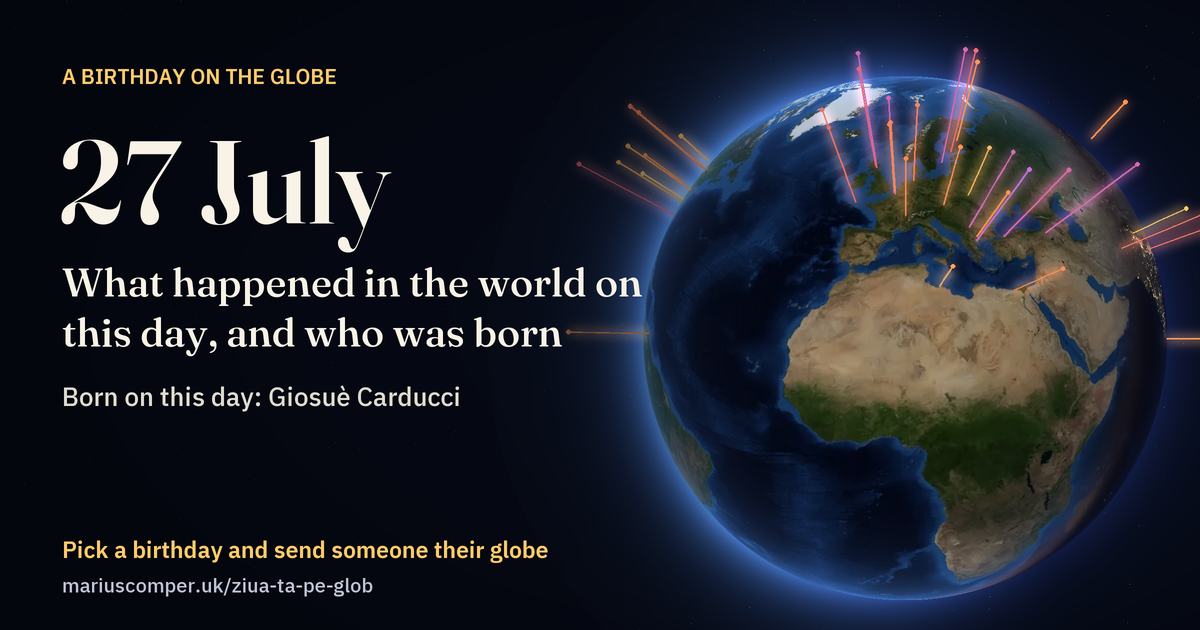
For 27 July, the English Wikipedia lists 57 events and 265 births. 36 of the events stand at their places as rays of light; three more are dashed circles, where the sentence links only to a country or a sea. The taller the ray, the longer ago it happened. The people born that day come further down, as blue points.
A birthday, yours or someone else’s:
Turn it into a greetingScroll: the globe turns to each place
The day you were born, on the globe.
Three things from your day
Scroll: your day first, then 27 July through the years
The Earth on 27 July
The picture on the globe was assembled by NASA from satellite photographs taken in July 2004: the snow, the ice and the green are those of the month.
On 27 July the Sun passes straight overhead at noon along the parallel of 19.2° north. In London, the day lasts about 15 hours 40 minutes.
Beyond 71° north the Sun no longer sets; beyond 71° south it no longer rises.
The line between day and night is tilted on the globe exactly as on this day of the year. On the dark side you can see the lights of towns.
Britain & Ireland · Valentia Island
1866
The first permanent transatlantic telegraph cable is successfully completed, stretching from Valentia Island, Ireland, to Heart's Content, Newfoundland.
On the map: Valentia Island.
Europe · Gotland
1225
Saint Mary's Church on Gotland, later to become Visby Cathedral, was consecrated.
On the map: Gotland.
Europe · Bremerhaven
1900
Kaiser Wilhelm II makes a speech comparing Germans to Huns; for years afterwards, "Hun" would be a disparaging name for Germans.
On the map: Bremerhaven.
Europe · Austrian State Treaty
1955
The Austrian State Treaty restores Austrian sovereignty.
On the map: the coordinates Wikidata gives for the article “Austrian State Treaty”.
Also on the day’s list of Wikipedia in Spanish.
North America · University of Toronto
1921
Researchers at the University of Toronto, led by biochemist Frederick Banting, prove that the hormone insulin regulates blood sugar.
On the map: University of Toronto.
Also on the day’s list of Wikipedia in Chinese.
North America · Chicago
1965
Mattachine Midwest, a gay rights organization in Chicago, held its first meeting.
On the map: Chicago.
27 July
What the other Wikipedias remember#
For these years the English list has nothing on this day. The events below come from the same day’s lists on Wikipedia in Spanish and Chinese and were translated for this page.
From Wikipedia in Spanish · Paris
1924
In Paris, the VIII Olympic Games of the modern era close.
On the map: Paris.
Translated from the list on Wikipedia in Spanish.
The article on Wikipedia in Spanish: Juegos Olímpicos de París 1924
From Wikipedia in Chinese · 2012 Summer Olympics
2012
The 2012 Summer Olympic Games open at the Olympic Stadium in London, Britain, with the opening ceremony presided over by Queen Elizabeth II.
On the map: 2012 Summer Olympics.
Translated from the list on Wikipedia in Chinese.
27 July
Born on 27 July#
The English Wikipedia lists 265 births for this day. The blue points are the birthplaces of 60 of these people: those written about in the most Wikipedia editions, where Wikidata gives a place of birth.
Born on 27 July
1835
Giosuè Carducci, Italian poet and educator, Nobel Prize laureate (died 1907)
Place of birth: Valdicastello Carducci.
Born on 27 July
1824
Alexandre Dumas, fils, French novelist and playwright (died 1895)
Place of birth: former 2nd arrondissement of Paris.
Born on 27 July
1929
Jean Baudrillard, French sociologist and philosopher (died 2007)
Place of birth: Reims.
Born on 27 July
1881
Hans Fischer, German chemist and academic, Nobel Prize laureate (died 1945)
Place of birth: Höchst.
Born on 27 July
1987
Marek Hamšík, Slovak footballer
Place of birth: Banská Bystrica.
Born in Britain and Ireland
1976
Demis Hassabis, English computer scientist and academic
Place of birth: London.
Born in Britain and Ireland
1977
Jonathan Rhys Meyers, Irish actor
Place of birth: Dublin.
Born in Britain and Ireland
1801
George Biddell Airy, English mathematician and 7th Astronomer Royal (died 1892)
Place of birth: Alnwick.
27 July
Number one in the charts that week
At the cinema
An animal recorded that day
The record can be seen in GBIF, which brings together wildlife records from around the world.
All your birthdays
The weather that day
Data: Met Office Hadley Centre (HadCET); NOAA (GHCN-Daily, Mauna Loa).
Above the Earth
Sources: Jonathan McDowell, GCAT (launches); GFZ Potsdam (Kp index). Days are counted in Universal Time.
Football that day
International matches played that day:
Source: the “International football results” dataset kept by Mart Jürisoo (CC0).
Also that day
The earthquake’s page at the USGS
Source: the USGS catalogue. The day is counted in Universal Time (UTC).
In those days
Make a link for someone
Type the name, pick the day and the year of birth. The link opens straight on their day, with their name in the greeting.
The link carries the name, date and place typed here; anyone who gets it can see them.
Put another birthday beside it
Your mother’s, your child’s, a friend’s: the two days appear side by side.
Below: 27 July through the years.
The whole globe of the day
Drag the globe to turn it. Touch a ray or a point to read what happened there.
Everything Wikipedia lists for 27 July
The list is the English Wikipedia’s, in its own wording, as it stood in October 2026. 18 events have no place on the map: the sentence links to no place with coordinates, only to places too wide to mark, or to several countries.
- 678
Unable to penetrate the city's defences, the Sclaveni gave up their siege of the Byzantine city of Thessalonica.
Europe · Siege of ThessalonicaWikipedia: Siege of Thessalonica - 1054
Siward, Earl of Northumbria, invades Scotland and defeats Macbeth, King of Scotland, somewhere north of the Firth of Forth. This is known as the Battle of Dunsinane.
Britain & Ireland · Battle of DunsinaneWikipedia: Battle of Dunsinane - 1189
Friedrich Barbarossa arrives at Niš, the capital of Serbian King Stefan Nemanja, during the Third Crusade.
Europe · NišWikipedia: Third Crusade - 1202
Georgian–Seljuk wars: At the Battle of Basian the Kingdom of Georgia defeats the Sultanate of Rum.
Asia · Battle of BasianiWikipedia: Battle of Basiani - 1214
Battle of Bouvines: Philip II of France decisively defeats Imperial, English and Flemish armies, effectively ending John of England's Angevin Empire.
Europe · Battle of BouvinesWikipedia: Battle of Bouvines - 1225
Saint Mary's Church on Gotland, later to become Visby Cathedral, was consecrated.
Europe · GotlandWikipedia: Gotland - 1299
According to Edward Gibbon, Osman I invades the territory of Nicomedia for the first time, usually considered to be the founding day of the Ottoman state.
Asia · NicomediaWikipedia: Nicomedia - 1302
Battle of Bapheus: Decisive Ottoman victory over the Byzantines opening up Bithynia for Turkish conquest.
no place on the mapWikipedia: Battle of Bapheus - 1549
The Jesuit priest Francis Xavier's ship reaches Japan.
no place on the mapWikipedia: Jesuits - 1663
The English Parliament passes the second Navigation Act requiring that all goods bound for the American colonies have to be sent in English ships from English ports. After the Acts of Union 1707, Scotland would be included in the Act.
North America · Thirteen ColoniesWikipedia: Acts of Union 1707 - 1689
Glorious Revolution: The Battle of Killiecrankie is a victory for the Jacobites.
Britain & Ireland · Battle of KilliecrankieWikipedia: Glorious Revolution - 1694
A Royal charter is granted to the Bank of England.
no place on the mapWikipedia: Royal charter - 1714
The Great Northern War: The first significant victory of the Russian Navy in the naval battle of Gangut against the Swedish Navy near the Hanko Peninsula.
Europe · Battle of GangutWikipedia: Battle of Gangut - 1775
Founding of the U.S. Army Medical Department: The Second Continental Congress passes legislation establishing "an hospital for an army consisting of 20,000 men."
no place on the mapWikipedia: Second Continental Congress - 1778
American Revolution: First Battle of Ushant: British and French fleets fight to a standoff.
Oceans · Battle of UshantWikipedia: American Revolution - 1789
The first U.S. federal government agency, the Department of Foreign Affairs, is established (it will be later renamed Department of State).
no place on the mapWikipedia: Federal government of the United States - 1794
French Revolution: Maximilien Robespierre is arrested after encouraging the execution of more than 17,000 "enemies of the Revolution".
no place on the mapWikipedia: French Revolution - 1816
Seminole Wars: The Battle of Negro Fort ends when a hot shot cannonball fired by US Navy Gunboat No. 154 explodes the fort's Powder Magazine, killing approximately 275. It is considered the deadliest single cannon shot in US history.
North America · Negro FortWikipedia: Negro Fort - 1857
Indian Rebellion: Sixty-eight men hold out for eight days against a force of 2,500 to 3,000 mutinying sepoys and 8,000 irregular forces.
Asia · Siege of ArrahWikipedia: Siege of Arrah - 1865
Welsh settlers arrive at Chubut in Argentina.
Latin America · ArgentinaWikipedia: Y Wladfa - 1866
The first permanent transatlantic telegraph cable is successfully completed, stretching from Valentia Island, Ireland, to Heart's Content, Newfoundland.
Britain & Ireland · Valentia IslandWikipedia: Valentia Island - 1880
Second Anglo-Afghan War: Battle of Maiwand: Afghan forces led by Mohammad Ayub Khan defeat the British Army in battle near Maiwand, Afghanistan.
Asia · Battle of MaiwandWikipedia: Battle of Maiwand - 1890
Vincent van Gogh shoots himself and dies two days later.
no place on the mapWikipedia: Vincent van Gogh - 1900
Kaiser Wilhelm II makes a speech comparing Germans to Huns; for years afterwards, "Hun" would be a disparaging name for Germans.
Europe · BremerhavenWikipedia: Hun speech - 1916
First World War: British mariner Charles Fryatt was executed in Bruges, Belgium, after a German court-martial found him guilty of being a franc-tireur.
Europe · BrugesWikipedia: World War I - 1917
World War I: The Allies reach the Yser Canal at the Battle of Passchendaele.
Europe · Battle of PasschendaeleWikipedia: World War I - 1919
The Chicago Race Riot erupts after a racial incident occurred on a South Side beach, leading to 38 fatalities and 537 injuries over a five-day period.
North America · South Side, ChicagoWikipedia: Chicago race riot of 1919 - 1921
Researchers at the University of Toronto, led by biochemist Frederick Banting, prove that the hormone insulin regulates blood sugar.
North America · University of TorontoWikipedia: University of Toronto - 1929
The Geneva Convention of 1929, dealing with treatment of prisoners-of-war, is signed by 53 nations.
Europe · GenevaWikipedia: Geneva Convention on Prisoners of War - 1940
The animated short A Wild Hare is released, introducing the character of Bugs Bunny.
no place on the mapWikipedia: A Wild Hare - 1942
World War II: Allied forces successfully halt the final Axis advance into Egypt.
Africa · First Battle of El AlameinWikipedia: World War II - 1943
As the Surprise Hurricane struck Texas, a United States Army Air Forces pilot made the first reconnaissance flight into a hurricane.
no place on the mapWikipedia: 1943 Surprise Hurricane - 1947
In Vatican City, Rome, canonization of Catherine Labouré, the saint whose apparitions of the Virgin Mary originated the worldwide distribution of the Miraculous Medal.
no place on the mapWikipedia: Canonization - 1949
Initial flight of the de Havilland Comet, the first jet-powered airliner.
no place on the mapWikipedia: De Havilland Comet - 1953
Korean War: Cessation of hostilities is achieved when the United States, China, and North Korea sign an armistice agreement. Syngman Rhee, President of South Korea, refuses to sign but pledges to observe the armistice.
Asia · Korean Armistice AgreementWikipedia: Korean Armistice Agreement - 1955
El Al Flight 402 is shot down by two fighter jets after straying into Bulgarian air space. All 58 people on board are killed.
Europe · El Al Flight 402Wikipedia: El Al Flight 402 - 1955
The Austrian State Treaty restores Austrian sovereignty.
Europe · Austrian State TreatyWikipedia: Austrian State Treaty - 1959
The Continental League is announced as baseball's "third major league" in the United States.
no place on the mapWikipedia: Continental League - 1963
The Puijo observation tower is opened to the general public at Puijo Hill in Kuopio, Finland.
Europe · Puijo towerWikipedia: Puijo tower - 1964
Vietnam War: Five thousand more American military advisers are sent to South Vietnam bringing the total number of United States forces in Vietnam to 21,000.
no place on the mapWikipedia: Vietnam War - 1965
Mattachine Midwest, a gay rights organization in Chicago, held its first meeting.
North America · ChicagoWikipedia: Mattachine Midwest - 1974
Watergate scandal: The House of Representatives Judiciary Committee votes 27 to 11 to recommend the first article of impeachment (for obstruction of justice) against President Richard Nixon.
no place on the mapWikipedia: Impeachment process against Richard Nixon - 1975
Mayor of Jaffna and former MP Alfred Duraiappah is shot dead.
no place on the mapWikipedia: List of mayors of Jaffna - 1981
While landing at Chihuahua International Airport, Aeromexico Flight 230 overshoots the runway. Thirty-two of the 66 passengers and crew on board the DC-9 are killed.
Latin America · Aeroméxico Flight 230Wikipedia: Aeroméxico Flight 230 - 1983
American musician Madonna released her self-titled debut album, which set the standard for the genre of dance-pop for decades.
no place on the mapWikipedia: Madonna - 1983
Black July: Eighteen Tamil political prisoners at the Welikada high security prison in Colombo are massacred by Sinhalese prisoners, the second such massacre in two days.
Asia · WelikadaWikipedia: Black July - 1989
While attempting to land at Tripoli International Airport in Libya, Korean Air Flight 803 crashes just short of the runway. Seventy-five of the 199 passengers and crew and four people on the ground are killed, in the second accident involving a DC-10 in less than two weeks, the first being United Airlines Flight 232.
Africa · Korean Air Flight 803Wikipedia: Korean Air Flight 803 - 1990
The Jamaat al Muslimeen attempt a coup d'état in Trinidad and Tobago.
Latin America · The Red HouseWikipedia: Jamaat al Muslimeen coup attempt - 1995
The Korean War Veterans Memorial is dedicated in Washington, D.C.
North America · Korean War Veterans MemorialWikipedia: Korean War Veterans Memorial - 1996
In Atlanta, United States, a pipe bomb explodes at Centennial Olympic Park during the 1996 Summer Olympics.
North America · Centennial Olympic Park bombingWikipedia: Centennial Olympic Park bombing - 1997
About 50 people are killed in the Si Zerrouk massacre in Algeria.
Africa · AlgeriaWikipedia: Si Zerrouk massacre - 2002
Ukraine airshow disaster: A Sukhoi Su-27 fighter crashes during an air show at Lviv, Ukraine killing 77 and injuring more than 500 others, making it the deadliest air show disaster in history.
Europe · Sknyliv air show disasterWikipedia: Sknyliv air show disaster - 2007
While covering a police pursuit in Phoenix, Arizona, two news helicopters collided in mid-air, killing both crews.
North America · Phoenix news helicopter collisionWikipedia: Phoenix news helicopter collision - 2010
Police in Tokyo found the mummified remains of Sogen Kato, thought to have died in 1978, leading to widespread inquiries into the status of isolated elderly people in Japan.
no place on the mapWikipedia: Mummy - 2015
Seven people are killed and many injured after gunmen attack an Indian police station in Punjab.
Asia · 2015 Gurdaspur attackWikipedia: 2015 Gurdaspur attack - 2016
The last nine Aston Martin DB9 units rolled off the production line, marking the end of a twelve-year manufacturing period.
no place on the mapWikipedia: Aston Martin DB9 - 2020
A major oil spill from the Colonial Pipeline was discovered in Mecklenburg County, North Carolina.
North America · 2020 Colonial Pipeline oil spillWikipedia: 2020 Colonial Pipeline oil spill
What the other Wikipedias remember
For these years the English list has nothing on this day. The events below come from the same day’s lists on Wikipedia in Spanish and Chinese and were translated for this page.
- 1924
In Paris, the VIII Olympic Games of the modern era close.
Europe · ParisTranslated from the list on Wikipedia in SpanishWikipedia: Juegos Olímpicos de París 1924 - 2012
The 2012 Summer Olympic Games open at the Olympic Stadium in London, Britain, with the opening ceremony presided over by Queen Elizabeth II.
Britain & Ireland · 2012 Summer OlympicsTranslated from the list on Wikipedia in ChineseWikipedia: 2012年夏季奥林匹克运动会
Who was born on 27 July
In order of how many Wikipedia editions have an article about each. The first 60 of 265 are shown.
- 1835
Giosuè Carducci, Italian poet and educator, Nobel Prize laureate (died 1907)
Valdicastello CarducciWikipedia: Giosuè Carducci - 1824
Alexandre Dumas, fils, French novelist and playwright (died 1895)
former 2nd arrondissement of ParisWikipedia: Alexandre Dumas fils - 1929
Jean Baudrillard, French sociologist and philosopher (died 2007)
- 1612
Murad IV, Ottoman Sultan (died 1640)
ConstantinopleWikipedia: Murad IV - 1881
Hans Fischer, German chemist and academic, Nobel Prize laureate (died 1945)
HöchstWikipedia: Hans Fischer - 1987
Marek Hamšík, Slovak footballer
Banská BystricaWikipedia: Marek Hamšík - 1853
Vladimir Korolenko, Ukrainian journalist, author, and activist (died 1921)
ZhytomyrWikipedia: Vladimir Korolenko - 1963
Donnie Yen, Chinese-Hong Kong actor, director, producer, and martial artist
GuangzhouWikipedia: Donnie Yen - 1969
Triple H, American wrestler and actor
NashuaWikipedia: Triple H - 1976
Demis Hassabis, English computer scientist and academic
- 1768
Charlotte Corday, French assassin of Jean-Paul Marat (died 1793)
LigneriesWikipedia: Charlotte Corday - 1990
Kriti Sanon, Indian actress
New DelhiWikipedia: Kriti Sanon - 1970
Nikolaj Coster-Waldau, Danish actor and producer
RudkøbingWikipedia: Nikolaj Coster-Waldau - 1977
Jonathan Rhys Meyers, Irish actor
- 1452
Ludovico Sforza, Italian son of Francesco I Sforza (died 1508)
VigevanoWikipedia: Ludovico Sforza - 1801
George Biddell Airy, English mathematician and 7th Astronomer Royal (died 1892)
- 1870
Hilaire Belloc, French-born British writer and historian (died 1953)
La Celle-Saint-CloudWikipedia: Hilaire Belloc - 1965
José Luis Chilavert, Paraguayan footballer
- 1940
Pina Bausch, German dancer and choreographer (died 2009)
SolingenWikipedia: Pina Bausch - 1983
Goran Pandev, Macedonian footballer
StrumicaWikipedia: Goran Pandev - 774
Kūkai, Japanese Buddhist monk, founder of Esoteric (Shingon) Buddhism (died 835)
Zentsū-ji TempleWikipedia: Kūkai - 1848
Loránd Eötvös, Hungarian physicist and politician, Minister of Education of Hungary (died 1919)
- 1967
Rahul Bose, Indian journalist, actor, director, and screenwriter
KolkataWikipedia: Rahul Bose - 1973
Cassandra Clare, American journalist and author
United StatesWikipedia: Cassandra Clare - 1983
Lorik Cana, Albanian footballer
PristinaWikipedia: Lorik Cana - 1979
Sidney Govou, French footballer
Le Puy-en-VelayWikipedia: Sidney Govou - 1972
Maya Rudolph, American actress and comedian
GainesvilleWikipedia: Maya Rudolph - 1979
Marielle Franco, Brazilian politician, feminist, and human rights activist (died 2018)
Rio de JaneiroWikipedia: Marielle Franco - 1968
Julian McMahon, Australian actor and producer (died 2025)
- 1740
Jeanne Baret, French explorer (died 1803)
La ComelleWikipedia: Jeanne Baret - 1867
Enrique Granados, Spanish pianist and composer (died 1916)
- 1910
Julien Gracq, French author and critic (died 2007)
Saint-Florent-le-VieilWikipedia: Julien Gracq - 1984
Taylor Schilling, American actress
- 1904
Lyudmila Rudenko, Soviet chess player (died 1986)
- 1968
Maria Grazia Cucinotta, Italian actress and producer
- 1980
Dolph Ziggler, American wrestler and comedian
ClevelandWikipedia: Dolph Ziggler - 1923
Mas Oyama, South Korean-Japanese martial artist (died 1994)
GimjeWikipedia: Mas Oyama - 1854
Takahashi Korekiyo, Japanese accountant and politician, 20th Prime Minister of Japan (died 1936)
- 1972
Sheikh Muszaphar Shukor, Malaysian surgeon and astronaut
Kuala LumpurWikipedia: Sheikh Muszaphar Shukor - 1931
Khieu Samphan, Cambodian academic and politician, 28th Prime Minister of Cambodia
Svay Rieng ProvinceWikipedia: Khieu Samphan - 1938
Gary Gygax, American game designer, co-created Dungeons & Dragons (died 2008)
ChicagoWikipedia: Gary Gygax - 1877
Ernő Dohnányi, Hungarian pianist, composer, and conductor (died 1960)
BratislavaWikipedia: Ernst von Dohnányi - 1928
Joseph Kittinger, American colonel and pilot (died 2022)
- 1903
Nikolay Cherkasov, Russian actor (died 1966)
Saint PetersburgWikipedia: Nikolay Cherkasov - 1915
Mario Del Monaco, Italian tenor (died 1982)
FlorenceWikipedia: Mario Del Monaco - 1975
Alex Rodriguez, American baseball player
BrooklynWikipedia: Alex Rodriguez - 1922
Adolfo Celi, Italian actor, director, and screenwriter (died 1986)
MessinaWikipedia: Adolfo Celi - 1990
Paolo Hurtado, Peruvian footballer
CallaoWikipedia: Paolo Hurtado - 1929
Jack Higgins, English author and academic (died 2022)
Newcastle upon TyneWikipedia: Jack Higgins - 1781
Mauro Giuliani, Italian singer-songwriter and guitarist (died 1828)
BisceglieWikipedia: Mauro Giuliani - 1948
Peggy Fleming, American figure skater and sportscaster
San JoseWikipedia: Peggy Fleming - 1903
Michail Stasinopoulos, Greek jurist and politician, President of Greece (died 2002)
- 1916
Keenan Wynn, American actor (died 1986)
New York CityWikipedia: Keenan Wynn - 1993
Jordan Spieth, American golfer
DallasWikipedia: Jordan Spieth - 1777
Thomas Campbell, Scottish-French poet and academic (died 1844)
GlasgowWikipedia: Thomas Campbell - 1784
Denis Davydov, Russian general and poet (died 1839)
MoscowWikipedia: Denis Davydov - 1930
Shirley Williams, English academic and politician, Secretary of State for Education (died 2021)
- 1931
Jerry Van Dyke, American actor (died 2018)
DanvilleWikipedia: Jerry Van Dyke - 2001
Miguel Gutiérrez, Spanish footballer
- 1910
Lupita Tovar, Mexican-American actress (died 2016)
Oaxaca de JuárezWikipedia: Lupita Tovar
What is celebrated on 27 July
- Christian feast day: Anthusa of Mantinea
- Christian feast day: Aurelius and Natalia and companions of the Martyrs of Córdoba.
- Christian feast day: Blessed Maria Maddalena Martinengo
- Christian feast day: Maurus, Pantalemon, and Sergius
- Christian feast day: Pantaleon
- Christian feast day: Seven Sleepers of Ephesus (Roman Martyrology) National Sleepy Head Day (Finland)
- Christian feast day: July 27 (Eastern Orthodox liturgics)
- Day of Victory in the Great Fatherland Liberation War (North Korea)
- Iglesia ni Cristo Day (the Philippines)
- José Celso Barbosa Day (Puerto Rico)
- Medical Workers Day (Ukraine)
- Martyrs and Wounded Soldiers Day (Vietnam)
A greeting link for someone
Type a name and, if you like, the year of birth. The link opens with a greeting, and beside each event it says how old the person turned that day, or how many years before their birth it happened.
The name and the year go only into the link you send.
All 366 days
How the globe is made
Where the events come from
Each edition of this page uses the day’s list from Wikipedia in its own language: Romanian, English, Spanish, Chinese. The lists are written by volunteers and differ from one edition to the next; the text of each event is Wikipedia’s, with a link to the article. A row that appears twice in a list is shown once. The lists have not been checked event by event: they are Wikipedia’s, mistakes included.
For events before 1582, and for countries that moved to the Gregorian calendar later (Britain in 1752, Russia in 1918), the same day may be counted Old Style in one list and New Style in another.
The chapter “What the other Wikipedias remember” adds up to five events a day from the lists of the other three editions, only for years in which the English list has nothing on that day. They were translated for this page, passed the same filters as the tour, and are not counted among the events of the English list.
How an event gets onto the map
The place comes from Wikidata. If the sentence links to the article about the event itself (a battle, an opening, an earthquake), dated to the same year, the ray stands on its coordinates or on those of its location. Otherwise it stands on the first place the sentence links to: a town, a building, a mountain, an island. This second step can be wrong: sometimes the sentence only mentions the place. That is why the page says, under each event, which place the ray stands on.
When the sentence links to a single state or province, or to a single sea, lake or desert larger than 5,000 km², the globe shows a dashed circle, not a ray. The circle has the area Wikidata gives, with its radius kept between 1.2° and 16°, or a radius of 4.5° when Wikidata gives no area; it says only that the sentence links to that place. Organisations, ships, spacecraft, museum objects, rivers, mountain ranges, languages and continents are never used as places. When a sentence names several states and no exact place, the event stays in the list only.
What the height means
The height of a ray shows how many years have passed, on a logarithmic scale: 10 years, 100 years and 1,000 years are equal steps apart; anything older than about 2,600 years has the tallest ray. The colour runs from pale yellow for recent years to violet for antiquity.
Where the tour stops
In each region the tour stops at up to three events (five in Britain and Ireland), chosen mainly by three things: whether Wikipedia’s editors put the event in the “On this day” box of their main page (the English, Spanish and Chinese editions), how many Wikipedia editions have an article about it, and how many of the four lists include it. Events whose sentence or article is about a war, an attack, a crime or a disaster are left out of the tour; they stay in the whole list, in Wikipedia’s wording. The filter is a list of words and a list of Wikidata types, so it can miss some.
The tour of births names the people with articles in the most editions and leaves aside those whom the list or Wikidata describes as rulers, politicians, commanders, leaders of movements or criminals; they stay in the list.
The Earth and the Sun
The daytime images are NASA’s Blue Marble Next Generation mosaics, one for each month of 2004; the night side is Black Marble 2016. The tilt of the line between day and night is computed for the day; the hour is chosen so that the place being read is in daylight. The latitude where the Sun stands overhead is the average of the four years of the leap cycle; in a given year it can differ by up to 0.4°.
The day you were born
The number ones come from the weekly lists on Wikipedia: Billboard for the United States (from 1940; the Hot 100 from August 1958), the UK Singles Chart (from November 1952), Los 40 Principales for Spain (from July 1966) and, for Romania, the Romanian Top 100 and Airplay 100 (2001–2021, with missing weeks). The page shows the chart of the week in which the day of birth falls, with its date; Billboard and the UK chart are dated at the end of their week. For Romania before 2001 and for China these sources have no weekly chart.
The films are those that reached cinemas in the United States up to ten days before or three days after that day (some of them in a few cinemas at first), from the English Wikipedia’s yearly lists (from 1968), in order of how many editions have an article about them. The events “in those days” are the ones on the neighbouring days’ lists that carry the year of birth, passed through the same filter as the tour.
The day of birth, year included
The Moon, the star sign and the constellation are worked out by the page itself, for noon Universal Time on the day. The lit part of the Moon is rounded and can differ by a few per cent from that at the hour of birth. The sign follows the usual zodiac of twelve equal parts starting at the March equinox; the constellation is the one the Sun actually stood in front of, by the borders set by the International Astronomical Union, and within a day of a border the page does not name it. When the Sun changes sign while it is that day anywhere on Earth, the page gives the moment of crossing, rounded to ten minutes and accurate to within about a quarter of an hour, and the clock time in a few cities, with the time zone and summer time of that year.
The year in the Chinese calendar is the one your device’s own calendar gives for the date, checked against the Hong Kong Observatory’s tables. “All your birthdays” uses the same sources as the rest of the chapter for the same day in every year since the birth: the temperature, well-known launches that took place on that very day, matches of the teams the edition follows, snow deeper than 10 cm and strong geomagnetic storms. The three things at the top and the four on the picture are chosen in a fixed order (the song, the animal, a full Moon, a well-known launch before an ordinary earthquake); on the picture you can change them.
When the link carries a year of birth, the page adds a few things about that exact day. The weather is the Met Office’s Central England temperature record and the readings from New York’s Central Park; the “usual high” is the average of the daily highs of 1961–1990 for that date, with two days either side. The carbon dioxide figure is the monthly mean at the Mauna Loa observatory, where measurements begin in March 1958.
The earthquake is the one with the largest magnitude in the USGS catalogue for that day, counted in Universal Time. Before the 1960s the catalogue has gaps even above magnitude 5.5, so in the older years many days have no earthquake. The page gives only the magnitude and the place: the country the epicentre falls in or, when the epicentre is at sea within 300 km of a coast, the nearest country; farther out, only the ocean.
The launches are those that reached orbit or left for the Moon and the planets, from Jonathan McDowell’s GCAT catalogue. If nothing left that day, the page shows the nearest launch within three days before or after, and says how many days away it was. The geomagnetic storm appears only when the Kp index reached at least 5 in one of the day’s eight three-hour intervals.
The animal comes from GBIF: an observation made by a person (the animal seen or heard, or its tracks), dated to that exact day, with coordinates and a CC0 or CC BY licence. Only a few hundred well-known species are searched (mammals, birds, turtles, butterflies); of those noted that day, mammals and species with articles in many Wikipedia editions come first; birds noted almost every day, and species used recently, wait their turn. Observations dated 1 January are left out, because records without a day are often filed there. An observation shows that the animal was recorded there, not how many animals there were.
The matches are those between national teams. Only matches of England, Scotland, Wales, Northern Ireland, the Republic of Ireland, the United States, Canada and Australia are shown, along with those at the big final tournaments. The picture to send is drawn in the page from the day’s globe and the facts above, and stays on your device until you send it.
Sources
- Events, births and holidays: the day’s page on Wikipedia, text under CC BY-SA 4.0.
- Coordinates, places of birth and the number of editions: Wikidata (CC0).
- The Earth by day: NASA Blue Marble Next Generation. The Earth by night: NASA Black Marble 2016.
- Borders and regions: Natural Earth.
- World population and births per year: UN World Population Prospects 2024.
- Charts and films: Wikipedia’s lists for Billboard, the UK Singles Chart, Los 40 Principales, Romanian Top 100, Airplay 100 and American films by year (CC BY-SA 4.0).
- Weather: Met Office Hadley Centre, HadCET (Open Government Licence) and NOAA GHCN-Daily, New York Central Park. Carbon dioxide: NOAA Global Monitoring Laboratory, Mauna Loa.
- Earthquakes: the USGS catalogue. Launches: Jonathan McDowell, GCAT (CC BY). Kp index: GFZ Potsdam (CC BY 4.0). Matches: International football results, Mart Jürisoo (CC0).
- Animal observations: GBIF, with a link to each record; species names come from Wikidata.