A birthday on the globe
9 March on the globe: what happened in the world on this day, and who was born
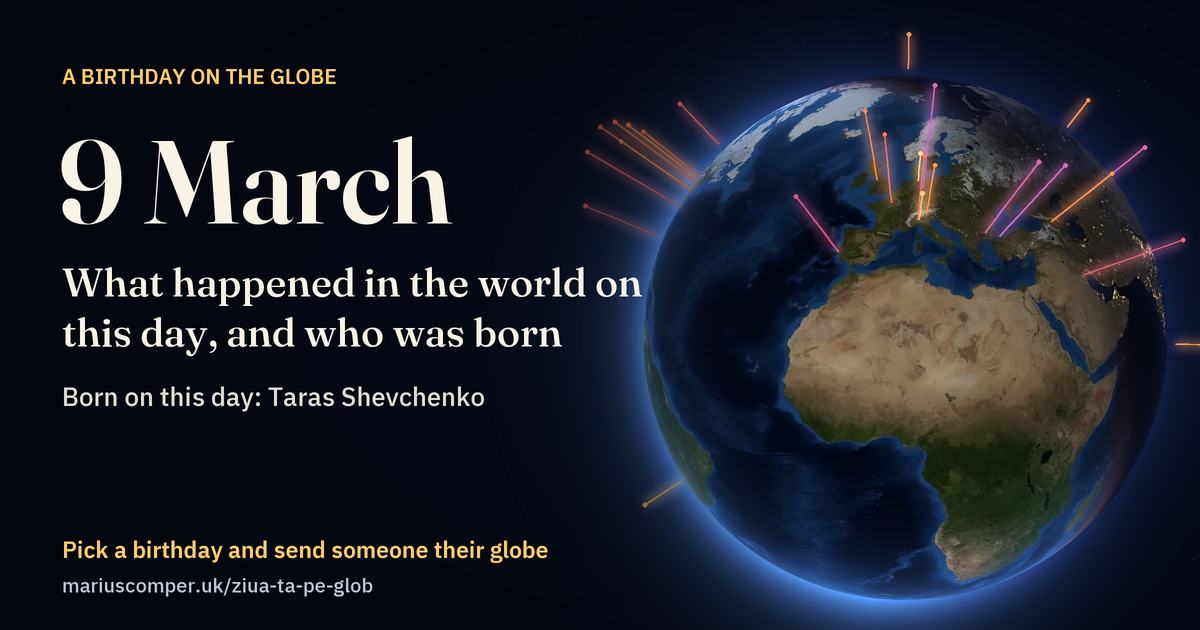
For 9 March, the English Wikipedia lists 51 events and 177 births. 26 of the events stand at their places as rays of light; seven more are dashed circles, where the sentence links only to a country or a sea. The taller the ray, the longer ago it happened. The people born that day come further down, as blue points.
A birthday, yours or someone else’s:
Turn it into a greetingScroll: the globe turns to each place
The day you were born, on the globe.
Three things from your day
Scroll: your day first, then 9 March through the years
The Earth on 9 March
The picture on the globe was assembled by NASA from satellite photographs taken in March 2004: the snow, the ice and the green are those of the month.
On 9 March the Sun passes straight overhead at noon along the parallel of 4.3° south. In London, the day lasts about 11 hours 30 minutes.
Beyond 86° south the Sun no longer sets; beyond 86° north it no longer rises.
The line between day and night is tilted on the globe exactly as on this day of the year. On the dark side you can see the lights of towns.
Europe · Quedlinburg
1009
First known mention of Lithuania, in the annals of the monastery of Quedlinburg.
On the map: Quedlinburg.
Also on the day’s list of Wikipedia in Spanish.
Europe · Lisbon
1500
The fleet of Pedro Álvares Cabral leaves Lisbon for the Indies. The fleet will discover Brazil which lies within boundaries granted to Portugal in the Treaty of Tordesillas in 1494.
On the map: Lisbon.
Also on the day’s list of Wikipedia in Spanish.
Europe · Milan
1842
Giuseppe Verdi's third opera, Nabucco, receives its première performance in Milan; its success establishes Verdi as one of Italy's foremost opera composers.
On the map: Milan.
Also on the day’s list of Wikipedia in Romanian and Chinese.
Asia · Jakarta
1978
President Soeharto inaugurates Jagorawi Toll Road, the first toll highway in Indonesia, connecting Jakarta, Bogor and Ciawi, West Java.
On the map: Jakarta.
North America · Rancho San Francisco
1842
The first documented discovery of gold in California occurs at Rancho San Francisco, six years before the California Gold Rush.
On the map: Rancho San Francisco.
Also on the day’s list of Wikipedia in Spanish.
9 March
What the other Wikipedias remember#
For these years the English list has nothing on this day. The events below come from the same day’s lists on Wikipedia in Chinese, Spanish and Romanian and were translated for this page.
From Wikipedia in Chinese · Augsburg
1276
Augsburg becomes a free imperial city within the Holy Roman Empire.
On the map: Augsburg.
Translated from the list on Wikipedia in Chinese.
From Wikipedia in Spanish · Bogotá
1687
In the town of Santafé de Bogotá (in present-day Colombia), at 22:00, the Time of the Noise occurs for 15 minutes: an extremely loud din of unknown origin, accompanied by a strong smell of sulphur, which causes panic among the city's inhabitants.
On the map: Bogotá.
Translated from the list on Wikipedia in Spanish.
From Wikipedia in Spanish · Saint Petersburg
1917
In Saint Petersburg, a workers' demonstration breaks out, which the Cossacks refuse to charge, in a prelude to the Russian Revolution.
On the map: Saint Petersburg.
Translated from the list on Wikipedia in Spanish.
From Wikipedia in Romanian · Belgrade
1991
In Belgrade, massive demonstrations take place against Slobodan Milošević. Two people are killed and tanks are on the streets.
On the map: Belgrade.
Translated from the list on Wikipedia in Romanian.
9 March
Born on 9 March#
The English Wikipedia lists 177 births for this day. The blue points are the birthplaces of 59 of these people: those written about in the most Wikipedia editions, where Wikidata gives a place of birth.
Born on 9 March
1814
Taras Shevchenko, Ukrainian poet and playwright (died 1861)
Place of birth: Moryntsi.
Born on 9 March
1943
Bobby Fischer, American chess player and author (died 2008)
Place of birth: Chicago.
Born on 9 March
1454
Amerigo Vespucci, Italian cartographer and explorer, namesake of the Americas (died 1512)
Place of birth: Florence.
Born on 9 March
1942
John Cale, Welsh musician, composer, singer, songwriter and record producer
Place of birth: Garnant.
Born on 9 March
1964
Juliette Binoche, French actress
Place of birth: 12th arrondissement of Paris.
Born in Britain and Ireland
1892
Vita Sackville-West, English author, poet, and gardener (died 1962)
Place of birth: Knole House.
Born in Britain and Ireland
1763
William Cobbett, English journalist and author (died 1835)
Place of birth: Farnham.
Born in Britain and Ireland
1993
George Baldock, Greek footballer (died 2024)
Place of birth: Buckingham.
9 March
Number one in the charts that week
At the cinema
An animal recorded that day
The record can be seen in GBIF, which brings together wildlife records from around the world.
All your birthdays
The weather that day
Data: Met Office Hadley Centre (HadCET); NOAA (GHCN-Daily, Mauna Loa).
Above the Earth
Sources: Jonathan McDowell, GCAT (launches); GFZ Potsdam (Kp index). Days are counted in Universal Time.
Football that day
International matches played that day:
Source: the “International football results” dataset kept by Mart Jürisoo (CC0).
Also that day
The earthquake’s page at the USGS
Source: the USGS catalogue. The day is counted in Universal Time (UTC).
In those days
Make a link for someone
Type the name, pick the day and the year of birth. The link opens straight on their day, with their name in the greeting.
The link carries the name, date and place typed here; anyone who gets it can see them.
Put another birthday beside it
Your mother’s, your child’s, a friend’s: the two days appear side by side.
Below: 9 March through the years.
The whole globe of the day
Drag the globe to turn it. Touch a ray or a point to read what happened there.
Everything Wikipedia lists for 9 March
The list is the English Wikipedia’s, in its own wording, as it stood in October 2026. 18 events have no place on the map: the sentence links to no place with coordinates, only to places too wide to mark, or to several countries.
- 141 BC
Liu Che, posthumously known as Emperor Wu of Han, assumes the throne over the Han dynasty of China.
Asia · Han dynastyWikipedia: Posthumous name - 1009
First known mention of Lithuania, in the annals of the monastery of Quedlinburg.
Europe · QuedlinburgWikipedia: Lithuania - 1044
The people of Constantinople riot against emperor Constantine IX Monomachos, whose preference of his mistress Maria Skleraina over empress Zoe Porphyrogenita is seen as an insult.
Asia · ConstantinopleWikipedia: Constantinople - 1226
Khwarazmian sultan Jalal ad-Din conquers the Georgian capital of Tbilisi.
Asia · TbilisiWikipedia: Anushtegin dynasty - 1230
Bulgarian Tsar Ivan Asen II defeats Theodore of Epirus in the Battle of Klokotnitsa.
Europe · Battle of KlokotnitsaWikipedia: Battle of Klokotnitsa - 1500
The fleet of Pedro Álvares Cabral leaves Lisbon for the Indies. The fleet will discover Brazil which lies within boundaries granted to Portugal in the Treaty of Tordesillas in 1494.
Europe · LisbonWikipedia: Treaty of Tordesillas - 1701
Safavid troops retreat from Basra, ending a three-year occupation.
Asia · BasraWikipedia: Safavid occupation of Basra - 1765
After a campaign by the writer Voltaire, judges in Paris posthumously exonerate Jean Calas of murdering his son. Calas had been tortured and executed in 1762 on the charge, though his son may have actually died by suicide.
no place on the mapWikipedia: Voltaire - 1776
Scottish philosopher Adam Smith publishes The Wealth of Nations, ushering in the classical period of political economy.
no place on the mapWikipedia: Adam Smith - 1796
Napoléon Bonaparte marries his first wife, Joséphine de Beauharnais.
no place on the mapWikipedia: Napoleon - 1811
Paraguayan forces defeat Manuel Belgrano at the Battle of Tacuarí.
no place on the mapWikipedia: Battle of Tacuarí - 1815
Francis Ronalds describes the first battery-operated clock in the Philosophical Magazine.
no place on the mapWikipedia: Francis Ronalds - 1841
The U.S. Supreme Court rules in the United States v. The Amistad case that captive Africans who had seized control of the ship carrying them had been taken into slavery illegally.
North America · Supreme Court of the United StatesWikipedia: Supreme Court of the United States - 1842
Giuseppe Verdi's third opera, Nabucco, receives its première performance in Milan; its success establishes Verdi as one of Italy's foremost opera composers.
Europe · MilanWikipedia: Giuseppe Verdi - 1842
The first documented discovery of gold in California occurs at Rancho San Francisco, six years before the California Gold Rush.
North America · Rancho San FranciscoWikipedia: California gold rush - 1847
Mexican–American War: The first large-scale amphibious assault in U.S. history is launched in the Siege of Veracruz.
Latin America · Siege of VeracruzWikipedia: Mexican–American War - 1862
American Civil War: USS Monitor and CSS Virginia (rebuilt from the engines and lower hull of the USS Merrimack) fight to a draw in the Battle of Hampton Roads, the first battle between two ironclad warships.
North America · USS MonitorWikipedia: American Civil War - 1883
Demonstration of 9 March 1883: Parisian anarchists, unemployed and carpenters narrowly miss the Presidential palace during a violent protest; first use of the black flag as a symbol of anarchism by Louise Michel.
Europe · ParisWikipedia: Demonstration of 9 March 1883 - 1891
Kaʻiulani was appointed the heir apparent to the throne of the Hawaiian Kingdom.
North America · Hawaiian KingdomWikipedia: Kaʻiulani - 1908
Inter Milan is founded on Football Club Internazionale, following a schism from A.C. Milan.
no place on the mapWikipedia: Inter Milan - 1910
A seventeen-month-long strike, which at its peak involved 15,000 coal miners represented by the United Mine Workers across 65 mines, began in Westmoreland County, Pennsylvania, U.S.
North America · Westmoreland County, PennsylvaniaWikipedia: 1910–1911 Westmoreland County coal strike - 1916
Mexican Revolution: Pancho Villa leads nearly 500 Mexican raiders in an attack against the border town of Columbus, New Mexico.
North America · Battle of ColumbusWikipedia: Battle of Columbus - 1925
The Royal Air Force began a bombardment and strafing campaign against the mountain strongholds of Mahsud tribesmen in South Waziristan, present-day Pakistan.
Asia · South Waziristan DistrictWikipedia: Pink's War - 1927
Former Royal Air Force officer Vivian Stranders was convicted of industrial espionage by a French court.
no place on the mapWikipedia: Royal Air Force - 1932
Éamon de Valera, a dominant political figure in 20th-century Ireland, became President of the Executive Council of the Irish Free State.
Britain & Ireland · Irish Free StateWikipedia: Éamon de Valera - 1933
Great Depression: President Franklin D. Roosevelt submits the Emergency Banking Act to Congress, the first of his New Deal policies.
no place on the mapWikipedia: New Deal - 1942
World War II: Dutch East Indies unconditionally surrenders to the Japanese forces in Kalijati, Subang, West Java, and the Japanese complete their Dutch East Indies campaign.
Asia · Subang RegencyWikipedia: World War II - 1944
World War II: Soviet Army planes attack Tallinn, Estonia.
no place on the mapWikipedia: Bombing of Tallinn in World War II - 1945
World War II: A coup d'état by Japanese forces in French Indochina removes the French from power.
Asia · French IndochinaWikipedia: Japanese coup d'état in French Indochina - 1945
World War II: Allied forces carry out firebombing over Tokyo, destroying most of the capital and killing over 100,000 civilians.
Asia · Bombing of TokyoWikipedia: Bombing of Tokyo - 1946
Bolton Wanderers stadium disaster at Burnden Park, Bolton, England, kills 33 and injures hundreds more.
Britain & Ireland · Burnden Park disasterWikipedia: Burnden Park disaster - 1954
McCarthyism: CBS television broadcasts the See It Now episode, "A Report on Senator Joseph McCarthy", produced by Fred Friendly.
no place on the mapWikipedia: McCarthyism - 1956
Soviet forces suppress mass demonstrations in the Georgian SSR, reacting to Nikita Khrushchev's de-Stalinization policy.
Asia · 1956 Georgian demonstrationsWikipedia: 1956 Georgian demonstrations - 1957
The 8.6 Mw Andreanof Islands earthquake shakes the Aleutian Islands, causing over $5 million in damage from ground movement and a destructive tsunami.
North America · 1957 Andreanof Islands earthquakeWikipedia: 1957 Andreanof Islands earthquake - 1959
The Barbie doll makes its debut at the American International Toy Fair in New York.
no place on the mapWikipedia: Barbie - 1960
Dr. Belding Hibbard Scribner implants for the first time a shunt he invented into a patient, which allows the patient to receive hemodialysis on a regular basis.
no place on the mapWikipedia: Belding Hibbard Scribner - 1961
Sputnik 9 successfully launches, carrying a dog and a human dummy, and demonstrating that the Soviet Union was ready to begin human spaceflight.
Asia · Soviet UnionWikipedia: Korabl-Sputnik 4 - 1967
Svetlana Alliluyeva, the daughter of former Soviet leader Joseph Stalin, defected to the United States.
no place on the mapWikipedia: Svetlana Alliluyeva - 1967
Trans World Airlines Flight 553 crashes in a field in Concord Township, Ohio, following a mid-air collision with a Beechcraft Baron, killing 26 people.
North America · TWA Flight 553Wikipedia: TWA Flight 553 - 1974
The Mars 7 Flyby bus releases the descent module too early, missing Mars.
no place on the mapWikipedia: Mars 7 - 1976
Forty-two people die in the Cavalese cable car disaster, the deadliest cable car accident in history.
Europe · 1976 Cavalese cable car crashWikipedia: 1976 Cavalese cable car crash - 1977
The Hanafi Siege: In a 39-hour standoff, armed Hanafi Muslims seize three Washington, D.C., buildings.
North America · 1977 Washington, D.C., attack and hostage takingWikipedia: 1977 Washington, D.C., attack and hostage taking - 1978
President Soeharto inaugurates Jagorawi Toll Road, the first toll highway in Indonesia, connecting Jakarta, Bogor and Ciawi, West Java.
Asia · JakartaWikipedia: Suharto - 1987
Chrysler announces its acquisition of American Motors Corporation.
no place on the mapWikipedia: Chrysler - 1997
Comet Hale–Bopp: Observers in China, Mongolia and eastern Siberia are treated to a rare double feature as an eclipse permits Hale-Bopp to be seen during the day.
Asia · MongoliaWikipedia: Comet Hale–Bopp - 2000
Nupedia, a multi-language online encyclopedia, is launched.
no place on the mapWikipedia: Nupedia - 2011
Space Shuttle Discovery makes its final landing after 39 flights.
no place on the mapWikipedia: Space Shuttle Discovery - 2012
A truce between the Salvadoran government and gangs in the country goes into effect when 30 gang leaders are transferred to lower security prisons.
no place on the mapWikipedia: 2012–2014 Salvadoran gang truce - 2015
Two Eurocopter AS350 Écureuil helicopters collide in mid-air over Villa Castelli, Argentina, killing all 10 people on board both aircraft, including French athletes Florence Arthaud, Camille Muffat and Alexis Vastine, as well as producers and guests for the French TV show Dropped.
Latin America · 2015 Villa Castelli mid-air collisionWikipedia: 2015 Villa Castelli mid-air collision - 2020
Giuseppe Conte, Prime Minister of Italy, announces in a televised address and signs the decree imposing the first nationwide COVID-19 lockdown in the world.
Europe · COVID-19 lockdowns in ItalyWikipedia: COVID-19 lockdowns - 2023
A shooting in the Alsterdorf quarter of Hamburg, Germany, kills eight people and injures another eight.
Europe · 2023 Hamburg shootingWikipedia: 2023 Hamburg shooting
What the other Wikipedias remember
For these years the English list has nothing on this day. The events below come from the same day’s lists on Wikipedia in Chinese, Spanish and Romanian and were translated for this page.
- 1276
Augsburg becomes a free imperial city within the Holy Roman Empire.
- 1687
In the town of Santafé de Bogotá (in present-day Colombia), at 22:00, the Time of the Noise occurs for 15 minutes: an extremely loud din of unknown origin, accompanied by a strong smell of sulphur, which causes panic among the city's inhabitants.
- 1917
In Saint Petersburg, a workers' demonstration breaks out, which the Cossacks refuse to charge, in a prelude to the Russian Revolution.
- 1991
In Belgrade, massive demonstrations take place against Slobodan Milošević. Two people are killed and tanks are on the streets.
Who was born on 9 March
In order of how many Wikipedia editions have an article about each. The first 60 of 177 are shown.
- 1934
Yuri Gagarin, Russian colonel, pilot, and cosmonaut, first human in space (died 1968)
KlushinoWikipedia: Yuri Gagarin - 1814
Taras Shevchenko, Ukrainian poet and playwright (died 1861)
MoryntsiWikipedia: Taras Shevchenko - 1943
Bobby Fischer, American chess player and author (died 2008)
ChicagoWikipedia: Bobby Fischer - 1454
Amerigo Vespucci, Italian cartographer and explorer, namesake of the Americas (died 1512)
FlorenceWikipedia: Amerigo Vespucci - 1890
Vyacheslav Molotov, Russian politician and diplomat, Soviet Minister of Foreign Affairs (died 1986)
- 1942
John Cale, Welsh musician, composer, singer, songwriter and record producer
GarnantWikipedia: John Cale - 1964
Juliette Binoche, French actress
12th arrondissement of ParisWikipedia: Juliette Binoche - 1749
Honoré Gabriel Riqueti, comte de Mirabeau, French journalist and politician (died 1791)
Le Bignon-MirabeauWikipedia: Honoré Gabriel Riqueti, comte de Mirabeau - 1959
Takaaki Kajita, Japanese physicist and academic, Nobel Prize laureate
HigashimatsuyamaWikipedia: Takaaki Kajita - 1534
Joseph of Anchieta, Spanish Jesuit saint and missionary (died 1597)
San Cristóbal de La LagunaWikipedia: Joseph of Anchieta - 1892
Mátyás Rákosi, Hungarian politician (died 1971)
- 1979
Oscar Isaac, Guatemalan-American actor
Guatemala CityWikipedia: Oscar Isaac - 1923
Walter Kohn, Austrian-American physicist and academic, Nobel Prize laureate (died 2016)
ViennaWikipedia: Walter Kohn - 1990
Daley Blind, Dutch footballer
AmsterdamWikipedia: Daley Blind - 1983
Clint Dempsey, American soccer player
NacogdochesWikipedia: Clint Dempsey - 1968
Youri Djorkaeff, French footballer
6th arrondissement of LyonWikipedia: Youri Djorkaeff - 1975
Juan Sebastián Verón, Argentine footballer
La PlataWikipedia: Juan Sebastián Verón - 1993
Suga, South Korean rapper, songwriter and record producer
DaeguWikipedia: Suga - 1930
Ornette Coleman, American saxophonist, violinist, trumpet player, and composer (died 2015)
Fort WorthWikipedia: Ornette Coleman - 1929
Zillur Rahman, Bangladeshi politician, 19th President of Bangladesh (died 2013)
Bhairab UpazilaWikipedia: Zillur Rahman - 1568
Aloysius Gonzaga, Italian saint, namesake of Gonzaga University (died 1591)
Castiglione delle StiviereWikipedia: Aloysius Gonzaga - 1910
Samuel Barber, American pianist and composer (died 1981)
West ChesterWikipedia: Samuel Barber - 1954
Bobby Sands, PIRA volunteer, Irish republican, politician, died on hunger strike (died 1981)
RathcooleWikipedia: Bobby Sands - 2000
Khaby Lame, Senegalese-Italian social media personality
- 1940
Raul Julia, Puerto Rican actor (died 1994)
San JuanWikipedia: Raul Julia - 1824
Amasa Leland Stanford, American businessman and politician, founded Stanford University (died 1893)
- 1891
José P. Laurel, Filipino lawyer, politician and President of the Philippines (died 1959)
TanauanWikipedia: Jose P. Laurel - 1980
Matthew Gray Gubler, American actor
Las VegasWikipedia: Matthew Gray Gubler - 1985
Pastor Maldonado, Venezuelan race car driver
MaracayWikipedia: Pastor Maldonado - 1989
Taeyeon, South Korean singer
JeonjuWikipedia: Taeyeon - 1892
Vita Sackville-West, English author, poet, and gardener (died 1962)
Knole HouseWikipedia: Vita Sackville-West - 1986
Brittany Snow, American actress and producer
- 1946
Bernd Hölzenbein, German footballer and scout (died 2024)
- 1948
Emma Bonino, Italian politician, Italian Minister of Foreign Affairs
- 1918
Mickey Spillane, American crime novelist (died 2006)
BrooklynWikipedia: Mickey Spillane - 1958
Linda Fiorentino, American actress
PhiladelphiaWikipedia: Linda Fiorentino - 1753
Jean-Baptiste Kléber, French general (died 1800)
StrasbourgWikipedia: Jean-Baptiste Kléber - 1758
Franz Joseph Gall, German neuroanatomist and physiologist (died 1828)
TiefenbronnWikipedia: Franz Joseph Gall - 1918
George Lincoln Rockwell, American sailor and politician, founded the American Nazi Party (died 1967)
BloomingtonWikipedia: George Lincoln Rockwell - 1954
Carlos Ghosn, Brazilian-Lebanese-French business executive
Guajará-MirimWikipedia: Carlos Ghosn - 1564
David Fabricius, German theologian, cartographer and astronomer (died 1617)
- 1956
Shashi Tharoor, Indian politician, Indian Minister of External Affairs
- 2003
Sunisa Lee, American gymnast
Saint PaulWikipedia: Sunisa Lee - 1970
Shannon Leto, American musician and songwriter
Bossier CityWikipedia: Shannon Leto - 1984
Julia Mancuso, American skier
- 1987
Bow Wow, American rapper and actor
ColumbusWikipedia: Bow Wow - 1951
Helen Zille, South African journalist, politician and Premier of the Western Cape
JohannesburgWikipedia: Helen Zille - 1763
William Cobbett, English journalist and author (died 1835)
FarnhamWikipedia: William Cobbett - 1911
Clara Rockmore, American classical violin prodigy and theremin player (died 1998)
VilniusWikipedia: Clara Rockmore - 1945
Dennis Rader, American serial killer
United StatesWikipedia: Dennis Rader - 1982
Mirjana Lučić-Baroni, Croatian tennis player
DortmundWikipedia: Mirjana Lučić-Baroni - 2001
Jeon Somi, South Korean-Canadian singer
WindsorWikipedia: Jeon Somi - 1737
Josef Mysliveček, Czech violinist and composer (died 1781)
- 1960
Željko Obradović, Serbian basketball player and coach
- 1948
Eric Fischl, American painter and sculptor
New York CityWikipedia: Eric Fischl - 1947
Keri Hulme, New Zealand author and poet (died 2021)
ChristchurchWikipedia: Keri Hulme - 1972
Kerr Smith, American actor
- 1984
Abdoulay Konko, French footballer
MarseilleWikipedia: Abdoulay Konko - 1990
YG, American rapper
ComptonWikipedia: YG - 1993
George Baldock, Greek footballer (died 2024)
BuckinghamWikipedia: George Baldock
What is celebrated on 9 March
- Christian feast day: Catherine of Bologna
- Christian feast day: Forty Martyrs of Sebaste
- Christian feast day: Frances of Rome
- Christian feast day: Pacian
- Christian feast day: Pope Cyril VI of Alexandria (Coptic Orthodox Church)
- Christian feast day: Gregory of Nyssa (Episcopal Church (United States))
- Christian feast day: March 9 (Eastern Orthodox liturgics)
- Teachers' Day or Eid Al Moalim (Lebanon)
A greeting link for someone
Type a name and, if you like, the year of birth. The link opens with a greeting, and beside each event it says how old the person turned that day, or how many years before their birth it happened.
The name and the year go only into the link you send.
All 366 days
How the globe is made
Where the events come from
Each edition of this page uses the day’s list from Wikipedia in its own language: Romanian, English, Spanish, Chinese. The lists are written by volunteers and differ from one edition to the next; the text of each event is Wikipedia’s, with a link to the article. A row that appears twice in a list is shown once. The lists have not been checked event by event: they are Wikipedia’s, mistakes included.
For events before 1582, and for countries that moved to the Gregorian calendar later (Britain in 1752, Russia in 1918), the same day may be counted Old Style in one list and New Style in another.
The chapter “What the other Wikipedias remember” adds up to five events a day from the lists of the other three editions, only for years in which the English list has nothing on that day. They were translated for this page, passed the same filters as the tour, and are not counted among the events of the English list.
How an event gets onto the map
The place comes from Wikidata. If the sentence links to the article about the event itself (a battle, an opening, an earthquake), dated to the same year, the ray stands on its coordinates or on those of its location. Otherwise it stands on the first place the sentence links to: a town, a building, a mountain, an island. This second step can be wrong: sometimes the sentence only mentions the place. That is why the page says, under each event, which place the ray stands on.
When the sentence links to a single state or province, or to a single sea, lake or desert larger than 5,000 km², the globe shows a dashed circle, not a ray. The circle has the area Wikidata gives, with its radius kept between 1.2° and 16°, or a radius of 4.5° when Wikidata gives no area; it says only that the sentence links to that place. Organisations, ships, spacecraft, museum objects, rivers, mountain ranges, languages and continents are never used as places. When a sentence names several states and no exact place, the event stays in the list only.
What the height means
The height of a ray shows how many years have passed, on a logarithmic scale: 10 years, 100 years and 1,000 years are equal steps apart; anything older than about 2,600 years has the tallest ray. The colour runs from pale yellow for recent years to violet for antiquity.
Where the tour stops
In each region the tour stops at up to three events (five in Britain and Ireland), chosen mainly by three things: whether Wikipedia’s editors put the event in the “On this day” box of their main page (the English, Spanish and Chinese editions), how many Wikipedia editions have an article about it, and how many of the four lists include it. Events whose sentence or article is about a war, an attack, a crime or a disaster are left out of the tour; they stay in the whole list, in Wikipedia’s wording. The filter is a list of words and a list of Wikidata types, so it can miss some.
The tour of births names the people with articles in the most editions and leaves aside those whom the list or Wikidata describes as rulers, politicians, commanders, leaders of movements or criminals; they stay in the list.
The Earth and the Sun
The daytime images are NASA’s Blue Marble Next Generation mosaics, one for each month of 2004; the night side is Black Marble 2016. The tilt of the line between day and night is computed for the day; the hour is chosen so that the place being read is in daylight. The latitude where the Sun stands overhead is the average of the four years of the leap cycle; in a given year it can differ by up to 0.4°.
The day you were born
The number ones come from the weekly lists on Wikipedia: Billboard for the United States (from 1940; the Hot 100 from August 1958), the UK Singles Chart (from November 1952), Los 40 Principales for Spain (from July 1966) and, for Romania, the Romanian Top 100 and Airplay 100 (2001–2021, with missing weeks). The page shows the chart of the week in which the day of birth falls, with its date; Billboard and the UK chart are dated at the end of their week. For Romania before 2001 and for China these sources have no weekly chart.
The films are those that reached cinemas in the United States up to ten days before or three days after that day (some of them in a few cinemas at first), from the English Wikipedia’s yearly lists (from 1968), in order of how many editions have an article about them. The events “in those days” are the ones on the neighbouring days’ lists that carry the year of birth, passed through the same filter as the tour.
The day of birth, year included
The Moon, the star sign and the constellation are worked out by the page itself, for noon Universal Time on the day. The lit part of the Moon is rounded and can differ by a few per cent from that at the hour of birth. The sign follows the usual zodiac of twelve equal parts starting at the March equinox; the constellation is the one the Sun actually stood in front of, by the borders set by the International Astronomical Union, and within a day of a border the page does not name it. When the Sun changes sign while it is that day anywhere on Earth, the page gives the moment of crossing, rounded to ten minutes and accurate to within about a quarter of an hour, and the clock time in a few cities, with the time zone and summer time of that year.
The year in the Chinese calendar is the one your device’s own calendar gives for the date, checked against the Hong Kong Observatory’s tables. “All your birthdays” uses the same sources as the rest of the chapter for the same day in every year since the birth: the temperature, well-known launches that took place on that very day, matches of the teams the edition follows, snow deeper than 10 cm and strong geomagnetic storms. The three things at the top and the four on the picture are chosen in a fixed order (the song, the animal, a full Moon, a well-known launch before an ordinary earthquake); on the picture you can change them.
When the link carries a year of birth, the page adds a few things about that exact day. The weather is the Met Office’s Central England temperature record and the readings from New York’s Central Park; the “usual high” is the average of the daily highs of 1961–1990 for that date, with two days either side. The carbon dioxide figure is the monthly mean at the Mauna Loa observatory, where measurements begin in March 1958.
The earthquake is the one with the largest magnitude in the USGS catalogue for that day, counted in Universal Time. Before the 1960s the catalogue has gaps even above magnitude 5.5, so in the older years many days have no earthquake. The page gives only the magnitude and the place: the country the epicentre falls in or, when the epicentre is at sea within 300 km of a coast, the nearest country; farther out, only the ocean.
The launches are those that reached orbit or left for the Moon and the planets, from Jonathan McDowell’s GCAT catalogue. If nothing left that day, the page shows the nearest launch within three days before or after, and says how many days away it was. The geomagnetic storm appears only when the Kp index reached at least 5 in one of the day’s eight three-hour intervals.
The animal comes from GBIF: an observation made by a person (the animal seen or heard, or its tracks), dated to that exact day, with coordinates and a CC0 or CC BY licence. Only a few hundred well-known species are searched (mammals, birds, turtles, butterflies); of those noted that day, mammals and species with articles in many Wikipedia editions come first; birds noted almost every day, and species used recently, wait their turn. Observations dated 1 January are left out, because records without a day are often filed there. An observation shows that the animal was recorded there, not how many animals there were.
The matches are those between national teams. Only matches of England, Scotland, Wales, Northern Ireland, the Republic of Ireland, the United States, Canada and Australia are shown, along with those at the big final tournaments. The picture to send is drawn in the page from the day’s globe and the facts above, and stays on your device until you send it.
Sources
- Events, births and holidays: the day’s page on Wikipedia, text under CC BY-SA 4.0.
- Coordinates, places of birth and the number of editions: Wikidata (CC0).
- The Earth by day: NASA Blue Marble Next Generation. The Earth by night: NASA Black Marble 2016.
- Borders and regions: Natural Earth.
- World population and births per year: UN World Population Prospects 2024.
- Charts and films: Wikipedia’s lists for Billboard, the UK Singles Chart, Los 40 Principales, Romanian Top 100, Airplay 100 and American films by year (CC BY-SA 4.0).
- Weather: Met Office Hadley Centre, HadCET (Open Government Licence) and NOAA GHCN-Daily, New York Central Park. Carbon dioxide: NOAA Global Monitoring Laboratory, Mauna Loa.
- Earthquakes: the USGS catalogue. Launches: Jonathan McDowell, GCAT (CC BY). Kp index: GFZ Potsdam (CC BY 4.0). Matches: International football results, Mart Jürisoo (CC0).
- Animal observations: GBIF, with a link to each record; species names come from Wikidata.