A birthday on the globe
26 February on the globe: what happened in the world on this day, and who was born
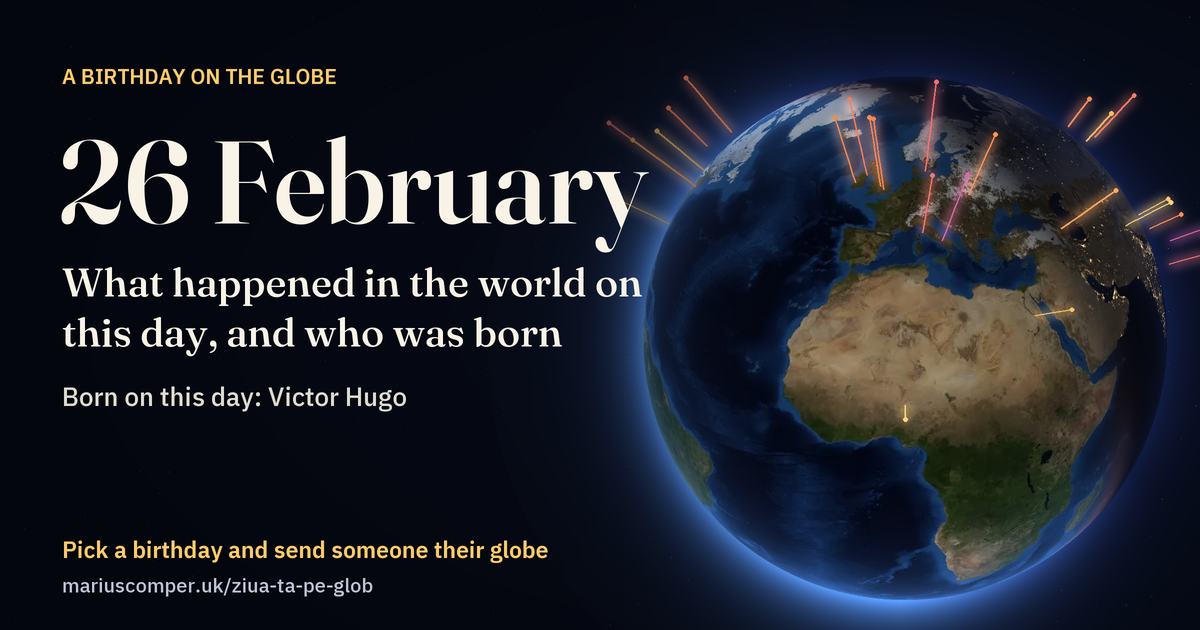
For 26 February, the English Wikipedia lists 42 events and 173 births. 25 of the events stand at their places as rays of light. The taller the ray, the longer ago it happened. The people born that day come further down, as blue points.
A birthday, yours or someone else’s:
Turn it into a greetingScroll: the globe turns to each place
The day you were born, on the globe.
Three things from your day
Scroll: your day first, then 26 February through the years
The Earth on 26 February
The picture on the globe was assembled by NASA from satellite photographs taken in February 2004: the snow, the ice and the green are those of the month.
On 26 February the Sun passes straight overhead at noon along the parallel of 8.9° south. In London, the day lasts about 10 hours 40 minutes.
Beyond 81° south the Sun no longer sets; beyond 81° north it no longer rises.
The line between day and night is tilted on the globe exactly as on this day of the year. On the dark side you can see the lights of towns.
Britain & Ireland · Palace Theatre, London
1909
Kinemacolor, the first successful color motion picture process, is first shown to the general public at the Palace Theatre in London.
On the map: Palace Theatre, London.
Britain & Ireland · Daventry
1935
Robert Watson-Watt carries out a demonstration near Daventry which leads directly to the development of radar in the United Kingdom.
On the map: Daventry.
Asia · Inwa
1365
The Ava Kingdom and the royal city of Ava (Inwa) were founded by King Thado Minbya.
On the map: Inwa.
Asia · Ganghwa Island
1876
Japan and Korea sign the Treaty of Kangwha, which grants Japanese citizens extraterritoriality rights in Korea, opens three Korean ports to Japanese trade, and ends Korea's status as a tributary state of Qing dynasty China.
On the map: Ganghwa Island.
Also on the day’s list of Wikipedia in Chinese.
Asia · East Pyongyang Grand Theatre
2008
The New York Philharmonic performs in Pyongyang, North Korea; this was the first such event to take place in North Korea.
On the map: East Pyongyang Grand Theatre.
Also on the day’s list of Wikipedia in Chinese.
Wikipedia: 2008 visit by New York Philharmonic to North Korea
North America · Beach Pneumatic Transit
1870
The Beach Pneumatic Transit in New York City, intended as a demonstration for a subway line, opens.
On the map: Beach Pneumatic Transit.
North America · Grand Canyon National Park
1919
President Woodrow Wilson signs an act of Congress establishing the Grand Canyon National Park.
On the map: Grand Canyon National Park.
North America · Grand Teton National Park
1929
President Calvin Coolidge signs legislation establishing the 96,000 acres (390 km2) Grand Teton National Park in Wyoming.
On the map: Grand Teton National Park.
26 February
What the other Wikipedias remember#
For these years the English list has nothing on this day. The events below come from the same day’s lists on Wikipedia in Spanish and Romanian and were translated for this page.
From Wikipedia in Spanish · Seville
1902
In Seville the rains continue, and the waters of the Guadalquivir reach five metres above their usual level.
On the map: Seville.
Translated from the list on Wikipedia in Spanish.
From Wikipedia in Romanian · 2006 Winter Olympics
2006
Closing ceremony of the Winter Olympic Games in Turin, Italy.
On the map: 2006 Winter Olympics.
Translated from the list on Wikipedia in Romanian.
The article on Wikipedia in Romanian: Jocurile Olimpice de iarnă din 2006
26 February
Born on 26 February#
The English Wikipedia lists 173 births for this day. The blue points are the birthplaces of 60 of these people: those written about in the most Wikipedia editions, where Wikidata gives a place of birth.
Born on 26 February
1802
Victor Hugo, French author, poet, and playwright (died 1885)
Place of birth: Besançon.
Born on 26 February
1564
Christopher Marlowe, English playwright, poet and translator (died 1593)
Place of birth: Canterbury.
Born on 26 February
1956
Michel Houellebecq, French author, poet, screenwriter, and director
Place of birth: Saint-Pierre.
Born on 26 February
1946
Ahmed Zewail, Egyptian-American chemist and academic, Nobel Prize laureate (died 2016)
Place of birth: Damanhur.
Born in Britain and Ireland
1947
Sandie Shaw, English singer and psychotherapist
Place of birth: Dagenham.
Born in Britain and Ireland
1946
Colin Bell, English footballer (died 2021)
Place of birth: Hesleden.
Born in Britain and Ireland
1906
Madeleine Carroll, English actress (died 1987)
Place of birth: West Bromwich.
26 February
Number one in the charts that week
At the cinema
An animal recorded that day
The record can be seen in GBIF, which brings together wildlife records from around the world.
All your birthdays
The weather that day
Data: Met Office Hadley Centre (HadCET); NOAA (GHCN-Daily, Mauna Loa).
Above the Earth
Sources: Jonathan McDowell, GCAT (launches); GFZ Potsdam (Kp index). Days are counted in Universal Time.
Football that day
International matches played that day:
Source: the “International football results” dataset kept by Mart Jürisoo (CC0).
Also that day
The earthquake’s page at the USGS
Source: the USGS catalogue. The day is counted in Universal Time (UTC).
In those days
Make a link for someone
Type the name, pick the day and the year of birth. The link opens straight on their day, with their name in the greeting.
The link carries the name, date and place typed here; anyone who gets it can see them.
Put another birthday beside it
Your mother’s, your child’s, a friend’s: the two days appear side by side.
Below: 26 February through the years.
The whole globe of the day
Drag the globe to turn it. Touch a ray or a point to read what happened there.
Everything Wikipedia lists for 26 February
The list is the English Wikipedia’s, in its own wording, as it stood in October 2026. 17 events have no place on the map: the sentence links to no place with coordinates, only to places too wide to mark, or to several countries.
- 747 BC
According to Ptolemy, the epoch (origin) of the Nabonassar Era began at noon on this date. Historians use this to establish the modern BC chronology for dating historic events.
no place on the mapWikipedia: Ptolemy - 320
Chandragupta I is officially crowned as the first Gupta Emperor.
no place on the mapWikipedia: Chandragupta I - 364
Valentinian I is proclaimed Roman Emperor.
no place on the mapWikipedia: Valentinian I - 1074
Battle of Kemej: The royal army of Solomon, King of Hungary defeats the force of his rebellious cousin Duke Géza.
no place on the mapWikipedia: Battle of Kemej - 1266
Battle of Benevento: An army led by Charles, Count of Anjou, defeats a combined German and Sicilian force led by Manfred, King of Sicily. Manfred is killed in the battle and Pope Clement IV invests Charles as king of Sicily and Naples.
Europe · Battle of BeneventoWikipedia: Battle of Benevento - 1365
The Ava Kingdom and the royal city of Ava (Inwa) were founded by King Thado Minbya.
Asia · InwaWikipedia: Kingdom of Ava - 1606
The Janszoon voyage of 1605–06 becomes the first European expedition to set foot on Australia, although it is mistaken as a part of New Guinea.
no place on the mapWikipedia: Janszoon voyage of 1605–1606 - 1616
Galileo Galilei is formally banned by the Roman Catholic Church from teaching or defending the view that the earth orbits the sun.
no place on the mapWikipedia: Galileo affair - 1775
The British East India Company factory on Balambangan Island is destroyed by Moro pirates.
Asia · Balambangan IslandWikipedia: Piracy in the Sulu and Celebes Seas - 1794
The first Christiansborg Palace in Copenhagen burns down.
Europe · Christiansborg PalaceWikipedia: Christiansborg Palace - 1815
Napoleon Bonaparte escapes from exile on the island of Elba.
Europe · ElbaWikipedia: Napoleon - 1870
The Beach Pneumatic Transit in New York City, intended as a demonstration for a subway line, opens.
North America · Beach Pneumatic TransitWikipedia: Beach Pneumatic Transit - 1876
Japan and Korea sign the Treaty of Kangwha, which grants Japanese citizens extraterritoriality rights in Korea, opens three Korean ports to Japanese trade, and ends Korea's status as a tributary state of Qing dynasty China.
Asia · Ganghwa IslandWikipedia: Japan–Korea Treaty of 1876 - 1903
Storm Ulysses struck Ireland, felling thousands of trees and causing damage to up to a quarter of all houses in Dublin.
no place on the mapWikipedia: Storm Ulysses - 1909
Kinemacolor, the first successful color motion picture process, is first shown to the general public at the Palace Theatre in London.
Britain & Ireland · Palace Theatre, LondonWikipedia: Kinemacolor - 1914
HMHS Britannic, sister to the RMS Titanic, is launched at Harland and Wolff shipyard in Belfast.
Britain & Ireland · BelfastWikipedia: Titanic - 1917
The Original Dixieland Jass Band recorded "Livery Stable Blues", the first jazz single ever released.
no place on the mapWikipedia: Original Dixieland Jass Band - 1919
President Woodrow Wilson signs an act of Congress establishing the Grand Canyon National Park.
North America · Grand Canyon National ParkWikipedia: Woodrow Wilson - 1929
President Calvin Coolidge signs legislation establishing the 96,000 acres (390 km2) Grand Teton National Park in Wyoming.
North America · Grand Teton National ParkWikipedia: Calvin Coolidge - 1935
Adolf Hitler orders the Luftwaffe to be re-formed, violating the provisions of the Treaty of Versailles.
no place on the mapWikipedia: Treaty of Versailles - 1935
Robert Watson-Watt carries out a demonstration near Daventry which leads directly to the development of radar in the United Kingdom.
Britain & Ireland · DaventryWikipedia: Robert Watson-Watt - 1936
In the February 26 Incident, young nationalist Japanese military officers assassinate multiple cabinet statesmen and start a rebellion in downtown Tokyo, which is ended 3 days later.
Asia · February 26 incidentWikipedia: February 26 incident - 1945
World War II: US troops reclaim the Philippine island of Corregidor from the Japanese.
Asia · Battle of CorregidorWikipedia: Battle of Corregidor - 1952
Vincent Massey is sworn in as the first Canadian-born Governor General of Canada.
no place on the mapWikipedia: Vincent Massey - 1960
A Kyiv-bound Aeroflot airliner crashes on approach to Snilow Airport in Lviv, killing 32 of the 33 people on board.
Europe · LvivWikipedia: Aeroflot Flight 315 - 1960
A New York-bound Alitalia airliner crashes into a cemetery in Shannon, Ireland, shortly after takeoff, killing 34 of the 52 persons on board.
Britain & Ireland · ShannonWikipedia: Alitalia Flight 618 - 1966
Apollo program: Launch of AS-201, the first flight of the Saturn IB rocket.
no place on the mapWikipedia: Apollo program - 1971
U.N. Secretary-General U Thant signs United Nations proclamation of the vernal equinox as Earth Day.
no place on the mapWikipedia: Secretary-General of the United Nations - 1979
The Superliner railcar enters revenue service with Amtrak.
no place on the mapWikipedia: Superliner - 1980
Egypt and Israel establish full diplomatic relations.
no place on the mapWikipedia: Egypt–Israel relations - 1987
Iran–Contra affair: The Tower Commission rebukes President Ronald Reagan for not controlling his national security staff.
no place on the mapWikipedia: Iran–Contra affair - 1992
First Nagorno-Karabakh War: Khojaly Massacre: Armenian armed forces open fire on Azeri civilians at a military post outside the town of Khojaly leaving hundreds dead.
Asia · Khojaly massacreWikipedia: Khojaly massacre - 1993
World Trade Center bombing: In New York City, a truck bomb parked below the North Tower of the World Trade Center explodes, killing six and injuring over a thousand people.
North America · 1993 World Trade Center bombingWikipedia: 1993 World Trade Center bombing - 1995
The UK's oldest investment banking institute, Barings Bank, collapses after a rogue securities broker Nick Leeson loses $1.4 billion by speculating on the Singapore International Monetary Exchange using futures contracts.
no place on the mapWikipedia: Barings Bank - 2008
The New York Philharmonic performs in Pyongyang, North Korea; this was the first such event to take place in North Korea.
Asia · East Pyongyang Grand TheatreWikipedia: 2008 visit by New York Philharmonic to North Korea - 2012
A train derails in Burlington, Ontario, Canada killing at least three people and injuring 45.
North America · Burlington, OntarioWikipedia: 2012 Burlington Via derailment - 2012
Seventeen-year-old African-American student Trayvon Martin is shot to death by neighborhood watch coordinator George Zimmerman in an altercation in Sanford, Florida.
North America · Killing of Trayvon MartinWikipedia: Killing of Trayvon Martin - 2013
A hot air balloon crashes near Luxor, Egypt, killing 19 people.
Africa · 2013 Luxor hot air balloon crashWikipedia: 2013 Luxor hot air balloon crash - 2014
Former editor-in-chief of Hong Kong newspaper Ming Pao Kevin Lau was stabbed, prompting concerns and protests about media freedom.
Asia · Sai Wan HoWikipedia: Knife attack on Kevin Lau - 2019
Indian Air Force fighter-jets target Jaish-e-Mohammed terrorist training camps in Balakot, Pakistan.
Asia · 2019 Balakot airstrikeWikipedia: 2019 Balakot airstrike - 2021
A total of 279 female students aged between 10 and 17 are kidnapped by bandits in the Zamfara kidnapping in Zamfara State, Nigeria.
Africa · 2021 Zamfara school kidnappingWikipedia: 2021 Zamfara school kidnapping - 2026
The government of Pakistan declares "open war" against the Taliban in Afghanistan, initiating the 2026 Afghanistan–Pakistan War.
no place on the mapWikipedia: 2026 Afghanistan–Pakistan war
What the other Wikipedias remember
For these years the English list has nothing on this day. The events below come from the same day’s lists on Wikipedia in Spanish and Romanian and were translated for this page.
- 1902
In Seville the rains continue, and the waters of the Guadalquivir reach five metres above their usual level.
- 2006
Closing ceremony of the Winter Olympic Games in Turin, Italy.
Europe · 2006 Winter OlympicsTranslated from the list on Wikipedia in RomanianWikipedia: Jocurile Olimpice de iarnă din 2006
Who was born on 26 February
In order of how many Wikipedia editions have an article about each. The first 60 of 173 are shown.
- 1802
Victor Hugo, French author, poet, and playwright (died 1885)
BesançonWikipedia: Victor Hugo - 1928
Ariel Sharon, Israeli general and politician, 11th Prime Minister of Israel (died 2014)
Kfar MalalWikipedia: Ariel Sharon - 1564
Christopher Marlowe, English playwright, poet and translator (died 1593)
CanterburyWikipedia: Christopher Marlowe - 1959
Ahmet Davutoğlu, Turkish political scientist, academic, and politician, 37th Prime Minister of Turkey
TaşkentWikipedia: Ahmet Davutoğlu - 1861
Nadezhda Krupskaya, Russian soldier and politician (died 1939)
Saint PetersburgWikipedia: Nadezhda Krupskaya - 1956
Michel Houellebecq, French author, poet, screenwriter, and director
Saint-PierreWikipedia: Michel Houellebecq - 1950
Helen Clark, New Zealand academic and politician, 37th Prime Minister of New Zealand
Te PahuWikipedia: Helen Clark - 1946
Ahmed Zewail, Egyptian-American chemist and academic, Nobel Prize laureate (died 2016)
DamanhurWikipedia: Ahmed Zewail - 1983
Pepe, Brazilian-Portuguese footballer
MaceióWikipedia: Pepe - 1786
François Arago, French mathematician and politician, 25th Prime Minister of France (died 1853)
EstagelWikipedia: François Arago - 1984
Emmanuel Adebayor, Togolese footballer
- 1903
Giulio Natta, Italian chemist and academic, Nobel Prize laureate (died 1979)
Porto MaurizioWikipedia: Giulio Natta - 1982
Li Na, Chinese tennis player
WuhanWikipedia: Li Na - 1973
Ole Gunnar Solskjær, Norwegian footballer and manager
Kristiansund MunicipalityWikipedia: Ole Gunnar Solskjær - 1808
Honoré Daumier, French painter, illustrator, and sculptor (died 1879)
MarseilleWikipedia: Honoré Daumier - 1842
Camille Flammarion, French astronomer and author (died 1925)
Val-de-MeuseWikipedia: Camille Flammarion - 1967
Kazuyoshi Miura, Japanese footballer
ShizuokaWikipedia: Kazuyoshi Miura - 1861
Ferdinand I of Bulgaria (died 1948)
- 1985
Fernando Llorente, Spanish footballer
PamplonaWikipedia: Fernando Llorente - 2003
Jamal Musiala, German footballer
StuttgartWikipedia: Jamal Musiala - 1928
Fats Domino, American singer-songwriter and pianist (died 2017)
New OrleansWikipedia: Fats Domino - 1896
Andrei Zhdanov, Ukrainian-Russian civil servant and politician (died 1948)
MariupolWikipedia: Andrei Zhdanov - 1846
Buffalo Bill, American soldier and hunter (died 1917)
Le ClaireWikipedia: Buffalo Bill - 1984
Beren Saat, Turkish actress
AnkaraWikipedia: Beren Saat - 1361
Wenceslaus IV of Bohemia (died 1419)
NurembergWikipedia: Wenceslaus IV of Bohemia - 1829
Levi Strauss, German-American fashion designer, founded Levi Strauss & Co. (died 1902)
- 1909
Talal of Jordan (died 1972)
- 1924
Noboru Takeshita, Japanese soldier and politician, 74th Prime Minister of Japan (died 2000)
- 1947
Sandie Shaw, English singer and psychotherapist
DagenhamWikipedia: Sandie Shaw - 1958
Tim Kaine, American lawyer and politician, 70th Governor of Virginia
Saint PaulWikipedia: Tim Kaine - 1974
Sébastien Loeb, French racing driver
HaguenauWikipedia: Sébastien Loeb - 1416
Christopher of Bavaria (died 1448)
Neumarkt in der OberpfalzWikipedia: Christopher of Bavaria - 1918
Theodore Sturgeon, American author and critic (died 1985)
Staten IslandWikipedia: Theodore Sturgeon - 1671
Anthony Ashley-Cooper, 3rd Earl of Shaftesbury, English philosopher and politician (died 1713)
- 1908
Tex Avery, American animator, producer, and voice actor (died 1980)
TaylorWikipedia: Tex Avery - 1885
Aleksandras Stulginskis, Lithuanian farmer and politician, 2nd President of Lithuania (died 1969)
- 2000
Yeat, American rapper
IrvineWikipedia: Yeat - 1902
Jean Bruller, French author and illustrator, co-founded Les Éditions de Minuit (died 1991)
15th arrondissement of ParisWikipedia: Jean Bruller - 1921
Betty Hutton, American actress, singer, dancer and comedian (died 2007)
Battle CreekWikipedia: Betty Hutton - 1958
Susan Helms, American general, engineer, and astronaut
CharlotteWikipedia: Susan Helms - 1900
Halina Konopacka, Polish discus thrower and poet (died 1989)
Rawa MazowieckaWikipedia: Halina Konopacka - 1971
Max Martin, Swedish-American record producer and songwriter
Sånga församlingWikipedia: Max Martin - 1770
Anton Reicha, Bohemian composer and flautist (died 1836)
PragueWikipedia: Anton Reicha - 1852
John Harvey Kellogg, American surgeon, co-created Corn flakes (died 1943)
Tyrone TownshipWikipedia: John Harvey Kellogg - 1944
Ronald Lauder, American businessman and diplomat, United States Ambassador to Austria
New York CityWikipedia: Ronald Lauder - 1946
Colin Bell, English footballer (died 2021)
HesledenWikipedia: Colin Bell - 1966
Najwa Karam, Lebanese singer
- 1746
Maria Amalia, Duchess of Parma (died 1804)
- 1978
Abdoulaye Faye, Senegalese footballer
- 1989
Gabriel Obertan, French footballer
- 1906
Madeleine Carroll, English actress (died 1987)
West BromwichWikipedia: Madeleine Carroll - 1922
Margaret Leighton, English actress (died 1976)
Barnt GreenWikipedia: Margaret Leighton - 1857
Émile Coué, French psychologist and pharmacist (died 1926)
TroyesWikipedia: Émile Coué - 1882
Husband E. Kimmel, American admiral (died 1968)
HendersonWikipedia: Husband E. Kimmel - 1979
Pedro Mendes, Portuguese footballer
Moreira de CónegosWikipedia: Pedro Mendes - 1949
Elizabeth George, American author and educator
- 1729
Anders Chydenius, Finnish economist, philosopher and Lutheran priest (died 1803)
Sotkamo parish villageWikipedia: Anders Chydenius - 1973
Jenny Thompson, American swimmer
DanversWikipedia: Jenny Thompson - 2002
Gerard Martín, Spanish footballer
Esplugues de LlobregatWikipedia: Gerard Martín - 1926
Henry Molaison, American medical patient (died 2008)
ManchesterWikipedia: Henry Molaison
What is celebrated on 26 February
- Christian feast day: Alexander of Alexandria
- Christian feast day: Emily Malbone Morgan (Episcopal Church (USA))
- Christian feast day: Isabelle of France
- Christian feast day: Li Tim-Oi (Anglican Church of Canada)
- Christian feast day: Paula Montal Fornés
- Christian feast day: Porphyry of Gaza
- Christian feast day: February 26 (Eastern Orthodox liturgics)
- Day of Remembrance for Victims of Khojaly Massacre (Azerbaijan)
- Liberation Day (Kuwait)
- Saviours' Day (Nation of Islam)
A greeting link for someone
Type a name and, if you like, the year of birth. The link opens with a greeting, and beside each event it says how old the person turned that day, or how many years before their birth it happened.
The name and the year go only into the link you send.
All 366 days
How the globe is made
Where the events come from
Each edition of this page uses the day’s list from Wikipedia in its own language: Romanian, English, Spanish, Chinese. The lists are written by volunteers and differ from one edition to the next; the text of each event is Wikipedia’s, with a link to the article. A row that appears twice in a list is shown once. The lists have not been checked event by event: they are Wikipedia’s, mistakes included.
For events before 1582, and for countries that moved to the Gregorian calendar later (Britain in 1752, Russia in 1918), the same day may be counted Old Style in one list and New Style in another.
The chapter “What the other Wikipedias remember” adds up to five events a day from the lists of the other three editions, only for years in which the English list has nothing on that day. They were translated for this page, passed the same filters as the tour, and are not counted among the events of the English list.
How an event gets onto the map
The place comes from Wikidata. If the sentence links to the article about the event itself (a battle, an opening, an earthquake), dated to the same year, the ray stands on its coordinates or on those of its location. Otherwise it stands on the first place the sentence links to: a town, a building, a mountain, an island. This second step can be wrong: sometimes the sentence only mentions the place. That is why the page says, under each event, which place the ray stands on.
When the sentence links to a single state or province, or to a single sea, lake or desert larger than 5,000 km², the globe shows a dashed circle, not a ray. The circle has the area Wikidata gives, with its radius kept between 1.2° and 16°, or a radius of 4.5° when Wikidata gives no area; it says only that the sentence links to that place. Organisations, ships, spacecraft, museum objects, rivers, mountain ranges, languages and continents are never used as places. When a sentence names several states and no exact place, the event stays in the list only.
What the height means
The height of a ray shows how many years have passed, on a logarithmic scale: 10 years, 100 years and 1,000 years are equal steps apart; anything older than about 2,600 years has the tallest ray. The colour runs from pale yellow for recent years to violet for antiquity.
Where the tour stops
In each region the tour stops at up to three events (five in Britain and Ireland), chosen mainly by three things: whether Wikipedia’s editors put the event in the “On this day” box of their main page (the English, Spanish and Chinese editions), how many Wikipedia editions have an article about it, and how many of the four lists include it. Events whose sentence or article is about a war, an attack, a crime or a disaster are left out of the tour; they stay in the whole list, in Wikipedia’s wording. The filter is a list of words and a list of Wikidata types, so it can miss some.
The tour of births names the people with articles in the most editions and leaves aside those whom the list or Wikidata describes as rulers, politicians, commanders, leaders of movements or criminals; they stay in the list.
The Earth and the Sun
The daytime images are NASA’s Blue Marble Next Generation mosaics, one for each month of 2004; the night side is Black Marble 2016. The tilt of the line between day and night is computed for the day; the hour is chosen so that the place being read is in daylight. The latitude where the Sun stands overhead is the average of the four years of the leap cycle; in a given year it can differ by up to 0.4°.
The day you were born
The number ones come from the weekly lists on Wikipedia: Billboard for the United States (from 1940; the Hot 100 from August 1958), the UK Singles Chart (from November 1952), Los 40 Principales for Spain (from July 1966) and, for Romania, the Romanian Top 100 and Airplay 100 (2001–2021, with missing weeks). The page shows the chart of the week in which the day of birth falls, with its date; Billboard and the UK chart are dated at the end of their week. For Romania before 2001 and for China these sources have no weekly chart.
The films are those that reached cinemas in the United States up to ten days before or three days after that day (some of them in a few cinemas at first), from the English Wikipedia’s yearly lists (from 1968), in order of how many editions have an article about them. The events “in those days” are the ones on the neighbouring days’ lists that carry the year of birth, passed through the same filter as the tour.
The day of birth, year included
The Moon, the star sign and the constellation are worked out by the page itself, for noon Universal Time on the day. The lit part of the Moon is rounded and can differ by a few per cent from that at the hour of birth. The sign follows the usual zodiac of twelve equal parts starting at the March equinox; the constellation is the one the Sun actually stood in front of, by the borders set by the International Astronomical Union, and within a day of a border the page does not name it. When the Sun changes sign while it is that day anywhere on Earth, the page gives the moment of crossing, rounded to ten minutes and accurate to within about a quarter of an hour, and the clock time in a few cities, with the time zone and summer time of that year.
The year in the Chinese calendar is the one your device’s own calendar gives for the date, checked against the Hong Kong Observatory’s tables. “All your birthdays” uses the same sources as the rest of the chapter for the same day in every year since the birth: the temperature, well-known launches that took place on that very day, matches of the teams the edition follows, snow deeper than 10 cm and strong geomagnetic storms. The three things at the top and the four on the picture are chosen in a fixed order (the song, the animal, a full Moon, a well-known launch before an ordinary earthquake); on the picture you can change them.
When the link carries a year of birth, the page adds a few things about that exact day. The weather is the Met Office’s Central England temperature record and the readings from New York’s Central Park; the “usual high” is the average of the daily highs of 1961–1990 for that date, with two days either side. The carbon dioxide figure is the monthly mean at the Mauna Loa observatory, where measurements begin in March 1958.
The earthquake is the one with the largest magnitude in the USGS catalogue for that day, counted in Universal Time. Before the 1960s the catalogue has gaps even above magnitude 5.5, so in the older years many days have no earthquake. The page gives only the magnitude and the place: the country the epicentre falls in or, when the epicentre is at sea within 300 km of a coast, the nearest country; farther out, only the ocean.
The launches are those that reached orbit or left for the Moon and the planets, from Jonathan McDowell’s GCAT catalogue. If nothing left that day, the page shows the nearest launch within three days before or after, and says how many days away it was. The geomagnetic storm appears only when the Kp index reached at least 5 in one of the day’s eight three-hour intervals.
The animal comes from GBIF: an observation made by a person (the animal seen or heard, or its tracks), dated to that exact day, with coordinates and a CC0 or CC BY licence. Only a few hundred well-known species are searched (mammals, birds, turtles, butterflies); of those noted that day, mammals and species with articles in many Wikipedia editions come first; birds noted almost every day, and species used recently, wait their turn. Observations dated 1 January are left out, because records without a day are often filed there. An observation shows that the animal was recorded there, not how many animals there were.
The matches are those between national teams. Only matches of England, Scotland, Wales, Northern Ireland, the Republic of Ireland, the United States, Canada and Australia are shown, along with those at the big final tournaments. The picture to send is drawn in the page from the day’s globe and the facts above, and stays on your device until you send it.
Sources
- Events, births and holidays: the day’s page on Wikipedia, text under CC BY-SA 4.0.
- Coordinates, places of birth and the number of editions: Wikidata (CC0).
- The Earth by day: NASA Blue Marble Next Generation. The Earth by night: NASA Black Marble 2016.
- Borders and regions: Natural Earth.
- World population and births per year: UN World Population Prospects 2024.
- Charts and films: Wikipedia’s lists for Billboard, the UK Singles Chart, Los 40 Principales, Romanian Top 100, Airplay 100 and American films by year (CC BY-SA 4.0).
- Weather: Met Office Hadley Centre, HadCET (Open Government Licence) and NOAA GHCN-Daily, New York Central Park. Carbon dioxide: NOAA Global Monitoring Laboratory, Mauna Loa.
- Earthquakes: the USGS catalogue. Launches: Jonathan McDowell, GCAT (CC BY). Kp index: GFZ Potsdam (CC BY 4.0). Matches: International football results, Mart Jürisoo (CC0).
- Animal observations: GBIF, with a link to each record; species names come from Wikidata.