A birthday on the globe
25 February on the globe: what happened in the world on this day, and who was born
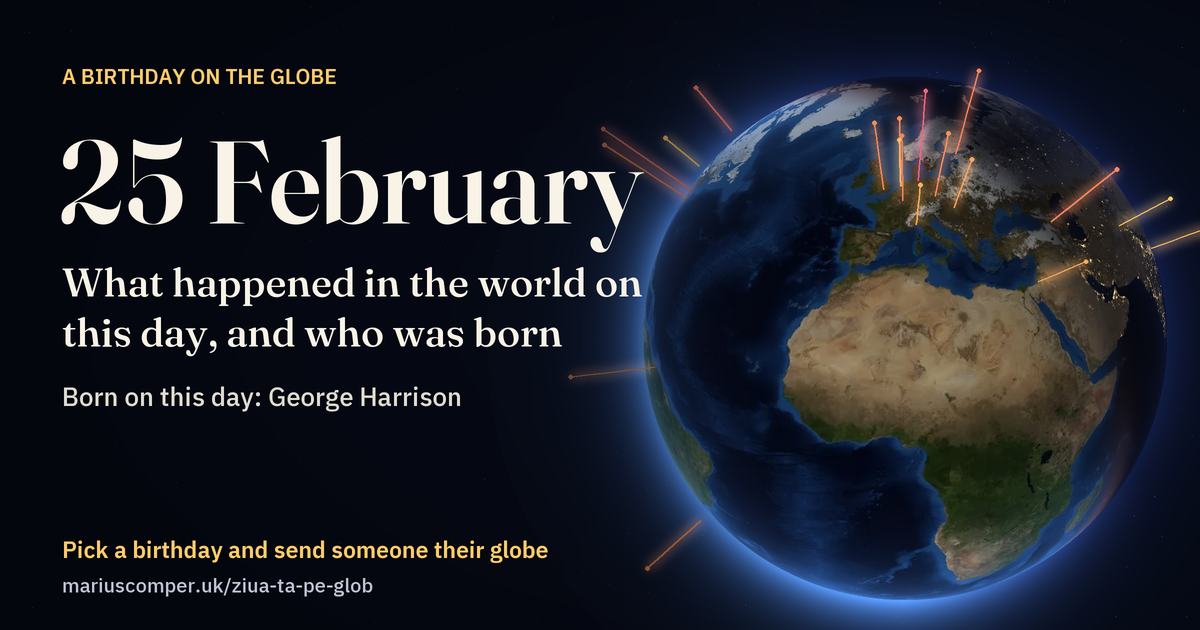
For 25 February, the English Wikipedia lists 32 events and 157 births. 20 of the events stand at their places as rays of light; six more are dashed circles, where the sentence links only to a country or a sea. The taller the ray, the longer ago it happened. The people born that day come further down, as blue points.
A birthday, yours or someone else’s:
Turn it into a greetingScroll: the globe turns to each place
The day you were born, on the globe.
Three things from your day
Scroll: your day first, then 25 February through the years
The Earth on 25 February
The picture on the globe was assembled by NASA from satellite photographs taken in February 2004: the snow, the ice and the green are those of the month.
On 25 February the Sun passes straight overhead at noon along the parallel of 9.3° south. In London, the day lasts about 10 hours 35 minutes.
Beyond 81° south the Sun no longer sets; beyond 81° north it no longer rises.
The line between day and night is tilted on the globe exactly as on this day of the year. On the dark side you can see the lights of towns.
Europe · Hamburg
1705
George Frideric Handel's opera Nero premieres in Hamburg.
On the map: Hamburg.
Also on the day’s list of Wikipedia in Spanish.
Europe · Budapest
1991
Disbandment of the Warsaw Pact at a meeting of its members in Budapest.
On the map: Budapest.
Also on the day’s list of Wikipedia in Spanish.
Latin America · Buenos Aires
1951
The first Pan American Games are officially opened in Buenos Aires by Argentine President Juan Perón.
On the map: Buenos Aires.
Also on the day’s list of Wikipedia in Chinese.
North America · Calaveras County, California
1866
Miners in Calaveras County, California, discovered a human skull that was taken to show that humans had existed during the Pliocene, a thesis that was later disproved.
On the map: Calaveras County, California.
North America · United States Congress
1870
Hiram Rhodes Revels, a Republican from Mississippi, is sworn into the United States Senate, becoming the first African American ever to sit in Congress.
On the map: United States Congress.
North America · Newport News, Virginia
1933
Launch of the USS Ranger at Newport News, Virginia. It is the first purpose-built aircraft carrier to be commissioned by the US Navy.
On the map: Newport News, Virginia.
25 February
What the other Wikipedias remember#
For these years the English list has nothing on this day. The events below come from the same day’s lists on Wikipedia in Romanian and Spanish and were translated for this page.
From Wikipedia in Romanian · 1952 Winter Olympics
1952
Closing ceremony of the Winter Olympic Games in Oslo, Norway.
On the map: 1952 Winter Olympics.
Translated from the list on Wikipedia in Romanian.
The article on Wikipedia in Romanian: Jocurile Olimpice de iarnă din 1952
From Wikipedia in Spanish · Seoul
2003
In Seoul (South Korea), the new president Roh Moo-hyun, successor to Kim Dae-jung, is sworn into office.
On the map: Seoul.
Translated from the list on Wikipedia in Spanish.
From Wikipedia in Spanish · 2018 Winter Olympics
2018
In Pyeongchang (South Korea), the XXIII Winter Olympic Games end.
On the map: 2018 Winter Olympics.
Translated from the list on Wikipedia in Spanish.
The article on Wikipedia in Spanish: Juegos Olímpicos de Pieonchang 2018
25 February
Born on 25 February#
The English Wikipedia lists 157 births for this day. The blue points are the birthplaces of 60 of these people: those written about in the most Wikipedia editions, where Wikidata gives a place of birth.
Born on 25 February
1943
George Harrison, English singer-songwriter, guitarist and film producer (died 2001)
Place of birth: 12 Arnold Grove.
Born on 25 February
1841
Pierre-Auguste Renoir, French painter and sculptor (died 1919)
Place of birth: Limoges.
Born on 25 February
1707
Carlo Goldoni, Italian playwright and composer (died 1793)
Place of birth: Venice.
Born on 25 February
1871
Lesya Ukrainka, Ukrainian poet and playwright (died1913)
Place of birth: Zviahel.
Born on 25 February
1917
Anthony Burgess, English author, playwright, and critic (died 1993)
Place of birth: Harpurhey.
Born in Britain and Ireland
1986
Jameela Jamil, English actress and presenter
Place of birth: Hampstead.
Born in Britain and Ireland
1937
Tom Courtenay, English actor
Place of birth: Kingston upon Hull.
Born in Britain and Ireland
1950
Neil Jordan, Irish film director, screenwriter and author
Place of birth: Sligo.
25 February
Number one in the charts that week
At the cinema
An animal recorded that day
The record can be seen in GBIF, which brings together wildlife records from around the world.
All your birthdays
The weather that day
Data: Met Office Hadley Centre (HadCET); NOAA (GHCN-Daily, Mauna Loa).
Above the Earth
Sources: Jonathan McDowell, GCAT (launches); GFZ Potsdam (Kp index). Days are counted in Universal Time.
Football that day
International matches played that day:
Source: the “International football results” dataset kept by Mart Jürisoo (CC0).
Also that day
The earthquake’s page at the USGS
Source: the USGS catalogue. The day is counted in Universal Time (UTC).
In those days
Make a link for someone
Type the name, pick the day and the year of birth. The link opens straight on their day, with their name in the greeting.
The link carries the name, date and place typed here; anyone who gets it can see them.
Put another birthday beside it
Your mother’s, your child’s, a friend’s: the two days appear side by side.
Below: 25 February through the years.
The whole globe of the day
Drag the globe to turn it. Touch a ray or a point to read what happened there.
Everything Wikipedia lists for 25 February
The list is the English Wikipedia’s, in its own wording, as it stood in October 2026. Six events have no place on the map: the sentence links to no place with coordinates, only to places too wide to mark, or to several countries.
- 138
Roman emperor Hadrian adopts Antoninus Pius as his son, effectively making him his successor.
no place on the mapWikipedia: Roman emperor - 628
Khosrow II, the last great Shah of the Sasanian Empire (Iran), is overthrown by his son Kavadh II.
Asia · Sasanian EmpireWikipedia: Khosrow II - 1705
George Frideric Handel's opera Nero premieres in Hamburg.
Europe · HamburgWikipedia: George Frideric Handel - 1836
Samuel Colt is granted a United States patent for his revolver firearm.
no place on the mapWikipedia: Samuel Colt - 1843
Lord George Paulet occupies the Kingdom of Hawaii in the name of Great Britain in the Paulet affair.
North America · Paulet affairWikipedia: Paulet affair - 1866
Miners in Calaveras County, California, discovered a human skull that was taken to show that humans had existed during the Pliocene, a thesis that was later disproved.
North America · Calaveras County, CaliforniaWikipedia: Calaveras County, California - 1870
Hiram Rhodes Revels, a Republican from Mississippi, is sworn into the United States Senate, becoming the first African American ever to sit in Congress.
North America · United States CongressWikipedia: United States Congress - 1875
Guangxu Emperor of Qing dynasty China begins his reign, under Empress Dowager Cixi's regency.
Asia · Qing dynastyWikipedia: Guangxu Emperor - 1912
Marie-Adélaïde, the eldest of six daughters of Guillaume IV, becomes the first reigning Grand Duchess of Luxembourg.
Europe · LuxembourgWikipedia: Marie-Adélaïde, Grand Duchess of Luxembourg - 1916
World War I: In the Battle of Verdun, a German unit captures Fort Douaumont, keystone of the French defences, without a fight.
Europe · Battle of VerdunWikipedia: World War I - 1918
World War I: German forces capture Tallinn to virtually complete the occupation of Estonia.
Europe · TallinnWikipedia: Tallinn - 1921
Georgian capital Tbilisi falls to the invading Russian forces after heavy fighting and the Russians declare the Georgian Soviet Socialist Republic.
Asia · TbilisiWikipedia: Soviet invasion of Georgia - 1932
Adolf Hitler, having been stateless for seven years, obtains German citizenship when he is appointed a Brunswick state official by Dietrich Klagges, a fellow Nazi. As a result, Hitler is able to run for Reichspräsident in the 1932 election.
no place on the mapWikipedia: Adolf Hitler - 1933
Launch of the USS Ranger at Newport News, Virginia. It is the first purpose-built aircraft carrier to be commissioned by the US Navy.
North America · Newport News, VirginiaWikipedia: United States Navy - 1939
As part of British air raid precautions, the first of 2.5 million Anderson shelters is constructed in a garden in Islington, north London.
Britain & Ireland · IslingtonWikipedia: Air Raid Precautions - 1941
The outlawed Communist Party of the Netherlands organises a general strike in German-occupied Amsterdam to protest against Nazi persecution of Dutch Jews.
Europe · AmsterdamWikipedia: February strike - 1947
Soviet NKVD forces in Hungary abduct Béla Kovács—secretary-general of the majority Independent Smallholders' Party—and deport him to the USSR in defiance of Parliament. His arrest is an important turning point in the Communist takeover of Hungary.
Europe · Second Hungarian RepublicWikipedia: NKVD - 1947
The formal abolition of Prussia is proclaimed by the Allied Control Council, the Prussian government having already been abolished by the Preußenschlag of 1932.
no place on the mapWikipedia: 1932 Prussian coup d'état - 1948
In a coup d'état led by Klement Gottwald, the Communist Party of Czechoslovakia takes control of government in Prague to end the Third Czechoslovak Republic.
Europe · PragueWikipedia: 1948 Czechoslovak coup d'état - 1951
The first Pan American Games are officially opened in Buenos Aires by Argentine President Juan Perón.
Latin America · Buenos AiresWikipedia: Pan American Games - 1956
In his speech On the Cult of Personality and Its Consequences, Nikita Khrushchev, leader of the Soviet Union, denounces Stalin.
Asia · Soviet UnionWikipedia: On the Cult of Personality and Its Consequences - 1980
The government of Suriname is overthrown by a military coup led by Dési Bouterse.
Latin America · 1980 Surinamese coup d'étatWikipedia: 1980 Surinamese coup d'état - 1986
People Power Revolution: President of the Philippines Ferdinand Marcos flees the nation after 20 years of rule; Corazon Aquino becomes the Philippines' first female president.
Asia · PhilippinesWikipedia: People Power Revolution - 1991
Disbandment of the Warsaw Pact at a meeting of its members in Budapest.
Europe · BudapestWikipedia: Warsaw Pact - 1994
American-Israeli extremist Baruch Goldstein commits a mass shooting at the Cave of the Patriarchs mausoleum, leaving 29 dead and over 100 injured before he is disarmed and beaten to death by survivors.
Asia · Cave of the Patriarchs massacreWikipedia: Cave of the Patriarchs massacre - 1999
Alitalia Flight 1553 crashes at Genoa Cristoforo Colombo Airport in Genoa, Italy, killing four.
Europe · Minerva Airlines Flight 1553Wikipedia: Minerva Airlines Flight 1553 - 2009
Soldiers of the Bangladesh Rifles mutiny at their headquarters in Pilkhana, Dhaka, Bangladesh, resulting in 74 deaths, including 57 army officials.
Asia · Bangladesh Rifles revoltWikipedia: Bangladesh Rifles revolt - 2009
Turkish Airlines Flight 1951 crashes during landing at the Amsterdam Schiphol Airport, Netherlands, primarily due to a faulty radio altimeter, resulting in the death of nine passengers and crew including all three pilots.
Europe · Turkish Airlines Flight 1951Wikipedia: Turkish Airlines Flight 1951 - 2015
At least 310 people are killed in avalanches in northeastern Afghanistan.
Asia · Panjshir ProvinceWikipedia: 2015 Afghanistan avalanches - 2016
Three people are killed and fourteen others injured in a series of shootings in the small Kansas cities of Newton and Hesston.
North America · HesstonWikipedia: Hesston shootings - 2020
Hong Kong–based writer and publisher Gui Minhai, known for writing about Chinese Communist Party politicians, was sentenced to ten years' imprisonment for intelligence violations.
no place on the mapWikipedia: Gui Minhai - 2026
Four people are killed and several more are injured when Cuban Border Guard Troops confront and open fire on a US-registered speedboat violating Cuban waters.
no place on the mapWikipedia: 2026 Cuban boat incident
What the other Wikipedias remember
For these years the English list has nothing on this day. The events below come from the same day’s lists on Wikipedia in Romanian and Spanish and were translated for this page.
- 1952
Closing ceremony of the Winter Olympic Games in Oslo, Norway.
Europe · 1952 Winter OlympicsTranslated from the list on Wikipedia in RomanianWikipedia: Jocurile Olimpice de iarnă din 1952 - 2003
In Seoul (South Korea), the new president Roh Moo-hyun, successor to Kim Dae-jung, is sworn into office.
- 2018
In Pyeongchang (South Korea), the XXIII Winter Olympic Games end.
Asia · 2018 Winter OlympicsTranslated from the list on Wikipedia in SpanishWikipedia: Juegos Olímpicos de Pieonchang 2018
Who was born on 25 February
In order of how many Wikipedia editions have an article about each. The first 60 of 157 are shown.
- 1943
George Harrison, English singer-songwriter, guitarist and film producer (died 2001)
12 Arnold GroveWikipedia: George Harrison - 1841
Pierre-Auguste Renoir, French painter and sculptor (died 1919)
- 1707
Carlo Goldoni, Italian playwright and composer (died 1793)
VeniceWikipedia: Carlo Goldoni - 1871
Lesya Ukrainka, Ukrainian poet and playwright (died1913)
ZviahelWikipedia: Lesya Ukrainka - 1778
José de San Martín, Argentinian general and politician, 1st President of Peru (died 1850)
- 1866
Benedetto Croce, Italian philosopher and politician (died 1952)
PescasseroliWikipedia: Benedetto Croce - 1873
Enrico Caruso, Italian-American tenor; the most popular operatic tenor of the early 20th century and the first great recording star. (died 1921)
NaplesWikipedia: Enrico Caruso - 1950
Néstor Kirchner, Argentine politician; 51st President of Argentina (died 2010)
Río GallegosWikipedia: Néstor Kirchner - 1917
Anthony Burgess, English author, playwright, and critic (died 1993)
HarpurheyWikipedia: Anthony Burgess - 1953
José María Aznar, Spanish politician; Prime Minister of Spain, 1996–2004
- 1949
Amin Maalouf, Lebanese-French journalist and author
BeirutWikipedia: Amin Maalouf - 1842
Karl May, German author, poet, and playwright (died 1912)
ErnstthalWikipedia: Karl May - 1981
Park Ji-sung, South Korean footballer
- 1643
Ahmed II, Ottoman sultan (died 1695)
ConstantinopleWikipedia: Ahmed II - 1999
Gianluigi Donnarumma, Italian footballer
Castellammare di StabiaWikipedia: Gianluigi Donnarumma - 1881
Alexei Rykov, Russian politician, Premier of Russia (died 1938)
SaratovWikipedia: Alexei Rykov - 1965
Carrot Top, American comedian
RockledgeWikipedia: Carrot Top - 1971
Sean Astin, American actor, director and producer
Santa MonicaWikipedia: Sean Astin - 1888
John Foster Dulles, American soldier, lawyer, and politician, 52nd United States Secretary of State (died 1959)
Washington, D.C.Wikipedia: John Foster Dulles - 1966
Téa Leoni, American actress
New York CityWikipedia: Téa Leoni - 1885
Princess Alice of Battenberg, mother of Prince Philip, Duke of Edinburgh (died 1969)
Windsor CastleWikipedia: Princess Alice of Battenberg - 1976
Rashida Jones, American actress and writer
Los AngelesWikipedia: Rashida Jones - 1974
Dominic Raab, English politician; First Secretary of State and Secretary of State for Foreign and Commonwealth Affairs
BuckinghamshireWikipedia: Dominic Raab - 1982
Flavia Pennetta, Italian tennis player
BrindisiWikipedia: Flavia Pennetta - 1957
Tharman Shanmugaratnam, Singaporean economist and politician; 5th Senior Minister and 9th President of Singapore
SingaporeWikipedia: Tharman Shanmugaratnam - 1894
Meher Baba, Indian spiritual master (died 1969)
- 1865
Andranik, Armenian general (died 1927)
ŞebinkarahisarWikipedia: Andranik - 1997
Isabelle Fuhrman, American actress
Washington, D.C.Wikipedia: Isabelle Fuhrman - 1845
George Reid, Scottish-Australian lawyer and politician, 4th Prime Minister of Australia (died 1918)
JohnstoneWikipedia: George Reid - 1925
Shehu Shagari, Nigerian politician, 6th President of Nigeria (died 2018)
ShagariWikipedia: Shehu Shagari - 1986
Jameela Jamil, English actress and presenter
HampsteadWikipedia: Jameela Jamil - 1907
Sabahattin Ali, Turkish journalist, author, and poet (died 1948)
- 1928
Paul Elvstrøm, Danish yachtsman (died 2016)
HellerupWikipedia: Paul Elvstrøm - 1985
Joakim Noah, French-American basketball player
New York CityWikipedia: Joakim Noah - 1913
Gert Fröbe, German actor (died 1988)
OberplanitzWikipedia: Gert Fröbe - 1896
Ida Noddack, German chemist and physicist (died 1978)
- 1937
Tom Courtenay, English actor
Kingston upon HullWikipedia: Tom Courtenay - 1949
Ric Flair, American professional wrestler
MemphisWikipedia: Ric Flair - 1980
Kash Patel, American lawyer, former federal prosecutor and official
Garden CityWikipedia: Kash Patel - 1999
Matvey Safonov, Russian footballer
StavropolWikipedia: Matvey Safonov - 1962
Birgit Fischer, German kayaker
Brandenburg an der HavelWikipedia: Birgit Fischer - 1950
Neil Jordan, Irish film director, screenwriter and author
- 1670
Maria Margarethe Kirch, German astronomer and mathematician (died 1720)
PanitzschWikipedia: Maria Margaretha Kirch - 1938
Diane Baker, American actress and producer
HollywoodWikipedia: Diane Baker - 1946
Jean Todt, French racing driver and team manager
PierrefortWikipedia: Jean Todt - 1883
Princess Alice, Countess of Athlone (died 1981)
Windsor CastleWikipedia: Princess Alice, Countess of Athlone - 1901
Zeppo Marx, American comedian and theatrical agent (died 1979)
ManhattanWikipedia: Zeppo Marx - 1932
Tony Brooks, English racing driver (died 2022)
DukinfieldWikipedia: Tony Brooks - 1944
François Cevert, French racing driver (died 1973)
13th arrondissement of ParisWikipedia: François Cevert - 1975
Chelsea Handler, American comedian, actress, author, and television host
LivingstonWikipedia: Chelsea Handler - 1682
Giovanni Battista Morgagni, Italian anatomist and pathologist (died 1771)
- 1973
Anson Mount, American actor
White BluffWikipedia: Anson Mount - 1971
Daniel Powter, Canadian singer-songwriter and musician
VernonWikipedia: Daniel Powter - 1966
Alexis Denisof, American actor
SalisburyWikipedia: Alexis Denisof - 1968
Oumou Sangaré, Malian musician
BamakoWikipedia: Oumou Sangaré - 1995
Mario Hezonja, Croatian basketball player
DubrovnikWikipedia: Mario Hezonja - 2005
Noah Jupe, English actor
London Borough of IslingtonWikipedia: Noah Jupe - 1918
Bobby Riggs, American tennis player (died 1995)
Los AngelesWikipedia: Bobby Riggs - 1989
Kana Hanazawa, Japanese voice actress and singer
- 1947
Lee Evans, American sprinter and athletics coach (died 2021)
MaderaWikipedia: Lee Evans
What is celebrated on 25 February
- Christian feast days: Æthelberht of Kent
- Christian feast days: Blessed Ciriaco María Sancha y Hervás
- Christian feast days: Gerland of Agrigento
- Christian feast days: John Roberts, writer and missionary (Anglican Communion)
- Christian feast days: Hamburg Matthiae-mahl, feast of Hanseatic League cities on the mediaeval first day of spring
- Christian feast days: Blessed Maria Adeodata Pisani
- Christian feast days: Blessed Robert of Arbrissel, founder of Fontevraud Abbey
- Christian feast days: Saint Walpurga (she was canonised on 1 May c. 870 and Walpurgis Night is celebrated 30 April)
- Christian feast days: February 25 (Eastern Orthodox liturgics)
- Kitano Baika-sai or "Plum Blossom Festival" (Kitano Tenman-gu Shrine, Kyoto, Japan)
- Memorial Day for the Victims of the Communist Dictatorships (Hungary)
- National Day (Kuwait)
- People Power Day (Philippines)
- Revolution Day in Suriname
A greeting link for someone
Type a name and, if you like, the year of birth. The link opens with a greeting, and beside each event it says how old the person turned that day, or how many years before their birth it happened.
The name and the year go only into the link you send.
All 366 days
How the globe is made
Where the events come from
Each edition of this page uses the day’s list from Wikipedia in its own language: Romanian, English, Spanish, Chinese. The lists are written by volunteers and differ from one edition to the next; the text of each event is Wikipedia’s, with a link to the article. A row that appears twice in a list is shown once. The lists have not been checked event by event: they are Wikipedia’s, mistakes included.
For events before 1582, and for countries that moved to the Gregorian calendar later (Britain in 1752, Russia in 1918), the same day may be counted Old Style in one list and New Style in another.
The chapter “What the other Wikipedias remember” adds up to five events a day from the lists of the other three editions, only for years in which the English list has nothing on that day. They were translated for this page, passed the same filters as the tour, and are not counted among the events of the English list.
How an event gets onto the map
The place comes from Wikidata. If the sentence links to the article about the event itself (a battle, an opening, an earthquake), dated to the same year, the ray stands on its coordinates or on those of its location. Otherwise it stands on the first place the sentence links to: a town, a building, a mountain, an island. This second step can be wrong: sometimes the sentence only mentions the place. That is why the page says, under each event, which place the ray stands on.
When the sentence links to a single state or province, or to a single sea, lake or desert larger than 5,000 km², the globe shows a dashed circle, not a ray. The circle has the area Wikidata gives, with its radius kept between 1.2° and 16°, or a radius of 4.5° when Wikidata gives no area; it says only that the sentence links to that place. Organisations, ships, spacecraft, museum objects, rivers, mountain ranges, languages and continents are never used as places. When a sentence names several states and no exact place, the event stays in the list only.
What the height means
The height of a ray shows how many years have passed, on a logarithmic scale: 10 years, 100 years and 1,000 years are equal steps apart; anything older than about 2,600 years has the tallest ray. The colour runs from pale yellow for recent years to violet for antiquity.
Where the tour stops
In each region the tour stops at up to three events (five in Britain and Ireland), chosen mainly by three things: whether Wikipedia’s editors put the event in the “On this day” box of their main page (the English, Spanish and Chinese editions), how many Wikipedia editions have an article about it, and how many of the four lists include it. Events whose sentence or article is about a war, an attack, a crime or a disaster are left out of the tour; they stay in the whole list, in Wikipedia’s wording. The filter is a list of words and a list of Wikidata types, so it can miss some.
The tour of births names the people with articles in the most editions and leaves aside those whom the list or Wikidata describes as rulers, politicians, commanders, leaders of movements or criminals; they stay in the list.
The Earth and the Sun
The daytime images are NASA’s Blue Marble Next Generation mosaics, one for each month of 2004; the night side is Black Marble 2016. The tilt of the line between day and night is computed for the day; the hour is chosen so that the place being read is in daylight. The latitude where the Sun stands overhead is the average of the four years of the leap cycle; in a given year it can differ by up to 0.4°.
The day you were born
The number ones come from the weekly lists on Wikipedia: Billboard for the United States (from 1940; the Hot 100 from August 1958), the UK Singles Chart (from November 1952), Los 40 Principales for Spain (from July 1966) and, for Romania, the Romanian Top 100 and Airplay 100 (2001–2021, with missing weeks). The page shows the chart of the week in which the day of birth falls, with its date; Billboard and the UK chart are dated at the end of their week. For Romania before 2001 and for China these sources have no weekly chart.
The films are those that reached cinemas in the United States up to ten days before or three days after that day (some of them in a few cinemas at first), from the English Wikipedia’s yearly lists (from 1968), in order of how many editions have an article about them. The events “in those days” are the ones on the neighbouring days’ lists that carry the year of birth, passed through the same filter as the tour.
The day of birth, year included
The Moon, the star sign and the constellation are worked out by the page itself, for noon Universal Time on the day. The lit part of the Moon is rounded and can differ by a few per cent from that at the hour of birth. The sign follows the usual zodiac of twelve equal parts starting at the March equinox; the constellation is the one the Sun actually stood in front of, by the borders set by the International Astronomical Union, and within a day of a border the page does not name it. When the Sun changes sign while it is that day anywhere on Earth, the page gives the moment of crossing, rounded to ten minutes and accurate to within about a quarter of an hour, and the clock time in a few cities, with the time zone and summer time of that year.
The year in the Chinese calendar is the one your device’s own calendar gives for the date, checked against the Hong Kong Observatory’s tables. “All your birthdays” uses the same sources as the rest of the chapter for the same day in every year since the birth: the temperature, well-known launches that took place on that very day, matches of the teams the edition follows, snow deeper than 10 cm and strong geomagnetic storms. The three things at the top and the four on the picture are chosen in a fixed order (the song, the animal, a full Moon, a well-known launch before an ordinary earthquake); on the picture you can change them.
When the link carries a year of birth, the page adds a few things about that exact day. The weather is the Met Office’s Central England temperature record and the readings from New York’s Central Park; the “usual high” is the average of the daily highs of 1961–1990 for that date, with two days either side. The carbon dioxide figure is the monthly mean at the Mauna Loa observatory, where measurements begin in March 1958.
The earthquake is the one with the largest magnitude in the USGS catalogue for that day, counted in Universal Time. Before the 1960s the catalogue has gaps even above magnitude 5.5, so in the older years many days have no earthquake. The page gives only the magnitude and the place: the country the epicentre falls in or, when the epicentre is at sea within 300 km of a coast, the nearest country; farther out, only the ocean.
The launches are those that reached orbit or left for the Moon and the planets, from Jonathan McDowell’s GCAT catalogue. If nothing left that day, the page shows the nearest launch within three days before or after, and says how many days away it was. The geomagnetic storm appears only when the Kp index reached at least 5 in one of the day’s eight three-hour intervals.
The animal comes from GBIF: an observation made by a person (the animal seen or heard, or its tracks), dated to that exact day, with coordinates and a CC0 or CC BY licence. Only a few hundred well-known species are searched (mammals, birds, turtles, butterflies); of those noted that day, mammals and species with articles in many Wikipedia editions come first; birds noted almost every day, and species used recently, wait their turn. Observations dated 1 January are left out, because records without a day are often filed there. An observation shows that the animal was recorded there, not how many animals there were.
The matches are those between national teams. Only matches of England, Scotland, Wales, Northern Ireland, the Republic of Ireland, the United States, Canada and Australia are shown, along with those at the big final tournaments. The picture to send is drawn in the page from the day’s globe and the facts above, and stays on your device until you send it.
Sources
- Events, births and holidays: the day’s page on Wikipedia, text under CC BY-SA 4.0.
- Coordinates, places of birth and the number of editions: Wikidata (CC0).
- The Earth by day: NASA Blue Marble Next Generation. The Earth by night: NASA Black Marble 2016.
- Borders and regions: Natural Earth.
- World population and births per year: UN World Population Prospects 2024.
- Charts and films: Wikipedia’s lists for Billboard, the UK Singles Chart, Los 40 Principales, Romanian Top 100, Airplay 100 and American films by year (CC BY-SA 4.0).
- Weather: Met Office Hadley Centre, HadCET (Open Government Licence) and NOAA GHCN-Daily, New York Central Park. Carbon dioxide: NOAA Global Monitoring Laboratory, Mauna Loa.
- Earthquakes: the USGS catalogue. Launches: Jonathan McDowell, GCAT (CC BY). Kp index: GFZ Potsdam (CC BY 4.0). Matches: International football results, Mart Jürisoo (CC0).
- Animal observations: GBIF, with a link to each record; species names come from Wikidata.