A birthday on the globe
23 April on the globe: what happened in the world on this day, and who was born
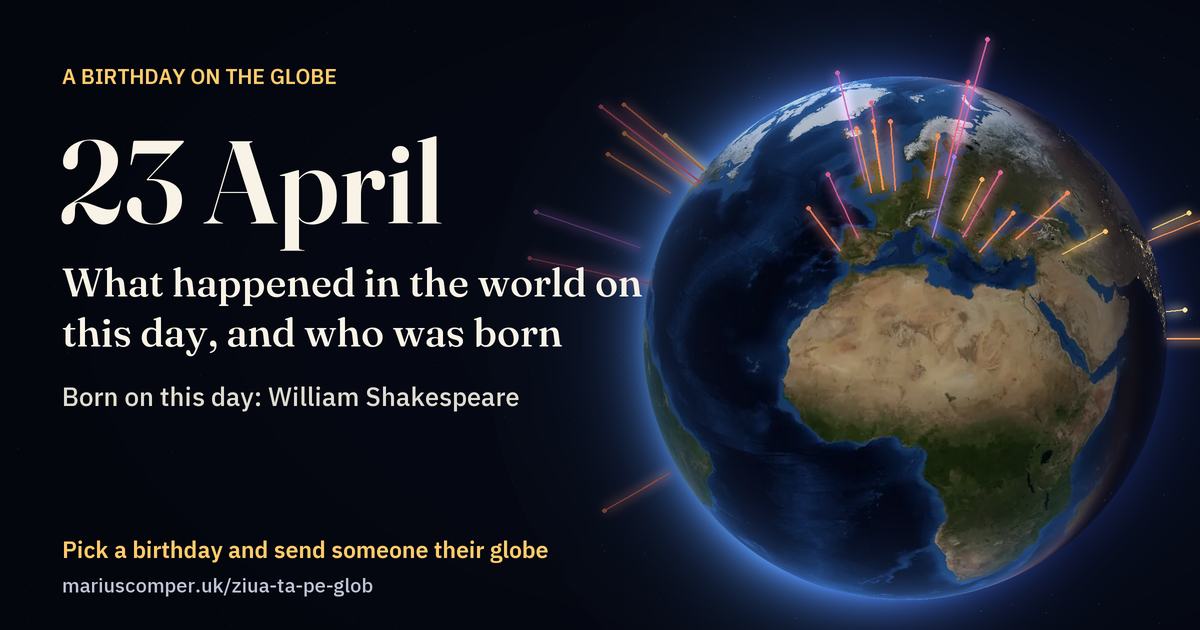
For 23 April, the English Wikipedia lists 57 events and 231 births. 29 of the events stand at their places as rays of light; eight more are dashed circles, where the sentence links only to a country or a sea. The taller the ray, the longer ago it happened. The people born that day come further down, as blue points.
A birthday, yours or someone else’s:
Turn it into a greetingScroll: the globe turns to each place
The day you were born, on the globe.
Three things from your day
Scroll: your day first, then 23 April through the years
The Earth on 23 April
The picture on the globe was assembled by NASA from satellite photographs taken in April 2004: the snow, the ice and the green are those of the month.
On 23 April the Sun passes straight overhead at noon along the parallel of 12.7° north. In London, the day lasts about 14 hours 25 minutes.
Beyond 77° north the Sun no longer sets; beyond 77° south it no longer rises.
The line between day and night is tilted on the globe exactly as on this day of the year. On the dark side you can see the lights of towns.
Britain & Ireland · Westminster Abbey
1661
King Charles II of England, Scotland and Ireland is crowned in Westminster Abbey.
On the map: Westminster Abbey.
Also on the day’s list of Wikipedia in Romanian and Chinese.
Europe · Oliwa
1660
Treaty of Oliva is established between Sweden and Poland.
On the map: Oliwa.
Asia · Ankara
1920
The Grand National Assembly of Turkey (TBMM) is founded in Ankara. The assembly denounces the government of Sultan Mehmed VI and announces the preparation of a temporary constitution.
On the map: Ankara.
Also on the day’s list of Wikipedia in Spanish and Chinese.
North America · Boston Latin School
1635
The first public school in the United States, the Boston Latin School, is founded.
On the map: Boston Latin School.
23 April
What the other Wikipedias remember#
For these years the English list has nothing on this day. The events below come from the same day’s lists on Wikipedia in Spanish and Romanian and were translated for this page.
From Wikipedia in Spanish · Royal Monastery of San Lorenzo de El Escorial
1563
In Spain, work begins on the Monastery of El Escorial.
On the map: Royal Monastery of San Lorenzo de El Escorial.
Translated from the list on Wikipedia in Spanish.
The article on Wikipedia in Spanish: Real Monasterio de San Lorenzo de El Escorial
From Wikipedia in Romanian · Beijing
2003
In Beijing, all schools are closed for two weeks because of the SARS virus.
On the map: Beijing.
Translated from the list on Wikipedia in Romanian.
From Wikipedia in Spanish · Seville
2022
In Seville, Spain, at the La Cartuja stadium, Real Betis Balompié wins its third Copa del Rey.
On the map: Seville.
Translated from the list on Wikipedia in Spanish.
23 April
Born on 23 April#
The English Wikipedia lists 231 births for this day. The blue points are the birthplaces of 60 of these people: those written about in the most Wikipedia editions, where Wikidata gives a place of birth.
Born on 23 April
1564
William Shakespeare, English playwright and poet (died 1616)
Place of birth: Stratford-upon-Avon.
Born on 23 April
1858
Max Planck, German physicist and academic, Nobel Prize laureate (died 1947)
Place of birth: Kiel.
Born on 23 April
1902
Halldór Laxness, Icelandic author and poet, Nobel Prize laureate (died 1998)
Place of birth: Reykjavík.
Born on 23 April
1977
John Cena, American professional wrestler and actor
Place of birth: West Newbury.
Born on 23 April
1954
Michael Moore, American director, producer, and activist
Place of birth: Flint.
Born in Britain and Ireland
1977
John Oliver, English comedian, actor, producer, and screenwriter
Place of birth: Erdington.
Born in Britain and Ireland
1962
John Hannah, Scottish actor and producer
Place of birth: East Kilbride.
23 April
Number one in the charts that week
At the cinema
An animal recorded that day
The record can be seen in GBIF, which brings together wildlife records from around the world.
All your birthdays
The weather that day
Data: Met Office Hadley Centre (HadCET); NOAA (GHCN-Daily, Mauna Loa).
Above the Earth
Sources: Jonathan McDowell, GCAT (launches); GFZ Potsdam (Kp index). Days are counted in Universal Time.
Football that day
International matches played that day:
Source: the “International football results” dataset kept by Mart Jürisoo (CC0).
Also that day
The earthquake’s page at the USGS
Source: the USGS catalogue. The day is counted in Universal Time (UTC).
In those days
Make a link for someone
Type the name, pick the day and the year of birth. The link opens straight on their day, with their name in the greeting.
The link carries the name, date and place typed here; anyone who gets it can see them.
Put another birthday beside it
Your mother’s, your child’s, a friend’s: the two days appear side by side.
Below: 23 April through the years.
The whole globe of the day
Drag the globe to turn it. Touch a ray or a point to read what happened there.
Everything Wikipedia lists for 23 April
The list is the English Wikipedia’s, in its own wording, as it stood in October 2026. 20 events have no place on the map: the sentence links to no place with coordinates, only to places too wide to mark, or to several countries.
- 215 BC
A temple is built on the Capitoline Hill dedicated to Venus Erycina to commemorate the Roman defeat at Lake Trasimene.
Europe · Temple of Venus ErycinaWikipedia: Battle of Lake Trasimene - 599
Maya king Uneh Chan of Calakmul attacks rival city-state Palenque in southern Mexico, defeating queen Yohl Ik'nal and sacking the city.
Latin America · CalakmulWikipedia: Scroll Serpent - 711
Dagobert III succeeds his father King Childebert III as King of the Franks.
no place on the mapWikipedia: Dagobert III - 1014
Battle of Clontarf: High King of Ireland Brian Boru defeats Viking invaders, but is killed in battle.
Britain & Ireland · Battle of ClontarfWikipedia: Battle of Clontarf - 1016
Edmund Ironside succeeds his father Æthelred the Unready as King of England.
no place on the mapWikipedia: Edmund Ironside - 1343
St. George's Night Uprising commences in the Duchy of Estonia.
Europe · Duchy of EstoniaWikipedia: Saint George's Night Uprising - 1348
The founding of the Order of the Garter by King Edward III is announced on St. George's Day.
no place on the mapWikipedia: Order of the Garter - 1467
Albanian commander Skanderbeg entered Krujë, breaking a 10-month siege by Ottoman forces.
Europe · Siege of KrujëWikipedia: Siege of Krujë - 1500
Portuguese explorer Pedro Alvarez Cabral reaches new coastline (Brazil).
no place on the mapWikipedia: Pedro Álvares Cabral - 1516
The Munich Reinheitsgebot (regarding the ingredients of beer) takes effect in all of Bavaria.
no place on the mapWikipedia: Reinheitsgebot - 1521
Battle of Villalar: King Charles I of Spain defeats the Comuneros.
Europe · Battle of VillalarWikipedia: Battle of Villalar - 1635
The first public school in the United States, the Boston Latin School, is founded.
North America · Boston Latin SchoolWikipedia: Boston Latin School - 1655
The Siege of Santo Domingo begins during the Anglo-Spanish War, and fails seven days later.
Latin America · Siege of Santo DomingoWikipedia: Siege of Santo Domingo - 1660
Treaty of Oliva is established between Sweden and Poland.
Europe · OliwaWikipedia: Treaty of Oliva - 1661
King Charles II of England, Scotland and Ireland is crowned in Westminster Abbey.
Britain & Ireland · Westminster AbbeyWikipedia: Charles II of England - 1685
Succeeding Charles II, his late brother, James II was crowned King of England, becoming last Catholic to hold the title.
no place on the mapWikipedia: Charles II of England - 1724
Johann Sebastian Bach leads the first performance of his cantata Du Hirte Israel, höre, BWV 104, illustrating the topic of the Good Shepherd in pastoral music.
no place on the mapWikipedia: Johann Sebastian Bach - 1815
The Second Serbian Uprising: A second phase of the national revolution of the Serbs against the Ottoman Empire, erupts shortly after the annexation of the country to the Ottoman Empire.
Asia · Ottoman EmpireWikipedia: Second Serbian Uprising - 1879
Fire burns down the second main building and dome of the University of Notre Dame, which prompts the construction of the third, and current, Main Building with its golden dome.
North America · University of Notre DameWikipedia: University of Notre Dame - 1891
Chilean Civil War: The ironclad Blanco Encalada is sunk at Caldera Bay by torpedo boats.
Latin America · Battle of Caldera BayWikipedia: Chilean Civil War of 1891 - 1909
In Portugal, a magnitude 6.0 earthquake strikes near Lisbon, killing at least 60 people and injuring 75.
Europe · 1909 Benavente earthquakeWikipedia: 1909 Benavente earthquake - 1918
World War I: The British Royal Navy makes a raid in an attempt to neutralise the Belgian port of Bruges-Zeebrugge.
Europe · Zeebrugge RaidWikipedia: World War I - 1919
The Estonian Constituent Assembly is held in Estonia, which marks the birth of the Estonian Parliament, the Riigikogu.
Europe · EstoniaWikipedia: Estonian Constituent Assembly - 1920
The Grand National Assembly of Turkey (TBMM) is founded in Ankara. The assembly denounces the government of Sultan Mehmed VI and announces the preparation of a temporary constitution.
Asia · AnkaraWikipedia: Ankara - 1927
Cardiff City defeat Arsenal in the FA Cup Final, the only time it has been won by a team not based in England.
Britain & Ireland · Wembley StadiumWikipedia: 1927 FA Cup final - 1935
The Polish Constitution of 1935 is adopted.
no place on the mapWikipedia: April Constitution of Poland - 1940
The Rhythm Club fire at a dance hall in Natchez, Mississippi, kills 198 people.
North America · Rhythm Club fireWikipedia: Rhythm Club fire - 1941
World War II: The Greek government and King George II evacuate Athens before the invading Wehrmacht.
Europe · German invasion of GreeceWikipedia: German invasion of Greece - 1942
World War II: Baedeker Blitz: German bombers hit Exeter, Bath and York in retaliation for the British raid on Lübeck.
Britain & Ireland · ExeterWikipedia: Baedeker Blitz - 1945
World War II: Adolf Hitler's designated successor, Hermann Göring, sends him a telegram asking permission to take leadership of Nazi Germany. Martin Bormann and Joseph Goebbels advise Göring that the telegram is treasonous.
Europe · Nazi GermanyWikipedia: Adolf Hitler - 1945
World War II: The US Army's 90th Infantry Division liberated Flossenbürg concentration camp in Germany, freeing 1,500 prisoners.
Europe · Flossenbürg concentration campWikipedia: World War II - 1946
Manuel Roxas is elected the last President of the Commonwealth of the Philippines.
no place on the mapWikipedia: Manuel Roxas - 1949
Chinese Civil War: Establishment of the People's Liberation Army Navy.
no place on the mapWikipedia: Chinese Civil War - 1951
Cold War: American journalist William N. Oatis is arrested for espionage by the Communist government of Czechoslovakia.
Europe · CzechoslovakiaWikipedia: Cold War - 1954
Batting for the Milwaukee Braves against Vic Raschi of the St. Louis Cardinals, Hank Aaron hit the first of his 755 home runs in Major League Baseball.
no place on the mapWikipedia: Batting - 1961
During the Algiers putsch by French generals, President Charles de Gaulle announces he has assumed emergency powers, and calls on troops and civilians to support him.
Africa · French AlgeriaWikipedia: Algiers putsch of 1961 - 1966
Aeroflot Flight 2723 crashes into the Caspian Sea off the Absheron Peninsula, killing 33 people.
Asia · Caspian SeaWikipedia: Aeroflot Flight 2723 - 1967
Soviet space program: Soyuz 1 (Russian: Союз 1, Union 1), a crewed spaceflight carrying cosmonaut Colonel Vladimir Komarov, is launched into orbit.
no place on the mapWikipedia: Soviet space program - 1968
Vietnam War: Student protesters at Columbia University in New York City take over administration buildings and shut down the university.
North America · Columbia UniversityWikipedia: Vietnam War - 1971
Bangladesh Liberation War: The Pakistan Army and Razakars massacre approximately 3,000 Hindu emigrants in the Jathibhanga area of East Pakistan (now Bangladesh).
Asia · Jathibhanga massacreWikipedia: Jathibhanga massacre - 1971
The Rolling Stones released Sticky Fingers, the first album on their own label, Rolling Stones Records.
no place on the mapWikipedia: The Rolling Stones - 1976
The American band the Ramones released their debut album, which became highly influential on the emerging punk rock movement.
no place on the mapWikipedia: Ramones - 1979
Blair Peach, a British activist, is fatally injured after being knocked unconscious during an Anti-Nazi League demonstration against a National Front election meeting in Southall, London.
Britain & Ireland · SouthallWikipedia: Death of Blair Peach - 1979
SAETA Flight 011 crashes in Pastaza Province, Ecuador, killing all 57 people on board. The wreckage was not discovered until 1984.
Latin America · Pastaza ProvinceWikipedia: SAETA Flight 011 - 1982
The ZX Spectrum, Britain's best-selling microcomputer, was released.
no place on the mapWikipedia: ZX Spectrum - 1985
Coca-Cola changes its formula and releases New Coke. The response is overwhelmingly negative, and the original formula is back on the market in less than three months.
no place on the mapWikipedia: Coca-Cola - 1990
Namibia becomes the 160th member of the United Nations and the 50th member of the Commonwealth of Nations.
Africa · NamibiaWikipedia: Namibia - 1993
Eritreans vote overwhelmingly for independence from Ethiopia in a United Nations-monitored referendum.
no place on the mapWikipedia: Eritrea - 1993
Sri Lankan politician Lalith Athulathmudali is assassinated while addressing a gathering, approximately four weeks ahead of the Provincial Council elections for the Western Province.
Asia · Western Province, Sri LankaWikipedia: Assassination of Lalith Athulathmudali - 1999
NATO bombs the headquarters of Radio Television of Serbia, as part of their aerial campaign against the Federal Republic of Yugoslavia.
Europe · NATO bombing of the Radio Television of Serbia headquartersWikipedia: NATO bombing of the Radio Television of Serbia headquarters - 2005
The first YouTube video, titled "Me at the zoo", is published by co-founder Jawed Karim.
no place on the mapWikipedia: YouTube - 2009
The gamma-ray burst GRB 090423 was detected coming from the most distant astronomical object of any kind known at the time.
no place on the mapWikipedia: Gamma-ray burst - 2010
Arizona governor Jan Brewer signed into law the controversial anti–illegal immigration bill SB 1070, much of which was later struck down by the U.S. Supreme Court.
no place on the mapWikipedia: Jan Brewer - 2013
At least 111 people are killed and 233 injured as violence breaks out in Hawija, Iraq.
Asia · HawijaWikipedia: 2013 Hawija clashes - 2018
A vehicle-ramming attack kills 11 people and injures 15 in Toronto. A 25-year-old suspect, Alek Minassian, is arrested.
North America · 2018 Toronto van attackWikipedia: 2018 Toronto van attack - 2019
The April 2019 Hpakant jade mine collapse in Myanmar kills four miners and two rescuers, with at least 50 others missing and presumed dead.
Asia · April 2019 Hpakant jade mine collapseWikipedia: April 2019 Hpakant jade mine collapse - 2024
The 2024 Lumut mid-air collision in Malaysia kills 10 people while rehearsing for the 90th anniversary of the Royal Malaysian Navy.
Asia · 2024 Lumut mid-air collisionWikipedia: 2024 Lumut mid-air collision
What the other Wikipedias remember
For these years the English list has nothing on this day. The events below come from the same day’s lists on Wikipedia in Spanish and Romanian and were translated for this page.
- 1563
In Spain, work begins on the Monastery of El Escorial.
Europe · Royal Monastery of San Lorenzo de El EscorialTranslated from the list on Wikipedia in SpanishWikipedia: Real Monasterio de San Lorenzo de El Escorial - 2003
In Beijing, all schools are closed for two weeks because of the SARS virus.
- 2022
In Seville, Spain, at the La Cartuja stadium, Real Betis Balompié wins its third Copa del Rey.
Who was born on 23 April
In order of how many Wikipedia editions have an article about each. The first 60 of 231 are shown.
- 1564
William Shakespeare, English playwright and poet (died 1616)
Stratford-upon-AvonWikipedia: William Shakespeare - 1858
Max Planck, German physicist and academic, Nobel Prize laureate (died 1947)
- 1791
James Buchanan, American soldier, lawyer, and politician, 15th President of the United States (died 1868)
Stony BatterWikipedia: James Buchanan - 1902
Halldór Laxness, Icelandic author and poet, Nobel Prize laureate (died 1998)
ReykjavíkWikipedia: Halldór Laxness - 1928
Shirley Temple, American actress, singer, dancer, and diplomat (died 2014)
Santa MonicaWikipedia: Shirley Temple - 1977
John Cena, American professional wrestler and actor
West NewburyWikipedia: John Cena - 1897
Lester B. Pearson, Canadian historian and politician, 14th Prime Minister of Canada, Nobel Peace Prize laureate (died 1972)
TorontoWikipedia: Lester B. Pearson - 1954
Michael Moore, American director, producer, and activist
- 1857
Ruggero Leoncavallo, Italian composer (died 1919)
- 1990
Dev Patel, English actor
HarrowWikipedia: Dev Patel - 1936
Roy Orbison, American singer-songwriter (died 1988)
VernonWikipedia: Roy Orbison - 1899
Bertil Ohlin, Swedish economist and politician, Nobel Prize laureate (died 1979)
Parish of KlippanWikipedia: Bertil Ohlin - 1995
Gigi Hadid, American fashion model and television personality
Los AngelesWikipedia: Gigi Hadid - 1867
Johannes Fibiger, Danish physician and pathologist, Nobel Prize laureate (died 1928)
SilkeborgWikipedia: Johannes Fibiger - 1918
Maurice Druon, French author and screenwriter (died 2009)
13th arrondissement of ParisWikipedia: Maurice Druon - 1185
Afonso II of Portugal (died 1223)
- 2018
Prince Louis of Wales, British royal
St Mary's HospitalWikipedia: Prince Louis of Wales - 1894
Frank Borzage, American actor and director (died 1962)
Salt Lake CityWikipedia: Frank Borzage - 1984
Alexandra Kosteniuk, Russian chess player
- 1907
Lee Miller, American model and photographer (died 1977)
PoughkeepsieWikipedia: Lee Miller - 1977
John Oliver, English comedian, actor, producer, and screenwriter
ErdingtonWikipedia: John Oliver - 1977
Kal Penn, Indian-American actor
MontclairWikipedia: Kal Penn - 1880
Michel Fokine, Russian dancer and choreographer (died 1942)
Saint PetersburgWikipedia: Michel Fokine - 1941
Ray Tomlinson, American computer programmer and engineer (died 2016)
AmsterdamWikipedia: Ray Tomlinson - 1929
George Steiner, French-American philosopher, author, and critic (died 2020)
Neuilly-sur-SeineWikipedia: George Steiner - 1983
Daniela Hantuchová, Slovak tennis player
- 1464
Joan of France, Duchess of Berry (died 1505)
Nogent-le-RoiWikipedia: Joan of France, Duchess of Berry - 1968
Timothy McVeigh, American terrorist, Oklahoma City bombing co-perpetrator (died 2001)
LockportWikipedia: Timothy McVeigh - 1941
Jacqueline Boyer, French singer and actress
15th arrondissement of ParisWikipedia: Jacqueline Boyer - 1955
Judy Davis, Australian actress
- 1720
Vilna Gaon, Lithuanian rabbi and author (died 1797)
SialiecWikipedia: Vilna Gaon - 1941
Paavo Lipponen, Finnish journalist and politician, 38th Prime Minister of Finland
- 1962
John Hannah, Scottish actor and producer
East KilbrideWikipedia: John Hannah - 1986
Sven Kramer, Dutch speed skater
HeerenveenWikipedia: Sven Kramer - 1988
Victor Anichebe, Nigerian footballer
- 1942
Sandra Dee, American model and actress (died 2005)
BayonneWikipedia: Sandra Dee - 1420
George of Poděbrady, King of Bohemia (died 1471)
PoděbradyWikipedia: George of Poděbrady - 1948
Pascal Quignard, French author and screenwriter
Verneuil-sur-AvreWikipedia: Pascal Quignard - 1961
George Lopez, American comedian, actor, and talk show host
Mission HillsWikipedia: George Lopez - 1813
Stephen A. Douglas, American educator and politician, 7th Illinois Secretary of State (died 1861)
- 1861
Edmund Allenby, 1st Viscount Allenby, English field marshal and diplomat, British High Commissioner in Egypt (died 1936)
NottinghamshireWikipedia: Edmund Allenby, 1st Viscount Allenby - 1989
Nicole Vaidišová, Czech tennis player
NurembergWikipedia: Nicole Vaidišová - 1999
Laufey, Icelandic singer-songwriter and musician
ReykjavíkWikipedia: Laufey - 1979
Jaime King, American actress and model
- 1484
Julius Caesar Scaliger, Italian physician and scholar (died 1558)
Riva del GardaWikipedia: Julius Caesar Scaliger - 1876
Arthur Moeller van den Bruck, German historian and author (died 1925)
- 1999
Son Chaeyoung, South Korean rapper and singer-songwriter
SeoulWikipedia: Chaeyoung - 2000
Chloe Kim, American snowboarder
Long BeachWikipedia: Chloe Kim - 1895
Ngaio Marsh, New Zealand author and director (died 1982)
ChristchurchWikipedia: Ngaio Marsh - 1977
Lee Young-pyo, South Korean international footballer
Hongcheon CountyWikipedia: Lee Young-pyo - 1910
Simone Simon, French actress (died 2005)
MarseilleWikipedia: Simone Simon - 1933
Annie Easley, American computer scientist, mathematician, and engineer (died 2011)
BirminghamWikipedia: Annie Easley - 1919
Oleg Penkovsky, Russian colonel (died 1963)
VladikavkazWikipedia: Oleg Penkovsky - 1944
Jean-François Stévenin, French actor and director (died 2021)
Lons-le-SaunierWikipedia: Jean-François Stévenin - 1967
Melina Kanakaredes, American actress
- 1994
Song Kang, South Korean actor
SuwonWikipedia: Song Kang - 1960
Valerie Bertinelli, American actress
WilmingtonWikipedia: Valerie Bertinelli - 1963
Paul Belmondo, French race car driver
Boulogne-BillancourtWikipedia: Paul Belmondo - 1965
Leni Robredo, Filipina human rights lawyer, 14th Vice President of the Philippines
- 1939
Lee Majors, American actor
WyandotteWikipedia: Lee Majors
What is celebrated on 23 April
- Christian feast day: Adalbert of Prague
- Christian feast day: Felix, Fortunatus, and Achilleus
- Christian feast day: Saint George
- Christian feast day: Blessed Giles of Assisi
- Christian feast day: Gerard of Toul
- Christian feast day: Ibar of Beggerin (Meath)
- Christian feast day: Blessed Maria Gabriella Sagheddu
- Christian feast day: Toyohiko Kagawa (Episcopal and Lutheran Church)
- Christian feast day: Saint George's Day and its related observances: Saint George's Day (Catalonia)
- Christian feast day: Saint George's Day and its related observances: Saint George's Day (England)
- Christian feast day: Blessed Teresa Maria Manetti
- Christian feast day: April 23 (Eastern Orthodox liturgics)
- Canada Book Day (Canada)
- Castile and León Day (Castile and León)
A greeting link for someone
Type a name and, if you like, the year of birth. The link opens with a greeting, and beside each event it says how old the person turned that day, or how many years before their birth it happened.
The name and the year go only into the link you send.
All 366 days
How the globe is made
Where the events come from
Each edition of this page uses the day’s list from Wikipedia in its own language: Romanian, English, Spanish, Chinese. The lists are written by volunteers and differ from one edition to the next; the text of each event is Wikipedia’s, with a link to the article. A row that appears twice in a list is shown once. The lists have not been checked event by event: they are Wikipedia’s, mistakes included.
For events before 1582, and for countries that moved to the Gregorian calendar later (Britain in 1752, Russia in 1918), the same day may be counted Old Style in one list and New Style in another.
The chapter “What the other Wikipedias remember” adds up to five events a day from the lists of the other three editions, only for years in which the English list has nothing on that day. They were translated for this page, passed the same filters as the tour, and are not counted among the events of the English list.
How an event gets onto the map
The place comes from Wikidata. If the sentence links to the article about the event itself (a battle, an opening, an earthquake), dated to the same year, the ray stands on its coordinates or on those of its location. Otherwise it stands on the first place the sentence links to: a town, a building, a mountain, an island. This second step can be wrong: sometimes the sentence only mentions the place. That is why the page says, under each event, which place the ray stands on.
When the sentence links to a single state or province, or to a single sea, lake or desert larger than 5,000 km², the globe shows a dashed circle, not a ray. The circle has the area Wikidata gives, with its radius kept between 1.2° and 16°, or a radius of 4.5° when Wikidata gives no area; it says only that the sentence links to that place. Organisations, ships, spacecraft, museum objects, rivers, mountain ranges, languages and continents are never used as places. When a sentence names several states and no exact place, the event stays in the list only.
What the height means
The height of a ray shows how many years have passed, on a logarithmic scale: 10 years, 100 years and 1,000 years are equal steps apart; anything older than about 2,600 years has the tallest ray. The colour runs from pale yellow for recent years to violet for antiquity.
Where the tour stops
In each region the tour stops at up to three events (five in Britain and Ireland), chosen mainly by three things: whether Wikipedia’s editors put the event in the “On this day” box of their main page (the English, Spanish and Chinese editions), how many Wikipedia editions have an article about it, and how many of the four lists include it. Events whose sentence or article is about a war, an attack, a crime or a disaster are left out of the tour; they stay in the whole list, in Wikipedia’s wording. The filter is a list of words and a list of Wikidata types, so it can miss some.
The tour of births names the people with articles in the most editions and leaves aside those whom the list or Wikidata describes as rulers, politicians, commanders, leaders of movements or criminals; they stay in the list.
The Earth and the Sun
The daytime images are NASA’s Blue Marble Next Generation mosaics, one for each month of 2004; the night side is Black Marble 2016. The tilt of the line between day and night is computed for the day; the hour is chosen so that the place being read is in daylight. The latitude where the Sun stands overhead is the average of the four years of the leap cycle; in a given year it can differ by up to 0.4°.
The day you were born
The number ones come from the weekly lists on Wikipedia: Billboard for the United States (from 1940; the Hot 100 from August 1958), the UK Singles Chart (from November 1952), Los 40 Principales for Spain (from July 1966) and, for Romania, the Romanian Top 100 and Airplay 100 (2001–2021, with missing weeks). The page shows the chart of the week in which the day of birth falls, with its date; Billboard and the UK chart are dated at the end of their week. For Romania before 2001 and for China these sources have no weekly chart.
The films are those that reached cinemas in the United States up to ten days before or three days after that day (some of them in a few cinemas at first), from the English Wikipedia’s yearly lists (from 1968), in order of how many editions have an article about them. The events “in those days” are the ones on the neighbouring days’ lists that carry the year of birth, passed through the same filter as the tour.
The day of birth, year included
The Moon, the star sign and the constellation are worked out by the page itself, for noon Universal Time on the day. The lit part of the Moon is rounded and can differ by a few per cent from that at the hour of birth. The sign follows the usual zodiac of twelve equal parts starting at the March equinox; the constellation is the one the Sun actually stood in front of, by the borders set by the International Astronomical Union, and within a day of a border the page does not name it. When the Sun changes sign while it is that day anywhere on Earth, the page gives the moment of crossing, rounded to ten minutes and accurate to within about a quarter of an hour, and the clock time in a few cities, with the time zone and summer time of that year.
The year in the Chinese calendar is the one your device’s own calendar gives for the date, checked against the Hong Kong Observatory’s tables. “All your birthdays” uses the same sources as the rest of the chapter for the same day in every year since the birth: the temperature, well-known launches that took place on that very day, matches of the teams the edition follows, snow deeper than 10 cm and strong geomagnetic storms. The three things at the top and the four on the picture are chosen in a fixed order (the song, the animal, a full Moon, a well-known launch before an ordinary earthquake); on the picture you can change them.
When the link carries a year of birth, the page adds a few things about that exact day. The weather is the Met Office’s Central England temperature record and the readings from New York’s Central Park; the “usual high” is the average of the daily highs of 1961–1990 for that date, with two days either side. The carbon dioxide figure is the monthly mean at the Mauna Loa observatory, where measurements begin in March 1958.
The earthquake is the one with the largest magnitude in the USGS catalogue for that day, counted in Universal Time. Before the 1960s the catalogue has gaps even above magnitude 5.5, so in the older years many days have no earthquake. The page gives only the magnitude and the place: the country the epicentre falls in or, when the epicentre is at sea within 300 km of a coast, the nearest country; farther out, only the ocean.
The launches are those that reached orbit or left for the Moon and the planets, from Jonathan McDowell’s GCAT catalogue. If nothing left that day, the page shows the nearest launch within three days before or after, and says how many days away it was. The geomagnetic storm appears only when the Kp index reached at least 5 in one of the day’s eight three-hour intervals.
The animal comes from GBIF: an observation made by a person (the animal seen or heard, or its tracks), dated to that exact day, with coordinates and a CC0 or CC BY licence. Only a few hundred well-known species are searched (mammals, birds, turtles, butterflies); of those noted that day, mammals and species with articles in many Wikipedia editions come first; birds noted almost every day, and species used recently, wait their turn. Observations dated 1 January are left out, because records without a day are often filed there. An observation shows that the animal was recorded there, not how many animals there were.
The matches are those between national teams. Only matches of England, Scotland, Wales, Northern Ireland, the Republic of Ireland, the United States, Canada and Australia are shown, along with those at the big final tournaments. The picture to send is drawn in the page from the day’s globe and the facts above, and stays on your device until you send it.
Sources
- Events, births and holidays: the day’s page on Wikipedia, text under CC BY-SA 4.0.
- Coordinates, places of birth and the number of editions: Wikidata (CC0).
- The Earth by day: NASA Blue Marble Next Generation. The Earth by night: NASA Black Marble 2016.
- Borders and regions: Natural Earth.
- World population and births per year: UN World Population Prospects 2024.
- Charts and films: Wikipedia’s lists for Billboard, the UK Singles Chart, Los 40 Principales, Romanian Top 100, Airplay 100 and American films by year (CC BY-SA 4.0).
- Weather: Met Office Hadley Centre, HadCET (Open Government Licence) and NOAA GHCN-Daily, New York Central Park. Carbon dioxide: NOAA Global Monitoring Laboratory, Mauna Loa.
- Earthquakes: the USGS catalogue. Launches: Jonathan McDowell, GCAT (CC BY). Kp index: GFZ Potsdam (CC BY 4.0). Matches: International football results, Mart Jürisoo (CC0).
- Animal observations: GBIF, with a link to each record; species names come from Wikidata.